It’s Friday the 13th! Hope you’re feeling lucky. Enjoy this roundup of stories that caught our eye this past week.
This week in Greater Auckland
- On Tuesday, Matt did a deep dive into the hidden details of the recent City Rail Link test.
- On Wednesday, we ran Connor’s op-ed about the recent debate about planning and intensification in Auckland.
- And on Thursday, Matt whipped up some charts to examine how recent world events increasing fuel prices might influence how people get around in our city.
This roundup, like all our work, is brought to you by the Greater Auckland crew and made possible by generous donations from our readers and fans.
To support our work by setting up a monthly donation, you can join our circle of supporters here. We’re now a registered charity, so your donations are tax-deductible.
Greater Auckland in the media
Housing has been a hot topic again this week with the Council debating the rules for how they’ll change Plan Change 120 to reduce housing to the government’s new target of 1.6 million homes (down from 2 million). Matt had a few words to say on the issue.
Director of the transport advocacy website Greater Auckland, Matt Lowrie, also agreed with the mayor’s approach.“It makes sense that the focus of intensification will be in the areas closest to the city centre, on good public transport routes, and in town centres. Those are the areas where there’s the highest amenity and the most attractiveness for development, and also the best transport links to the city centre, where a lot of people are working,” Lowrie said.“There’s a whole lot of noise that’s gone on from people who have been successful in the past in forcing development out to the fringes in places like Flatbush, leading to people having long commutes because they’ve tried to prevent housing in their areas.“What we’re seeing now is housing being put in the places where it should be put, which is close to the city.”He believed people did not need to be fearful about suburbs being taken over by high-rises.“Just because something is zoned for an apartment doesn’t mean that it’s going to be built.“For example, we’re already seeing where zoning allows for five-and-six-storey apartments, two to three-storey townhouses are being built instead.“That’s a key point that often people miss about this. It’s just allowing development, should people want to. But those locations close to train stations and busway stations are ideal for more homes.”
Speaking of the housing debate…
Mayor Wayne Brown had some great comments about the issue:
“We’ll just be handing them ‘this is the process we’re going to go through’ and if you don’t like it we’ll stick with 2 million,” he told Morning Report.
He was asked what would happen if the government did not like the plan from councillors.
“They’re just the government, and they live in Wellington, and they should just spend their time wandering around the coast picking up the lavatory paper that they put into the harbour,” he said.
“And we’ll carry on running a big city.”
…..
But he said there would be in places with good public transport and infrastructure.
“It’s just sensible, it will end up with a city which looks like a city, not the world’s largest suburb,” the mayor told Morning Report.
Brown said “vocal constituents” had no more influence than local councillors did.
“Parnell has a railway station, bus service, and is on the upgraded sewage area so it will certainly be involved in intensification,” he said.
“Just like Mount Eden, Epsom, Ponsonby, and all the other areas that are close into the city that actually have a lot of it already.
“If you have a look, if you visit Parnell, there’s a multi-storey apartments everywhere, same with Ponsonby where I live, I’m in a multi-storey apartment as we speak so they’re just sensible things make it into a nice city.”
And Hayden Donnell at The Spinoff had some great coverage of the debate:
Fletcher accused both National and Labour of having “blood on their hands” over their housing plans, before lamenting how polarising and divisive the intensification debate has become
…..
It should have been a celebration. But what would you know, most of the people who were once so concerned about ensuring housing is near infrastructure weren’t happy. Instead they were stewing over the revelation that the places with the best infrastructure were in their well-to-do wards. North Shore councillor John Gillon had looked at the maps and found that a 10km radius from the city centre would include the entire area he represents. He moved an amendment, seconded by Fletcher, to delete the 10km clause, saying he was “concerned” about the figure.
And as Albert-Eden-Puketāpapa Ward Councillor Julie Fairey has pointed out, the likelihood of most areas being zoned for taller buildings is unlikely.
Claims that _every_ Parnell, Ponsonby & Mt Eden resident can have a 15 storey building built on their boundary are incorrect. These are big suburbs &only parts of them are proposed for 15. Mt Eden is roughly the area inbthe red circle here, much smaller yellow circle is approx the 15 storey area.
— Julie Fairey (she/her) (@juliefairey.bsky.social) 2026-03-11T06:25:28.029Z
Electrification of buses continues
Auckland Transport announced it had awarded a new bus contract covering 23 bus routes accounting for about 14% of all bus trips in Auckland.
Auckland Transport is today announcing the award of a $755 million bus services contract to Kinetic – Australasia’s largest bus service operator and a long-time operator of Auckland bus services.
The contract will see Kinetic introducing a fully-electric fleet in mid-2027 to serve 23 different bus routes across the Auckland Isthmus, including some of AT’s most popular frequent routes – the 24B/24R, 25B/25L, 65, 66, 67A/67B, 68 and 68.
Services that will connect Auckland’s Eastern suburbs with the transformational Eastern Busway and serve suburbs like Flatbush and East Tāmaki are also included in the contract announced today.
…..
“This contract also includes some really exciting innovations, including New Zealand’s lightest electric double-decker bus, advanced battery and driving safety technology, and onboard fare evasion detection systems.”
…..
With light new buses, Dominion Road won’t have to bend under its own weight
With the introduction of lightweight electric double decker buses, Dominion Road will no longer have to bend under its own weight.
Under the new contract, the majority of buses using Dominion Road will be electric from mid-2027, including the new double-decker buses built using aerospace-grade aluminium technology, similar to that used in the Airbus A380. The lightweight double-decker delivers a strong and lighter frame than traditional steel construction.
AT’s Stacey van der Putten says these new double decker buses will be better for Auckland’s roads, as well as Auckland’s bus passengers.
“Aucklanders have really embraced double decker buses since we first introduced them back in 2013 and they have helped to really transform Auckland’s bus network into one of the best in a city of our size.
“But double decker buses have traditionally been heavy vehicles that do cause a bit more wear and tear on our roads, so I’m sure my colleagues in road maintenance will be thrilled to hear we’re getting electric double decker buses that are lighter than our current fleet of double deckers.”
…..
This contract means 125 additional electric buses will be added to Auckland’s fleet by July 2027, taking the total number of low emission buses to nearly 600, approximately 44 percent of the Auckland bus fleet.
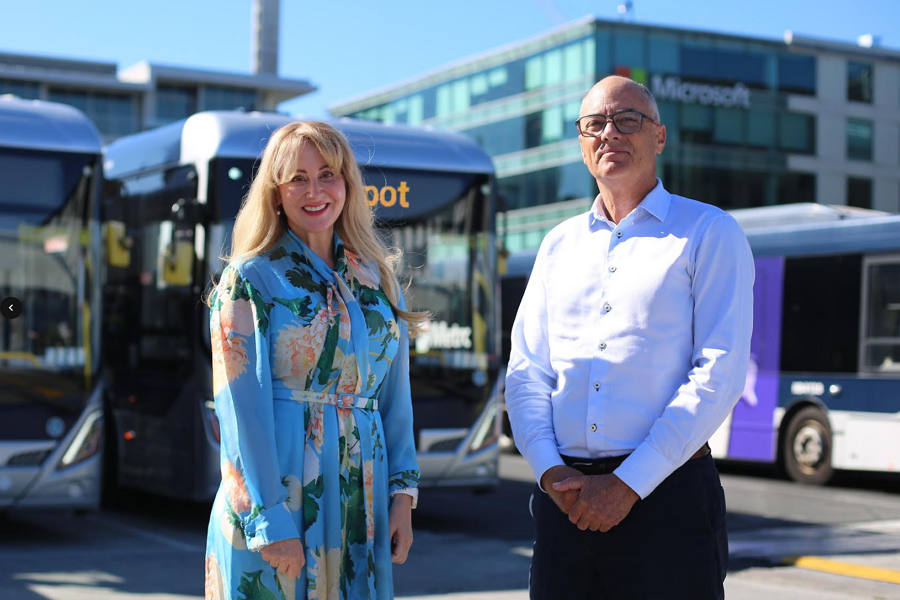
AT Director Public Transport and Active Modes Stacey van der Putten with Kinetic New Zealand Managing Director Calum Haslop
Auckland’s Most Congested Streets
Auckland Transport has revealed the city’s 16 most congested arterial roads.
The worst choke points span the city but many of them are in central areas that feed into the CBD.
Congestion is a perennial frustration for Auckland’s commuters. And while Auckland Council plans to implement congestion charging to tackle the problem, the move is likely years from implementation.
….
Auckland’s most congested roads
- Ti Rakau Dr (from Harris Rd to Pakuranga Rd)
- Gillies Ave (from Greenlane West to Khyber Pass Rd)
- Manukau Rd / Broadway (from Owens Rd to Parnell Rd)
- Mountain Rd (from Owens Rd to Khyber Pass Rd)
- Great North Rd (from Bond St to Karangahape Rd)
- Ponsonby Rd / Newton Rd (from Franklin Rd to Ian McKinnon Dr)
- Meola Rd (from Point Chevalier Rd to Garnet Rd)
- Esmonde Rd (from Lake Rd to Fred Thomas Dr)
- Raleigh Rd / Lake Rd (from Ocean View Rd to Onewa Rd)
- Albany Highway (from Sunset Rd to the SH18 interchange)
- Lincoln Rd (from Te Pai Pl to Triangle Road)
- Triangle Rd (from Waimumu Rd to Lincoln Rd)
- Central Park Dr (from Universal Dr to Lincoln Rd)
- Dominion Rd (from Balmoral Rd to Walters Rd)
- St Lukes Rd (from Sandringham Rd to New North Rd)
- Constellation Dr / Upper Harbour Highway (from Parkway Dr to Caribbean Dr)
Many of the roads on that list will be no surprise as they’re often key arterials that get funnelled traffic from surrounding neighbourhoods, and/or nearby motorways.
Also buried in the fine print: the Herald’s visualisation uses data from February 2025 – a time when at least two of the roads on the list were starting (Great North Road) or emerging from (Meola Road) major improvement works. 
A bit of a look at the methodology does give a hint at a solution though:
AT’s customer and network performance team said a road was considered congested when average speeds were at or below 50% of the speed limit.
The worst roads slowed to below 30% of the posted speed limit during peak travel times, which were 8am-9am and 5pm-6pm.
So if we just cut the speed limit, they won’t be considered as congested?
Tsunami get-away ride
A great little story about using a bike to escape disaster.
When the offshore fault that is one day expected to generate a massive tsunami off the coast of Napier ruptures, 77-year-old Valerie Norton won’t panic.
She’ll pick up the easy-grab supplies she has stored by the garage door of her beach-adjacent Westshore home, then she’ll mount her electric trike and head for Onehunga Hill with as much confidence as she can muster.
She’s done it before. She knows the route and its little kinks and quirks.
Norton’s thinking is simple.

The joy of cities in an age of disinformation
There’s always been disinformation about changing cities but it’s really ramped up in the last few years – along with disinformation about many other aspects of our lives. Here’s a new attempt to address it – the Urban Truth Collective.
Fifteen-minute cities are open air prisons. There’s a war on cars. Homelessness has nothing to do with housing. Wider, faster roads and highways are an improvement.
When it comes to cities, we’re inundated with lies like these.
But it makes no sense that we should be afraid of places where people can get most of what we need, closer by. Maybe our kids can even walk to the store! No walls, no guards – just convenient options that don’t need a car every time. It’s just a normal, “common sense” place to live — as most cities used to be, before we mandated car dependency.
…..
This week, to combat this constant stream of lies and disinformation that undermines our progress toward better city-building, we launched the Urban Truth Collective – a collaboration to bring together better city-building ideas and knowledge, with better communication, marketing and branding. The collective is led by the three of us: one, a well-known global city planning practitioner and urbanist; another, a marketing expert who used to work for car companies and now markets better streets and cities; and the third, a respected researcher and author (read “Dark PR: How Corporate Disinformation Undermines our Health and the Environment”). We three friends launched this, but it’s designed to grow, with the kind of diverse perspectives and ideas that reflect what make cities great.
Along with our many like-minded allies and collaborators in professional city-building practice, media, communications, marketing, politics, advocacy/activism, research etc, we will work to be more clear and persuasive. Not just when it comes to debunking what isn’t true and doesn’t work — but also championing more effectively what does.
Meanwhile:
How to market a city: FOTC > HOTC
In an interview with the Guardian, Bret McKenzie of Flight of the Conchords fame shares his thoughts on places to visit in Wellington:
I’ve been based in Wellington for most of my life, aside from a stint in Los Angeles. I love that it’s small and incredibly liveable here. There are lots of beautiful wooden homes with water views in the hills surrounding the harbour.
Unlike Los Angeles, you can do several things in a day and leave 10 minutes before you need to be somewhere, as Wellington is very pedestrian and ebike friendly.
It’s also wildly windy; apparently the world’s windiest city. Our normal wind would be a national emergency in many countries! I think it makes Wellington creatively buzzy because the southerly blasts are cold and fresh; it’s a dynamic environment.

This is exactly the kind of thing Auckland’s Heart of The City should be doing – enthusing about what’s working, and getting people excited to visit instead of constantly claiming the city is dead.
A new book
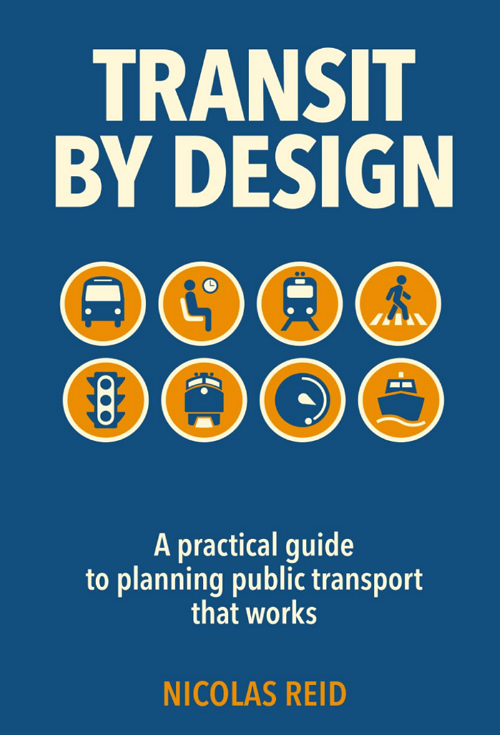
A new book on designing transit systems has just dropped, and it’s from our friend Nicolas Reid.
Maybe one day it will be possible to walk (or waddle) over
An injured kororā / little penguin has a new lease on life after being rescued from the Auckland Harbour Bridge.
In late January, a motorist spotted a kororā standing in the bus lane at the base of the bridge and quickly pulled over.
The woman gently scooped up the bird and contacted the Department of Conservation, who arranged for him to be taken to Auckland Zoo’s veterinary hospital.

Videos to check out
From the socials
Some neat visuals from Elliot on what you could get for the $22,000,000,000 road!
View this post on Instagram
Video of the new East West line train trip from Manukau to Swanson
View this post on Instagram
You know what to do
— Cool Bike Art (@coolbikeart1.bsky.social) 2026-03-06T19:53:44.987Z
That’s it from us for the week, we hope you have a good weekend!

 Processing...
Pretty sad the Daily Show platformed a horrible POS like Hopkins
Wayne Brown, maybe not the mayor we wanted, but definitely the mayor we needed
Agree, especially on housing.
Just a quick fact check please – as far as I understand, the Electric double decker buses are actually heavier than the Diesel double deckers, due to weight of massive battery pack needed. I’m also amazed that by 2027, “The contract will see Kinetic introducing a fully-electric fleet in mid-2027” – a 100% electric bus service ?! Miles from it now, and mid-2027 is only a year away. And last time, Auckland shipped it’s old diesels to Wellington – and they’re all still running there now.
I’d also like to know how often the battery packs need replacing on the electric buses
An electric bus without batteries is just e-waste, what are the chances they last as long as our heritage trams
Normally one mid-life battery replacement with buses, so about five or six years.
So the bus is not waste, just gets a newer battery, and old one goes on to live and work in a second life. Such is the pace of battery tech improvement 6 years is like two generations of upgrade so bus just gets better and better. Diesel buses just get worse and more expensive to maintain.
You don’t really see how much fuel a car uses. It is all neatly hidden inside fuel pumps, that hose you plug into your car, and your fuel tank.
If you drive a petrol car for a couple of years you can easily get to 15,000 kilometres. During that time you’ll almost certainly burn through more than a cubic metre of fuel. That is a lot of material!
All that has to be mined (drilled, or fracked, or even worse, dug up as oil sand) transported, processed, etc. And it is all gone. The next couple of years another cubic metre will be gone. The fuel used by your car in 5 years will almost certainly weigh more than your entire car.
Whereas with batteries, even if they are degraded after many years of use, that material is all still there. That could be a problem of how to deposit it safely, but also let’s see if we can recycle it into a new battery. And talking about safe disposal, it would be a stretch to claim that the combustion products of a petrol car are disposed of safely.
The amount of materials going into those batteries is a valid concern but we should be honest about petrol cars having similar concerns.
I am also against petrol cars???
This contract for Kinetic’s fleet. So there will be other providers that will still run Diesel.
As mentioned in the article, they used different materials (“using aerospace-grade aluminium technology”) to make the new electric double-deckers lighter. I really hope they wouldn’t lie about it because it would be kind of stupid.
Battery packs are getting denser, ie smaller ones deliver same power. Also they are building lighter bodies. The weight issue is receding.
Also battery packs in real world use are proving longer lasting and more effective than modelled (by cautious scientists). Additionally even degraded battery packs are having second lives as stationary storage (where energy density is less important), and after that are recycled.
The waste of e-buses is entirely trivial compare the waste and pollution of the diesel supply change and combustion.
Here is a very cautious NZTA report on these issues from last year .
Note zero comparison with the incumbent horror stinky-buses (no doubt ‘out of scope’ further evidence to my mantra: “control the scope: control the world”).
https://www.nzta.govt.nz/assets/resources/research/reports/731/731-battery-electric-bus-whole-of-life-study.pdf
I think we’re all getting denser listening to the EV sales spin
Didn’t you read it – lighter than the existing diesel DDs? And other contracts will be coming up to cover the rest of Auckland. Diesel fumes and soot will blow away faster in Welly, when Auckland’s buses go there when phased out.
Electric buses are great, can’t wait. That covers all the routes I use.
Ages I last used a bus (cycle and train for me) but as a pedestrian & cyclist they are so much better. Especially at those stops they used to sit idling.
Yes, I am in the habit of holding my breath when riding behind our stinky buses, leading to a hilarious situation where I was stuck behind a stationary one slowly going purple when it accelerated away, and it wasn’t until then i realised it was electric, and my breath-holding was unnecessary!
The joy. E-buses are better for everyone, both inside and out of buses, for the economy (not importing so much poisonous junk), for public cost, for the bus drivers… the co-benefits are limitless, especially in a possible liquid fuels crisis.
Maybe that Infrastructure Victoria video is simple enough it could even be understood in Pakuranga. Just wishing.
The problem there isn’t understanding, it’s a pathological rejection of evidence.
I have posted on this before.
But, our overly reliance of fossil fuels used to be just a problem.
A problem that our current government was making next to no effort in solving. Probably because solutions are all disruptive to status quo entrenched commercial interests.
But war has now made this over reliance. A CRISIS. not that you would know it, from our government’s response to date.
Now is the time to rapidly introduce more bus priority measures to entice mode shift to public transport.
And to advance micromobility enablement.
And bring forward uniform light vehicle charges to remove the financial disincentive to move from petrol propulsion.
Thanks for sharing my Skeet on the Mt Eden example – but jeez I wish I had proof read it rather than been in a hurry to get it out there hah.
I’ve had a chat with a colleague more familiar with Ponsonby and Parnell than I am and similar story to Mt Eden.
The vote on Tuesday does NOT mean more up within 10km of the city centre, as some are portraying. It just means that there probably won’t be much down from what’s proposed in PC120 in those areas, unless there’s a reason like flood hazard.
Looking forward to the less polluted (both fumes and noise) Ponsonby Road. From what I can find out, all the current bus routes that use it will be electric from 1 July 2027. This will be awesome for the strip.
Now, what about some bike lanes too?