Auckland Transport tested their planned City Rail Link timetable in January, and it wasn’t a success. We know they plan to make some changes before their next test run in April. In the meantime, a close look at the tested timetable reveals some useful insights into their approach – and some concerning details when it comes to how the timetable will actually work for the people who’ll be relying on it.
As AT reported back to Auckland Council’s Transport and Infrastructure Delivery Committee:
The key actions that have come out of the January test are that we do need to look at the maximum peak frequencies going through some of the highly congested points on the existing network — in particular at the junction between Wiri, Ōtāhuhu, and Westfield. That’s where the highest congestion on the network occurs. [emphasis added]
It seems their response to this challenge will be to cut some services, to reduce pressure.
But before we learnt about the outcomes of the test, we – and others – were interested in understanding just what AT’s plans for the CRL timetables were. Such as, how would frequencies change over the course of the day? Would headways be consistent? Would we see any benefit to travel times, after all of the wider rail network disruption we’ve endured for nearly six years?
We recently requested and received the timetable that AT tested, which represents a Monday to Thursday timetable. While we know it won’t be the final version of what is rolled out later this year, it gives a good indication of the answers to the questions above.
Below are some comments they included in their reply to us:
This test of the new timetable, known internally as Test Case 72 (TC-72), involved the execution of a timetable that differed materially from the current operational timetable. TC-72 tested increased train frequency, with more services operating to more stations across the region, using different operational patterns – alongside passenger information systems.
It included conducting the first dry run of the new train service pattern, including:
- Morning and evening peak simulations;
- Transitions between peak and off peak service levels;
- High-frequency peak service levels;
- Disruption recovery scenarios;
- Concurrent operation of passenger, freight, and interregional services (e.g., Northern Explorer, Te Huia).
The morning peak, for example, testing included up to 16 trains per hour, per direction (tphd) through the CRL tunnels and 20 tphd through the Westfield Junction. A service pattern visualisation is provided below.
And, on the outcomes of the test:
The timetable tested included high-frequency peak services to stress test the existing network at the highest points of congestion on the network. It was identified that this created pressure points, in particular around the section between Wiri and Westfield, due to the combination of:
- Frequent AT trains (South City Line trains and East West Line trains converge in this area),
- Movements of Te Huia and freight trains,
- Movements in and out of depots in this area.
The operation of high frequency services with short headways at the highest congestion points and junctions on the existing network provides little headroom for service recovery. Managing an unplanned incident in this context helped us to understand the flow on effects across the network.
On day 1 (27 Jan), start-up was slower than planned due to train positioning challenges. Revised plans for Day 2 delivered a smoother morning start and demonstrated the value of iterative improvement.
So, let’s dig into some of the details buried within the data.
Frequency
Frequency is perhaps the most important factor when it comes to public transport – how often the trains show up, and also, how long you’d need to wait on average.
Trains per hour
Trains per hour (TPH) is a useful metric for understanding the frequency of service on a given line. AT’s plans around train frequency have been signalled for a long time: essentially, the three main lines would see a frequency of four trains per hour during the day and an additional four trains per hour during peak times.
With one exception: the Western Line, which would only see the additional trains in the peak direction. This is due to AT’s concerns about the impact of more services on the many level crossings on the Western Line.
There is still more we can learn by looking at these timetables, and I’ve made some charts to show what I’m seeing.
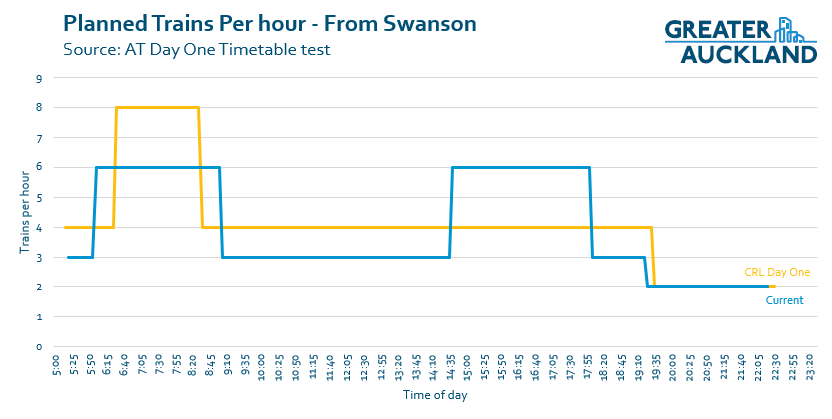
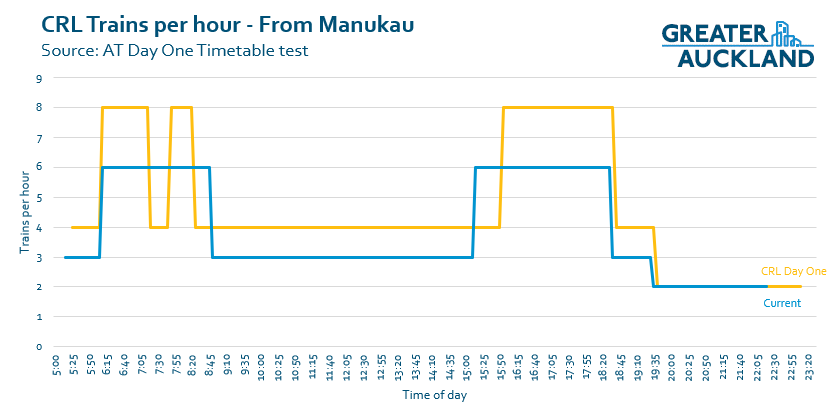
These first charts below show the number of services per hour over the course of the day, departing from Swanson, Manukau or Papakura, for the tested timetable – compared to the existing timetables.
Starting with Swanson: the thing that stands out is that while post-CRL there would be more trains per hour in the middle of the peak period, the time-span of the peak periods is shorter.
You’ll also notice that in the evening, we’re still seeing services drop back to just two trains an hour. While that might fall within AT’s technical definitions of what Rapid Transit should be (at least every 15 minutes from 7am to 7pm), to me this really isn’t an acceptable standard for what should be the core of our public transport network.
By comparison, the NX1 (North Shore express bus) has services to the city at least every 10 minutes all the way through to 11pm – and the NX2 and WX1 also run at least every 15 minutes till after 11pm.
Looking at trains from Manukau: there’s a dip in frequency in the middle of the morning peak. This is because two services are set to start from Puhinui instead of Manukau before heading up the Eastern Line and then out along the Western Line to Swanson.
These are trains coming straight out of the depot, so presumably this is about reducing movements though the Wiri junction in the middle of the peak.
The Eastern Line actually gets a bit more interesting north of Otāhuhu. During the peak, there are an additional two services an hour that start from Sylvia Park, meaning the inner-Eastern Line gets up to 10TPH in the morning. (There’s something else interesting about those Sylvia Park services which I’ll cover later in the post.)
Finally, looking at trains from Papakura: while Papakura itself would see 8TPH at peak, the same can’t be said for the stations just up the track. That’s because some of those additional trains from Papakura are “limited stop” services – meaning they’ll sail past stations like Manurewa, which will still only get 6TPH just like today. And, depending on your destination, there might only be four per hour.
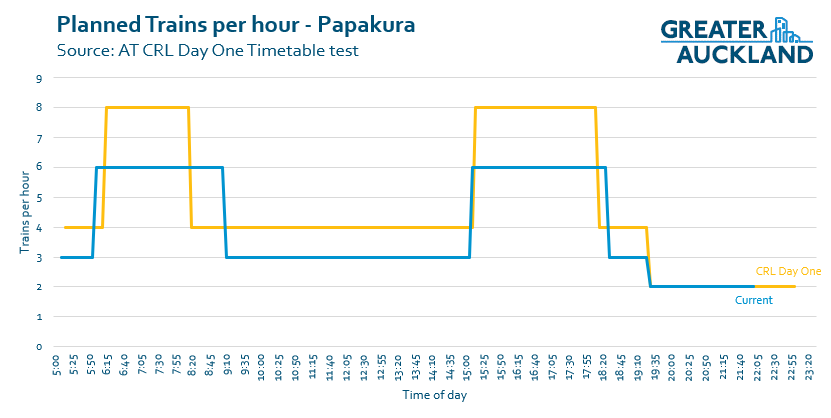
You may also notice that the span of services hasn’t increased much, between today’s timetable and the tested post-CRL timetable. One area where this will have an impact is for airport connections. The Airport Link bus runs every 10 mins until just before 1am – but the last train north from Puhinui is 10:48pm, and last one south is 11:07pm. So, good luck getting home if you’re arriving on a late flight, or even if your flight is a bit late.
Headways
For the best outcomes, services will ideally be evenly spaced: for example, if the service level is 6TPH then ideally trains arrive every 10 minutes. At 8TPH – an average spacing of 7.5 minutes – alternating 7 and 8 minute gaps between services is the best that can be expected.
Off-peak, when services are at 4TPH, the current timetable is showing exactly 15 minutes between services, like clockwork. But when all of the additional post-CRL peak services are overlaid, we’re not seeing that even spacing. What that means is that in some cases, the quality of the services will be worse than it is today.
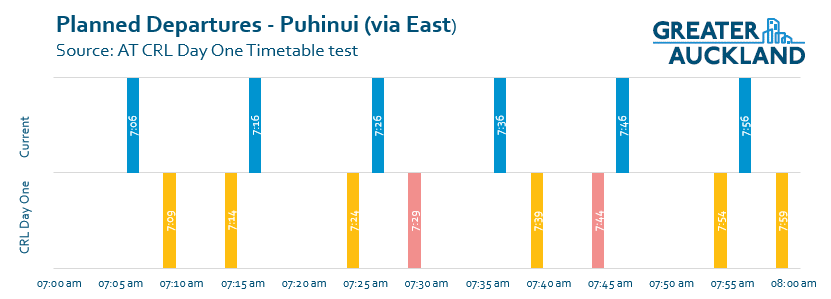
Below, I’ve pulled together some comparisons of departure times for the tested post-CRL timetable versus departure times for the existing timetable, from 7am to 8am. Other parts of the peak will reflect this same pattern.
First up, the Western Line: which, with the tested-timetable, has perhaps the best spread of headways, with gaps between services of six and nine minutes. Not great but not terrible.

Next we move to the Eastern Line. For this, I’ve used Puhinui instead of Manukau to show those two extra services (in red) I mentioned earlier. The spacing between services here is five and ten minutes – so slightly worse than from Swanson. And if you’re coming from Manukau, you’ll face up to a 15-minute gap in the morning peak.
Then we have Papakura – and here’s where things get silly. In the CRL Day One timetable a tested, the gap between services from Papakura varies from 12 minutes to as little as three minutes. But you’ll also need to pay careful attention to what kind of service it is.
- The yellow services come from Pukekohe, run every 15 minutes (all day), and stop at all stations.
- The green services also originate in Pukekohe – but after Papakura, they will only stop at Puhinui before travelling via the Eastern Line to Waitematā and through the CRL.
- The purple services start from Papakura, running all stops to Otāhuhu, then skipping Penrose, Ellerslie, Greenlane and Remuera. The catch: they leave Papakura just three minutes after the all-stops trains, meaning they’ll be crawling along behind the train in front all through the inner Southern Line, before arriving at Newmarket still three minutes behind the all-stopping service. So this is a limited-stop service that saves nobody any time.
- All of this also means that if you’re travelling from anywhere south of Otāhuhu and want to go to one of those inner-southern line stations, there are effectively only four trains an hour. At peak.
In practice, with a 15-minute gap between services at the stations between Papakura and Puhinui due to the green express service, those all-stopping trains are going to be absolutely jammed – while the train following three minutes behind will probably be largely empty.
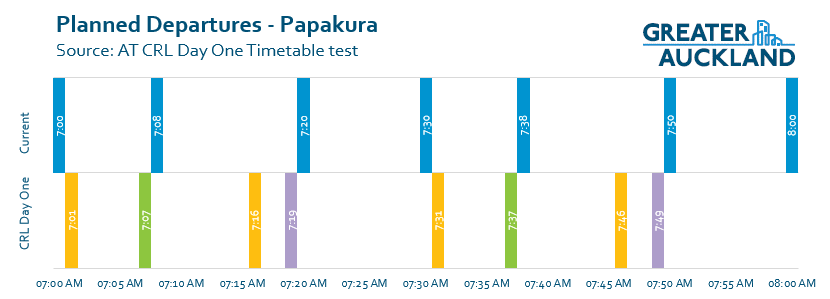
This is a classic sign that the timetable has been designed to achieve some modelled average frequency (e.g. we just need to run X number of trains to meet a set level of capacity), and that no thought has been put into meeting the needs of the actual passengers who will be using it.
Travel times
One of the reasons I’ve been looking forward to seeing this timetable was to see if we’ll be getting any notable travel time improvements. As I’ve highlighted many times in the past, Auckland’s trains are much slower than most comparable lines in other cities, and slower than the speeds cited by the train-maker CAF during the procurement process.
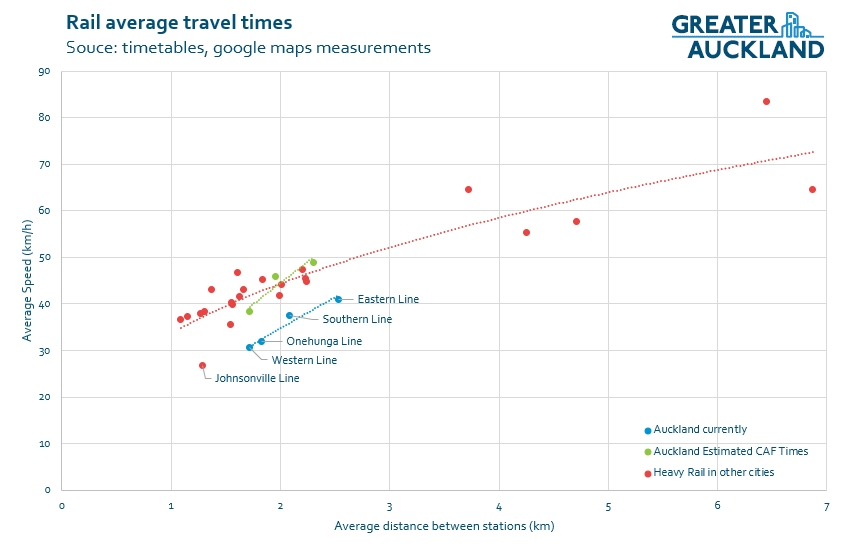 There are a variety of reasons for this slowness, including very poor operational processes around operating the doors. But we’ve also had additional fat built into the timetable, to cope with the multitude of Temporary Speed Restrictions (TSRs) that the six-year long massively disruptive rail works were meant to resolve. As reported in 2024:
KiwiRail has promised to cut delays on Auckland trains, amid growing concerns about the readiness of the city’s failing rail network for the opening of the $5.5 billion City Rail Link in 2026.
KiwiRail says it will cut delays from five-and-a-half minutes to a maximum 45-second delay on the western line, 30 seconds on the southern line, and 1 minute 20 seconds on the eastern line.
So, how do travel times compare to today, in the post-CRL Day One timetable that AT just tested?
(Note: as the CRL will fundamentally change the shape of the network, for the Western and Southern line examples below, I’m comparing travel time to inner-line stations just before the new CRL stations.)
Western Line
We do see a small improvement over today’s timetable, but at 34 minutes from Swanson to Kingsland it’s the same sort of travel time we’ve seen before, so no real change. Remember the original EMU requirement was for this part of the journey to take just over 27 minutes.
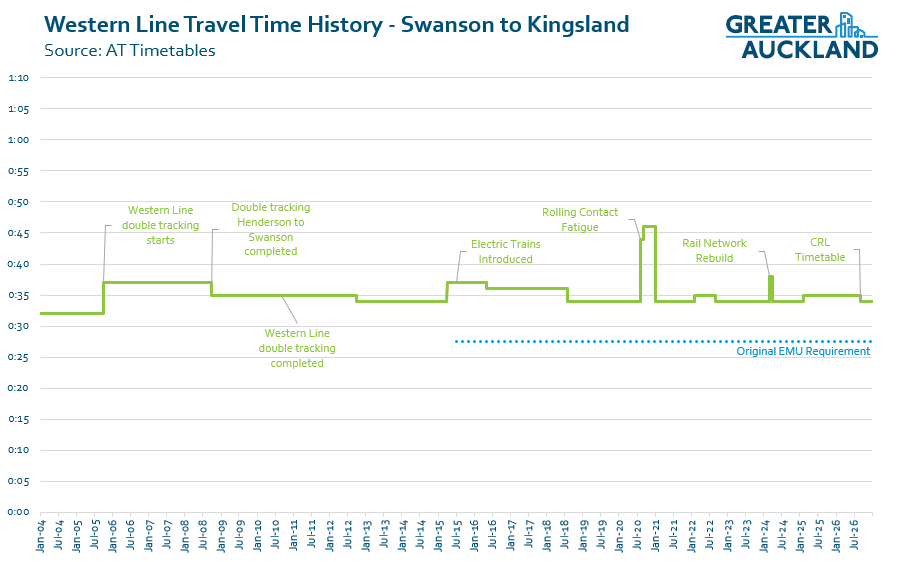
Of course, thanks to the CRL, the Western Line benefits massively from Kingsland on in towards the city. As such, the total travel time from Swanson to Waitematā drops from 56 minutes today to 45 minutes. If we could achieve those original EMU requirements for the outer part of the Western Line, we could get that down to less than 40 minutes. A worthy goal.
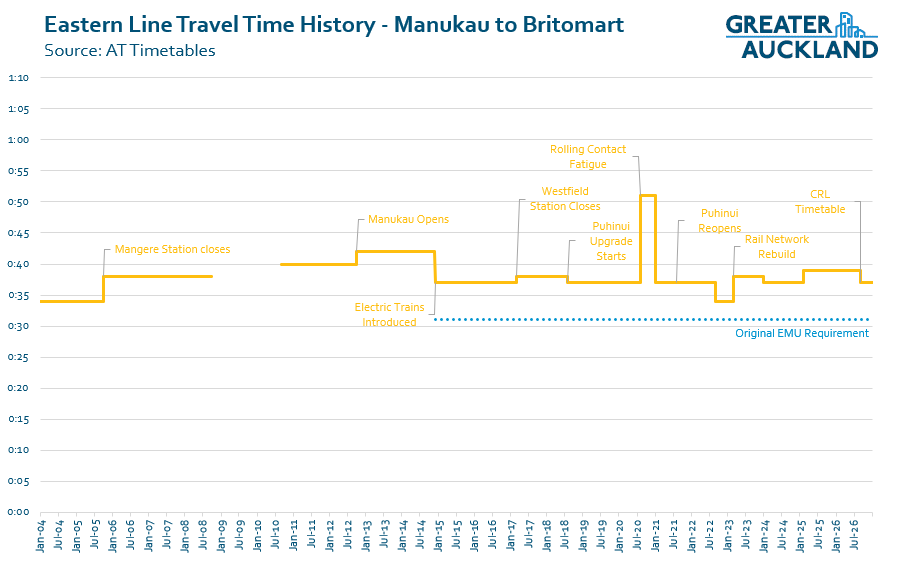
Eastern Line
This is the easiest comparison, as the shape of the trip doesn’t change. The journey time does improve slightly, by around 2 minutes, to 37 minutes total. This is similar to what we’ve seen before, but still above the 31 minutes our trains should be capable of for this journey.
Southern Line
A trip from Papakura to Newmarket sees the biggest improvement from the current timetable – but again, as you can clearly see from the chart below, it’s just getting back to earlier travel times at 41 minutes. The original requirement was that this journey could be achieved in around 33 minutes.
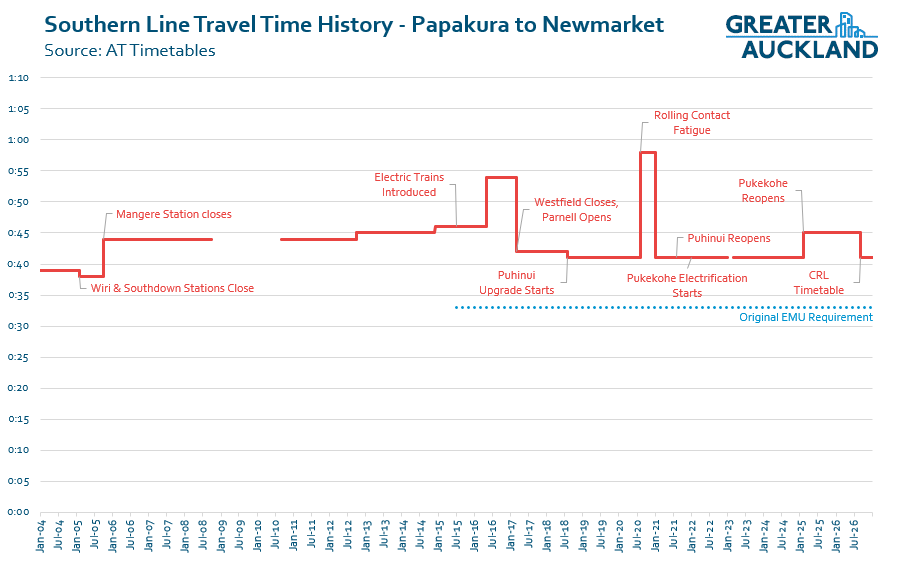
Trains from south of Otāhuhu heading north will travel through Newmarket then up past Grafton before heading down the CRL. Trips from Papakura to Waitematā are expected to take 54 minutes in total – the same as today.
However, as mentioned above, there would be two express services per hour (shown in green earlier). For a trip to Waitematā, these services will be around 9 minutes faster than the all-stopping trains, but a trip to Te Waihorotiu is only about 4 minutes faster.
One final observation
This relates to the Onehunga line. It’s been discussed before that this line will travel to Henderson off-peak, but be cut short during the peak. Nominally these trains are scheduled to terminate at Grafton. There also happen to be 2TPH that start from Sylvia Park and travel through to Grafton where they terminate. While these are being treated as separate services, the same train that departs from Onehunga will eventually run though to Sylvia Park – meaning, at least for the tested timetable, Onehunga Line passengers to the city could stay on the train which will then travel through the CRL.
Conclusion
Overall, this timetable as tested in January looks to be all about being able to claim improvements, while not actually delivering them for many users. Hopefully future iterations will result in something far more useful and passenger-friendly.
Greater Auckland’s work is made possible by generous donations from our readers and fans. We’re now a registered charity, so your donations are tax-deductible. If you’d like to support our work you can join our circle of supporters here.

 Processing...
As the OIA requester of the test timetable information, I’m very pleased to see this analysis. Keep up the good work!
We requested it too
I hoped that you had!
Great minds! Here’s the link to Mike’s LGOIMA request for readers following along 🙂 https://fyi.org.nz/request/33633-city-rail-link-train-timetable
I work on Albert Street, right next to Te Waihorotiu.
I usually travel in the afternoon on the Western line.
Bus+change at Kingsland.
Am I reading the timetable wrong, or could I still get on a bus at 14:45 on Wellesley Street West and catch up with the train at Kingsland at 15:00 that leaves Te Waihorotiu at 14:50?
Why would you do that, and not just catch a train from Te Waihorotui?
Was there any record of AT at least discussing their pathetic approach to train dwell-times?
Thanks for requesting. It’s been interesting to have a look and see that sometimes the line leaving Manukau alternates between having a 5 minute headway and a 10 minute headway.
Normal people: 8tph means 6.5 minutes between trains
Whoever fucked up this timetabling: 8tph means sometimes having 5 minutes between trains and sometimes having 10 minutes between trains
Very interesting & careful analysis. Wondering whether anyone has factored in future Te Huia & Northern Explorer service frequency improvements, including once again them accessing the Britomart/Waitemata terminating lines? Te Huia may – depending on future Govt decisions – be getting new kit, which could likely enable it to use Britomart/Waitemata, rather than the out-of-the-way, unconnected wasteland at The Strand. Other inter-regional services (eg Whangarei) will potentially become issues in future as well – all of them will need to access the Auckland network.
Given they can’t even run this timetable because of network congestion there’s zero chance there’s space for any additional Te Huia services at peak times.
Personally I think the long term solution to Te Huia is to get new kit and integrate them with the Pukekohe express services.
This
At this point, what is worse: having to transfer to a Te Huia at Pukekohe, or having lower frequencies overall to allow Te Huias to continue to the city centre.
Well for Auckland Metro, def worse to lower frequencies to allow some Waikato trains one seat ride. As much as I am a fan of Te Huia, I’m not sure why some train fans don’t like a transfer, I tend to like them as it adds to the interest and gives you a break from sitting. Te Huia is a nicer train set of course. Of course non peak and new kit they could just continue all the way through to, hopefully Waitemata.
That’s a good shout. This also illustrates the need for additional main lines (mainly South but also one day for the Western Line).
Thus spake an Aucklander.
Nothing so likely to kill a public transport service as having to transfer half way through.
Unfortunately we’ve had to battle Auckland indifference, de-prioritising and downright opposition for 7 years now; your comment suggests we’ll have to continue that. Have you forgotten that 50% of CRL was funded by taxpayers, 67% of them from out of Auckland. Noting also that over 20% of Te Huia patronage is Aucklanders, who contribute not a cent towards the running costs.
So find ways to support Te Huia’s expansion, not to sideline it!
Can we do that without reducing the overall number of people transported via public transport though?
Matt L suggests that we can, however compromises need to made and those compromises ought to favour the interests of the largest number of people.
With the current infrastructure available, the Te Huia service is always going be slightly half-baked.
Here’s to better infrastructure then.
If you have an expansion plan, being able to do it before we 4-track the railway to Pukekohe is a really important feature right now.
The hope would be that Te Huia is using separate trackage from that used by metro services for much of its run through southern Auckland. I have seen it overtake suburban services.
Yes that is exactly how other countries do it. 4-track railway out of the city, and intercity trains can go to full speed relatively quickly. If you take speeds in other countries as a reference, think of it as Auckland City to Papakura in 25 minutes, and to Pukekohe in 45 minutes.
Question is where we are going to put those extra tracks.
Expect the ‘limited’ service that skips inner south stations to be dropped.
Western line needs political pressure to not care so much about barrier down time.
Our transport evaluation processes value Travel Time Savings (TTS) above everything else. It is extraordinary how illusory significant improvements in journey times appears to be, both in train travel times (operational efficiency and effectiveness), and in users’ journey times (frequency and span), on our fully rebuilt urban rail system.
This is not getting as close to a true Metro as it should be. As feared:
https://www.greaterauckland.org.nz/2026/03/02/a-metro-for-auckland/
The short span is so unambitious. I assume they assume low demand, but how can anyone use trains that aren’t run. Or for earlier in the evening are on useless frequencies?
CRL changes everything, right? Well only if we operate services to enable that. Ghost trains can’t draw ridership.
Where is the strategic alignment? This all looks to be technically led, not outcomes led.
Build it, but don’t operate it in a way consistent with its possibility.
A train every 7.5mins is barely metro when compared to oversees. 10 or 15mins? Pfft.
Such a letdown.
Except for CRL where it was magical Wider Economic Benefits that were used to justified the horrendous cost. Wider Economic Benefits had the uncanny ability to grow every time the costs blew out to make the whole nonsense ‘viable’ again. I bet nobody involved in that process will be going back to review how much a reduced timetable wipes off there claimed benefits.
I’m trained as an electrical engineer at university. How good are predictive schedules modelling software systems, or transportation mathematical models when they use them to build planned schedules? I know that in engineering modelling is always a greatly simplified picture so some unanticipated things will always result in tests finding the models needs revision. Thanks.
The regional demand model is simplistic, it doesn’t actually model individual services or stops, it’s a sort of average demand thing.
The model can’t do the service planning for you, no.
Interested in this as well
For the cost of running actual trains for testing, you think that you could set up a network simulation with station nodes, all network routes and run hundreds of thousands of simulation with some chaos simulations (car on level crossing, break downs, events) and modelled lots of scenarios to see if there was some patterns that improved performance; maybe even unexpected choices
Looks like there was events in Auckland last year, so I wonder if anybody from Greater Auckland:
https://www.opentrack.ch/opentrack/opentrack_e/opentrack_e.html
And of course, there is even a model available(?) already:
https://www.kiwirail.co.nz/assets/Uploads/Our-Regions/Auckland-Metro/Strategic-Rail-Programme-PBC/Documents-Appendices/AppendixH_Options-Development-Report-Part-2-REDACTED.pdf
It would be pretty cool if the model was release for people to play with; a learning from open source software, that more eyes and more ideas, could help come up with solutions
I thought the CRL was going to cut some serious time off the western line? $6 billion to save 11 minutes?
Obviously this is hindsight, but I do wonder if the best bang for buck would have been to convert the western line to LR at the time of double tracking and run a (much cheaper) LR tunnel through the city. That tunnel could then also be used for LR to airport / north west / north shore. Southern and eastern could have continued terminating at Britomart with more frequency possible without the western line and Onehunga line.
Seems like the main bottleneck for train frequency isn’t the trains, its cars crossing the tracks
Not so much of a problem for LR…
Might not be a problem for the trams in your magical fantasy land, but if you had some realistic ideas about how to improve the situation that would be more helpful, I think
Traffic lights are better at this than rail crossings. Go to a traffic light on your nearest arterial, and observe that it will cycle much more often than 8 times per hour. This works for trams because trams can stop much more quickly than heavy rail trains.
If we import a bit of traffic light tech from overseas, we can put transponders on buses and trams to make it so they get green light quickly, or so they never have to stop for an amber light.
It’s not cars crossing tracks it’s the policy of deferring to “driver frustration” by not running sufficient trains. Instead that absurd concept should be treated as the unserious issue it is – it’s actually “driver resentment” ie drivers that will patiently wait for similar lengths of time at road intersections for other drivers, somehow refuse to do so for the much more valuable (ie higher volume) train passengers.
The safety issue of drivers choosing, idiotically and suicidally, to go round barrier arms, is solved by installing double barriers, ie closing off both sides of the road on both sides. A small investment until such time as grade separation can be funded.
Instead AT choose to just run a suboptimal urban rail system, deferring to, and encouraging, the worst sort car brain, instead of optimising all modes in fairer balance.
Alternatively we could install ramps so impatient drivers can Dukes of Hazard their way over the trains
Some people will go across closed barrier arms, whether they are in a car, on a bicycle or on foot. This is not just a car driver problem.
A lot of reckons going into that alternative scheme.
11 minutes faster to Waitemata is nothing to sneeze at, but could be a lot more if we sorted out travel times, a large part of which is caused by excessive dwells.
Changing the western line to LR wouldn’t change that there are level crossings and that AT are nervous that running more trains will result in more people risking it by walking/driving around barriers to not get delayed.
Trams run on the same roads as cars, what are you even talking about
If it wasn’t for this blog, very little of this would have come to light.
Assuming that the ‘key stakeholders’ (obstructive senior mandarins) were capable of recongising the failure they’re setting Auckland up for, is there any reasonable likelyhood that they could change their approach at such a late juncture?
I’d like to hope that there are clear-headed individuals within the organisation fighting tooth and nail for public transport users, hover I don’t hold any hope.
It seems direct political oversight (and restructuring) can’t come soon enough.
Everything indicates their doubling down on their approach rather than looking to make wholesale changes
Hahahahahah you think adding politicians to transport planning will make things *better*?? Lol. Lmao, even.
Devil’s advocate, how are politicians expected to make good policy decisions if they aren’t well informed?
According to an AT document I recall seeing, the half-hourly evening frequency is because of KiwiRail maintenance requirements. That sounds a bit odd – why would such time be required every night?
There’s a body that RNZ and Scoop have referred to called the Auckland (Network) Timetable Committee, which apparently includes AT, KR, Auckland One Rail, and Waikato Regional Council (re Te Huia), but has no obvious web presence. Presumably this body would have had input, including such need for maintenance windows, so their relevant documentation would be helpful.
It’s not funny to see that journeys in 2004 are faster than the CRL day 1 timetable, on all lines!
Keep in mind the pre-double tracking numbers are kind of fake. My experience on the western line in that era is they only worked because the patronage was so low that some of the stations effectively operated as on-demand stops. The train manger checked if anyone wanted to get off and if no one did then the train coasted through the station at low speed and only stopped if someone was waiting on the platform.
When patronage started to pick up and they were stopping at every station the timetable simply fell apart for peak hour services as they couldn’t get them through the single track segment between Avondale and Henderson fast enough for a 30 min service frequency.
This level of crushing disappointment shows that there are no technological/infrastructural solutions to political problems. All the new tracks and rolling stock in the galaxy won’t actually improve life for commuters as long as an out-of-touch bureaucracy operates them to optimise fantasy “metrics”.
The CRL in itself solves nothing.
This seems to be unfortunately true of the Country as a whole. Whenever the government turns on the taps, we just get more committees, more consultants and more bullshit reports; so little seems to make it to actual physical infrastrucutre and frontline services.
They should really fix the evening frequencies. You can only get people to take public transport if they can go to a show/bar/event until 11pm and don’t have to worry about missing the last train or wait 30 minutes at a station. So have trains run at least until midnight and at 4 TPH!
One thing that always defines the experience of taking the metro in other big cities is the turn up and go frequencies. You don’t read time tables. You go to some line and assume a train will show up and you’ll start making progress along that train line within a reasonable time. This makes it basically an extension to walking.
15 minutes is a long time to wait though.
Trains will fall between two chairs. For shorter trips, most people will quickly realise that by the time a train shows up they would have long made it to their destination by car. That is true even in the city centre. You can do many kilometres by car, or even by electric bike, within 15 minutes. For long trips the slow line speeds will make it absurdly slow compared to cars.
Exactly. I’d argue 10mins is too long.
I suppose you could argue that half of people would arrive with 5mins to go or less. But still. 10min frequencies should be the minimum during peak.
Perhaps they could divert all Western line trains to Newmarket and people wanting to go to the Central Area could change there.
Perhaps a couple of rail over rail overpasses at Westfield should be prioritised, even over some road over rail overpasses?
shhh shhh, don’t mention spending on any sort of infrastructure, Miffy doesn’t like that
Every single post, it’s always this guy with the dumbest take.
Why did we bother spending 5 billion to allow Western line travellers to go direct to the city rather than via Newmarket, if we just turn around and…not do that. Have you got a head injury or something? Is that it?
libertarianism? classical liberalism? prioritising the accumulation of money over social good? i’d count those as mental health problems.
Unfortunately trains are just an unsolved problem and no one has figured out how to do them well anywhere else in the world. AT and KR are just doing the best they can given the arcane and experimental nature of transport constrained to a fixed track. Maybe one day our brightest minds can crack the code and then trains might be good.
Even if we could scrape together enough brain cells to try and fix the problem they would need a lot of training
Yep, we should just keep building more roads for cars until on demand, door to door, flying pods have proved themselves to be a high capacity reliable, safe, environmentally friendly, low impact, and economical.
In the meantime wheels on a low friction, wear resistant, load spreading, robust self guiding track way are the best we can do providing for high capacity land transportation.
Have you ever been to Tokyo…?
Is that where all the people with the ability to detect sarcasm went to?
Did I understand correctly that there will actually be fewer trains per hour around 9am on the Western line?
Yes that’s correct, the peak period will finish earlier than it does right now
My experience as a frequent visitor to Auckland in recent times and has been that while the trains are clean and comfortable, they do not travel very fast between stations and the times with open doors at each station are excessive. Each of these issues irritates me, but I have been holding out for both to be resolved with the CRL. Yes, frequency and capacity are also important, but at least when on is on board, it would be nice not to have to be constantly saying to oneself ‘Just get on with it. Let’s go’. The data given by Matt L is so disappointing.
I once took the train from Britomart to New Lynn and was tearing my hair out at the dwell times. It just wound me up more and more at each stop because one of the advantages of PT is supposed to be the ability to sit back and chill out.
We just make this so, so hard.
I wanted to say, 30mins felt like an hour.
I feel like a lot of the Western line pain is also due to dwelling near Newmarket, something ostensibly solved by the CRL (we’ll see I suppose, looking forward to 30kph underground limit due to unforeseen track or design issues). The trains do feel like the are crawling some days, I don’t ever want to see cars driving parallel and going faster than the train!
Nice.
We spent $5.5b to get 1-2 extra trains per hour, but basically no faster than before.
Sounds like a great use of tax money.
I was a major CRL suporter, but to see this potential outcome is so dissapointing.
It makes me lose faith in the entire public service.
How is this supposed to generate any economic benefits in reality? I just can’t see how it can pan out. The BCR in reality must be negative by a huge margin.
With basically no travel time savings in reality
Well timetable is disappointing but there are lots of saving for anyone heading to the central city. Lot more directly there, and the city centre is just that, the centre so a lot of people need to do this and the ability to do so will encourage more.
The Western line users particularly save from no Newmarket turn around with a wait.
Also more options if things go wrong.
It’s really not as bad as reading the articles here would make it seem. Greater Auckland has just firmly planted their flag in the “CRL will be a disaster” position and so will keep spamming pieces talking about how awful everything is.
No, we don’t think it will be a disaster at all.
But we keenly want it to be the ragging success it should be. Auckland needs this, in fact the nation does.
At the moment we fear it may be a disappointment, not a disaster.
A costly disappointment though, as hiding its potential would have a chilling effect on future investment into quality rapid transit systems in AKl and Wellington and Christchurch.
I get alerts on my phone whenever there are train delays or other issues, and there are periods where there are quite a lot due to a range of issues. Once we open up the CRL do you think general reliability will improve, or do you think with a new and more complex timetable the impacts will spread wider across the network?
An efficient urban train service should have an off-peak minor station dwell of around 20-25 seconds.
For example, in Sydney, with two-person operation and big (1.8m wide) plug doors, common figures are:
trains stops 0
doors are opening 1-5
handling passengers say 5-17
doors are closing 17-21
train starts 25
In Melbourne, with narrower sliding doors that take about 2 seconds to open/close, the total is often closer to 20. That’s with one-person operation.
In a high capacity metro system it’s essential to absolutely minimise dwells, because extra dwell time adds directly to the headway, thus reducing trains-per-hour capacity.
In those systems (for example Paris) you can arrange it so that the doors unlock in the last second or two before the train stops. The first alighting passenger can have their foot on the platform within 3 seconds of the train stopping.
Can anyone advise what a typical off-peak minor station dwell in Auckland is? The enthusiast videos that I find on Youtube all edit out that detail.
And in trains with optional door opening, obviously the system should be awake so that passengers can request door opening for a suitable period before the train stops. How are Auckland trains set up on that detail, and if they don’t have it, why not?
Train dwells in Auckland are typically around 45-50 seconds per station, even in the off peak. I’ve written about it a few times e.g. this was 11 years ago
https://www.greaterauckland.org.nz/2015/06/24/dropping-the-dwell/
Basically most doors are usually closed by about 30 seconds but the last 15-20 seconds of that is a really inefficient door closing process with the train manager hopping on and off the train before signalling to the driver to depart.
Tell the whole truth Matt – you’ve been told before the biggest dwell time delays are because of the computer system on the EMUs and how long it takes for the door loops to clear. It is not due to the Train Managers, which AT and AOR want to remove as a cost-saving and use this as a false reason to try to justify it, which certain people gullibly fall for.
Door closing and Train Manager right of way times were quicker with the previous diesel fleet which didn’t have the door loop delays that the EMUs have.
Dwell times and timetable travel times have not improved with the introduction of EMUs, because Auckland One Rail have a contract agreement with AT with KPIs based on trains departing every station at a set time, with timetables set with an excessive amount of slack in them which helps AOR run services on time. Good for AOR, not good for rail users.
Green, this is concerning. But surely the computer system can be upgraded / reprogrammed?
Obviously the TMs aren’t ‘the problem’ but the system is. I actually think we should keep trains staffed for customer service and safety / security. But train dispatch should be controlled by the driver, even if it only saves a few seconds per stop.
I often get frustrated at the amount of time it takes for the doors to open when the train has stopped but this is mainly because I’m usually in the low-floor carriage with my bike and it will always take some time to deploy the ramp.
Yes the computer systems and doors themselves are a part of it but only one part and certainly not the biggest. The TM process of closing all but the local door, getting off the train to check the closed doors are clear, then waiting for their door to close before they signal the driver adds significant time. I’ve also witnessed first hand TMs change that process up and speed up dwells significantly.
Most cities that still use a TM have them in the rear cab, closing all doors at the same time and looking out a window or the drivers side door to check everyone is clear before signalling the driver. That alone would save 5-10 seconds per stop.
I’m also aware of attempts to improve dwell times that failed because AT and AOR (and transdev before them) just don’t care. The key point is we’ve had electric trains for 12 years now and that nothing has been done to improve this, including buying new trains with the same issues, is outrageous.
That’s still not the whole truth, Matt. There have been several real improvements in door processes since the EMUs were introduced. Small and unsatisfactory, but real. There have also been several attempts to develop alternative processes involving people who have contributed to this blog, but none of those yielded useful results in part because not every outside observer has all the clues they might think they have, and also because AT and NZTA have set an extremely high bar for passenger safety at the door interface. Unlocking doors while moving is absolutely verboten to the point that the train requires multiple confirmations of zero speed and correct location on the platform before the doors will open. Similarly extending the ramps cannot occur without the same requirements satisfied, this delaying the T-Car doors by the duration of that whole process at both ends of the stop. Bypassing this system intentionally is instant dismissal. Unintentionally is a probable delayed dismissal. They’re not going to back down on that. People inside and outside the organizations have been fighting for dwell time reductions for more than ten years and it’s simply not going to happen until someone in a high place is willing to sign off changes that will eventually result in serious harm to a passenger.
Putting all this process argument aside I think the main issue is the timetable is padded way too much. Acceleration and deacceleration is pretty minimal. Door fluffing around in my opinion is mainly due to the timetable. Once they are used to this pace at most times then be easy to carry it on when we should make up time. I’ve been on trains that really hoot along when the driver seems to be making up for lost time.
If overseas ones are pretty safe and can be faster why are ours so slow? The plug door design is another reason and freight clearance at platforms combined with some curved platforms and extending the ramp on central carriages all factored in is more time it would seem.
To provide some balance – head to wellington and watch the dwell times on their EMUs.
They use the exact same procedure with a Train Manager closing all doors but local, doing a last check, closing their own door and signalling to the driver.
While there are hardware things that make auckland slower (extending ramp, plug style doors), there are definitely parts which just seem needlessly slow in Auckland.
Watching the TM press the button to release the train after their local door is shut, acelleration in a Matangi is often near on immediate whereas in auckland you must wait more time.
Why do they hop on and off?
Get a better view of anyone in harms way, especially at curved platforms. I would think for some exercise too!
“45 to 50 seconds ..”
I’d be curious to know how that time is split among the elements that I mentioned, that is:
1. Train stops
2. (Delay)
3. Doors are opening
4. Handling passengers
5. Doors are closing
6. (Delay)
7.Train starts
Is the main problem at item 2 or 6 or both?
there’s extra steps involved
1. Train stops
2 Delay
3. Doors open
4. Passengers handling
5. All but one set of doors close, train manager out on platform.
6. Delay, train manager gets back on.
7. Train manager closes last set of doors.
8. Delay.
9. Train starts.
The problem phases:
Delay 2 includes around 2sec of the train confirming that it is stationary, another second of switching, a second while the doors beep to warn they’re about to open, ten a couple of seconds to actually open.
On the T-cars there’s another several seconds for the ramps to deploy and lock before the doors actually open.
In addition to the TM process, which depends greatly on who it is, what passengers are doing, where they are (visibility and special timetable obligations) and whether they’re on time or not (TMs are no longer permitted to close the doors until up to 15 seconds after the scheduled time).
Then the final control system delay is a fixed time (several seconds) between the last door locking and the train accepting control inputs from the driver. Again, this is to absolutely ensure that the doors are all locked before moving. There is a new fly in the ointment in that the new unit doors will induce another set of delays if they detect interference that might indicate certain unacceptable hazards.
There is probably 7-10 seconds that could be eliminated from the whole process, but from an administrative point of view that would mean someone upstairs knowingly authorizing a change that would put them in the dock at a coroner’s inquiry.
Jimt – the obvious question is how other operators around the world and even in Wellington have managed to get dwell times down without it being a serious safety issue?
AT appear to think they are the first operator in the world to operate a train system.
Thanks for this. It’s useful information, and incredibly disappointing.
It beggars belief that congestion at Wiri has not been mitigated by a third main platform at Puhinui being built for the southern expresses. Creates an entirely avoidable conflict with Eastern line services there and renders the third main almost redundant operationally. Staggering.
Eastern line terminators at Sylvia Park to ease pressure on Westfield junction is a very interesting idea. I wasn’t aware of turn back facilities there. Has that been enabled by the third main works in that area?
I think just the highspeed crossover they recently built near Sylvia would allows this.
The planned timetable AT are going with for the CRL is clearly not going to work and is not going to deliver the service Aucklanders are expecting. It will be interesting to see who takes the blame when it all goes wrong, which it will. This will be a national embarrassment if changes aren’t made now. AT should be testing other operating options.
The simplest option would be to run two end to end routes:
1. Pukekohe-CRL-Newmarket via Panmure, with some 3 car trains continuing on to Onehunga.
2. Swanson-CRL-Parnell-Manukau.
New express services with 9 car EMUs should take advantage of the third main and replace the Te Huia services north of Pukekohe, stopping at only the main destinations people travel to from the south – Puhinui (for Manukau), Middlemore, Otahuhu, Sylvia Park. The Te Huia trains could in turn then run more services between Hamilton and Pukekohe, and to Tauranga.
This would have the least amount of conflicting movements and cause the least amount of congestion, whilst providing direct services between where most people travel to on the Auckland rail network.
The Onehunga Line should be extended to Auckland Airport, which the Southern Line services terminating at Newmarket, could then all be extended to the airport.
When the Avondale-Southdown Line gets built, a new direct Henderson-Otahuhu service could be introduced on it.
The poorly-used Te Mahia Station ought to be closed and replaced with a new station on Walters Road midway between Papakura and Takanini to serve the large new retail and residential hub in this area.
We have already being told that trains can not reverse at Newmarket so what happens to the empty service if we were going to adopt your running pattern. What your suggesting has merit though especially more Te Huia services. Need that Puhinui third platform as well. I notice that park and ride at Pukekohe is really filling up but soon the new station will open at Paerata which will provide much more. If we could quickly string up some wires to Hamilton and build some more stations in Northern Waikato this would be a good running pattern.
If we electrify to Hamilton might as well double track at the same time, which is most likely the plan post-CRL
It is double tracked, except for a section at Whangamarino and one bridge at Ngaruawahia
What is the state of the existing track, if you know?
Good, is a very busy section of the nation’s network: lots of freighters.
Level crossings likely need to all be fitted with double boom gates, where currently not the case.
We need more stations especially at Te Kauwhata and Pokeno.
I ask because if we electrify the block of line between Drury and Hamilton it will be a good chance to do any track works at the same time
Wasn’t double tracking formation put in decades ago at Whangamarino to bypass a problematical swamp?
I’m sure a well thought out solution can be made at Whangamarino but ” problematic swamp” . It is a hugely significant wetland feature of international importance ( RAMSAR) so some respect please.
And then isnt bypassing the problematic swamp on an already partly completed formation preferable to trying to rebuild a stiffer formation on the current route? Or were significant engineering chalenges encountered on the alternative routing?
I just want to know why this deviation was abandoned after significant work?
Did Kiwirail release their Detailed Business Case for the Golden Triangle Electrification Programme yet? It was due to be completed end of 2025: https://core.opentext.eu/pdfjs/web/viewer.html?shortLink=9ab5356eeda2227a83bedbf70b60ccd0d056a16d56382ff8
Good post and graphs, great we have the proper details to look at. I’ll probably do some more intelligent comments tomorrow in the day light but man, what a mixed bag of services and outcomes.
This is what you get when your head of training and your head of operations are card carrying libertarians who resent their tax dollars being spent on services they would never use and vote for a party that wants to strip rail services back to just the profitable ones. They and their employer are not here to make things better for Aucklanders.
Looking at the older operating plans for the CRL… i wonder if there would hypothetically be merit to revisiting these ones.
Aside from, of course, the downsides that would need addressing such as extending the Western Line peak overlay all the way to Swanson, the top operating plan (to 2025) looks to put 15-18 trains per hour per direction at peak through Westfield junction, instead of 22. Maybe that would make the situation more manageable?
https://www.greaterauckland.org.nz/wp-content/uploads/2017/01/Post-CRL-rail-network-ops-plan.jpg
If we are really going to understand this we need to know what happens to the empty service after a train terminates at places like Grafton or Sylvia park. Trains do not die and go to heaven when they terminate. What is the actual point of having trains terminate at these stations. It seems to me there is too many out of service trains wandering around the network now and I get the impression there might be more when the tunnel opens
Presumably the Grafton empty service runs around the third leg of the triangle at Newmarket. And I can only think. It goes down to storage at the Strand. Then what happens at Sylvia park. If it doesn’t reverse it’s got to run through the Westfield junction anyway.
If you’re a dwell time tragic look at this video of train doors closing in 20 cities: https://www.youtube.com/watch?v=rYtM14aPAX0
In most cases the photographer has cut away the second the doors are shut, without letting us see the train start. Following the conventional wisdom of youtube video makers that viewers have the attention span of a gnat and won’t tolerate a shot that’s longer than 3 seconds.
However in the few cases where the photographer has dared a longer shot, you can see examples where the train starts within 2-3 seconds of the door being fully shut.
Further comment relevant to dwell time: Do Auckland trains allow passengers to order door opening before the train has stopped? If not why not?
If that’s not possible, the alighting routine for a non-expert user is:
1. Go to the door and press the button (as you naturally would as you wait by the door), say in the last 5 seconds before the train stops.
2. Train stops. Nothing more happens.
3. After another 5 seconds you start to wonder what the hell is going on and anxiously press the button again (unless a more expert rider beside you does it first).
4. The door opens.
This is really, really annoying and time wasting.
Obviously the system should be set up so it can accept a request for door opening for some suitable period, say 5-10 seconds, before the train stops.
@jimt
‘Delay 2 [between train has stopped and doors start to open] includes around 2sec of the train confirming that it is stationary, another second of switching, a second while the doors beep to warn they’re about to open…’
So that’s about 4 seconds. Compare typically 1 second in Sydney or Melbourne, and possibly minus 1-2 seconds [that is the door wakes up before the train has completely stopped] in efficient metro systems that prioritise short dwells.
In the last case obviously you need safeguards:
1. the timing is such that the train has stopped before it’s possible for a passenger to actually get out, noting that a plug door will usually need about 2 seconds after waking up to get to that point. You can save that time.
2. The doors are interlocked with the throttle so that after the doors have woken up it’s compulsory for the train to continue braking to a halt; that is, the driver can’t go crazy and accelerate again.
@jimt
‘Then the final control system delay is a fixed time (several seconds) between the last door locking and the train accepting control inputs from the driver. Again, this is to absolutely ensure that the doors are all locked before moving. ‘
Why is this delay necessary? An electrical circuit is either on or off, and the transition between those states takes, I guess, hundreths of a second.
When I flick a switch in my kitchen the system does not take several seconds to confirm that the circuit is closed before it allows me to turn the kettle on.
You CANNOT BE SERIOUS! Is that for real that the Western Line drops to two trains an hour at night.. .?? what is the point. This is the crux of the matter… that getting into town is easy but getting is a bloody nightmare. Every half an hour and add to that the 14 bus that might get you a bit closer to your home a bit more safely goes every half an hour and usually misses the train by one minute ..
after all the delays, all the promises, all the hope That is really , very, depressing.
The short span is terrible.
Finishing before midnight is non-serious.
If you can’t use it to get home, you can’t use it to get in either.
Please at least tell me that if there are major events on at night at Eden Park or Mt Smart, they will run more and larger trains until at least an hour or two after the event closes