There’s a lot going on in the world right now and it has the potential to have significant impact on transport (and the economy) here in New Zealand.
With that in mind, I thought I’d just pull together a few quick charts.
Petrol
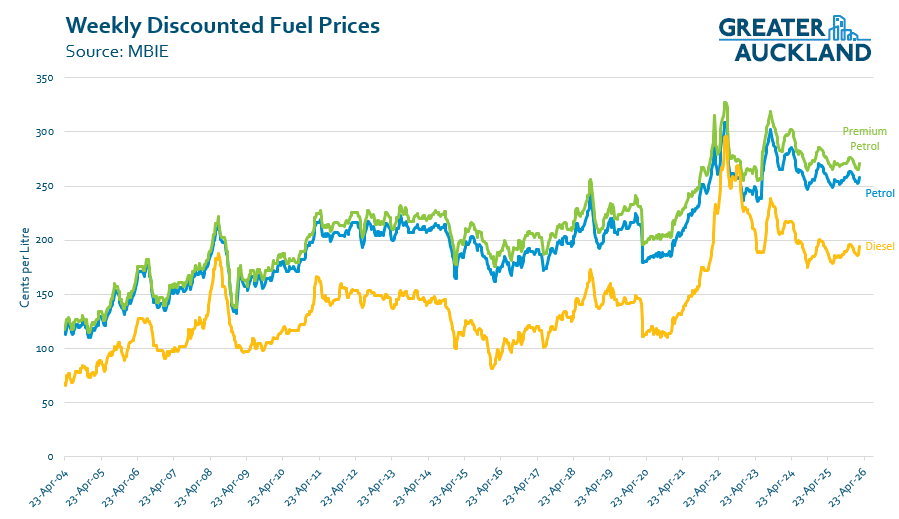
The price of petrol has already started going up. A check on prices near me puts regular petrol at over $2.70 per litre, up 20c or more in just a week or so. It seems like there’s a good chance it will go much higher too, but we’ve got a way to go to get to what levels were just a few years ago.
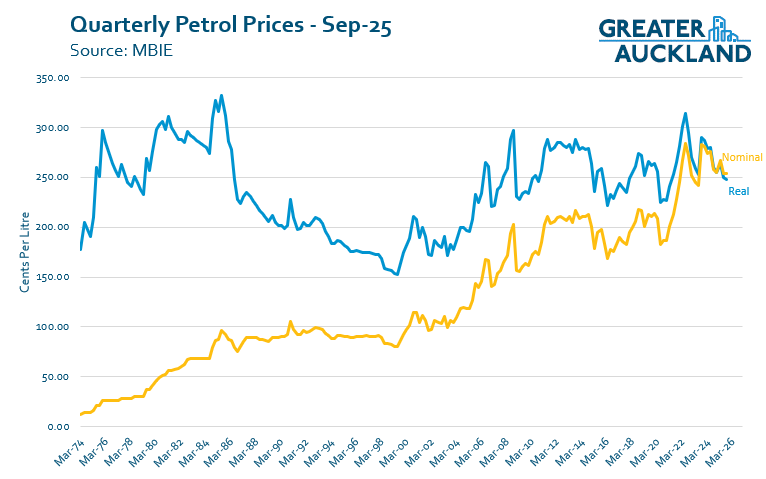
There’s also still a while to go before prices get to the level they were in the mid-1980’s – which in real terms was around $3.30 per litre.
With those prices in mind, I thought I’d look at a few other metrics that might be worth keeping an eye on in the coming weeks…
Public Transport Ridership
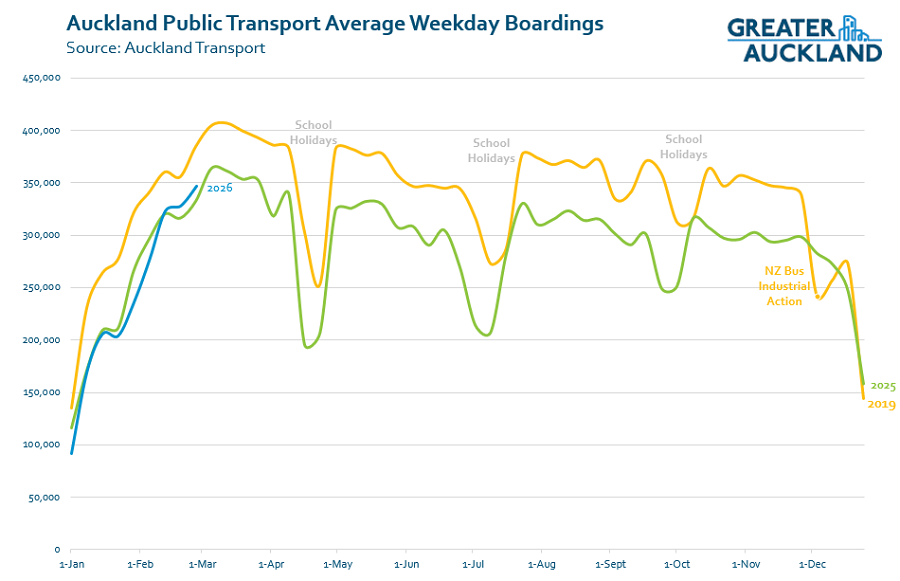
As we’ve highlighted before, PT ridership has been flat for the last year or more, hovering at around 86% of pre-COVID levels. Auckland Transport’s weekly released data shows that so far this year, things have been tracking pretty similarly.
Could higher fuel prices push ridership back to closer to pre-COVID levels?
Of course higher fuel prices will also have an impact on our PT network, though we are seeing more and more electric vehicles in the fleet. The trains, of course, are fully electric. By August this year there are expected to be around 450 electric buses – more electric buses than any other city in Australasia and about a third of the total bus fleet in Auckland.
AT also just announced a new contract which would see the number of electric buses rise to 600 by July next year, about 44% of the bus fleet – though that’s likely to arrive a bit late for this current crisis.
Finally, the two new electric ferries are currently being tested and are due to go into service later this year, while the first plug-in hybrid ferry has just completed sea trials.
Cycling
Auckland’s safe cycle network has had some fantastic additions recently, with the likes of Gt North Rd and the Pt Chev improvements. These improvements come as the number of trips to and from the central city by bike has reached all time highs, surpassing even pre-COVID levels.
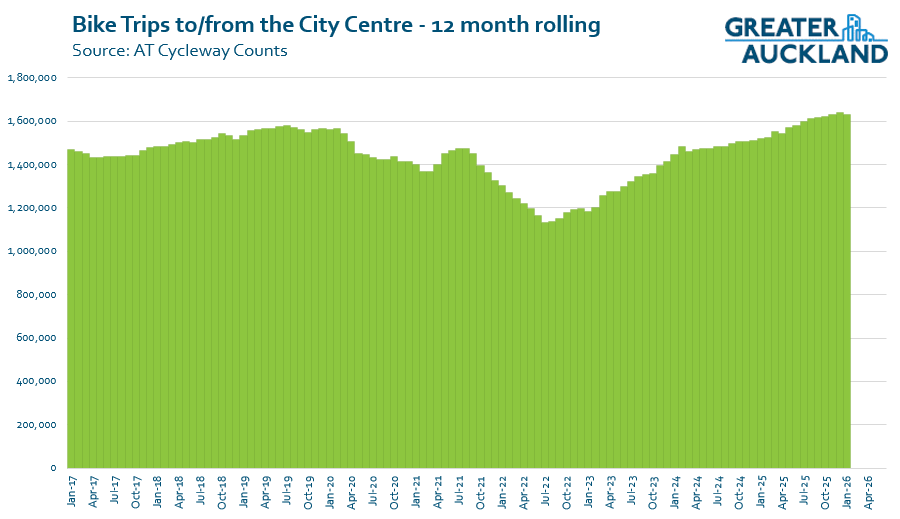
The weather i usually fairly bike-friendly at this time of the year (March is generally the busiest month), and some of our most well-known cycleways, like the Northwestern, can already be fairly busy at peak times. Maybe we’ll see those bike paths get even busier?
And if fuel prices get too bad, could we see a modern day Trevor Lanigan? He famously borrowed his daughter’s bike to ride over the Auckland Harbour Bridge in 1974 during a bus strike, when lanes were liberated for people on feet and on wheels.

Electric Vehicle sales
One of the first things the current government did after coming to power in late 2023 was to cancel the Clean Car Discount that had been introduced in mid-2021 by the previous Labour government. This cancellation had an immediate and significant negative impact on the sale of electric vehicles.
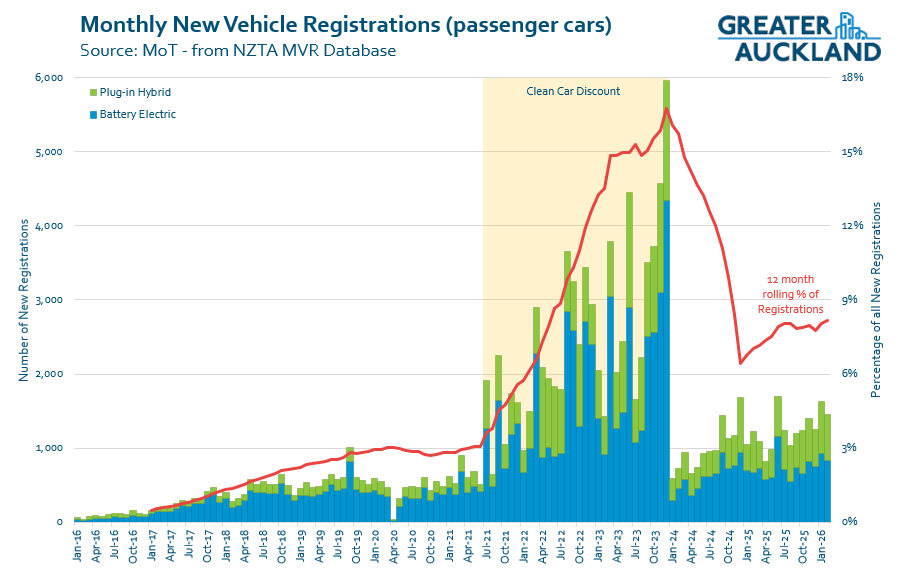
Prior to the current coalition government being elected, EVs and plug in hybrids accounted for just over 15% of all new cars registered over a 12-month period. Had that rate continued there’d perhaps be an additional 30,000 families who’d be able ignore any changes in the price of fuel – on top of the nearly 90,000 that already have an EV.
That’s not much compared to how many cars are on our roads (over 3.6 million light passenger vehicles) but every bit would help.
What else should we keep an eye on?
PS A survey by Consumer NZ released yesterday finds that 96% of New Zealanders who own an electric car would never go back to petrol. Sustainable transport options are pretty popular!
Greater Auckland’s work is made possible by generous donations from our readers and fans. We’re now a registered charity, so your donations are tax-deductible. If you’d like to support our work you can join our circle of supporters here.

 Processing...
Car pooling is also an opportunity for avoiding the effect of higher fuel prices, as is working from home. Both could be done one day a week. Each would have an impact of 20% on the fuel bill. The impact of cycling, catching public transport, pooling, and WFH would be in reduced peak period traffic. So perhaps you could track peak period traffic volumes, and the amount of delay.
The crisis currently unfolding in the Middle East is just a taster of what is to come if we can’t transition our transport away from fossil fuels and towards sustainable fuels like Electricity. The Chinese clearly see it the same way, given the massive EV drive they’ve been undertaking for the past several years in both EV manufacturing and sales. As long as we are dependent on Oil, we will always be slaves to the volatility of that region.
Does everyone forget what roads are made of? Ashpalt is an oil byproduct. EVs still run on the same roads as cars with combustion engines
Yes, but you don’t have to have a lot of smarts to realise fuel is a much bigger component of each journey than the asphalt or bitumen is.
An EV will still significantly reduce your exposure to oil prices.
Asphalt is separated from the fuel we put in our cars, they are byproducts of the same process, both part of the oil consumption equation. If you want roads, you also have to produce fuel which will otherwise be used for what?
While you’re right it is currently a byproduct there is plenty of scope to adjust the refining process to focus on the products still needed, such as chemicals, asphalt, jetfuel, lubricants, plastics etc.
The idea that we would keep running cars on petrol just to keep a supply of asphalt going is absurd.
Thats why we need to be using the existing roads more efficently – Bus priority and repurposing lanes. With Aotearoa’s potential to be less and less dependant on oil we can see it as a health, wealth and social dividend – ironically like the benefits Norway provides it’s citizens through their use of their oil dividends.
No one is saying to stop making oil I think. It is very true though that if we rely solely on oil for transport whenever there are temporary shocks like this it will hurt everything. Price shocks wouldn’t really hurt road making because they could just hold off on maintaining till the price is lower. If you want to get around and your only option is high fuel prices then say goodbye to your retirement savings.
Sorry to be the bearer of bad news but we haven’t figured out how to make oil yet, and most of the transport we have in Aotearoa relies on it
We import asphalt completely separately from liquid fuels. As we burn less and less fuel, and import less and less fuel for transport, this has no bearing on asphalt deliveries.
Offshore refineries will continue to crack crude and generate the sludge that becomes asphalt and want to sell and deliver it.
Furthermore, even if the whole world stopped burning refined petroleum products overnight, Canadian and Venezuelan heavy oil-sands will still be sitting there for mining. These approximate asphalt much more than they do refined petroleum products and likely will remain a viable and less polluting asphalt biz long after they are, at great expensive and filth, turned into liquid fuels for surface transport.
Treasurey had a report looking at converting car tires into road surfaces. There’s oil in them thar mouldering car tyre mountains
Oil is so useful for long lived end products, seems crazy to be burning it for a one-time use.
At least we stopped rendering down whales, until we figure out how to run ford rangers on whale oil.
AI truth approximation follows…
High Production: In its best year, 1853, the hunt brought in 8,000 whales. This catch yielded a significant amount of product, including 103,000 barrels of sperm oil, 260,000 barrels of whale oil, and millions of pounds of baleen .
Economic Importance: The industry was so significant that it ranked as the fifth-largest industry in the United States at the time
If only someone could invent a magic powder that could be mixed with water to make a slurry that would then harden like stone.
Hi troll,
If you mean concrete then
1 – how do you propose extracting and treating it in a world where fossil fuels are extremely expensive
1 – how do you propose moving it to where it needs to go when fossil fuels are so expensive
Suggesting concrete roads as a solution to asphalt roads becoming too expensive is like using gold for plumbing because copper becomes expensive.
You mean is like swapping out PVC water pipes for copper pipes.
Concrete is by no means a gold solution and is quite often the standard in many countries.
It absolutely is superior in most situations but also lasts a lot longer and requires a lot less maintenance.
Which one of your favourite beaches should we strip of sand then?
Anon as we move freight onto rail (and to an extent passengers onto rail from buses) there will be less wear on the roads meaning less continual resurfacing and rebuilding. Don’t forget the 4th power rule that road damage is to the 4th power of the axle weight – a little bit heavier mans radically higher wear. And before you say that EVs are heavier than fossil cars, yes they are but only by a few hundred kg. Pretty insignificant compared to 55tonne trucks
Our bikeway infrastructure is slowly improving and gives the best value for money.
There have been small projects such as the connection at Stanley St where our 2 busiest bikeways, NW and Tamaki Dr, have been connected against the wishes of Simeon Brown. The Great N road connecting to K road, Glen Innes bikeways.
The NW bikeway is often very busy and in some places needs to be widened to make it safer.
Te Whau and Orakei basin bikeways are coming soon.
I notice that Parnell station seems to be much busier now after the underpass was opened and a new pathway is being built on the east side heading up to Parnell Rd
On a rather dull point the Sheet you get on the AT Website says there are 83 Courting points however they only list 26 on a map?
I want to make sure I’m cycling past them on my way to work!
As I understand the 26 points are the ones that provide the long term monitoring and so are a control if you like. But keep riding anyway its always good to be on a bicycle.
Courting points? The mind idly wonders… Points where you have to go courting? Take some fresh roses with you just in case? Or if not courting, maybe a point where the courts can get you? Fine you? Jail you? Prosecute? Hmmmm…. courting.
Ironically, in an extreme case an oil shock would probably stall new cycleway development as the roads would be so quiet. Though our economy would probably be nuked, it would be awesome to see car demand fall off so strongly that we could simply start reallocating lanes.
The power of disruption. Any sensible government would use the opportunity to accelerate network-level mode shift and vehicle travel reduction projects.
I would say I am grateful that we have an electrified train service, and that we are moving towards an electric bus fleet. Although I suspect we need oil for gears and stuff, I believe it would be far less than diesel of petrol or gas power costs.
For a while, many progressive persons have been pushing for electrification. Now we are entering a period of oil crisis, like the 1970s. We could have electrified in the 1970s. History never repeats, I tell myself before I go to sleep (Split Enz) but then in the morning it seems a bit Groundhog, albeit with a thirty year education glitch, a fifty year oil clutch, and an eight year war glitch, not mention a one hundred and eighty six year Te Tiriti glitch.
Probably better to stay in bed.
bah humbug
Don’t need gears if the motors are electric
EVs typically have reduction gears that are oil lubricated as the motor shaft speed is too high to connect directly to the wheels.
There’s one other aspects of EV that’s worth tracking – public DC chargers numbers. It’s one thing to use your EV for daily commute around town (and charge it at home) but once you leave the main centres its apparent that we have a very long way to go. Not only there are very few chargers, but they tend to be of the very low power (50kW, sometimes even below that) variety (meaning long charging times). That makes EV much harder to use.
If only a form of electric vehicle existed that didn’t need chargable batteries and could be powered by some sort of cable transferring power directly to the vehicle while it was moving…
I have done numerous road trips in my EV, including to Dunedin and back. Charging was never a problem.
The only anxiety on that trip was getting across Cook Straight!
Cool story Patrick, you should write an article about it
We drove an EV towing a trailer from Christchurch to Cambridge, then on to Auckland and Kerikeri without the trailer. We turned around and drove back to Christchurch. All up over 4,000k’s. We made some deliberate choices about accommodation and charging because of the ferries, otherwise made it up as we went along. High speed charging in Bulls – great. Accommodation in Waiouru – quirky but very nice. The only charging challenge was in Newmarket in a very tight and full charging station at the bottom of Seccombes Rd. Many charging stations are laid out that we didn’t have to remove the trailer; Kaikoura – no, Taupo – yes. Getting out of Auckland in rush hour on a Thursday night was the most painful part of the trip. So glad I don’t do that anymore.
As an aside towing a laden trailer back north with the EV was easier and less stressful than when we towed the laden trailer south with an ICE vehicle five years earlier. The EV is a slot car; you want to pass someone, as long as it’s safe do it, even with the trailer, just do it. Unlike the ICE vehicle where you have plan your over taking, take over the gearbox get the revs and timing right and wait while the engine climbs it way through the power curve. So 20th century. Never going back! Sorry smug rant over.
Was it just you and Patrick on this trip or did you have some other chums along for the ride
Different trips, not sure Mr Plod would have me on board!
Also not sure my touring makes for interesting stories, is just normal, get in car and drive, re-fuel when necessary. I’ve had the BYD for 3.5 years, is still as good as new. The idea of going back to a stinky car is hilarious.
Anyway it’s only our back-up EV, for out of town trips (rail system non-existent), and the odd heavy/bulky load. Our main EVs are the E-bikes, they get daily use.
The only issue with public chargers is that the government intentionally throttled EV uptake, so remains a marginal business for providers. This slow uptake means the current supply of chargers is more than adequate, I am of the view that fixing the incentives (huge public benefit) will lead to increase in charger supply, by the market.
The govt’s verbiage about chargers was all greenwash, as they set out to kill the EV rivals to their donors.
Which donors are you referring too Patrick?
Thoroughly Lobbied Luxie still seems to be driving with his eyes shut, relying on his back-seat drivers. NZ might not be able to buy any oil, never mind the price at the pump.
We need to be ready for Sudden Mode Shift, as practised during Covid.
This is not a price problem, this is a supply problem. Yes, it can be papered over by making it look like a price problem and paying more. That approach quickly becomes unsustainable for those with the least working steadily up through the rest of the income brackets until we are all snookered.
A supply problem can be addressed by making it a usage problem. The first usage reduction step taken in the 1973 was to lower the top national speed limit to 80km/h. This would be a great starting point today as it both reduces usage and sends a powerful message; we have a big problem and every fuel user must play their part.
If you don’t mind clicking on links this is one suggestion;
https://substack.com/home/post/p-190675556
If you do, search “Nathan Surendran as Chairperson of the Wise Response Society” and eventually you will find out about TEXs.
Just further on this – the Tradable Energy Quotas can (and should) be used for climate change emissions too. We have a hard capo on the amount of emissions per year, 40% of them are allocated to citizens equally, 60% available for businesses to purchase at auction. Much better than the hugely inequitable rationing by price where the rich buy EVs (or hybrids) and so use very little fuel, the poor in their cheaper far flung suburbs often have to travel further and can’t afford EVs…
Can’t wait until oil is such a thing anymore. Bring on the electric vehicles, including boats and even planes. There would unlikely be these all these now complicated Middle East & other oil hot spot crisis if we never needed the stuff or to such a large extent.
Where do you think the mines should be located to extract the minerals used in the batteries and solar panels?
Not in NZ according to Labour and the Greens.
It’s a good debate. Don’t know much about all that but Australia maybe our bigger source of these minerals especially if China is finding (all/more of?) it’s own now.
My guess is the mines should be located where the minerals are.
And if we had large deposits of those minerals here in NZ, would that be ok?
Unlike havesting agricultural products. and even aquaculture, where there is a strong element of “use it or lose it”, mining and fossil fuel extraction is a one off.
There is nix replenishment.
North Sea Oil gave the UK a wonderful few decades of extracting god given wealth, but this has now very largely run out, thus depriving its own citizens of those sorely needed options right now.
Minerals and oil in the ground are in nil cost highly secure storage. And retain options for future generations.
Our descendants may well have much better use of these resources then we are currently doing.
We need to give this more consideration.
91 is currently 263.7c/L at Mt Albert Pak n Save, up 18c/L since 28Feb/1Mar, or 7%. This is still less than what it was a year or 2 ago.
Meanwhile, my power bill is up 15% since last year and 24% from 2 years ago, comparing the same kWh/month.
My Leaf EV is still cheaper to run than my Toyota hybrids, even with RUC included. This is only due to the power company slowly increasing fixed charges and decreasing kWh charges.
Yes, it seemed to hit that about $3 mark while back. I don’t use much fuel at all lately but often note the prices driving/biking/busing past certain stations. I do remember the nice $1 per ltr days though.
Nice you got some options there. The RUC to balance hybrids/EV’s all got a bit weird I thought as not sure they encouraging the right behaviours. From memory they are making it weight based thing or moving toward that at least as that is what damages the roads most. Also what causes most damage with an accident, human or otherwise, but it doesn’t really handle the efficiency/pollution/climate change aspect that well?
It’s funny the panic isn’t it, considering that back in 07 or 08 we had a period of well over $2.50 per litre. Back then I remember being on minimum wage which was around $12 p/h, so in terms of peoples’ incomes it must have been a far bigger cost. Using the RBNZ’s inflation calculator tool, $2.50/L would be $3.97/L in today’s money. So essentially we have already had $4/l petrol, and even that wasn’t enough to dent our car obsession.
Adam the 70’s oil shocks had a major impact in size of vehicles and going for economy. Small was in. Look at the original Honda Accords, the Honda Civic are that size now. Look at the original minis compared to todays minis – half the weight? and only 2/3 the size, same with Fiat Bambinas. Look at the original hill utes with their 1600 cc engines, again perhaps a third smaller and lighter than present day ones. EVs weren’t available in the 70s at least AC propulsion wasn’t and neither were lithium batteries.
Probably the only country not to be worried about oil shock price rises right now is Norway. Didn’t they hit over 90% EV target for new vehicles?
Yes but there’s still old vehicles on the road, almost 100% in terms of new sales, last i saw was about 30% penetration at this point, so a way to go. And heavy vehicle fleet is behind that too, but accelerating, via policy, of course:
“2025 was an exceptional year for cars. We are seeing the effects of a long-term, targeted electric vehicle policy and how specific tax decisions have an immediate impact on the market,” says OFV Director Geir Inge Stokke”
Remember too, Oslo has the most urban rail per capita in Europe, fully pedestrianised city core, slow speeds, and protected bike networks. Zero pedestrian fatalities recently as a result.
Major towns and cities are connected by rail, despite the serious topographical and climate constraints and ferries, increasingly electrified too.
It is not enough to just electrify road vehicles, though that is important too. even when you have your own oil.