This is a guest post by Darren Davis. It originally appeared on his excellent blog, Adventures in Transitland, which we encourage you to check out. It is shared by kind permission.
A Detailed Business Case for the electrification of the Golden Triangle’s rail network has been underway for a while but information recently shared by KiwiRail with Waikato’s Regional Land Transport Committee sheds some light on their emerging thinking on what this might look like.
But first some context on the Golden Triangle (feel free to skip this if you’re already familiar with the Upper North Island):
What is the Golden Triangle?
Put simply, it’s the triangle in the Upper North Island made up of:
- Tāmaki Makaurau/ Auckland
- Kirikiriroa/ Hamilton
- Tauranga Moana
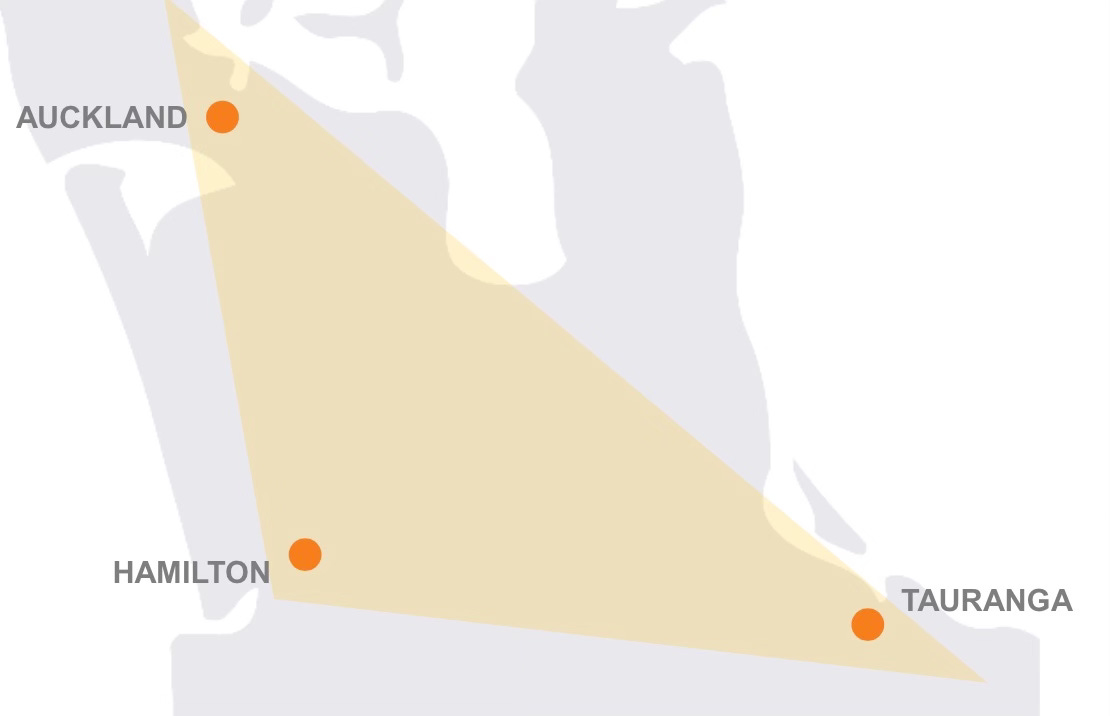
Aotearoa’s Golden Triangle. Image credit: KiwiRail
Some fun facts:
- The three cities of the Golden Triangle have a combined population of 2.141 million or 40 per cent of New Zealand’s population
- It is projected to grow by 35 per cent in the next 25 years
- It has 56 per cent of the nation’s freight movements
- It has more than half of the nation’s building consents
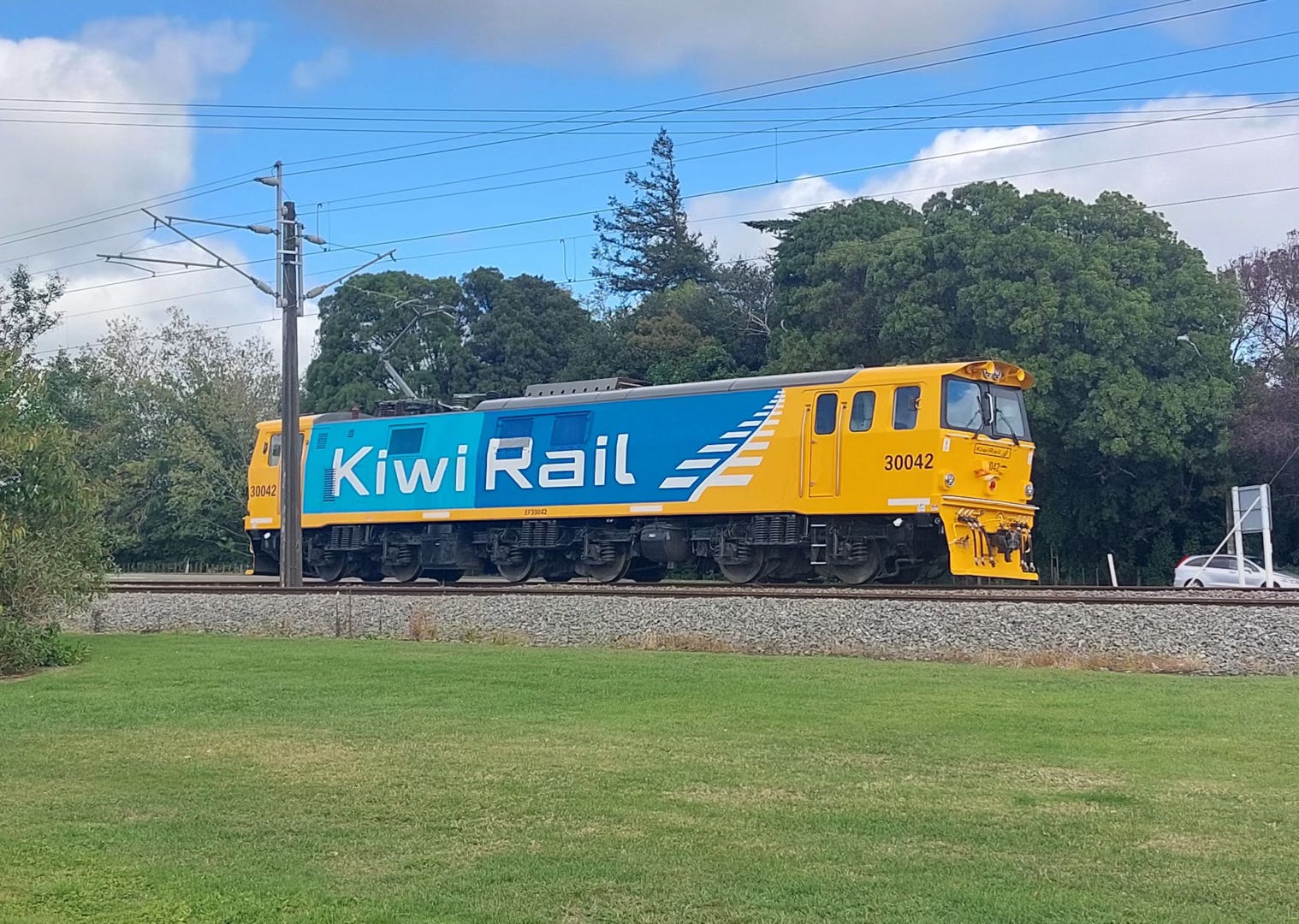
KiwiRail EF class electric locomotive. Image credit: DoctorFosterGloster CC BY 4.0
And one un-fun fact:
- One leg of the Golden Triangle, Tauranga, has no passenger rail
Roads the mode (at the moment)
From Auckland, the Southern Motorway extends 45 kilometres to the south and becomes the Waikato Expressway at the top of the Bombay Hills, the regional boundary between Auckland and the Waikato. From there, the Waikato Expressway stretches 101.4 kilometres as four lane dual carriageway to past Cambridge. On 22 September 2025, Waka Kotahi/ NZ Transport Agency was granted consent for a further 16 kilometre extension of the Waikato Expressway from its current terminus to the recently completed roundabout at the intersection of State Highway 1 and 29.
From this point, State Highway 29 heads east towards Tauranga as two-lane state highway with periodic passing lanes, including the steep ascent, peaking at around 450 metres above sea level, over the Kaimai Ranges towards Tauranga. At the Tauranga end, enabling works for an extensive upgrade of State Highway 29, including further four-laning, are underway in Tauriko.
But there’s rail too…
The North Island Main Trunk line extends 138 kilometres from Waitematā (formerly Britomart) Station in Auckland to Frankton Junction in Hamilton. It is double-tracked for this whole length, except through the Whangamarino Swamp and across the Ngāruawāhia Bridge, and tripled-tracked between Westfield and Wiri Junctions in Auckland. The first 52.3 kilometres from Waitematā Station to Pukekohe are electrified at 25kV AC as well as the two kilometre or so section from Te Rapa to Frankton Junction.
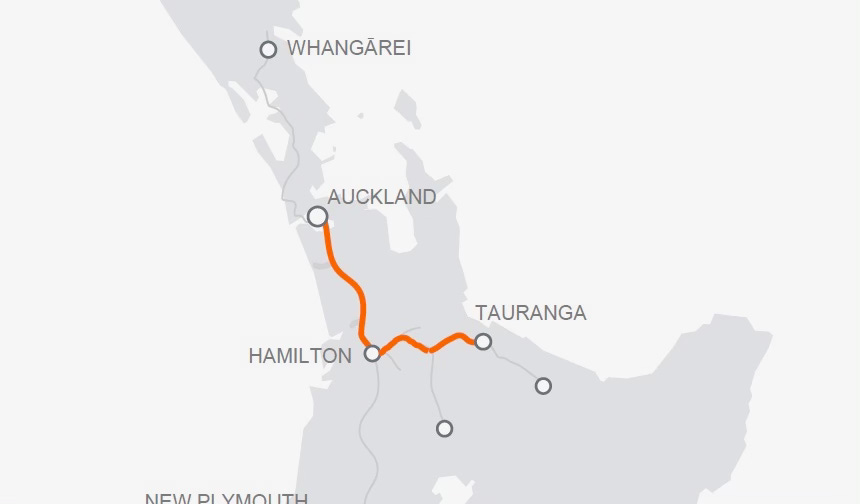
Golden Triangle rail. Image source: KiwiRail
From Frankton Junction, the unelectrified East Coast Main Trunk extends eastward to Tauranga, Mount Maunganui and beyond to Kawerau as single-track line with 11 passing loops between Hamilton and Tauranga. But unlike State Highway 29 which has to climb over the Kaimai Ranges, the East Coast Main Trunk goes under the Kaimais in Aotearoa’s longest rail tunnel at 8,896 metres long. This gives rail a significant advantage over road.
While rail dominates freight flows between Mount Maunganui/ Tauranga and Hamilton, the last time passenger trains ran east of Hamilton was the final run of the Kaimai Express on 7 October 2001.
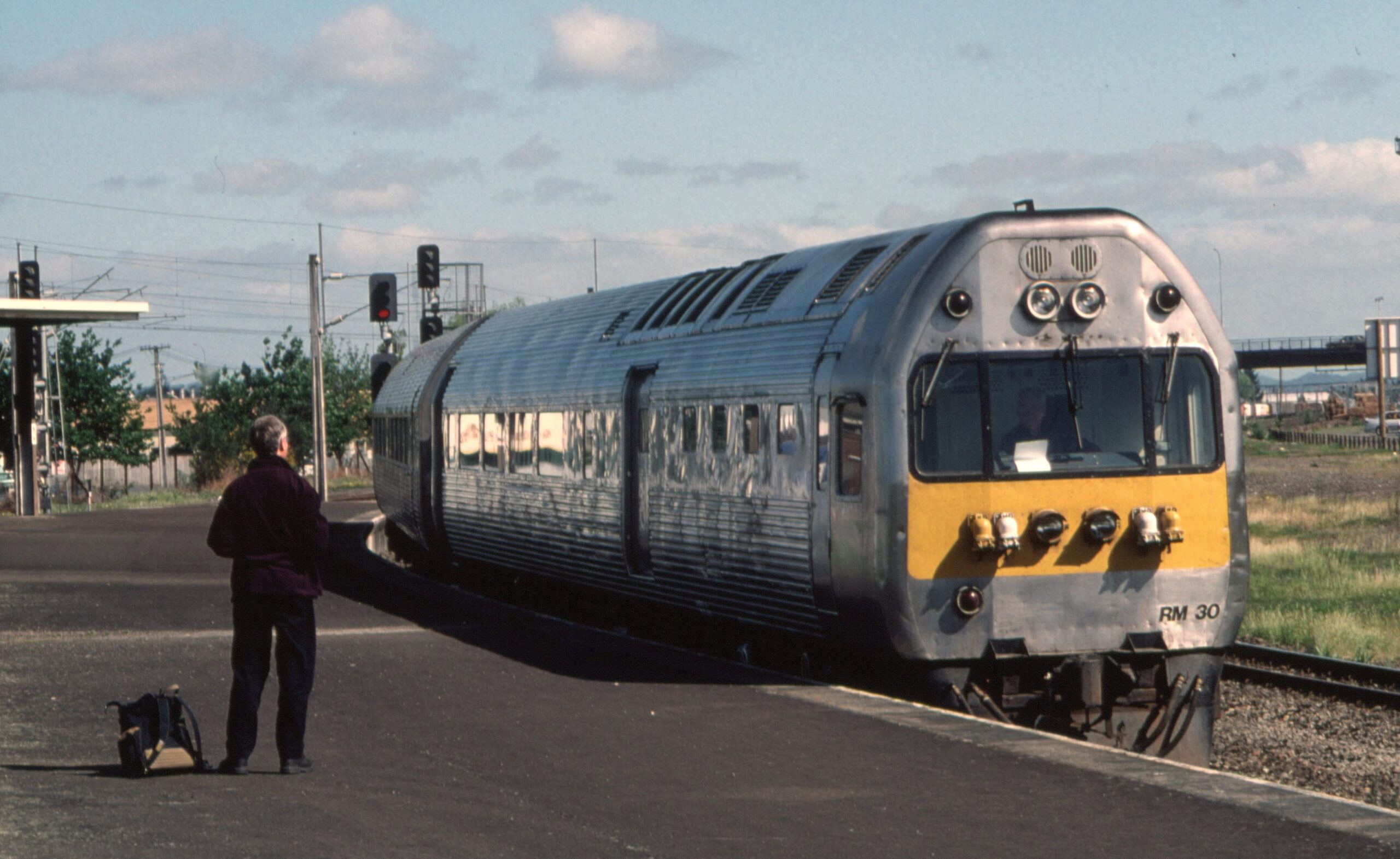
Kaimai Express at Hamilton Frankton Station. Image credit: Weston Langford Railway Photography, CC BY-ND 4.0
KiwiRail’s emerging thinking
- Install 25kV overhead wires and undertake other necessary infrastructure works to electrify the North Island Main Trunk between Pukekohe and Te Rapa in Hamilton
- In addition, some overhead wires may be required east of Hamilton to ensure that the electric hybrid locomotives have the necessary range and reliability to reach Tauranga and Mount Maunganui
- Install locomotive battery charges in key railway terminuses
- Undertake the procurement of the new EH locomotives
- These activities are expected to take 4 to 5 years from design to commissioning
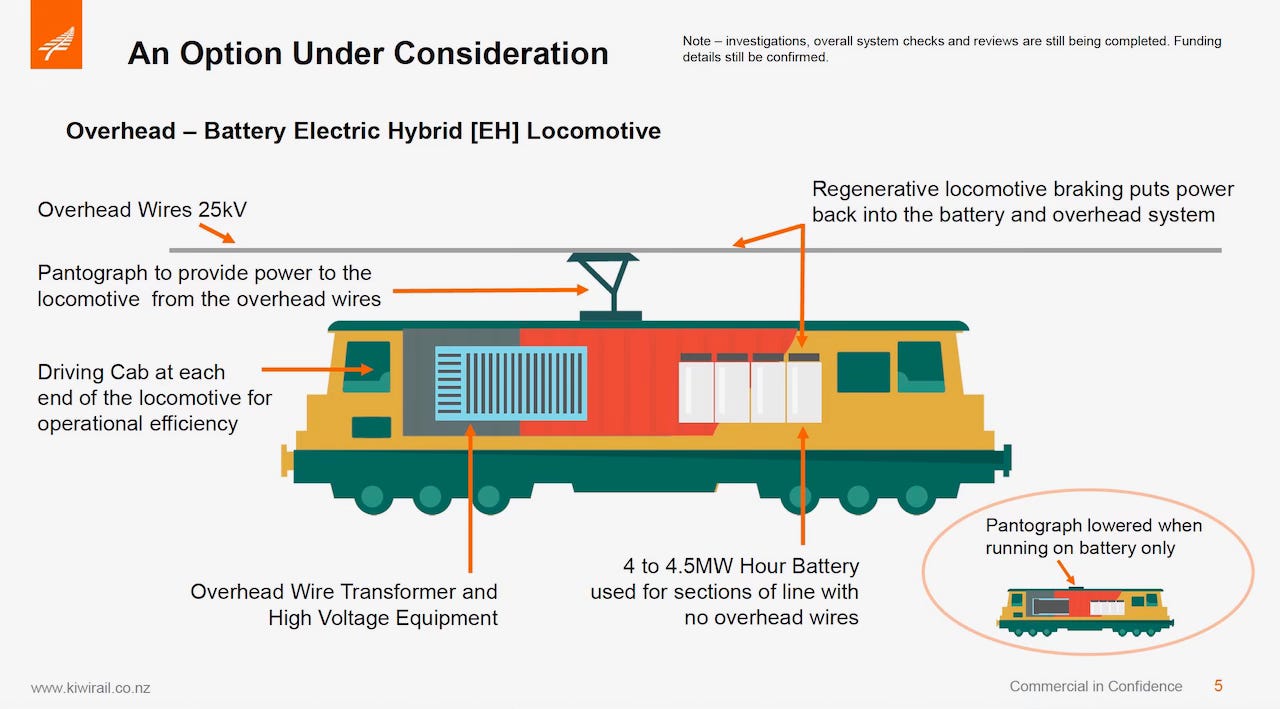
KiwiRail electrification option. Image source: KiwiRail presentation to Waikato Regional Land Transport Committee, 8th September 2025
This would enable is freight trains between Auckland and Tauranga use the overhead power between Auckland to Hamilton then run mostly on battery power between Hamilton and Tauranga with no requirement to change locomotive for the journey. While the train is unloaded and loaded in Tauranga the Electric Hybrid locomotive battery can be re-charged for the return journey to Hamilton.
This would mean that the entire North Island Main Trunk between Auckland and Palmerston North would be electrified at 25kV AC. And of course, Electric Multiple Auckland electric multiple units would be able to operate south of Pukekohe and hybrid electric passenger trains, similar to the bi-mode rolling stock being acquired for the Lower North Island would be able to run on the North Island Main Trunk to Palmerston North as well as in hybrid mode to Tauranga.
KiwiRail advises that the next steps are:
- Complete the Detailed Business Case by the end of 2025 to identify the best and preferred electric solution plus the staged delivery pathway
- After this it is expected that further work on the funding options will be discussed with key stakeholders. This will include exploring funding options for the delivery stages from within KiwiRail and potential Government budget bids.
- It is also likely that further technical work will be recommended on the preferred option to further increase confidence in the programme estimates and help narrow the risk contingency range.
Managed decline, except in the Golden Triangle
This information is interesting and potentially great news for the Golden Triangle of the Upper North Island. But if you read the fine print of the Rail Network Investment Programme, then the story for the rest of Aotearoa is rather more sobering:
These investment priorities over the next 3-year period are:
- improved efficiency and productivity of works delivery
- maintaining asset condition/service level ratings in Golden Triangle priority routes
- safety and compliance with minor decline in service levels (remaining priority network routes)
- safety and compliance with moderate decline in service levels (secondary routes)
- safety and compliance with significant decline in service levels (tertiary routes)
What this means is that only the Golden Triangle and Auckland and Wellington metro networks are being maintained at current levels. While the Golden Triangle are undoubtedly KiwiRail’s busiest rail freight routes, KiwiRail is a national network operator and the rail network is a national asset. The analogy of a state highway network only invested in the Upper North Island would be unthinkable and it should be equally unthinkable that only the subsection of the Upper North Island rail network in the Golden Triangle should be maintained at current levels.
The Whangamarino Swamp and the Ngāruawāhia Rail Bridge are the only single-tracked sections of the North Island Main Trunk between Auckland and Hamilton.
The curious case of the Whangamarino Swamp
According to Greater Auckland’s coverage of the issue:
[KiwiRail] said that more capacity could be created by slightly lengthening the passing loop in the middle and upgrading the signalling to allow for high-speed arrivals and departures and to simultaneously berth – which is the ability to have trains enter the swamp at about the same time from each end. This is something not possible with the existing signalling system, which dates from the 1960s. Elsewhere, more capacity could come from improvements like new or lengthened passing loops.
While we may be able to eke out some additional capacity by doing this, it would be hard to imagine the Waikato Expressway having a 12 kilometre long single lane bridge with a passing bay in the middle. This goes to show the huge disparity in thinking, and level of ambition, between roading and rail projects.
That said, the Whangamarino Wetlands are a highly sensitive environment with high ecological and Mana Whenua values. It is the second largest wetland complex of the North Island, encompassing a total area of more than 7200 hectares It is listed as a wetland of international importance under the Ramsar Convention.
It is located within the rohe of the Waikato-Tainui iwi (tribe) and is considered a taonga by local hapū. Early Māori utilised the wetland as a source of eel/tuna and birds for food, and flax/harakeke for traditional cultural purposes. The rivers of the wetland were used for travel and recreation and the peat margins were used to preserve taonga such as waka, tools and weapons. Dense vegetation inhibited further use of the wetland, although it was used as a sanctuary during the New Zealand Wars.
Given this, it is likely that a albeit not particularly cheap solution could be delivered that is better for the wetland than the current single-track corridor through the swamp, built in the days when environmental and Mana Whenua considerations were not exactly front of mind.
Final thoughts
Really just one final thought. While it’s great that serious consideration is being given to further rail electrification in the Upper North Island, it’s disturbing and a case of one step forward and ten steps back that this is taking place in the context of an effective return to the managed decline of the rest of Aotearoa’s rail network, harking back to the very bad old days of the asset stripping privatisation era.
This post, like all our work, is brought to you by the Greater Auckland crew and made possible by generous donations from our readers and fans. If you’d like to support our work, you can join our circle of supporters here, or support us on Substack!

 Processing...
The golden triangle is a bit overrated IMO. Sure it has a population of 2.141, but 1.7 million of that is Auckland.
Connecting the Central Isthmus “void” to Auckland City via a short bit of overground light rail would be used by thousands of people an hour and enable a compact city. Electrifying the full golden triangle and providing passenger services will be lucky to be used by thousands of people a day, will potentially compete with Auckland commuter services, and will enable sprawl.
We need to get the priorities right…
You would never justify electrifying the Golden Triangle based on passengers alone, however freight is the main justification for this electrification, passenger services just benefit from it.
The isthmus is also important but in reality electrification of the golden triangle is not stopping this happening. It’s resistance to making the changes to Dominion Rd that would be required for light rail to function properly.
That’s if you’re counting the urban areas only. Waikato Region has 500k and BOP has 360k and Auckland has 1.8m so 2.66m all up.
The managed decline of the rest of the rail network is especially odd when the government is spending a significant amount of money on rail enabled inter-island ferries.
Presumably Winston thinks even at the age of 80 he will outlast the current National led government?
National didn’t want to spend even on the rail ferries. The National Party line is trains in the Golden Triangle and Wellington commuters. Everything else close down. Tbf to Key though, he did rebuild the Kaikoura but after the quakes, which if Key had totally swallowed the Nat Party line that wouldn’t have happened nor CRL.
Thankfully (from a rail perspective) based on current polling Winston is going to have a stronger negotiating position if we do end up with a National let government.
The only urban rail I have ever heard him talk about is a Puhinui spur to the airport, where a bus-train transfer already exists. And he dropped that quick.
I really don’t think he has any desire to advance passenger rail. Its all about freight, as Kraut points out below.
And remember his absolute hatred for LRT in Auckland, though that may well because it was pushed by the Greens.
They could announce a billion dollars into horse racing and he would give thought to opposing it, just because they proposed it.
I’d still prefer he has a decent amount of influence in any coalition with National and ACT. Governments come and go, and managed decline can be turned around but without rail ferries it would likely have been the end of the South Island network.
Also getting Marsden Point built will be something that benefits Northland for decades.
“They could announce a billion dollars into horse racing and he would give thought to opposing it, just because they proposed it.”
“I am opposing this Green nanny state subsidy for horse racing – if New Zealanders want to enter a race derby in a Ford Ranger that should be their right, and we shouldn’t spend tax money on social engineering like this.”
Key can hardly take credit for that as most of the funding was from insurance.
Same applies for the whole “rockstar” economy… funded by insurance rebuilding Chch.
‘built in the days when environmental and Mana Whenua considerations were not exactly front of mind.’
Boy have I got news for you!
BEMUs now to get through the gap to Hamilton and into Waitemata.
Then when we have electrified to Hamilton, they can then be used all the way to Tauranga.
Absolute no brainer
I’d suggest someone speak to the Minister of Rail about it, but he only seems interested in rail-enabled Cook Strait ferries and a link at Northport. Nothing in between.
Very odd isn’t it, only interested in rail for freight in the countryside but presumably thinks urban rail transport is woke nonsense
You might manage to run a passenger BEMU off the wires at Pukekohe and reach Te Rapa, noting that the current distance run on batteries in Europe seems to be 100 – 120km unless you count this…. https://railway-news.com/gwr-battery-electric-train-achieves-world-record-with-200-miles-on-a-single-charge/. Hauling a 1000t plus freight train is a totally different thing…… one to watch and see, but I’m not aware of any long haul battery freight rail locomotive…
Electrifying between Pukekohe and Hamilton needs to happen for both freight and passenger rail, allowing Kiwirail freight to operate the proposed EH locomotives to Palmerston North, as you know, will be a major rail/road freight hub.
Since Kiwirail is introducing Stadler built DM Class locomotives in the South Island, I wouldn’t be surprised, Stadler is proposing the EH Class locomotives, be based on their EURO DuFour platform (https://www.stadlerrail.com/en/solutions/rolling-stock/locomotive-euro-dufour) as 25kva only or dual voltage (25kva and 1500v DC)/battery locomotives.
By the way, the proposed EH Locomotives can be used for the Northern Explorer passenger service.
This electrification proposal can only be justified by increasing the freight transportation between the 3 key cities in the triangle. If the upgrade can attract passenger services as well then that will be a positive.
I would like to see included in the plan an extension of the rail-track lowering in Hamilton from River Road through to Ruakura. With battery capability of the engines it would be possible to construct a “roof” over the lowered section which could then provide a safe pedestrian / cycle connection between Ruakura, Waikato University, Hamilton Boys High, and the CBD. The path might be a bus route to the Claudlands Bridge.
The level crossings at Grey Street and at Peachgrove Road are way past there use-by date!
Would be great to have a station in that area, maybe two, with one near the intersection with Te Aroha Street.
Hamilton to Palmerston North is electrified but most of the trains going through Te Kuiti are diesel.
Mainline passenger trains are for rich tourists, twice the cost of flying, why not railcars at frequent times catering for kiwis who would prefer rail than driving.
coals the answer… steam trains are the future…..
KiwiRail has not grown since its inception in 2008, due to investment being in infrastructure at the expense of volume growth. Now that the network is in good shape, this electrification plan is a way of continuing to spend billions whilst not growing volumes. It makes the politicians seem pro-rail when they are not.
The reason the world’s big freight railroads are not electrifying is because it comes with a huge opportunity cost. You can invest in “feel good” projects at the expense of growth, or you can invest in growth.
KiwiRail needs to get back to competing with trucks. Grow the rolling stock fleet and carry more freight. Spending billions to electrify with not a single tonne of freight gained is not something anyone pro-rail should support.
Electrification of the triangle makes sense – it is justified solely by freight movement. However the upgrade will improve the attraction for passenger services.
In addition to the improvements set out in the article serious consideration should be given to extending the rail lowering through Hamilton to remove the level crossings at Grey St and at Peachgrove Rd, both of which have gone past their us-by date. Consideration should also be given to roofing the lowered track to provide a walking / cycling & possibly bus link between University and the CBD.
KIwirail’s Golden Triangle electrification Programme (GTEP) for freight operations, helps in the re-introduction of regional ‘tap’ and travel regional passenger rail in the Waikato region between Hamilton, Pukekohe, Te Kuiti and Tokoroa. but also inter-regional passenger rail between Hamilton, Auckland, Tauranga, Rotorua (once the Rotorua branch line is reopened) and Palmerston North using a fleet of 5 carriage BEMU train sets based on Wellington’s ‘Tuhono’ production specification.
The ‘Tuhono’ train sets have a range up to 90kms under battery operation. The distance between Hamilton (Frankton) and Tauranga is 110kms. Under Kiwirail’s GTEP, it is proposed to electrified between Te Rapa and Ruakura which will meet the battery range between Hamilton and Tauranga which would rapid charge facility and slow overnight charging for freight.
With regards to Whangamarino Wetlands, under GTEP, the track between Pukekohe and Hamilton (Te Rapa) will be electrified, will have ETCS 2 (European Train Control System Level 2) allowing for higher train movements along the rail corridor and the single track through the Wetlands will remain, with the current passing loop being extended for longer freight trains.
Yeah it is a good plan. Wiring up to Ruakura is clearly sensible. OHL for freight all the way from AKL to Ruakura and Palmy.
Battery/OHL bimodes are great new technology for extending the benefits of electrification at a lower up-front cost.
On the face of it, however, maintaining the single track at Whangamarino looks like value engineering gone too far. Surely there’s benefits of sorting that section properly, once?
Otherwise very exciting.
Then Hamilton needs a city station with de-interlining of freight and pax. But as we learnt from AKL don’t try to do everything all at once, as it becomes too big and complex, too easy to oppose on cost (I guess that’s the thinking with Whangamarino?).
Patrick – As Darren pointed, Whangamarino Wetlands is a highly sensitive environment with high ecological and Mana Whenua values.
Kiwirail thinking, is to keep the existing single track with an extended passing loop to reduce any environmental and cultural issues that would happen if the Wetlands section is doubled track.
Hi Kris, yes, I understand that.
Double tracking offers the opportunity to do some restoration of the wetlands while undertaking that work, this is essentially the kind of work we (or at least used to?) do routinely at Waka Kotahi when upgrading State Highways.
We now have a far greater understanding of ecology of these places than we did when the line was first put in.
Adds to the cost, of course, but also increases the benefits (properly calculated).
I would imagine any upgrades would be bridged. but the real answer is to move it to the west , out of the wetland.
Yes, bring on more wires.
The sooner this piss poor Tory government are binned the better. I really can’t wait for the next election. I’ve never seen NZ in such a bad place economically, politically and socially.
*1987-93 enters the chat*
Seems that Willis is trying to be Ruth Richardson 2.0
Glad Kiwirail pursuing ‘Golden Triangle’ with actual electrical overhead wiring! But if Kiwirail is to go through.with this! It needs phase plan involving needing earthworks and construction work like with CRL!
Pukekohe – Te Rapa is going to need ‘passing loops’ for some parts of the track corridor. Some segments Pukekohe – Te Rapa need ‘passing loops’ as a line for freight trains like Rotokauri station, Ngaruawahia, Huntly Station, Te Kauwhata and will need main line track as a line for freight trains. For Pukekohe-Mercer it should be 3 tracked main line given gradient climb needed for freight train. This will allow more frequency without needs of slots/restrictions of passenger services of Auckland-Hamilton going forwards! The Te huia would be able to become a one hour or 30 mins service each day. Huntly station needs to become a ‘island platform station rather than the ‘side platform’. In Ngaruawahia, the bridge they’ve got is one tracked rail bridge and needs to be converted into a two tracked rail bridge. Also locals voice concern about converting bridge two tracked rail bridge, how we solve these issues is by getting rid of Old Taupiri Rd & Lower Hamilton Esplanade intersection and redesign the track location. Place shops where Old Taupiri Rd & Lower Hamilton Esplanade intersection located and place housing behind the shops/rail-line. With it, Galbraith Street will need to relocate their houses right next-to the rail corridor instead of infant of grass embarkment. Higher fencing/ steel grounded fence needed underneath bridge required currently the cause of issue of why kids jump from the bridge during summer months.
As for extending to Tauranga, in 20 years time or less, it won’t be possible to service a unless East Coast Main Trunk become two tracked rail where most of it is one tracked with ‘multiple passing loop’ tracks where trains have to wait for another pass each other. Also there’s fact 63 trains a week passed under Hamilton, 90 of them on weekday nights, or evenings, 37 at weekends and 36 between 8am and 5pm, Monday to Friday. Meaning 38 trains a day meaning operating passenger service to Tauranga currently not possible unless funding to eliminate ‘passing loop’ and convert it into a two line main trunk. Also Kaimai tunnel will need to be converted into a two tracked tunnel.
The Kaimai tunnel can handle 96 tpd with the right signalling, it wont need duplication for decades.
45 TPH each way on bidirectional on a one line track? Get real! That’s not even possible by far! The trains would be on collision course.
Day =/= hour. That’s 4 trains an hour, or 2 each way. Feels like it could be increased by running 2 trains going in the same direction behind each other as well rather than alternating.
96 tpd is 4tph or 2tph each direction, easy for a ~9km section of single track.
96 tph on a 120km long single track with lots of passing loops, that’s a recipe for collision! Also you got tph wrong for 30 mins of train actually running bidirectionally, it be 9-10 tph given the distance from Hamilton-Tauranga To add more services on the route isn’t realistically practical in the ‘real world’ unless you’re in the ‘upside down world’! Twin track for Eastern Main Line Trunk very much needed for passenger service to commence firstly with second Kaimai tunnel before think about twin track!
Agree 96 tpd (not tph) wouldn’t work on a 120km section of track but that’s not what I said.
However, if you had any reading comprehension you would have understood I was talking about the 9km long Kaimai tunnel. The rest of the track would likely need double tracking, but I’ve already mentioned that.
Also, why on earth would you double track the most expensive bit (the Kaimai tunnel) first.
Unless of course you just happened to be a troll…
Anon – Under the ‘Waikato Regional Passenger Rail’ initiative, the plan is for 16 intra/inter regional ‘tap’ and travel passenger train services per day passing through Hamilton (Rotokauri, Frankton, Central, Ruakura), made up of 8 regional services between Auckland (Pukekohe) or Auckland (Puhinui, if the 3rd platform is built on the 3rd mail line), Hamilton, Te Kuiti and Tokoroa and 8 inter-regional services between Auckland (Britomart), Hamilton, Tauranga and Rotorua.
There is no need for a ‘passing loop’ at Te Rapa and there is spare track capacity at the maintenance depot and freight handling yards,
Under Kiwirail’s Golden Triangle Electrification Programme, high capacity train control between Pukekohe and Hamilton is planned to allow for increase train movements along the rail corridor. The new EH locomotives and the planned BEMU passenger train sets will be fitted with the necessary systems for increased train movements.
“‘Waikato Regional Passenger Rail’ initiative”
What bogus is this?!
And you say its currently serviceable to operate 8 passenger trains per day on the Eastern Main Line Trunk with 34 Freight Trains daily operating ?
https://www.youtube.com/watch?v=UFmvaRWQpO8
“the plan is for 16 intra/inter regional ‘tap’”
Should operate hourly service from 4 am – 8 pm from Hamilton – Auckland Hamilton should be main priority right now and get on with installing ‘passing loop” for freight trains at certain stations due to more weight in Freight trains resulting it moving slower speeds on gradient climbs than passenger rail. Right now Hamilton- Auckland can’t run due freight trains running between this corridor every 30 mins. Running 8 TPH per day won’t be possible unless theirs installation of ‘Passing loop” since the Te Huia would be forced to travel even slower speeds due to freight train ahead and no way of passing freight, Passing loop” very much needed! .
Tauranga should be focused in 10 years time until there’s funding for second Kaimai tunnel first. Once there’s second tunnel, you’ll be able think about track upgrades & installation of twin track for Eastern Main Line Trunk.
“There is no need for a ‘passing loop’ at Te Rapa”
That track is not serviceable currently due to maintenance works done to it!
As per my comment above, there is plenty of capacity left in the Kaimai tunnel. A second tunnel is the last step in increasing capacity on this line, after increased passing loops, better signalling and ultimately double tracking the rest of the line.
Anon – The ‘Waikato Regional Passenger Rail’ initiative is the re-introduction of intra/inter-regional passenger train services in the Waikato region and lessor extent the Bay of Plenty region (Tauranga and Rotorua).
The ‘ 8 passenger trains per day on the Eastern Main Line Trunk’ is 8 daily inter-regional passenger (excluding freight) train services , operating between Auckland (Britomart), Hamilton (Rotokauri, Frankton, Central, Ruakura), Tauranga and Rotorua using 5 carriage, bi power mode, bi directional passenger train sets.
With regards to ‘Tap’ refers to Motu Move – the national contactless payment system that is being introduced across the 13 regions that have public transport services.
“The ‘Waikato Regional Passenger Rail’ initiative”
Laughable and hasn’t even been created and non-existent! Get in the ‘Real world’! Not some fantasy land! Just another misinformant!
yeahhhh anon we’re really not going to trust you on that one when you think that the avondale-southdown line has “already been paid for” (it hasn’t, $6 billion is the projected construction cost) or that suburban heavy rail can instantly accelerate from standing to 110kph for stations 1km or closer apart (not physically possible)
you could quibble about the details of the Waikato passenger rail initiative but this is just childish
+ 1
“+1ing” your own comments just makes you look desperate bro,
So getting Auckland Tauranga hourly and Auckland Hamilton, passenger rail is such a massively expensive project, we shouldn’t even contemplate doing anything?
That was the thinking, behind the decades of decline of suburban rail in Auckland, until an opportune purchase of a second hand fleet of diesel multiple units from Perth.
Britomart station , double tracking the western line, electrification and the crl, projects were all initially opposed by the governments and councils of the day, as being unaffordable. Without the incremental progress of these projects Auckland would have now been blighted by hugely more multilane roads and square kilometres of carparking. And congestion.
The reality is that regional passenger service in the Golden Triangle is never going to be viable without metro services in Hamilton and Tauranga first.
Personally, I’d prefer to bypass Hamilton entirely. Once the Ports of Auckland are gone, freight movements between Auckland and Tauranga are going to increase substantially. A new line between Drury via Bombay and Te Aroha would be much more beneficial to the network when Whangamarino will always be a chokepoint on the NIMT. It would provide a much straighter alignment and could increase the viability of passenger services between Auckland and Tauranga.
Te Aroha could be an interchange with the right of way restored to Morrinsville and would provide greater incentive to invest in Hamilton commuter services than a regional connection between Hamilton and Tauranga.
What metro services are you thinking of? Hamilton is only really long enough to have 4 or 5 stations from one end of the city to the other, which isn’t going to sustain a metro service.
And the champion for getting rid of the port Auckland is now championing it’s retention. https://ourauckland.aucklandcouncil.govt.nz/media-centre/2025/july/tripartite-accord-positive-step-for-auckland/
yeah i feel like at this rate moving the port is never going to happen
expanding northport to free up Captain Cook Marsden and eventually Bledisloe wharves? maybe. but building a new port and associated infrastructure out near Orere Point, or dredging the Manukau for a port near the airport seems too big for any govt to want to commit to it
I think any move of the Port is definitely off in the medium term, given the Accord and PoA committing to a billion dollars a year return to AC.
But we have got Captain Cook and Marsden wharves back. Apparently some of Bledisloe will be available a part of moving some cruise facilities there. And I think its likely Queens Wharf will see a spruce up, starting with removal of The Cloud.
Overall it seems a good result.
In my view any thorough upper North Island ports study is likely to conclude a three-port strategy is best: Mt Maunagnui/AKL/Marsden
For resilience and capacity for growth in whole golden triangle + Northland. Covid proved the value of a third port for the region, and with a rail connection it is the same distance as the Mt from AKL, but also will, as BoP has and is, be able to help develop Northland’s own business.
So I don’t think it’s about ‘moving’ the port, but about right-sizing AKL and and the Mount (both are spatially constrained), and growing Marsden, especially via rail connection, and port facilities.
AKL will continue to concentrate eastwards, through efficiency and volume growth in Northland.
If any passenger train services were to make it back to the Bay of Plenty, it may be preferable to call the train as going to Mount Maunganui/ Papamoa. 36percent & growing of the population lives on the eastern side of town. Perhaps more of the potential train user demographic lives over that side and further south. Many locals actively avoid the downtown Tauranga area. Perma-coughs etc discourage local bay bus use that could potentially link to a Hamilton to Papamoa train. Vehicle driving healthy relatives/ friends would be a 1st choice of home to a Bay rail station, then taxi/ rideshare etc.
Modern Battery locomotives still seem to be beta technology. ‘Cando Rail and Terminals’ has built a battery electric locomotive for yard use, the battery is expected to last 10 years. The Wabtec FLX 2.0 battery electric locomotives used in the Pilbara (Australia) use NMC batteries, the Pilbara is not known for long underground ore train rail tunnels. Wabtec is moving onto NMCA batteries for the 2.5 edition. Stadler used lithium titanate battery power for the UK’s hybrid Class 93 locomotives. Aurizon (Australia) has not started battery tender on-rail trials yet. The way I interpret the current locomotive battery chemistry and early FLX issues. I would install electric overheads between Kereone and Te Puna Station (44 kilometres, less than 50 percent of the Frankton to Mount Maunganui port route) with no locomotive battery charging or depletion use until the Kaimai Tunnel is exited. There would be a battery cool down distance, prior to a BEL (battery electric locomotive) entering the Kaimai Tunnel, some serious initial battery temperature etc checks at Wardville and Apata and secondary battery checks before entering the Kaimai Tunnel Portals.
Alternatives – The Yutong Electric coach buses with Ember Transport in Scotland can do 480km on a single charge (carry 53 passengers). Hamilton(NZ) only has 2.5 km of bus lane, that at present would not overly speed an electric bus (out of Hamilton) from Rotokauri Transport hub to Mount Maunganui.(via Karapiro, Matamata etc)
Heart Aerospace ES30 electric plane (30 seater) is in New York state at an airport but is being rigorously tested on the ground before any test flights.