We hope everyone had a good week after the long weekend – here’s a few things that caught our eye to cap off October!
This Week in Greater Auckland
- On Tuesday we had a guest post from Tim Adriaansen asking if electric cars are a climate solution.
- On Wednesday, Matt had some More Thoughts on MOAR RoNS.
- On Thursday, Patrick took a look at the success of urban renewal in Manchester.
This roundup, like all our work, is brought to you by the Greater Auckland crew and made possible by generous donations from our readers and fans. If you’d like to support our work, you can join our circle of supporters here, or support us on Substack.
Nocturnalists interview – Optimism and excitement!
Fantastic interview in the Spinoff’s “Nocturnalists” series talking to people from Auckland’s night-time scene: Emma Gleason had a chat with owner and chef of Pici Jono Thevenard. Awesome to see some optimism on the transformation Auckland is going through!
How do you feel about Auckland’s vibe shift?
It’s been so great to see the city revitalised. I feel like, the way the whole city has been completely dug up and our whole culture here revolves around cars, that we’re in a real growing-pain period where there’s nowhere to park, but the travel infrastructure is about to be upgraded. And the economy has been struggling. But I just feel like we had to do it. We had to break a few eggs to make an omelette, and we’re about to get served that omelette. And I tell you what, the city is just smelling it and going “pleeeeease”.
Not to mention excitement for CRL:
I can’t wait to get that train up K’ Road.
I think it’s going to be great. And apparently the trains are going to go late into the night.
Because that’s critical, having that late train, so you know you can get home.
Exactly. People can just zoom into the city. And it’s only going to be a few minutes from Britomart up to here.
And the fact there’s a station up here just spitting people out on Pitt Street and Mercury Lane, it will be so different.
I think the one constant of K’ Road is that it’s always changing.
Keeping connected in CRL
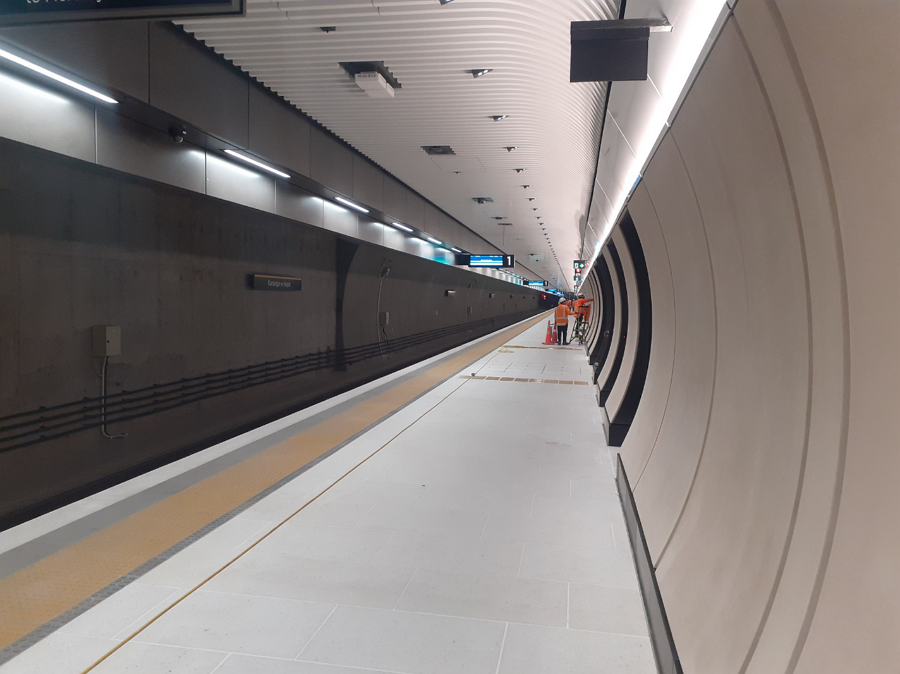
Speaking of the CRL, the covers have started coming off at Karanga-a-Hape, giving an unobstructed view of the platforms.
Over the long weekend, during a scheduled rail network closure, the construction coverings and equipment at Karanga-a-Hape Station were finally peeled away, revealing the stunning finished platforms for the very first time. The before-and-after images speak for themselves—the change is dramatic, and it’s a thrilling glimpse of what’s to come.
This milestone marks another major step toward opening day, with the platforms officially handed over to KiwiRail as part of the staged handover process. Although the platforms may now look ready, there is still a considerable amount of testing and commissioning to be done before passengers can ride the trains in 2026.
Floor protection was removed to uncover the finished terrazzo tiles, while temporary fencing, mesh, sandbags and plastic ballast weights were also cleared away. These items had previously taken up more than a metre of space along the platform edge, so the transformation means the platforms feel wider, cleaner and more open.
And while you’re in the tunnels, there’ll be full cell coverage – with One NZ and Nokia installing infrastructure that will be used by all mobile operators to provider 4G and 5G coverage. According to the press release, it seems like quite a bit of work has been going into this:
Although cell coverage above ground is widespread thanks to cell towers, establishing it underground poses significant challenges. Solid materials such as concrete, steel, and earth used to build the CRL make it harder to provide consistent wireless connections.
The work involves the installation of a large amount of sophisticated hardware and software – over 350 radio transmitters connected by 74 kilometres of cabling, and 30 kilometres of leaky feeders (cables that transmit radio frequencies) – to ensure mobile coverage throughout the CRL tunnels and stations. Installation will continue into early next year and full coverage is expected when CRL opens in 2026.
Together, City Rail Link Ltd, Auckland Transport and KiwiRail are ensuring Auckland’s new world-class railway is ready to provide safe, reliable, and seamless journeys for passengers. There is still a significant amount of work to go, but the project is on track for opening in 2026.
Check out the video:
National flood data released
Earth Sciences New Zealand has just released a national model of flood risk. Per RNZs report:
The researchers involved hope the information will guide better decisions about where to prioritise climate adaptation – and where to avoid future development.
The data shows that nationwide, 750,000 people, or 15 percent of the population, are already at risk from a major rainfall or river flooding event – one that has a one in 100 chance of occurring in any given year. The number of people exposed rises steadily to more than 900,000 with 3°C of warming.
The data also includes the number and value of buildings exposed, and other crucial infrastructure, such as thousands of kilometres of roads and stormwater pipes, that are at risk.
$235 billion of buildings are exposed at the moment, rising to $288bn with an additional 3°C of warming.
You can check out the map viewer here, and it includes projections based on the outcomes of different degrees of temperature increase due to climate change.
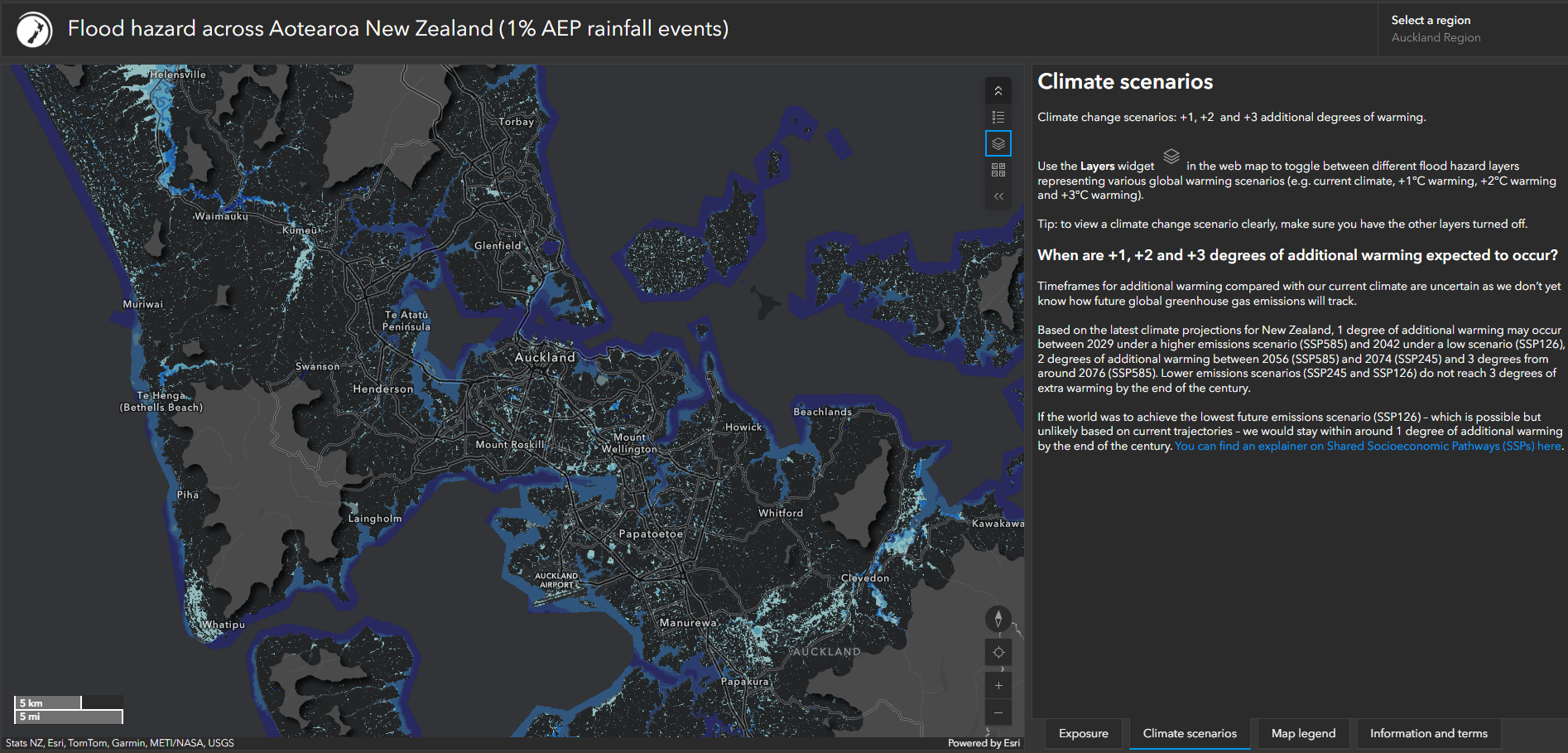
Flood modelling for Auckland, based on a 1°C temperature increase (which we’ve already passed)
Housing Direction
Last month, Auckland Council voted to withdraw Plan Change 78 – which implemented the Medium Density Residential Standards – and replace it with Plan Change 120.
Consultation on the new plan change opens next week, but this week Minister Chris Bishop has provided additional direction on the process that follows. The third paragraph is particularly interesting (emphasis added).
“Public submissions will be open from 3 November to 19 December 2025, followed by hearings in 2026 overseen by a panel with a minimum of eight and maximum of nine members. Four members will be appointed by Ministers, with the remaining members to be appointed by the Council. Ministers are working with the Council on who the Council will appoint as Chair.
“As I have said many times, it is important that Aucklanders have robust opportunities to participate in this important process. The Council itself has asked for a transparent process, and that’s exactly what we’re committed to delivering.
“Ministers have also issued a formal statement of expectations for PC120, which asks the hearings panel and Council to consider whether PC120 provisions unduly frustrate development, to test the appropriate distribution of housing capacity (including greenfield development), and to look at whether all planned rapid transit stops have been identified (including the Northwest Busway).
“We’ve consulted with Auckland Council on the draft direction and statement of expectations and refined these in response to some of the feedback. The Government has declined the request of the Council to remove the reference to greenfield development in the statement of expectations.
Electric Bus Misinfo
Last week a bus driver tragically lost his life as a result of a fire following a crash with a car. Sean Cleary is being remembered as a positive person, who “disproved the ‘old grumpy bus driver’ stereotype with his helpful and caring nature” and was “an exceptionally kind colleague, always willing to lend a hand”.
It’s now been confirmed that the fire wasn’t caused by the electric bus. But that didn’t stop a lot of anti-EV misinformation being spread, and fast. Councillor Richard Hills has called that out:
North Shore councillor Richard Hills said he was saddened to see misinformation about the incident and the “bizarre anti-EV propaganda” on social media.
He took to social media to reassure people that catching a public bus was perfectly safe.
“Just like all types of vehicles, there will be times we sadly have EV bus collisions and / or fires, and we know batteries can be harder to put out,” Hills said. “That’s why there are fire safety systems and technology built in and around the batteries.”
…..
A spokesperson for Fire and Emergency confirmed the fire started in the car’s engine.
Bus operator Kinetic said an investigation found the batteries in the bus were undamaged and not a factor in the blaze.
Hills said it was important that people remained confident about getting on a bus, and said data from the UK, America and Australia showed electric vehicles were far less likely to catch fire than petrol vehicles, although both were very unlikely.
Parking Enforcement
A classic parking fine article popped up this week in the NZ Herald and it was good to see AT not shying away from the conversation:
The amount of drivers pinged annually by Auckland Transport’s licence plate-recognition vehicles has almost doubled.
Data provided to Newstalk ZB shows the licence plate recognition vehicles issued more than 518,000 fines last year.
That’s almost twice as many as the 261,713 fines they gave out in 2023.
…..
Parking Services group manager John Strawbridge said the rise was because the fleet increased from nine cars in 2023 to 16 last year.
He said the most common type of infringement is failing to pay for parking in paid zones.
“That’s a $70 fine. It does my head in because if you use the AT Park app, for example, you only pay for the short time you’re there.”
…..
Strawbridge said while no one likes getting a parking fine, there needs to be a way to manage kerbs and other spots.
“If we didn’t manage the kerbside, there’d be cars parked everywhere, it would be unsafe, and there’d be very limited opportunity for people to come into the city and find a spot,” he said.
The Mayor has been quite keen on AT increasing its enforcement activities to help reduce pressure on ratepayers, and maybe next time it would be good for AT to remind readers of this?
Also it’s worth noting that last year the government finally increased parking fines, having not done so for around 25 years. Along with the doubling of the detection fleet, this will play some part in the recent increase in income recouped.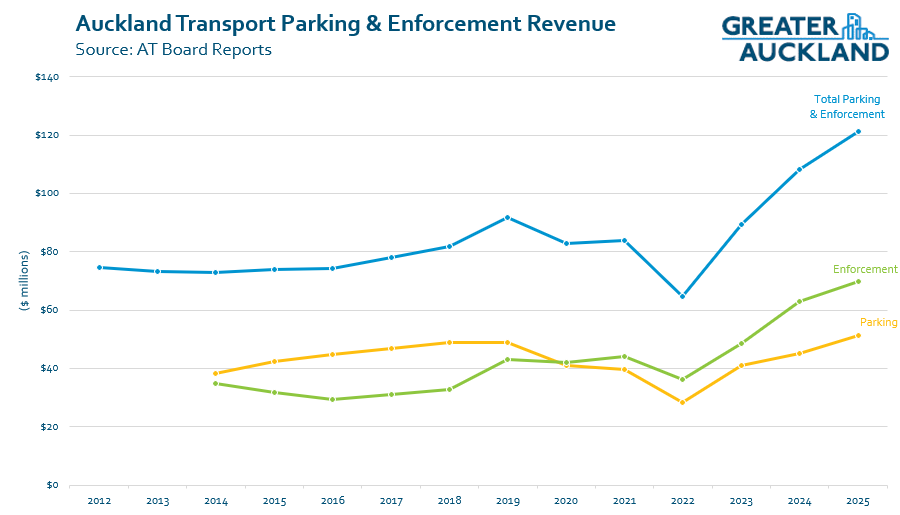
“So You’ve Got a Crappy New Council, Now What?” Training Webinar
If you want to get some tips on how to lobby councils for more climate action, 350 Aotearoa is running a webinar on the 12th November. Check it out here.
As a follow up to our successful “Draw the Line on crappy local politics” campaign, our newest training will cover:
—Figuring out the priority areas for your newly elected council.
—Tips on how to lobby that new local council for increasing climate action in your community.
—Lessons from previous climate campaigns which have targeted local govt/councils
—Effective story and narratives that you can use when talking with others in your community about climate action opportunities.
RSVP before Monday 10 November. All welcome, no prior experience needed.
Check out this time lapse of Grafton Gully
From the socials
Some timely and alarming stats about local road safety at Halloween from Prof Tim Welch. Whether you celebrate or nah, one of the magical things about it – aside from the sheer fun – is the way it shines a spotlight on the value of safe streets. Kids should be able to confidently roam their own neighbourhoods every day of the year.
Happy Halloween! The scariest thing about tonight isn't the costumes, it's the road safety stats.Halloween sees a 30% spike in crashes involving people walking or cycling w/ 1/3 of these crashes between 4-8pm, peak trick-or-treating hours.Drivers: slow down tonight so everyone gets home safe.
In just over a week, the National Ticketing System will go live in Canterbury:
#BREAKING #TicketingNews: Metro Canterbury has announced that, from November 10, the Motu Move contactless payment system will go live across all Metro buses and ferries.Passengers will be able to tag on with debit or credit card, phone, or smartwatch to pay for standard adult fares
— NZ Transit Buzz (@nztransitbuzz.bsky.social) 2025-10-29T21:33:35.093Z
Lots of discussion of the heavy load that the planned RoNS place on our future:
This is quite literally the future National wants.
— Russell Brown (@publicaddress.bsky.social) 2025-10-27T20:09:16.535Z
A delightful story of a city-creator, working in cardboard and found materials:
View this post on Instagram
Our old mate Chris Dews is back at the canvas, daylighting the natural history and future potential of Queen St:
View this post on Instagram
Some interesting videos for your viewing pleasure!
That’s it from us this week! Happy Halloween, enjoy the streets filled with happy children and let’s keep doing whatever makes it possible for everyone to feel that free, every day of the year.

 Processing...
K’rd station looks fabulous, but can anyone explain why platform screen doors were not part of the design of all the new stations? Do the stations have anti-suicide pits under the tracks? Ending it all by throwing yourself in front of a train isn’t exactly unknown, and apart from the easily preventable human cost the network disruption is considerable. And of course, if you really want wreck public enthusiasm in the use of PT you just need someone to murdered by being pushed in a front of train.
They left room for platform screen doors in future, but in order to use them you need some level of Automatic Train Control that we don’t currently have.
Perfectly plausible to retrofit it on (and probably necessary in future) but that’s more money/complexity/arguments with drivers unions/risk etc. on a project that’s already burdened with a lot of cost and risk.
PSDs without ATC are possible. Not ideal, true, but definitely possible.
(Line 3 of St.Petersburg metro, Russia, has been doing this since 1967.)
I came here to say this. There are two main benefits to Platform Screen Doors.
1. Management of station air temperature – when you have a huge piston running in and out of the station (the train) all the warm or cooled air is pumped out of the station. You can literally feel the air movements as you enter the station from ground level. This is a huge waste of energy and money – this is the reason Platform Screen Doors pay for themselves.
2. Increases the capacity of the station platforms because people can queue closer to the edge of the platform. The safe space formed by the glass makes this possible. (obviously other life safety reasons). It’s frankly a bit scary visiting older systems without Platform Screen Doors at crush hour.
Not including platform screen doors from the beginning will prove expensive as a retro-fit process – I hope they’ve designed and built in all the necessary support structures already. If it is a signalling issue – get the signalling system needed for it to be implemented. Very short sighted. We always designed these into the systems I worked on – factor 2 being most important during the design process as we could build smaller cheaper underground stations for the expected capacity. And smaller MVAC plant systems needed for all station types.
More info here: –
https://www.researchgate.net/publication/325937164_Effects_of_platform_screen_doors_on_the_overall_railway_system
Auckland’s “crush hour” is probably less than a big city’s off peak.
I haven’t been to London recently, but when I was last there only one line had some (Victoria Line I believe). I don’t recall seeing any in Tokyo. If they didn’t need it I can’t see why we would.
Ah Jimbo then you didnt look proper. Tokyo has plenty of these, especially at busy stations. A quick google sees that they started refitting their metro in 1991 with them.
Its a given that we should have them. Accidents and sadly suicides will now shut down the entire system. For events we will see a constant limit on the number of people that can, safely, be on the platforms simultaneously etc.
Amateurish not to include them and that decision just reenforces the view that too many that work with infrastructure in NZ are complete numpties. Can we hire japanese/singaporean managers from now on so we get the basics right.
I was in Tokyo early in the year and every metro station and amost all of the above ground stations I saw had them.
“If it is a signalling issue – get the signalling system needed for it to be implemented. Very short sighted.”
Can you give us a billion and a half dollars to do that then please?
The Government has undermined the ultimate point of PC120. The exact wording in the expectations is:
“consideration is given to testing the appropriate distribution of housing capacity, including enabling greenfield development”
Enabling it!
Intensification, in whatever shape or form we decide on, must be intended to halt greenfields development.
Auckland’s hope is in improving each part of the city now. Improving access, improving infrastructure, improving liveability.
In declining Council’s request on this, the government has ensured our rates revenue and infrastructure builds will be wasted on enabling sprawl. They are serving the climate-denying sprawl-development-banking-roading-car complex.
No surprises there, I suppose.
Time to get going on submissions. There will be some greenfields development. The questions are, how much and when? There is a real need to “duly frustrate” cheapskate developers who don’t want to follow Council’s sequence of infrastructure development, to the extent of leaving residents reliant on “night soil” tankers.
And protection of productive soils to avoid starvation should be part of this.
Golf courses can move back to the links that will be subject to flooding and coastal inundation (see maps above) where the “good walk spoiled” originated.
I’d argue that enabling both sprawl and density allows people to choose what they want. As long as the sprawl isn’t subsidised that is – if you choose to live in the middle of no where then don’t expect the council/government to build you a motorway or train line.
What would be even better is if we had multiple council’s in Auckland. Then the one close to the city (lets call it Auckland City Council) could spend all its ratepayer money on density projects, and the other councils could spend their money on sprawl projects.
All sprawl is subsidised. And the choice to live in a standalone home is already available.
To achieve the ideal balance between home types, it is critical we create good density, and that we halt sprawl.
The choice to live in “density” is also available – in fact there is probably more of them for rent/sale.
If we really want to create density we need to improve the PT close to the city to make it more attractive. Yet almost all the transport budget goes to sprawl, while the central areas have the same roads and buses they always had.
A single council was always going to create that outcome – fix the existing problem (sprawl traffic) instead of encouraging the solution (live closer).
Overheard coworkers in my office talking, exclaiming about traffic from the bus incident and they specifically said “there was an electric bus crash.” I hadn’t heard about it but I wondered at the time why they didn’t just say “a bus crash.” Saw the article later.
As someone interested in how words shape perspectives and the spread of misinformation, it was a jarring example of how these things slip through and shape people’s reality.
There absolutely must be some fossil-fuelled lobbyists leaning on news organisations to bang the “EVs Catch Fire” drum. Or sponsoring them, Or bribing them.
Today Richard Hills has a good Facebook post explaining what exactly caught fire (the tankful of inflammable liquid) and it is full of dipshit tinfoil-hatted comments saying: “oF c0uR5e tH4t’s WhAt th3y WANT u 2 th1nk!!!!111”
There is really no point trying to reason with people who are determined to ignore actual facts and portray everything they don’t understand as a “conspiracy”.
Mmm. Take a look at this article, too: https://www.rnz.co.nz/news/country/577287/storms-knocked-out-virtual-farm-fences
The fences were not knocked out, as it says later in the article.
So what makes RNZ lead with misinformation in the title and opening paragraph?
RNZ should be above running beat-up headlines designed to make progressive change harder. Those virtual fences are a game-chamber for regenerative agriculture.
Also, the photo of the shelterbelt trees is old. The root plate of those trees doesn’t fit between the fence and fallen trees, there are no craters shown. The line in the grass (change in colour) shows the extent of the former craters. the fenceline was installed after the event. The growth on the trees is dead.
Really poor.
Yes, really bad. Ready to pounce on the thought that there is bad e-vehicle battery danger crisis. Not to mention that dangerous PT, better bit catch a bus with a stranger.
* not catch
They did the same with the bus that crashed into New Lynn station, the fact it was one of the third of the fleet that are electric was irrelevant. The media also referred to “smoke” coming from that bus’s roof, suggesting it had a battery fire (afaik there are no batteries in the roof, just the aircon unit).
Interesting that they were so worried about the concrete arch on Grafton Bridge failing when it was built that they didn’t pay the contractor but it was the approaches either side that started to fail.
Parking revenue. $50m from honest customers, $70m from cheats.
Imagine if Grafton Gully hadn’t had a motorway rammed through it but instead had been retained and developed as a public park; a green lung on the edge of the city like Christchurch’s Hagley Park (but with more interesting views).
With gently sloping paths leading into the valley, it would connect Aucklanders with nature, the mountains with the sea and and city with its suburbs. It would be a place to run, to cycle, to sit and relax in the birdsong; a true symbol of the best of Aotearoa.
The best-case scenario could be like Barcelona’s Park Güell, designed not by Antoni Gaudí but Friedensreich Hundertwasser.
https://en.wikipedia.org/wiki/Park_G%C3%BCell
The future belongs to those who believe in the beauty of their dreams.
I am not sure if someone who writes for Greater Auckland can comment, it’s in regards to the Roads of National Significance project Petone to Grenada and Cross Valley Link.
The project itself is not only expensive but it is running into opposition from the community in Lower Hutt including suburbs such as Petone, Korokoro, Woburn, Moera and Alicetown and including suburbs under WCC jurisdiction such as Grenada, Tawa and Johnsonville
In Lower Hutt residents in the following affected suburbs are not only worried but oppose the Cross Valley Link:
– Woburn, Moera, Alicetown, Petone, Seaview and Korokoro, streets and roads such as Hutt Rd, Wakefield St, Whites Line West, Randwick Rd will become main arterial routes bringing in more traffic into the area and in the initial designs, the roads are up for widening and there is serious opposition from residents who are potentially living in both sides and the majority of the residents are retired/elderley and there are also 3 retirement homes in Woburn
– Petone residents who live close to State Highway 2 on the affected Hutt Rd and connected roads such as Nelson St, Riddlers Crescent. Hector St, Richmond St, are also worried as this is where the Petone to Grenada and Cross Valley Link meet, this means the property buyouts is huge and the access road to Korokoro is impacted and also Cornish St at Petone which serves as a access to Belmont regional park is also impacted
– Residents in Horokiwi are worried as well as Horokiwi rd is impacted and it is the only access to Horokiwi village and are worried about potential land acquisition under the Public works act.
Tawa, Newlands, Grenada, Lincolnshire Farms and Johnsonville residents also oppose the Petone to Grenada link project
– On the Grenada side where the Seton Nossiter Park is located, this is also where the old NIMT/Belmont Railway viaduct is located and it is actually a park, according to NZTA designers, 2 tunnels are planned one under Mark Avenue and Seton Nossiter Park and the other under Lincolnshire Farms which is a new residential development
Fears and concerns around Petone to Grenada and Cross Valley Link being submitted through the Fast Track Approvals Act process
– On the NZTA website it states that the Petone to Grenada and Cross Valley Link project will be submitted through the Fast Track Approvals Act process. When Te Ara Tupua which runs from Ngauranga to Petone was fast tracked, according to a Victoria University law student, the NZTA being in charge of the project engaged in open consultation with KiwiRail, Iwi, councils including WCC and LHCC and sports clubs rather than an open consultation with the public. This is why the Petone to Grenada and Cross Valley Link project along with NZTA’s attempt to submit the Petone to Grenada and Cross Valley Link project through the Fast Track Approvals Act process is being opposed by residents and community organizations in Lower Hutt City and Wellington City Council jurisdiction is because if fast tracked, the NZTA does not have to do an open consultation which includes affected residents and community organizations affected by the Petone to Grenada and Cross Valley Link
The only positive thing with Petone to Grenada link is to provide back up to Ngauranga Gorge in event the Gorge is damage due to any natural or climate event.
Any new RoNS type of road’s in the Wellington city and Hutt City boundaries need to be tolled
And here is what I caught on the 3rd Weekend of October with AT Test trains doing the Loop Testing
https://www.youtube.com/watch?v=HqQPLoK0uIs
Thanks David. Always appreciate your videos!
I just spotted a new EMU on a truck on Greenlane Rd West heading east. It turned south into Gt South Rd.
Is this the preferred route from the port to Wiri?
Here is another being moved and it shows some of the route
https://www.youtube.com/watch?v=vufts-BAYfo
And another with it being moved
https://www.youtube.com/watch?v=W9MxbSCBTRE
Germany spending up on infrastructure including updating rail. Also power link between UK and German to transfer excess power one to the other.
https://youtu.be/7Ue5uWCtqxM?si=DoSI3zRHN1fNPHZb
What is Auckland waiting for to built something like the Montreal REM?
https://www.youtube.com/watch?v=XlHqqA0onn0
Beside the governance and financing scheme tied to the CDPQ, a lot of great ideas were applied to this project, reminiscent to Lille’s automatic VAL metro in the 1980s (short frequent trains, cheap and compact station design, elevated right of way etc…).