I lived in the UK in the 1980s, so whenever anyone describes the Auckland city centre as “dilapidated” (as the Herald did in an recent editorial), I can’t help chuckling. While we do have very real problems, we have nothing like the complete physical ruin of whole areas and communities on the scale that was so widespread in post-industrial Thatcher’s Britain, especially in the north where the Industrial revolution began, like Manchester below.

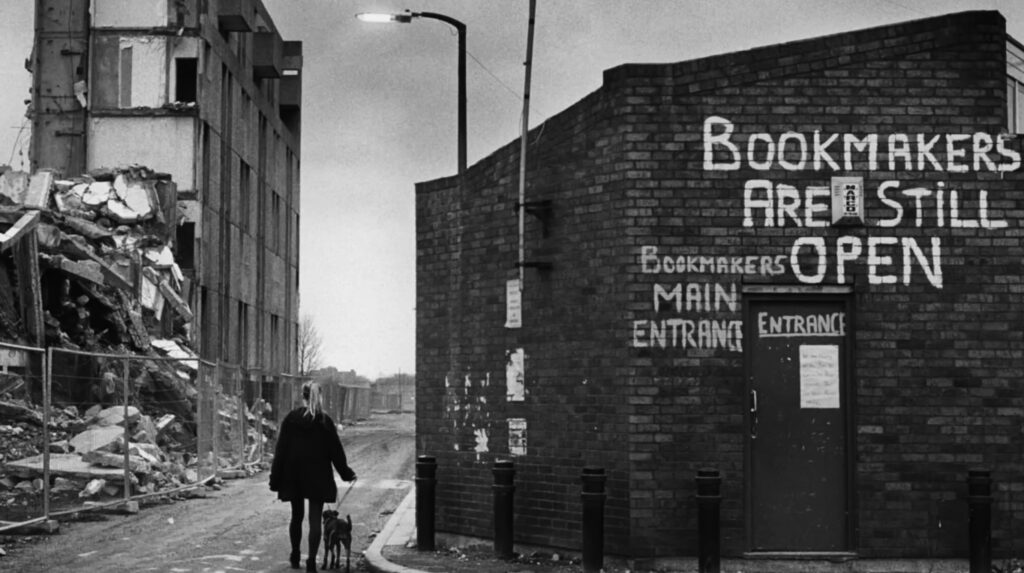 So how did Manchester go from that… to this?


These images are all frames from an extremely well made and thoughtful video by CityEd telling of Manchester’s development, warts and all, over the last 40 years. Scroll to the end of this post to see it – I strongly recommend watching it, and I also look forward to reading the book he refers to.
There are universal lessons to be learned from Manchester’s story, which are highly relevant to NZ cities. For while the problems and opportunities that confront every city are their own, the basic logic of cities everywhere is the same.
I’m especially interested in Manchester’s culture-led revival, which (as this video and the related book argue) led both its economic and physical revival. Bring the city back to life, by bringing life back to the city.
The recipe isn’t new, but like any nourishing classic it’s always handy to see it spelt out. For your city to succeed, focus on making it exciting and vibrant, so that people to want to come to it and stay in it. Here’s how:
- Lean in to your city’s cultural uniqueness – and invest in this
- Help as many people live and work as centrally as possible
- Treat all public realm as potential people-space – this means limiting vehicle traffic as much as possible
- Add high quality public transport to the wider city and beyond, eliminate through traffic
- Provide space for all kinds of pedestrian acceleration – bikes, etc
- Value your city’s architectural quality, past and future
- Green everything possible
- Maximise access to water
- And don’t ignore those who are left behind financially
And, perhaps most importantly:
- Be wise (or lucky) in choosing your city leaders
Following these precepts is what takes you from this:
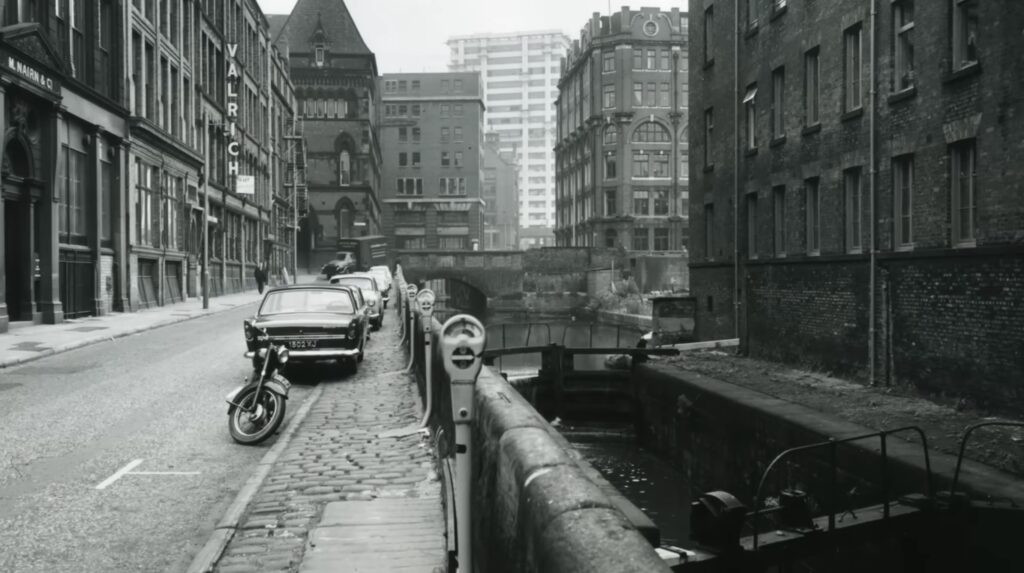 To this (yes, it’s the same street):
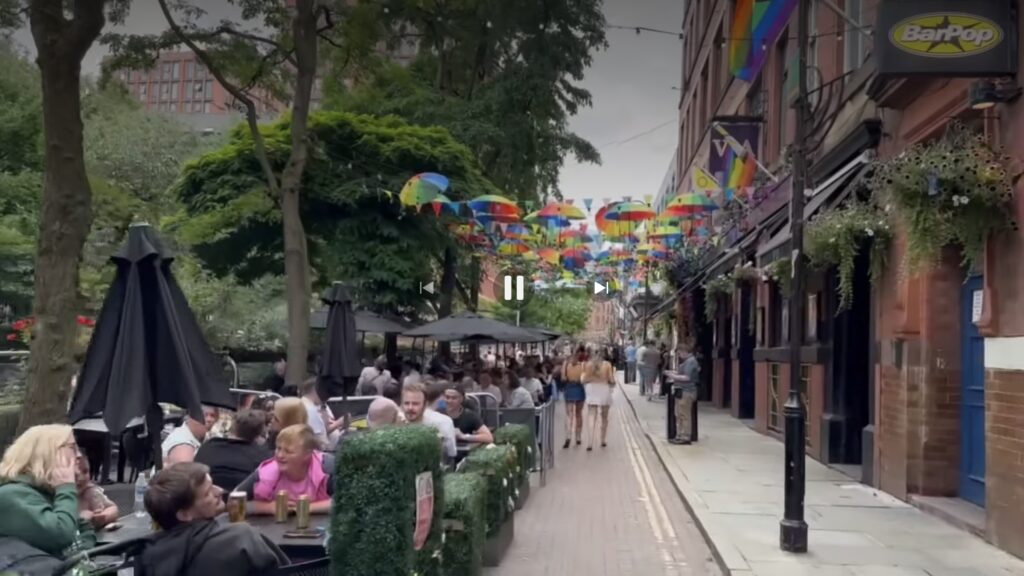 As the author says at the end of the video:
“The Manchester model could provide a blueprint for other post-industrial cities, or just places that are struggling to find a purpose or identity in the post-pandemic world”.
This line really stood out to me. It’s as close to a perfect plain-language summary of our current task, here in the heart of Tāmaki Makaurau, as you’ll find anywhere:
“Attract people into cities with stuff that’s worth visiting, or that they can’t get online, like music, culture, history, or public realm, that encourages you to stay there a little longer”.
Take a moment to enjoy this well-told story of Manchester’s economic miracle. It’s full of universal truths, and much we could learn; it also covers some problems and mistakes that are just as instructive, especially around equity.
Once you’ve watched it, let me know what stands out most for you, that our cities could learn?
This post, like all our work, is brought to you by the Greater Auckland crew and made possible by generous donations from our readers and fans. If you’d like to support our work, you can join our circle of supporters here, or support us on Substack.

 Processing...
The Herald calling the city centre “dilapidated” is nearly as funny as Viv Beck seemingly running a one-woman campaign to convince everyone not to bother coming into town.
As someone who *has* been physically attacked in broad daylight by a (homeless? mentally ill?) person in the City Centre end of last year, I am rather conflicted about the whole thing. It certainly made (makes) me reluctant to go back. If that doesn’t improve, the City Centre will, at best, play below it’s strengths. Of course it needs a supportive and constructive approach rather than a punitive approach, but just being silent or glossing up the situation isn’t really an option either so I could see Heart of the City being quite conflicted on this too.
Sadly your not alone. Got three colleagues that’s been assaulted or faced attempted robberies since I returned from overseas in July. Upper Queen Street is not safe and I don’t want any female to walk there alone.
There are too many with severe addiction problems that frequent a handful of streets. Queen Street, Elliot st, Albert St and Federal st as well as connecting streets such as Victoria Street. High street doesn’t seem to attract the same clientele and the rumour doing the rounds among the Queen Street offices is that some Asian shops paid ‘people’ to forcefully explain to said clientele that High Street was not for loitering. That is a sign of a broken society – the contract between citizens and government is then not maintained and that is a slippery slope that we can not go down.
But Upper Queen Street just is not safe and it looks like an asylum and sadly it keeps getting worse.
It depends on where you go. The hip rich people areas like Wynyard Quarter of course look good. But go to any city block where a lot of people actually live, and dilapidated will be the right way of describing it. Hobson Street, Princess Avenue, Union Street. Pick any. Go to Nicholas Street, count how many apartments you can see from there, and then ponder for a while why the street looks the way it does.
I went to Manchester Uni in the mid late 1980s and it was a damp, desolate and declining city bu with amazing people and a great nightlife.
I returned in 2024 and the transformation was amazing. Manchester is a very large student city and student numbers have grown. The growth of universities has been a significant factor in the revival – tech business follow looking for graduates.
The tram system also makes getting around very easy
I meet so many people who say they ‘love trees’ BUT not that one beside me that drops its leaves on my pristine pavers. There needs to be some education about how trees improve our environment by lowering temperatures on hot days, suck up pollution and help our mental health. We should value all of our existing trees and quickly plant a lot more.
They of course did have some help from higher powers, ” and on the sixth day….”. I grew up between Liverpool and Manchester and saw so much of this unfolding in both cities. The Hacienda must be built and Safe and Sound Cream were catchphrases that left legacies – and as Patrick mentioned based on music, culture and art in and of its place.
Good morning,
That is of course Canal St in the picture.
You might want to have a look at the paper I wrote during the last year of my MPlanPrac degree at Auckland University in 2003. Titled “From Cotton Town to Tinsel Town” it examined the changes in Manchester during the urban renewal of the 1980’s, the support from the Labour Council and the use of Government $$$ for targeted community urban renewal – the Gay Village, the Chinatown, and the Curry Mile, set up in the “zones of discard” around the city centre.
It compared what happened in a city which supported its Gay community in terms of economic and social progress, and compared it with Auckland under Banks and Mills.
Kind regards
Lindsey
Ha. I was a student in Manchester during the late 1970s and can remember many wastelands scattered through the city. Often there would be what I hoped were bonfires. It was quite an eye-opener after growing up in Surrey.
I agree with Patrick. Just about every part of Auckland is more like Surrey than 1970s or 1980s Manchester.
Heh. Canal Street – went through (on a narrowboat) back in 2018. The guidebooks for narrowboating still made it out as rather dodgy and dangerous, basically “get through fast and don’t look around”. Wasn’t our experience, but being on the canal towpaths below certainly felt a bit less like the cafe scene 2m higher up on the street itself!
I went through in a canal boat a couple of years earlier and had a plastic “glass” of beer, container and all thrown at me.
There is some stunning modern buildings in the Salford Quays, former Port area redevelopment, but the redevelopment was just a little too thorough.
Apart from a few bollards around the now incongruous rectangular ponds there is nothing left to link it with once being an internationally significant port. Just the retention of a few selected remnants in the Wynyard Quarter enriches the location by linking it with it’s past.
Funnily I also went to uni in Manchester, late nineties in the post-Hacienda, Queer as Folk era. It was such a vibe.
And I’m thrilled that 20+ years on it has finally become a viable alternative to living in London (anyone who wanted to ‘make it’ had to move, even if they didn’t want to)
Now you can get a good meal, have solid career options, especially in the creative industries, the city centre population has boomed, and the independent business scene is excellent… it’s much better value. It left the other previously-rival northern cities well behind (remember when Leeds was a thing?) – and the UK has another nascent global city now / after Edinburgh too.
And it’s just so much fun there, and hilarious people. Much better nightlife than London… probably the best in the country. Also for later nights. Still got that edge though.
Per the comment on trees and greenery – that’s the biggest drawback is the parks aren’t plentiful or with much civic grandeur.
agree c – I moved to the south from rural Scotland and the lack of parks or trees in Manchester was depressing. The Manc accent was interesting and they were quite friendly for southerners.
Aotearoa NZ is different and we need to create what works for here though.
Thanks again Patrick,
Hope Mayor Brown and our councillors see this post & video so our shared streets and other streets (Queen St) become closed to car streets; cars around the city rather than through it; more trees and green spaces as well as the city owning its public transport system. Also the need for council owned affordable housing in refurbished and new, well designed buildings.
Genius high floor rail system with off and on street running.
Manchester has played its hand well for decades. The city has suffered deindustrialisation, has a damp climate and is surprisingly peripheral to the main north-south motorway and rail lines (they are much nearer to Warrington, Wigan and Preston). It’s also worth pointing out that the City of Manchester is not terribly big; it’s a bit like the city of Sydney. Head west for about a kilometre and you’re into Salford, which is a different local authority.
And yet…it has flourished for decades, built on its successes, been lucky with its leaders and emerged as a real powerhouse.
Manchester was one of the first big UK cities (outside London) to make inner-city living fashionable. Urban Splash, a developer, realised the value of old buildings for residential conversions…and obtained public money to de-risk their initial developments.
Manchester United was by far the best-known British football team in the 1990s and this made Manchester relevant worldwide. I personally know a Malaysian academic who chose to do a postgraduate degree on the basis of being able to see Man Utd play at home.
The universities have been a huge draw for decades – again, making the city globally relevant.
Manchester is the birthplace of factories, passenger railways and computers.
And as for music, the best summary on film is the 2002 film ’24 Hour Party People’. https://en.wikipedia.org/wiki/24_Hour_Party_People which is itself a love letter to Manchester. Watch it!
and spot the ‘extras’ like Mark E Smith just stood in the queue!
Great transformation. Interesting that we had University student commenting from the 70’s, 80’s. & 90’s!
Is there a similar article to write on Birmingham with references to Peaky Blinders?!
Where? Haha
Wow a lot to be taken away here for our current bunch of back ward thinking central government .The key take away is build more homes and people will come and the place will thrive .Currently we are seeing the reverse of that and a mass exodus of people leaving the country all together .
Time to wake up and see what is the end result of those stupid policies .People make a country not corporations and the grifters they bring with them .
I’ve recently started working in the CBD again( although more the viaduct than the CBD) The physical surroundings are really coming along nicely and you can definitely get a feel for the change that will happen when the CRL opens. The development in the wynyard quarter is top class and when the new park at tank farm opens it will be game changing. I’m often amazed at the number of people out and about in the CBD. However, something needs to be done about the number of homeless people. I’m not talking about a good old fashioned clear out but something coordinated that gives these folk the actual support they need. They need proper help and everyone else needs to feel safe.
I was in Manchester in July, speaking at a conference, and I can confirm that the area really has been regenerated.
To pick up on something else we talk about, the train out to the airport was super-convenient, only 25 minutes, and is connected to a lot of the rest of Great Britain. The tram back took closer to an hour, and wasn’t used that much where the airport was concerned.