This guest post by Tim Adriaansen, an advocate for accessibility and sustainable transport, originally published on LinkedIn and cross posted here with permission.
Electric cars aren’t a climate solution.
So why do they keep popping up as a focus for climate action, everywhere from government advisors to environmental advocacy groups?
The complexity of transport systems, their inherent feedback loops and the multitude of outcomes different systems produce is a difficult subject which requires extensive understanding and big-picture thinking.
Recently Climate Foundation New Zealand has emerged as an exciting collaboration between great people in Aotearoa’s climate space, seeking to fund real climate action at scale. An email from Chair James Shaw laid out their premise:
“CFNZ’s mission is simple but urgent: accelerate transformative, systemic change that has a rapid and material impact on Aotearoa New Zealand’s carbon emissions.”
This is urgently needed, as funding for impactful climate initiatives has become extremely tight in the wake of a climate-denying coalition government who have simultaneously cut most publicly funded climate-action, piled costs onto local government and engineered an economic recession which is starving out philanthropist funding.
Ironic it is, however, to read the very next line in Shaw’s email: “To this end, we’ve launched our first initiative: Electric Vehicles.”
Electric vehicles are the polar opposite of “transformative, systemic change”. Accelerating electric vehicle adoption reinforces the systemic problems that cause outcomes like climate-damaging pollution in the first place.
While EVs will undoubtedly play a critical role in reducing atmospheric emissions from transport, we need to take stock of why we place importance on climate action: To create a better life for people. Setting out some first principles around equity, social sustainability and a ‘just transition’ is a critical first step towards understanding the bigger picture when it comes to decarbonising transport.
Electric cars not only cannot achieve these outcomes, they actively work against the people who are trying to create better lives through better systems. EV adoption sets us all back when it comes to the reason why climate action matters.
That’s because transport resources are a zero-sum game: We can either use public space and public funding to move cars, or we can use it to make walking, cycling and public transport attractive options. But physical space and public funding have a limit — we cannot possibly do everything for everyone (and the good news is we don’t have to). There is no credible transport strategy in existence which will achieve a high level of active and shared transport use without also intentionally reducing car use.
Cars take up a lot of space, and the infrastructure to move and store them sucks up an endless supply of money. This is why capitalism favours cars: Car-based projects will always involve bigger returns on capital — including a large transfer of wealth from governments to the private sector to deliver endless expensive infrastructure, maintenance and operations (spoiler: this results in worsening inequality as public money turns into shareholder dividends).
Car-based transport systems result in sprawling land-use, which increases travel distances and locks communities into a cycle of car-dependency — where getting access to the things people need requires the use of a car (tough luck if you’re one of the roughly 30% of people for whom a car is not an option). Auto manufacturers and oil companies love this, because it produces an ever-growing supply of lifelong customers for the products they sell. But those increased travel distances which cars create have a downside: It becomes less practical to walk or cycle to the places people want to go.
Busy roads and fast moving traffic also make walking and cycling much less attractive because people feel unsafe and uncomfortable in car-dominated spaces — public spaces that simultaneously become unattractive for human-centric activities like retail, social gathering, play or relaxation. Alongside the increased distances which car travel produces, a car-heavy transport system eviscerates people’s options for walking and cycling – the two most efficient, affordable, environmentally sustainable and egalitarian forms of transport in existence.
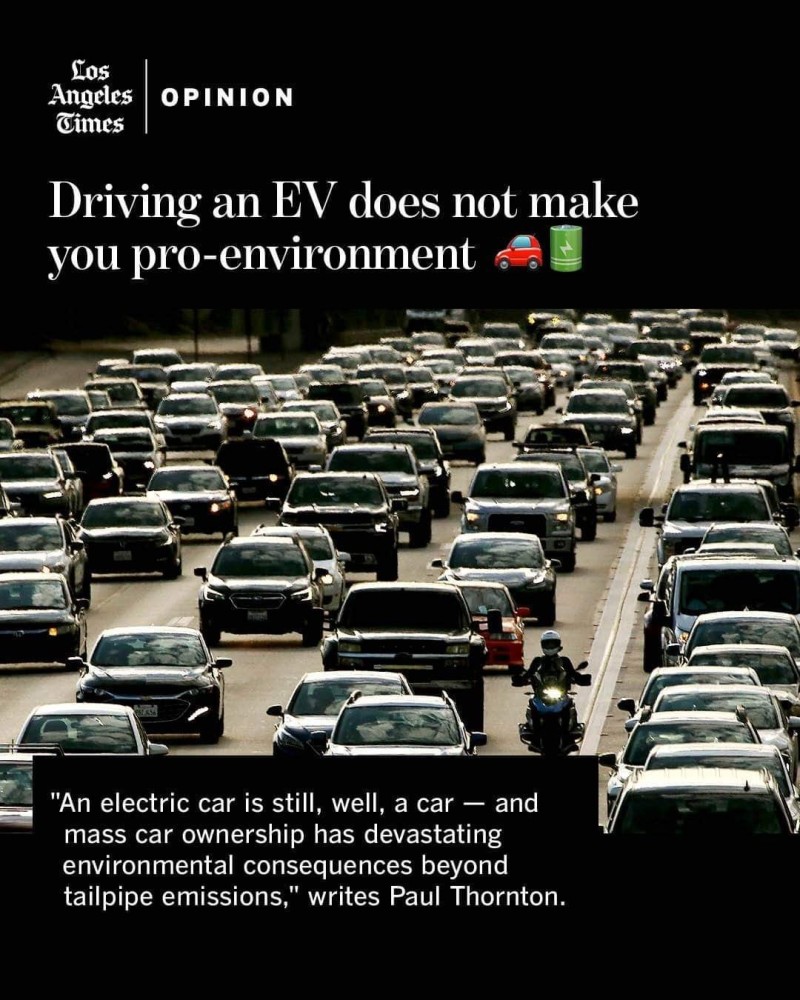
“An electric car is still, well, a car”.
The bigger problem, however, is that this is only a scratch on the surface of what’s going on when it comes to transport. Transport systems are complex: They’ve got 99 problems, and climate-damaging pollution is just one.
Most of those problems have a singular, common root cause: The low cost of private vehicle mobility.
Mobility describes how far and how fast things are able to travel, and it’s a fundamentally different concept from access, which is what people are actually able to get to. Mobility is the movement while access is the destination.
In theory, increasing mobility results in an increase in access, because if you can travel further and more quickly, then you can get to more places. But because cars take up space, consume endless funding, create a hostile environment for non-car activities and result in increased travel distances, the access gains of car-based mobility are severely limited.
Unfortunately, for the last 70 years or so, transport planners pretended these limits didn’t exist. Ever more public resources were poured into trying to increase private vehicle mobility, amounting to a massive subsidy for driving. By reducing the time-cost of driving, the people who designed our transport system made driving into a much more attractive option while simultaneously destroying the viability of alternatives — and created a situation where most of the population now view car travel as essential for living a reasonable quality of life. Non-car travel is deemed to be too expensive (mostly in terms of time spent) while car-travel is propped up by three generation’s worth of public resources.

We need to rebalance the level of public resources provided for different transport modes.
This enormous imbalance of resource allocation towards making driving cheaper and easier sits at the root of almost every transport problem: From traffic congestion to financial insolvency to high injury and death rates to physical inactivity to microplastic pollution to social isolation to transport poverty to climate-damaging emissions.
All of these problems are caused by the same thing: Driving is too cheap, because we subsidised it with public resources for 70 years.
Here’s the kicker we need to ask: Do electric vehicles make driving more or less expensive? Because anything that makes driving cheaper makes our transport problems worse.
When the actual problem is understood, it becomes clear why EVs are not and cannot be the solution.
Electric vehicles are cheaper to operate than internal combustion equivalents, which further reduces the cost of already-subsidised private vehicle based mobility. Some advocates will even tout this as a bonus: Lower vehicle operating costs could help address transport poverty, they will argue (from a position of bewildering ignorance as to the cause of transport poverty). Even worse, EV advocacy often involves even more public subsidy for cars, through the provision of EV-supporting infrastructure like chargers, through to direct purchase or tax discounts for EV owners.
The thing that caused our transport problems was people in government choosing to pour shared resources (land and money) into driving. The very last thing we need is for even more shared resource to be tipped towards a slightly different but still problematic form of driving.
Muddling our way through this takes work. It can’t be explained in a single LinkedIn article, let alone a reply in a comment thread. It requires genuine expertise.
And this is where the New Zealand climate movement hits a wall. New Zealand has a bucketload of brilliant people working in the transport space, but most of them are gagged by the need to earn a living from a major consultancy, limited in scope or resource by working for local government, or forced to respond to the central government direction of the day (which is typically the wrong direction no matter who is in government). As far as I am aware, there are no genuine transport experts “accelerating transformative, systemic change” at a national level in Aotearoa.
Within this vacuum, Dunning-Kruger takes over. I don’t doubt for a second James Shaw’s climate committment. But I do doubt the quality of transport advice, and whether or not it’s coming from people who are genuine experts in the field. I suspect EV adoption has been picked out by well-intentioned climate advocates working a handy spreadsheet which tells them nothing about feedback loops, transport economics and higher-order systemic determinants.
It’s easy to understand why somebody might think electric vehicle adoption is a priority climate solution. New Zealand’s transport system is responsible for a huge portion of the country’s greenhouse gas emissions, and right now, it’s not decarbonising anywhere near fast enough.
Stick the numbers in a calculator and they look good: Adopt EVs at a fast enough rate, and the emissions trajectory will head towards a rapid decline. Problem solved, right?
Sadly not. Because EVs lower the cost of driving, and because the low cost of driving is the cause of our transport problems, accelerating EV uptake won’t solve 98 of our transport problems. When we revisit our first principles about equity and a just transition, we realise that EV adoption works against the reasons we’re doing climate action in the first place. Electric cars may not even solve the emissions problem, because EV adoption alone doesn’t result in less driving of internal combustion engine vehicles, but it does further embed car-dependency and car culture, which open the door wide to further exploitation from auto manufacturers and fossil fuel profiteers.
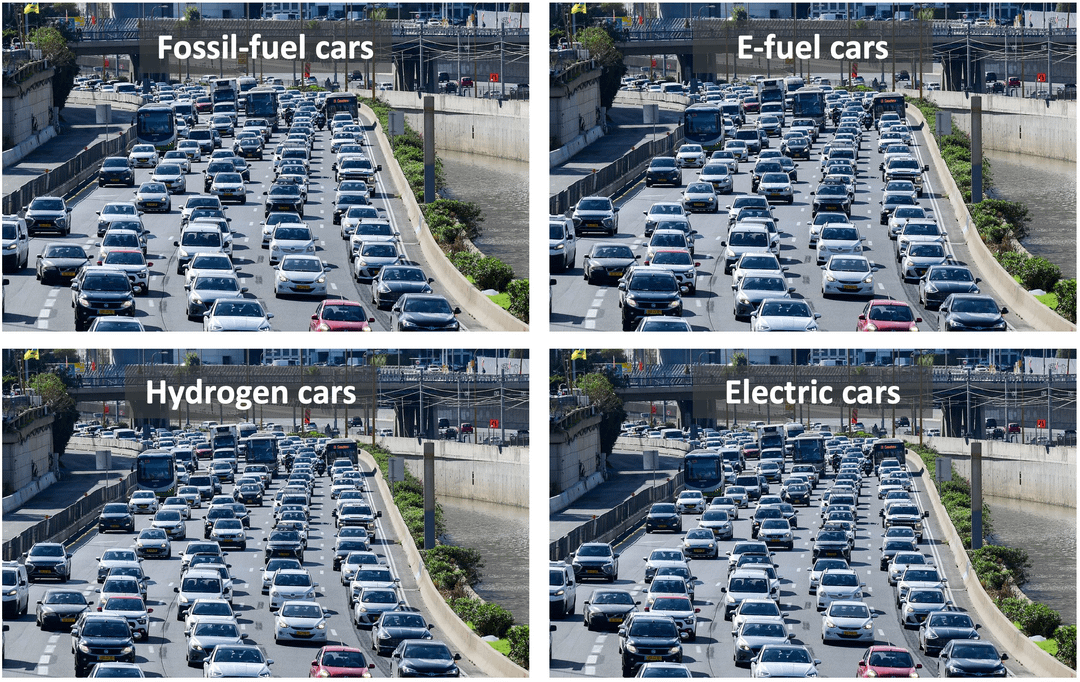
More cars will not and cannot solve the “too-many-cars” problem that our transport system currently creates. We must change the system to reduce car use — but adding electric cars only makes that more difficult.
There is a real solution to this problem, of course: The climate movement must focus on reducing the amount of driving that people do. That’s a complex challenge, but it is a technically solved one.
Collectively, we spent 70 years investing shared resources like public land and public money into making driving cheaper and easier.
Now, we must take some of those resources and upgrade them to create climate-ready transport systems. We need to take some of the space away from cars, and give it over to bikes and buses. How we do this is where strategy comes in, and that’s where we need to focus our mahi. How will organisations like Climate Foundation New Zealand ensure that the movement they fund is working towards reducing car dependency, rather than propping up a socially and environmentally problematic transport system?
That’s what anybody wanting to solve New Zealand’s transport emissions problem needs to work at, and that’s what anybody looking to “accelerate transformative, systemic change” needs to fund.
Header image by Sulthan Auliya on Unsplash.
This post, like all our work, is brought to you by the Greater Auckland crew and made possible by generous donations from our readers and fans. If you’d like to support our work, you can join our circle of supporters here, or support us on Substack.

 Processing...
After wondering why Finland had much lower per capita domestic transport emissions than New Zealand, I was lucky to find a Finnish collaborator who helped me understand why. This prompted a short paper looking at their transport systems. They have fewer cars than us per capita, but more of them are electrified. What really makes a difference is their investment in public transport, including long distance trains and coaches as well as active transport. https://thefutureisrail.org/trams-bikes-and-trains-what-can-we-learn-from-finland
I definitely agree that more cars (propelled by any type of fuel) is not good for us. But I still think that EVs must be part of the strategy to address our climate challenge, particularly in realities of NZ. We had decades of car-fuelled sprawl. Transformation of our cities into those where PT and active modes are viable for more trips will take at least as long. And in the meantime we still need to reduce the emissions.
Most people presented with a number of options will chose reasonably, based on the factors important to them (cost, time, ability to carry various loads, or just simply ability to get to the destination). And in some of those circumstances a car will be the most reasonable option.
Moving even 50% of journeys from cars to other modes would take 50 years plus of continuous investment. Look at something as major as the CRL, both in terms of timeframe and cost, it won’t make the slightest dent to the country’s C02 emissions.
Electric cars are the only way to get any meaningful reduction in C02 emissions in the short term.
We need to start reallocating space- bus priority along more of our roads whilst taking the space from parking or single occupancy vehicles is needed. If we keep spending a fortune on expanding roads for whatever mode we are still not going to reduce the harmful impacts that go beyond emissions.
In many cities in NZ there is barely any congestion, its going to be hard to get those people into buses. It would probably require some kind of car tax.
As for Auckland, it would be really difficult to get many of the off peak journeys and those that don’t start or end in the city into buses. It is normally just quicker and easier to drive, and bus lanes won’t change that very much.
Not saying we shouldn’t improve public transport, but I do think electric cars will make much more impact on C02 than public transport will.
There is evidence from Paris and other major cities that low-cost, rapidly deployed bike lanes can actually result in huge mode-shifts in very short amounts of time.
By taking a parking lanes-worth of space away on all major arterials using physical barriers (planters, timtams) you can incredibly quickly generate a low-cost cycling network. These aren’t glamorous, but they remove the fundamental barrier to entry for cycling – lack of safety/protection.
We have everything we need to deploy an amazing bike network in all our major cities, the paved space already exists. It’s just a matter of political will.
Completely agree but don’t forget about low speed zones as a means of completing the cycle network really quickly. Where we should rapidly be moving to in all our urban areas is 30kph speed limits (“enforced” by traffic calming) on all roads where there isn’t protected cycle lanes. It is as simple as that. If you want to drive faster than 30kph on a road, you need to make protected cycling on it. While the current government has mandated blanket high speed driving in our urban areas, I don’t think this will last long. And the 30kph speed thing needs to be well marketed as encouraging people not to drive which makes the roads less congested for those that have to drive.
Yes. And for this to be effective, the 30 kph zones need to have low traffic volumes, and small vehicles sizes, too. Ultimately, they need to be designed as low traffic neighbourhoods, have regulations that encourage smaller vehicles and systems for right-sizing or managing the freight and construction vehicles.
We should by default make all small streets (eg. those marked as “residential” on openstreetmap.org) 30 km/h. It is really unusual to drive long enough on those streets to loose any significant amount of time and usually you can’t drive much faster anyway.
And yes this is indeed how cycling works for a large part. For example, most Dutch streets do not have bike lanes, instead you often ride on low speed and low traffic streets.
Substituting ICE cars with EVs just reinforces the status quo.
It just gives motor dealerships additional sales as ICE vehicles are prematurely retired in favour of Government incentivised/subsidised, EV sales.
Emissions are only part of car problem.
The biggest problem are the ongoing inefficiencies of land use to provide for car dominance in urban transportation. The costs of providing scarce land, and then maintaining, and draining huge acreages of high strength pavement.
And to think selecting a hybrid vehicle is a good ‘transition’ to the full EV climate solution is advanced wishful thinking. Driving a hybrid is like wearing a Marlboro-branded nicotine patch so it’s no surprise the ICE industry is banging on about hybrids as if they are a salvation.
Disclaimer: I own two EVs and agree totally with the thrust of this article. Any political party that offers free public transport for the unwaged and substantial subsidies for cargo and commuter e-bikes gets my vote. User demand will drive a shift in public spending. I am saving that as someone who pays substantial taxes and don’t want them spent on MoreRONS.
New car dealerships make more money from the workshop than from selling new cars. That is why lots of them are not pushing EVs as EVs don’t need nearly as much maintenance.
Less maintenance is actually a good thing for the planet.
As a “greenie” mechanic, I get angry at the amount of components I have to throw away that are perfectly usable/overhaulable because the OEM/Manufacturer finds it financially beneficial to replace, not repair.
Every time I have to take the kids somewhere in the pouring rain, I reconsider my decision to live a car-free life
Car free is probably too extreme for many people, me included.
But where there are viable alternatives, car use can be minimised.
Ours has done 20000k in the last 6 years, only because where we live, on the CBD fringe public transport improvements, and the proximity here to most services makes public transport viable alternative for most of our trips.
And you do not need to park a bus!
What is needed, is to continue to improve non car transport options for more and more people, for more and of their trips. As a bonus, taking this path hugely enhances mobility and independence to those yet to obtain the means to drive, or who can no longer drive. Our young, and many of our elderly.
Just driving less, has a greater impact on emission reduction, and congestion, then changing the engine fuel.
I agree. I have a car and only do a few thousand km’s per year – mostly errands that don’t work for public transport or visiting family scattered all over Auckland. I would struggle to see them if I didn’t have a car. However I travel to work and do some weekend trips using public transport, and also walk a lot to save using my car locally. If public transport was better I would use it even more, and I know others who would as well.
For kiwis in rural areas this is their climate solution, they will always have to drive due to the nature of living rurally.
Rural lifestyle blocks are unsustainable. People shovel really live close to where they work, educate and play or work close to where they live. (We live on a lifestyle block but we are 8 minutes by bike from the Nelson Cathedral so I don’t think that counts).
EV are better for the climate than ICE vehicles. Climate change is primarily the result of carbon that was locked underground as coal, oil, and natural gas being used as a fuel resulting in the carbon being transferred to the atmosphere in the form of CO2. This causes a thicker more insulating blanket for a resulting warming planet. EVs don’t have this effect whilst ICE vehicle does so the headline is wrong.
The problem with EVs is they don’t solve the energy and spatial inefficiencies of car dependency. And the reason NZ has car dependency is not because motor vehicle operating costs are reducing (they aren’t – road congestion which is a cost is getting worse). The problem is NZ has no effective infrastructure funding mechanism to build non car dependent environments.
For 100 years NZ has had a funding mechanism for the building and maintenance of public right of ways for the use of motor vehicles. It started out being called the Main Highways Act. It is now the National Land Transport Fund, and the delivery agency is called Waka Kotahi. But its basic structure hasn’t changed since the 1920s. https://teara.govt.nz/en/roads/page-6
In Europe, Finland for example local government gets a far greater tax share, so it can build walking, cycling, and public transport providing, non-car dependent environments. Some places like France even have a dedicated transit tax. A payroll tax on urban employers of more than 11 workers of up to 0.55% of income.
https://www.lafabriquedelacite.com/en/solutions/the-specific-case-in-france-public-transportation-funded-by-employers-through-the-versement-mobilite/
New Zealand will need to make this sort of institutional reform if it wants to build energy and spatially efficient urban environments. There is plenty of evidence there would be productivity and economic gains from making this transportation and environmental reform. There would be a significant improvement in access and connection in the urban environments where most people live. Conservative system status quo unfortunately stops us from adopting this proven solution.
This comment here we are overly centralised in turns of taxation and public spending and history of central government agencies building roads and mostly closing and ripping out railway services is good reason to have a little more localism, not less.
And those local government, local area solutions are a big chunk of the solution because a big proportion of total kilometres travelled by car are within 5km of your house.
Central government can look after the buslanes, busways and additional rail lines, in addition to inevitable new or upgraded motorways.
Brendon I agree with what you are saying but you miss a significant reason why NZ has car dependency – Sprawl has been mandated in our urban planning rules since mid last century. Here in Nelson 2 story townhouses built before these rules have been completely illegal for years. We have mandated low density zones 100m from the cathedral and even the high(er) density residential zones you are required to have 300m2 per dwelling
What is the point of this article? Yes, if we could wave a magic wand the world could be a better place, but we can’t. What we can do is make incremental improvements in as many areas as possible.
The article begins by saying “Electric cars aren’t a climate solution” and then follows it up by saying “EVs will undoubtedly play a critical role in reducing atmospheric emissions from transport”. So which is it?
Climate change is a too many emissions problem not a too many cars problem. Conflating the two is dishonest and should be called out.
The climate emergency is real. Unfortunately there is no fundamental reason why its solution has to also deliver the “first principles around equity, social sustainability and a ‘just transition’”. I think action on climate change is going to require action across the political spectrum, including those who will still want to drive cars.
In NZ’s transport sector, incrementalism has become a faith-based practice. Have pity for its adherents: progressives whose initial vision and energy for larger, transformative changes have been stymied by incompetent leadership.
Reduced to mere cogs-in-the-wheel of car dependence, seeing only tiny wins, and bitter about their own impotence, it’s no wonder they are now putting faith in “incremental improvements in as many areas as possible.”
You ask about the purpose of the article. Perhaps it’s to alert James Shaw and Climate Foundation NZ, to how they have fallen for this EV bullshit from the legacy industries?
Fair enough, keep dreaming and not doing. After all the most important thing is moral purity not moral action.
Yes it is an and and solution rather than an either or. Heidi you should note research from Rewire Aotearoa shows how someone cycling to work everyday but at the weekends driving to the beach has their carbon footprint blown out of the water by these longer distance drives. EVs are a really necessary step to quickly reduce if not eliminate fossil emissions. And I think the definition of an EV should be broad enough to include an e cargo bike which for many families replaces a second car. But then we need safe cycling network for them (easy actually – see other post 30kph urban default speed where bikes and cars can mix and otherwise protected cycle paths on or adjacent to any roads faster than this)
Peter, I agree EVs will be a helpful part of the solutions (I encourage friends to buy them, and I support regulations to encourage them), but that’s not what is going on here.
P 75 of the TERP captures this: “consider the required relative change in trips for each mode as another indicator of where effort should be focussed.”
To achieve the desired balance of walking, cycling and public transport within NZ’s transport system requires far more policy and advocacy effort than achieving the desired balance for EVs.
The machinery of government has long relied on electrification instead of systems change in transport. The auto industry has ensured EVs get the policy focus, because they wish to slide electrification in when it suits them, rather than slashing the number of cars NZers own.
The way for NZ to solve its transport emissions problem is with a coordinated approach to unravelling the political economy of car dependence: fighting back against each of those powerful strands:
– the automotive industry;
– the provision of car infrastructure;
– the political economy of car-dependent land-use patterns;
– the [substandard] provision of public transport; and
– cultures of consumption of the automobile.
Advocates and bureaucrats alike need a better approach than: “What we can do is make incremental improvements in as many areas as possible.” They need to support articles like Tim’s, not attack them. They need to support the equity focus (and understand why the corporates are manoeuvring to avoid it), rather than dismissing it.
Incremental improvements are not all that’s required. They need to be coordinated by an overarching strategy of system reform; without this they are too few, too laboured, too slow, and too reversible.
The conversation has to also start with land use. Travel is a derived demand. Build low density sprawling cities and you get the outcome you’d expect.
Greenfields development is often heavily subsidised. Land use planning laws outlaw density, outlaw mixed use development or severely restrict both. Alongside underpriced travel this leads to sprawl as it becomes the most financially sustainable outcome for the masses considering short term outcomes.
There is a distinction between Electric cars and other EVs. Buses and trucks are needed to improve air quality, especially close to people outside vehicles as well as to reduce greenhouse gas build-up. Trade EVs can enable charging of electric power tools.
These significant sectors need to be supported while calling out greenwashing by car manufacturers and oil-sector producers and suppliers.
I have always thought that if EVs were to be ‘capital cost’ subsidised the best bang for buck would come from subsidising the vehicles that do the most mileage; commercial vehicles. The humble white van used by tradies and couriers should be the first focus of any subsidy. The problem here is two fold; 1. that the white van supply side is dominated by the Japanese ICE manufacturers who want to perpetuate ICE and 2. that the ‘white van’ isn’t a thing in China so there is no base load volume production from that source for us to leverage off. Pity as converting all those ICE vans to E-vans would also help a lot with city air quality.
Would these be a preferable solution…. https://insideevs.com/news/776646/rivian-also-electric-bike-tm-b/ ?????
or how about this……? https://www.youtube.com/watch?v=FkHbNE9bfJo
From my own experience, EV’s are a gateway. You get your EV a few years ago and then charge it at home. It’s a sunny day so you think – hey wait a minute – I could charge this “for free” from the sun. Once the PV arrives then you think – Why do I have a gas furnace to heat the house, heat the hot water etc and before you know it you are an all-electric home (making Rewire Aotearoa’s Mike Casey’s heart beat faster. Now THAT is good for the climate.
Plus, I agree with the previous comment (Trev) that EV’s are an increment along the way, and reduced car usage (one or fewer cars per household) has to be a help even if the eBike or eBus might generally be preferable.
Mike, you’re absolutely right. Mike Casey’s ‘all electric stack’ is the end point and it doesn’t really matter where people enter the stack as long as they see the transition through to the end. To see greater adoption of e-bikes and more use of e-buses and e-trains along the way would yield even greater benefits. All of this will require public money to be moved away from MoreRONs for cars and trucks to investment in alternate modes.
Seems like some logical fallacies in the post.
1) Assumption that Electric vehicles = Electric Cars. This might be just common usage at play, but as somebody who is a proponent of EVs, I consider the term includes electrified trains, trams, buses and e-bikes. All of these are electric vehicles, and e-bikes & public transport are very much part of the solution
2) Of course electrical cars are not the entire answer, I hope not many people are suggesting that. But one of those cases where “perfection is the enemy of good”.
There are an awful lot of people going out every day in New Zealand and still buying SUV’s and other fossil fuel vehicles for sometimes short sighted reasons. If customers are determined to buy a new SUV, I personally would rather it was one that won’t be consuming fossil fuels and producing pollution and emissions for the next 20 years.
And yes, of course it would be better if they didn’t buy the 2-tonne SUV to take themselves on a short commute. But that sort of change to consumers is a much harder task.
TBH, given some of the anti-EV, anti-cycleway, anti-change conservatism I encounter in my daily life, I think making real, significant change to reduce emissions feels near impossible given current political leadership. I can only do my bit (bike, PT and EV) and vote for change.
Re your last paragraph – there are green shoots showing. I was an “early adopter” actually 2019 is not that early and after 6 years I see many of my colleagues saying that their next car will be an EV, after (what feels like) 5.5 years of poking the borax at EV’s
Of course they are not a solution. There are no practical solutions that every country will adopt, so start planning for a warmer climate. The four largest emitting countries are increasing their emissions. Get used to it or be very disappointed. Get an EV if you want one, don’t get an EV if you don’t want one or if you don’t have somewhere to charge it that isn’t separated from your house with a fire break.
This is likely to become false soon, and if those big players start getting cross at smaller players not doing their bit we’re in big trouble.
Electric cars aren’t a climate solution….
Because your definition of Climate action is,
“To create a better life for people. Setting out some first principles around equity, social sustainability and a ‘just transition’ is a critical first step towards understanding the bigger picture ”
At which point most people start to eyeroll…..
EVs solve the problem they are designed to solve, ICE emissions.
As for bringing about societal revolution, there’s probably only one car that was designed to do that, and its origins are best left in history…..
Yeah I rolled my eyes and kinda stopped reading after this. Don’t use climate as a springboard for other concerns and overcomplicate the core message. This is how a political consensus dies – turning potential allies against the coalition and aligning it along political lines into merely another left/right partisan issue.
And I say this as someone who heartily supports reorientating our transport system towards active transport! It’s just that that is another issue that needs to fight its own battles.
Perhaps have a re-read of the TERP on the topic of equity, or of the international publications about what is required for climate solutions in the transport. For a transport system like ours: unhealthy, inequitable and ineffective as well as high carbon; it is impossible to decarbonise first and then attempt to fix its long-standing health, equity and access problems. This is because the causes of all the problems are the same. The only cost effective way is to tackle them together.
The topic of divisiveness between different groups – all genuinely aligned on wanting climate action and transport transformation – is one I’ve been studying for a while. What has become obvious is that these progressive groups are failing to achieve their goals because they are not coordinated in tackling the big common enemy: the space, power and money wasted on cars. There’s ample space and money to achieve all our goals, but only if we are coordinated in our push back on car domination.
It’s not helpful in this forum, but I could go through each advocacy organisation in turn and show how their campaigns could be mutually supportive, and thus more effective overall.
It does remind me a little bit about how someone once told me how the Greens could be a lot more effective at protecting the environment, if they, you know, concentrated on the environment – and less on all that social justice stuff.
Missing the point: Inequality, pollution, animal abuse (in industrial farming), unaffordable housing – the core reason for all is the same. Greed.
All these issues could be fixed by the haves having a little bit less. Paying a little bit more. Whether in ensuring that poison from industrial processes gets treated instead of dumped in our rivers, that chickens aren’t penned into little cages, or people are paid a fair wage. You can’t fix “just the greed causing pollution”.
But thanks to a constant race to the bottom, and everyone’s wages (well, 90% of the society’s wages) being lowered in real term ever more, all people focus on is “but our eggs will cost more, I can barely afford them now”. The rich smile when they hear that kind of take. Their answer is always lower taxes, less fees etc.
I’ll agree with you to a limited extent – we shouldn’t privilege electrictrifying cars ahead of other initiatives which also reduce emissions. To that extent, it’s good that National got rid of EV subsidies (except the ETS) – while it did incentivise emissions reduction it also subsidised private road use, which is wasteful.
We should be charging more for road use (or subsidise alternatives). However, I think even after you account for all the externalities, we are still going to have a lot of cars (and buses, and trucks) – they simply have enormous user benefits. Therefore, electrifying these cars is a climate solution, just as valid as energy efficiency, increasing renewables share in electricity, and substituting for fossil fuels for industrial processes.
Great article.
We can’t afford a car-based transport system, however the vehicles are propelled.
Comments are disappointing. They indicate a lack of willingness to critically examine where NZ has gone wrong. Curbing our driving is far faster and far cheaper than replacing the fleet. Let alone having to continue with the road building.
Can’t-change attitudes are how we became the world’s most car dependent country.
That last sentence isn’t true. People changed very quickly from horses and trams to cars because it made their lives better. Changing away from cars makes people’s lives harder.
Speak for yourself, leaving NZ to live somewhere I didn’t have to drive on the motorway just to buy milk was the biggest quality of life improvement I ever made.
The article fails to acknowledge that a great proportion of our population lives outside cities or in parts of cities where there is no public transportation at all today.
Further, it conflates many issues not related to climate change, which has s a real existential threat to mankind. EVs address this TODAY. The building out of the infrastructure needed to solve our PT woes is decades long at least. Let’s fix decarbonisation as a priority while we rejig the strategy for the future.
“Great proportion of our population lives outside cities”
Although a little difficult to define a statement like that, this is a blog called ‘Greater Auckland’ focused on Auckland.
On the stats I found about: 51.0% of the population lived in the major urban areas of Auckland, Christchurch, Wellington, Hamilton, Tauranga, Dunedin and Lower Hutt
13.8% lived in large urban areas (such as Rotorua, Whanganui and Invercargill)
9.0% lived in medium urban areas (such as Cambridge, Te Awamutu and Rolleston)
10.5% lived in small urban areas (such as Thames, Stratford and Gore)
15.7% of New Zealanders lived in rural areas.
From that I get that well over half of NZ should be well serviced with PT.
As an Aucklander, I am of course focused on our solutions; I don’t know what works best for people in Gore or rural population.
Electric cars/trucks etc must be part of the solution of course, but investing in things like a light rail running rapid transport routes, will make a very significant change to tens of thousands of people daily. Changes to somewhere like Gore will make far less difference; and in my personal experience, there is a strong conservative feed back to any change that will reduce emissions in these sorts of areas
This kind of leftist slapfight is cannibalistic and only serves conservatives who would prefer the status quo of no action at all.
Do both. Advocate for both. Stop making enemies out of friends in some imagined zero-sum game.
Completely agree
completely agree
Owning a car gives greater independence and greater freedom. Anyone who thinks mass transportation is the answer can think again. METHANOL wil probably be the fuel of the future perhaps with a much smaller volume of Hydrogen powered vehicles.
But if we only cater to cars, those who cannot drive are robbed of all their freedom. People that cannot or should not drive include children, elderly, disabled people, everybody after 2 beers or 2 glasses of wine, tired people, people who cannot afford a car, people in one-car households when another person is running errands, …
Also, converting electricity to methanol to then burn to power an ICE is horribly ineffective.
*inefficient, not ineffective
A large part of the issue is cost of Public Transportation in the first place and a drive to make Public transportation self or partially funded,
From where I live in Karaka to Travel into Auckland CBD is approx $7.50 one way, $15 return, even with the $50 per week cap on transport its still $200 on a four week month and $250 for a 5 week month, which is a huge cost and I know people who really struggle with this cost alone.
Given I do run an EV, its just plain cheaper and more convenient to just drive into town as I get free parking and pay the equivalent of $1.20 per litre of gas, including RUC Tax
However if my fare was $0.50 cents one way or $1 return, I would gladly put up with the inconvenience of public transportation as the money savings would be significant,
Another added bonus would like be the extra money in my pocket would get spent on coffee food entertainment while in town or around transport hubs,
When Councils and the Govt realize that to drive a behavior change you have to make public transport cheap and reasonably reliable, until then its drive all the way baby!
It is still because the lions share of any transport funding goes to roads. Both central and local govt. If road spending was reduced, then there would be plenty to improve the operations of PT all over NZ.
Even worse, autonomous cars also don’t solve the car problem, will possibly make it worse.
Zombie Miles And Napa Weekends: How A Week With Chauffeurs Showed The Major Flaw In Our Self-Driving Car Future
https://jalopnik.com/zombie-miles-and-napa-weekends-how-a-week-with-chauffe-1839648416
As the quote goes, there is no such thing as bad press. Constant coverage of electric cars positive or negative puts the idea in a lot of people’s heads.
I could get a bus to work, why don’t I? It takes 3 buses to get there and approx 1.5hrs. I could bike to work why don’t I? Wgtn 4 seasons in one day predictability. Time and convenience rules. The best public investment is mixed mode living/working infrastructure. Create a very low cost commute both in time and money.
Your reasoning as to why climate action is important is “to create a better life for people.” Climate action is not merely about creating a better life for people, it’s about trying to ensure our planet is still habitable. It’s about reigning in emissions to ensure we avoid environmental and societal collapse.
We need to urgently reduce emissions to stabilise our warming climate. CFNZ’s missions is to “accelerate transformative, systemic change that has a rapid and material impact on Aotearoa New Zealand’s carbon emissions.”
ICE vehicles burn fuel and release emissions, therefore replacing them with electric vehicles which do not burn fossil fuels, IS climate action.
Electric vehicles may not address the transport issues associated with excessive private vehicle ownership you have outlined, however these should not be conflated with climate issues.
Climate action involves reducing emissions. Electric vehicles are one method to achieve emissions reductions. Suggesting that they are not is incorrect.
Trams are electric vehicles, can we start re-building the tram networks?