Welcome to another Friday. Who’s ready for Daylight Saving Time this weekend? And it’s almost October, aka Biketober, a great excuse to get out and enjoy the longer evenings. For now, enjoy our roundup of stories that caught our eye this week, on the subject of transport, cities, and connections.
Also, remember to vote! There’s two weeks left to ensure you get your ballots in, either by posting them in the mail, or dropping them in one of the ballet boxes around town. All the info you need is here.
This Week in Greater Auckland
- On Tuesday, Matt looked at the creative accounting behind Infrastructure NZ’s report on the value of motorways (turns out they look like a great deal if you just count the benefits and disregard the costs).
- On Wednesday, a guest post from Women in Urbanism Aotearoa explored the appeal and potential of retrofitting perimeter-block housing into Auckland neighbourhoods.
- And on Thursday, we covered the big decision at Auckland Council to proceed with a fresh Plan Change, focusing new housing around urban centres and transport links, and away from areas prone to floods and erosion.
This roundup, like all our work, is brought to you by the Greater Auckland crew and made possible by generous donations from our readers and fans. If you’d like to support our work, you can join our circle of supporters here, or support us on Substack.
State government for Auckland?
An interesting thought experiment from Tommy da Silva in the Spinoff, who reckons Auckland is big enough now to need its own state government, “similar to how federal democracies operate overseas, including just over the ditch in Australia.”
Does your bus turn up on time? Do the pipes in your suburb burst and flood during big downpours? Are community amenities like libraries, parks and pools readily accessible in your neighbourhood? Is one of your city’s champions at the helm or is it someone bankrolled by vested interests? Most of these questions are answered by the local, not national, spheres of government. So why don’t people seem to care?
Two million what, where?
For Newsroom, Tim Murphy digs into the big number that bounced around the table throughout the housing debate this week: two million new dwellings. Where did it come from, and what does it mean?
Two million. A number that took on a life of its own and might have derailed public buy-in for this latest council-Government deal. The change aims to re-shape how and where Auckland grows – away from flood plains and coastal risks and into 10- and 15-storey towers around isthmus transport hubs.
Two million reasons for councillors and local board members facing re-election on October 11 to be irritated at Bishop for the rushed deadline to agree the reforms before that date. And to be irritated at previous councils, mayors and planners who didn’t debunk it years ago.

[Christchurch-themed heading]
…or, Good things from the Garden City
A cool new bridge in the (increasingly green) red zone
The opening of the new Dallington Bridge was celebrated in the Ōtākaro Avon River Corridor (OARC) today.
A ceremony was held to mark the opening of the bridge, which is the fourth and final walking and cycling bridge to be constructed as part of the Corridor’s Regeneration Plan.
…..
The new bridge is based on concepts created by engineering and fine arts students from the University of Canterbury.
Its design is inspired by Mōkihi, a small canoe-type vessel fashioned from raupō and flax. These were more suitable than waka for navigating streams and small rivers, such as the Ōtākaro.
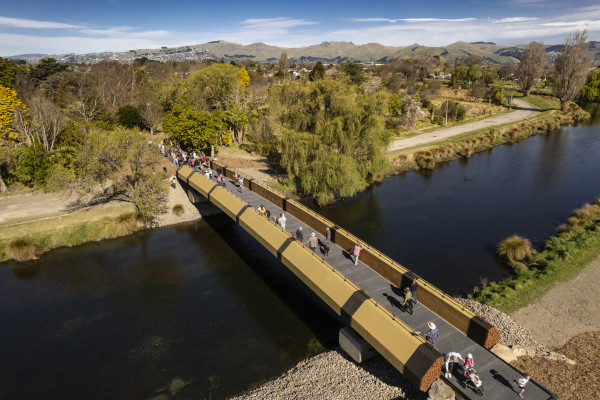
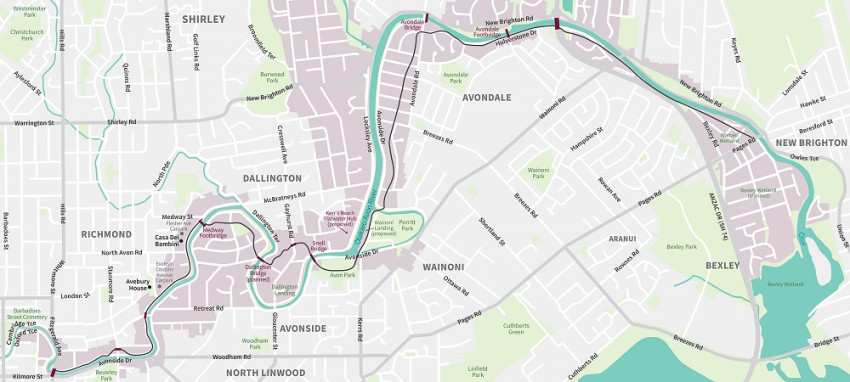
The opening of the bridge completes the first phase of the City to Sea Pathway, linking the Pathway from the corner of Avonside Drive/Morris Street to Dallington Terrace.
The City to Sea Pathway is an 11-kilometre-long shared-use path following the river from the central city to New Brighton.
The Pathway is being designed and constructed in three sections, with the final section expected to be completed in 2027.
 And some surprisingly nuanced coverage of the role of speed calming in conversations around the upcoming election. A candidate opposed to traffic calming claimed it delayed emergency services, but the reporter actually checked that claim.
Jones said there was certainly evidence of emergency vehicles being slowed by bumps.
The Sunday Star-Times asked police, Fire and Emergency New Zealand (Fenz) and Hato Hone St John for their position on speed humps. Do they hinder their job and delay their vehicles getting to emergencies?
Acting director of road policing Inspector Peter McKennie said police did not have any data to suggest that speed humps cost lives in an emergency.
He said police supported roading infrastructure that reduced harm and encouraged safe driving behaviours.
A Fenz spokesperson said the organisation supported the overall goal of safer roading networks. Traffic calming, including speed humps, worked toward that goal.
They said increased response times were an occasional trade-off.St John Christchurch metro operations manager Sam Kellick said raised platforms did require ambulances to reduce speed and they might interrupt the flow of traffic or make for a less smooth driving experience for patients.
But the organisation had not seen any evidence that speed humps negatively impact ambulance response times or patient outcomes.
Safety first
Mixed messages in this week’s announcement about the $2.1bn upgrade of SH1 Ōtaki to north of Levin. (Recall that after speeds were raised back to 100kmh over community objections, there was a fatal crash to the great despair of the local community).
“Anyone who’s driven it knows, knows that it’s a death trap,” [Transport Minister Chris Bishop] said. “There have been 70 deaths and serious injuries in the five years to 2024. It’s an extremely dangerous road, and that’s one of the reasons why we’re building a replacement.”
That is, on average, 14 deaths or serious injuries per year.
In 2022, under a Labour Government policy, the speed limit on stretches of the highway between Ōtaki and Levin was lowered from 100kph to 80kph. But the National Party campaigned on reversing those speed limit reductions, meaning the road was back to 100kph.
Bishop said, despite it being a “death trap”, it was still safe to drive at that speed.
Meanwhile, overseas…
The number of cyclists injured or killed from road traffic incidents in Wales has fallen by more than a quarter since the roll-out of ‘default’ 20mph speed limits on most roads, new data shows.
Data to the end of March shows that there have been 348 cyclists killed or injured on all roads since the 20mph law came into force in September 2023, down 28 percent compared with the 481 reported casualties from April 2022 to September 2023.
The number of cyclists seriously injured has also decreased by 30 percent in the same time. North Wales, which saw 94 percent of its 30mph roads switch to 20mph, also recorded the biggest decrease in total casualties.
Bike busy-ness
Montréal is often hailed as the most “biking-friendly” city in North America. But our research has found that only 2.3 per cent of the city’s roadways are allocated to bike infrastructure, with car infrastructure occupying the remaining 97.7 per cent of road space.
We measured the street space allocated to transport infrastructures across Montréal, and contrasted it with traveller counts by travel mode. We found a wide discrepancy: comparing bike travellers with car travellers, bikes represent 4.9 per cent of trips to 95.1 per cent for cars.
Proposals for new or expanded bike lanes are often met with fierce backlash, in a phenomenon dubbed “bikelash,” with car drivers reluctant to lose any street space.
Yet our study finds that the current imbalance of spatial allocation is so overwhelmingly in favour of cars that it’s possible to make substantial improvements to bike infrastructure without significantly decreasing the space allocated per driver.
What would Auckland’s numbers be?
Meanwhile in London.
Light Rail
A useful look at how light rail (and other projects) can be built cheaper in an anglosphere country.
Intergenerational active-transport justice
A family from Geelong, Australia, recently presented at a summer school in Delft on how essential it is to design with – not just for – people of all ages:
For us, bikes are not just a way to get around. They represent a just city where people — of all ages and backgrounds — can move freely, safely, and joyfully. They represent elongating your lifespan and living and ageing well. My key takeaways for readers, after presenting at the summer school, is to encourage us all to continuously ask through a lens of vulnerability and empathy. This includes asking:
- What does your city look like from 90 cm off the ground — from a pram, the tiny legs of a toddler like Louie or from a wheelchair?
- Would all types of teenagers feel safe riding alone to school, the pool, or a friend’s house in your city?
- Are your bike lanes connected — or do they stop at the suburb boundary and create unsafe situations for vulnerable users like [teenage] Bella?
- Can someone bike ride to fresh food without risking their life at a roundabout?
- Do your transport policies name ageing, caregiving, and non-car modes as central — not optional?
Good reads
- A new blog out of Wellington, hitting the ground running with a quirky take on the city’s arguably worst commercial development (the Paddington, on Taranaki St).
- This Bloomberg article looks at when urbanisation will peak, and how it’s happening faster than we’re building.
But nothing compares to the 100-year period starting in 1980. In the decades since then, we have gone from just 40% of the world population living in urban areas (2.3 billion) to an anticipated peak in the year 2080, when 9.2 billion people could be living in cities, about 85-90% of the world’s population, based on UN-Habitat projections. Over that same 100-year period from 1980 to 2080, we estimate that the number of cities with more than 1 million people will jump from 275 to nearly 1,600, a six-fold increase.
…..
But the majority of people do not live in these largest megalopolises, and there is faster growth today in smaller cities and towns that are close to, and connected with, larger cities. Transport connectivity between neighboring cities — and their neighboring towns — fosters an interdependence between them that means metropolitan areas increasingly function as the key organizational units.
…..
New initiatives in planning, housing, transport, energy and utility investment are required, alongside policies to safeguard and enrich human life, tackle global warming and be resilient to wider changes. But at the same time, we need to think ahead.
- A new Waka Kotahi-commissioned research report on road-space reallocation (and the effect on how much people drive) makes a good case for both low-traffic neighbourhoods, and liberating a lane on the Auckland Harbour Bridge:
When it came to the factors that helped achieve a change in network VKT, projects where multiple streets, or a key strategic link such as a bridge or tunnel, were affected by RSR [road-space reallocation] interventions were found to be most effective.
- Front yard greenery is good for society – tear down this wall!
While backyards keep their privacy, front gardens are forging more connections with the street. Walk around the residential suburbs of Melbourne and Sydney and, increasingly, you find front gardens that look like vibrant social spaces rather than purely ornamental ones.
As Melbourne landscape architect Emmaline Bowman puts it, these gardens don’t look like they are only for entering and leaving but as if they are “widely used extensions of the house”. They seem lived in and cared for. They seem like exactly the sort of thing you want for yourself.
Speed limits have played an incredibly important role, not just for pedestrians on urban roads but for all road users. As the World Bank’s report puts it:
“[…] there are no other risk factors that have such a substantial and pervasive impact on safety as speed. Speed has an impact on both the likelihood of a crash occurring, and severity of the outcome when crashes do occur.”
Fun stuff
There are four words guaranteed to cause despair and derision among commuters waiting on a railway platform: “leaves on the line”.
They are known for causing significant annual delays and prompt discussion about how a country can be considered functioning if it can’t deal with some damp foliage.
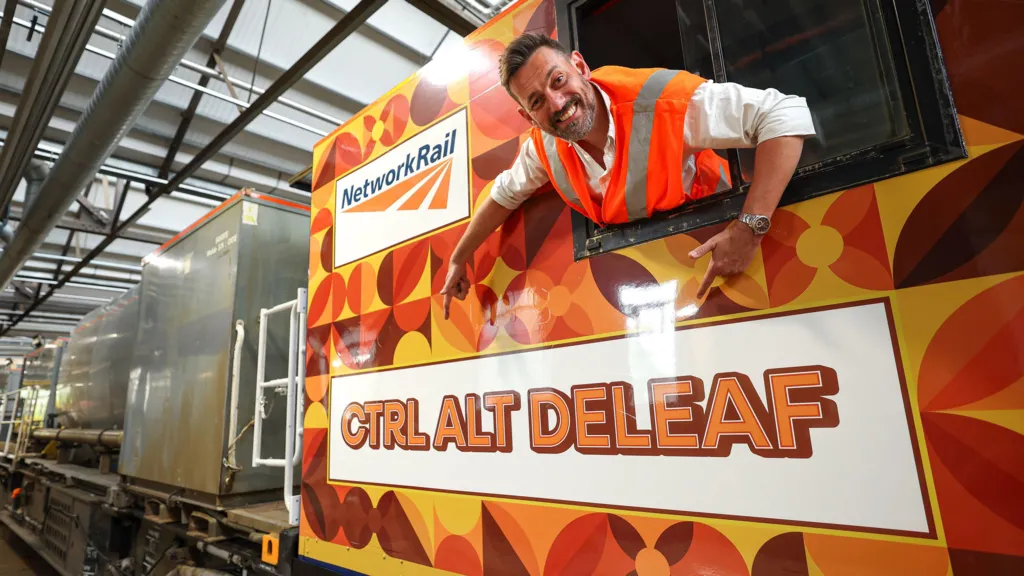
Every autumn for the past 25 years, Network Rail has sought to remedy this by sending out a fleet of specialist trains to clear the tracks with high-pressure water jets.
Now the public have voted to name one of these specialist trains. The shortlist included Leaf-Fall Weapon, Pulp Friction and The Autumn Avenger. The winner? Ctrl Alt Deleaf.
Have a great weekend.

 Processing...
The debate about intensification has been raging for too long. Close to the Morningside Train station there are about 6 or 7 multistory apartment buildings. I live in one of them. And Simplicity has been clearing a large site of 3 or 4 run down commercial buildings on Morningside Rd and will build 2 buildings of 8 stories and 300 apartments. There are some quality buildings for the many businesses in the area but overall the area looks a little tatty. In Auckland there are areas where there are now clusters of taller apartment buildings and people are not complaining. Panmure, Avondale, Newmarket, Sylvia Park, Fruitvale, Glen Eden. Wherever there are CLUSTERS of taller apartments then it seems to me that it is easier to get consent to build some more close by. People living in them better support intensification and the benefits.
Over these recent grey days the view from the train out west or south of the endless kilometers of sprawling suburbs is not atractive and some apartment add variety and choices for people.
Might want to fix up *[Christchurch-themed heading]*
I think it is appropriately Christchurch-themed as it is! 🙂
[Christchurch-themed comment]
[Christchurch-related response to comment]
It seems to be a common theme that roads that connect to new RoNS have increased deaths and injuries. Does that mean that big highways just move the accidents along the road? This is the case with the Waikato Expressway leading to the Cambridge to Piarere section and the Kapiti Expressway leading to the Otaki to Levin section. Any other examples? Has a serious study been done of this?
Transition from any safe high-speed road onto less safe roads that require slower safe speed is always difficult. Switching the brain from 110 to 80 or 50 needs some serious help. At the very least the less-safe road needs to look different from the safe one.
Question – has anybody (who knows what they’re talking about) – ever looked at some of Auckland’s wide-ass streets and proposed a better way to utilise them?
Drive (or walk or cycle or bus etc) around – for example – parts of the inner suburbs and it’s striking how wide the streets are (even by NZ’s generous standards).
It seems like a bit of a waste of space – even if you’re the type of person who sees on-street parking as a God-given right.
A radical response might be a narrow row of terraced town-houses stitched down the middle of – say – Wanganui Road (off Jervois).
Alternatively (and probably even more radically) you could take a block streets and ‘shunt’ every row back (so that each street becomes more narrow) and then turn the freed up land that results into another row of houses.
Probably more practical to just bowl everything and build something totally new, but still.
Underground the power lines and more trees would be great. Most streets have hardly any decent large tree cover.
Costs a lot to move all the utilities. Better to plant lots more trees and make space for people.
Bledlisloe cup here in Auckland people! GO THE ALL BLACKS!!!! Meaning being staged in Eden Park. Eden Park tenant to Rugby union, Rugby League, Soccer(football & Cricket.
With plans to develop one of its old stand(Northern Stand) but not the oldest(Western Stand built in 1992)/prone to water leakage. For quite sometime Eden Park has been fortress for mainly All Blacks, Blues Rugby/Auckland Rugby, Black Caps & Auckland Cricket. It’s time Eden Park changed its tenants and how they operate financially in-future! The whole aspect of what Eden Park should be in-future is to be a venue where all our National Sports teams host matches since it’s New Zealand’s National Stadium. Also suppose to be venue where everyone who lives in New Zealand from far & wide to visit for concerts and sports matches. Eden Park suppose the epicentre for concerts and National Sports teams host matches!
The capped 12 amounts and six artists of concerts per year should be abolished. Only keep the curfew of finishing at 11 pm. At Eden Park, concerts are capped at 12 a year from six artists. Weekday shows must finish by 11pm, with a maximum duration of five hours. No more than four concerts in any four-week period.
Our regional sport teams like the Blues, Auckland rugby and Auckland Cricket shouldn’t be tenant anymore going forward into the future! It’s not economically viable or even sustainable for them to be hosting matches as tenant as Eden Park loses out on big money opportunities like hosting more New Zealand National sport teams matches and concerts like Taylor Swift, Eminem as examples! Eden Park should be home to New Zealand National sport teams matches and a epicentre for New Zealanders to visit for concerts!
If things were ever to materialise between stadium finances and fixing venue capacity, it needs government intervention for sure! What central government needs to fix Auckland stadiums capacity and making Auckland financially viable(feasible)/sustainable for our regional teams to place one-off payment of building two seperate stadiums with funding Eden Park redevelopments. Auckland really needs two more stadiums, one 15,000 seated capacity stadium tenants Auckland Rugby, AFC potentially either Western Springs or elsewhere and one 30,000 seated capacity stadium tenants Blues rugby & Warriors at Bledisloe Wharf or elsewhere, anywhere that’s central part of Auckland so everybody all parts of Auckland can commute and can easily access the venue.
Central government really needs to back Auckland in funding a one-off payment for two more stadiums one 15,000 seated capacity stadium and one 30,000 seated capacity stadium with Eden Park redevelopments. That way tenants are actually making full use of ‘whole venue’ rather than viable rows of empty seating. Once two more stadiums are built in Auckland, these stadium will be financially feasibility to operate and be sustainable. Meaning Auckland council wouldn’t have to rely on central government for funding projects like new stadiums, new roading projects or rapid transits. The stadiums be able to financially fund themselves and not be in debts and be operated by Auckland Council
Football does not go near Eden park.
The best thing that could happen for Auckland is that eyesore white elephant gets torn down, its land developed and the proceeds used to rebuild North Harbour, Mt Smart and Western Springs to cater for what Auckland really needs, sport and entertainment wise.
+1
“The best thing that could happen for Auckland is that eyesore white elephant gets torn down“
The two eye sore white elephants that’s letting down Auckland is Mt Smart Stadium & North Harbour stadium not Eden Park due to seperate specific issues. Mt Smart Stadium is an issue due to its location, outdated underutilisation in how to run different events, not purpose build for some events. North Harbour stadium gain enough money to fund its own expenses due to not enough attendances with its current tenants North Harbour Rugby & Moana Pasifika.
What needs to happen with Eden Park is properly designed well thought through redevelopment of Western Stand and eventually North Stand.
Western Springs stadium capacity of 15,000 definitely should get funding from any government. It must be placed under their election policy from any party for 2026 election and make one off payment in funding so Auckland can fund its own projects without need of central government. The one thing with the design of Western Springs stadium should changed by placing grass embarkment on side facing the lakeside park.
Mt Smart is not a white elephant, it is the most booked venue in NZ.
Eden Park is effectively owned by the Eden Park Trust. They are the only ones who can decide what happens with it and they have shown no desire to do anything else other than upgrade it. There is a very good plan for that, but it will never happen – or not completely anytime soon. There is no money.
One of the options for Albany is to downsize it to a 10k all seated, all covered (but not roofed) venue, unlike any other in the country. All the sporting codes want it but the local councilors and MP are trying to keep it as is.
Western Springs had the chance to have a 15,000 seat stadium, via the Auckland FC proposal, but that is now dead in the water.
Central government is not going to be funding, fully anyway, any stadium building anywhere in NZ. Christchurch got help with Te Kaha as part of the wider earthquake rebuild. EP got money for the 2011 RWC. Those two are anomalies.
In saying that, it woul not surprise me if EP got the $110m to get started, as an election bribe by National ander the guise of getting Auckland moving and getting infrastructure built. But I think all that would get you is an upgrade of the lower North Stand to allow for retractable seating and a proper cricket oval, when needed. Its got to be twice that number to do the rest of the North Stand, to make it identical to the South.
Yes Eden Park is an independent trust meaning source of funding from central government whatever project inside Eden Park it maybe! Also it is on the Fast-track for redevelopment already but don’t agree with Eden Parks redevelopment plans!
Western Springs Stadium proposal was backed by entrepreneurial investors and obviously plans failed due to the investors backing. Still doesn’t mean government can intervene in funding Western Springs Stadiums and input some stadium design changes and change the ownership to council. Central government after 2026 election do have the affordability in funding Western Springs Stadiums.
“There is a very good plan for that, but it will never happen – or not completely anytime soon. There is no money.” There is negative money, because they never pay(ed) their previous Council loans back.
at the very least, anon, have the self-awareness to comment under a different username if you’re going to “+1” your own comments
“Once two more stadiums are built in Auckland, these stadium will be financially feasibility to operate and be sustainable. ”
Is there just a shred of evidence that this is true? Auckland has two 20,000 odd venues that need propping up.
Anon or Ali?
this is also the guy who thinks that the Avondale-Southdown line “has already been paid for”, don’t expect financial literacy out of them
Every time when Blues rugby play at Eden Park, what do you see?! Answers: Rows to Rows for empty seats where average attendance is about 15,000 or 2000 lesser attendance
There really is never a case for any central government funding stadiums and event centres. This should always be the realm of regional, unitary, or local government.
What is needed though is for central government to relinquish some of its power in tax collection. Local Authorities need more sources of income then just property rates and discretionary, read political, project grants.
Government opposition to a bed tax smacks more of power centralisation then any economic competence. Bit like the rest of our current government’s decision making.
A local bed tax contributing to both facility provision and some event funding seems eminently sensible.
We don’t even get to control our transport. Govt ministers make the decisions what speeds we are to drive, what traffic calming we are allowed to use, and place their unelected representatives on our bodies deciding what gets built. Of course they don’t want to give us any added funding base. That would mean we would be less dependent on their “handouts” at election time.
This is not Auckland v. Wellington. It’s Auckland MPs v. Council and people.
No taxation without Representation!