This is a guest post by Alex Bonham, Yasmin Tapiheroe, and Nic Williams of Women in Urbanism Aotearoa. They make the case that permitting perimeter blocks in mixed urban housing zones will better provide green space, trees and safe access to play. (Header image: the courtyard of a perimeter block in Copenhagen, via PlanDesignXplore.)
The media presents the current debate over Auckland’s planning changes as a battle between heritage and high-rise development, and yet both Plan Change 78 and its replacement both retain all of the heritage areas and most of the Special Character Areas. And the idea of taller apartment buildings in or near the city centre is neither new, nor problematic.
In contrast, there has been relative silence around the proposed mixed housing zones. These permit three (3) three-storey houses per site on large swathes of the isthmus, and are thus effectively the MDRS (medium density residential standards) in all but name.
This is odd, because when the MDRS were first imposed on councils, they were controversial. Even practitioners and commentators including Jade Kake, and Brendan Harre were ambivalent: they lauded the extra capacity the standards enabled, but recommended that councils adopt rules to enable good urban design and deliver the sorts of homes that would serve different communities well – particularly families and extended families who want common outdoor space.
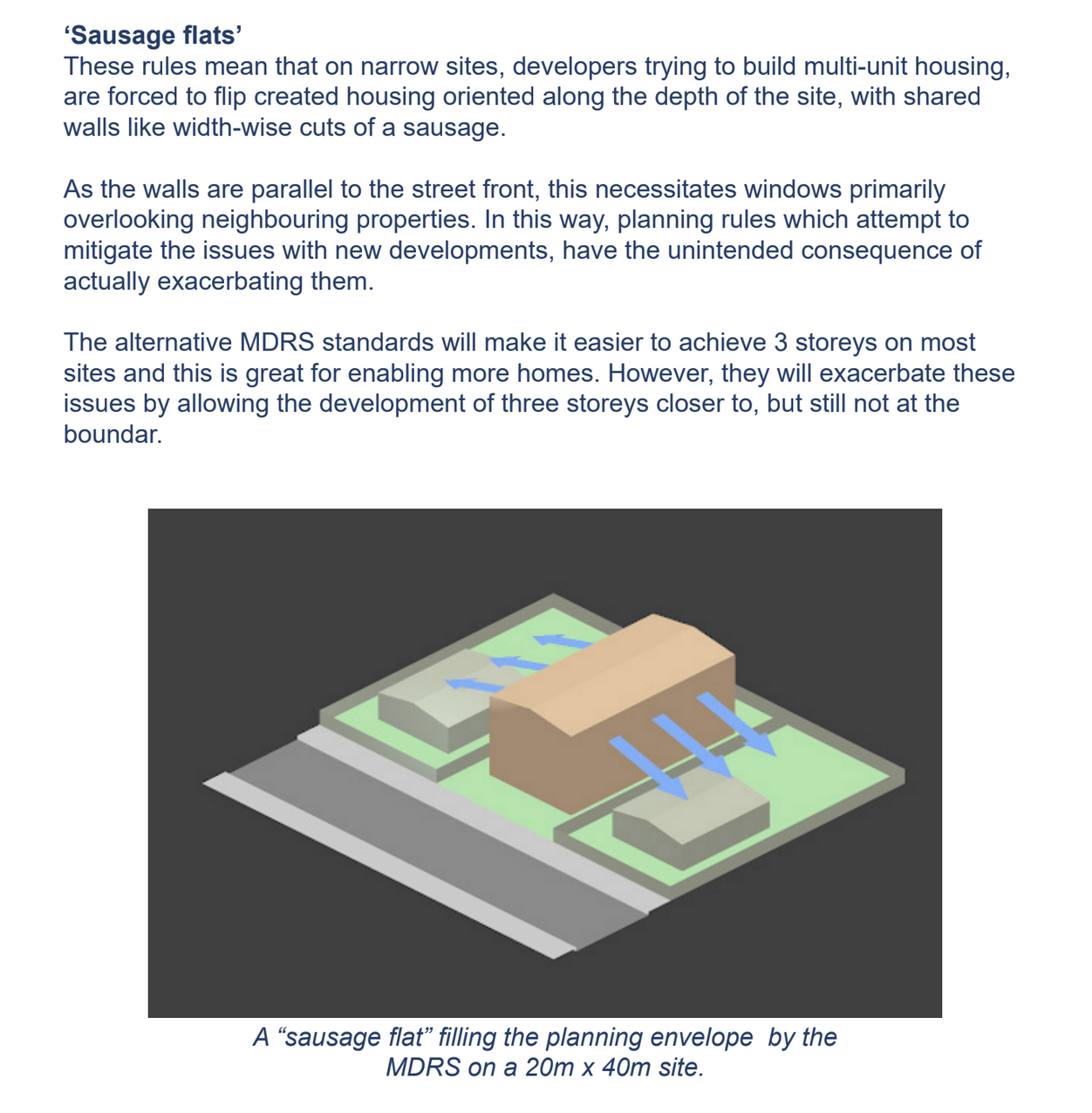
Advocacy group Coalition for More Homes even went to the trouble of presenting Alternative Medium Density Residential Standards. They sum up the issue well, firstly highlighting the issues with the familiar layout that produces strips of townhouses alongside driveways:
 Instead, the Coalition for More Homes proposed an exemption to height-in-relation-to-boundary rules and yard requirements at the front of the site, to enable more effective use of sites:
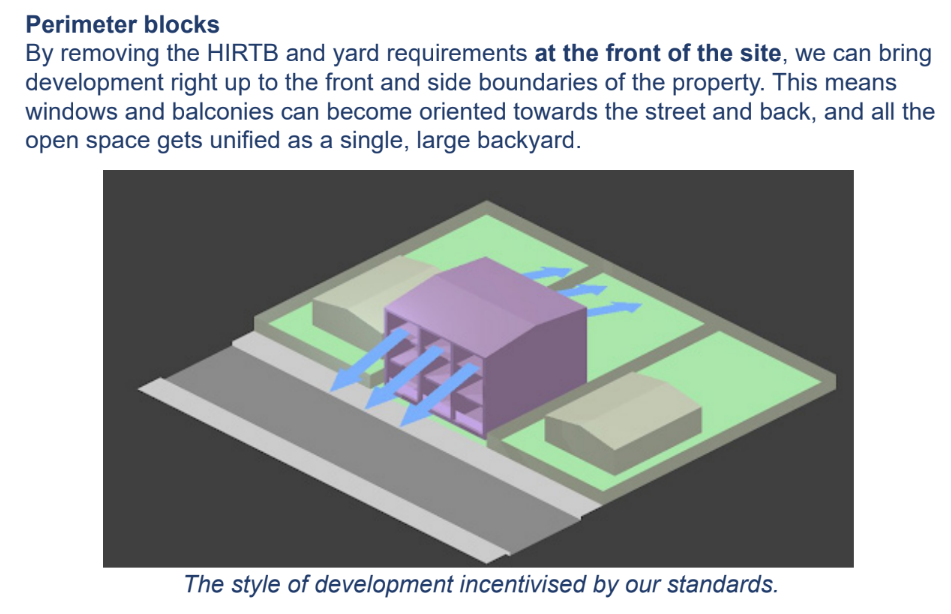 Over time, this approach can form a perimeter block – with an unbroken urban fabric facing and connecting with the street, and a large green space at the back.
Perimeter blocks have many advantages: for recreation; to ensure space for trees and plants that support biodiversity; and permeable routes to soak up and channel water in flash floods. They also work when the buildings are of different heights.
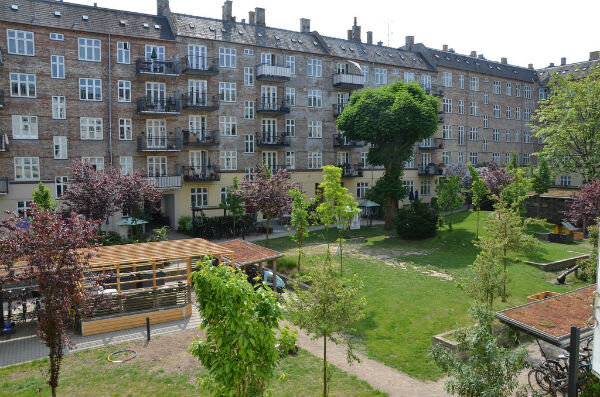 Another Copenhagen courtyard in a perimeter block. Via PlanDesignXplore
It turns out that this sort of built form provides more density across a suburb than tall towers on podiums, and is cheaper too. Density brings with it more cafes, shops and amenities in walking distance; and less isolation, particularly for families and seniors who spend more time at home or close to home.
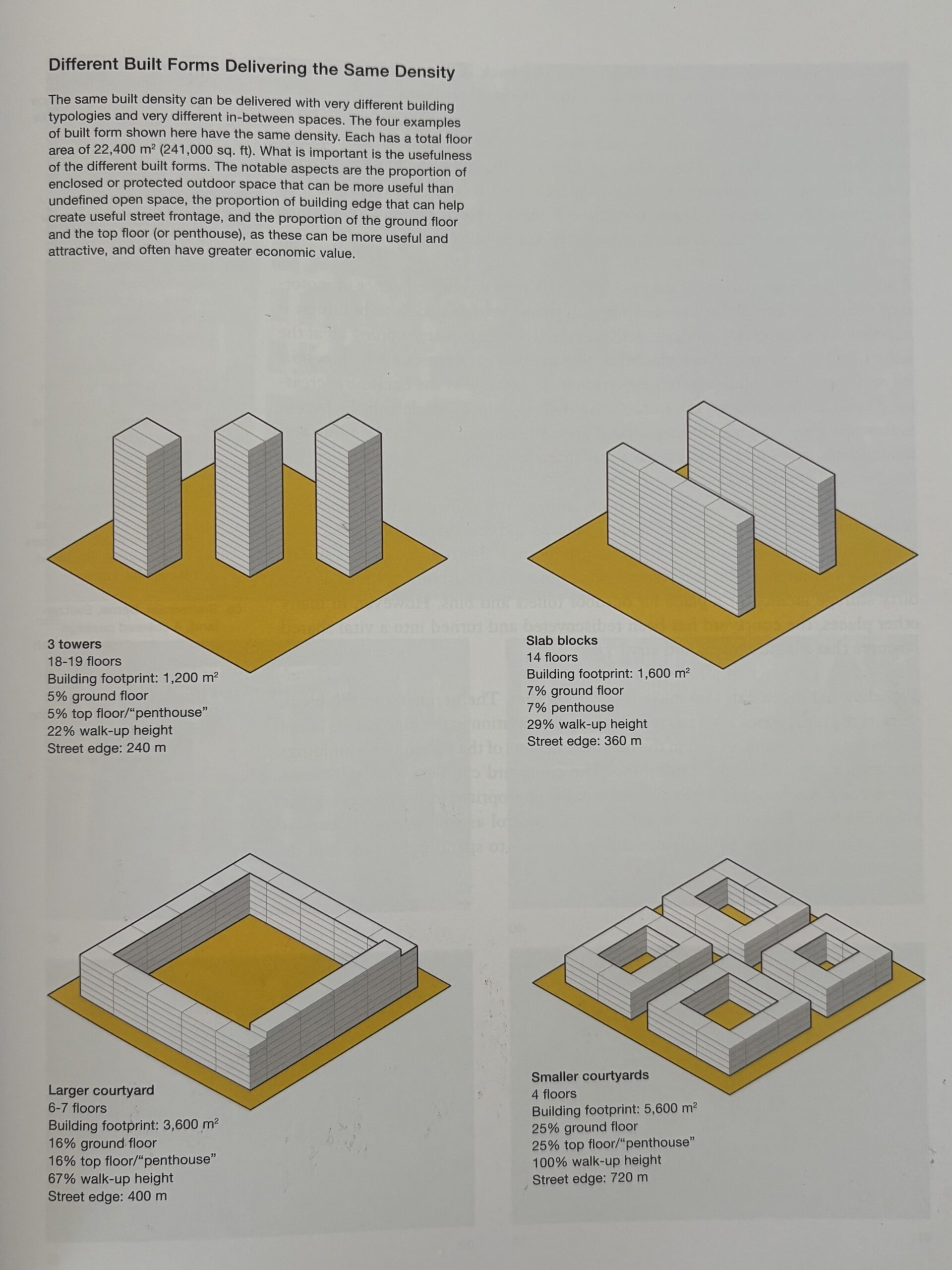 Different building forms delivering the same density.
Image from David Sim, Soft City – Building Density for Everyday Life.
As advocates for women, families and non-binary people, we at Women in Urbanism Aotearoa recognise the value of fostering safer streets, walkable cities and attractive homes that are accessible for all. We believe that children are an indicator species and that if cities work for them, they will work for everyone.
It is worth noting that the radical transformation of Dutch cities towards what we now know as walkable, bikeable, sustainable and child-friendly cities was triggered by the ‘Stop de Kindermoord’ (translated as ‘Stop the Child Murder’) movement in the 1970s, driven by a shared sense of urgency to reclaim congested and unsafe streets on behalf of children.
Perimeter blocks are better for children than high rise apartments, and sausage flats!
 Child with strawberry. Image: Andy Evans..

Child with Apple iPad. Image: IntelFreePress via Wikimedia Commons (CC-BY-SA-2.0)
Children are wired to learn through play, and the more ways they can play, the more they will learn. Safe access to greenspace makes a huge difference to how kids can engage with the world, but most children who live in apartments never make it to a park in the winter at all because their adults are not keen on accompanying them. If children cannot safely access the outdoors by themselves, they will not spend much time there and will experience the world second-hand.
In our view, the time children most need easy access to outdoor space is during their early years. Toddlers are extremely active. Before they are two years old, they will be out and about, whizzing on trikes, pushing a toy lawnmower and exploring the garden.
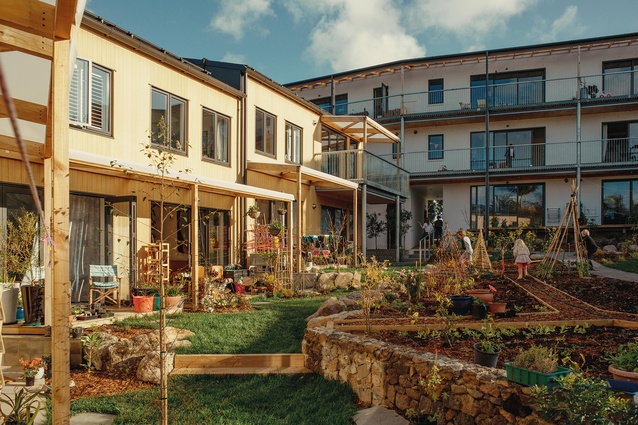 Children enjoying the CoHaus courtyard gardens in Grey Lynn, Auckland.
Image: Adam Luxton, Architecture Now
Gardens continue to be important sites of play as they get older and move through swings, water play, trampolines, growing flowers, and hanging out and enjoying a BBQ with family and friends. At this point, the appeal of the perimeter block to all ages is hopefully coming into view. And we have not mentioned yet how much nicer it is if you get sunlight into a dwelling.
Despite what a few planners say, you do not need to build a whole perimeter block at once. They can be delivered over time independently on small lots as demonstrated convincingly by the Montreal-based traffic engineer who blogs pseudonymously as Urban Kchoze, using East European city blocks as an example:
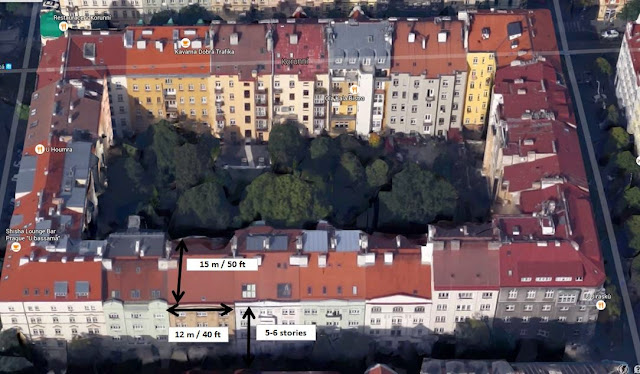 A ‘Euro-bloc’ made up of lots of narrow buildings, not a few big ones.
Image via Urban Kchoze
“… the block is NOT made of one large building, nor even of a few large buildings. No, it is in fact made up of a lot of narrow buildings about twelve meters wide (40 feet). Why is this important? Because if buildings are narrow, it means that blocks such as this can be built progressively. . . And indeed, looking at smaller cities, we can notice similarities between these blocks and blocks of smaller townhouses . . . and find areas where the two building forms coexist.”
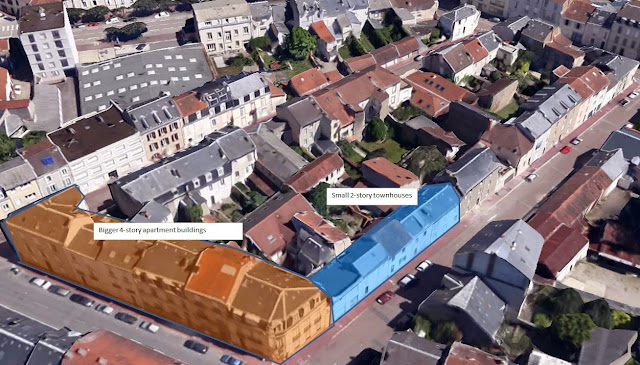 “The bloc’s basic design is already present, but some buildings are older, smaller, with only 2 stories, whereas buildings on the main avenue are deeper and taller, yet they have the same width, so can be built on the same lot.” (Image and caption via Urban Kchoze)
This is exactly the sort of site width that’s typical in our isthmus suburbs here in Tāmaki Makaurau. The lot-by-lot approach can be an advantage. It makes for a combination of coherence and textual variety that makes the city more interesting. For an idea of where architects have leaned into this, look at Vinegar Lane (which has even smaller individual lot widths) in Crummer Road just off Ponsonby Road:

Textures of Vinegar Lane. Image: David St George/ TOA Architects
The way Vinegar Lane was created was by using form codes. These constrain the architect to a given horizontal and vertical building envelope and a palette of materials to choose from. In this case: dual aspect housing, no front or side yards, fifteen metres high and a set depth to allow a shared garden to form at the back.
Where sites are deep, rules could enable two rows of single aspect apartments (one row facing and overlooking the street, and the other looking out over a communal green area). All still cross-ventilated. This would provide for a high intensity of living, yet also ensure a high degree of sunlight access (for neighbours too) throughout most of the year.
We will end up with some blank concrete walls during the transformation period, but we can cope with that. Auckland could accelerate the transformation process by following the example of the New South Wales government and offering a range of pre-approved housing pattern designs – each includes a landscape pattern suitable for low to mid-rise developments which can be adapted to suit many neighbourhoods. In Australia, if you build exactly to the chosen typology, you get your resource consent in ten working days (rather than twenty).
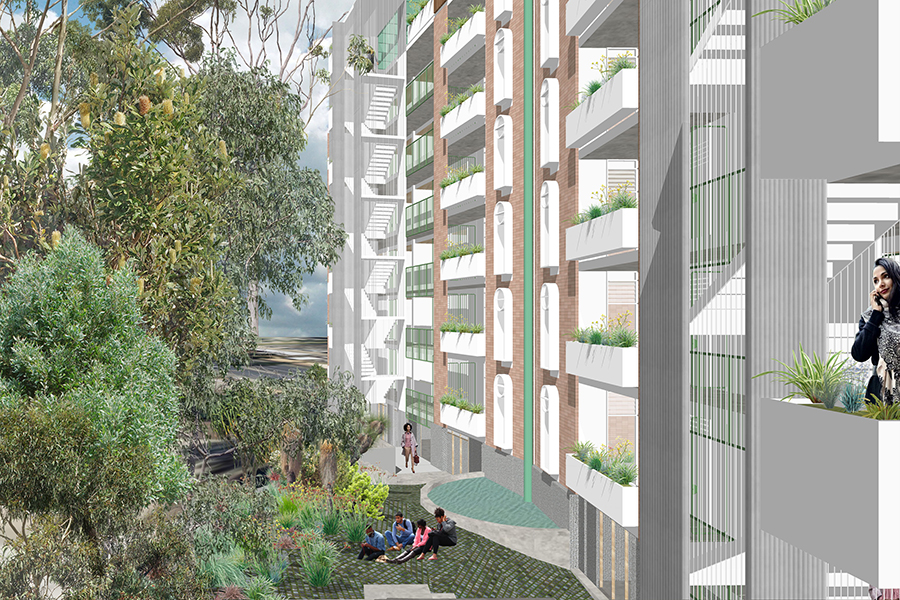
A building design by Spacecraft Architects, winner of the “medium-rise apartment building” category in the NSW Housing Pattern Book design competition. (Originally designed for Urban Habitat Collective, a planned co-housing project in Wellington). Image: Spacecraft Architects
Ōtautahi Christchurch has set a precedent in its recent plan change (approved by Minister Chris Bishop) by allowing an exemption to the height in relation to boundary standard in the High Density Residential Zone (14A.6.2.2.c) and Medium Density Residential Zones within the Local Centre Intensification Precinct (LCIP) walkable catchments (14A.5.2.6.b). This allows for the construction of three or more residential units for a maximum of twelve metres in height from ground level along the first 20m or 60% of the site.
Auckland could apply a similar rule in “mixed housing urban” zones on the isthmus anywhere there is a grid street layout. What do you think?
Last week it was announced that there will be public consultation on the replacement plan change – it will run from 3 November till 19 December, so let your voice be heard. What sort of city do you want to live in?
EDITORIAL NOTE: Auckland Council will be discussing the withdrawal of Plan Change 78 and the proposed replacement plan change this Wednesday, 24 September from 10am, at an extraordinary meeting of the Policy and Planning Committee.
The purpose of the discussion is “to decide whether to proceed with Plan Change 78, or withdraw Plan Change 78 and progress the draft replacement plan change.”
See agenda here, and attachments here and here and here. (If we’re not mistaken, that looks to be over 2000 pages of material!)

 Processing...
Was just listening to this interview with Simon Wilson and going to link on the last Weekly Roundup but realised it’s more relevant here perhaps.
Quite a good beginners crash course in what has been going on in Auckland with planning or lack of planning for density.
https://www.youtube.com/watch?v=5ELqvbX6ZEg
Thanks Grant for linking this excellent vlog
I have some great photos from 2018 when I went to Amsterdam to see the site by site building going on there. With the same principle or creating a 3 up but positioned on the front of a narrow site, forming either a row of front lawns, or a row of back ones. With cars on the outside and all calmed to 30km – 10km limits depending on the pedestrian or share priority of the space.
It was great.
Plenty of plot-based perimeter blocks in Almere Poort – just outside Amsterdam. This is all veyr new. You can change the dates to see how the plots develop.
https://www.google.com/maps/place/Almere+Poort,+Almere,+Netherlands/@52.354055,5.153669,3a,75y,25.65h,79.93t/data=!3m7!1e1!3m5!1sd50plsWRGKkUEJNlGNOGfA!2e0!6shttps:%2F%2Fstreetviewpixels-pa.googleapis.com%2Fv1%2Fthumbnail%3Fcb_client%3Dmaps_sv.tactile%26w%3D900%26h%3D600%26pitch%3D10.07044116374793%26panoid%3Dd50plsWRGKkUEJNlGNOGfA%26yaw%3D25.65070432177982!7i16384!8i8192!4m6!3m5!1s0x47c6116a86891947:0xe05ab7380dec0f9a!8m2!3d52.3431463!4d5.1454804!16s%2Fm%2F0kfx28l?entry=ttu&g_ep=EgoyMDI1MDkyMi4wIKXMDSoASAFQAw%3D%3D
Missing from the conversation is any notion of popular aesthetic appeal – something mentioned recently by the owners of Brookfields homes when speaking about widespread opposition to modern infill housing.
Whether NZ-trained architects are unable to appeal to such a notion or whether they simply don’t want to is slightly moot.
The fact is, that popular opinion is against their work and therefore modern innovations (in the NZ context) of good ideas such as the perimeter block.
New Zealanders will only support a higher level of density when our architectural profession is capable of making them beautiful. In this respect, the cheap-looking synthetic mediocrity of Vinegar Lane will do very little to persuade New Zealanders that this mode of living is worth taking up.
If any architects are wondering how they can achieve this, I suggest that they stop worshipping the present iteration of their profession and start engaging with the public to calibrate their tastes with the people obliged to actually live with their work.
Yeah nah, kiwis don’t pay for architecturally beautiful housing, regardless of the mode of housing.
Architects are perfectly capable of that, but for every architecturally designed house that gets built there are literally a hundred off the plan GJ Gardner houses slapped up. People aren’t moving into Milldale and Kumeu sprawl suburbs because the houses are beautiful.
While it is certainly true that most Kiwis can’t afford to – partly because our planning law counter-intuitively makes good design harder to achieve – a big reason for the reluctance is because we see the work of Kiwi architects and see little value in what they can produce.
They’ve imposed a post-modern aesthetic that doesn’t resonate with any of our cultures. This is why they speak in complete gibberish whenever they’re asked to describe their usually leaking crap-shacks.
There are exceptions of course, however most of them are mired in group-think and self-worship. When AI replaces them entirely I doubt we’ll notice.
You can get an architect to design you a faux villa or a fake wharenui if you want to, no problem there.
Meh architects will design whatever they get paid to at the end of the day. The people with the money are deciding they style they want – property developers for the most part. If villas are so great, why doesn’t anyone build new ones? Even for big projects, architects might compete for tenders with their concepts, it’s ultimately the investors, council if it’s a public project, that decide.
Love the concept of pre-approved designs. I’ve just been thorough a leaky home ordeal and finding many things that seemed to be one off solutions and going through the building consent and endless amendments to resolve them. If standardised desgins were available then we would have had so many less problems (and not been leaky in the first place). Problem is, who decides what the designs will be? Unfortunately, probably politicians. We actually do need strong regulation and make it difficult to build silly things (wealthy people can still pay if they want) but good standardised pre-approved designs available. It would also allow material suppliers to focus on standard manufacturing and supply and enable lower cost building.
Feel like I’m repeating myself with the whole the villa’s are product of time and place the timbers used were readily available and cheap most were working people’s cottages not manor’s for wealthy if the sheet cladding was massed produced and building techniques available in 1980 was available in early 20th century inner city could of looked this https://www.google.com/maps/@-36.7536222,174.7211382,3a,75y,117.84h,94.08t/data=!3m7!1e1!3m5!1sHhueQnO3Dc0bhYw9fysOew!2e0!6shttps:%2F%2Fstreetviewpixels-pa.googleapis.com%2Fv1%2Fthumbnail%3Fcb_client%3Dmaps_sv.tactile%26w%3D900%26h%3D600%26pitch%3D-4.081128819213163%26panoid%3DHhueQnO3Dc0bhYw9fysOew%26yaw%3D117.83953662747935!7i16384!8i8192?authuser=0&entry=ttu&g_ep=EgoyMDI1MDkyMS4wIKXMDSoASAFQAw%3D%3D
In terms of Vinegar lane I would of gone with different colour palette maybe but I don’t get strong feelings either way from the building. So hard to judge how well it age but I don’t write off last 50 years of whole field with such confidence.
Good post BTW, now I’ve just read it. Don’t forget to vote everyone as the public consultation period will be after the new council/local boards are voted in.
Great article! This morning my husband showed me a publication suggesting that based on their current lifestyle, the average American 18-year old is on track to spend 93 per cent of their free time as adults on screens.
Sure, that’s a US stat and not just about housing, but honestly, I think we’re facing the same issue here. Unless we create more safe outdoor spaces for people to play and hang out, I don’t see it getting any better. Of course, it’s nice when buildings look good, but even if a space isn’t pretty, if it’s safe and gives people somewhere to connect, that’s a win.
Excellent read. Perimeter blocks can of course take any form or style, and price point, including social housing. They are such an ideal and flexible midrise form, with a near perfect blend of public and private space, ideal for social balance in ann age of anxiety and social isolation.
There are plenty of really good contemporary examples being built in Europe now. Especially in Nordic and Central Europe, and the UK too.
There I particularly like the work of Peter Barber and Alison Brooks:
https://alisonbrooksarchitects.com/
http://www.peterbarberarchitects.com/
Peter Barber has a great philosophy for contemporary architecture – his buildings always include opportunities for residents to impose their own decorative tastes on their residences. This can come in the form of space outside their front doors for outdoor furniture or even special niches for things like sculptures.
One all-too-rare aspect of his design is his genuine respect for both locality and craftsmanship. For instance, a pattern of much of his recent work is to give bricklayers a chance to flex their skills (soaring arches etc) and the utilisation of yellow London clay bricks (contributing to the building’s sense of place in its neighbourhood).
If you visit his website you can see how this plays out from his initial (hand) drawings to their eventual implementation.
I would love to see his philosophy applied in New Zealand – although I suspect NZ’s architects would fall over themselves before admitting the influence a contemporary and populist English architect.
Here’s a set of buildings by Peter Barber under construction. I went there in 2023 after it had been finished. It’s a very good gentle density development in a tricky narrow site next to the A406 North Circular Road.
https://www.google.com/maps/place/Brent+Cross,+London,+UK/@51.5899796,-0.1957222,3a,75y,130.6h,86.35t/data=!3m7!1e1!3m5!1s3MQLYKf0rhCEPuhXsSjddQ!2e0!6shttps:%2F%2Fstreetviewpixels-pa.googleapis.com%2Fv1%2Fthumbnail%3Fcb_client%3Dmaps_sv.tactile%26w%3D900%26h%3D600%26pitch%3D3.64822529431396%26panoid%3D3MQLYKf0rhCEPuhXsSjddQ%26yaw%3D130.59879280906625!7i16384!8i8192!4m6!3m5!1s0x487610e86dffe111:0xef0e43b31af1c644!8m2!3d51.5763589!4d-0.2236956!16zL20vMDM0cnlr?entry=ttu&g_ep=EgoyMDI1MDkyMi4wIKXMDSoASAFQAw%3D%3D
Great piece Alex, Yasmin and Nic! I am reflecting how this could play out in West Auckland – currently sausage flat central. Greater density has so far not brought with it much in the way of improved amenities, and the loss of green space and tree cover has been immense. I wonder what the levers can be for Council/local boards to steer developer towards including more shared gardens and public amenities like walkways and seating areas, with the economic being what they are.
Makes so much sense to have building at the front near road, close to the boundary, with shared garden spaces at out the back. As people just don’t have time to go to the park with there children as much these days. Plus it’s a lot more attractive model than the current ugly sausage model of so many high density in fill housing throughout suburban Auckland. Plus the privacy and sunlight factors mentioned are actually greater. Many places in Europe do it well, particularly London.
Thank you, Alex, Yasmin, and Nic — this piece makes such a strong case for why perimeter blocks are the smarter, greener, and more family-friendly way to do density.
With the Council meeting tomorrow (Wednesday 24 Sept, 10am) to decide whether to stick with PC78 or withdraw it, I hope they choose wisely. If they press on with PC78, consultation will be slow, fragmented, and pushed into 2026. But if they withdraw PC78 and adopt the replacement plan, the public will get a proper say during the consultation period running 3 November – 19 December 2025.
That’s our chance to speak up for safer streets, greener courtyards, and housing that works for children, families, and communities — not just housing numbers.
The real problem in NZ cities – where do you put the cars? 6m of free kerbside works quite well if people don’t insist on having a garage/laundry/gym/study/bedroom that has to have a vehicle crossing taking up the kerb and footpath. Take a look all along Vinegar Lane.
Perimeter block does have potential if, like Vinegar Lane, the whole block is being redeveloped. Most Auckland build is on one or two lots with the neighbours unchanged to start with. Unless they are ready to sell to allow the block to grow out, “island” town houses will look weird and be unwelcome.
On-street car parking can work well if it is desiged and managed properly as part of the street cross-section. It’s more efficient and safer than having repeated driveway crossovers.
Here’s an example from IJburg (Netherlands) showing car parking designed as part of the carriageway in a new residential street (Cornelis Zillesenlaan).
https://www.google.com/maps/place/IJburg/@52.3610718,4.9786303,3a,75y,22.96h,73.47t/data=!3m7!1e1!3m5!1sXKnALX5XOEkVt0R-GQq71A!2e0!6shttps:%2F%2Fstreetviewpixels-pa.googleapis.com%2Fv1%2Fthumbnail%3Fcb_client%3Dmaps_sv.tactile%26w%3D900%26h%3D600%26pitch%3D16.534168677645525%26panoid%3DXKnALX5XOEkVt0R-GQq71A%26yaw%3D22.955312188298368!7i16384!8i8192!4m6!3m5!1s0x47c60ebd9a860733:0xdedc190fa755d732!8m2!3d52.355!4d4.997778!16zL20vMGRuNXNr?entry=ttu&g_ep=EgoyMDI1MDkyMi4wIKXMDSoASAFQAw%3D%3D
I don’t think that is any different from island apartment buildings so I think we’d cope
The battle of the inner city continues https://www.stuff.co.nz/nz-news/360833542/vote-aucklands-housing-intensification-goes-through-heated-council-meeting
Another option not shown in the diagram of four housing types is the good old fashioned, but still very practical, terrace house.
Of course terrace houses with internal stairs are usually no more than three storeys high, which limits the density; but note that in these diagrams the building height is an independent variable over all the types that’s not really relevant to the comparison that we’re discussing.
For similar overall density, there are pros and cons of perimeter housing with shared open space and terrace houses/ town houses with small private gardens.
Communal open space, to be useful, needs to be properly designed and curated. Too often it just ends up being ‘the land around the buildings that no-one has worked out what to do with.’
For example (Housing Commission flats in Collingwood, Melbourne):
https://maps.app.goo.gl/NbbSE5EGdogzsKA58
For an interesting example of these issues look at the Griffith Flats in Canberra Avenue, Griffith Australian Capital Territory:
https://region.com.au/well-preserved-griffith-flats-granted-provisional-heritage-listing/714766/#comments
https://maps.app.goo.gl/g1RQnPsNXjqvPnVVA
In round figures, a block of 11,000 square metres is allocated to:
2,000 square metres: footprint of 2-storey buldings providing 48x80sqm flats.
4,500 square metres: boring, featureless, unloved common space on the street side, which is visually continuous with the 10-metre wide berm/nature strip of the road easement. Effectively a 20-metre wide (!) front setback. This is garden city gone crazy, which is quite common in older Canberra.
4,500 square metres: mostly boring, featureless, unloved common space between the buildings, much of which is now occupied by an ugly covered communal carport and hardstanding (some ground floor flatters have unofficially developed small personal gardens, but they have no privacy.)
Note the vandalised sign in the picture in the first link. That gives a fair idea of the general ambiance of the internal common space.
In the same space, for the *same* number of similar *or bigger* 2-storey dwellings, you could have built two rows of bog standard terrace houses on 200sqm lots, with a rear lane across the block between them, giving everyone their own front door, their own private yard, and their own lockup garage at the rear.
That’s roughly what has been done more recently in places like Devlin Street Gungahlin (about 25 years old):
https://www.google.com.au/maps/place/Griffith+ACT+2603/@-35.1822366,149.1366979,123m/data=!3m1!1e3!4m6!3m5!1s0x6b164cf20fe05933:0x500ea6ea7695710!8m2!3d-35.3224545!4d149.1345298!16zL20vMDRjbXo2?entry=ttu&g_ep=EgoyMDI1MDkyMy4wIKXMDSoASAFQAw%3D%3D
What got into the town planners of the mid 20th century to make them think that no matter what the question was, the answer was always ‘more open space’?
(Rhetorical question. I suspect the answer is that they were overreacting to memories of British, Sydney and Melbourne inner city slums.)