Welcome to the last Friday of August, and our regular roundup of insights from the world of urbanism. As always, feel free to share your links to stories on transport, cities, and what makes them great.
This Week in Greater Auckland
- On Monday, Matt took a look at the announcement about the start to level crossing removals in the south.
- For Wednesday we had a guest post from Malcolm McCracken on improving Local Government representation in New Zealand
This roundup, like all our work, is brought to you by the Greater Auckland crew and made possible by generous donations from our readers and fans. If you’d like to support our work, you can join our circle of supporters here, or support us on Substack.
Note: We continue to experience some glitches with our mail-outs to social media and to our subscribers. Please contact us if you’re having any issues. And thank you for your patience while we sort this out!
The coolest (and greenest) way to cool (and green) cities
How to cool cities is an increasingly burning question, especially in the midst of record-breaking summer temperatures in the northern hemisphere. Carlo Ratti, director of the Venice Biennale Archittetura, reports on the value of urban trees – specifically, the right kinds of trees. (The piece is subscriber-only, so this is just an excerpt)
We showed that trees maintain a cooler temperature than the surrounding urban surfaces as much as 15 degrees in the hottest times of the day. But not all plants are created equal. Shrubs and grass provide minimal cooling. Trees with dense canopies perform far better in many locations. In Dubai, native drought-resistant neems outperformed imports. Los Angeles’s iconic palms — tall and sparse — offered little relief. Movie stars of the boulevard, yes; climate heroes, not so much.
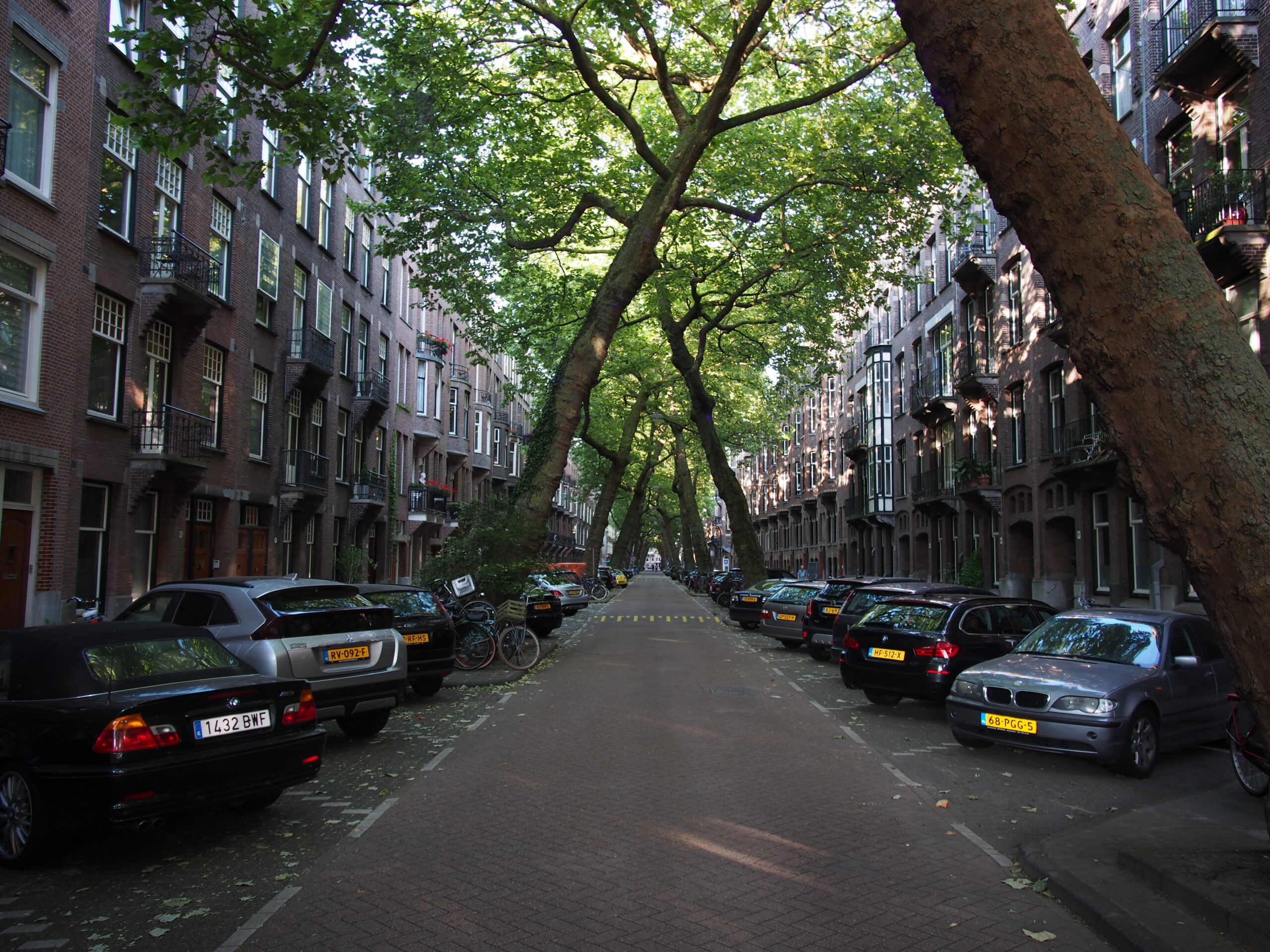
Lomanstraat, Amsterdam: even the vehicles have curled up in the shade for a nap under those great trees. Image: Alf van Beem via Wikimedia.
Councils and the “four wellbeings”
Former Auckland Deputy Mayor Penny Hulse has a great piece in The Spinoff on why the Coalition government’s push to remove the “four wellbeings” from councils is a step in the wrong direction:
The language of “back to basics” has too often been used to justify recentralisation – stripping councils of their mandate under the pretext of fiscal responsibility. It’s a political manoeuvre, not a cost-saving measure: one that shifts power away from local communities and into the hands of central government, under the guise of efficiency.
The government of today stands on a platform of localism and supporting communities to deliver on their unique aspirations. Removing the four wellbeings (social, economic, environmental and cultural) flies in the face of this promise. It is also a real lost opportunity to work with local government to collaborate on projects to stretch the central budgets. Unlocking local wisdom and community-led innovation depends on local government being treated not as a contractor, but as a genuine partner.
All communities want good water quality, safe roads and robust infrastructure. Over 80% of rates – closer to 90% in many councils – already goes toward water, roads and core infrastructure.
The remaining 15% of local government budgets fund sports fields, playgrounds, pools, libraries and community houses – to name a few. For decades, councils have partnered with NGOs, iwi and social agencies to make limited resources go further – often delivering outcomes central government cannot. While modest, these investments act as catalysts. Through vision and strong community partnerships, councils stretch every dollar further – leveraging donated time, local sponsorship and mobilised communities to deliver events, festivals, safety initiatives, town centre revitalisation and meaningful opportunities for connection in our neighbourhoods.
Allowing more housing – a fate worse than death?
Any time housing plans come up for discussion, you can be sure to hear some of the most hyperbolic nonsense pour forth to oppose change – and it’s already begun with the latest housing plans for Auckland.
Last night, a meeting in Mt Eden was a prime example with local councillor Christine Fletcher again one of the key culprits. This time with some absolutely nonsense figures.
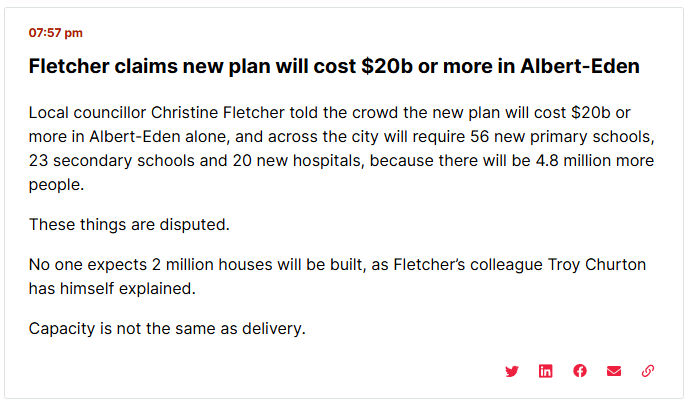 Another 4.8 million people – well, that would certainly get the economy pumping. Earlier in the week Councillor Fletcher called it “Planning by firing squad”. Both takes are less obscene than her comments four years ago.
This is the real issue though: we need more housing. And if we don’t enable that within reach of the central city, close to amenities, jobs, education, and where existing residents will benefit from the improvements that come with having more neighbours – then by definition, it will mean more people pushed further out. That in turn will cost us vastly more to create the overall infrastructure to support housing as it spreads out all over the countryside. Not to mention more congestion, more emissions, and a lower quality of life all round.
Michael, member of the public, gets it:
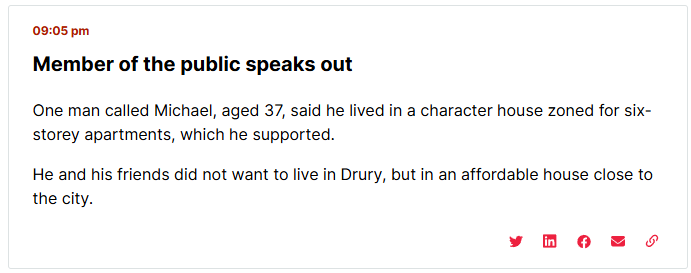 The crowds at events like these are typically heavily weighted to older demographics, and a regular and troubling feature of this kind of event is that anyone young who dares to speak up gets yelled at merely for existing, let alone expressing an opinion. This kind of behaviour is not leadership.
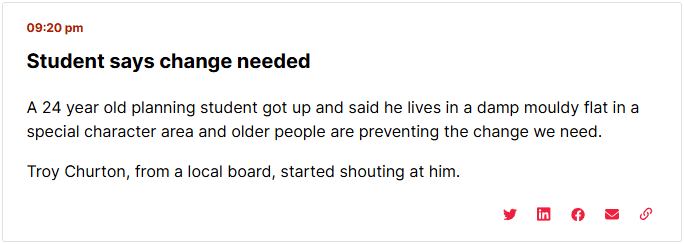
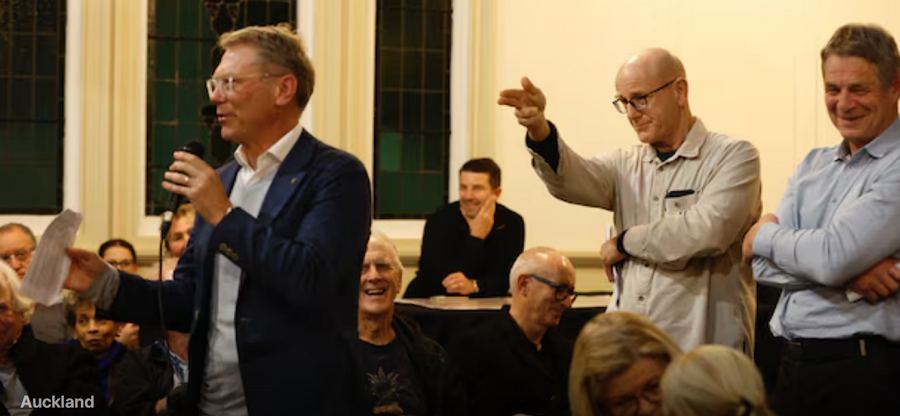
Troy Churton (in the middle) during the meeting
Against the usual tide of coverage (like above), RNZ this week had some useful comments from architect Graeme Scott:
An Auckland architect says the council’s draft plan for housing density around key transport routes and town centres will change suburbs for the better, if done right.
…..
The Urban Design Forum’s Graeme Scott told Morning Report they had strong support for the draft changes.
…..
Scott said there were ways of carrying out the plan that had great urban outcomes, attracting people who want to visit the areas, and not just those who lived there.
“We that, given the right process that council’s embarking on, let’s give it a go,” he said.
“We have to try.”
More people were needed in the living closer to town to drive the Auckland economy, Scott said.
“The population in the inner suburbs of Auckland is actually falling, because wealthy people can afford more space,” he said.
“That’s exactly the opposite to what we need, we need a lot more people close to the centre to get the economic activity and the productivity of the city up.”
Frustration Gully
Shocking, but perhaps not surprising, news about Transmission Gully, where the surface is failing so badly it needs rebuilding. Who’s paying for this, and why did the reporter not ask? If it’s the taxpayer, this will be another classic example of PPPs failing to do exactly the thing they are meant to be used for – to transfer risk to the private sector.
Wellington commuters can expect more disruption on the beleaguered Transmission Gully, as work’s done to patch up a stretch of the Lower North Island highway for up to half a year.
The Transport Agency is planning to re-surface and rebuild several kilometres of the road north of Porirua, likely meaning lane closures during the day, and full closures at night.
The work’s forecast to go from roughly October until March.
It comes just three and a half years after the $1.25 billion highway opened after years of delays, and relates to a legal battle with one of the road’s builders over unfinished work and quality issues.
The agency settled the matter out of court.
NZTA Regional Manager Mark Owen said the work’s not unexpected, but part of the road has deteriorated faster than expected, and concedes it will be frustrating for drivers over virtually the entirety of summer.
“At the moment there are some sections that are a little bit rough, and the chipsealing’s not always the most waterproof,” he said.
“[The road] was finished acceptable for people to use, but it wasn’t complete.”
Maybe they shouldn’t have laid the surface in winter when it doesn’t take properly, as they rushed to try and meet completion targets? There’s also a spectacularly appropriate typo in the article…
The road’s southbound lanes would take up much of the roadworks, but some parts of the northbound lanes might be resurfarced [sic] too.
Building back better
From the Hawkes Bay, a happier infrastructure tory:
A Hawke’s Bay community hammered by Cyclone Gabrielle has officially had its most important connection restored.
A big crowd was in attendance to open the new Moteo-Puketapu Bridge on Saturday, two and a half years after the old one was swept down the raging Tūtaekurī River.
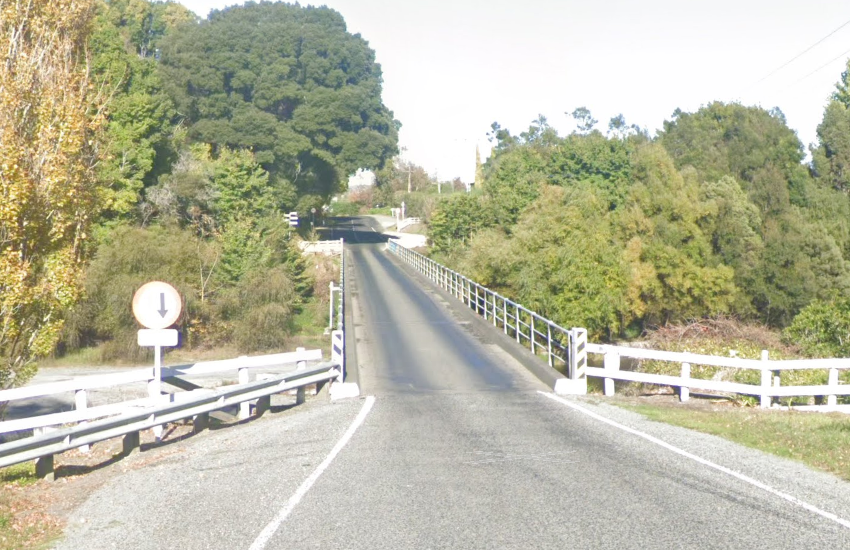
The $28 million project was built three metres higher than the original, with piles reaching 41 metres deep, and three columns instead of five to reduce debris build-up.
Two and a half years on, the result is a new, stronger, two-lane bridge with a shared cycle and walking path.
The old bridge was a single lane structure, while the new one is bigger, stronger and now caters for all users, which is great to see. (Images below from Google maps, and Hastings District Council).
Another thing to note: this bridge is 129m long and cost $28 million. So how is it that Auckland Transport says smaller bridges crossing rail lines will cost hundreds of millions of dollars each?

Down in Dunedin
From Dunedin, Councilor Steve Walker is right. No amount of car parking will ever be enough to satisfy some. Better to just focus on making the city better, nicer, safer and more accessible – but unfortunately that’s not what they’ve decided to do, just weeks away from a local election, the mayor used his casting vote to move the city backwards.
Dunedin has walked away from a controversial cycleway through the student quarter, with the mayor using his casting vote to decide its fate.
The Dunedin City Council had planned to create a safe and accessible walking and cycling link on Albany St, between Te Aka Ōtākou (the Harbour Shared Path) and Dunedin’s tertiary area and CBD.
An update on that original 2023 plan included a reinstatement of nine car parks, with 48 still to be lost.
But at a meeting on Tuesday, council voted not to proceed with the plan.
…..
Cr Steve Walker said parking was the most “inexact science we have”, and even if there were tens of thousands of new car parks created, the council would still field complaints.
…..
Walker noted that if council didn’t support the plan, “we may as well already rip up our goal of being one of the world’s great small cities”.
As per the project page, “the Albany Street Connection project provides the missing east-west cycleway connection across the central city to the Otago Harbour, the Te Aka Ōtākou walking and cycleway and connecting to the SH1 separated cycle lanes.”
Looks like a lot of engagement and design has already been done, and construction was set to get underway by the end of the year. Perhaps the new council will pick this up again after the election?
Keep Wellington Weird
Housing policy continues to rile up those who prefer to keep things the way they are, with Joel MacManus reporting for the Spinoff on an online game in which players are encouraged to “Beat the Bish”.
As MacManus notes, the game is the creation of Live Wellington, “an anti-density group that recently sued Wellington City Council and housing minister Chris Bishop over their decision to allow six-storey apartments in the so-called ‘character suburbs’ (basically anywhere within walking distance of the CBD).” Spoiler: they lost in court.
The political commentary implicit in this game is remarkable. One of the playable characters is a “homeowner” – a frightened-looking grey-haired couple with a wooden villa, standing on top of the Beehive, lobbing projectiles at a politician who legalised higher-density housing. It’s an unintentional masterpiece: a perfect caricature of the voters who dominate New Zealand’s political economy while still painting themselves as victims. The other character choices are telling: an environmentalist, a cyclist, a te Tiriti supporter (an unlicensed depiction of Stan Walker), and the Gordon Wilson flats, which look as derelict as ever.
It’s also quite striking that the “cyclist” is a cheerful-looking and helmet-free lady on a basket bike. Is this an (un)intentional tribute to Wellington’s relentless tenacity in pushing ahead with its Paneke Pōneke all-ages, people-friendly urban bike network?
Now you see us, now you don’t
From the USA, worrying news about vehicle safety for those outside the vehicle –click through to the story, for a powerful illustration of the (in)visibility zones:
The forward blind zones of six top-selling passenger vehicles grew substantially over the past 25 years as pedestrian and bicyclist fatalities soared, a comparison technique developed by the Insurance Institute for Highway Safety shows.
“Over multiple redesign cycles from 1997 to 2023, forward visibility within a 10-meter radius fell as much as 58% for three popular SUVs, the researchers found.”
This affects us in Aotearoa, too, as these particular models (and other similar shapes and sizes) are common here:
“The most dramatic reduction came for the Honda CR-V, as the vehicle’s hood, mirrors and A-pillars all obstructed a greater portion of the driver’s view over time. Drivers of the 1997 model were able to see 68% of the area 10 meters in front of the vehicle, while drivers of the 2022 model can see only 28%.”
Travel corner
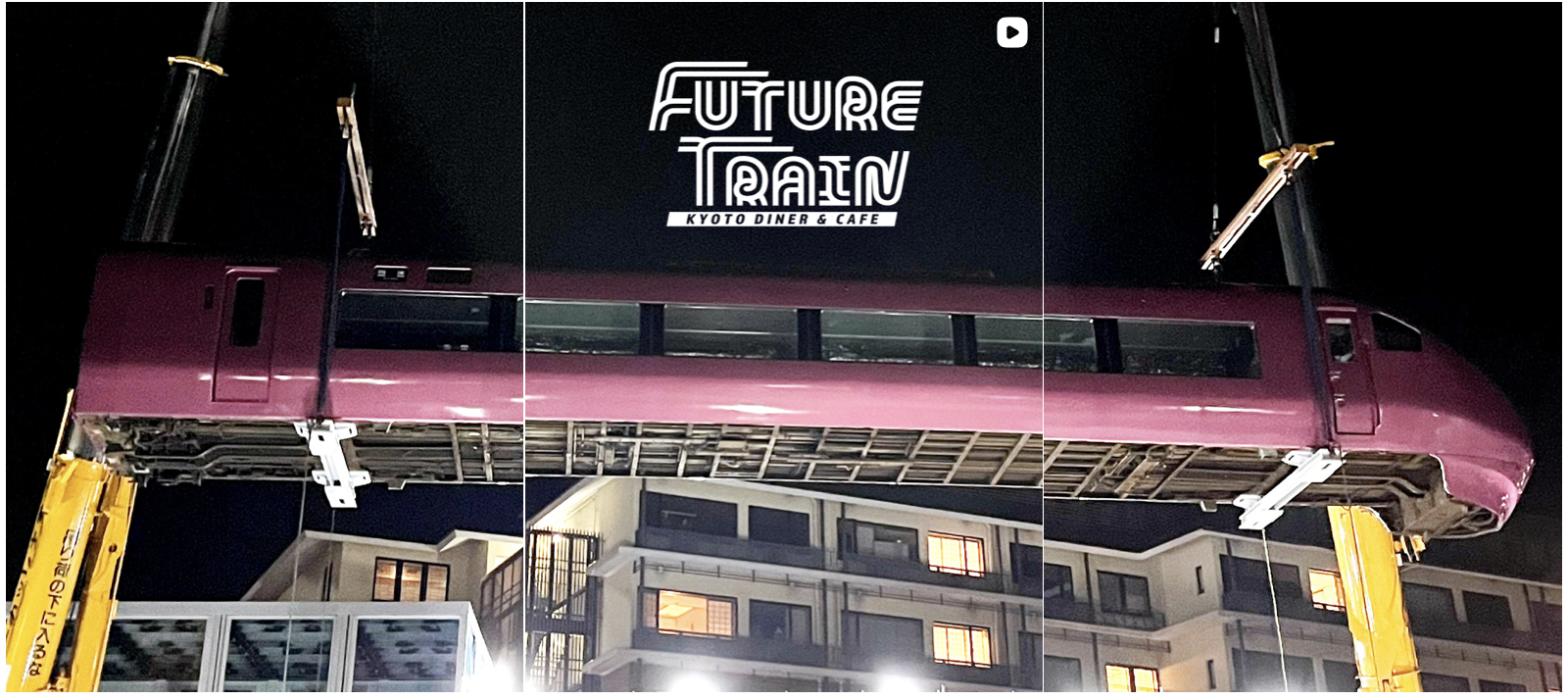
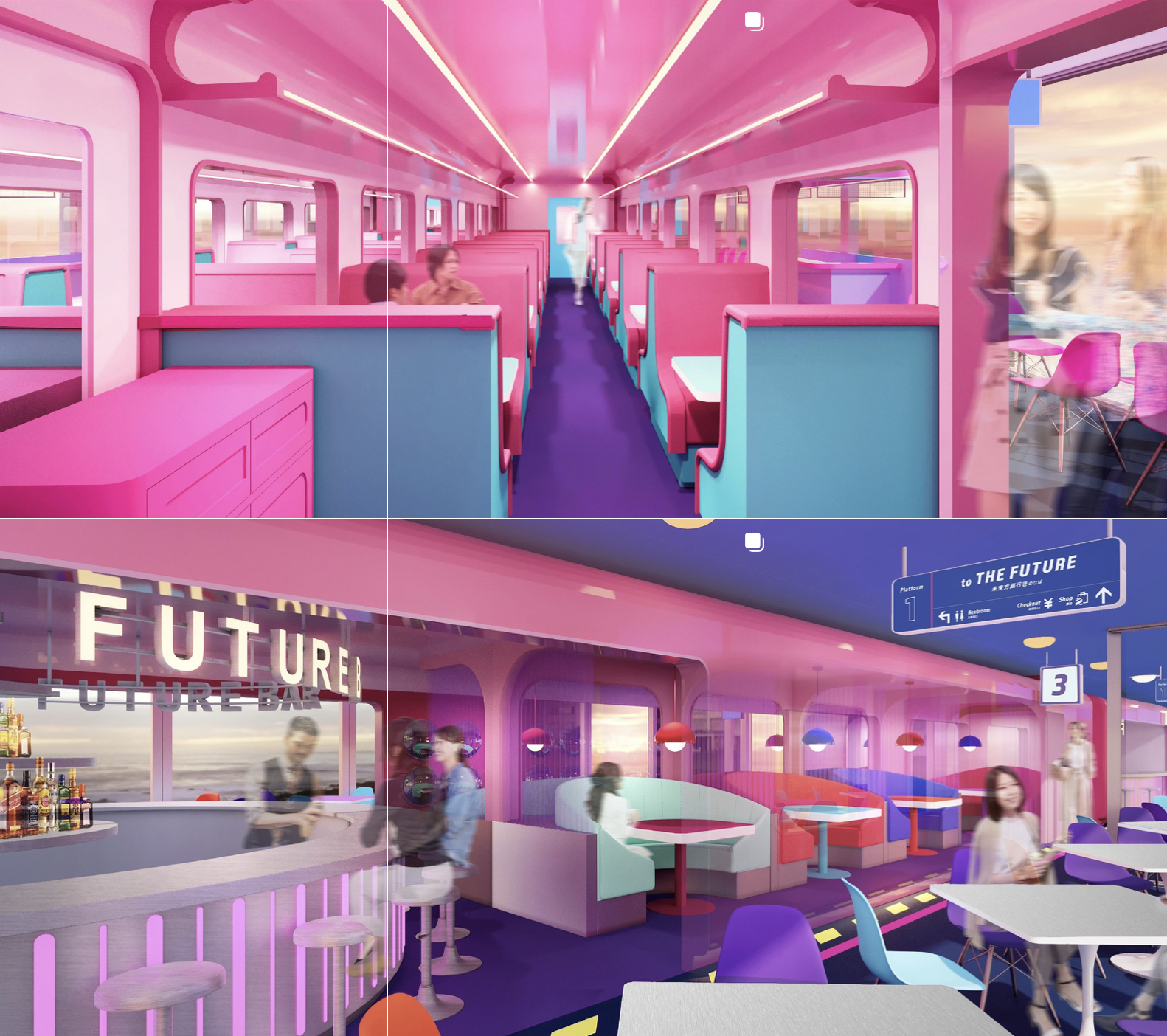
An “interactive dining experience on board an upcycled 681-series Thunderbird limited express train”? Don’t mind if we do!
From the mind of Sebastian Masuda – the guy behind the Kawaii Monster cafe in Tokyo –the Future Train eatery in Kyoto is “located on an abandoned elevated railway line” and has a hot pink aesthetic. So, a bit like Lightpath/ Te Ara a Whiti, but with food?
(Images below via the Future Train Instagram grid.)
And, possibly related: this highly debatable observation caught our eye, in a recent travel column in Stuff on the pros and cons of New Zealand after travelling in Europe. Fighting words. What do you reckon?
Our cities are dull by comparisonNew Zealand cities are fine when you live here, but you wouldn’t travel for hours across the globe to visit one. The European cities we visit – Athens, Rome, Naples, Istanbul – win hands down with their ancient buildings, rambling piazzas buzzing with people and excitement, galleries and museums (free on Sundays in Naples). Restaurants come alive from 10pm and the fasting theory – don’t eat after 8pm – doesn’t seem to have reached Paris or Rome.
That’s us for the week. As always feel free to share links and stories in the comments, and have a great weekend!

 Processing...
I was the 24 year old student that stood up at the end of that meeting. That bald prick Troy Churton had been prancing around all evening, pointing gestures, huffing and puffing.
So I challenged him, pointing out the state of many of the houses in these character areas (including mine) and he almost popped a blood vessel. It really spoke of his “character” (pun intended) that his immediate response to the younger generation was to start shouting and swearing. I let my feelings known with my last remark (something along the lines of go f* ya self Troy).
Was I crass, sure, but so was his comparison that the government held a “Putin style gun to the head” (including him literally holding his hands up like so behind MP Goldsmiths head).
Thank you RC for standing up to him. Disgusting how entitled wealthy and smug people like him are. Totally resistant to change.
Seems like the apoplectic behaviour we saw a few years ago in St Heliers when Council proposed removing car parking to get a decent cycle lane in place, is back.
I like to think hell will freeze over before we would see a separated cycleway the length of Tamaki Drive thanks to cocks like him. Liveable city ? Yeah right.
Good on you for speaking up!
Character ain’t about the houses they would try it with 1980’s McMansions if that was Mt Eden. New and different houses brings in new and different not them people. Your comment just reminded old Troy what those were before and in some cases still are slums.
Kia ora RC thanks for speaking up – I couldn’t be at the meeting due to some health issues and had an email discussion with Sally Hughes to give my apologies but I understand they were not given, sigh. I’m keen to chat with you further if you are interested and I’m so sorry that happened. If you want to get in touch my email is julie.fairey@gmail.com
Hey RC all good to have an opinion but getting personal with “ Bald Prick” just makes you look foolish.
Some things, even when obviously true, are best left unsaid, for maximum impact. But RC, not getting up and saying what you did, would have been a much bigger mistake. Good on you.
Don I’m referring to what he has written as his comment above not at the meeting.
But if you are referring to the meeting he does say he was crass and did tell the guy to ….
Mike F, now do Troy Churton. You must really take issue with that guy given his conduct was far worse.
KLK, I’m sure you are correct and as the saying goes two wrongs do not make a right however only RC has posted a comment to this site which is after the heated exchange at the meeting. Why continue personal insults here on this website ? – read the Greater Auckland guidelines.
No insults or personal attacks (ad hominem); sexist, racist or other offensive comments.
My personal view is that adding someone’s appearance like bald (he is bald) crosses a line and it should be for Greater Auckland mods.
All fair. But still no condemnation of Mr Churton? Sounds like you might be in his camp.
KLK. I realise maybe English is not your 1st language but when you say “his conduct was far worse” and I say “ I’m sure you are correct” then somehow you turn it into that I’m in his camp ? There is a saying “Not the sharpest tool in the tool shed”
I do not know exactly what went down at that heated meeting so it’s inappropriate to make any comment.
And as for which camp I’m in re intensification I actually own a site next to a railway station and the plan is for redevelopment at an appropriate time.
Nice try with the subtle insults, but you’ll need to try harder to at least give the illusion you might be clever.
@ Mike F
Sounds like you are a land banker and/or one of the landlords referred to here, trying to maximise your gain at the expense of the greater good.
You could make a complaint, as he has breached the code of conduct that he signed when he became a local board member. I work for Council, and if I behaved like that I would be fired – he works for Council as well – it should be the same. It’s despicable that people like him think they can treat the public that way.
Hi RC, I’m from the Coalition for More Homes, an advocacy group focussed on solving Auckland’s housing crisis by increasing housing supply, especially in the central isthmus.
We’d also like to get in touch with you. If you’re interested, flick me an email at moreshomesnz@gmail.com
If you want to read more, see our website: https://www.morehomes.nz/
It turns out I was wrong (it has happened before). Not all Judicial Reviews are a waste of time.
https://www.youtube.com/watch?v=zKlk5aW0V8g
So does anyone need to obey any traffic signs, lines or signals anywhere in the country now? Because if the incredibly bureaucratic and risk adverse AT decision making process can be said by a judge to have been legally deficient because the decision makers didn’t make a record of the fact that ofcourse it is bloody obvious that a speed table doesn’t “unduly” impede traffic what chance is there that any stop sign or no passing line was put in place with records that prove the council or NZTA expressly thought about undue impediments when making their decisions.
Not sure why you rejected my comment responding to this so will make it again.
The outcome of this JR puts every the enforceability of almost every traffic control in the country at risk. Why would anyone bother to stop at a red light now? How can they be enforced if they weren’t installed legally. This judge has said that the decision maker needs to have been given specific information by the engineer proposing a traffic control explaining why it does not “unduly impede” traffic. The decision-maker then needs to explicitly minute their conclusions on this matter before their decision to agree to the installation of the traffic control can be legal. Apparently it doesn’t matter whether it is blindingly obvious to to complete amateurs that a traffic control couldn’t possibly met the very high bar of the test for “unduly” impeding traffic. So it cant be trusted that very experienced expert decision makers can assess in an instant, without the need for any discussion or advice, that a control will not unduly impede traffic.
So if even the very bureaucratic and risk adverse AT decision makers cant be relied upon to have considered a thing (when they even say they have in their minutes) then you can absolutely bet that no other road controlling authority anywhere in the country will be able to prove to this judge’s standards that an assessment of whether something unduly impedes traffic took place and was recoded in writing.
According to this JR judgment then it is open season on every traffic light, pedestrian crossing, no passing line, one lane bridge etc. Compliance is optional because if you get a ticket this judgement will give you a defence by saying the police have to prove that traffic control legally exists.
AT should appeal to save us all
Yes, it really needed a judicial review to tell AT to check the box and confirm that pedestrian crossings in a residential area need a bit more protection than paint and disco lights.
Stick it Upson! Hump for victory! Egalitarian, minimal opex, ever vigilant, instant dealers of concretey road justice!
It won’t make the slightest difference to the outcome. But annoying people who work at AT is a worthy cause.
contrarian nonsense? or miffy aligning with the Murder Box On Wheels Go Fast lobby? you decide.
Judge has made it possible to challenge every traffic violation in the country. If you get a ticket for running a red light, not stopping at a pedestrian crossing, passing on a no passing line, driving in a bus lane, parking on a cycle lane anything at all anywhere in the country. Because if the incredibly bureaucratic and risk adverse AT decision making processes have failed to make an explicit record that the TCC really thought hard about whether a speed hump might “unduly” impede traffic then you can bet no other road controlling authority in the country will be able to point to any minutes that proves their decision-maker for any traffic control really thought about this either.
According to this judge it is not enough for the TCC to expressly say they thought about it in the standard wording of their reports. They have to prove that there was real information in the report that explained the reasoning behind why it would be possible to reach this conclusion. It seems the judge wouldn’t accept that it was completely obvious and goes without saying for an expert on traffic controls that speed humps do not “unduly” impede traffic – they instead deliberately impede traffic the intentional amount.
But if the decision maker for any traffic control in the country did not record in writing why that traffic control does not unduly impede traffic, then the High Court now says that traffic control has not be lawfully decided on. So how can it be enforced if it doesn’t legally exist?
It’s a bit of a worry.
RNZ was rather less balanced in its coverage of the Mt Eden meeting. The Herald live blog discussed how some people spoke in favour of the zoning changes.
https://www.nzherald.co.nz/nz/auckland/mt-eden-public-meeting-to-protest-loss-of-character-homes-and-high-rise-apartments/VLFBVRMXQNCEJBHVS22QXR366Q/
Perhaps the balance was there because it was a live blog. If Bernard Orsman was doing a news story he would probably be less balanced.
The RNZ report (below) says there were 200 furious people, with no mention of anyone being in favour. Perhaps the journalist left early. I’ve emailed the journalist pointing this out.
https://www.rnz.co.nz/news/national/571398/mt-eden-residents-say-auckland-council-s-housing-intensification-plan-is-a-very-blunt-instrument
> anyone young who dares to speak up gets yelled at merely for existing, let alone expressing an opinion.
I had a similar experience in that very room a decade ago when the local brigade of Dad’s Army were up in arms about some minor changes to improve the utility of the bus stops in Mt Eden Village with the resultant loss of a grand total of 6 car parks (the horror!).
It’s quite telling that a large cohort of mortgage-free pensioners want to shout down anyone of working age who dares to ask for slightly more affordable housing closer to where their jobs are. Unfortunately, those pensioners have all the time and resources in the world to make their case loudly heard, the rest of us are too busy commuting and working (to scrounge enough for a deposit on a house in Drury or Milldale and to pay the rest in taxes to said pensioners) to have the time or energy to advocate for our own interests.
Local elections seem to be good for bringing together people who want to live 50 years in the past rather than 50 years in the future. They don’t seem to think about how to travel back to a world with a lot less people, doing less harm to each other and their environment. And 50 years ago wasn’t all good. You don’t need to go to that Kyoto diner if your glasses are that colour anyway.
Congratulations to Hawkes Bay for the Moteo-Puketapu Bridge. I don’t want to take away from that great achievement by pointing out that they didn’t have to buy a lot of expensive residential and commercial properties nor to deal with lots of car and truck traffic while they built it. What is similar is that their bridge and the Takaanini rail bridges need to accommodate a lot more going under them than anyone imagined years ago.
Vehicle visibility: I hope insurance companies are going to respond to this research with scaled premiums!
re Moteo-Puketapu Bridge vs Urban Auckland bridges – is it more the case that an urban bridge comes with a 100m ramp each side as well as the actual bridge? And expensive property and cramped conditions to work in? No room to swing a bulldozer, so to speak?
I attended a Meet The Candidates for your Local Board event yesterday evening, and yes, the older demographic dominates these settings. Very much on the PROTECT OUR HERITAGE that comes with owning property, I suspect.
I live in a modest apartment, and have for most of my adult life, and know that it is a superior way to exist.
Current planning laws make it very difficult to build higher density apartment communities, and it isn’t helped by the often quoted Hobson Nelson Street sector that has some rather unsightly examples of densification.
OCKHAM has been rather obviously challenging this for a while now, and although I find their Ponsonby ridge building a bit gaudy, I love it for the middle finger it is giving to the “protect our damp, leaky, flood prone outdated houses” persons that dominate the city fringe.
If we could house our current population in apartments, we would save so much on infrastructure, although with the sprawl already in place, it is probably too late.
On the positive side, the baby boomers, who are the loudest defenders of the standalone house and private motor vehicle way of life, are nearing the end of their own lives, so hopefully the younger generation will not be poisoned by the experience of persons expected to rebuild a country following the second world world war.
bah humbug
If the Auckland Transport reforms go ahead local boards are likely to have a lot more decision making power over our streets – safety, cyclepaths, bus lanes etc
This week C&R (National Party in Auckland) came out with an AI generated article attempting to explain their opposition to bus lanes on Dominion Road. https://www.c-r.nz/news/dominion-road-at-the-crossroads-auckland-transports-bus-lane-extensions-threaten-our-communitys-heart
C&R are going hard promoting the government’s “back to basic” agenda this election. Their slogan is Rates, Roads, Rubbish.
Malcolm’s article does an excellent job explaining all the barriers to voting and why turnout is so low. Perhaps understanding the role of local boards will encourage voters to take a closer look at candidate transport policies and help get more voting papers in the post (or dropped off in ballot boxes at supermarkets, transport hubs and libraries)
Pippa this just makes it all the more important to fight as hard as possible to oppose the idea of taking the RCA powers away from AT and giving them to politicians. The Royal Commission that set up AT as separate from Council after detailed analysis by experts was right and undoing it all just so that Wayne Brown can get a sound byte saying he crushed AT in order to win votes from car obsessed haters is ridiculous.
There was a time when I would have agreed with you. I invested a lot of political capital trying to make the governance structure work so that AT did just focus on delivery as a RCA.
Unfortunately AT made delivery political from the start (especially with regards to active transport) to the point that there is nothing to be gained from fighting to keep RCA powers separate from the politicians. At least if politicians have transport powers the decision making will be more transparent and we will know who is responsible.
And even if the reforms don’t happen local boards still have a lot of influence currently. For example next term AT is only going to work with supportive local boards on speed management. If C&R had gained the majority on the Waitematā Local Board this term a whole lot of projects would not have progressed including Great North Road, Westmere and Meola Road improvements.
Pippa there are numerous problems with having the local boards responsible for traffic control decision making but two of the biggest are that they are so divided in their priorities that the region will go back to an even worse hodge podge of inconsistent approaches to everything than before the amalgamation. With 21 of them it will be at least 3 times worse than it was with 7 councils.
The even bigger problem obviously is that for the vast majority of politicians the only reason they make their decisions is based on what they think will win the most votes. They don’t give a hoot about what is best for the public or the climate. There are more and louder car obsessed whinging voters than not so that is who they will pander to everything time
Thanks for the link Pippa. C&R are putting the needs of “37 businesses” ahead of “50,000 weekly bus passengers”.(their numbers)
As if the capital of said 37 businesses deserves more support and protection than the decision of 50,000 people to select the bus as a means of transport each and every week.
Talk about myopia said the one eyed man in the valley of the blind.
You get the overriding impression that these businesses don’t actually know what is good for them. Or they are being used as a front for an entirely different agenda, that to maintain the dominance of private vehicle motor transport, even to the extent of sabotaging improvements to public transport alternatives.
To be useful for hospitality businesses in the evening carparks need to be at least P180. And given that for this role 2 persons per car is probably generous, the requirement of the kerbside metres for viable customer numbers is unlikely.
And one of those car arrivals will be severly restricted in their alcohol consumption to stay legal driving. And this alcohol consumption is the dominant part of the profitability of most hospitality businesses.
Such businesses are much better served by frequent adjacent bus services and bus stops and by drop off zones adjacent to the corners in the side streets for uber like services.
Patrons arriving by bus, or uber, are freed of parking hassles, and drink driving restraints. A much more relaxing night is possible.
I do feel that particular bridge has an advantage in that it’s not required to get up and over, just over.
It does boggle the mind of a lay person such as myself that you can’t just spend $28m twice more to do the over though.
Speaking of Drury… Drury is being destroyed by the government. No-one who writes about it ever treats it like it’s a place that already exists. It does and key parts of it are being demolished to build a traffic inducing bridge to support the ludicrously expensive train station. Lay down two asphalt blocks for the platforms, build a (ludicrously expensive) pedestrian over bridge and then close the existing Waihoehoe Rd Bridge. Or just demolish the vacant buildings on the south side instead of the vibrant and thriving shops on the north side.
(And apparently the Jolly is going too, but that seems unrelated. I guess the owner’s have decided to cash in and build townhouses. That is very much a guess, however. There’s a giant carpark, there should be a way of having the cake and eating it too. Progress does not and should not come at cost of levelling everything that already exists. You keep what manages to survive so there’s something left. The problem with heritage protections in this country is not heritage protection as a concept but the fact genuine heritage like the Jolly doesn’t count and vast swathes in places with political capital do, instead of individual and specifically valuable representatives.)
I do understand the forgotten feeling of anyone already living in or near Drury. Only developers are building there, so existing properties are effectively being replaced, not built into the growth. Only the existing industrial area is being left to continue, along with sports fields and a few parts along Great South Road. The rest is a new town (at best) to replace old Drury, with nothing much that Council can do to influence what the developers want to do.
The change in meaning of the concept of Drury is one thing — and it remains to be seen whether names like Drury Crossing and Auranga fail to stick — but there is rather a lot that the council can do to not destroy Drury Village, i.e. one of the following
* build a more expensive version of the absurd bridge they want to build on the south side of the present Waihoehoe Rd Bridge
* close Waihoehoe Rd while the new bridge is installed (and to preserve pedestrian access do so after the station’s pedestrian bridging is built)
* rightsize the bridge
What would rightsizing mean here?
1. you can clip on active modes lanes a la Slippery Creek on the north side
2. build a new two lane bridge on the south side just for busses
Building on the south side costs more and that’s the cited reason for demolishing the shops but the reality is that what they want to do is insane. It feels to me that a more rational plan would cost no more than intended offence against urbanism.
Losing the Jolly is tremendously unfortunate but the groups destroying Drury Village aren’t developers working in what Stats NZ calls Drury Rural, it’s whichever specific combo of AC, AT, NZTA and KiwiRail have decided to step in.
You’d think the MP would step up and say something but Judith Collins just gets votes for doing bloody nothing.
Love it how Fletcher says the planning changes have been “Foisted on us”. Surely that applies to anywhere getting new housing! I imagine plenty of Drury residents live there for the country lifestyle for example, they have had houses foisted on them too. 80 years ago my suburban street was a farm (within walking distance to a short tram ride into the city!), should it have been left like that?
That is the question who the right not to change and going back to slum comment that’s the reason these places didn’t change much until gentrifiers like Fletcher and Troy came along was lack of capital post WWII in the alternative history of the movers and shakers in 1980’s central city moving to the inner city next a Mt Eden filled Condos, McMansions even actual Mansions. Instead got these guys that might actually fetishize these old houses but who really knows.
Where was Christine Fletcher when they dropped an intensification bomb on West Auckland..
Interesting articles.