Almost exactly three years ago, Auckland Council notified “Plan Change 78” (PC78) in response to government direction to allow apartments near major centres/transit stations and to allow townhouses throughout the suburbs.
Since then, Council has fought that government direction tooth and nail, while also facing extreme weather events like the infamous Auckland Anniversary floods in 2023. In lieu of this, Auckland Council decided it wanted to prevent development in flood and hazard sensitive parts of the city.
This has led to delays upon delays for PC78 while becoming a political knot for central government.
In May, the Minister relented on the townhouse direction, allowing for a new plan change process to begin – with the following stipulations:
- It must be notified by October (a very tight deadline for a whole-of-city change)
- It must allow for highly intensive development (10-15 stories) around the CRL stations
- It must allow for at least the same amount of housing capacity as PC7
On Tuesday, the Council made their new plan public (see attachments here, here, and here), ahead of a vote on the plan at today’s Planning Committee.
(Ed: at the meeting, Council voted in favour of putting the plan out to consultation with local boards and mana whenua, with only councillors Mike Lee and John Watson voted against. See coverage by Hayden Donnell at the Spinoff, .).
This blog will examine The Good, The Bad, The Odd – and whether this plan meets the needs of our city.
The Good
In making up for capacity lost from the townhouse direction and down-zoning to account for flood zones, Auckland Council has instead chosen to allow for much more height around core stations. Specifically:
- The walkable catchment (about 800 meters) of the higher tier of accessible and high demand stations/centres will be zoned to allow for 15 storey development
- The walkable catchment the medium tier of accessibility and demand will be zoned to allow for 10 storey development
- The walkable catchment of the lowest tier of accessibility and demand will be zoned to allow for 6 storey development
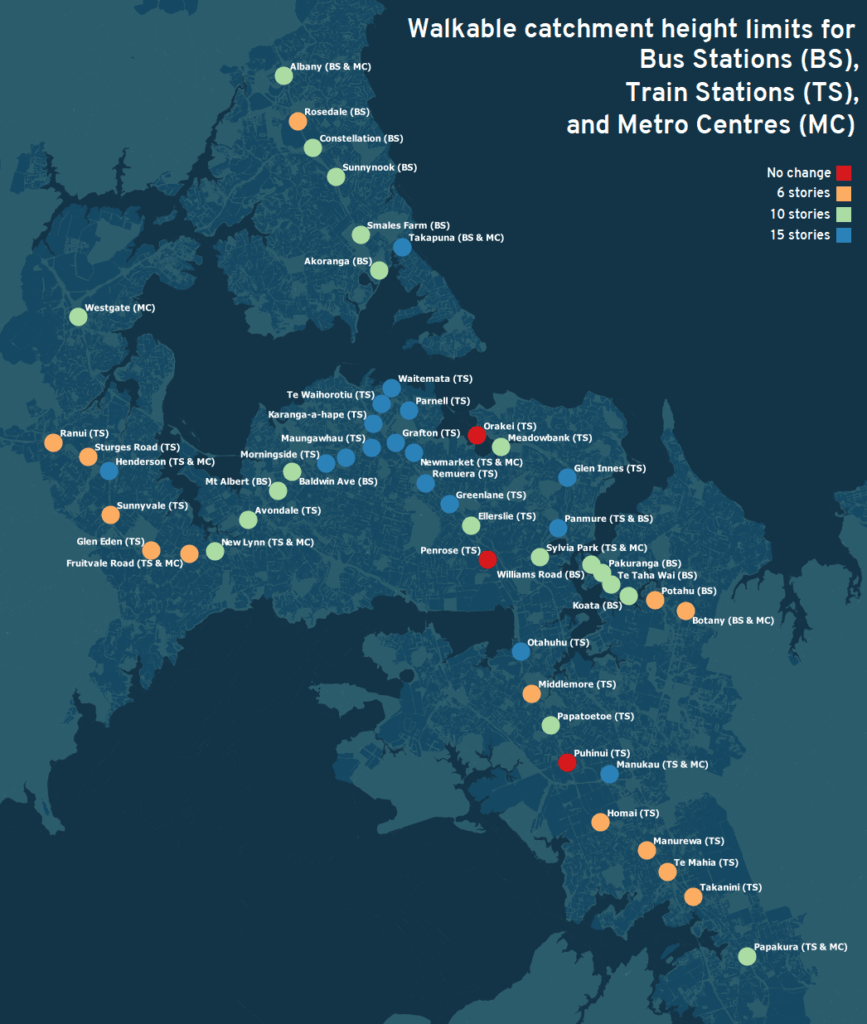
Representation of walkable catchments. Note: the size of the dot does NOT correlate to size of the catchment. Author: Scott Caldwell
Additional to this, a small catchment (200m) around core frequent transport network will be zoned for 6 storey development. From looking at the maps, these seem to be the following corridors:

Representation of the targeted bus network for upzoning. Author: Scott Caldwell
This is mostly the collection of the most popular bus routes, so these make a lot of sense to target as opportunities for intensification. (Ed: longtime readers may note an overlap with Auckland Transport’s ill-fated Connected Communities programme, which had the aim of improving rapid transit routes).
Beyond the major centres and transit network, most town and village centres will see some modest upzoning, with 6 storey apartments largely being permitted in the immediately adjacent land.
Updates are being made to the most common apartm ent zone (Terraced Housing and Apartment Buildings Zone, known affectionately as THAB). These are two particularly notable, positive changes:
- Restaurants, cafes, dairies, and offices up to 200m² are now permitted by-right on the ground floor of apartment buildings. This is a very positive step towards mixed use neighbourhoods.
- Changes are being made to allow 6 storey development much closer to the front boundary of sites, enabling perimeter block housing.
In suburban Auckland, most land which is not affected by hazards is now zoned for “Mixed Housing Urban” – a three-storey townhouse zone. You’d be forgiven for being confused, as this seems to be exactly what Auckland Council was trying to get out of.
Unlike the previous directive, this does not allow for that typology “by-right”, meaning developers will still need to apply for resource consent which will be subject to a number of requirements from Council.
The Bad
Although height limits have been set at 10-15 stories in many critical locations, it’s not clear that it’s really possible to build that high. While raising the high limits, Auckland Council is also introducing “slender tower on a podium controls”. Keen readers will note that this is a re-run of a drama that played out just a couple of months ago in the City Centre.
These are specifically:
- ‘height in relation to boundary’ plane of 60 degrees above 20 meters for the front 21.5 of the site
- ‘height in relation to boundary’ plane of 60 degrees above 8 meters for the rest of the site
- 6 meter set-back from all sides above 6 stories
- The ‘tower’ must fit within a 38 meter diameter circle
In practice, these requirements mean most sites won’t physically fit a 10-15 storey building – and even if they could, the constraints would likely kill economic viability.
For a flagship apartment like Ockham’s Greenhouse (the exact type of development that this new plan should be promoting), this would likely mean lopping off the top 4 stories to get consent.
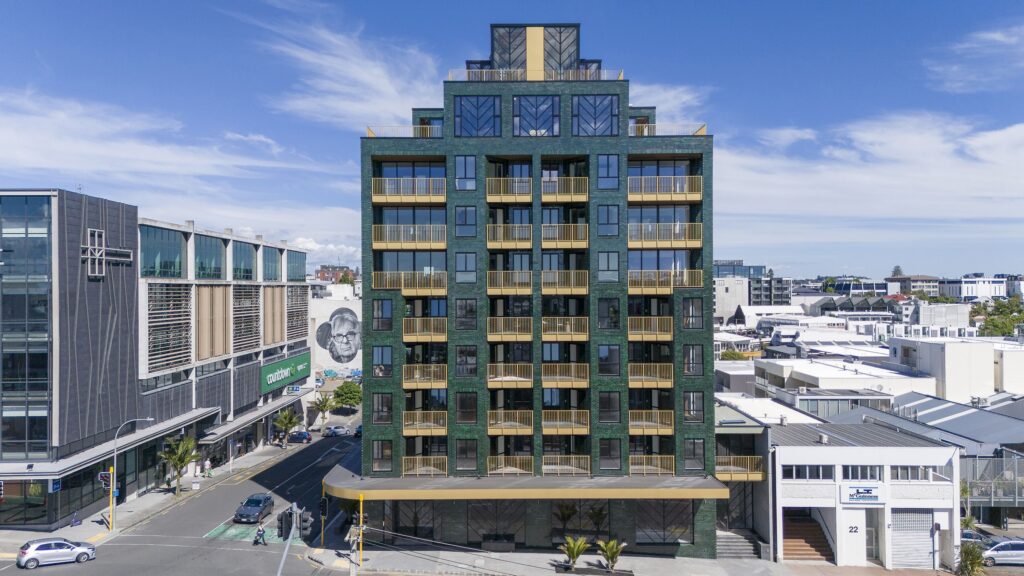
The Greenhouse. Image Credit: Ockham
The other major issue preventing more developments like the Greenhouse is the perennial issue of special character areas. While parts of the city are seeing reductions in SCA as part of this plan, places like Ponsonby are still filled to the brim with blanket protections.
This is choking the city centre, and harming the places they seek to protect. Census-to-census, Ponsonby’s 18-35 population declined ~20% as its “preservation” leaves behind a suburb filled with empty nests. It doesn’t take a hyperactive imagination to connect this to the recent bout of high-profile closures of Ponsonby Road institutions.
The Odd
Having been created on quite a tight timeline, there are some odd things in this plan.
While the down-zoning in response to hazard-risk is broadly reasonable, Auckland Council has also used this opportunity to apply a blanket downzoning to anywhere 100m from the coastline as the crow flies (regardless of elevation).
It’s extremely unclear what risk, if any, this is trying to mitigate – and it creates some absurd outcomes:
- Ōrakei, a station well above sea-level, has practically no catchment as it sits above the ocean.
- Our spindly inlets that pervade the city makes this rule have quite a significant impact, with places as in-land as Middlemore hospital sitting under this overlay
The classification of which walkable catchments meet the high, medium, and low tiers contains some surprises:
- New Lynn is strictly more accessible than Henderson, and similarly has a train station and is a metro centre, but is only zoned for 10 rather than 15 stories
- While Ellerslie is slightly further from the city than Greenlane, it sits at a natural crossroads and consequently it’s one of the busier train stations on the network – about 3 times as popular as Greenlane. So it’s somewhat surprising that Ellerslie is the tier below.
In implementing the changes to allow different built forms in the walkable catchments, Auckland Council has poured lots of new rules into the THAB zone, which apply conditionally based on where the THAB-zoned site is.
It seems like it would be simpler for people trying to understand what can be built on their property or in their neighbourhood to have a new zone which caters to higher density residential development, leaving THAB for 3-6 storey development.
The Verdict
At a high-level this plan looks really good, but there’s devil in the details and some strange things – that’s to be expected from a plan produced on such a tight deadline.
Looking forward, if Council confirms this plan, the next steps will be a Ministerial statement of expectations for an independent panel to assess against this plan.
If they can course-correct on a few things, the bones of this plan will send Tāmaki Makaurau on a vastly better trajectory over the next 30 years, on the path towards the kind of dense, walkable, resilient city its future demands.

 Processing...
Why can’t we just have townhouses everywhere as well as apartments around transit stations?
To…you know….BUILD AS KUCH HOUSING AS POSSIBLE
Because the 4 Avenues and their majestic motorway view is incredibly important to AC planners for some reason.
Thanks for the summary, ‘the good’ sounds good.
I’m mystified by the “podium controls”. Who do they serve?
Is this just smarty pants local body planners trying to show they are smarter than central government planners, as in “Any rule that you make we can make unworkable?”
Is it the “You’d never get me living in one of those” brigade?
Are they against the success of projects like The Greenhouse?
Have they been included due to pressure from elected officials?
Some clarity of the driver(s) here would be useful.
What we see here, and have seen for many years, is that council planners seem to see as their primary duty as change prevention. Perhaps that’s in reaction to some very loud voices, but is a big downgrade of their profession.
While retaining and enhancing what is truly valuable is an important part of planning, it is absolutely not the whole purpose. They have diminished the practice to a kind anti-planning. A halting, a frustrating, a stopping.
Planning is, or should be, the creative imagining and incentivising of a better world, or at least its possibility. This, it goes without saying, can only happen forward. Stopping change, as the principle kaupapa self-reduces their role from planning to permitting.
From positive to negative. There is a balance to be sought here.
I can see how this urge arose from the sense of betrayal many felt from the pace of change after the war when the profession, and their allies in transport, and indeed the whole zeitgeist, were equally unbalanced in the other direction – the Breve New World of the modernist blank slate, sweeping all before it.
But we’ve surely swung badly the other way, and the costs of that are obvious. It’s time for real balance.
A global city needs global experts. We don’t have that in the planning team. However, I’m also amazed that Council and Councillors don’t have an external independent advisory group for planning the city. We have some of the world’s best urbanists here. We need a built environment think tank to up our game.
“We have some of the world’s best urbanists here.” Ummmm, really? Like who? Says who? If we had great urbanists here, how come we don’t have better cities?
Umm… because we have operated under useless legislation like the RMA for 30 years which was a 1980s free for all “so long as effects were mitigated”.
More 10,15 or 20 storey apartment blocks with ‘shoebox’ studio, 1 bedroom and 2 bedroom (in essence 1 and half bedrooms) in the regional city of Auckland. 🙁
Podium rules are intended to manage a human-scale view of the street from footpath. This relates to a proportion of width between building facades to height of facades. It should provide for sun/shade management and mitigation of wind tunnel effect. Proportion should also suit mature street trees, which add to heat and wind mitigation.
Above the podium, a setback to towers protects the sky view from footpath level.
The catch with this is that the site on which the tower is to be build needs to be sufficiently large that the tower (38 m diameter?) can actually be fitted above the podium. Too few sites of that size can be accumulated in the city. Of course, there’s the Public Works Act….
Applications will naturally be made for developments that don’t comply with all the Rules. The fun comes in assessing what is acceptable and what isn’t in each case, and how easy it is to approve good stuff and decline shockers.
Great comment, Patrick. From planning to permitting; how to downgrade your profession in one step.
Totally agree, Streetguy, so why can’t the planners resolve this conundrum before they publish? Stretching Patrick’s terminology they have permitted this big bold goal over here (15 stories) and then unpermitted it over there (setbacks) with confusion being the nett effect. They have abdicating their planning role to litigants and the courts to resolve. Sounds very much like a profession that has lost its way.
Talking to friends who are involved in council planning, there’s a definite motivation to avoid being hauled into court by an irate property owner / developer.
Well that sounds like poor governance.
Public bodies should not be shy of the courts. Success is not avoiding legal action, but in successfully defending it.
Being court-shy makes them ineffective at executing public policy, because requires folding at the mere threat.
Also if you lose, important things are learnt: either what you’re trying to do is contra to statues or your team is doing sloppy work. Both are good things to find out!
The plan change should require developers to aggregate sites so that, say, 30m street frontage is achieved.
We need to get away from letting long, narrow, sites be developed. This is crap urban design, both as viewed from the street, but also for the on site amenity of future occupants.
I wonder how the infamous view-shafts will impact this proposal as well. There are quite a few of them blanketing the central isthmus.
Yeah, it’s not much use having a 15 storey/50m height zone around Maungawhau Station if a viewshaft from the Harbour Bridge means the *actual* height limit is less than half of that.
I’d like to meet the developer who thinks they can build a 15 storey building in Glen Innes and make a profit; I have a bridge to sell them.
Tamaki Precinct at 265 Morrin Road. Live zoned 24 m high. 50 m might be more economical. Was a Private Plan Change. They might also be in the market for that bridge.
25 min to Britomart by train, 45 min by slow bike.
Doesn’t really matter though, right? If it’s not economically viable it won’t get built. If it is, it will.
Never quite understand how arguments about economics in terms of zoning are valid when we’re talking about legal maximums, not minimums. Development not currently being economic isn’t justification for the government to make it illegal to do so at all.
There is a 20 storey tower going up in Henderson. Lots of people don’t want to live in the CBD but still value apartment living.
Thanks Scott, great post. Two things:
1. Can we see the legend on the first figure? I assume orange is six stories but what is red?
2. Regarding the default MHU zoning, what is the “fallback” zoning if there is a hazard? MHS? Or do the rules depend on the hazard?
1. Open the figure in a new tab to see legend
Right click to Open the image in a separate tab. It’s been cutoff by the ratio in the article.
Red is “No change”
Select the image on mobile (press and hold) to see the key.
I can’t help think that the upzoning along the 72X/72M route is an error. Surely it makes way more sense to this have instead been the 72 rroute along Pakuranga Road.
I’m guessing their thinking is once the busway is built the 72X will connect to it and be a fast route to Panmure/City?? But yes, makes no sense that the 72 isn’t included.
Howick to Pakuranga is an obvious FTN upzone needed. Includes someone’s Constituency Office, but that is covered by Pakuranga (BS) Zone anyway. Any ideas what BS stands for?
Bus Station
If you right click on the image and open it in a separate tab, you’ll see the legend. BS = bus station, TS = train station, MC = metro centre.
Not my first guess. 🙂
A fun game is drawing 800 m circles around the Northern Busway stations and colouring in the potential building sites. Use one colour for sites redeveloped already and another for those that could be redeveloped.
Albany has plenty of empty land.
“In suburban Auckland, most land which is not affected by hazards is now zoned for “Mixed Housing Urban” – a three storey townhouse zone. You’d be forgiven for being confused, as this seems to be exactly what Auckland Council was trying to get out of.”
The devil is definitely in the detail here.
Development in suburban areas is going to be far far harder it seems. More restrictive standards are being added (outlook area restrictions, glazing %, deep soil areas, tree planting, safety/privacy buffers), and of great significance will be a change to the definition of Landscaped Area which doesn’t allow decks, paths etc to be included. (They have effectively adopted the MDRS definition)
These are going to have huge ramifications in terms of developments being able to comply. I would guess that MOST suburban development in the city enabled or consented through the Unitary Plan will immediately have a Landscaped Area shortfall, and so will have zero development potential left, and will be reliant on existing use rights/consents to even maintain the status quo. Huge ramifications in terms of people assuming they can still add paving or a little ground level deck.
Combine that with the tree planting requirements being introduced:
People will be need to provide 1 ‘medium’ tree (with a mature height of 10m+ and canopy of 8m+) for every 300m2 of site area. So a 600m2 urban site needs to be provide 2. A 900m2 site requires 3. You can imagine how much developable area of a site will be taken by tree canopies. So many sites that might be allowed three dwellings under a Mixed Housing Urban zoning won’t actually be able to fit three in. Might even be hard to fit two.
Would be great to get some analysis on what could potentially built, sites of interest and where. Something to highlight what these new limits mean in real life terms. Right now the bad seems to completely wipe out the good?
Yes. A new building zone “HD-THAB” for “High Density THAB” could of been created perhaps.
Interesting that Glen Eden shows a 6 story limit, but already has a 10 story apartment building.
Hopefully the change will also stop further 3×3 developments in areas beyond the walkup catchment, as has happened in the rural fringes of Ranui and Swanson (and presumably other parts of the city where the largest cheapest sections are the furthest from the required infrastructure).
To more historic monumental important topic! It’s a fantastic step to progress finally! But we need to get on with more rapid transit corridors(Heavy rail/Busways) to accommodate these highly intensive development (10-15 stories), 6 highly intensive development. Plan Change 78” (PC78) housing capacity increases located on frequent bus route corridors, so too does the ‘ridership’ increases!
It particularly doesn’t make sense to construct highly overly expensive EAST-WEST link with no actual economic benefit while a building a new rapid transit corridor would bring tonnes more economic benefit into Auckland and break a bottleneck roading corridor that our frequent buses everyday are sharing with general traffic and means we can properly accommodate highly intensive development (10-15 stories) on Dominion RD for example! Southdown/Sylvia park area in-future won’t be a manufacturing industrialised area cause a lot of businesses will choose to place themselves in Mill RD cause of the Greenfield’s available and better area to set up business. Southdown/Sylvia park where all the manufacturing/industrialised businesses are currently will gradually be converted a highly intensive development (10-15 stories) area and townhouse area. When this happens it becomes pointless for EAST-WEST link to be constructed and built.
Auckland is better off without EAST-WEST link! We need more Rapid transit corridor (Busway, Heavy Rail) in Auckland. Auckland CBD isn’t going to grow by building road by roads! That’s whole purpose why we need more rapid transits so we can accommodate more people into the CBD and not rely private vehicles driven in the CBD. If more private vehicles are driving into the CBD, that means more carparks needed and massive amounts of private vehicles to accommodate which would 1000’s more carparks which is really unrealistic for a city like Auckland! Also means commuters get ‘turned off’ coming into the CBD and employers can’t hire people due to PT constraint. Auckland needs more Rapid Transit(Heavy Rail/Busways) corridors from central government!
In summary: busways are our future.
If the government is to bring any real life changing benefits to everyday Aucklanders right now, it be swapping EAST-WEST link for a rapid transit corridor which is badly needed in Auckland right now! EAST-WEST link doesn’t make any economical, social, community sense to construct! NZ International economy is doing well, farmers, businesses who manufacture goods/services overseas are doing well. But for NZ’s domestic economy, it’s not doing well and that’s majority of NZ’s working force employed! From small businesses, service domestic industries, retail aren’t doing well. Domestic economy usually relies on central government to bring change like rapid transits and so everyday workers feels improvement of their ‘Quality of life’ and it’s currently being diminished due to lack of action and decisive plan by central government! It’s central governments opportunity to drive change and improve lives! Employees from NZ’s International economy are a minority in this country and don’t have enough buying power to provide for domestic economy cause of their incomes and employment workforce numbers.
Building more rapid transits in Auckland will definitely improve ‘Quality of life’ and really bring more faster PT to Britomart, Midtown, K RD & Newmarket. Part of problem for Auckland is the buses being stuck in general traffic without any ‘dedicated busway’ or Heavy Rail corridor to replace a already overcapacity frequent bus routes during peak hrs during weekdays and on normal hrs during weekends results in longer journey times and longer commutes from home to work which is why Aucklanders many are leaving in drove to overseas! Replacing the Northern Busway for example would make a massive difference to Aucklanders right now! It’s ridiculous the speed and time it takes by PT on Northern Busway currently from Smales Farm takes 20 mins to Britomart or Midtown, same could be said for Albany takes 35 mins by both NX1 & NX2 when it should only take 17 mins from Albany and 10 mins to either Britomart or Midtown. Heavy Rail would be able to go double the speed and time it takes commute to Britomart or Midtown even on peak hrs during weekdays. There’s a real need for more busways and Heavy Rail corridors in Auckland!
We could slash the journey time of the NEX by, among other things, having 24/7 buslanes on the city side.
Ultimately it will need a rail solution over the harbour, though I would have thought it will be in conjunction with, not a replacement for, the current busway. And I think its more likely to be LR or LM than HR because of gradients, etc.
well you are talking to the person who thinks heavy rail can accelerate up to 110km/h then back down within an 800m station spacing… wouldn’t be surprised if they think heavy rail can just be plonked down on the busway and handle gradients like the Polar Express
Not only will there be few sites large enough to develop 10-15 storey apartments, but even when there are the council is proposing even more onerous design standards and assessment criteria which will truly help ensure little of that height gets built.
It’s a charade.
They seemed to have mixed up the numbers of the 95 and 97 bus routes on the map
Important clarification needed: the current Unitary Plan has always allowed three houses ‘as of right’ on properties zoned suburban and urban.
PC78 changes allowed how big those houses could be thanks to
The latest changes proposed
Important clarification needed:
– The current Unitary Plan has ALWAYS allowed 1-3 houses ‘as of right’ on properties zoned Suburban and Urban. Only Single House Zone restricted the number of homes.
– PC78 changed the zoning of a lot Auckland to Urban and removed a lot of Single House Zone. It also allowed the 1-3 houses to be even larger thanks to central government imposing the ‘Medium Density Residential Standards’ (MDRS).
– The key changes in the current proposal compared to PC78 is that MDRS is gone and there is a lot more Terraced Housing and Apartment Zone. The amount of Single House Zone is still reduced compared to the current rules.
I’m surprised you can up zone to six storeys in the area surrounding Grey Lynn shops, as a centre, but not surrounding West Lynn shops or the Richmond Rd shopping. While they have increased height in the centre, nothing in the surrounds, both more substantive shopping areas / centres in the Grey Lynn area? And West Lynn has the community centre?
Possibly off topic – I have been trying to find an Apartment Review website. From owners/residents of the different apartment blocks around the city. Those Ockham apartments for example look great, but what are they like to live in, and what is their longevity? The Simplicity builds are designed for a 150 year life? What are they like to live in. Are the Sugartree apartments better to live in than they look? etc etc
I have never seen such a website but the Auckland Subreddit often has discussions on this topic.
Can someone please tell me how putting 5-6 storey apartments on both sides of Beechwood in Browns Bay, doesn’t create a wind tunnel? Also, how does this work from a shade perspective given that a large part of the of this road is flat, with multiply stacked houses in back sections, but the plan allows for 6 storeys north facing creating a huge amount of shadow?