This is a guest post by Malcolm McCracken. It previously appeared on his blog Better Things Are Possible and is shared by kind permission.
Local government elections in New Zealand face persistent challenges with low voter turnout and a shortage of candidates. National average turnout in the 2023 elections was just 41% with Auckland, the largest region, at 35.5%. Meanwhile 64 people were elected uncontested (i.e. were the only candidate to stand for a position). With 2025 shaping up similarly, even senior Cabinet Ministers have expressed concern about the lack of candidates in their electorates..

Improving candidacy and voter turnout should be a focus for the next three year cycle, leading into the 2028 elections. But it is also important given current discussions of ‘rates capping’ local councils, which seems to be likely in place by the end of the year. This would see councils limited in the amount rates could increase per year.
Rates capping may be well intended in a cost of living crisis, but I would argue is fundamentally undemocratic. If rates increases are so bad, why can’t we leave this to democratic process? If it is such an issue, then why is turnout at Local Elections so low? It is even below that of home ownership rates. There are so many local government projects, which communities want but would likely be unable to deliver with rates capping in place. Take the new Christchurch Stadium – Te Kaha, for example. It accounted for 2.1% of the total 9.9% increase in rates in 2024. While we haven’t seen details of how rates capping will work in NZ. If people want nice things, we should let them pay for it.
I see the continued misalignment between supposed sentiment on rates increases and low turnout, as a further reflection of local government representation issues. If rates rises are an issue, then Central Government should first be focused on addressing barriers to candidacy and voter turnout. I think the contributing issues to this can fall into three categories:
- Poor media coverage of most local council matters
- Low understanding of what roles and responsibilities local council have (and don’t have
- Barriers to voting and standing in elections
Today, I want to focus on how we address the latter points.
Barriers to voting
Local Government elections in New Zealand are run solely through postal voting. While offering some cost savings, it also introduces barriers. Firstly, voters are required to update their address 10 weeks before votes close. This systematically disadvantages renters who are more likely to have changed address, more recently. If you remember too late, you have to do a special vote which by all accounts is a PITA. You also have to do this if you move house during that 10-week period. Alternatively, you could commit voter fraud or, most likely, you simply don’t bother to vote.
Interestingly, postal voting is considered by some to be a way to enhance electoral participation by minimising the costs associated with voting. This includes wait times and providing flexibility on when people vote. The latter has been successful in New Zealand Central Government elections with over 1.6m of the 2.88m votes being cast before election day. Critically though, this is provided in-person. I firmly believe we need to provide more options, including in-person voting to make it easier if we want improve voter turnout at our local government elections.
Underlying this, we have an inconsistent approach around the country to how local elections are managed with councils able to decide on their own provisions for special voting. This includes the number of locations that are open for Special Voting. We should simplify this and have the Electoral Commission run local elections, as they do for Central Government elections. This will no doubt cost more than the current approach, but should be willing to spend to ensure the democratic process is accessible and supports higher participation.
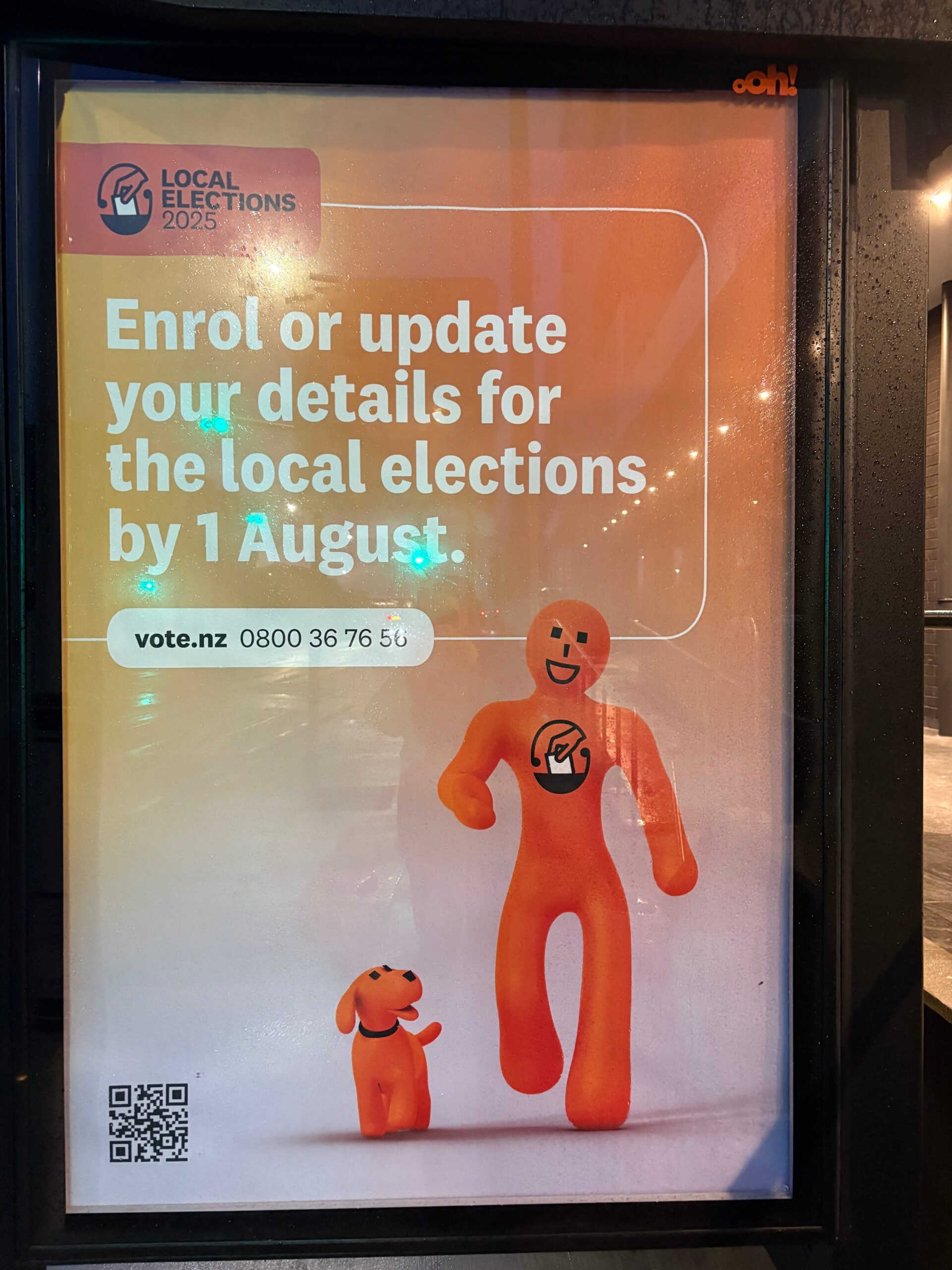
A bus shelter advertisement reminding people to enrol or update their details for local elections by August 1 2025, 10 weeks before the voting closes.
Improving candidacy turnout
We should want every position to be a competition of ideas, attract broad diversity of people from different backgrounds and ultimately, passionate, talented people who are dedicated to representing their community.
Existing settings firmly work against this. The majority of positions across the country are part-time, meaning most candidates will need to have an additional job to provide sufficient income. They also require a job that doesn’t have a conflict of interest and provides flexibility in hours worked so they can attend official council events and community meetings.
Most positions are, quite frankly, poorly paid, particularly when you consider the personal sacrifice of privacy that individuals, and often their families, must make to do the job well. You can likely think of a local representative you disagree with or you don’t think works hard enough. That’s fair. But how can we attract better candidates if we don’t offer decent, full time salaries?
Together, I think these factors provide real barriers to better candidates standing for local government. There are some other very real barriers to candidates standing, that sadly cannot be addressed through simple reforms. Namely the abuse online and genuine threats to safety that are increasingly common. Earlier this year, Auckland Mayor Wayne Brown had unmarked security cars stationed outside his house and CCTV installed after threats online and suspicious behaviour outside his house. Auckland councillor Josephine Bartley has faced consistent abuse online, leading to decisions including removing her name and face from the side of her car and delegating the Chair role of committee to minimise risks.
Abuse is disproportionately targeted at women and people of minority groups. Making it less likely for them to stand. We know that representation can support good governance and decision making. We should want people from all walks of life to feel comfortable to stand in our elections.
Final thoughts
I believe the changes noted here can make a positive difference in improving voter turnout and the number and quality of candidates standing. However, this alone is not enough. We do need to consider how we improve voter understanding of the role and importance of local government and improve media coverage. These likely go hand-in-hand and this may be explored further in future posts. We also need to consider changes as part of other potential reforms to local government that may be appropriate, including amalgamations of councils to better align representation and spatial issues. Overall though, if we want better outcomes, we should focus on making it easier and more attractive to participate in local elections.
Summary of Suggested Changes
Reduce barriers to voting by:
- Introducing in-person voting options and moving away from postal-only voting
- Centralising election management under the Electoral Commission
- Simplifying and expanding access to special voting
Improve the number and quality of candidates by:
- Making all elected roles full-time
- Offering competitive salaries to attract diverse, high-quality candidates
- Addressing safety concerns and online abuse, particularly for women and minority candidates
This post, like all our work, is brought to you by the Greater Auckland crew and made possible by generous donations from our readers and fans. If you’d like to support our work, you can join our circle of supporters here, or support us on Substack!

 Processing...
A key pillar is online voting. The only letter I’ve sent in the past 3 years is a postal vote and most people under 30 wouldn’t even have a thought process about how to mail something. If we can detect fraud in the Bird of the Year voting we can surely make elections secure.
Surely a postal vote has the same security as an online vote where they post you a unique ID. In both cases they only way to defraud it is to intercept the original letter.
Given no expert believes that it can be done safely, I think it’s nuts. Our intelligence agencies say it’s a high value target that regardless if it’s hacked or not, there isn’t a way to prove it isn’t. Meaning fairly easy for a bad actor to exploit it.
At least with physical you can investigate discrepancies with a reasonable confidence.
We have online banking as it’s relatively easy to prove when money goes wrong and they compensate when issues happen. You can’t do the same with votes.
Postal votes require someone to be physically there to intercept, rather than a lone person in Belarus.
I assume the postal votes have some kind of unique ID or marking so that when you send it back its guaranteed to be you. Why not do the same thing for electronic votes – post them a unique ID. To hack it you need to intercept that unique ID, the same risk as postal. The IT system that took the votes would also need to keep track of all the unique IDs for auditing purposes. The IDs are too unique to make up.
If we really can’t make this work digitally, in 2025, there is little hope for NZ.
Log on to a website. Use your drivers license/passport/other as proof of ID, provide a proof of residential address (utility bill) to allocate you a location. Cast your vote on the candidates in that location.
Technology is being used to solve much tougher world problems than postal voting.
> To hack it you need to intercept that unique ID, the same risk as postal.
It’s not the same risk.
It’s far easier to systematically intercept electronic communications than it is physical post.
Even if the electronic communication makes it safely to the voter’s device, their device could be compromised. The attack surface for online voting is so much larger.
In-person voting is the best way to ensure it’s not compromised.
How much of a risk is that really in the scheme of hundreds or thousands of people voting in an electorate. Maybe you upload an ID (e.g. drivers licence) when you vote, to prove authenticity. And if voter fraud does happen, the voter can submit a complaint if they go to vote and someone has already done it, illegaly. Or we have tech to identify bots hijacking profiles.
We are really overthinking this given the tech tools available and each year, less and less postal votes eventuate because of it. Just start on the road to digital voting and iron out the kinks as we go along.
I,m the same,except for my bowel screening test
I think in most cases it is a reflection that they will be voted back in. If the current councillor was not well liked, I reckon someone would contest it. If Wayne Brown wasn’t a guaranteed win, we would have more mayoral candidates for example.
Councils are allowed to get away with seeing democracy as a cost. There needs to be a legislative requirement that local government elections require at least a 50% turnout. If that isn’t achieved, they will need to be re-run. If that fails, the council will be automatically sacked and a commissioner will be appointed to run a third election. That should sharpen focus on turnout and voting.
At the last local govt elections my flatmate resisted voting on the grounds the short biographies of candidates were not very informative. He voted on the last morning and I offered to drop off his voting papers. The closest place for delivering votes turned out to be shut, and I had to cycle into town to deliver them. Lots of other people also had to hurriedly find another place to drop off their votes.
Having more drop boxes and making it clearer when voting stops would be helpful. Voting by young people who have left home is very low in local government elections. In addition, submitting for local and area plans is time consuming and favours grumpy superannuitants who oppose all changes.
We elect governments to set tax policy. Then that is undermined by local politicians who want to waste money on high cost projects because it will make them popular with the few people who vote for them. Capping rates is essential if we want to force some financial rigour on these idiots. Maybe then we won’t have to pay for movie studios, velodromes, events centres, historic building renovations, David Beckham, untested sludge plants, and ‘gold-plated’ underground railway links.
What do you think of Mayor Brian Cadogan’s position?
https://www.stuff.co.nz/nz-news/350340701/entrenched-three-waters-thinking-has-led-waterloo-crisis
He seems to have been very fiscally conservative over the years, and now is facing a crisis because of constant underspending on infrastructure.
shhh shh, don’t burst miffy’s miser economic stance. they need the imaginary numbers we made up…
People want to live in the middle of nowhere because they like the isolation, but then expect the city folk to pick up the tab so they can have “a wastewater plant or water treatment plant for every 577 residents.”
Shouldn’t those people pay for it with their rates?
The issue is there has never been a proper incentive on Councils to do the right thing. If there were cash fines every time they dumped crap in a river or in the ocean then suddenly they might take an interest in preventing it. If each time someone died due to bad water the Council had to sell one of their precious over funded community facilities to pay the fine then maybe they would avoid ingress of pathogens or protozoa.
Havelock was allowed to make people sick without consequence. So they did.
Three Waters was a political disaster, every time Labour started to get popular again they would kick the corpse of Three Waters just to make sure they would lose the election. And who actually thinks central government should manage flooding anyway?
Rates capping and ‘stick to basics’ regulation were a dismal failure in the UK. If central government were willing to set up and fund agencies to deliver on the four wellbeings at local levels down to support of local volunteer organisations, then it might work. Of course, the agencies would have to have transparency and accountability at a local level. Now, who already exists who might be able to do that?
The idea is moot when government is also busy defunding and stepping away from any responsibility for public wellbeing services.
Transparency and accountability exist if people bother and press their Councils to publicise themselves.
We’ll leave Miffy to vote however he chooses.
Miffy its not just individuals that pay rates, its businesses too.
” in 2025/2026, the total average rates bill was about $4068 for an average residential property and $22,123 for an average business property”
If I owned a business I would want my money spent on movie studios, velodromes, events centres, historic building renovations, David Beckham, untested sludge plants, and ‘gold-plated’ underground railway links, rather than emptying your rubbish and resurfacing your road.
They really need to have candidates answer a series of questions stating their positions on a variety of topics and then provide the information to voters so that people can choose a candidate that most represents their views best. Currently there’s very little way to know what the candidates positions, as the biographies are short and always generic. I abstained from voting last election as it was impossible to know the candidates agendas.
Yes, I was trying to read up on some of the people running in my area and all I had is one paragraph to go off. Hard to decide!
https://policy.nz/2025 Includes statements on a variety of topic areas from candidates.
A weird barrier to voting is living in an apartment. Having recently from a house to an apartment, it is infuriating having to input my address. Most address input forms, including the Electoral commission have all sorts of issues and basically none can auto complete.
This is a strange reality of living in a place that is still house dominated. Full power to us, the apartment dwellers!
The difficulty for electors is the ability to find out enough about candidates to make an informed choice when voting. Just went to a Meet the Candidates event last night.
There’s never enough time to cover all issues, but at least there is some opportunity to hear them speak for their selves. It does expose some ‘colouration’ of values and attitudes to help choose between candidates when there is at least one more candidate than the number of seats.
It is difficult to look for potentially collaborative people who may differ in policy but will at least work together, when national politics is being so partisan and divisive as at present and interfering in the ability of local democracy to function.
Capping rates increases by edict appeals to two groups;
1. The Miffys of the world who think restraining income will stop spending on what he views as a vanity project. Sorry mate your vanity project is another guys basic need and visa versa.
2. Those who have been told by central government politicians to focus on local body rates increases while income and GST taxes rocket away. Remember Local Body Rates are counted in CPI calculations whereas other taxes are not, so it makes them a soft target for self serving central govt politicians and their follow travelers (Mike Hosking et al.)
In response to group 1. If you really want to control local government spending focus on the spending, not on restraining local government income. The best way to control spending is to elect the local councilors whose spending priorities match yours.
In response to group 2. I sympathize with you and your desire for lower rates increases and the best way to achieve this is elect councilors who will really push back on central government as they push their costs onto councils and downright lie about the impact of their actions. The Three Waters debacle is an example of this. This Government has replaced Three Waters with a system that moves all the costs of delayed infrastructure spend and Central Govt imposed water standards onto local councils to fund. They blatantly lied about the cost reallocations and dressed their argument up in racism to appeal to certain groups. Local Councils and ratepayers are left to pick up the costs. We need strong and informed local councils who are empowered to talk truth to central government power. As suggested paying them better could help. Opps, that will increase my rates.
As a member of group 1 I am reasonably sure nobody needed the Wellington Town Hall to be rebuilt. A bulldozer would have made more sense. The problem with selecting politicians when few people vote is the vested interests carry a lot of weight. Sports clubs, industry sectors, special interest groups all lobby the turkeys who stand to get cash spent on their project. The councillors for their part are looking to be popular in the community and a hall, gym or pool wins more votes than avoiding a future cost blow out due to bad pipes.
So if the incentives are not there to create an efficient outcome then you need rules to force their hand.
Miffy, you have fallen into the trap that many Americans have viz-a-viz democracy. Democracy is not there to provide perfect, or the best outcomes. It is especially not there to “create an efficient outcome”. Democracy is there to ensure that the common wishes of the greatest number of participants is achieved. Voting is an absolutely foundational party of a functioning democracy, so get out and vote.
NB: posting to a blog is technically NOT democratic participation but it may help to attract other democratic participants to your way of thinking. Keep working up your attractiveness.
Yes but that isn’t what local government is for. It is there to do the unpopular things like keeping wastewater out of rivers, providing clean water and providing environmental controls. Democracy means the people who run these councils focus on the wrong things so they can be re-elected. Instead of doing the basics they spend on visible ‘improvements’ that were never really essential. Almost every rural district has wasted a fortune on tar-sealing minor little roads at high cost while ignoring water and wastewater issues and environmental controls. In urban areas the money went on events centres and other boondoggles. It’s ok to have democracy but at the local level we need strict rules to avoid crap going into waterways or into water supplies.
You’re probably right about needing rules in place but capping rates isn’t one of them. It is just an incentive to further defer out-of-sight out-of-mind expenditure.
Miffy – how is Queenstown Lakes District Council going to upgrade its wastewater plant if you’ve just capped their rates? Those types of projects require debt, which in turn, require rates to pay them off. This obsession with rates is the very reason infrastructure hasn’t been properly maintained.
They can sell something and then face the consequences at the next election. It would force Councillors to actually think about costs and benefits of their choices and then face the music when they get it wrong.
I would add a recommendation:
Join the ranks of countries that hold local and central government elections simultaneously. This would leverage the higher level of participation in central govt elections and enable people to vote for their local representatives at the same time. Yes, the media environment would be more crowded, but the payoff would probably be worth it.
Another plus is that the government is currently looking at electoral terms, so now’s the time!
Here in Wellington we seem to have a really weird list of people to vote for. Have only seen the Mayoral list so far – no sign of any advertising for Council Ward candidates. But for Mayor of Wellington, we have one clear front-runner Andrew Little, who has a good track record of being competent at running things (E Tu union, Labour party, law firm), and a bunch of complete weirdos. One candidate who is either an elaborate performance art piece for the last several elections, one complete nutcase who has been arrested multiple times, about 3 slightly right-wing candidates who should probably be locked in a room together and left there till a single fascist winner emerges, but really and honestly – there should be a minimum quality level for candidates like there is for a used car. eg:
Does it run without spluttering?
Does it burn too much fuel and leave a big oil patch on the driveway?
Can it get out of second gear?
Will it break down as soon as you have filled it up, leaving you penniless?
Will it cost you an arm and a leg to fix, to get it back on the road?
Personally, I think local politicians are many times more important than those that pass their time in Wellington.
They tend to be better at communication, and are more honest about their living conditions.
People that live amongst us, are easier to trust. Particularly with the current three men in suits in the top jobs in Wellington, who often appear to live in Ivory Towers with nil understanding of the area between the gutter and the sky that most of us occupy.
My home city, Taamaki Makaurau, Auckland, currently has a council that was elected by a third of us. If we the people, do not care about our politicians, then our politicians cannot represent us.
Local Body Elections have become less democratic during my lifetime, we know that property owners vote more, and that older people vote more, which leaves a huge demographic unrepresented.
An excellent democratic manoeuvre would be to extend suffrage to sixteen year olds, so that civic values could be encouraged during high school. I know how frustrated I was at age fifteen and unable to participate in democracy.
Auckland has always had mayors that were either wealthy, or ageing politicians, or both, and that seems very Roman Empire ish. Surely we should have better representatives of our general population, who are not financially endowed.
The cost of running an election campaign removes the average citizen from considering such a venture, when one is struggling to provide food for one’s offspring, it is difficult to consider representing more persons than your own household.
The world is questioning the value of democracy at the moment, with several autocratic leaders in various locations, and as a relatively liberal democracy, we must resist those that suggest they know better than us.
We are all human, and we must all vote.
bah humbug
I’m currently in a 29-way race for 8 seats for a local board position. It feels like an absurdly large scramble, and with the ability of political parties to parachute in candidates if they wanted to, I find it hard to believe that the unopposed seats are unopposed due to an inability to find a candidate at all.
I’m fairly convinced unopposed runs are just the nature of a long term incumbent who looks difficult to oust, combined with not knowing that no one else is going to try. After all, two challengers would split the “not this guy” vote.
I’m also very wary of “pay politicians more”. I think you want politicians to be like teachers: in this for the love of the game. You want people driven by financial incentives as far away from the levers of power as you can get them.
Bigger is not better – that has proven by the “super city” where voter turn out is worse than its ever been. We need smaller Councils that are more accountable to their communities. There was nothing wrong with Waitakere, North Shore etc. which were dismantled due to the particular ideology of the Act Party, not because there was any particular desire from the electorate.
Great post. Sure need people to “get out” and vote more.