Today’s guest post is a book review by George Weeks, of Transit by Design, by Nicolas Reid (available from Unity Books and Amazon Australia).
George Weeks is a transport adviser, planner and urban designer based in Auckland. An earlier version of this review originally appeared in issue 188 of Roundabout Magazine, the newsletter of the Transportation Group NZ. This review is written in a personal capacity.
Check out previous book reviews here.
Many successful fiction authors tell stories based upon personal experience. John Grisham was a lawyer. Roald Dahl raced greyhounds and sold antiques. Nevil Shute flew aeroplanes. And so on.
It works for non-fiction too. With Transit by Design, Nicolas Reid has distilled 15 years of professional public transport planning into 245 compact pages. The book aims to show clearly how public transport planning happens, the steps you need to follow, what you need to know, and what to avoid.
A central thesis – and one that justifies its early introduction, is the importance of service patterns. This is a key difference for public transport compared to car-based infrastructure. A driver, cyclist or pedestrian uses a right of way of their own volition. The freedom of the open road! Public transport requires a bit more thought.
To use a bus there needs to be a bus service. Same goes for trains – try catching a train from Inglewood and see how far you get. Service design is thus an extra layer, inherent to public transport planning. The type of service that we desire (in terms of speed, frequency, capacity, comfort, cost, etc) will influence the choice of infrastructure. Different types of infrastructure enable different kinds of service.
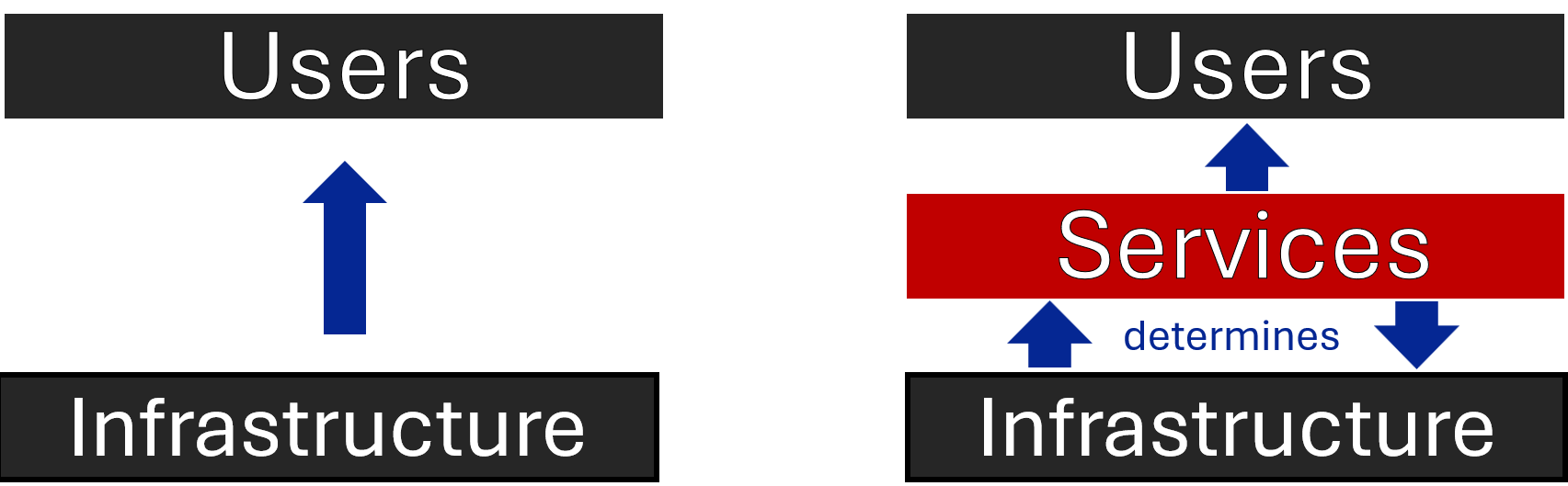
People use road infrastructure in a way that suit their needs. Public transport requires a service to be provided on the infrastructure that reflects people’s needs.
Throughout the book, Reid reminds us to think about service design. Transit by Design is split into four equal-ish parts. Part one (Transit strategy) makes a compelling case for public transport that will cover the widest-possible user base. This means providing a good baseload service throughout the day, covering 80-90% of travel demand. A diagram on p. 37 shows what this means in practice.
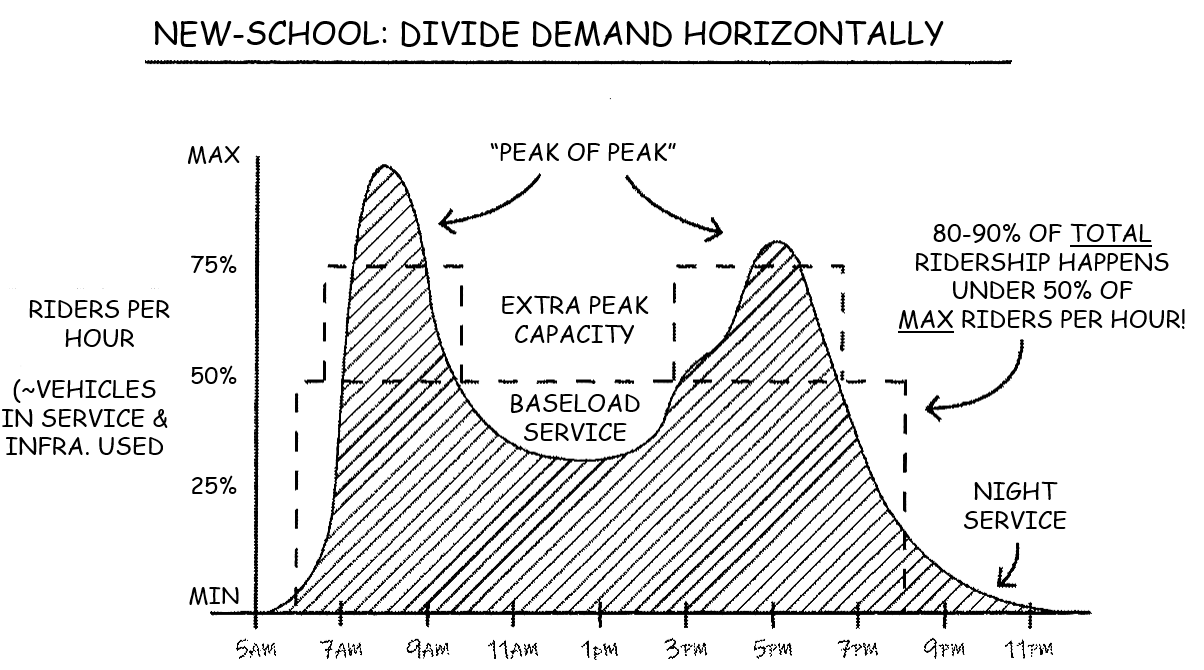
Diagram to show public transport ridership from 05:00 to 23:00. Peak-time trips make up a small proportion (10% – 20%) of overall demand.
There will always be edge cases. A billionaire may prefer a chauffeur-driven Mercedes-Benz, but they’re a very small fraction of the overall market. Successful public transport should work for many different types of trips.
Part two covers the hidden-in-plain-sight layer of service design. Some very important points appear here; usage is not the same as demand (no-one uses a bus service that doesn’t exist, irrespective of latent demand). The last bus of the night is meant to have low patronage (no-one wants to rely on the last bus). Consistent with part one, the most efficient public transport timetable is consistent throughout the day. This relates to the diagram above.
In part three – network planning – we quickly encounter the inherent trade-offs; (a.k.a. Jarrett Walker’s plumber’s questions). Do you want to prioritise directness? Or coverage?
This part has the best diagrams. Public transport planning is, essentially, applied geometry and it’s always easier to understand an idea if it’s illustrated. The sections on the network effect are useful, and all are analogous to Auckland’s City Rail Link (CRL). By adding new stations in existing destinations, the number of possible trips increases substantially.
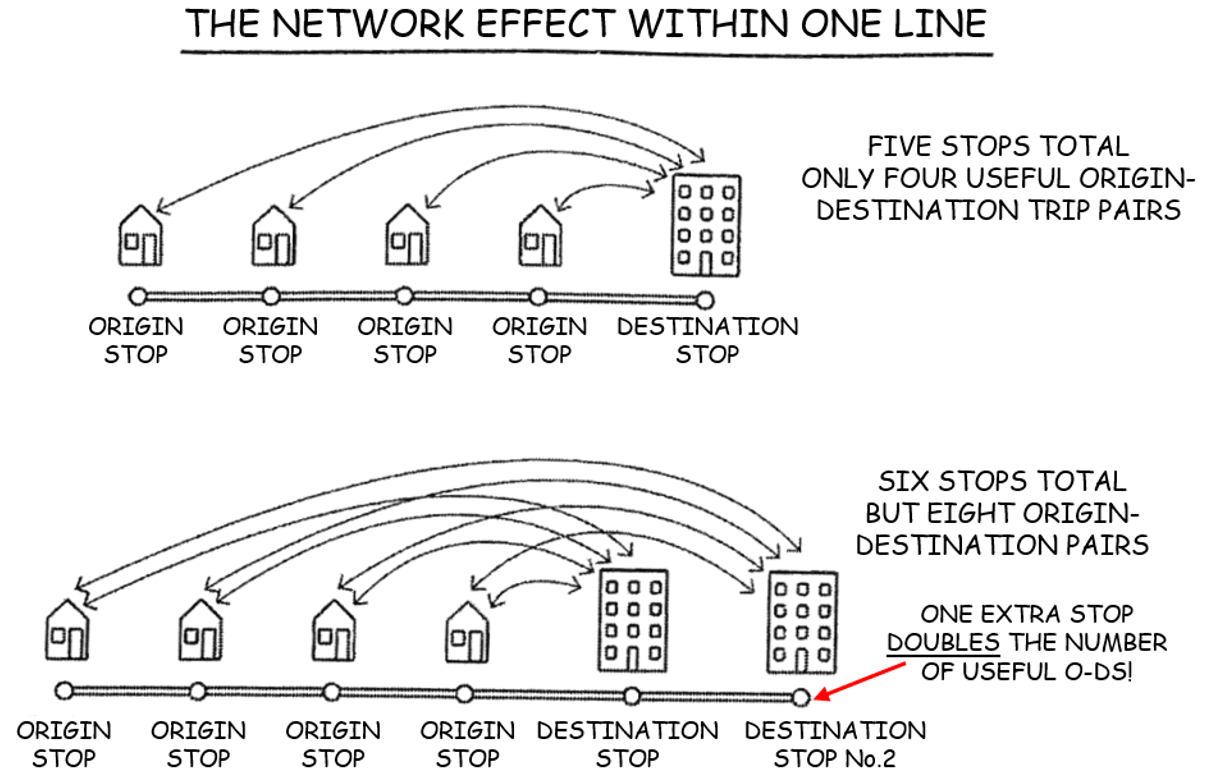
By joining two lines up, the number of possible trips more than doubles: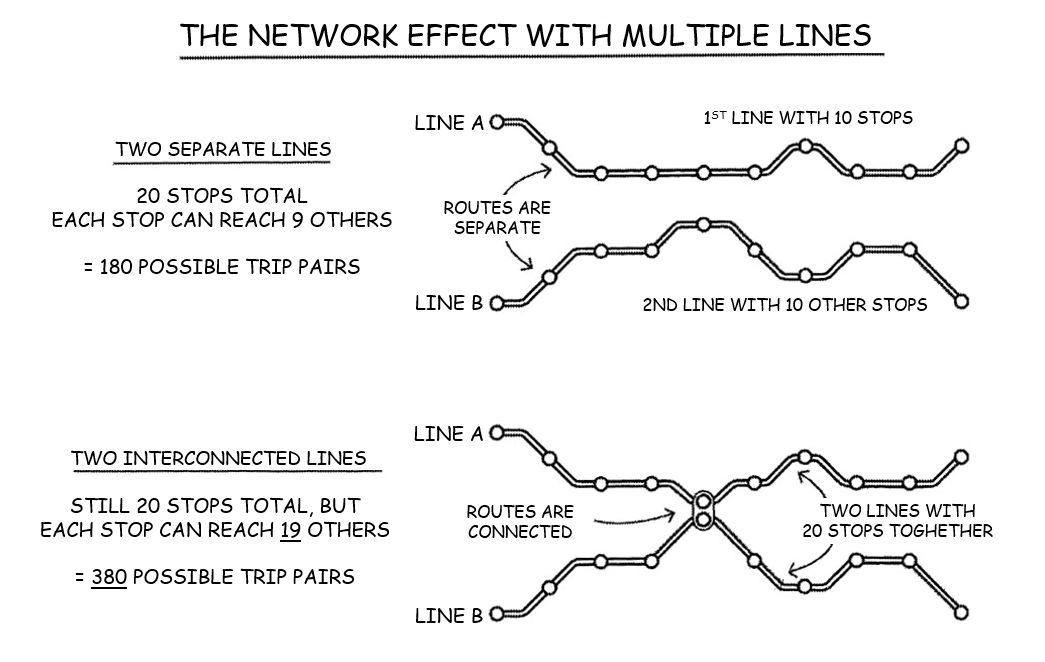
We also see the geometry of S-Bahn systems, or (again) CRL. A through-running service across a city centre can attract huge patronage and there are different service patterns to use on a given piece of infrastructure. compare different types of integrated networks.
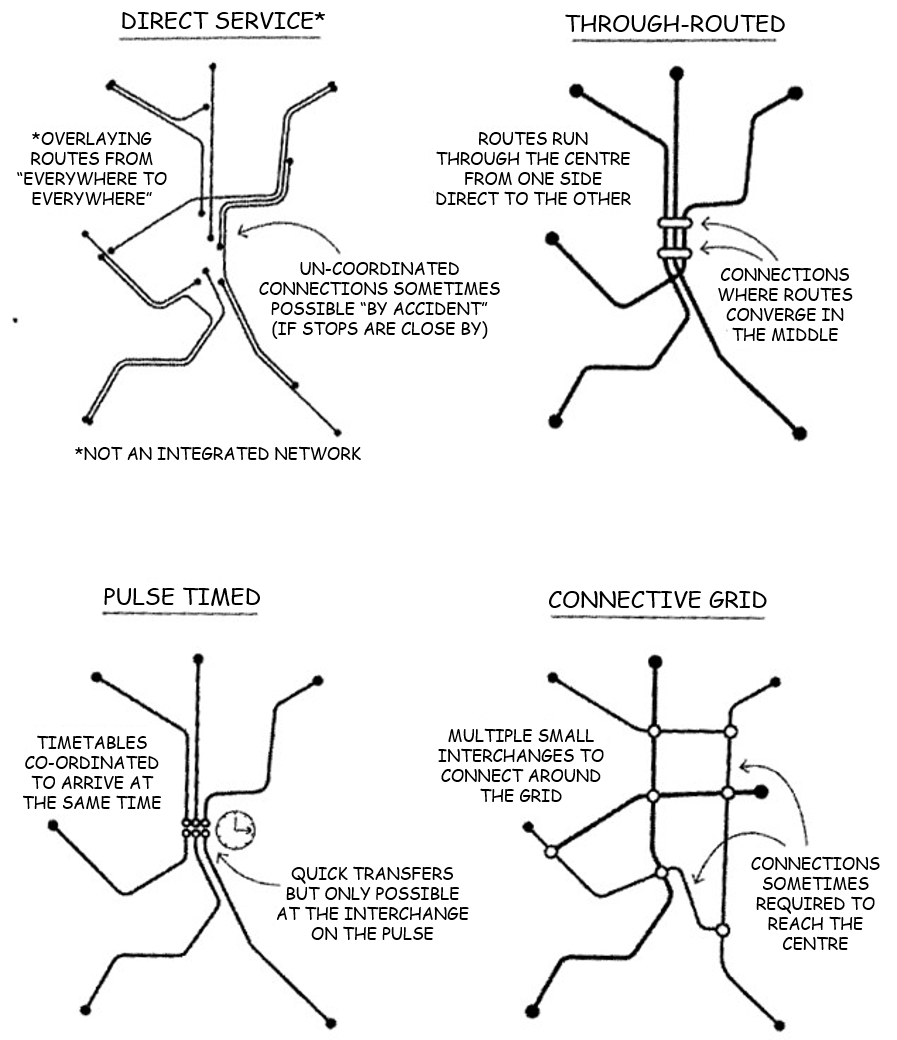
Diagram to show service patterns.
Transport modes, vehicles and infrastructure come last, in part four. This is deliberate. Reid has made us think about strategy, service and networks before getting into arguments about buses-versus-trams.
Helpfully, we compare four types of transitway, from the bus-in-the-street up to a fully grade-separated right of way. We learn that the biggest determinant of passenger capacity in any transit vehicle is its length, and that the length of the vehicle will depend on the design of the infrastructure.

Diagram showing type-3 corridor with either buses or surface-running light rail. For other diagrams – buy the book!
After a quick tour of ferries, gondolas and funiculars, we gawp at the absurd gadgetbahnen; transport technology in search of a problem. We conclude with the consistent thread that you design public transport around the service that you seek; the infrastructure needs to reflect this higher aim.
This book is a dense-yet-handy primer that helps the reader to ask the right questions. Reid is one of New Zealand’s best-qualified transport planners and this is clearly reflected in the accuracy of the book. The emphasis on designing infrastructure to enable a service is absolutely essential, though the emphasis on mode agnosticism may overlook psychological determinates of bus versus rail. It also omits the relationship between transport modes and public realm design, e.g. tramways à la Française.
While the language is pleasantly non-technical, the sheer quantity of facts can get tiring. Greater use of case studies, stories, lists and illustrations would help to make the main messages stick in the reader’s mind, particularly at the start. How about a cheat-sheet for the main rules and principles? The diagrams are helpful and it’d be great to have more of them. Is there potential for a second edition designed like an illustrated manual or a graphic novel?
Transit by Design is consistent with other well-established public transport handbooks by Jarrett Walker, Paul Mees, Pete Dyson, Rory Sutherland and others. For a detailed, thorough explanation of the principles of public transport design, it is a worthy addition to anyone’s bookshelf, amateur or professional.
For more about this book, and how Nicolas came to write it, you can check out this episode of the Streets and People podcast. You might also recognise Nicholas’ name from the brilliant bridge proposal Greater Auckland is backing for the next Waitematā Harbour Crossing.

 Processing...
