This is a guest post by Transport Advisor and Town Planner George Weeks, reviewing the revised edition of Human Transit by Jarrett Walker. It is written in his personal capacity.
You can check out past book review posts here.
Book review of Human Transit: Revised Edition (2024) by Jarrett Walker
In a sea of solutions in search of a problem, this digestible professional guide to public transport planning, now in its second edition, is a welcome arrival.
Perhaps the most appealing part of Human Transit is its simplicity. Author Jarrett Walker uses analogies, metaphors and plain language to explain complicated ideas. Decisions and trade-offs are phrased as “plumber’s questions” – what is the overall outcome? While a nerdier consultant might revert to fourth-order differentials, Walker helps us to get the basics right.
Walker is a man who thinks carefully before putting pen to paper. The first edition of Human Transit was published in 2011, after two decades’ worldwide experience as a consulting transit planner. In a manner similar to Flyvbjerg’s How Big Things Get Done, the book synthesised twenty years of data to understand the fundamental principles of public transport, then presented them clearly to the reader. Want to understand how public transport can address community needs and in turn, deliver a better human environment? Then get your head around the principles.
In 2017, during an online spat. Elon Musk publicly proclaimed Jarrett Walker to be “an idiot”. In the eight years that followed, we had a global pandemic, with big changes to travel patterns and a raft of next-big-things. Well-financed “disruptive” transit technologies have touted innovation as a correlate to success. Has this led to a commensurate volte-face for Walker’s book?
Happily, no. Human Transit: Revised Edition (2024) does not mess with the basic formula of the original; a continued synthesis of professional perspectives, with new chapters where they are needed. Chapter two reiterates passengers’ seven main demands – compiled from hundreds of case studies, they remain unchanged from the 2011 edition:
- “It takes me where I want to go.”
- “It takes me when I want to go.”
- “It’s a good use of my time.”
- “It’s a good use of my money.”
- “It respects”
- “I can trust”
- “It gives me freedom to change my plans.”
Any public transport proposal should be scrutinised with these criteria. Yes, an AI-controlled autonomous LH2-powered minicar which takes payment via NFTs (remember those?) may be dreadfully clever, but does it address the demands of public transport at scale?
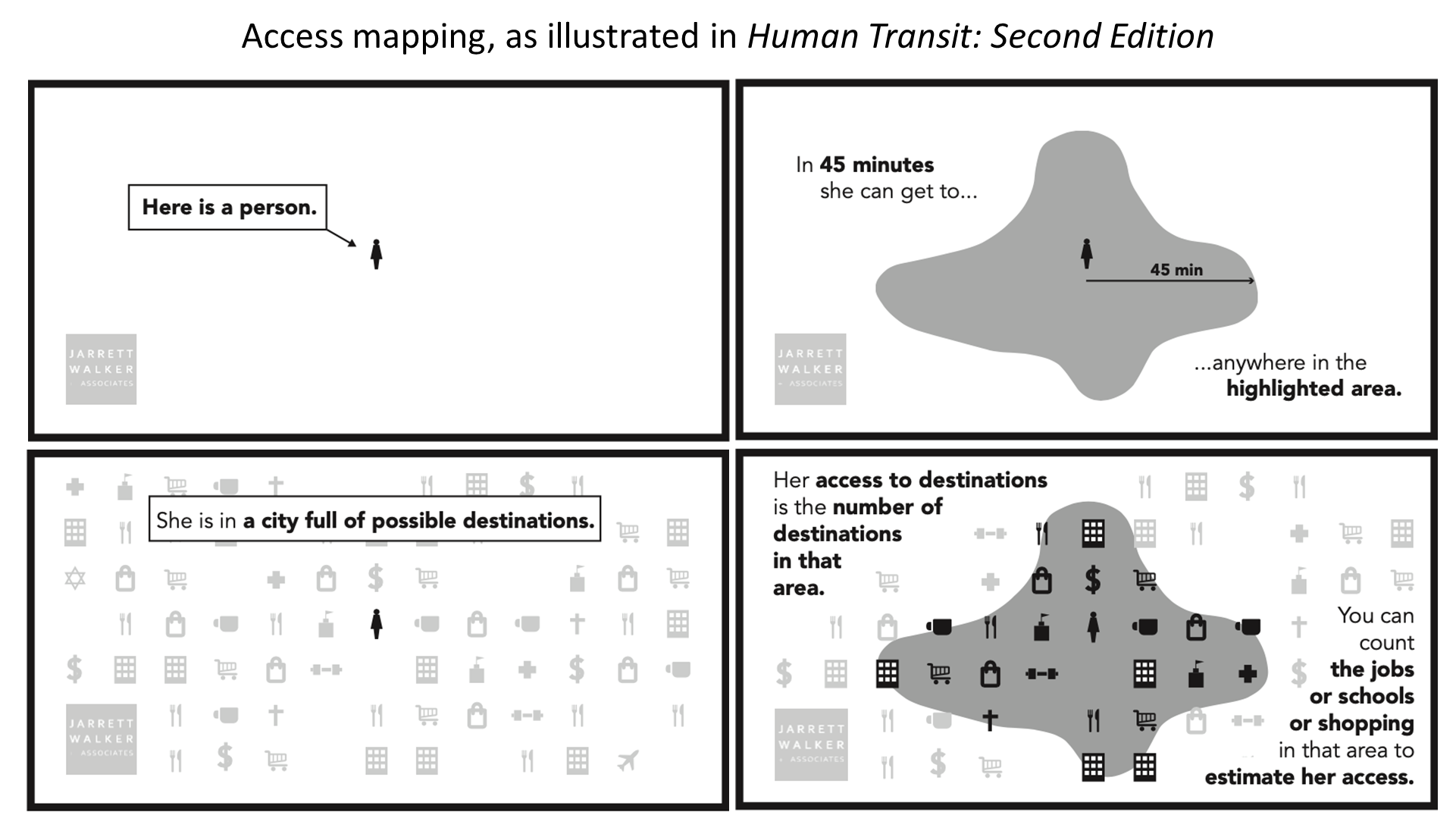
Chapter three is new for 2024. It describes the process of access analysis, which has recently entered the transport planning mainstream. New tools like Podaris:Insight can show us how many destinations a person can reach. This reflects Walker’s reflection that successful cities provide the freedom to go places and do things. Access is: “…a powerful frame for thinking about transport and urban planning” (p. 35).
The importance of a good baseline service, as opposed to a peak-focussed commuter service is explored in Chapter 7. Following COVID and the relative demise of the Dolly Parton working day, this has extra relevance and it leads us into Chapter 8: Frequency Is Freedom. This is absolutely key to understanding the appeal of public transport. No-one likes waiting for buses or trains, and a frequent all-day service makes many more trips possible. It’s a non-linear relationship. Double the frequency and you’ll more than double the numbers of people using a bus, train or ferry, particularly with an integrated network.
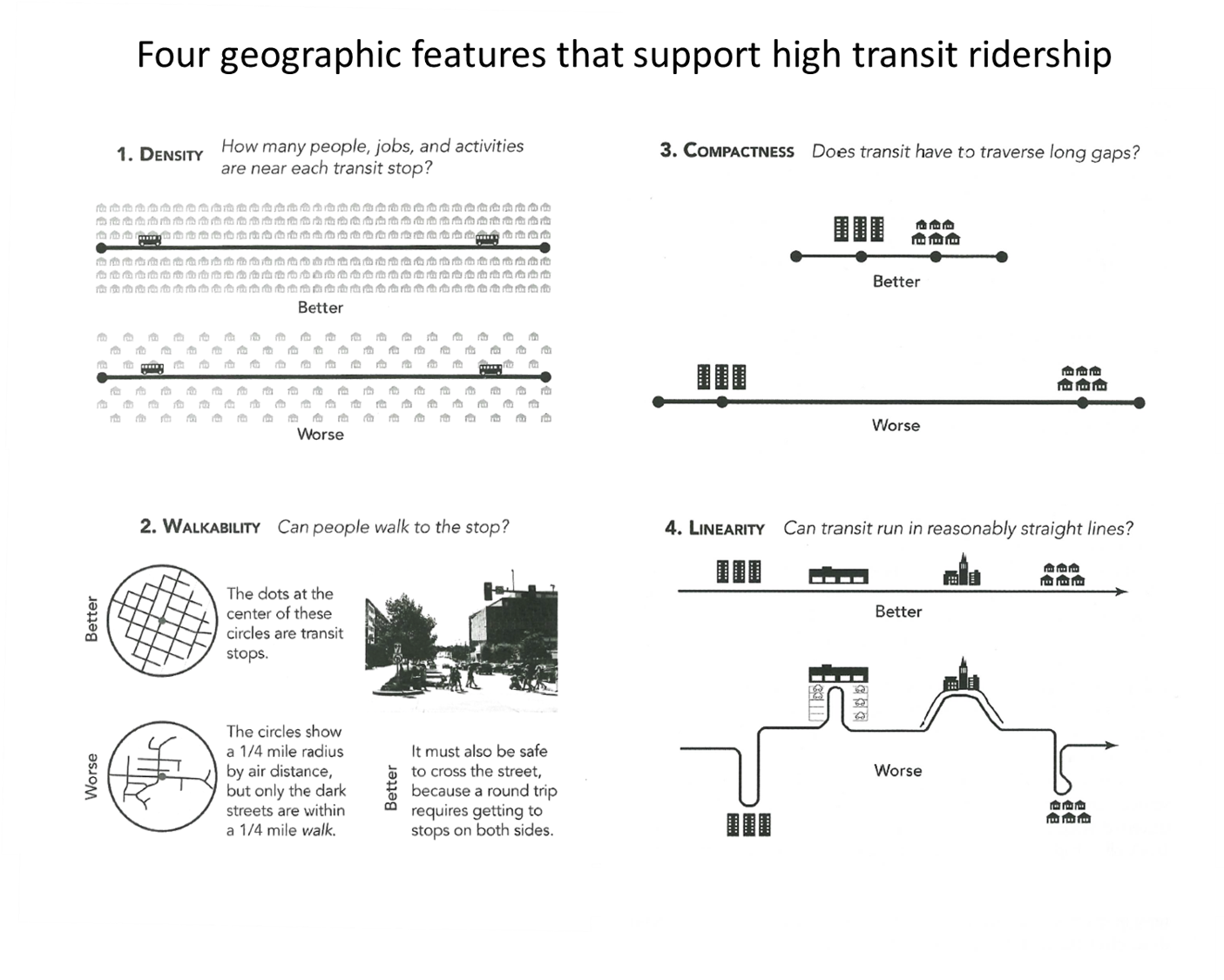
Chapter 9 emphasises the importance of prioritising public transport vehicles (the main benefit being speed, which saves money), Chapter 10 brings us into the realm of land use planning, where the concentration of public transport in a hypothetical Denseville and Sparseville are compared. Significantly, the most important place for density is right around the transit stops. This is consistent with the New Zealand government supporting denser developments at City Rail Link stations.
Chapter 11 address the thorny question of fair fares (summary: there is no perfect solution; someone will always lose out) and Chapter 12 connects this to the value of connected networks that enable transfers (as in Auckland Transport’s New Network) and, in Chapter 13 the places that optimise connectivity (e.g. New Lynn interchange). Auckland gets another mention in Chapter 14 (Network Design and Redesign), where the chaotic spaghetti of the old bus network gave way to the current connected network.
From an urban planning perspective, Chapter 15 (Be on the Way!) is highly relevant to ongoing conversations in New Zealand around density done well. A series of compact, dense, mixed-used walkable nodes, centred directly on high-capacity public transport routes is much more accessible – and successful – than spread-out car-centric developments with a meandering, indirect bus service. This chapter also highlights the moral imperative for organisations to locate on public transport routes.
Chapter 16 (On the Boulevard) we see how existing main roads could better support public transport and adjacent land uses while Chapter 17 (Take the Long View) is consistent with the need to work out what success looks like and the steps needed to get there.
The book’s epilogue reminds us to focus on geometry. The shape and layout of our cities determines the type and quality of public transport that we can reasonably expect. There is a final reminder that transport technology does not change geometry.
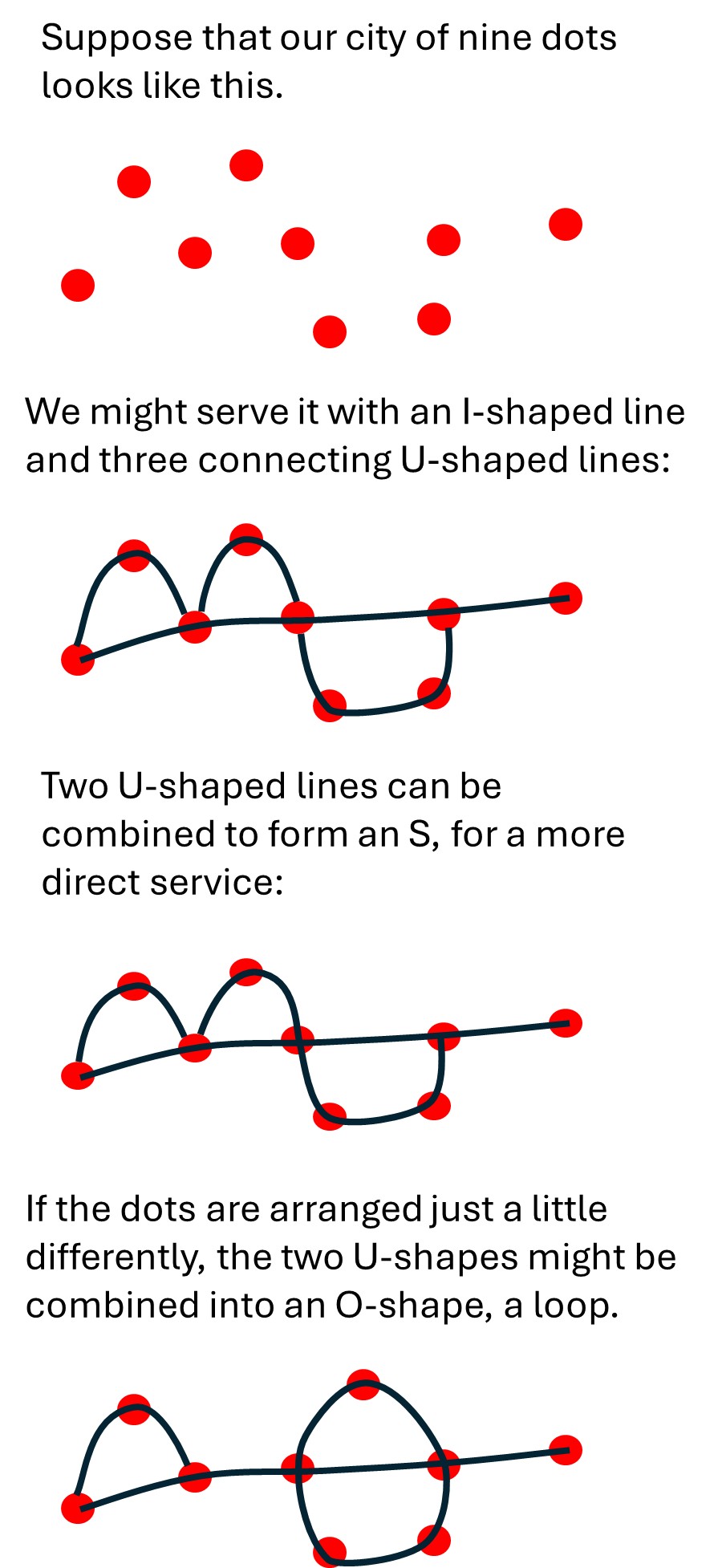
The Basic Line Shapes. From Human Transit, p. 60
A Human-Centred Approach
Walker originally did a PhD in a humanities field, and this is evident in his human-centred approach to public transport. Despite new electric buses and cars, driverless metros and micromobility, the dimensions of urban public transport – and humans – have not changed. Cities are habitats created by and for humans.
If we’re going to have sensible discussions about City Rail Link, bus networks, ferry planning and the future of Auckland, we need to understand the principles of the transport system that will enable it. Want to know more? Auckland Transport’s New Public Transport Network (implemented in stages from 2017-19, plus subsequent stages) uses Human Transit principles, and has delivered buses that are more frequent, better connected and (crucially) much more popular.
Like a good public transport system, Human Transit: Revised Edition is engaging to a wide ridership, for many purposes. This book should be compulsory reading for anyone involved in conversations about public transport, as a planner, operator, funder, passenger or elected representative.
While global rate of change* has been relentless, the geometry of urban transport has not changed, nor has the human dimension. Human Transit: Second Edition is an outstanding guide to public transport and its enablement of public life.
*This concept, and its effects on humanity, was first explored properly in 1970 by Alvin Toffler in Future Shock which is still worth reading 55 years later.
This post, like all our work, is brought to you by the Greater Auckland crew and made possible by generous donations from our readers and fans. If you’d like to support our work, you can join our circle of supporters here, or support us on Substack.

 Processing...
Excellent review of a great book, thanks George
Thank you!
Thanks for such an interesting review George, will need to read this book!
Do! It’s widely available in the Auckland library system and/or you can buy a copy for your own perusal. It’s digestible, detailed and thoroughly professional.
The illustrations and diagrams are particularly clear and I think they would look good as posters.
This is the updated statement of the principle that has brought Auckland PT as far as it has, with its plans for continued improvement.
Proof that’s the next best recommendation after George’s Review and Elon’s vituperation.
The geometry of the city is critical. Land use planning rules that don’t ensure that planning for PT is foremost in development frustrate the application of design principles that are already stated in AT’s TDM. Fast Track excuses for anything goes are no help.
Yes. Public transport is a geometry problem, i.e. how to use straight lines to cover an area. It’s therefore not surprising that the first-ever public transport system was created (in 1660s Paris) by a mathematician (Blaise Pascal).
With spatial planning, you can choose urban geometry favourable to public transport. ‘Human Transit’ makes these principles abundantly clear and explains the working behind them.
That L2 in the header photo isn’t going to Randwick Park. Not any time. We’ve got a lot of Sparseville to fix.
Just Randwick. Not Randwick Park 😉
Sounds like a great book I must read. Was keen on the older version after hearing of his involvement in the new Auckland network design.
Yes, you can see Jarrett Walker’s hand in the design of Auckland’s New Network…and the subsequent increase in patronage and service levels.
The pace of change is very impressive. Auckland had nine frequent services in 2016; it now has 43 of them – an amost five-fold increase. We learn in Human Transit that “Frequency is Freedom” and it’s great to see the effects of this approach borne out in practice, right here in Auckland.
Do you know of a book shop which has it in stock already? Unity? Anywhere else?
Also – glad to hear that Elon Musk had previously branded the author as “an idiot”. Seems to me that this is a phrase which might be better suited to Musk himself now….?
I don’t – sorry. But you can look on http://www.abebooks.com – there are plenty of copies available there if you want to buy it online.
The Musk-Walker spat went on for a little while…and yes I agree with you.
For future reference, https://bookhub.co.nz/ is a great way to search (and support) NZ independent booksellers, but unfortunately it doesn’t look like anyone has it.
Just ask your local bookshop to order it.
Thanks for this review. I am glad to see there is more emphasis on what people want from Transit, although the idea that one needs to consider the different sorts of demand looks like it is still missing. The public transport system needed to get commuters in and out of a CBD is likely very different from the one that is needed to meet some weekend travel needs. Simply talking about geometry ignores this. The physical geometry is the same but the social geography is very different.
Also, a minor point, the review includes this comment
“Significantly, the most important place for density is right around the transit stops. This is consistent with the New Zealand government supporting denser developments at City Rail Link stations.”
This is NOT what the NPSUD and related approaches do. They deregulate planning across a very wide area. One of the real problems with the NZ approach is that it is insufficiently focussed on what is called “focal density”. Although people in NZ seem to think the approach is Australia is similar, the new plans in Melbourne for example are incredibly focussed on development very close to rail stations and tram routes (no 15 min able-bodied “walkable catchments”) and step down very quickly as they move away this focal points.
In many ways while both countries talk about upzoning, they are very different, at the detail level. New Zealand is more concerned with dressing up deregulation as “enabling housing” while the Australian approach is more evidence-based and tightly focussed on increased density at focal points.