The City Rail Link has a bit of a secret power. It doesn’t just transport you around Auckland, but even further afield. Standing on the platform at Te Waihorotiu at certain times in the middle of the peak, with up to four trains turning up and departing within a five-minute period, it gives off the vibe of a real metro and can make you feel like you’re in a city far away.
That secret power will wane over time as taking the train becomes a more everyday experience for Aucklanders. But in its place will be ever more people making use of the new possibilities the CRL has unlocked.
Last week we reported our impressions of Day One, and now we have a week’s worth of information about how it’s going. Already, Aucklanders are flocking to use the CRL with the early numbers showing a massive increase in train use, smashing the record for the busiest single week of use on the rail network with over 528,000 official boardings.
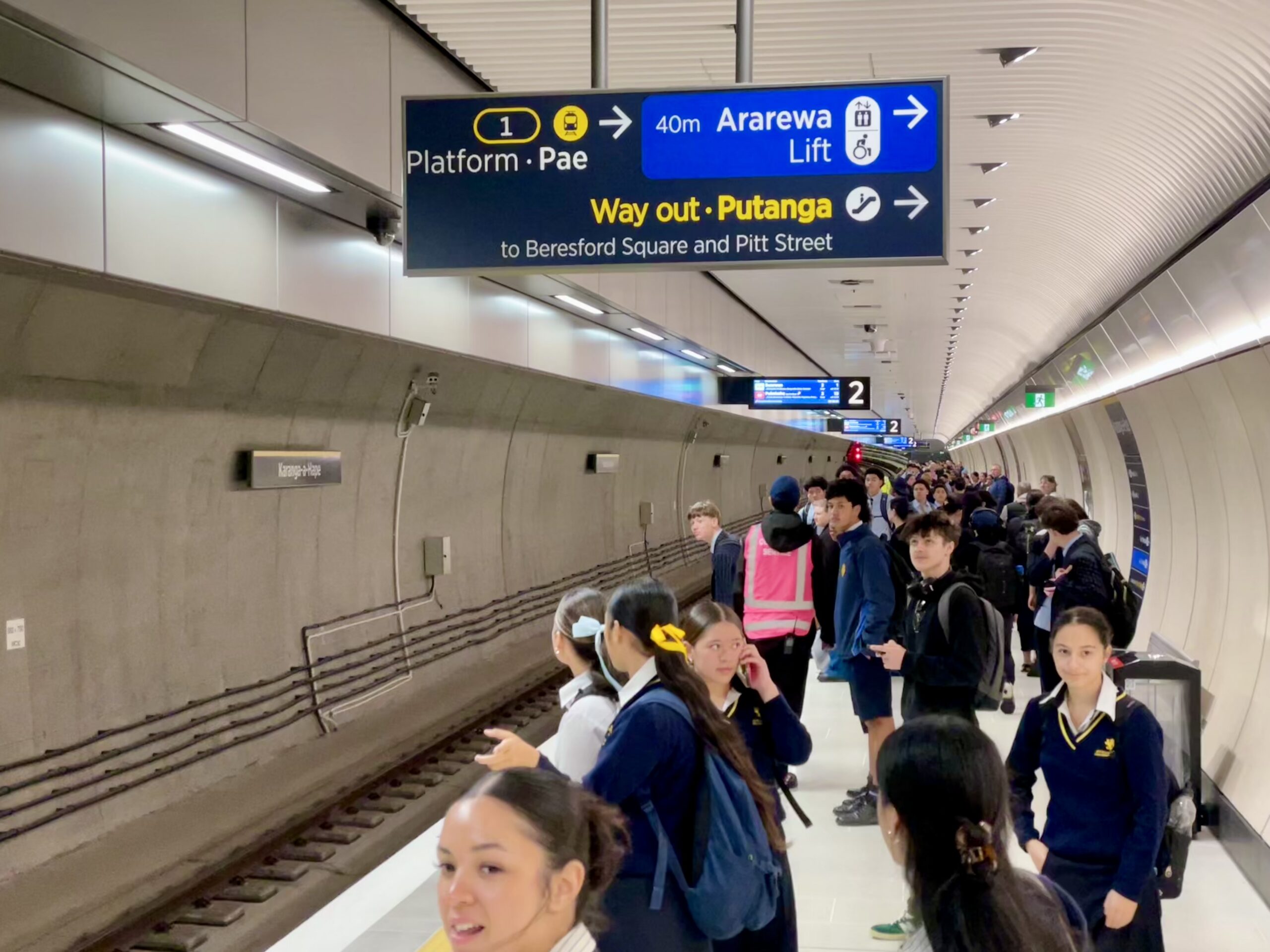
Karanga-a-Hape Station Platform 1 after school. Photo by Patrick Reynolds.
Auckland’s rail network has recorded its busiest week ever in the first seven days of CRL services, a strong early sign of Aucklanders embracing the new system, Transport Minister Chris Bishop and Auckland Mayor Wayne Brown say.
A total of 528,007 train boardings were recorded between Sunday 13 September and Saturday 19 September, beating the previous seven-day record of 504,380 set in March 2019 by more than 23,000.
“The CRL is one of the most significant transport investments in New Zealand’s history, and it’s fantastic to see Aucklanders getting on board in such huge numbers after waiting years for its arrival,” Mr Bishop says.
“The week before the CRL opened, Auckland’s rail network recorded 325,203 boardings. One week later, patronage was up by around 62 per cent, showing the immediate difference the new system is already making to the way Aucklanders move around the city.
“People were eager to try the new network right from the first services on Sunday, with early risers turning up for the first train at 4.57am from Ōtāhuhu. By the end of opening day, 56,757 train boardings had been recorded. Momentum continued to build throughout the week, peaking at 85,289 boardings on Thursday.
“The network also performed strongly as Aucklanders got used to the biggest change to the city’s rail system in generations. Punctuality and reliability of train services remained consistently in the mid-to-high 90 per cent range throughout the working week, strengthening further as the week went on.
“A strong performance in the first week was important for building confidence in the CRL as a reliable, genuine public transport alternative for Aucklanders who might otherwise choose to travel by car.
“For years, the focus was on getting the CRL built. Now the exciting part begins as we see what Auckland can do with it, joining the great modern cities around the world where fast, frequent rapid transit is part of everyday life.”
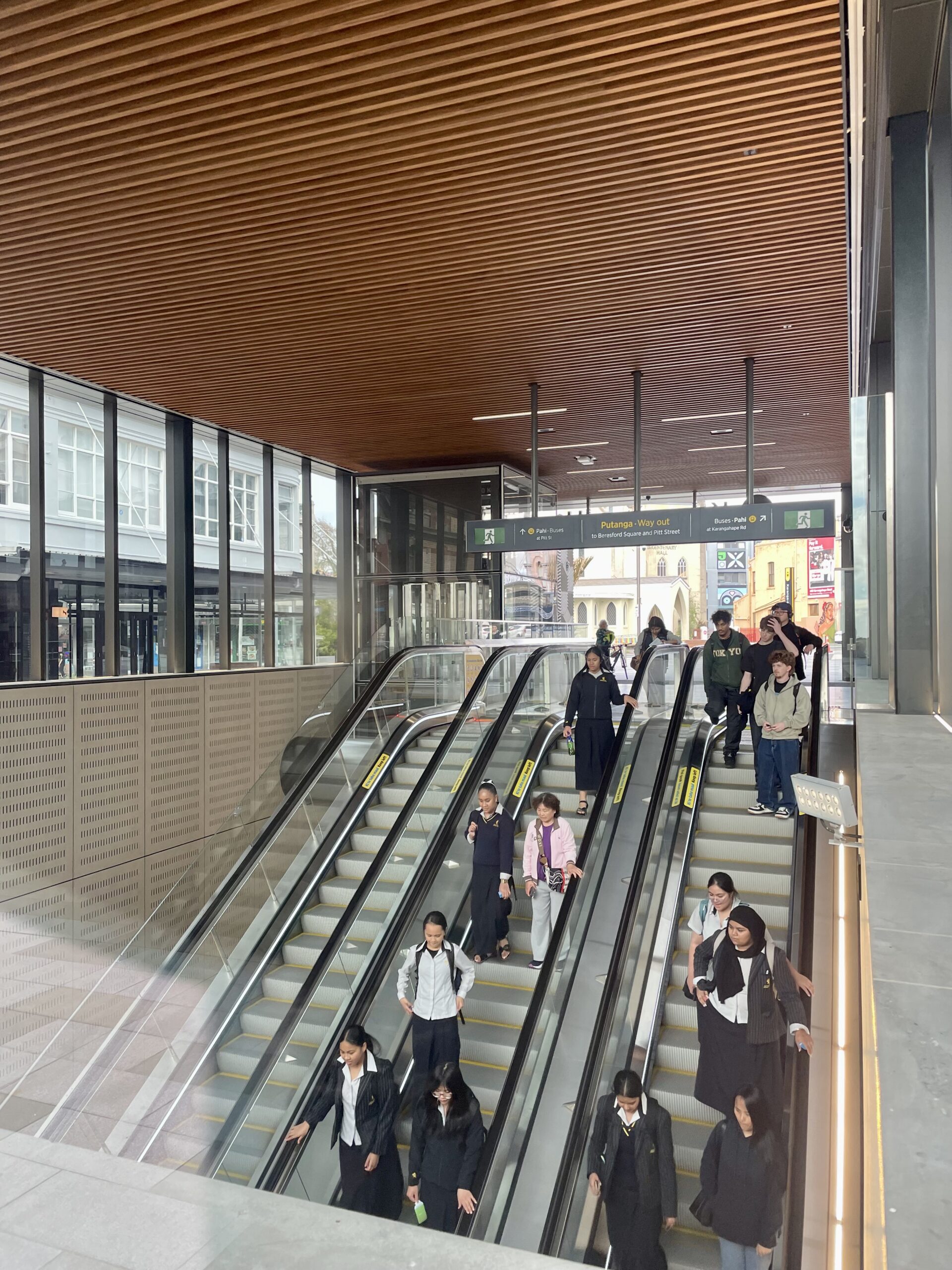
Karang-a-Hape Station Beresford St. photo PR
That’s a fantastic early result, and something so clearly out of line with the results we’d been seeing over the last few years. It shows that Aucklanders are keen for better options.
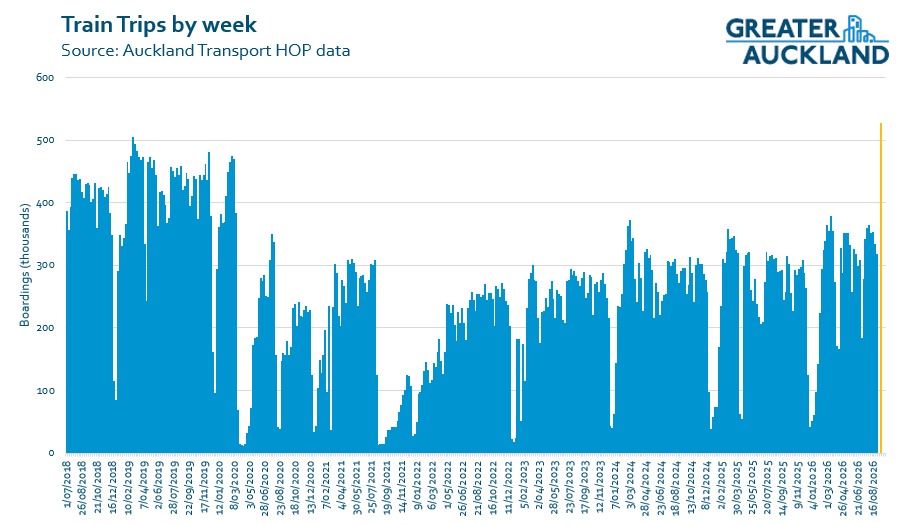
A key part of this new record was a significant increase in ridership on the weekends – so while the weekdays weren’t quite as the level of March Madness 2019, the massive increase in weekend usage secured the new record.
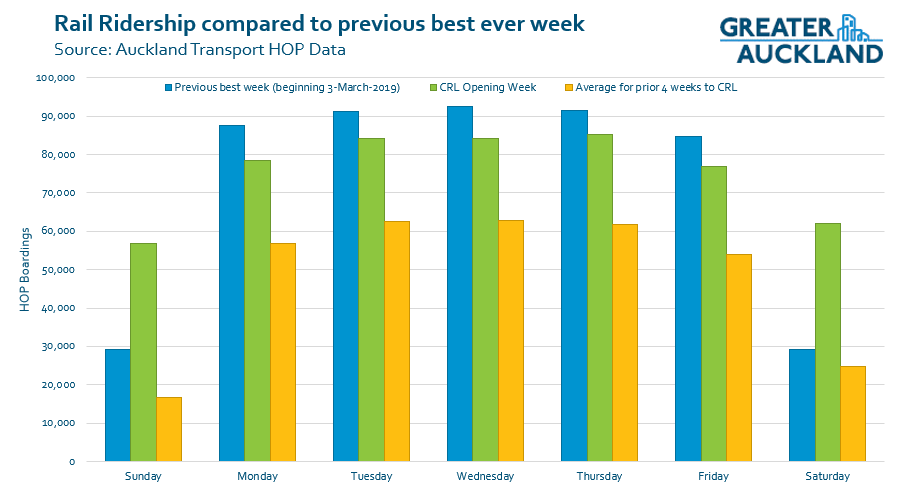
Absolutely, some or all of the extra trips will simply be people investigating the stations and network – many of whom may be riding trains in Auckland for the first time – but there will also be many new or returning rail users who are keen to make use of the improved service.
Auckland Transport told us yesterday afternoon that this Monday was tracking only around 10% lower than last Monday, and thus still significantly higher than we’ve seen in the last few years.
They also told us that numbers for both buses and ferries last week were up on the week before. That’s positive, as it highlights that while the CRL is likely to encourage some change in choice of public transport mode – such as people in the inner west shifting from bus to train – there is still overall growth happening in the system. This is something that’s bound to continue as fuel costs start to rise again.
It’s also worth a reminder that ridership growth from projects like the CRL doesn’t happen all on Day One, but instead is realised over many years. A great example of this was the electrification of the rail network which resulted in around three years of sustained high-growth and was still growing until COVID emerged.
So in this case, I expect we’ll have many years of strong growth ahead – providing Auckland Transport, Auckland One Rail and KiwiRail can keep the network running smoothly.
Interestingly, actual ridership is likely to be even higher than the numbers reported above. The data above is based on the HOP system, so it only counts when people tag on. So, it doesn’t pick up people who (like me and my family) tagged on, and then visited the various stations to take a look, but without tagging off at each station.
Auckland Transport also has automated counters onboard their trains which actually count people as they get on, allowing for a more accurate count of actual ridership. The latter were the numbers that were first reported last week, and they were even higher again – which will be largely due to lots of people hopping on and off trains to check out the tunnels and stations without ever leaving them.
Another interesting fact Auckland Transport shared with us was that Waitematā was still the number one station for boarding or alighting, with Te Waihorotiu not far behind.
This is interesting, as previous modelling suggests that the latter would grow to become the busiest station within in first year – and it still may, but it isn’t there yet. Perhaps even more interesting was that Karanga-a-Hape was not all that far behind them, which is notable as previous modelling suggested it would be significantly lower.
I’m sure there were plenty of people just waiting for something to go wrong – especially in the media, which to its credit has been reporting the positive news – but other than a few minor issues, the CRL had a great Week One. Well done to Auckland Transport, Auckland One Rail, KiwiRail and everyone who helped make the first week go pretty smoothly.
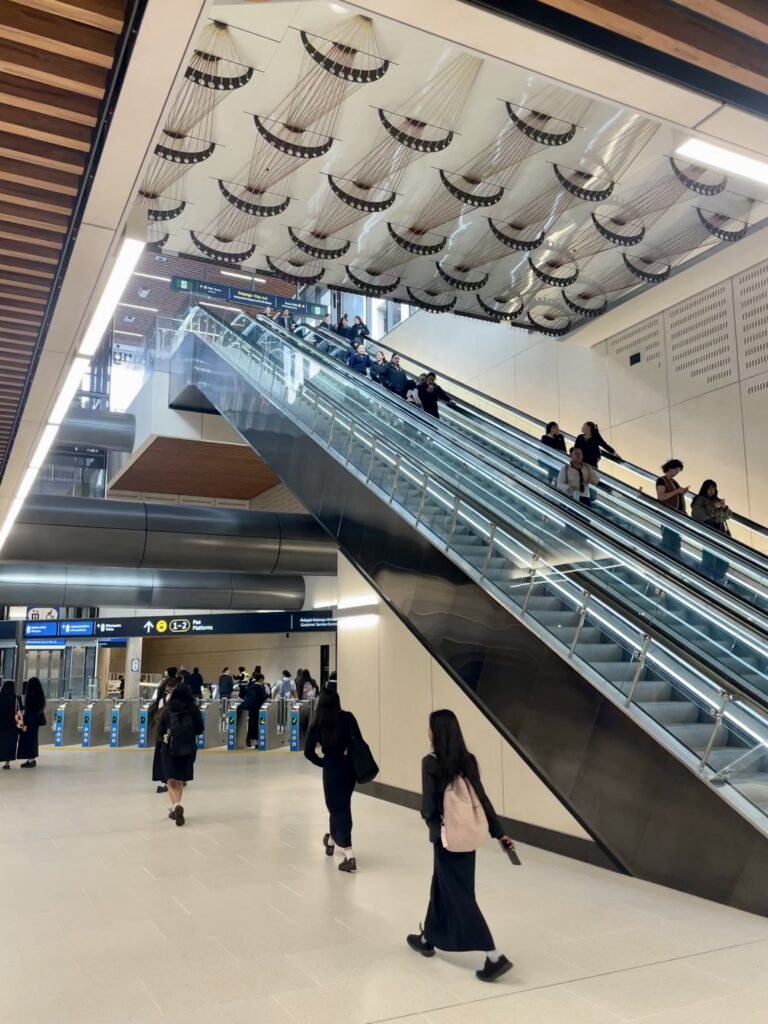
Karanga-a-Hape Station Beresford St. Photo PR
Making it even better
There’s more good news too, as the network is about to get even better soon. Auckland Transport is planning to update the timetable again in November, which will see most of the East-West line running at 8 trains per hour per direction at peak.
There are currently short-running services that run between Sylvia Park and Kingsland at peak times. This will be extended to Henderson, providing more capacity and further improving the ability to transfer between E-W and S-C services at Karanga-a-Hape. (Auckland Transport says the thing preventing this improvement from being extended to Swanson is concerns around the Metcalfe Rd level crossing, which from what I can tell is the busiest road level crossing in the country)
The November improvements will also see 15-minute frequencies continue till about 11-11:30 on Friday and Saturday nights, a very welcome improvement.
Further improvements are planned for February 2027, which is expected to see frequency improvements to the South-City line.
At this stage the changes are largely about filling in the gaps in the timetable, so they won’t change travel times. However, Auckland Transport do say they’re looking at how they improve dwell times and other train operations, which will allow travel time improvements eventually.
But still: getting to 8 trains per hour, per direction, on the two main lines at peak, will be a key milestone. Because the two main lines overlap in the CRL, and at Puhinui-Ōtāhuhu, this means a peak frequency 16 tph/pd – a train every 3:45mins each way – on those core sections. A real glimpse of the future, more a real metro-like experience. This will especially be able to be felt on the relatively narrow island platform at Te Waihorotui.
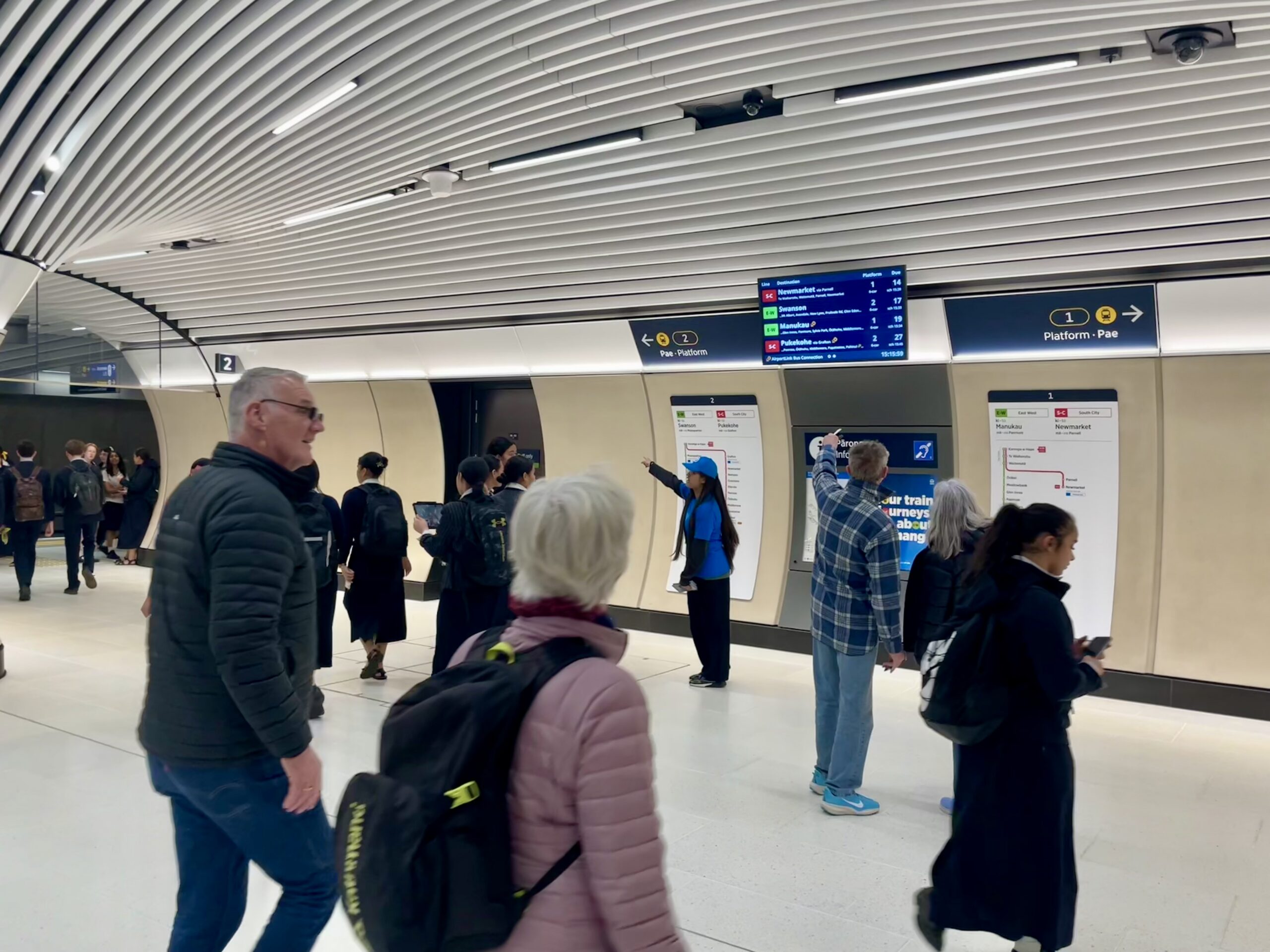
Karanga-a-Hape Station pointing. photo PR

 Processing...
Caught the E-W train on Saturday night. Train packed (and restaurants also packed). It was generally a good buzz.
Unfortunately it was a 3-car. Got talking to transport officers who said they had been running 3-cars a lot of the day. Didn’t know why. But there were too many people on board for them to check tickets. Especially hard for bikes, prams and disabled. Also, 3-cars very confusing for people at the long new underground stations as they have to run along platform.
Can someone please ask AT why they are still regularly running 3-cars? Is there a maintenance issue? Is it to save money?
Maybe they need to report on % of services that are 3-car and explain why.
Agree. They also stop them at the same place as the 6 car, so quite a long walk (and delay) at the big stations if you don’t know what’s happening.
Save money, wear and tear plus easier to manage for transit officers. Agree gets a bit busy some of those three sizes in the weekends.
We went to K Rd on Saturday, spent some money in St Kevin’s Arcade, had lunch in a café, didn’t see any 3 carriage trains, let a couple of full 6 car trains go by (full of greenie protesters heading home lol), before catching a nearly full 6 carriage train.
I imagine scheduling train maintenance around the extra services would be challenging.
AT say they are short 30 sets to be able to run 6-car consists with more intense timetable.
Which in turn needs more stabling, so that needs to go into the Long Term Plan.
A success problem.
Interesting. I was of the belief that they had received the new sets to allow this to happen, but it was obviously a partial order.
Do you know how many they ordered in the most recent bach?
Interesting that Waitemata is still the busiest, probably existing travel habits of nearby workers. Also I suspected K’Road would do well – a lot more going on around there perhaps compared to mid city until it picks up there again after all the works. Great to see timetable improvements planned so soon.
I’m not surprised for the first week. A lot of weekend uplift and from a recreational standpoint downtown has more going on, nicer to visit than midtown IMO.
I’d say as communters adjust this will settle down and Midtown station will become busiest as per the modelling due to the location to businesses.
Also midtown itself is a little bit of a mess at the moment, however as retail and businesses move back into the CBD we are likely to see some mode shift. Especially when the new convention centre starts being used.
I don’t want to harp on about it (this will be my last whinge I promise), but i wonder how many people have been put off using trains be the 30 min frequency after 8. Surely that wasn’t a network issue, just a cost saver. They should have made opening week awesome instead of conservative.
Their focus was on getting though the opening without any major issues, which is understandable. Can you imagine the headlines if something had gone wrong.
I’m really looking forward to seeing some fine grained data on the three city centre stations. I suspect that Karanga-a-Hape actually has a massive residential catchment and might be a ‘home’ station rather than the destination for a good chunk of it’s trips. It’s also a great transfer location for buses from the nw and the inner west.
The photos at Karanga-a-Hape station show pupils from Auckland Girls Grammar, where I suspect a lot of girls commute to and from by rail , and previously the 106 bus service to and from the Waitemata Station. Now they have a very nearby railway station.
15 mins till 11-11:30 on Friday and Saturday nights!!
Fantastic news!.
Being able to leave a show / bar etc. and know a train is more than 15 minutes away will be a game changer and really boost numbers at night.
How about services every 15 min until midnight every night? Like a proper city?
I suspect when they say that they mean the last service departing the origin station e.g. departing Manukau, Pukekohe and Swanson which means those trains will be leaving the city around midnight.
How about services every 15 min until midnight every night? Like a proper city?
This is great start.
However the real test will be in 6-12months time to see if we have real uplift (which I have no doubt we will as long as AT deliver constistent and reliable service).
The other big benefit will come from development in the surrounding catchments at all stations. There already has be some, but with a reliable service, businesses and developers will be eyeing up property surrounding all stations.
It sounds great. Is there any future plans to expand in any way.