On Saturday, an online headline in the NZ Herald hollered: “Auckland Council’s $3.9 billion splurge: Where buyouts, tunnels and a busway took the cash.”
A shorter version graced the print edition wrapper: “BIG SPENDERS: Auckland’s $3.9b infrastructure splurge.”
Right next to “Early warning signs: Missed chances to clear Mt Maunganui campground revealed.” (Hold that thought.)
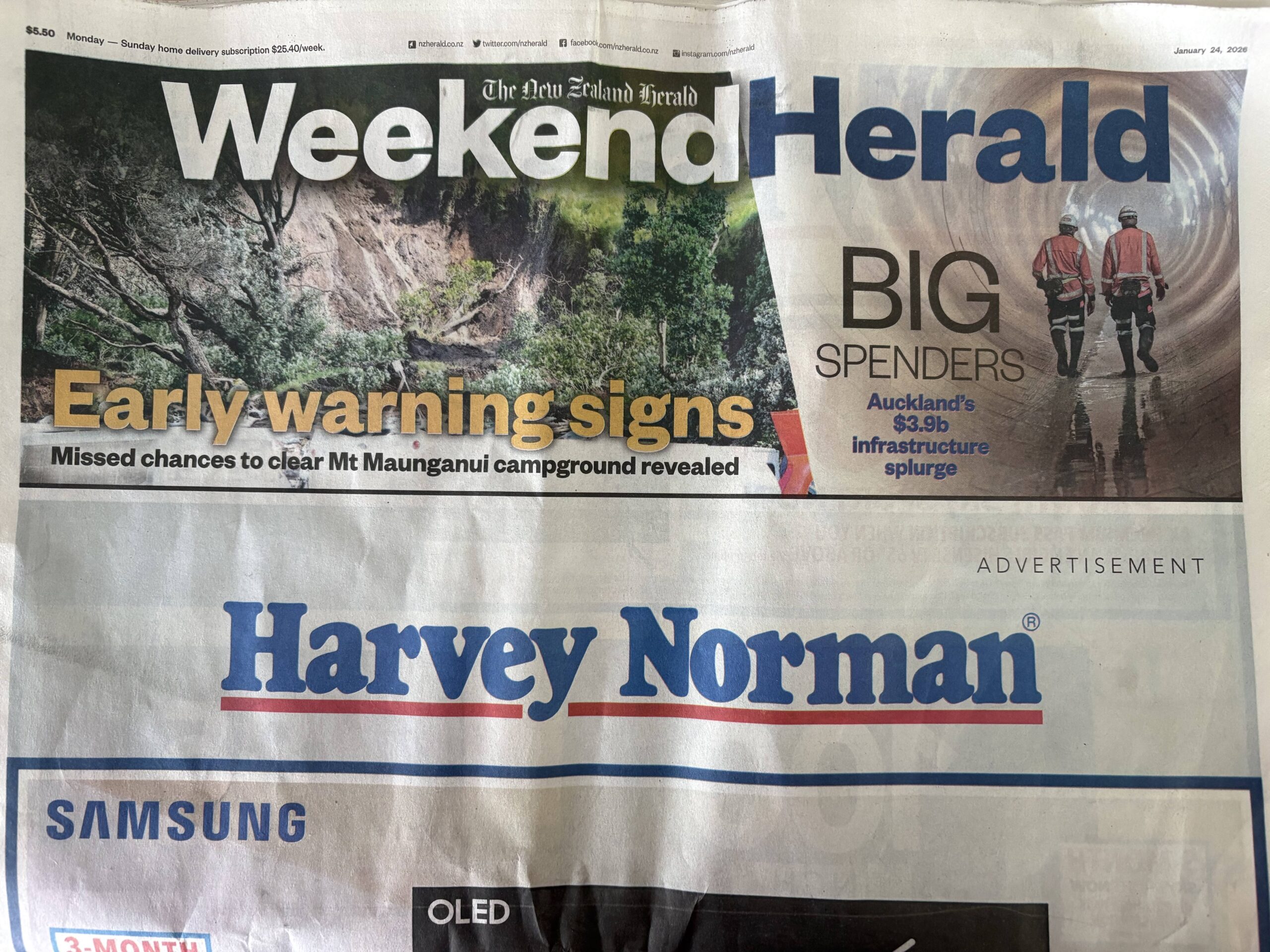
The advertising wraparound of the Weekend Herald, Saturday 24 January 2025.
The (paywalled) article, by veteran civic affairs reporter Bernard Orsman, presented itself as “a Herald investigation” looking at what “new figures reveal” about Auckland Council’s capital expenditure in 2025.
What’s a “splurge”? It’s classic tabloid-ese, a word designed to intrigue and/or rark people up (see also “spree”, “blowout”, “flaunt”, etc). To “splurge” is to spend money extravagantly, on something you don’t actually need – unnecessary, frivolous, ostentatious, maybe even reckless expenditure, aimed at pleasing yourself.
To be generous, perhaps the headline was one of those decisions made early, in a context of rapidly developing events, with a bit of long-weekend pre-scheduling in the mix.
Still, readers would rightly hope to learn how much was “splurged”, on which luxuries, and why.
As the article quickly “reveals”, in fact the “cash” went towards:
- mopping up after the damaging 2023 floods, and
- critical infrastructure to help the city be more resilient in general, and to future shocks
If there’s a scandal here at all, it’s that the paper of record seems to be swerving the bigger story:
- climate change is costing our city (and our country at large), big time
- this is completely unsustainable, so
- how can we best invest our limited resources for greater resilience?
Especially given that the biggest item in Council’s capital expenditure of 2025 was a one-off response (hold that thought) to a once-in-a-hundred-year event (hold that thought too):
The buyout of 667 storm‑damaged homes was the biggest cost incurred in Auckland Council’s record $3.9 billion capital programme last year, new figures reveal. [Emphasis added]
For sure, the flooding in 2023 Auckland Anniversary Weekend (and over the following weeks) was a profound shock to the system. But it shouldn’t have come as a surprise, given the overwhelming scientific consensus. We are now well into the proverbial “rainy days” for which savings should be – should have been – assiduously set aside.
Be that as it may, is it a “splurge” for Council to acquire 667 damaged homes? If anything, the story seems to suggest even more homeowners should have been compensated:
The buyout scheme was well on track in the 2025 financial year, but it has left those who missed out feeling helpless, and the council with hundreds of empty, cleared and flood-prone sections on its books.
And, another way of phrasing that last point would be: “Council now has hundreds of future blue-green reserves and restored wetlands on its books”.
Perhaps you’re wondering how this highly exceptional situation (thought – please hold) compares to expenditure in a “normal” year (yes, put that one alongside the other thoughts):
Strip out the $727 million paid to homeowners forced to abandon their red‑stickered properties after 2023’s furious floods, and the council’s capital programme lands roughly in line with the $3.2b recorded in 2024.
In other words, aside from an unexpected overrun in response to a climate disaster, capital expenditure remained steady. That’s a bit more challenging to spruik via a juicy headline, but worth noting.
So, does the “splurge” lurk within Council’s normal capital expenditure? If so, the Herald would be doing a valuable public service by pointing out any spending that’s extravagant/ unnecessary/ treat yourself/ insert splurgy adjective here.
Show us the civic equivalent of splashing out on a designer handbag, a fancy sports car, or a holiday somewhere that doesn’t flood or catch fire:
A Herald investigation shows that major transport and water projects dominated the $1.4b spent on the top 10 capital projects, led by $240m for the Eastern Busway and $129m for new trains before the City Rail Link (CRL) opens on Auckland Transport’s side, and $170m for the Central Interceptor on Watercare’s side.
“Transport and water”? Hold the front page! Oh wait, they did. Of those top three projects, only the Eastern Busway stands out as one that some of us reckon could have been delivered more affordably (and with better climate outcomes). Aside from grumbles about disruption (omelette; eggs), nobody seriously disputes the value of the CRL and the Central Interceptor.
Maybe the splashy cash is further down the list? The article lists a few projects beyond the top ten, but doesn’t single out any in particular as wasteful. More water, more transport, public libraries:
…a new wastewater pipe beneath Queen St to support central‑city growth, repairs to the Ōrākei main sewer line damaged by a sinkhole, roadworks in Drury, the Pt Chevalier to Westmere cycleway and road upgrade, further progress on the Te Whau Pathway, and $15.8m spent renewing library collections.
We also learn about $1.3bn of investment in a range of community amenities across the city: sports facilities, swimming pools, playgrounds, parks, plazas, seawalls – with no hint if any qualify as fripperies:
…work on the northern seawall at Ōrewa Beach, renewal works at Henderson’s West Wave Aquatic Centre, upgrading Manurewa’s historic Nathan Homestead, and completing the long-planned Te Rimutahi park on Ponsonby Rd.
So far, no “splurge”. If anything, to its credit, the article offers some helpful context:
- A quick note on how the capital programme is paid for – some significant co-funding from government / NZTA/ development contributions, and some increased debt
- Data for the top 30 projects (which the Herald’s data whizzes have made available for others to play with, see here).
- And a response from Council outlining the investment approach:
[Auckland Council’s financial strategy general manager Michael] Burns said the council used debt to spread the cost of assets over the generations that would benefit from them.
Continued investment in Auckland over the next decade required debt to rise to fund a record $39.3b capital programme under the long-term plan, and the council’s financial strategy placed firm limits on borrowing to ensure debt remained prudent and sustainable, he said.
Mayor Wayne Brown said his focus was on investment in Auckland’s growth and on building resilience to the impacts of climate change.
He said the council had invested $1.5b to improve public transport and reduce congestion, and $1.2b in water infrastructure to ensure reliable services, reduce wastewater overflows and protect the environment.
“As an engineer, I understand the importance of keeping infrastructure in good working order, and making sure it’s there before spades go in the ground for developments.” [Emphasis added]
Long story short, the juicy headline hook is not borne out by the article itself. But for those who don’t read beyond the headlines, a message has certainly been conveyed.
The thing is, if you want to spice up a story about infrastructure, there are far more gripping angles. Especially in the light of everything happening around us right now.
There are plenty of powerful questions to ask about whether, and how well, our leaders are investing for our future.
And there are extremely incisive and urgent stories to tell about the stakes and the costs of not doing so.
Let’s hear those.
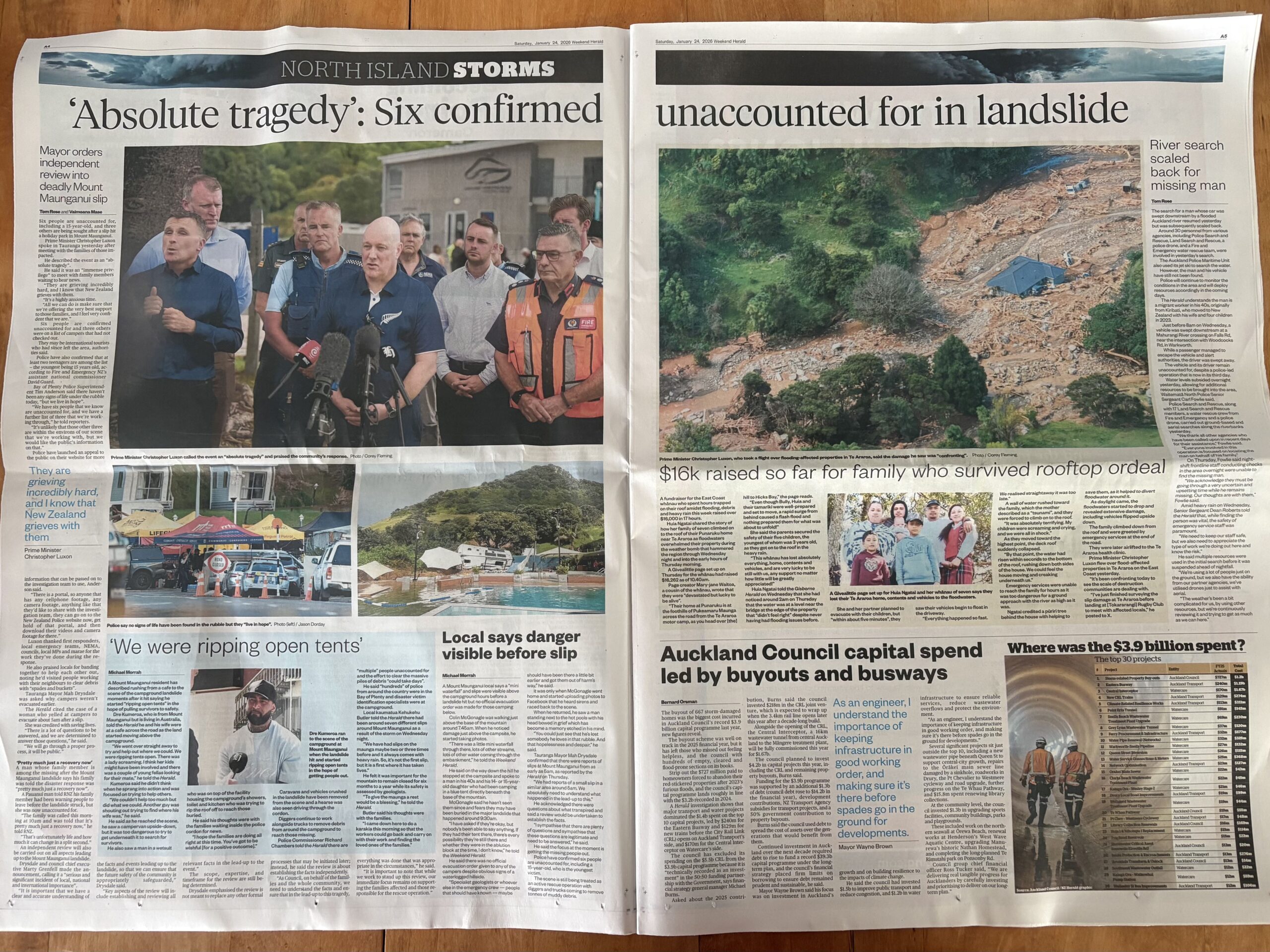
The story as it appeared on page 3 of the print edition, at the bottom right of a double-page spread about the ongoing tragedy at Mt Maunganui. (Note the less emotive, more proportionate headline, “Auckland Council capital spend led by buyouts and busways”.)
After I’d written the above, another story appeared – on Tuesday, under the same byline, but no paywall – a deeper, more nuanced account of the ongoing costs, both personal and social, of climate disaster.
It’s a harrowing read, compassionately written, and explicitly situated in our current context. It begins by describing how “the rain over Napier during last week’s tragic storms stirred painful memories” for Steve Miller, whose son Daniel tragically drowned in the 2023 Auckland Anniversary floods.
It then highlights some steps Auckland Council is taking to try to prevent future deaths, with the related costs simply noted as facts:
“To reduce these risks, the council is installing safety grills and self‑closing covers in high‑risk areas or where safety concerns are known,” Skelton said.
“These grills allow stormwater to flow while preventing people from entering the pipes. The programme will cost $9.5 million over four years, and more than 2300 grills have already been installed.”
Another step the council has taken since the floods is to proceed with a controversial plan to redevelop half of Takapuna Golf Course for a flood-detention wetland for Wairau Valley and Milford.
The Wairau flood resilience project is part of the council’s Making Space for Water programme, which has allocated $760m to building infrastructure that manages floodwaters in temporary reservoirs or detention sinks, usually on parkland.
Steve Miller wasn’t aware of the golf course plan, but welcomed the action to prevent future flooding in the low-lying basin on the North Shore.
The word “controversial” might give you pause, as it did for me, when there are other neutrally descriptive options, like “evidence-based”. (But hold this thought, too.)
The story then moves to a young family currently in a legal battle to be compensated for their flood-affected property. Again, the focus isn’t on what this means for Council’s “cash”, but on the human angle and the (natural) yearning to feel safe in an increasingly risky climate:
Brendon and Steph Deacon’s experience doesn’t compare to Miller losing his son, but it underscores how those excluded from the council’s buyout scheme are left feeling helpless and anxious whenever heavy rain is forecast.
…“There is still a huge amount of rain anxiety for us,” [Steph Deacon] said, adding that last Wednesday’s storm meant her husband was up all night keeping an eye on the water level.
Then there’s the impact on the couple’s daughters, aged 8 and 6.
The other night, Megan Deacon, who’s 8, kept asking, “Is it going to flood? Is it going to flood?” It was hard to reassure her when you don’t know yourself what’s going to happen, Brendon Deacon said. He has spent years trying to explain to the girls why neighbouring houses and their friends have disappeared.
“This is all about risk to life. Our children were put at risk to life. We were put at risk to life. Just do the human thing and give us what our neighbours got to move out of a dangerous place.”
The Council response, from recovery manager Mace Ward, touches on the challenge of equitable and humane decision-making, within available constraints, in a growing climate crisis:
Ward said the council understands how challenging the situations are for storm-affected people and recognised that some outcomes may not be what people hoped for.
“Our priority is to support recovery in line with agreed government and council risk policies and risk frameworks, which are essential to ensure equity when using public funds,” he said.
Ward would not comment on the Deacons’ case while it was before the court.
“We’re now at the tail end of a huge recovery programme, with thousands of individual repair and recovery initiatives delivered across the region by the Auckland Council group. Some of the hardest work hasn’t been the physically visible stuff; it’s been supporting Aucklanders to make incredibly difficult decisions about their future,” Ward said.
The article then covers more of Council’s ongoing flood recovery work, essentially filling out the picture sketched in the weekend article, with projects and their costs listed without judgement.
Watercare and the council’s Healthy Waters division have completed major network repairs, including to the wastewater networks in Murrays Bay, Northcote and Pukekohe.
Funding and designs have been confirmed for four major multimillion‑dollar flood‑resilience projects, accelerating nearly $200m of work. Two projects now underway in Māngere are due for completion this year; one replacing a bridge on a key transport route and the other replacing a wastewater pipe that carries 70% of Auckland’s wastewater, to reduce major blockage risks.
It ends with a characteristically blunt Mayor Wayne Brown reflecting on what was learned from 2023, addressing the “controversial” wetland restoration, and taking a solid stance:
“I wasn’t particularly well prepared. The council wasn’t particularly well prepared. Auckland Emergency Management wasn’t well prepared. The city wasn’t well prepared.
“Auckland Emergency Management is a hell of a lot better than it was. Fenz [Fire and Emergency New Zealand] has also taken a step forward. What I’m most proud of, which came out of that, is the Healthy Waters programme ‘Making Space for Water’. I think that’s a marvellous thing, even if it does upset one or two golfers from Takapuna. In the long term, it’s a really good thing to do.”
Climate action is a really good thing to do. Not just in the long term, but as we’re discovering, in the very short term, too. Not a splurge, not a splash, but a purposeful and urgent channelling of our collective “cash” and attention and ingenuity, in healthier directions.
This post was sparked by a headline, began with one set of thoughts, and ended somewhere different from initially expected.
These two articles are just two moments within a wider context, one that’s still soaked in grief, the earth still moving.
Hold that thought, we say, when trying to work through a complicated line of argument.
I can’t stop thinking about the people who went on holiday – or went out to work – and didn’t come home. The kids whose classmates will head back to school this week, without them. All the people whose whole worlds have just been swept out from under their feet.
We’re all holding so many thoughts right now, almost too many. I don’t know about you, but I find it harder and harder these days to think and speak clearly. But all the more necessary to keep trying.
I think I’m writing this as a plea for clarity – in words and actions.
For more intentional language. More thoughtful communication. More collaboration, more credit, more compassion, more commitment. Proper leadership. For a better chance of playing our part to address threats that once seemed hypothetical and that now keep our children awake at night.
Can we move beyond splashy headlines to the real stories, and beyond short-term politicking to some real action? We owe it to each other. We owe it to them.
Some further reading (other suggestions welcome)
- Councillor Richard Hills, on reflections on the 2023 floods, three years later
- Marc Daalder, on how New Zealanders are feeling about climate action
- Henry Cooke, on where the money will come from to fix this
- Fox Meyer on emergency management and empowering communities
- Dr Bex Graham, on what it feels like, and why we need to plan and act
- Manu Caddie, on vulnerable landscapes in a rapidly changing environment
Header image: Meola Road, around 4pm on the afternoon of Friday Jan 27th 2023, Auckland Anniversary Weekend, before the heaviest rain arrived. This road has since been fully rebuilt with new stormwater separation, footpaths, lighting, bus stops, a two-way cycleway, and rain gardens. (The project also came in under budget.)
Greater Auckland’s work is made possible by generous donations from our readers and fans. We’re now a registered charity, so your donations are tax-deductible. If you’d like to support our work you can join our circle of supporters here.

 Processing...
Bring back Simon Wilson/Brian Rodman.
Brian Rudman. Autocollect…grzzz….
Gee is splashing $60billion++ on RONS a good investment…perhaps there are more worthwhile local improvements. We can’t afford climate action but we can afford 15billion for cyclone Gabrielle costs…is this irrational? Our government has the worst climate, transport, environment, Maori and social policies ever seen in NZ but does anyone care…they lie constantly and are incompetent…these are their better qualities. Yaddayada
Resilience requires money. One of the worst choices we can make now is to ship $billions off-shore to buy carbon credits from people who may or may not have actually reduced carbon just to try and achieve a misguide Paris goal. The whole ETS missing markets BS is about to bite NZ on the bum.
If we are going to put a penalty on carbon, and we probably should, then a carbon tax is the only sensible answer. It keeps the cash here so we then have a source of funds to become resilient.
Agree (although resilience itself isn’t the cost per se. Ignoring it, and continuing with high carbon legacy systems is). A carbon tax was always superior to the ETS. Now, we have to turn on a pin just to do what’s required domestically. As we still have to meet international responsibilities (we want trade partners to play with, for starters), reducing emissions as fast as possible will prevent the overseas credit bill from rising too fast.
Any government that sends $23.7billion offshore tilting at windmills is going to cause a rebellion. Page 80 https://www.treasury.govt.nz/sites/default/files/2023-04/cefa23.pdf
Even the $3.3billion figure is going to result in them being thrown out of office at the next election. The whole Paris thing was a bunch of governments pretending to care while kicking the can down the road.
The problem is not how much they need to send offshore, not the agreement. It’s that successive governments didn’t do the obvious stuff to develop low carbon systems. And this government pulling the plug on the progress that has been made. Treasury is culpable, refusing to count what we’d have to send our overseas as a cost on the books didn’t help inform decisions, either.
Great piece, Jolisa. I would urge people to submit on the Planning Bill and Natural Environment Bill and the Emergency Planning Bill. It would be great if they all connected land use more with climate change, mitigation, adaption and delivering quality compact cities that make space for water, with trees, and biodiversity (and keeper out of harms way).
“Be that as it may, is it a “splurge” for Council to acquire 667 damaged homes?”
Sounds like the worst possible splurge to me; a subsidy for those that ignored the risks of global warming, a president for all future weather related events, and the council becoming the insurer of last resorts.
Precedent not president
I have to agree. I’m a person who hardly ever goes out or travels overseas because I can’t afford such things. But I do pay for all possible types of insurance. Why should the money i pay in rates and tax be spent buying useless properties from people who didn’t have the right insurance?
JimboJones – a subsidy to homeowners who bought houses in good faith, after due diligence identified no history of flooding or any official advice on flood risk, and on the expectation that the council would not have permitted houses to be built in areas subject to flooding (and approved by their bank and insurance company)?
Translex – You better read your house insurance policy carefully. What cover does it give you if your property is decimated by a flood or slip, and the land is deemed unlivable by your council? My house policy only covers the house and certain structures, with a specific exclusion for “land, earth or fill”, and EQC only covers the land within a certain distance of the house.
Many of those homes were reasonably flood resilient at the time of purchase.
Unfortunately the Council (and Central Government) subsequently approved the reckless intensification of the land around nearby these places.
In doing so they reduced the capability of the land to absorb water – either through expanding the amount of impermeable surfaces or by cutting through existing waterways.
Show me a flood risk category 3 graded property and – more often than not – you’ll find a large development of chicken coups nearby causing the problem.
The medium density standards have been a complete disaster.
Does anybody else remember how slavishly this blog championed the flood exacerbating Medium Density Housing Standards?
Unfortunately for density enthusiasts, permeable surfaces are essential to slow down (and thus mitigate) flooding events.
London / New York / Tokyo / etc flood every second day?
And Napier must also have too much density. Maybe we need the full acre paradise.
I can’t speak for Tokyo and New York – but yes London certainly has flood issues directly relating to over-building.
As a kiwi Londoner, the biggest issue is councils not cleaning out storm water drains so the roads flood when it rains heavily, although certainly not in the way Auckland did in ’23.
On the other hand, for every story added, another story full of residents is added for no extra land requirement.
Increased density should just require that site coverage and impermeable surface ratios be maintained. Even enhanced, with more communal open space.
Look at aerial photos of our recent very largely single story urban perimeter houses to see how little permeable surface remains in an area housing so few people.
Exactly. Lets go higher than 3 storeys, to allow for more area to be used for community parks and other permeable surfaces.
Win-win.
Yes. And, with higher density, proximity leads to less car dependence. So the ratio of paved area (road, pavement, building footprint) to home, is much, much lower.
Wasn’t it mainly the suburban areas that flooded? Ranui etc.
City centre survived didn’t it?
Parnell flooded. Parts of Sandringham and Kingsland (former wetlands iirc).
The parts of Ranui that flooded either had higher density housing on the flood plain (Clover Dr), or existing housing where new higher density housing drained into a stream (Candia Rd).
I remember the floods, our back yard was like a river, we are on a quarter acre. I doubt even a tiny fraction of the water that landed on our property soaked into the ground.
I can’t see how permeable surface makes any difference. For example the Napier floods were caused by rain on the farm land in the hills above, why didn’t that all soak into the ground?
Perhaps things wouldn’t be so bad if we mandated developers to have a minimum height threshold – the MDRS ended up cutting the lunch of the decent developers who were doing that anyway (e.g. Ockham suffered due to the oversupply of mostly impermeable chicken coup shitboxes).
If Auckland is to increase its population density, it needs to invest more in planning infrastructure before letting opportunistic blow-ins ruin the City with negligent building projects.
I take a great deal of comfort in the fact that so many of these building companies (and their investors) are hitting the wall financially. Their negligent building (and accounting) practices have been unfairly undercutting Kiwi firms – a state of affairs effectively subsidised by the tax payer.
Planning increases costs, surely this is quite evident by now. Just let the market sort everything out. If people want to live in “chicken coup shitboxes” then that’s OK with me.
Great piece, Jolisa. Thanks.
The Herald’s editors aren’t on the side of the people. Too many times they’ve acted in the interests of car dependence, corporate bullshit and stifling regressiveness. As far as I’m concerned, they have used up all their chances. We need a responsible news media, and we need to pay for it by subscribing. However, I suggest their good journalists should move elsewhere (I would subscribe, then), leaving the Herald to die.
I know some of the Herald’s best journalists urge people to subscribe, but I’d humbly suggest their entreaties should be to the editors, not to the public.
Finding the buried bodies at Tauranga is important but it might not be possible.
There is a chance of more heavy rainfall in the coming weeks.
The slip has left the land above it more vulnerable. Further taking away of the soil and clay undermines the hill even more and will speed up further erosion. The whole side of the hill could slip down. Just like when people dig hole in the sand at the beach it will collapse.
Orsman the angry boomer correspondent, the embodiment everything wrong with Auckland/Kiwi attitudes and governance
“Another step the council has taken since the floods is to proceed with a controversial plan to redevelop half of Takapuna Golf Course for a flood-detention wetland for Wairau Valley and Milford.”
There’s actually two interesting word choices in here:
You noted “controversial” is interesting because it’s technically true, but probably the most negative framing.
“Redevelop” is the more interesting word for me. A more accurate term would be that the council are proposing to *restore* the wetland that was destroyed when the gold course was developed.
Im surprised that Auckland Council’s communications haven’t leaned into this angle at all. The gold course destroyed something beautiful and useful. Restoring it is a positive and accurate framing, but council seemed to be intent on framing this as sacrificing the golf course for flood security.
Fantastic article Jolisa, thank you for writing it.
Yes we all hold so many complex emotions, very directly about the beautiful people lost in the landslide, and also more generally, in a world now marked by polar vortexes, heatwaves, flooding and wildfires, with droughts and crop failures on the horizon, and the rise of fascism and the threat of civil unrest in some places thrown in for good measure. It’s exhausting, and it’s maddening.
Yes let’s work on our resilience, immediately, urgently. And let’s also “turn off the tap” of emissions. And let’s be honest with each other about how we are feeling – I love that you are doing this here. Aroha nui!!
Frankly, Brian Orsman’s article was balanced and informative. It was just the nitwit who stuck “Splurge” on the front that was the negative element.
Density isn’t the problem. It’s loss of detention and infiltration resilience, with land-hungry development. Making Room for Water is much more important than zoning rules.
Thanks for the news analysis. I have mixed but mostly negative feelings about the Herald editors, though I certainly agree with the other comment about Simon Wilson.
My understanding of how news orgs work is that the writers write the story and then the editors assign the headline. Historically there were considerations about how it fits on the page, but that’s not really a thing online. Anyway, the writers do not determine the title/headline. So that’s why we get these ridiculous headlines.
Pity the newspapers who have to compete with Tik Tok for people’s short attention spans, I’m sure the writers also dislike having to use engagement bait for headlines (or maybe they love it?).