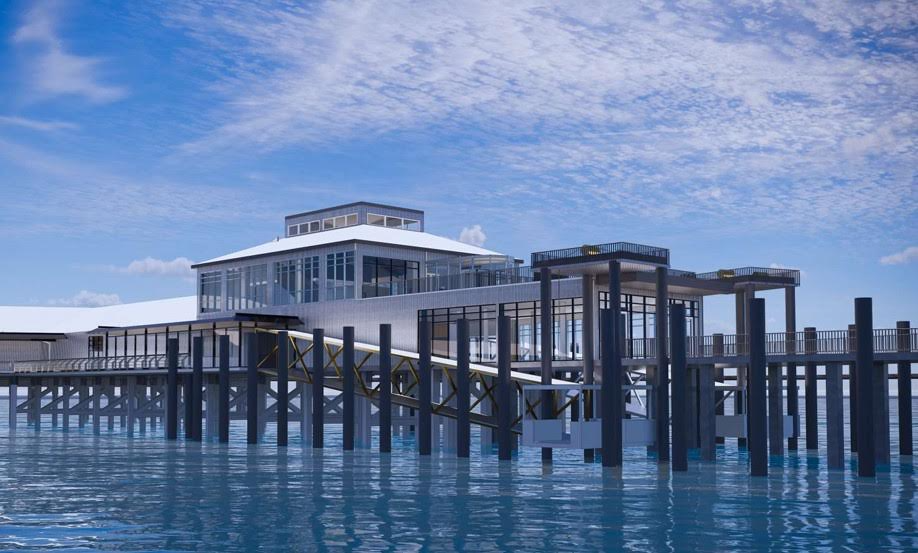
Kia ora and welcome to another weekly roundup of stories about what makes cities great, including our own. Today’s header image shows plans for a refresh of the Devonport ferry terminal – see related story below.
This Week in Greater Auckland
- On Monday, we reposted Connor’s Sunday Star-Times column about the massive opportunity cost of the Government ploughing ahead with a PPP for one more RoNS
- On Wednesday, Matt reported on the opening of the first major piece of NW Busway infrastructure, Westgate Te Waiarohia station
- On Thursday, we had a guest post from Ross Inglis, looking at the state of Auckland’s progress along the Transport Emissions Reduction Pathway – and what we can do about it.
Greater Auckland’s research and advocacy is powered by hundreds of hours of work each month, and your support helps keep us going! We warmly welcome your donations, and are always open to offers of guest posts, practical help, and pro-bono expertise.
Another great way to support the kaupapa: Greater Auckland merch. Allow a week for delivery – and these are print-on-demand (no returns possible), so double-check your sizing before ordering!
Greater Auckland in the news this week
Patrick spoke with RNZ about what to do with the old “cop shop”: the former central police station on the corner of Vincent St and Cook St, which has sat vacant for coming up seven years.
Patrick Reynolds, director of advocacy group Greater Auckland, saw an opportunity.
As more families moved into apartments, he said they were discovering a glaring flaw in the city centre lifestyle.
“One of the things that is absolutely a glaring deficiency in the city centre is a high school,” he said.
“Families are living in the city centre and there’s no school. It seems to be extremely difficult to get the Ministry of Education to contemplate an urban school.”
For a family living on Hobson Street, running alongside the Sky Tower, the nearest schools were Auckland Girl’s Grammar and Freeman’s Bay Primary.
Both were on the other side of Auckland’s tangled motorway, which Reynolds said was a great divide.
“There’s a lot of apartments on Hobson Street and Nelson Street. In fact, there are more people living on Hobson Street than any other street in the country,” he said.
“You see families crossing over to get to that school and it’s horrifying, really, because there’s a motorway on-ramp there. We really need some schools in the city centre proper.”
For some reason, the councillor for the densest neighbourhood in the country thinks families don’t belong in apartments.
[Mike Lee] was doubtful that enough families were living in the city centre to justify its own school.
“Families and high-rise apartment towers don’t necessarily go together,” Lee said.
“Families prefer to live on level sections with a bit of a garden for kids to go and play in. If there is, though, a genuine demonstrated need, then that may be a different matter.”
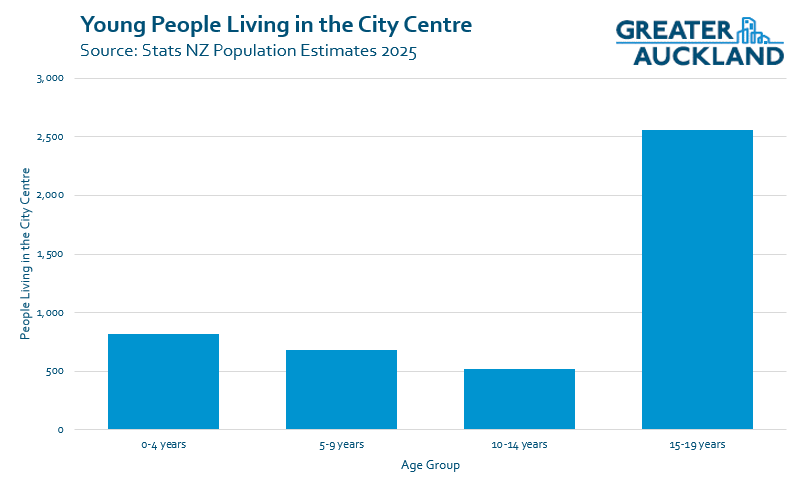
A quick check of Stats NZ data shows thousands of young people already live in the city centre. Interestingly, the under 5’s group are consistently higher than the next two cohorts: perhaps this reflects some parents moving out simply for schooling?
And on other topics, Matt spoke with BusinessDesk (paywalled) about the unevenness of the post-CRL timetables, due to KiwiRail’s freight movements.
Transport advocates say regular, reliable services are important for increasing uptake of public transport.
“It doesn’t matter whether it’s 9-6, or 5-10, that part doesn’t matter. What matters is that it’s not consistent,” Greater Auckland director Matt Lowrie said.
Lowrie said he understood the 15-minute gap in peak services was for additional train services to be added later, once AT and KiwiRail became more comfortable with the network.
But to really solve the freight problem, additional infrastructure would be needed.
CRL Events
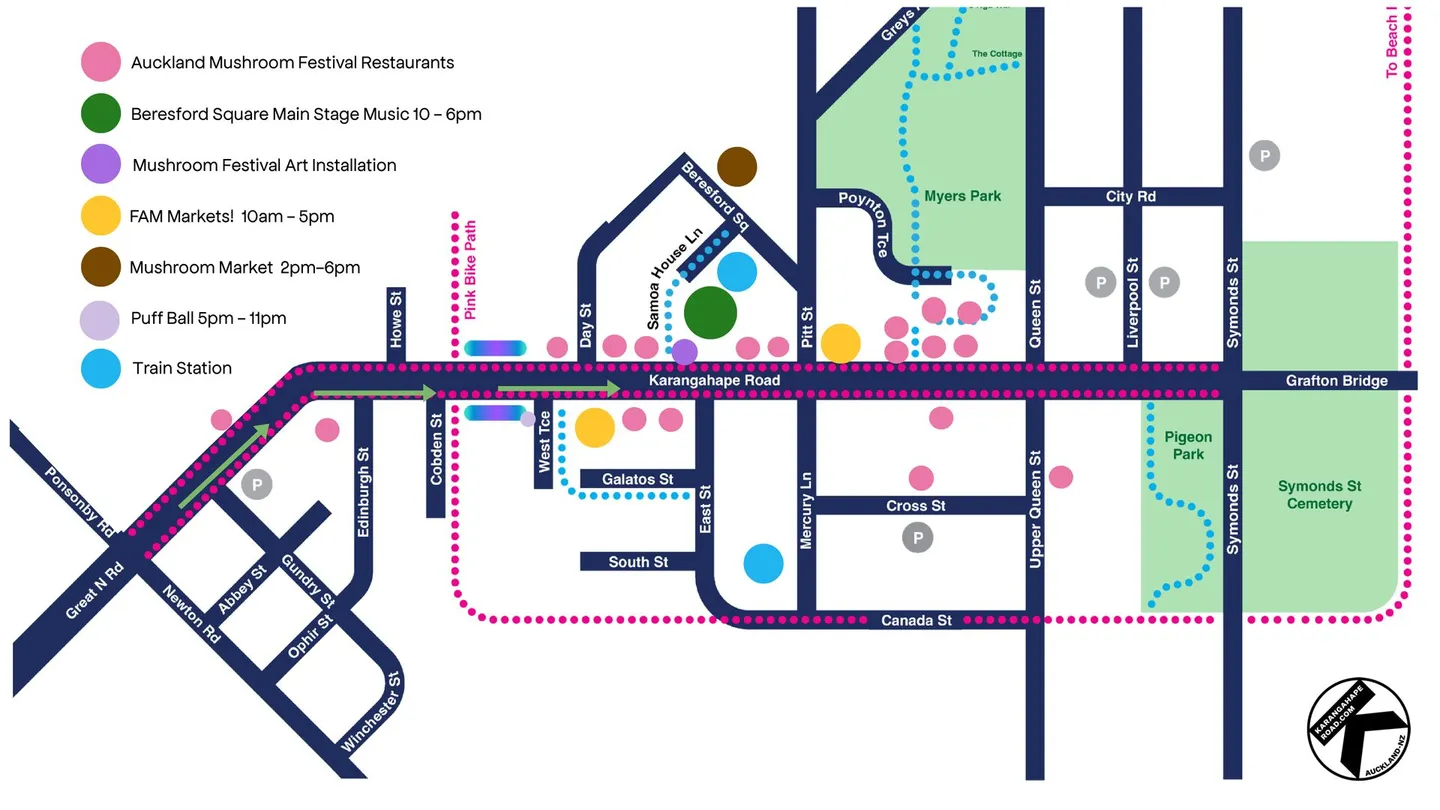
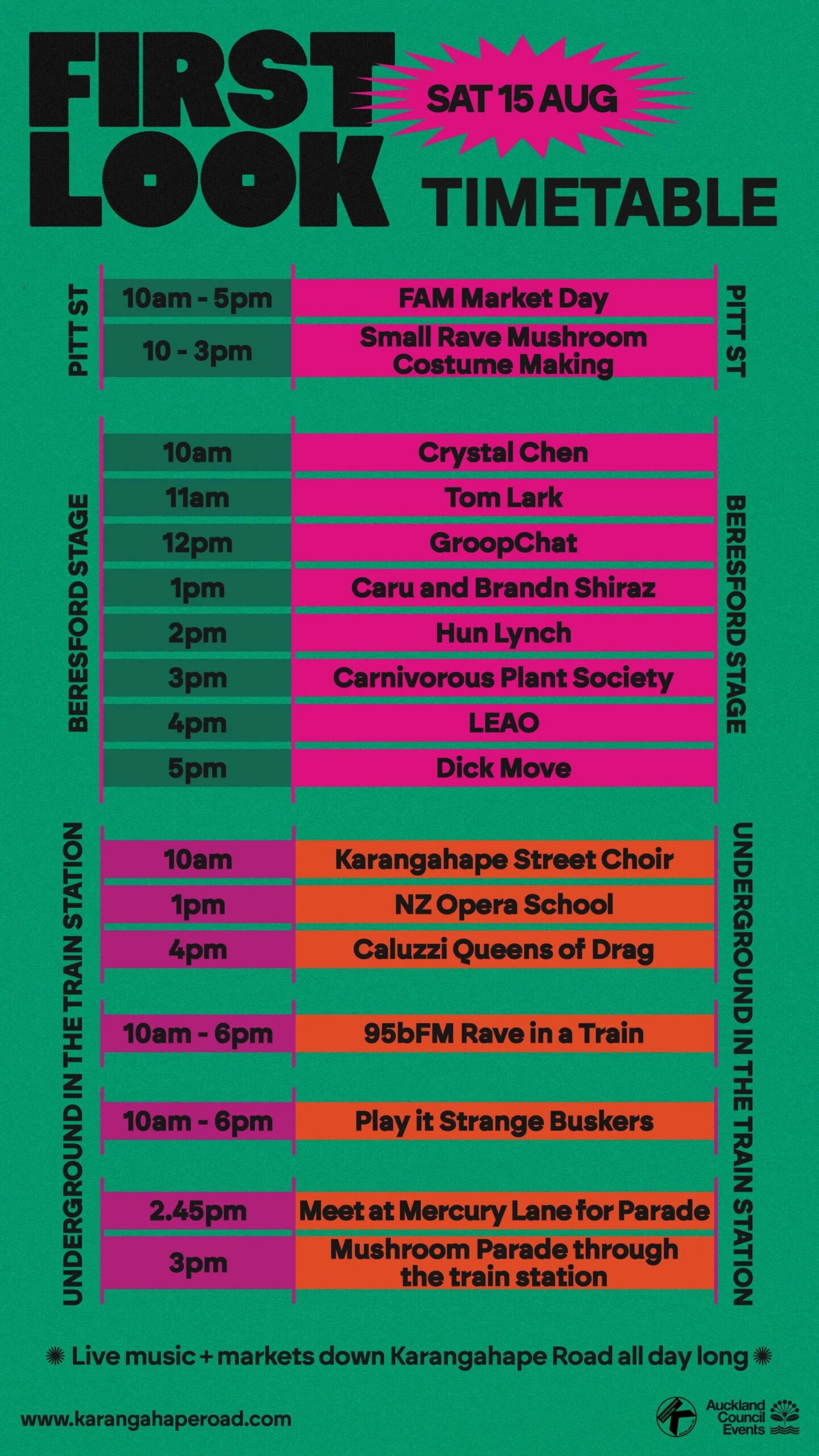
Last weekend’s Maungawhau Station “first look” event was very popular with AT saying 10,311 people turned up to check out the station. Tomorrow it’s the turn of Karanga-a-Hape. Tickets are free – sign up here.
And if you’re in the Karangahape Road area anyway, the monthly FAM markets are also on tomorrow, 10-5 at Beresford Square and nearby, including an enrol-to-vote initiative from 10-2. Looks like a fun day all round!
 And speaking of CRL things: Stuff has put together a list of great watering holes for your CRL-themed pub crawl. Inexplicably it stops at Morningside, missing out on spots like Bar Martin at Baldwin Ave, and more. What would you add to the list?
Street Smarts: Learn how change really happens
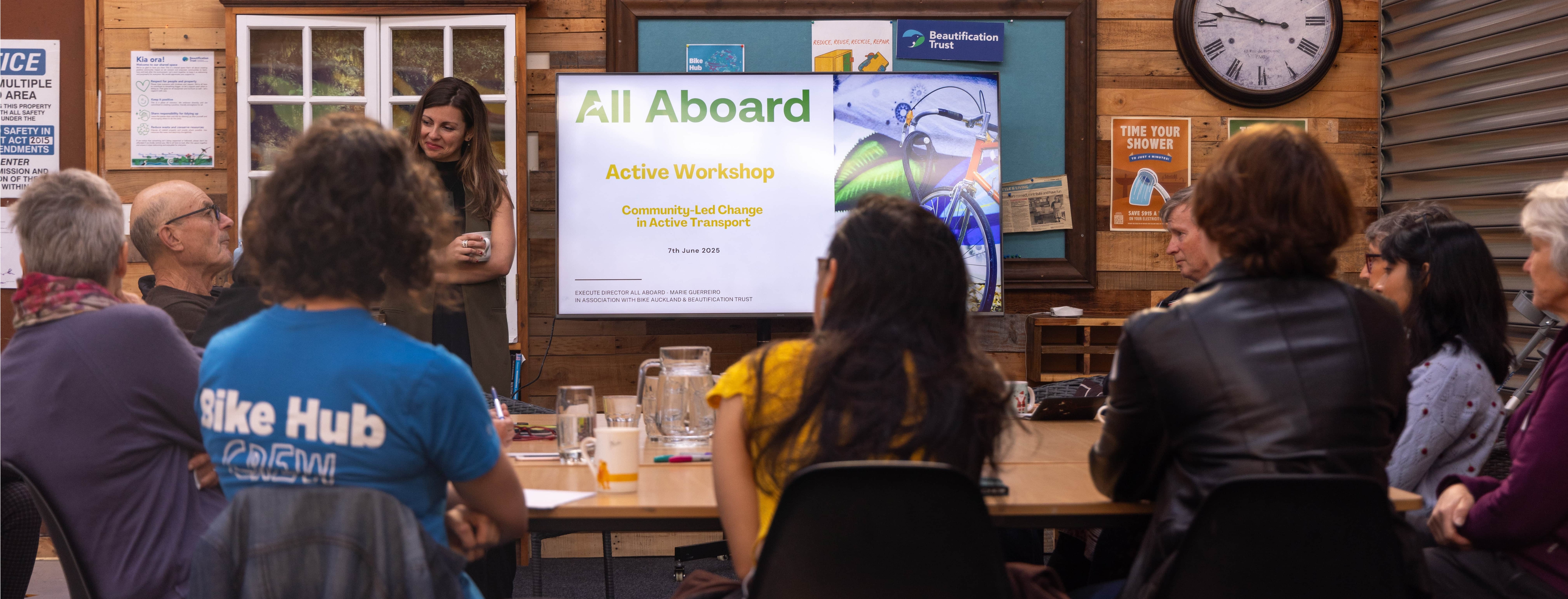
Street Smarts is a new two-day workshop series from All Aboard Aotearoa and Bike Auckland, supported by Auckland Council. Each workshop consists of two sessions on consecutive Saturdays, over upcoming weekends, across Tāmaki Makaurau. See here for dates, locations and details of how to sign up.
Designed for community leaders, advocates and anyone who wants to create better places, the workshops explore why our streets and communities look the way they do, why change can be difficult, and where communities have the greatest opportunity to influence what happens next.
You’ll gain a new perspective on transport, practical tools for navigating complex challenges, and a better understanding of where you can have the greatest impact.
Unprecedented: transport policy statement delayed till after election
The government look to be running scared as the RoNS reality continues to bite, harder by the day…
This time it’s to do with the Government Policy Statement on Land Transport (aka the GPS). This is typically refreshed every three years, and normally a draft GPS would be released by about this time, in order to collect feedback from local government, the transport industry and the public.
Also, for an incumbent government, the Draft GPS serves as their transport policy for the election, given it covers investment for the next three years. Except it turns out this government will not be releasing a draft.
Transport Minister Chris Bishop has announced the Government Policy Statement on Land Transport (GPS) is being delayed until after the election.
In the meantime, he has issued a statement to guide regional transport committees on the government’s intentions and investment strategy as they work on regional land transport plans.
That statement would signal that the government was focused on value for money, cost control, maintenance, resilience of the network, productivity-enhancing investments, improving safety, and maximising the use of the existing network, Bishop said.
“The GPS will likely include a focus on transit-oriented development – or TOD. This means supporting housing growth through alignment with spatial plans and concentrating development around transit nodes, key corridors, and strategic connections.”
The announcement also contains some pretty contradictory statements:
“I think we can and should build more four-lane highways. Perhaps just not at their current design, scope or specifications – or not under the current institutional or regulatory settings. We can build more. We just need to find a way to do it in a more cost-effective way.”
and
“My overall goal is to create a high-performing land transport system where maintenance and renewals are prioritised, the network is mostly funded from users and beneficiaries, investment aligns with demand, and where major projects are sequenced according to value for money.”
What this also means is that Simeon Brown’s extraordinarily ideological GPS for Transport – with its strict bans on funding multimodal improvements, and reductions to investment in walking and cycling (what journalist Russell Brown dubbed the “footpath fatwa”) continues to prevail.
Spot the solar gap
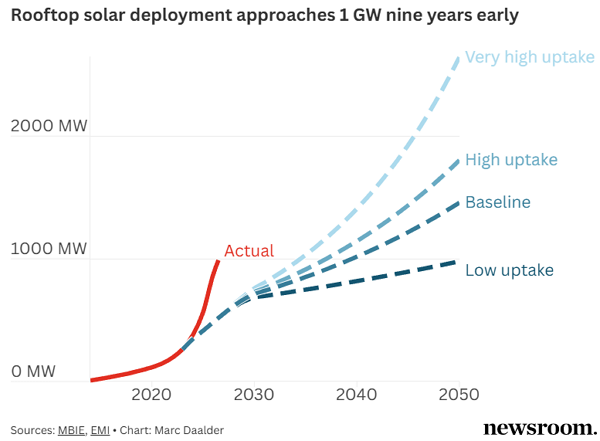
Solar uptake in Aotearoa has taken off, and is exceeding even the most optimistic estimations – as shown by this graph from Newsroom a few weeks ago.
Now RNZ is highlighting exactly where that uptake is happening:
An RNZ analysis of Electricity Authority data has found that Wānaka and Pāpāmoa Beach have the highest numbers of household solar installations in the country, generating about 50 percent more energy than anywhere else in the country.
Wānaka also had one of the highest rates of installations, with 17 percent of houses boasting some level of solar generation.
Earlier this year, New Zealand hit a milestone, with enough solar energy capacity now installed to generate a gigawatt of electricity – about half of it on people’s homes.
Across New Zealand, the installation rate on residential dwellings was just four percent – far behind Australia, where incentives have driven uptake over the last 15 years to more than a third of all households.
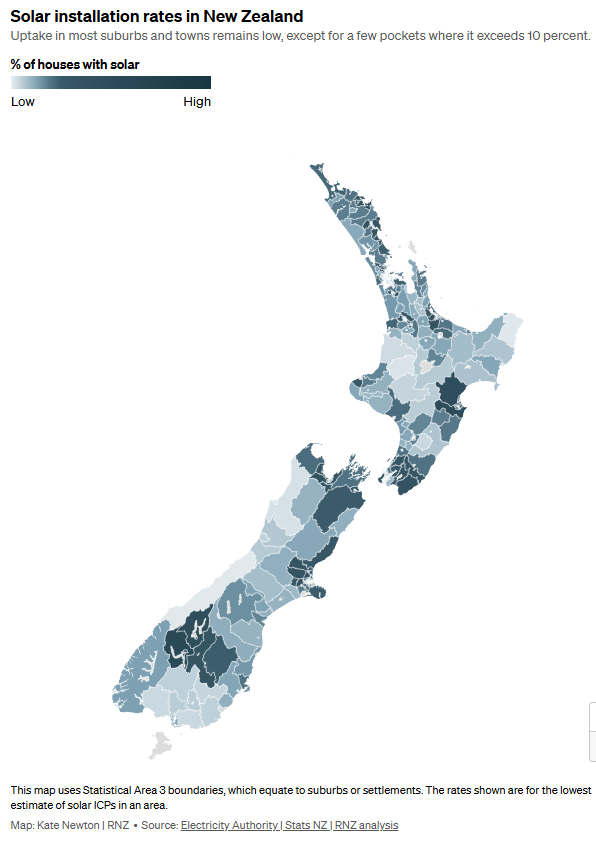
Spot one of the big gaps:
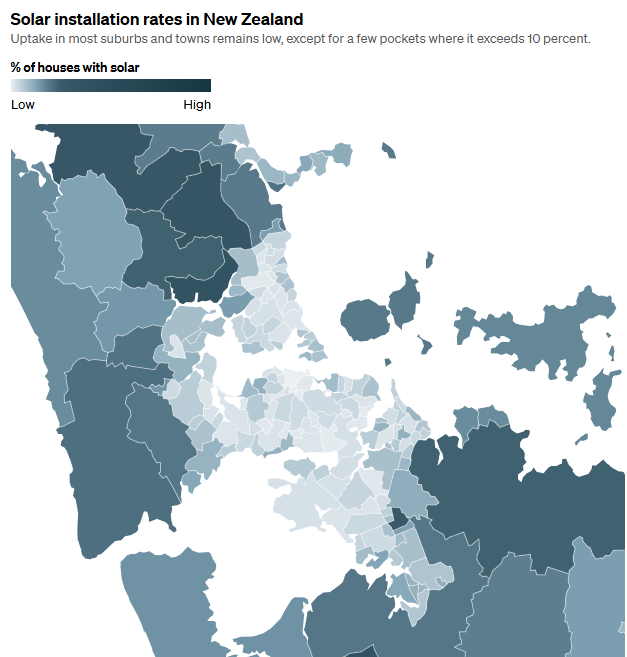
They’ve also looked at how uptake is impacted by home ownership and incomes – take a look at the article for more.
Changes afoot in Devonport
Auckland Transport announced this week that the Devonport Ferry Wharf and Terminal is to get a $31 million upgrade.
Auckland Transport (AT) is about to embark on a comprehensive asset and facility renewal of the Devonport Ferry Wharf and Terminal.
The renewal will focus on reconstructing Piers 1 and 2 and undertake a full refurbishment of the terminal waiting room. The project will cost $31 million and be completed over a three-year period.
North Shore Ward Councillor Richard Hills says the renewal is a crucial step in modernising public transport in the area.
“This is a fantastic and important investment in our public transport infrastructure. It brings resilience to the Devonport to City Centre route by replacing end-of-life Devonport ferry berths at Pier 1 and Pier 2.
“Additionally, the upgrades and improvements to the terminal, the entrances and the gangways will make it more modern, compliant, future-proofed for EV Ferry vessels, and optimised to enhance customer experience outcomes”, says Councillor Hills.
AT also include this on what is being done.
Pier 2 renewal
- New Pier 2 entrance and vestibule
- New 25-meter-long gangway with new fender pile system
- New mechanical hydraulically operated berthing platform, operable at all tides
Pier 1 renewal
- New transition point of entry and canopy
- New 25-meter-long gangway
- New fender pile system
- New mechanical hydraulically operated birthing platform
Terminal renewal
Work on the Terminal will include a range of essential internal ferry terminal renewal activities and will enable the integration of new ferry berths into the building structure.
The work will include:
- Terminal roof waterproofing, to replace end of life roofing membrane
- Terminal area ceiling remedial works to ensure fire and electrical systems compliance, passive air-flow system to address condensation and mildew issues, reinstatement of code compliant acoustic ceiling in support of clearer ferry timetable PA announcements.
- Wayfinding and lighting renewal
- Realignment of Pier 1 and Pier 2 boarding gates to enable a future HOP gate line.
- Relocation of level 1 tenancy stairs to facilitate new boarding gates and optimisation of queuing and waiting spaces.
- Replacement of redundant retail footprint with dedicated Fullers customer service kiosk.
Housing Density in Tāmaki Makaurau
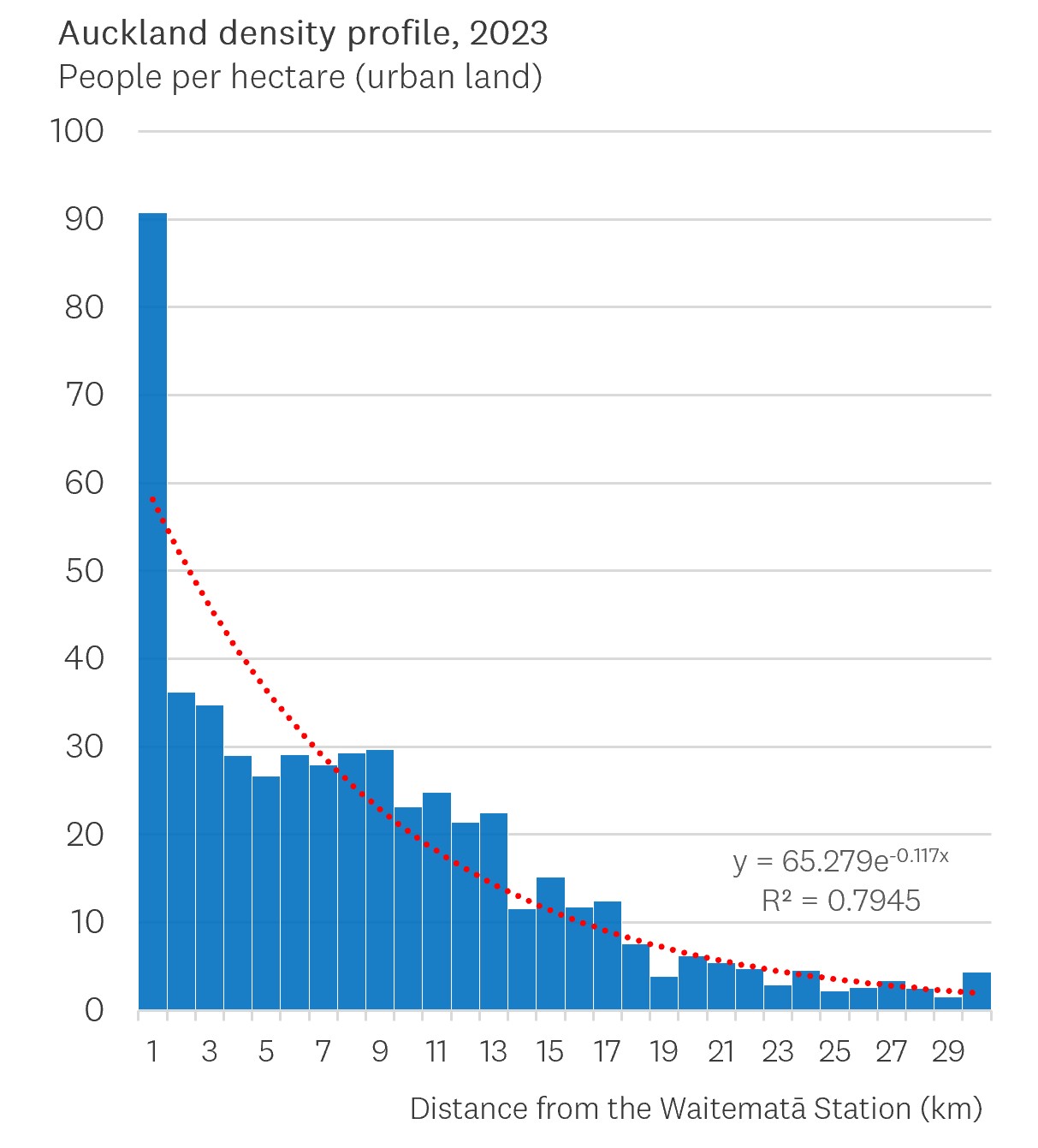
Auckland Council’s Chief Economist has a piece looking at housing and cities. One thing that stands out to us is this chart. There’s certainly some missing density in the 2-7km categories – that gap below the dotted red line is the absence of housing options within an easy trip of the city centre. Perhaps we should address that – with a plan change, say?
Dream jobs
With the changes to Auckland Transport governance nearly completed, there are some very important roles now available that will be critical in shaping transport in Auckland for years to come:
- Head of Transport Policy
- General Manager Transport Infrastructure
- General Manager Transport Performance and Optimisation
And then there’s this..
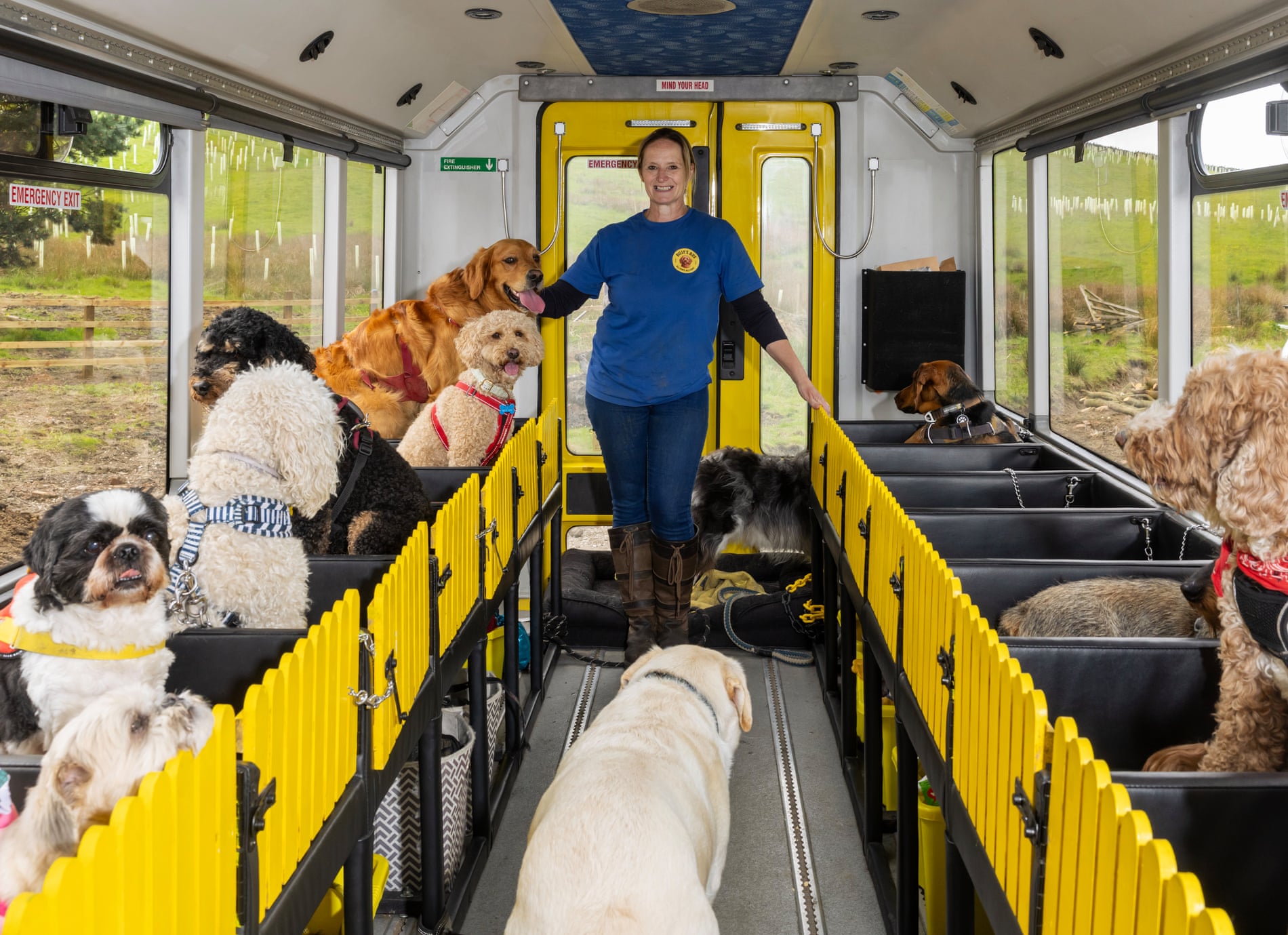
We can have up to 15 dogs on board. The bus has been adapted – the seats have been removed, and each dog sits in its own raised pod with safety restraints, harnesses and water bowls, with views out the window. All the dogs have a trial to make sure they’re suited to the service and get along with each other. We have people in the back talking to them and reassuring them. There’s a ratio of one person to six dogs.
The dogs all love the bus, and they know the routine. As soon as we turn on to a particular road and cross over the cattle grid, they start barking. They can’t wait to get to the field. I worked with children for years, so the noise doesn’t bother me.
…..
Some have a favourite seat on the bus. One poodle has a meltdown if another dog is in her pod on the front row. She stands there, barking at them, so we tend to let her sit there.
London is a cycling city
And we can be, too. See more here.
London’s Cycleway network has reached a major new milestone, growing to 450km following the completion of new and extended routes across the capital – longer than the entire Tube network and further than the distance from London to Paris.
The achievement means London’s Cycleway network is now five times larger than it was in 2016, when there were 90km of Cycleways. Since then, Transport for London (TfL) and London’s boroughs have worked closely to create a connected network of high-quality cycling routes that make it safer and easier for people of all ages and abilities to travel by bike. Data published last year by Transport for London (TfL) revealed that London’s cycling boom shows no sign of slowing, with an estimated 43 per cent increase in cycling journeys since 2016, and a massive 1.5 million daily journeys taking place in 2025.
View this post on Instagram
Not unrelated, this is what a climate mayor sounds like.
In the UK, where cross-party consensus on the climate crisis has collapsed, his ideas have been echoed by opposition politicians and rightwing populists who veer wildly between denialism and fatalism. As some claim the climate crisis is a hoax, others insist it’s too late to act.
Both arguments are bogus. The climate crisis is getting worse, but in London we’ve shown that – with courage and creativity – we can prepare ourselves for its impacts.
Videos to watch
Gold Coast light rail has been extended to Burleigh. (Video won’t embed, but trust us, worth a watch!)
Mayor Mamdani continues to light up “third spaces” for the people of New York City…
View this post on Instagram
Enjoy this catchy tune, shot in and around our public transport system…
Happy folks at the Maungawhau Station open day last weekend. Wait till they see Karanga-a-hape tomorrow!
View this post on Instagram
That’s us for the week – enjoy your weekend. And as always, feel free to share links and stories below, we know we haven’t captured every headline out there!

 Processing...
How many times has that wharf in devonport had major refurbishment? Must be like every 10 years at this rate
Feels like a series of temporary sheds that needs to be rebuilt
I remember having meals at really nice Devonport wharf restaurant decades ago, and I remember the place as being nicer then as it is now. Yet the current replacement build is apparently needing to be largely replaced.
Like the CRL stations, I feel as though we should really invest more if anything and make the terminal something really slick, as the views should make it a very attractive location to invest in.
Part of my frustration stems from the Fullers indifference to having a captive user base; I remember more than a few times helping tourists from cruise ships who want to jump on a Ferry to Devonport, but got paper tickets from staff that didn’t work on the gates.
Love to see more integration here and promotion so that somebody arriving in via Cruise ship or staying in a city hotel, can easily grab a one-day HOP card to allow them to explore the city
Visitors, and residents, have been able to use contactless payment since November 2024.
There’s no need to buy a Hop card unless you want one as a souvenir.
There’s a billionaire nearby who might put up a bit of money.
I recently spent a week on mid size Greek island overlooking the port. Multiple large and small, conventional and multihull ferries came in and out all day long. The process was similar no matter the size. The boat would reverse up to the concrete jetty with it loading ram on the way down. By the time the boat touched the jetty the ramp was down and vehicles were rolling off and passengers also. This was before the boat was actually tied up. Before everyone was fully off the departing vehicles and passengers were boarding. Within five minutes the boat was away with its ramps going up as it left. At times dozens of car and trucks and hundreds of people and always five minutes or less. The ‘passenger facilites’ was a long shed without seating but with protection from the sun and rain.
So I really have to wonder why we can’t do the same thing here. Sure tidal rise and fall is greater and maybe the weather more variable but do we really need gold star facilities at Devonport or Auckland when transport interchanges and commercial premises are close by. An all weather cover from the boarding ramp to the road is all that is needed. Let’s focus on getting people on & off the ferry as fast as possible and use the time saved to increase the frequency.
Sounds a bit like the train door dwell issue – no one is focussed on the speed of service.
NB: Some of the ferries were larger than the Cook Strait ferries and I had a good laugh when I thought about the two hours it takes for them to be turned around. Imagine suggesting a 5min turnaround to NZR.
even the Vancouver Seabus ferry has a better boarding procedure with multiple doors on their ferries. They’re able to maintain a 15 minute or better schedule over a wider stretch of water than Downtown to Devonport. Shouldn’t be too hard for that ferry route here to be run as a frequent RTN grade service with 2 in-service vessels
bike provision on the devonport ferry is/was pretty woeful too (though this was 10-15 years ago that I last used it). Depending on the ferry there was room for 5-10 bikes max, and it was a real deterrent to using the ferry at peak times. And if you couldn’t fit the bike on the ferry, good luck finding a free bike rack slot after 8 am. I really hope that the new boats make taking a bike far easier.
Best ferry I ever took was in Amsterdam – the boats had ramps on both ends, circulated 24/7, and were free. People even took those micro 1-seater cars on them.
https://twobudgettravellers.com/how-to-take-the-free-ferry-in-amsterdam-to-noord
The reason the government has not released the GPS is because of the RoNS directives to build 4 lane highways in a few favoured areas predominantly in the North Island has blown the Land Transport Fund budget. Not only are these RoNS projects undeliverable but because the funds GPS directs NZTA to deliver them (do the impossible) then there is no funding for maintenance or improvement anywhere else on the state highway network or any other transport project, such as improving cycle lanes, walkways and transit. Not just for a year or two. But due to transports long planning cycle for at least the coming decade or two.
This is a disaster of non delivery that is of similar scale to KiwiBuild or Auckland light rail.
The political implications are beginning to become apparent. South Island regional and local politicians have noticed the Land Transport Fund spending on the South Island is massively under what they contribute in funding from hypothecated taxes on vehicle movements and massively under their portion of NZ’s population and contribution to NZ economy.
A recent report noted.
“The south accounts for almost a quarter of the country’s population, 22 percent of GDP, a third of export goods and 40 percent of international visitor spending, but receives only 11 percent of transport spending.”
The shortfall is huge. Last year the South received $1.2bn less in transport spending than what its population or economic activity indicated it should receive.
It is not just projects like Christchurch’s request for MRT that has been ignored. South Island farmers, tourist operators and other exporters, many of whom will have been loyal National Party voters are beginning to notice the roads and bridges they rely upon have been neglected. This could become a political crisis for National, hence the need to delay the Land Transport Funds GPS until after the election.
A good account of the report can be read here.
https://www.thepress.co.nz/nz-news/361061289/bridges-not-scratch-roads-be-returned-gravel-south-island-counts-cost-under-investment
Pls build 4 lane motorways??
NO PAY!!
ONLY BUILD
At the end of the day, it is the civil contractors and general public who keep demanding all this expensive roading infrastructure. NZTA seems happy to keep selling the dream to pave over most of NZ as long as people keep buying it.
careful, craw, you’ll attract “James” with their trollop about how idiot apes have the right to impose environmental destruction and wasteful economics on the planet so they can get their rocks off going maybe 5km/h faster before they run into a traffic jam
Shane Jones is calling out the Emperor’s New (3 year old) Clothes that Chris Bishop is expected to parade around in. Time to get a new tailor.
On track to dive into a bottomless pit, with no new ideas, is not a great achievement.
Insanity is doing the same thing over and over again expecting a different result, like trying to reduce congestion by building more roads
Shane Jones, bottom trawler
I have thought way too much about the CRL pub crawl idea since Stuff published it. It’s a great initiative and I think it’s very viable but not without some niggle
-Most cities with train pub crawls have some sort of Day Pass. We don’t so you annoyingly have to pay $3 for the train every time you change pubs (this would probably lead me to “cheat” and walk between some of the stations which ruins the game a little bit).
-The article starts with Waitemata station and works its way out to Morningside. I think it would make more sense to go in the other direction, hitting the outer suburban pubs during daylight hours and working your way through to the city-centre bars that are generally open later.
-Adding Baldwin Ave is a great call. I think you could also do pubs near Parnell and Newmarket stations at the other end if you were particularly keen. As far as I can tell there isn’t anything near Remuera or Grafton stations so Newmarket seems to be as far as you can push it.
RE: The Chief Economist’s article. I think the graph on consents is more interesting.
It shows the big impact that falling / stalling house price inflation (and strongly associated rising interest rates) has on construction of new supply.
This is a big issue with the whole market philosophy.
That is, prices need to be rising to support significant new delivery of housing supply. So it becomes a catch 22, because rising house prices is obviously not good in terms of affordability.
I’m all for targeted intensification, but it’s only one element of the solution.
Much more community housing investment is needed, to address the limitations of the market.
It’s a pity that there don’t seem to be any economists in NZ, I am aware of, who get that.
They all seem to be enthralled by the magic power of ‘The Market’.
I think some of the issue with the new developments not selling is that they’re not appealing to many home buyers. I know first home buyers who are preferring to live further out rather than live in current new builds. The cost was similar between older properties on larger sections further out vs tiny townhouses more centrally.
The “they cant even sell em!!” stories are fun media filler. They attract a lot of attention. But it’s important to remember that those are the worst offering of their product class. Plus, you are much more likely to hear of failure than success in the New Zealand media.
The fact that we have these houses that can’t sell is a fantastic sign the market is working. Most townhouse developments sell down perfectly fine because they have produced a product that buyers want.
For a Christchurch example because that’s my local. A large builder Mike Greer homes tried their hand at the townhouse market for a while, they recently sold down their land and are exiting. Focusing on their bread and butter subdivisions. They had all kinds of derogatory statements, they didn’t want to build that kind of product, no parking, feel bad for the city, kind of thing. Of course cheers all round in the fb comments for the demise of the townhouse etc.
Townhouse consents are near record levels of course.
I think all this was to deflect from the fact they had were simply producing a far worse townhouse than the rest of the market was, and had taken a massive loss offloading them. They were bad at it, and couldn’t compete with the likes of Williams Corp, Brooksfield, Woolfbrook, and dozens of smaller companies, who have kept building and innovating.
I think most of the prominent housing economist people agree social housing spend is necessary and we should do more. Like anything, making things cheaper helps (including helping the state deliver more social housing for the same money) but some people just don’t or won’t produce or earn enough even then, and need transfers in value from the rest of the population. It’s just there isn’t as much to add to the conversation for an economist, it’s more of a political and values decision.
On the consents graph. House prices have been flat since Jan 2023. Falling in real terms, and still are. And yet consents bottomed out at rates similar to the mid 2000’s peak, and are now rising quickly again. I would not conclude that housing is only built during periods of booming prices.
I didn’t say it’s only built during periods of booming prices.
But a lot more housing is certainly built during times of booming prices. That’s entirely expected and rational on behalf of developers.
I work in the development sector. Yes consents are still reasonably high by historic standards. But so is wishful thinking amongst many amateur developers.
The next boom is just around the corner, mate!!!
What needs to be charted is proximity to things. We don’t all want to get to Te Komititanga as quickly as possible, so there is a bit more to this than just the density hole.
Affordable land to build affordable houses on is the difficulty to overcome.
I was recently in the Gold Coast – we didn’t hire a car while there and used public transport a lot. We used the tram a number of times – it was very good, but painfully slow. If I wasn’t on holiday it would have put me off using it a lot of the time.
The other difference over there is they have gone with Lime bikes rather than Lime scooters. The bikes were very popular (we used them a lot ourselves) and I felt a lot safer as a pedestrian over there due to less crazy scooters tearing around.
Our city still suffers from the lack of urban planning.
There are still terraced townhouses being built everywhere, and these are offensive to anyone who believes in art, architecture, or music.
OCKHAM set an example for apartments, SIMPLICITY LIVING is intensifiying this construction process in prominent parts of Tamaki Makaurau and the Town of the Queen. Both places that suffer from horrendous congestion, in spite of being lowly populated on a global scale.
The Karanga a hape Open Day was amazing, live music every where, Beresford was truly buzzing.
The sheer excitement of everyone to start believing in Auckland, as a city of the future, as a city that will move beyong building ugly houses, far away from train stations.
Let us build, take Carrington as a bad example, with good intentions, but we can evolve from this, if we keep Te Whanganui a Tara out of it. Chris Bishop is of Wellington, he does not have a clue about how our city functions.
We were the CAPITAL, we will be the CAPITAL again.
bah humbug
K Road Station
So visited K road yesterday, the whole area was buzzing and the station is an incredible achievement of architecture and engineering, stunning and world class….BUT
I’m just shooting off the hip but my main impression was wondering what this will actually look like on a daily basis?
I could only imagine the 200m platforms with a handful of people and the same traversing the enormous escalators.
The entrance is bound by the motorway, the exit right in the heart of K road but how many workers are commuting on rail to here, how many people living here to commute by rail elsewhere? Other than the empty former beca building (which had a builders sign up indicating refurbishment) this is the opposite end of town to premium grade offices and tenants.
I get that a station makes sense around here and building for the future, and it’s deep etc etc but my first reaction was it seems like an astronomically expensive piece of infrastructure for the numbers of people it could expect to serve in the short and long term?
Look forward to thoughts on this?
There’re thousands of apartments on Pitt St and thousands more at the ponsonby/k road intersection. This station will be heaving.
The short term use case is almost irrelevant. Long-term it will stimulate residential and commercial construction
Third Mt Vic tunnel is back from the dead for the umpteenth time, again why not reinstate trams through the tram tunnel? Buses could still use it
What if they widened the tram tunnel for pedestrians
Premium grade office space, requires premium grade connections to the rest of the city. That will hopefully be fixed in a month.
Then that premium ridge top site with it’s magnificent views will come into it’s own.
And we will get landlords and business owners elsewhere in the city feeling a migration of tenants and customers away from their location.
Replicating what happened when Lower Queen Street connectivity was uplifted with the then Britomart Station and waterfront area redevelopment. To the considerable commercial detriment of the mid town area.
A case for value uplift rate rises to fund further transport enhancements.
That was supposed to be in reply to Bigmac
I expect mid down will see a renaissance with the Aotea station and its existing building stock, amenities and proximity to AUT and UoA. I just can’t imagine the centre of (a grade office) gravity shifting from Wynyard / Britomart / lower Queen back to the ridge. Sure a growth in apartments and maybe smaller boutique scale offices like iron bank and Kirkpatrick but I stand by this being an extraordinarily grand station for the areas potential which largely lies down the ridge. I look forward to being wrong in the next 20-30 years.
Not only repositioning of value within the cbd, but also between the cbd and satellite office parks, and satellite shopping areas and malls.
And then even further afield between Auckland and other New Zealand cities, and even other Australaisian cities.
Wow this high speed rail plan for Australia, the B1M video on it pretty good.
Yeah, big geographically speaking & rich country, this really makes sense:
https://youtu.be/ljFDc3Tx4Rs?si=v2DMWZ5o7He2bSKi
Aussies rail network has the same problem NZ has where some parts of the network run on AC power and others run on DC power, they also use multiple gauges. Building a whole new railway sidesteps those problems but is very expensive
For sure, I suspect they would speed up the building of the whole planned network (some way out 30-40 years, from memory) once they get the first stage in and people see the benefits etc. More population and tax base by then too.