Auckland Council may be about to back away from the plan to put more new homes in the best places, close to transport, jobs, shops and everyday needs.
If you’re as concerned about this as we are, here’s ONE QUICK THING you can do.
Drop a note to the Mayor and your Councillors (e-mail addresses here) before Tuesday morning, urging them to:
- step away from Scenario A – which fails to put housing near the best transport options, and would cost us up to $320 million a year in lost affordability.
- embrace the better options (Scenario B is best) – which will maximise our assets by putting new homes near all the good things.
As always, be polite and encouraging, and say what it means for you. One vote may make all the difference for a liveable city in years to come – and save a bunch of cash!
On Tuesday, Auckland Council’s committee for Policy, Planning and Development will make a big call about the shape of the city’s housing plan.
They’ll look at a range of scenarios and choose one to take to local boards and iwi authorities for feedback, with a view to making a definitive call in July, which would then be open for public feedback for 20 days.
Why is this important? Because what kind of housing goes where is key to a healthy city.
However! As suggested in this 1News report by Justin Hu, some voices around the table on Tuesday look set to argue for the scenario that allows the least possible amount of potential housing.
Which is also the one most likely to keep the cost of housing as high as possible – both in dollars and time spent commuting – and would ultimately be more expensive for the city as a whole.
A new @pewresearch.org study finds that infill housing near jobs, stores, and transit costs governments ~$21,000 less per home to serve, cuts long term infrastructure maintenance costs in half, and generates 13% more in annual property tax revenue per acre than sprawl.
— Jonathan Berk 🏠 (@berkie1.bsky.social) 2026-06-06T21:01:29.496Z
Whereas, we know that when you give more people the chance to live closer to jobs, shops, schools, entertainment, and handy transport options – with access to recreational spaces like parks, beaches and maunga – you make life a bit easier and more affordable all round. Everyone gets to spend less time in traffic and more time enjoying life.
(Plus, the less your housing sprawls out and chews up prime growing land and wild areas, the closer city-dwellers are to the rural food basket, and to nature.)
This is the promise of a “compact, liveable city” – which also happens to be Greater Auckland’s vision for our loveable isthmus metropolis! It’s all about maximising your existing assets.
A story over the weekend offers a timely real-life illustration of the value of real housing choice.
When Gemma Mason and Paddy Bartlett decided to raise their son in a central Auckland apartment, Mason’s mother was surprised.
She was “a little bit shocked because she is a Kiwi and ‘we don’t do that here’,” Mason said. “She was worried about where our kid was going to play.”
Mason grew up in a house with a big garden and trees to climb. But when it came to what she wanted for her own family, the “quarter-acre dream” looked different.
“I wouldn’t say I never dreamed about it, but the dream is you have a huge yard and a dog and also somehow magically no commute, and then you start thinking about which parts of the dream you are willing to alter and which parts you want to keep.”
[…]
The couple bought the apartment for about $600,000 in 2018. They are now mortgage-free – something Bartlett doubts would have happened if they had bought a standalone house.
“With the house it would have been, what, 20 more years,” Bartlett said. “But you can actually do this here and then you have more resources and time to spend with your family.
“I talk to people about this and they say the house is an investment for the future, but I’m not raising a kid in the future.”
So. How’s Auckland’s housing plan looking, for people keen to live here now?
How we got here…
In the late 20th century, Auckland went about “homes-maxxing” by subdividing sections, adding sleepouts, and chucking up the occasional block of sausage flats… with pretty patchwork results. Meanwhile, the rise of big apartment buildings began to transform the shape and population of downtown.
Fast forward to 2016: the Auckland Unitary Plan unleashed the power of widespread upzoning, resulting in more townhouses in town centres (and other places), and more conscientious apartment buildings.
Over 2020-21, Labour led a rare bipartisan political accord to transform housing in our cities. The new policy set a more logical relationship between housing and public transport, and allowed for up to three triple-story dwellings to be built on most urban residential sites with no need for resource consent.
In 2022, Auckland Council got going on a Plan Change: PC78, to embed these changes. The process was not without controversy. Loud voices made the case for preserving “special character” (single-family wooden houses) in the suburbs most rich in access and amenities. Meanwhile, more peripheral places were shouldering more than their fair share, with housing intensification getting way ahead of much-needed transport upgrades.
Then in 2025, the National-led government changed course, saying Auckland should put new housing where it thought best. In the interim, there’d been a grim wake-up call, with deadly and destructive weather events confirming we really should not be building any more homes in areas prone to floods and slips.
So, Auckland Council got cracking on a new Plan Change (PC120), seizing the opportunity to incorporate climate resilience. Others saw yet another opportunity to preserve their precious part of the city in historic amber. And quite a few people started freaking out about an imaginary number.
Both PC78 and PC120 enabled theoretical housing capacity, in the form of up to two million opportunities for developers to choose from if they wanted to build new homes – potential apartments, townhouses, whatever.
Only a fraction of that can ever really happen. It’s a bit like a supermarket: heaps of options, but what actually makes it into your pantry is determined by your list, your budget, your appetite, and what fits in the trolley.
But once that big round number waltzed into the discourse it triggered panic, pushback and politicking (see Hayden Donnell and Robbie Nicol for great summaries of the palaver).
In February 2026, Minister Chris Bishop was like, okay sure whatever, make it 1.6 million – but make it snappy, before settling on “at least 1.4 million” potential, theoretical homes.
And this is why Auckland Council is now reassessing PC120, to see if any practical changes to the map are needed now that the imaginary number has shrunk a little.
What are the options?
As per Tuesday’s agenda, there are four scenarios on the table, with options for variations. “No scenario includes greenfields expansion” (phew), and Scenario B (outlined in red below) is the staff recommendation.
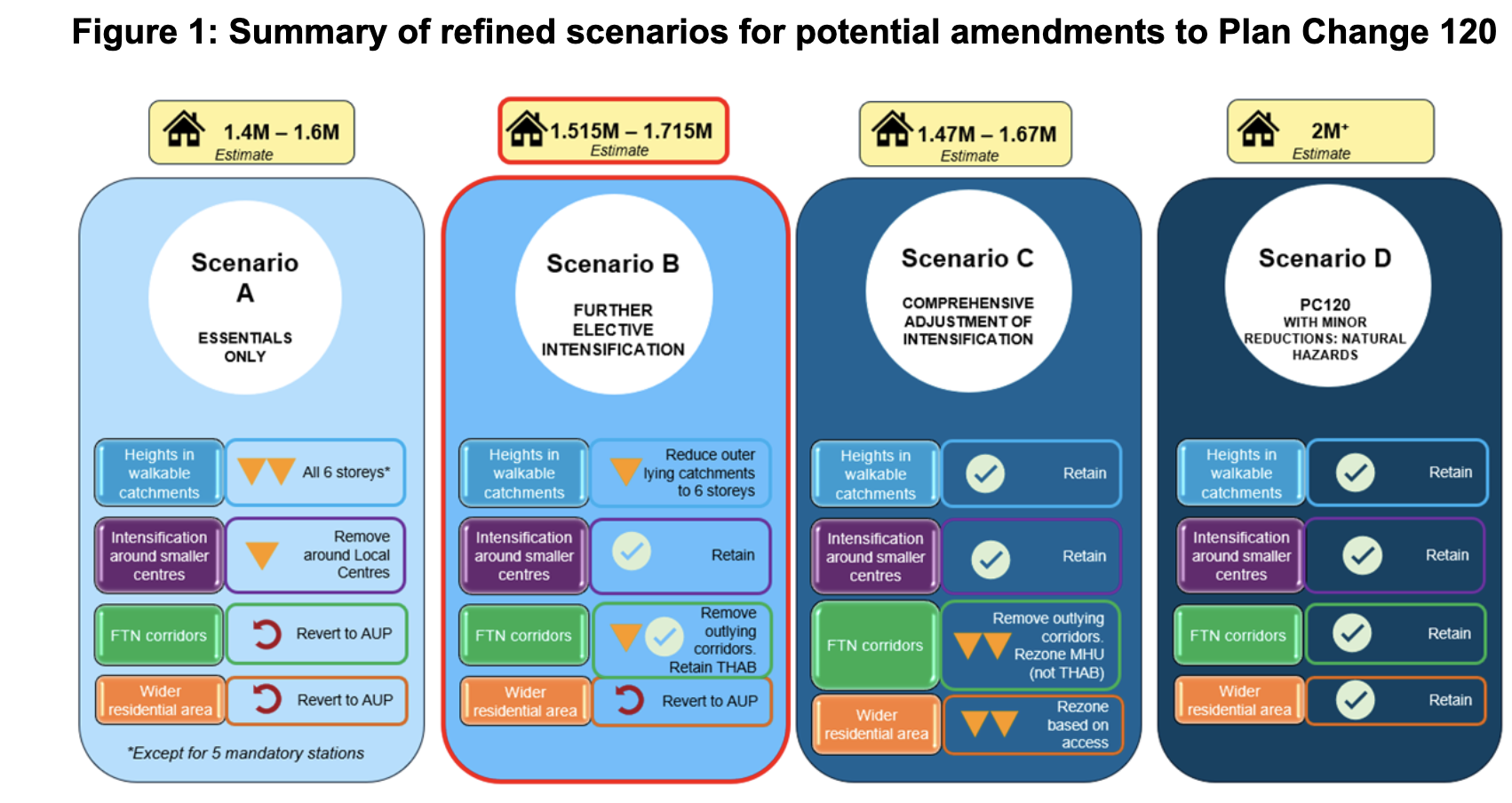
For comparison purposes:
Scenario A: “Essentials Only” would only do the bare legal minimum. In fact, it would be a massive backdown, wasting the opportunity for upzoning along the fuller extent of the Frequent Transit Network and all the stations that will benefit from CRL. By all measures of a liveable city, this is an actively bad choice.
Scenario B: “Further Elective Intensification” is the one staff recommend, with this rationale:
Because it reduces housing capacity to meet the updated requirements in a balanced way that retains intensification in areas that are best served by public transport. (emphasis added)
Scenario C: “Comprehensive Adjustment of Intensification” was an early fave of some progressive councillors (in the 1News story) but has changed since last week’s workshops, and now enables less housing capacity than Scenario B. It also includes some eye-catching downzoning, e.g. places like Massey, Bucklands Beach, and bits of St Heliers would revert to single-house zones.
Scenario D: “PC120 with Minor Reductions: Natural Hazards” would enable the most housing, because it’s basically PC120 minus the areas prone to flooding and slips. So why isn’t it the obvious option? Because of the panic, pushback and politicking mentioned above, which is a real shame.
Which way to more affordable housing?
Council staff have also estimated how each scenario would impact housing affordability. Councillors should care about this, because housing affordability directly affects how much money people have left over for all the other things after paying for housing, and transport.
In fact, it’s a very important consideration, if your goals include ensuring Aotearoa’s “economic engine room” can prosper, residents can thrive, you can attract talent, and young people can actually dream of being able to build a life here, rather than scooting off overseas, etc.
As Justin Hu notes, the estimated economic benefits cover quite a range. The high-capacity scenario is worth more than five times as much to the city and its people, compared to the bare-minimum one:
Chief economist Gary Blick told councillors that greater housing capacity would lead to lower house prices over time – between 1% and 2% lower under the most stripped-back option, and 5% to 8% lower under the full plan change.
The total estimated economic benefit over 10 years ranged from $700 million at the low end with Scenario A to $3.9 billion under the scenario closest to the original plan.
Another way of saying this is: a vote for Scenario A would be a choice to impoverish Auckland and Aucklanders to the tune of up to $320 million a year, compared to the other options on the table.
The nitty-gritty
You can check out the impact maps for each scenario here: Scenario A, Scenario B, Scenario C, Scenario D. All four meet the basic legal requirements…
a. are estimated to meet or exceed the minimum housing capacity requirement of 1.4 million dwellings for the AUP
b. are estimated to have less housing capacity than Plan Change 120 as notified, with Scenario A enabling the least and Scenario D enabling the most housing capacity. The scenario selected by committee for iwi consultation and local board engagement will be capacity-modelled for evidence-based subsequent decision-
making by the committee.
c. respond to the reduced housing capacity requirement by including additional residential re-zoning responses from updated flood modelling and rainfall data (including for the 5 per cent annual exceedance probability or flood plain associated with a 1 in 20 year probability event)
d. meet or exceed Policy 3(d) (intensification in walkable catchments) of the National Policy Statement on Urban Development,
e. meet or exceed the 10 or 15 storey walkable catchment building heights for five railway stations listed in legislation (Maungawhau, Kingsland, Morningside, Baldwin Avenue, Mount Albert)
f. include a potential change to the height to boundary rule in the Residential – Mixed Housing Urban Zone (Attachment I).
… and Scenario B, the staff recommendation, meets all of the above, plus (emphasis added):
a. within the central part of the region (using the nominal 10km radius from the city centre as a guide), includes the Residential – Terrace Housing and Apartment Building zone within approximately 200 metres of the Frequent Transport Networks
b. extends 10 storey and 15 heights within the walkable catchments of the city centre and metropolitan centres, and along the eastern and southern train lines, using the nominal 10km radius from the city centre as a guide
c. includes six storey intensification within the walkable catchments of all town and a number of local centres, including those areas outside the nominal 10km radius from the city centre
d. returns the zoning of the vast majority of the region (especially those areas outside the nominal 10km radius from the city centre) to the current zoning in the Auckland Unitary Plan.
Here’s a map of Scenario B (found deeper into the agenda attachments) that shows how the focus is about enabling more homes along the Frequent Transit Network – including out along the train lines, which will benefit from the CRL – and concentrated in town centres, where shops and businesses are. 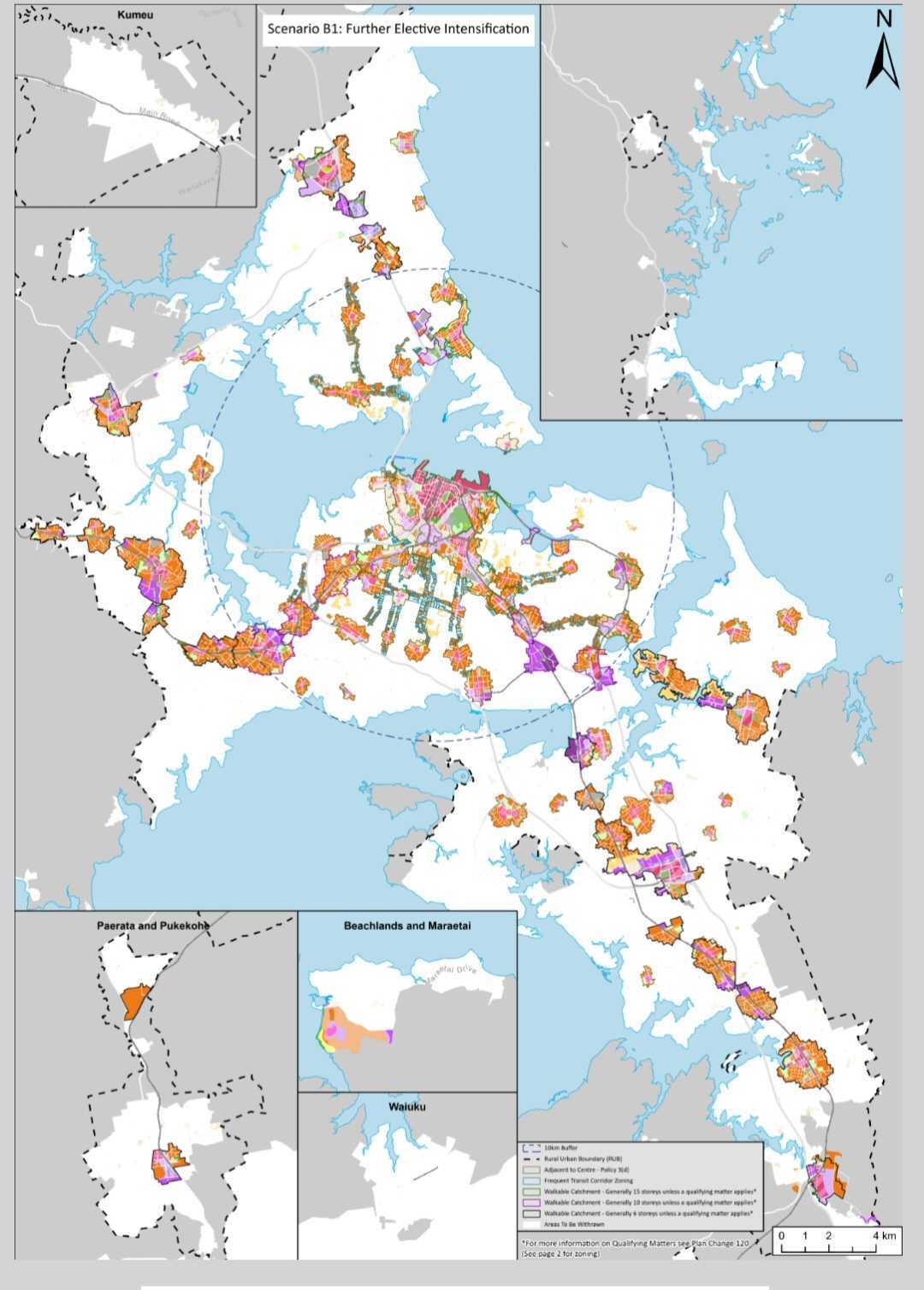
What’s at stake on Tuesday?
We’re hearing word that Tuesday’s debate will likely come down to a battle between Scenario B – the option recommended by staff, which is also the one with the greatest economic benefits for the city…
…and Scenario A – the “bare minimum” option, which would be a massive backdown on housing capacity, as well as squandering the opportunity to integrate housing with transport.
If so, this is a fork in the road for an affordable, liveable city, especially in this economy/ climate/ historical moment. It’s probably not to strong to say this is a generational choice.
Let’s hope Council chooses the option that maximises all the recent investment to improve public transport, and gives Aucklanders the greatest freedom of choice about where, and how, to live.
And now a question for readers: if you’ve had a chance to look through the agenda for Tuesday’s meeting – and/ or the related reporting – what else stands out to you?
REMINDER: If you want a more liveable city, drop a note to the Mayor and your Councillors (e-mail addresses here) before Tuesday’s meeting, urging them to:
- step away from Scenario A – which fails to put housing near the best transport options, and would cost us up to $320 million a year in lost affordability.
- embrace the better options (Scenario B is best) – which will maximise our assets by putting new homes in the best places, close to transport, jobs & shops.
Be polite and encouraging, and share what it means for you. One vote may make all the difference for a liveable city in years to come – and save a bunch of cash!
Greater Auckland’s work is made possible by generous donations from our readers and fans. You can support our mission by joining our circle of supporters here if you’d like to donate, and by sharing our work with friends and whanau.
Header image by Patrick Reynolds, showing a double-decker bus on a FTN route past the Kōkihi apartments on Great North Road in Waterview.

 Processing...
“It also includes some eye-catching downzoning, e.g. places like Massey, Bucklands Beach, and bits of St Heliers would revert to single-house zones.”. Not sure about St Heliers, but I think some upzoning in central areas and around train stations along with downzoning in the outer suburbs would be the best outcome. Too many townhouses are popping up in areas which are probably more suitable for stand alone housing.
I still think the best zoning is done with a compass. Draw a big circle around the CBD and a smaller one around each train station, then exclude any realistic flood zones. Or no planning at all and let the market decide.
No, no. The market can only decide when it leads to outcomes that NIMBYs and Boomers like. Otherwise, you are tallking about tsraight out socialism (whatever that means).
It really comes down to do we want to build a city for future generations? Thinking long term, it’s a no brainer to go with scenario B. Really hoping our councillors do the right thing. Thank you for the post!
Zoning, by definition, is imposed government (local and central) restrictions.
In Auckland’s case, far too much of it at the moment, is actually by central government, intervention.
Residential urban land use has very little national implications, and the bulk of these are allowing sprawl over productive land, and allowing more building in hazardous locations.
Also indefensible, is the oversized role that the libertarian advocates, (nominally for less government interventions in our lives) are playing in advocating against liberalising the regulation of land use. Land is by far the largest asset in by far our largest city.
Auckland is currently falling well short of it’s potential, very largely because we are misusing far to much of our biggest asset, our land, and it’s locations. We need to reverse this by considerably liberalising residential land use to realise the very considerable efficiencies that increased density can give us.
Not the minimum intensification options now being proposed.
Political hypocrisy however has no limits when current self interest is in play.
“Residential urban land use has very little national implications, and the bulk of these are allowing sprawl over productive land,”
I disagree with this. Blocking development increases the cost of housing, and individuals and the central government end up picking up the tab. Therefore central government should be able to liberalise restrictions on building housing, so, as you note, Auckland can fulfill its potential. This would also reduce the cost of the Accommodation Supplement to the central government.
The counter argument to this, is greenfield development by definition is beyond current urban boundaries.
Thus committing the Government to very expensive upgrading roading capacity through the already urbanised areas.
And the loss to the economy of agricultural production on that land.
And committing the Council to the future maintenance of many more kilometres of service infrastructure, then the alternative of increasing population density within existing urban boundaries.
Bluntly it locks in, land use inefficiencies inherent with sprawl.
One problem is our residential building industry is very characterised with the man, dog and leased ute model, building bespoke designs, instead of a lot more engineered volume produced standard components being assembled into fewer but standardised designs by well supervised labour familiar with the standardised components and designs. The fact that our formerly most experienced high rise construction companies, like Fletcher Building and Mainzeal, morphed into companies that lost the required institutional knowledge to remain in business, is testament to a wider malaise in the very structure of our construction industry.
“Aotearoa’s “economic engine room” can prosper, residents can thrive”
Like London sucking the energy, arts, money, business, leaving the most of the rest of the UK with the odd flourishing city centre and big wastes of poverty It will be even worse here because NZ is twice as long as the UK so the incentive to get close to the polluted, over-crowded, ugly (yes that matters too), expensive ‘engine room’.
Aotearoa doesn’t need an engine room. We need a whole country that is flourishing. Residents can’t be crammed into one or two economically viable cities while the rest of the country gets poorer and poorer.
Having said that (again), I’ve lived in three cities, and seen many more, with residential high rises over 6-8 stories. An awful lot of those 12 or 15 or 20 story buildings had become slums. And I haven’t seen the high rises I lived close to functioning as communities. I also value a mosaic city made of many different streetscapes and building types so yes to mixed heritage. But could those things be achieved by having wider areas of lower high rises? Six story streets are good. Maybe not this time round the plan but this won’t be the last go at it – and what I would like to read in Greater Auckland SS is commentary on the impact of big public transit systems in other cities. Thanks for what you are all doing.
You prefer horizontal slums? The issue isn’t the height of the buildings, it’s the quality of the economy and most importantly, how it is shared.
We have substandard dispersed housing, complaining about height will do nothing to improve the lives of those within them.
Additionally, to your first point- it is not a zero sum game, Auckland thriving takes nothing from the rest of the country, but gives much. Yours is a very weird idea that Auckland must fail to bring it down to the level of other places?
A thriving Auckland (and other urban areas) is a key to a thriving Aotearoa. And key to that is to improve its spatial efficiency, ie to enable it to be more compact, to consume fewer resources, including land, while enabling more people to live nearer to what they need to flourish.
Interestingly, the UKs fastest growing city is Manchester. Its growing largely because council there just got out of the way and allowed people to build homes and offices in the city centre and some other key nodes. They’ve had the largest population growth and the largest wage growth.
If we want growth in other regions,we should achieve that by allowing growth in other regions,not by banning it in Auckland. Auckland already is the engine room. We need to unlock those opportunities for the people currently priced out.
Finally, if you’re into 6 storey apartments, you should love PC120 as it proposes allowing exactly that typology at almost every single train station.
Well done Millions of us Kiwis agree with you Kia ora rā
TERP seems topical with Phil Evans apologising for AC/AT dropping the ball, report pending. If TERP existed in anything but apologies – what impact would it have on PC120 planning requirements. Seems if we are to address VKT and Carbon, this is exactly the tool to generate meaningful delivery.
Or not.
CERF, TERP, CATR -> CATTR , ETS – go chase the missing billions, and fix the remote greenfields subdivisions on elite soils being fast tracked into our screaming new reality.
And we’re keeping that single housing zone in the central suburbs.
Yup. Devonport and Ponsonby etc. This wouldn’t fly in a European city even in one with loads of cute little houses like Bergen, Norway. I get the need for special character on some streets but why not have 4-5 story buildings on the main streets? I wonder if NZ’s zoning system allows this kind of fine-grained density distinction.
A comment for the Urbanist nerds.
Gevorg Yeghikyan is an urban data scientist interested in studying cities with the mathematical apparatus of data science, machine learning, and complex systems, as well as understanding their relevance and impact on cities from an anthropological, historical, and sociological perspective.
He writes on Substack as “Soul of the City, City of the Soul” and has started an interesting series asking “Why Paris Built Apartments and London Built Row Houses”. It’s dense, detailed and pulls many strands together.
Half way through Part1 (https://substack.com/home/post/p-199380342) he introduces this formula as an hierarchical framework to explain the architecture of urban form.
Urban Morphology = F( Block size × Building code × Developer scale × Builder-side credit × Buyer-side credit × Rent-control regime | Inheritance regime )
It seems to me that all the conversations around Urban Morphology in Auckland we are discussing only one aspect of this formula – Building Code. As if all the other factors have NO impact at all. I think it was time we had broader conversations in this matter especially around Rent Control, Inheritance Regime (& taxation) and access to builder and buyer credit. The current discussion is very narrow, as if one thing alone drives urban morphology.
What do you think?
100% agree. Zoning is important, but not as important as it is usually portrayed.
The debate is far too one dimensional.
Unfortunately, the single issue debate (ie. density and zoning) is very complex in its own right. Most struggle with this issue, let alone engaging with the much more complex dynamics of city development.
There’s an awful lot of naivety, and ideology, at play.
How has Orakei Station escaped the upzoning process unscathed? Being one of the closest stations to the CBD, you would think this would be one of the first targets for intensification
3 possibilities:
– no thought given to it
– local objections carrying political sway
– cultural factors (Orakei Basin)
It has been up zoned. The walkable catchment is 800m. Everything on the north side is either too far away or in the coastal hazard zone.
Isn’t the zoning still mixed use, 4-5 storeys (adjacent to station)?. Why not high rise there. Probably a (high end) market for it
That apartment story is a nice one, but with big escalation in all manner of cost inputs, new build apartments are never gonna be affordable. We are talking 800-900k plus for small two bedroom apartments these days. I can get them to work around 750k in a three storey walk up format, in mid price locations. But anything 4 storeys or above in central locations – no chance.
Having said that, it’s not all about ownership, I guess. Higher density zoning enables the likes of the build to rent sector
Important to factor in transport costs too. People do instinctively when trying to decided where to live, both in terms of time and money. And if a household can drop one car because of how convenient a home is either directly to employment and education, or to higher quality transit, then they can spend a bit more on the housing payments, or other life benefits.
Tradeoffs, like they said in the article.