This is a guest post by Ross Inglis, a co-presenter of the podcast This Climate Business. It first appeared on Bike Auckland’s website and is shared here by kind permission.
If you’ve ever wondered why a yawning chasm lies between New Zealand’s climate ambitions and what we actually do about them, here’s a sobering example that helps explain it.
It’s Auckland’s Transport Emissions Reduction Pathway, or TERP. It’s a policy or, if you like, a strategy originally intended to put a big dent in the city’s transport emissions. Four years into its eight-year lifespan and it is nowhere near on track. The TERP is withering on the vine.
A little history. The TERP was born in August 2022, the child of Auckland Councils of a rather more progressive blush than our current one. It arrived at a time when the climate crisis wasn’t being quietly ignored: The city had declared a climate emergency in 2019 and later the following year followed up with Te Tāruke-ā-Tāwhiri, Auckland’s Climate Plan.
The new climate plan was ambitious – it aimed to cut the city’s greenhouse gas emissions by half by 2030 against a 2016 baseline. It identified a number of areas where cuts could be found but it was transport, which was felt to offer more scope for reductions, that was asked to trim the most – 64 percent across the region.

So how is it faring? A council update on the TERP in May this year was frank. There has been, it said, “little change in total transport emissions”, that there has been a slight improvement in average emissions per vehicle while vehicle travel has increased, and that Te Tāruke-ā-Tāwhiri is “not on track to achieve a 50 percent reduction by 2030”.
So the TERP is a damp squib. Worse, nobody I spoke to for this article holds much hope that it will be any more successful in the second half of its life. A very good question is, why?
It wasn’t for want of ambition. The TERP listed all sorts of measurable changes that would need to take place if it were to meet its 64 percent target. Cycling and micro-transport to account for 13 percent of all trips, up from less than one percent in 2019. Thirty-two percent of all light vehicles to be EVs. Vehicle kilometres travelled cut by half.
None of those metrics is on track. Not even close.
The simplest explanation for the failure of Auckland’s TERP is that it was ambition and ambition alone. It came with no budget, no delivery plan, no commitments from the council agencies that its success depended on. The council’s May update makes this clear: “The TERP was not tasked with considering issues such as affordability or any trade-offs that might be required with other strategic transport objectives.”
When the rubber met the road, you could say, there simply was no rubber.
In retrospect, it’s easy to see why. Just weeks after the TERP was launched in 2022 Auckland voted in a new and more conservative council. Early the next year the city was hit by the Auckland Anniversary Day floods, regarded at the time as our most expensive non-earthquake event ever and one that Mayor Wayne Brown estimated would ultimately cost the region $4 billion. And then in October that year New Zealand elected the current coalition government; it went on to gut funding for public transport and active modes and to cull the Clean Car Discount and other climate-positive initiatives.
The poor TERP, then, was ditched at the altar. But why even have a TERP without giving it the means to deliver? It’s here that local body politics comes into play.
The TERP describes itself as a pathway. A map, if you will, without any practical way of getting to the destination. It was launched with no budget and no step-by-step plan for delivery. Those things, crucially, rely on governance models that divide up decision-making. The council’s May TERP makes this clear, too: “…any implementation of TERP is dependent upon decisions taken through other processes such as the Long-Term Plan (LTP) and Regional Land Transport Plan (RLTP)”. Without statutory weight, the TERP binds neither of them.
The LTP, Auckland Council’s 10-year budget, is decided by its Governing Body – the mayor and all ward councillors – and you’ll remember that it lurched to the right after the 2022 council elections. The RLTP is rather more complicated. Prior to a restructure currently under way, it was written by Auckland Transport with input from the council, Waka Kotahi and KiwiRail. Transport advocates say AT’s senior leadership has in recent years been predictably conservative. Small wonder, they say, that the very body charged with implementing most of the changes that the TERP relied on has done little more than pay them lip service.
One such advocate is Heidi O’Callahan. “AT had responsibility for delivering TERP but it suffered from organisational conservatism,” she explains. “It’s hard not to read it as anything except a failure of governance.”
AT’s antediluvian disregard for the climate crisis didn’t exist in isolation, O’Callaghan reckons. The transport planning world in general is infected with a status-quo bias reflected in a “predict and provide” approach that, for example, relies on traffic forecasting models that don’t fairly account for induced demand.
Council-watchers such as O’Callaghan suspect that conservative councillors are maneuvering to scuttle the TERP once and for all. A case in point: Howick Ward councillor Maurice Williamson has made quite a play of asking AT and council staff for a TERP report on “realistic measures they can implement and their associated emissions targets and how they can be delivered and how they will be funded”.
You’d be forgiven for thinking that was setting the stage for a less ambitious TERP or putting the poor thing out of its misery altogether. If so, it would be no great surprise. Williamson, a former National Party minister, is no climate activist. He kicked off a recent op-ed in the Eastern Times by saying he was not a climate denier, and then promptly regurgitated a series of the most tired of denialist tropes: The earth’s climate has always changed. Carbon dioxide is a tiny proportion of the earth’s atmosphere. New Zealand’s emissions are a vanishingly small share of the global total. You get the idea.
So. We’ve got a transport emissions pathway that is going nowhere, a legacy of conservative leadership in the council body most responsible for cutting those emissions, and elected representatives like Williamson who are content to pay lip service to the climate crisis. It’s time to abandon all hope for the TERP, right?
Not so fast. The politics still matter, and you get the politics you vote for.
Former Waitematā and Gulf Ward councillor Pippa Coom says progressive climate policies come from progressive councils, and those are elected by… you. Only a third of eligible Aucklanders vote in council elections; when you do, your vote carries some weight.
There’s a useful inflection point in the governance of Auckland’s transport system just around the corner. In October, AT’s strategic functions will be taken over by the council. It’s an excellent time to write to the mayor, the chief executive and your own councillor to let them know that you care about the climate crisis and want the council to get real about it.
And consultation. Yes, people sometimes roll their eyes when it’s mentioned, but O’Callaghan says consultations on transport measures do matter. She points to the Inner West cycleways and street enhancements, rolled out in the face of determined resistance from councillors like Mike Lee. That, she says, was due in no small part to a tidal wave of support for the enhancements unearthed by public consultations.
O’Callaghan says submitting on consultations is an easy, here-and-now way to bolster support for the TERP. There will be an opportunity next year to support the TERP when submissions open for the council’s 2027 – 2037 Long Term Plan.
And next time Auckland Council consults on a transport initiative that matters to you, write in and let it know that our climate is important and that transport emissions need to be front and centre in that initiative and all others. If the initiative supports the TERP, that’s in its favour. If it doesn’t, it’s time to think again.
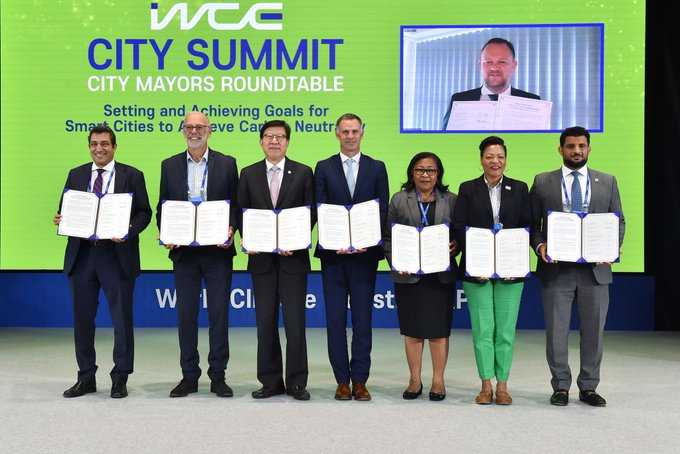
28 May 2023: Auckland’s Mayor Wayne Brown affirming a commitment to climate action, while attending the World Climate Industry Expo in Busan, Korea. (Image via Twitter)
Previous coverage of the TERP on Greater Auckland
Turbocharging the TERP 16 August 2021
Delivering climate action in Auckland 21 March 2022
The TERP: a pathway to a flourishing future 16 August 2022
Pick up the ball and run, AT! June 12 2023
How to fill Council’s climate leadership vacuum 31 July 2025
We already have a plan for the fuel crisis 7 April 2026

 Processing...
“When the rubber met the road, you could say, there simply was no rubber.“
But at least there was lots of road!
An excellent exposé of an ill-fated initiative.
There is a way to get this all back on track!
We need a solution that manages the quantity of fossil fuel used each year for ‘light fleet mobility’, with a declining cap. This would be a nation-wide solution, not specific to Auckland.
I have written a specification for such a system. Message me if you are interested. [email protected]
My concern is it’s already too late and we need to be preparing for the inevitable. China has made it clear they are going to keep increasing emissions unfortunately. It’s great that we can reduce emissions but we are a very small part of a larger picture.
In the C19 level 4 lock down the emissions gear on the motorway found what level of harmful emissions?
When the TERP was published it gave me hope that progressive leaders in Auckland were talking climate change seriously. It was especially good to see the ambition of reducing domestic aviation emissions by 50% by 2030. It was clear that it would be too quick for electric planes to make a difference and alternative aviation fuels were not scaling (as they still are not). So it had to happen through both mode shift and flying less. Neither has happened. Instead it’s growth, growth, growth in aviation with airport expansions and a government that has dropped any policy development for reducing aviation emissions. A night train – as promoted on GA a number of times – could reduce the need for flights between Auckland Wellington and towns inbetween. A train to Tauranga would help. But Auckland does not even provide financial support to Te Huia despite about a fifth of passengers using it living in Auckland. It is clear that the fossil fuel industry knows demand will go down through use of EVs, potentially trains and other changes in transport. So its great for them that fossil fueled flights keep growing.
I have a 1999 model car that I bought 20 years ago.
It is 3 litres, but very efficient on the open road at 8l/100km (33mpg), not so good around town.
I only use it to go to town, less than a 10 minute walk, unless it is raining, or if I need to get groceries etc.
So last month, July, it was only used about 18 of the 31 days in that month.
I keep a strict log, and average about 8,000 km a year.
I am still spending the same money on petrol as I did when I bought it despite the cost of fuel being about $1.00 to $1.50 a litre more expensive now.
By simply not using the car about 120 days or more a year, the fuel cost is about the same annually.
There is evidence to show the world demand for liquid fuels is dropping, partly because of price, but possibly because people have changed their way of driving and living.
When I visit the main cities in NZ, I park my car at the motel and walk or use their public transport systems, and find them all very good, just sad to see hundreds of cars in the rush hours with one person, and half empty buses struggling through the traffic and trying to keep to the timetable.
My family of 4 (with 2 busy teenagers) has one EV vehicle (15.4kWh/100km), uses public transport and I often cycle commute.
It’s a long range EV and including trips the EV is 6-7k km per year.
Note: a hybrid should get <6.5L/100km on open road and be lower around town.
There are quite independent two prongs to reducing transport emissions.
Firstly, and actually most importantly, just drive less.
But our society needs to much further provide the means to facilitate this by:
Reducing the actual need for transport by:
Further upping the rate of intensifying our urban areas. thus shortening our commuting distances and distances to needed facilities.
Better provision of alternatives to car transport by enhanced public transport provision. You don’t need to find a park for your bus or train.
Public transport provision is aided by urban intensification.
Increased enhanced provision for micromobility, and active mode mobility. Thus more cycleways and better pedestrian amenity. Why drive? when it is a pleasant walk, cycle, or scoot.
Secondly make vehicles more fuel efficient.
This is most easily and universally achieved by just a mild reduction in
speed limits. Especially in high hazard areas.
This also has a profound benifit on reducing accident damage, including most importantly to people, at the expense of only a very mild effect on journey times.
Replacing ICE vehicles with those with more efficient engines is only an important additional step. Not a replacement for other measures.
It does not reduce the other very considerable downsides of car dependency. The incredibly poor spacial efficiency of the car transport resulting in uneccesary congestion.
And the far too many inherent speed and weight conflicts, between cars, micromobility, and active mode moments, resulting in deaths and injuries.
Catch 22 when half of our urban areas are reserved for car parking
Councils should really abolish minimum parking requirements, and another travesty I see is people paving over half their property with concrete to accommodate their cars, or they have a garage almost as big as their house. Inefficient land use is heavily ingrained in NZ culture.
Please, only let them abolish minimum carparking requirements only if it’s coupled with the will to ban on street parking wherever necessary. Currently the building of houses and apartments with insufficient carpark just means all those people take over the public realm to store their vehicles. I’m all for having the option of not having a carpark of you don’t need it, but not if it means you clog up our streets, making walking and cycling more difficult, and getting in the way of buses and other vehicles that are actually using the street for transport.
But then where will the local residents with driveways and double garages store their cars 🙁
The TERP failed because it was unrealistic and it was predicated on a political and social licence for change that simply did not exist, and will not exist in Auckland’s short term. People ad nauseam citing Anne Hidalgo viral posts about Paris does not change that.
The more time people spend talking about idealistic hypothetical targets and not actual material politics or incremental but material improvement projects, the fewer good things will actually appear in the this city.
I think this is the type of “red tape activity” that many in the electorate would like to see eliminated entirely from Council workplans and funding. If the Council is never going to put the output of the TERP into action they should never start the process in the first place.
I have to agree with them. How much has been spend on developing, socialising and reviewing the TERP when the only only outcome has been inactivity?
In part it is caused by amalgamation. Larger councils can afford to have a bunch of policy analysts or if not afford them have them and people don’t notice. Small councils didn’t have the time or money for waste.
New Zealand has been seriously compromised across all sectors by the antics of the last coalition
The Greens do not understand the carbon cycle
The light rail and cycle bridge proposals were the brainchildren of politicians who predated the current Mayor and coalition
I know of no one who isn’t concerned by climate change
Any idea that a reduction in carbon emissions in New Zealand would make the slightest difference is fantasy
Concrete ie the stuff the light rail tunnels cycleway bridges are made of is responsible for 8 percent of global carbon emissions and it takes decades to amortise the carbon debt
The net effect of Green policy implementation has been to worsen emissions.
They could not be more carbon irrational
If this is not believed then please provide me with the evidence
So long as councils and governments enable unplanned greenfield growth then climate plans are a waste of space.
All the future urban zoning was a disaster, that is now being made worse by all this fast track nonsense.
The left was complicit in this too. Didn’t Twyford start the ‘Up AND Out’ nonsense?
It’s all too late now
The most disappointing part of Auckland’s failure to move on transport reform is, in my view, that the people who got paid to make it happen simply chose not to, and got away with it.
From Ross’ piece:
“The council’s May update makes this clear: “The TERP was not tasked with considering issues such as affordability or any trade-offs that might be required with other strategic transport objectives.””
Except… None of that is true. All of those things were considered. Reducing transport emissions is cheaper and delivers widespread co-benefits compared to a status-quo pathway. This was specifically identified within the TERP itself.
The reason the TERP went nowhere is because people inside Auckland Transport didn’t like it, and worked hard to stop it from being effective.
There is, to this day, no cross-party working group building momentum towards good outcomes or exploring solutions to barriers; there is no community engagement or socialisation programme discussing problems and opportunities with the people of Auckland; there is no training or upskilling of staff to respond to climate pressures; there is no long-term planning for climate adaptation and mitigation at a systems level; there is no effective accounting and reporting on systems-level emissions; there is no leadership position tasked with ensuring TERP outcomes are achieved (with corresponding KPIs); and there is no reporting on risks or alignment to TERP outcomes when project proposals are put forward.
None of these things required additional resources or tradeoffs: They required the people responsible for our transport system to choose to be responsible and do their jobs to a high professional standard.
The need to change that and pivot towards responsible, professional and effective transport system management remains as strong as ever, and the next steps Auckland needs to take are the same as they were when TERP was initially endorsed by Council: Get some competent people together and set them to work making it happen.
Yes! “None of these things required additional resources or tradeoffs”. Exactly. When people say the words “the TERP didn’t come with a budget” I try to explain that it came with much more than a budget: the methodology for reallocating existing budgets.
Why was it such a common excuse? The answers I got from AT showed me this nonsense was being spread by the very top layers at AT.
I want a pony.
It’d be more sustainable to use that for your commute than a car tbh
My commute is wandering from the kitchen to the back bedroom trying not to spill coffee.
Last night I attended an event at Maangere Arts Centre. A train and bus ride there, two bus rides to return to the city centre. On my return, at two oil stations in Epsom, cars were overflowing, as it appeared 91 had dropped a few cents.
As a city destroyed by the post world war two redirection of military funds to road building projects, we continue to suffer from the people in power having grown up with this reality, without ever questioning it.
Popularly known as boomers, there are a lot of them, but not as many as rangatahi; our current rangatahi are very climate conscious, very climate sensitive, very aware that they cannot guarantee anything to their future tamariki.
We do not allow sixteen year olds to vote, and our young people are over represented in non enrolment statistics.
Why do we not have an end date for suffrage? Why can a seventy six year old vote, but a sixteen year old not vote?
The older a person, the more resistant to change. Young people are growing up in climate change reality, and will have to live their entire lives through this reality.
Why can we not give them more voice?
Why are older people still dominating our city council? They have done nothing for our city for decades already. We have many disillusioned young people here, because seeing the age of our political representatives has not changed.
FIve years ago we could have elected a Pasifika person to lead our city; we choose an old palagi who was extremely unpopular up north, and continues to be an offensive person, excellent at playing bully, but a terrible example of a human.
Why? Because only Pākehā boomers vote. They already own everything, so they have every reason to maintain the status quo.
The sad state of the motu, and the planet, is all old peoples’ fault, and the old people are still in charge. Mostly old men.
Older people are valid members of our society, but at sixty five you get a free ticket to Waiheke, so instead of wasting space in political spaces, howabout retirement being bus train and ferry trips, to wineries on Waiheke. Let the younger persons lead us into a future!
bah humbug
Sadly TERF was too ambitious and not anchored among the wider Auckland population or institutionalised across the council. Then voters killed it off, when the average voter believes that their views aren’t listened to, they elect people that they perceive to better represent their views. That’s happened in this cycle where Patrick sadly didn’t get a seat at the table, despite his views being shared by most that frequent this site. We call it democracy and while I might not always agree with the results, I do defend the system. Currently in a cost of living crisis, few have the luxury to focus on climate add on that changes to peoples lifestyles are the hardest task for any elected representative body and we can understand why this policy document sadly has been ignored.
A slightly different thing that’s starting to bug me. This anti-boomer rhetoric is not helpful or in my humble view acceptable in an inclusive forum. Its slurring and we’d not accept it if it was towards a race, sexuality or bodyshapes etc so how come its OK towards an age group. We should be much better than that. Everyone deserves respect, always.
To achieve things keeping this in mind also helps. In a multicultural city like Auckland, half the population comes from backgrounds with much higher power-distance and where older generations are respected and their wisdom not questioned.
And I am not a boomer.
“half the population comes from backgrounds with much higher power-distance and where older generations are respected and their wisdom not questioned.”
And how is that going?
Unfortunately it seems globally our interest in actually addressing climate change and emissions peaked in the late-00s and early-10s and in the last decade everyone (particularly in positions of power) has just given up.
The mistake in a NZ context was not tying it to tangible benefits, locally.
Arguing that we should be at the front of the queue to take the pain while the Top 10 countries and entities causing 80% of the problem treated it with indifference – was always going to be a tough sell.
Why should we plough our efforts into renewable energy? Energy security and cost of living reductions. Move to electric vehicles and more active mode infrastructure? reduce cost of cars and fuelling them on your average household. EVs? Reduced cost, less air pollution. Carbon neautral supply chains? Avoiding penalties from trading partners and beeing locked out of contracts causing loss of jobs, etc.
There were local, tangible benefits to these things and that should have been the message prioritised, with meeting our climate targets a bonus. But I guess not all governments of late have really been interested.
I think things are getting better with all that. Between EECA, Rewiring Aotearoa, bank low cost finances and a bunch of other orgs, we’re improving on all those metrics. Obviously not fast enough, and we’re still far too vulnerable, but we’re at the point now for most things the economics make electric a no brainer (at least in terms of lifetime costs, but upfront is getting similar too). Pretty much every political party (bar NZF, haven’t seen much from them) is pushing for better solar stuff, or at least agreeing to support it. EVs wise, NZ will shift to EVs purely because ICE manufacturers are being outcompeted in terms of value for money.