It’s Friday again, and here we are with our roundup of the week’s most intriguing stories from the realms of cities and transport. Enjoy!
This Week in Greater Auckland
- On Monday, we had a guest post from Pippa Coom about the power of Local Board Plans.
- On Wednesday, Connor reported on Council’s decision on a modified version of PC120, its housing policy
- And on Thursday, Matt looked at Auckland Transport’s latest report on the plan for removing level crossings
This week’s header image is the view from the top of Maungawhau yesterday, by Jolisa.
Greater Auckland’s research and advocacy is powered by hundreds of hours of work each month, and your support helps keep us going! We warmly welcome your donations, and are always open to offers of guest posts, practical help, and pro-bono expertise.
PS Another fab way to back the kaupapa: Greater Auckland tees, totes, and caps! Remember, these are print-on-demand (no returns possible), so be sure to double-check sizing before ordering.
Greater Auckland in the media
Our commentary on upzoning was sought after this week. On Tuesday, Connor spoke with RNZ’s Morning Report about the modified scenario up for discussion:
“While we would like it to go further, it’s a decent enough compromise. It keeps a lot of the intensification within the isthmus where we really need more housing, so in that aspect, it’s really, really good.”
Connor also discussed the subject with RNZ’s Jesse Mulligan on Wednesday afternoon.
Meanwhile, Patrick spoke to Morning Report on Wednesday morning:
Patrick Reynolds from Greater Auckland said upzoning around these rapid transport stations in the inner suburbs was critical.
“I think there is a condition that I call ‘height fright’ that is extremely endemic. It’s almost like the only thing that people can picture about the future being different is taller buildings, so they focus on that.
“The much more important thing to focus on is the quality of the design of the building and the places between them, whatever height they are.”
… and you might have also spotted Patrick on Three News that same evening.
Small Improvements Win
With major projects recently delayed or put on the (likely) never-never list, NZTA are now celebrating the small wins – the kind that will probably make more of a difference anyway.
Upgrades to State Highway 16 (SH16) The Strand in central Auckland prove you don’t always need major new construction to get people and freight moving more efficiently.
“As Auckland grows, we need to make smarter use of existing infrastructure. The Strand is a key route for moving people and goods between the port, the city centre and the wider motorway network. These improvements show we can get a better performance out of the roads we already have,” says NZTA’s Regional Manager of Assets and Operations, Jacqui Hori-Hoult.
The project includes special vehicle lanes for freight and high-occupancy vehicles, alongside a new shared path, upgraded crossings and targeted safety improvements.
It’s one of the larger projects delivered as part of the Auckland Network Optimisation Programme, a joint initiative between NZ Transport Agency Waka Kotahi (NZTA) and Auckland Transport.
…..
The 10-year programme includes around 200 projects and activities, focused on relatively cheap, quick changes to our roads and paths to support economic growth and move people and freight around more effectively while reducing congestion.
“Freight and public transport are now moving more efficiently through SH16 The Strand. Vehicles using the priority lanes are seeing clear travel time advantages, with around 30% faster journeys southbound during peak times and improved performance northbound as well. That’s a real gain for productivity and reliability,” says Ms Hori-Hoult.
The special vehicle lane (SVL) on SH16 The Strand will be enforced from 27 July 2026 helping improve travel time reliability for eligible vehicles including freight and high-occupancy vehicles. More SVLs in other locations will follow suit within the next year.
Spot the mention of a “shared path”: safety for people walking and biking along The Strand has long been an issue.
A shared path is (only just) better than nothing. But it should be noted that the original design was downgraded for safety at the last moment to remove raised crossings, explicitly in line with Simeon Brown’s singular vision for transport. (See: NZTA reply to Patrick Reynolds re The Strand safety downgrade 8 August 2024)
There’s also some mention of improvements for bus users:
Also underway is the northbound Silverdale bus priority lane to help reduce delays for people travelling by bus.
The project will widen the emergency stopping lane so it can be used as a bus priority lane between 3pm and 7pm, Monday to Friday. This will help buses bypass afternoon queues near the Silverdale off-ramp and improve travel times and reliability.
The lane will be about 2.5 kilometres long and built within the existing highway corridor, alongside the existing lanes. This means there will be no change to the number of lanes available to traffic. Construction will be complete later this year.
For more information about the Auckland Network Optimisation Programme – check out:
With the Central Interceptor now complete, shit gets real…
It rivals the CRL as Auckland’s most influential (effluential?) tunnel project, and even though most of us will never actually see it, many of us will use it every day, and we’ll all enjoy the benefits (e.g. slightly more swimmable beaches).
After seven years of work below the scenes, Watercare’s $1.66bn 16.2km long Central Interceptor project has gone fully operational – “on schedule and close to its original budget.”
Hardworking Hayden Donnell was at the launch, and cut through the crap to get the poop-scoop on possibly the most “Explain It To Me Like I’m Five” question ever:
The Spinoff went directly to the top. “What would happen if everyone around the Central Interceptor went poos at the same time?” it asked mayor Wayne Brown.
“It would be a terrible smell,” he said.
But then the mayor put on his engineering hat. He decided the interceptor could easily accommodate the turd tsunami propelled by the roughly 400,000 butts it’s set to serve. Our creaking sewer network is already handling a rush hour surge of sorts every day, he said.
“We all do poo at once every morning,” he said. “We do a poo and a wee.”
Not content with Mayoral guesswork, Hayden also interviewed Watercare’s Central Interceptor delivery manager Bojan Jovanovic, project manager Francesco Saibene of Ghella, and University of Auckland statistics professor Thomas Lumley.
As Oliver Lewis at BusinessDesk reports, the new sewer tunnel is already proving its worth:
On June 24, central Auckland recorded 22 millimetres of rain. For the first time in 110 years, [Watercare chief executive Jamie] Sinclair said, the Central Interceptor meant there were no overflows at a common overflow point in Mount Albert.
And as RNZ notes, there’s more to come: “Watercare describes [the Central Interceptor] as the backbone of Auckland’s sewer system, but some of the ribs won’t be built until well beyond 2030.”
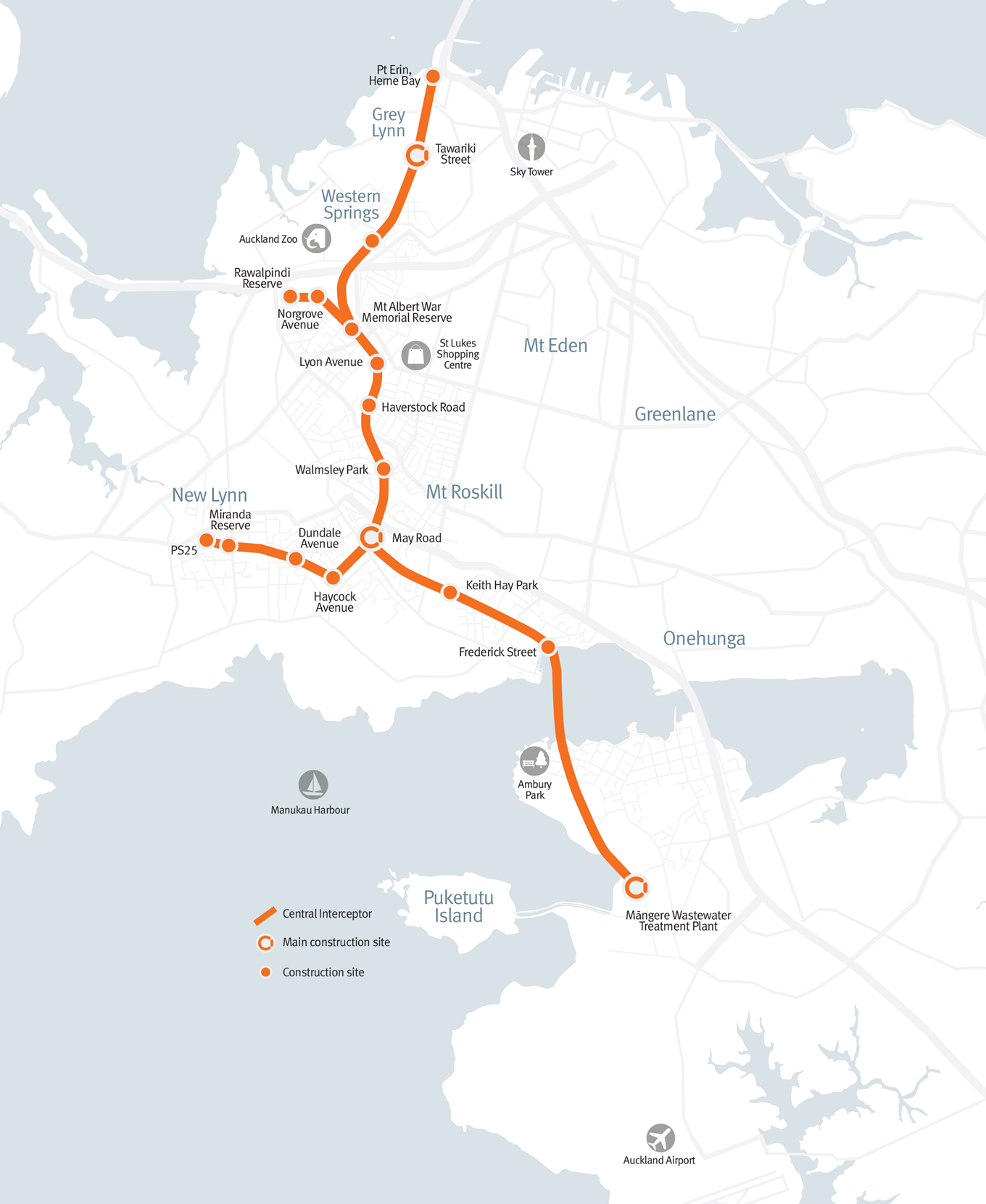
Under our noses: the Central Interceptor line. Image: Our Auckland.
Time to make more progress!
The second part of former Auckland Design Champion Ludo Campbell-Reid’s articles on Auckland’s transformation came out last Friday, on Newsroom. Some encouraging words to keep going with progress!
When I returned to Auckland in late 2025, I expected to feel nostalgic. Instead, I felt proud.
What struck me most was not the projects I remembered but actually the ones I didn’t. The continued evolution of Wynyard Quarter. The maturity of Commercial Bay. The remarkable civic transformation of Te Komititanga. The steady greening, beautification and humanising of Queen St. The extraordinary quality emerging around the City Rail Link stations. New offices, homes, public spaces, artworks and trees. And new confidence.
The city had continued to evolve quickly during my absence and that deserves recognition.
Auckland is small enough to change, and big enough to inspire!
Looking back now, I think Auckland occupies a fascinating place in the global story of cities. It was small enough to change but big enough to matter.
That combination made it one of the world’s most instructive laboratories for contemporary city making.
The lessons extend well beyond New Zealand.
Long-term vision matters, so does governance, design, implementation, infrastructure and identity. But perhaps most of all, belief matters.
Cities are not transformed simply by spending money. They change when enough people believe in a shared future and continue building it, even when progress feels slow and painful.
That may be Auckland’s greatest gift to other mid-sized cities around the world.
I remember hearing Janette Sadik Khan, former transport commissioner of NYC, speak at one of the Auckland Conversations events where over 2000 Aucklanders turned up to hear her speak about New York’s transformation under the leadership of mayor Michael Bloomberg. Janette said “If it can happen in New York, then it can happen anywhere”.
Perhaps the same can be said for Auckland and perhaps Auckland, too, can inspire the next generation of mid-sized cities to be better and more liveable.
Christchurch, city of arts – but not arts funding?
Here’s a lovely celebration of street art in Christchurch, and its enormous benefits for tourism:
Behind the hundreds of pieces of urban art across Christchurch city is a vast spiderweb of artists, the council, event organisers, project managers and facilitators.
Dr Reuben Woods has observed this network closely. From attaining a PhD in Art History exploring local urban art in 2016, to being creative director of Watch this Space, a comprehensive street art resource, he has insight into the city’s evolution, particularly post-earthquakes.
“We had this authentic art that responded to a real lived experience which is probably the most impactful event that the city has had since its formation,” he said.
“That has embedded in a way that’s different to other cities.”
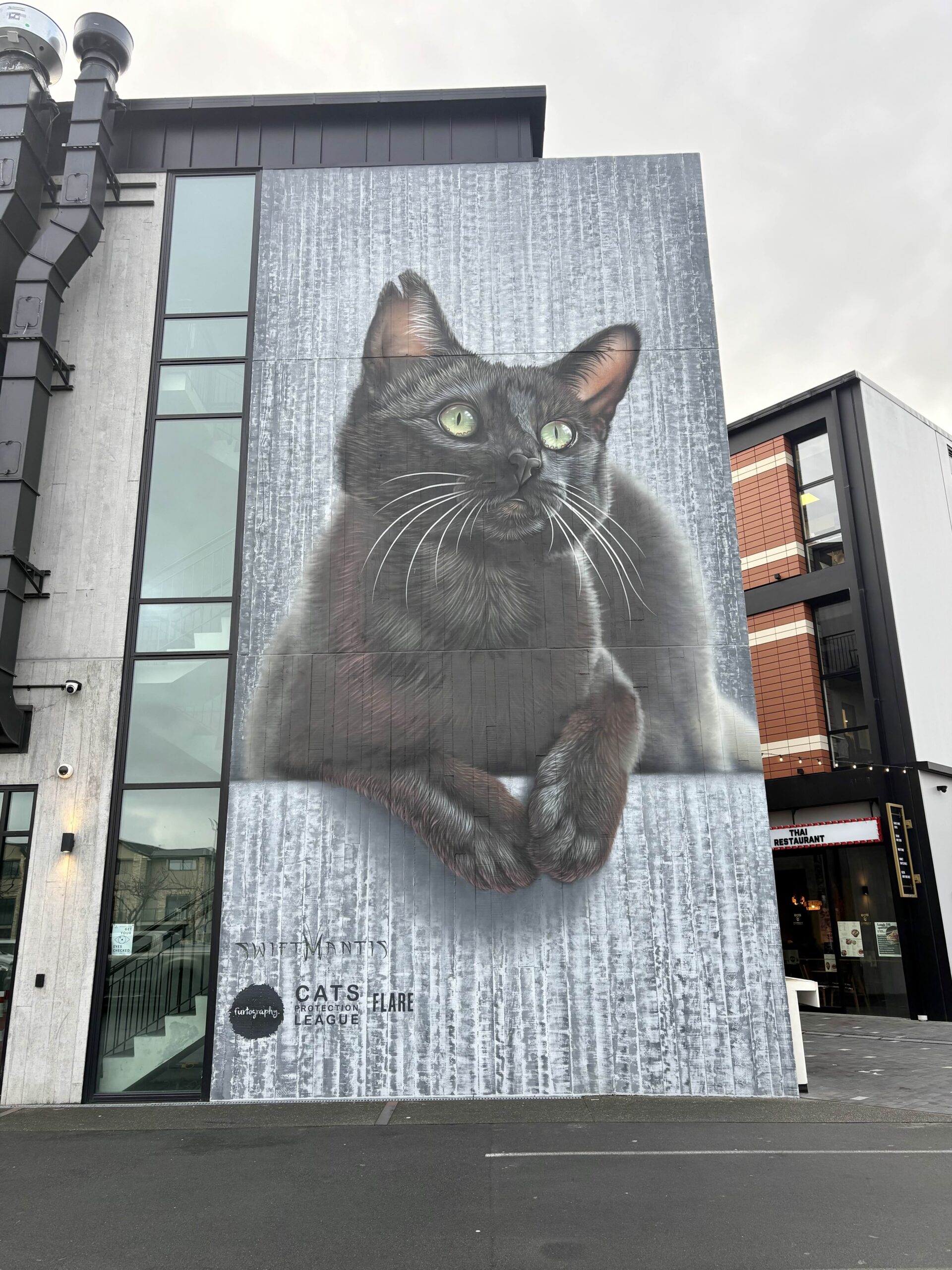
Sample of Christchurch’s large-scale wall art: a work by SwiftMantis at Little High (Image: Jolisa Gracewood)
And yet, as The Press reports, “it really sucks” that Christchurch isn’t getting much funding for the arts, out of what little there is:
Creative New Zealand this month announced the recipients for the larger of its two funding categories (those who applied for $125,000 or more). More than $104 million was awarded to 94 applicants nationwide, but just $9.9m went to South Island organisations and none outside Canterbury or Otago.
Auckland-based groups received 56% of the available money and Wellington groups nearly 30%. Christchurch received 6%.
Here’s a possible solution…
Peaky Blinders and the UK quota system
Smyth, who does not apply for CNZ funding, suggested a British quota system could be the way forward for the creative sector as a whole.
“In England, which is very similar to New Zealand — because London is at one end of a long country and Auckland is at one end of another long country — they had to legislate that a portion of the television drama funding went to a certain area.
“And then soon after, Peaky Blinders came out.”
The TV show, filmed in the north of England and the Midlands, went on to become one of the world’s most successful crime dramas.
“That would never have been made under the old way,” Smyth said. “So the vision for New Zealand would be for there to be a long term plan for local voices.”
…or transport funding, either
The trend of the South Island, and Christchurch getting underfunded in transport continues…
Christchurch councillors and ministers are at odds over whether the city’s list of priorities amounted to a bid for Budget funding or simply issues for the South Island minister to champion.
The Christchurch City Council submitted five priorities earlier this year after South Island Minister James Meager asked councils to identify projects he could advocate for.
They included mass rapid transit, expansion of Lyttelton Port, local government reform, support for heritage buildings and national reserve status for Takapūneke.
Councillor Nathaniel Herz-Jardine said councillors expected the submission to be considered when the Government made spending decisions.
“If those priorities aren’t going to be in the Budget, then where are they going to be?” he said.
More communities backing (a return to) safer speeds
Waikato Times reports Whatawhata residents are supporting slower speeds through the town after consultation.
NZTA said it had considered other safety improvements for the intersection, including a roundabout, but “delivery depends on future funding”.
“In the meantime, a reduced speed limit supports safety and any future roundabout,” the road agency said.
Slowly but surely safe speeds are happening; if only it wasn’t so hard due to Simeon Brown’s 2024 Speed Rule.
Videos to enjoy
City Rail Link have been publishing some videos on the history of the project
That’s us for the week – as always, feel free to share any links and stories in the comments!

 Processing...
I have been getting a lot of overnight or half-day rail line closure notifications from AT recently. E.g. Southern Line closed on Saturday between Waitemata and Newmarket until 12pm for CRL testing. Other lines are closed for nightworks from 9:30 pm. Will that still be a regular feature after CRL opens? If they are doing more testing this weekend, does that mean the opening is delayed until October or later?
Would be surprised to see the end of line closures once the crl is open. It’s basically institutional practice now.
Even the roads have issues – the Waikato Expressway has had major resurfacing work done on sections less than a decade old over the last few years.
Which sections are less than a decade old. Ngaruawahia and Cambridge both just barely scraped to 10 years.
It remains extremely frustrating that the media keeps describing the planning capacity of x buildable homes as a target. Or even as very significant. No. Whether Council enables 1m, 1.5m, or 2m possible new dwellings has very little bearing on what the actual future population of Auckland will be.
The total number doesn’t even really have bearing on the form or pattern of the future city either. It’s quality. No.
What really matters is where and in what size and typology future capacity is allowed to be – should it eventuate at any scale. Which is much more dependednt on the performance of the wider economy and on immigration settings and child raising incentives (or their lack).
Thankfully this compromised plan at allows more compact development around transit routes, patiently added and improved this century, and improved water infrastructure, and doesn’t continue vertical restrictions that leave only wasteful outward sprawl as the main growth option.
But as urban renewal, especially high quality urban renewal, is a complex and capital intensive (or rather requires patient capital as is less attractive to highly speculative bets), it is unlikely to occur without public urban renewal agencies. Especially well funded and empowered govt and city agencies with cross party enduring support.
Anyway this is the wrong place to explore this – I must write a proper poster on this!
What Zoning allows and what is economically viable to build are very different. How to get quality density in TOD locations is not easy.
Look at the history of zoning, consenting and actual building in Albany Centre. Often, developers put forward applications for half or less of what is zoned or masterplanned, because the land is there and cheaper development is all that is economical for them at the time.
Building smaller consumes the opportunity of good density.
Never say TOD in earshot of the Council. Planners, architects and urban designers all start to appear, dragging one foot behind them chanting “That’s not TOD. That’s not TOD”.
Panmure interchange was promoted as a TOD. It was finished in 2014. 12 years later it is still just carparks. There is less development there than there was before! And still no dates for anything significant
I think part of the issue is that the Housing Minister has legitimised talking about the planning capacity target by using it as the basis of his backdowns.
He may be responding to hysteria, but by choosing to respond to it in the terms of the targets, he is sending a message that it is something of significance.
“describing the planning capacity of x buildable homes as a target” – hard to know if the MSM are deliberately misleading or poorly researched.
You are all misinterpreting language. For example, the use of the word ‘target’ in this Herald article is clearly implying it’s a target for council to reach in terms of the capacity it should enable:
https://www.nzherald.co.nz/nz/auckland-planning-future-councillors-vote-for-hybrid-model-with-high-rises-in-inner-city-hubs/ABB53TFNE5GLTN5WIUI7GMXPTU/
Re: Peaky Blinders / mandated regional arts funding:
From a JAFA perspective, I see a lot of neglected stories to tell of the South Island. For instance, we could see dramatic biographies of impactful locals like Robert Logan or Alexander A. Cameron 😉
The Strand, I received an email about this, and as I live in the area, I took a stroll. It is a rather pleasant shared path, until it is not. The closer you get to the port, the considerably worse it becomes, as a footpath. So well done for a 60% upgrade to the walkability, it just fails to connect nicely to Quay / Tamaki, which it really should, considering the work we are putting into the Orakei to Tamaki Drive connection.
Could we not have a better freight solution, where rail moves it out of the city centre, then truck transfer happens somewhere else?
If the City Centre truly believes units masterplan, The Strand remains a toxic airspace, so NZTA has failed to make it any more bike able or walkable than previously. They can stop patting themselves on the back for their “cheap” upgrade. You pay peanuts, you getr monkeys as they say. Turns out that applies to infrastructure too.
Thank goodness we are paying properly for our CRL!!!
They’re increasing truck fees to take containers from the port, which means more will choose to do rail. But I think there will always be some level of trucks there, and although they’ll shift to electric I don’t think they’ve got any good solutions to tyre pollution yet.
So Paul Glucina signed his name to that letter of shame, eh?
“NZ Transport Agency Waka Kotahi (NZTA) is satisfied that the key safety objectives for the project are still met with the at-grade crossings.”
Satisfied, eh? That’s a nice sort of human-like word.
Yet it’s being applied to an organisation.
Perhaps there’s someone inside the organisation who feels it. Shall we guess who?
Perhaps it’s the man signing the letter himself? Is that the case, Paul? Is it you who’s got that nice *satisfying* feeling? If so, is it from defending NZTA’s dangerous infrastructure decisions? Or is it from being able to get away with writing letters that directly conflict with the evidence, and being so supported by the sector that you get away with it?
Personally, I’d feel sick to my stomach. I mean, the evidence is conclusive that raised crossings are effective, and in that location, are absolutely critical to keep people safe. Or maybe I’d feel a bit of a fraud. A bit unprofessional. A bit nasty, to tell the absolute truth.
What about you, Brett? Is it a warm, glowing sort of a satisfaction?