We hope everyone has had a great week after the long weekend! Here is a collection of all things cities and transport to enjoy!
This Week in Greater Auckland
- On Monday, Matt went into how the government has finally admitted the reality of the RoNS
- On Tuesday, Patrick wrote about our interview last year with Len Brown, and how the CRL happened.
- And on Thursday, we had Patrick’s op-ed about the Harbour Crossing, which ran in the Sunday Star Times and The Post this week.
Greater Auckland’s research and advocacy is powered by hundreds of hours of work each month, and your support helps keep us going! We warmly welcome your donations, and are always open to offers of guest posts, practical help, and pro-bono expertise.
PS Another great way to back the kaupapa: Greater Auckland tees, totes, and caps! Remember, these are print-on-demand (no returns possible), so be sure to double-check sizing before ordering.
The RoNS are coming home to roost
The RoNS reality was clearly released before a long weekend in the hopes of limiting the political fallout but the impact has continued this week as journalists dissect the announcement.
The Spinoff’s Hayden Donnell has written that this was always bound to happen and like us, questioned why it was ignored for so long.
Though he didn’t say it outright, it was hard to escape the impression that Bishop had been thrown a flaming bag of bitumen-based turds by his predecessor. National’s Roads of National Significance were announced during Simeon Brown’s tenure in charge of transport. The Pakuranga MP was confident to the point of gung-ho about the programme’s affordability. When he announced the first batch of 10 ahead of the 2023 election, he said they’d cost just $24bn. His faith didn’t waver as he added another seven to the list the following year. Brown also got rid of a source of funding for the projects for good measure, ruling out what he described as Labour’s unnecessary fuel tax increases during National’s first term. “Our plan is fully costed and won’t require the heavy burden of any petrol tax hikes in our first term,” he said.
…..
Some of the cost estimates look laughable in retrospect. Among other things, Brown said National would be able to build four-lane highways from Whangārei to Tauranga for $6bn. Just one section of that route – Warkworth to Whangārei – is now forecast to cost nearly $20bn. This is not a case of hindsight being 20/20 either. People at the time pointed out these roads were underpriced. Even mostly innumerate bozos from The Spinoff were posting about the problem.
…..
But for the most part, Brown got away scot-free from his two-year sojourn in monetary fantasyland, moving on to the troubled health portfolio with an untarnished reputation as a political Mr Fix-It. Now it’s Bishop’s unenviable job to arrange some of his promises into an economically feasible plan. That’s the thing with infrastructure: you can only get by on bluster and ideology for so long. Eventually reality will find a way to reassert itself. Maybe it would have done so earlier if our media had paid less attention to politics and more to the actual numbers.
The Post editors struck a similar tone, re the reality catching up with the government:
In the end, everyone gets mugged by reality. Sometimes it is slow, sometimes it is fast. You can never face up to reality too soon. So it is with individuals, households, companies and governments. In the end, reality has to be acknowledged. The sooner it is, the sooner the work of fixing things can begin.
And Thomas Manch at BusinessDesk noted the similarity to the state of Labour’s promises in 2023, which National derided:
Of course, the National Party essentially did the same to win Government.
The party campaigned in 2023 on 13 RoNS costing an estimated $17.36b to be “commenced” within a decade.
By the time investment cases for the expanded list of 17 RoNS were published in 2025, that figure was in excess of $50b, and timelines for each were spreading out.
The fantasy has finally been dispelled almost three years since that campaign promise.
And Nick James at The Post has revealed that the government has spent $323.8 million (so far) on planning the now on-hold RoNS.
The Post can reveal the Government has spent $323.8m on pre-implementation work for six of the projects in the second and third phases of the funding plan as of April.
This information came to light in an answer to a written parliamentary question from Labour to Bishop.
Those projects were sections two and three of the Northland Expressway, East West Link, Hamilton Southern Links, Petone to Grenada and the Cross Valley Link, State Highway 1 Wellington Improvements and the Hope Bypass.
That work included consenting, design, route protection, site investigations, and some early works.
Which is more than Labour spent on the ill-fated tunneled Auckland Light Rail project, for the same result.
Lastly, Robbie Nicol sums up the fate of the RoNS in this short clip:
There’s been quite a few other articles too – feel free to share other good ones in the comments.
Auckland – the city that makes us believe change is possible?
Former Auckland Design Champion Ludo Campbell-Reid has written some reflections on his time in Auckland. (Updated: this is the first of a two-part essay for Newsroom, and the second part landed today).
Auckland didn’t simply transform its streets and waterfront. It transformed its confidence. As the City Rail Link prepares to open, former Auckland design champion Ludo Campbell-Reid reflects on two decades of city making and the lessons one mid-sized city offers the world.
I never became a medical doctor, although for a time I thought I might. Instead, I became something close, a kind of doctor for cities. For more than three decades, I have worked with governments, mayors, businesses and communities helping cities including Tāmaki Makaurau Auckland, diagnose what is holding them back and, more importantly, helping them imagine what they could become.
Cities, like people, can lose confidence. They can lose direction. They can become trapped by old habits, short term thinking or a failure to recognise their own potential.
But cities can also recover. Sometimes remarkably.
…..
When I first arrived in Auckland in 2005 for my interview as first ever design champion and group manager, urban design at Auckland City Council, I was struck not by what the city and city region was, but by what it was not.
It felt grey, dull, underwhelming, and underdesigned. It also had one of the highest levels of car ownership per capita in the world and more carparks in the central city than I had experienced throughout my career, it felt like a city of cars rather than a city for people.
Here was one of the world’s most spectacular natural harbours, yet the city seemed strangely disconnected from it. Queen St functioned primarily as a traffic corridor rather than the civic heart of the country. The waterfront was broken and fragmented and largely locked behind a red fence. Public transport carried little prestige. Walking and cycling were marginal activities rather than everyday choices. Density done well was something other cities did. The bustling trams and street cars of the 1950s when Auckland had one of the highest public transport levels per head of capita in the world, were a distant memory.
Almost as if by design, we noticed some videos earlier in the week of people driving around Auckland. If, like many people you paid tribute to Sam Neill by re-watching his breakout role in Roger Donaldson’s eerily prescient Sleeping Dogs (1977), you’ll have noted a chase scene down a very different-looking Queen St. (Trailer: contains spoilers!)
Then there’s this, from 1988.
And here’s another one from 1996 – a lot has changed!
Big Event Weekend
There are three big events on tomorrow, and AT are putting a few extra services on. There are also some impacts to regular services.
The All Blacks, New Zealand Warriors and Harlem Globetrotters will all pull in the crowds this Saturday evening 18 July, putting more pressure than usual on Auckland’s transport network.
But if you’re one of the 85,000 plus fans expected at one of the three big events, Auckland Transport (AT) has you covered with the best ways to get there and home again.
Check for more details here.
South Auckland rail stations opening
Auckland Transport and KiwiRail have announced that the Drury and Paerātā stations will open on Sunday 2 August.
Auckland’s newest railway stations, Drury and Paerātā, will open to customers on Sunday 2 August 2026, putting South Auckland and Franklin’s fast-growing communities on the rapid transit map just in time for City Rail Link.
The new Drury and Paerātā stations, which have been built by KiwiRail with government funding, will be served by Auckland’s Southern Line, giving nearby communities seamless public transport journeys to Auckland’s city centre, Auckland Airport (via Puhinui and the AirportLink), Middlemore Hospital and destinations along the rest of the Southern Line.
The opening of the two stations will also be supported by an upgraded local bus network, making it quicker and easier for people in Paerata Rise, Ramarama, Drury, Waiuku, Glenbrook and Pukekohe to connect to Drury and Franklin train stations. Each station also provides 350 park and ride spaces with room for further extension in the future.
…..
- Ahead of the stations opening, Auckland Transport will be hosting a public information day for local communities on Saturday 1 August, where staff will be on hand to answer any questions people have about the new stations and the public transport services operating to them.
- The public information sessions will be held at Drury Railway Station from 10am to 12pm and at Paerātā Railway Station from 2pm to 4pm.
- Two new bus services will begin from Sunday 2 August to connect local communities with the new stations. Using one of these connecting bus services won’t cost passengers who are connecting to trains, as long as they transfer to the next service within 30 minutes.
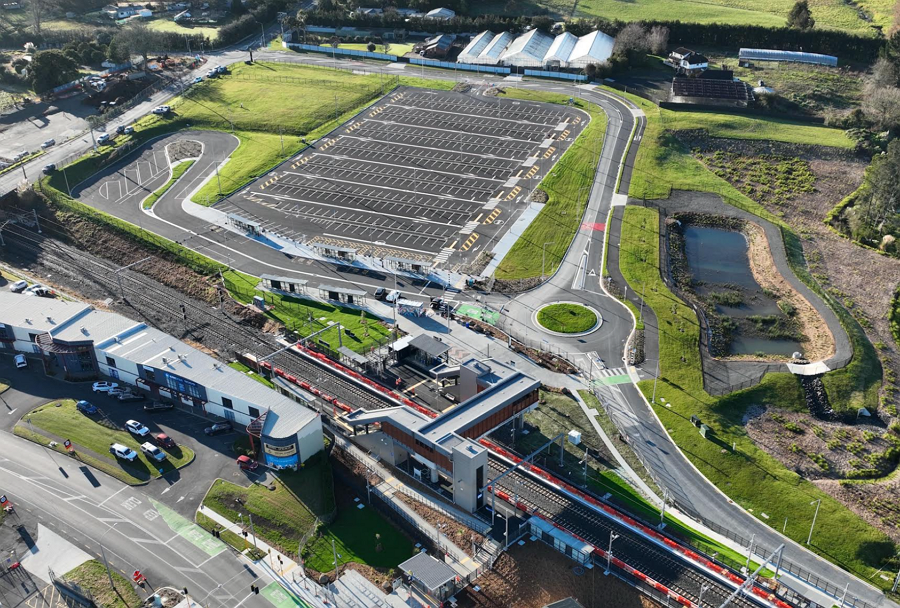
Drury Station

Paerata Station
The third of the new stations, Ngākōroa, is due to open next year.
We still find it incredible that these three stations cost $500 million to build, and that for that price there’s only a couple of bus stops placed on the platforms for shelter. It’s also hard to tell if it’s just the perspective of these images, but the platforms themselves look quite narrow.
Let’s also not forget how the Drury development was originally envisioned by the council – and compare that to the first image above for what we actually got.

Should (and will) the price of fuel stay up?
Raising fuel taxes as petrol prices start to fall could lock in the changes to transport habits kick-started by the fuel crisis, some say.
One transport urban planning researcher says the gains in fuel savings and public transport numbers will quickly fall away without any policies to permanently shift people’s habits.
Data collated by RNZ shows electric vehicle sales, public transport use and cycling numbers were all still higher than normal in June.
That was despite fuel prices starting to dip below $3 per litre after the Strait of Hormuz re-opened to global shipping in mid-June.
…..
Auckland Transport data showed the city hit a new June record for bus passenger numbers, with 6.3 million trips taken last month – up 14 percent on last June.
That followed an all-time monthly record set in March, as the annual ‘March madness’ peak coincided with the beginning of the fuel crisis.
Monthly Auckland cycling numbers have stayed up by about 20 percent on last year since fuel prices spiked.
In Wellington and Christchurch, the other centres with significant bus networks, monthly passenger numbers have been up by two to three percent on the same time last year.
Auckland University urban planning programme director Tim Welch said there had been a corresponding drop in nationwide traffic of 2.4 percent since the beginning of the crisis.
In late March, the Energy Efficiency and Conservation Authority (EECA) launched a $3.5 million campaign encouraging people to save fuel by modifying their driving, including accelerating and braking more smoothly, and lowering their speed slightly.
A return-on-investment report commissioned from consumer research company Verian estimated those behavioural changes saved 6.6 million litres of fuel over seven weeks.
That came at a total saving of $21 million in fuel costs that could be attributed to the campaign, the report said.
Welch said although the changes were heartening, previous research showed they would likely be “extremely short-lived”.
“We wouldn’t expect them to go beyond a month or two months … if fuel prices really do drop and stay low,” he said.
That was because the government had not introduced any policies to encourage a permanent change to people’s behaviour, he said.
Videos to watch
The return of cars to a Montreal street leads to businesses doing worse, surprise!
From the socials
CRL art!
View this post on Instagram
Streetblog comparing bus times in New York without cars
View this post on Instagram
A lovely bridge in Finland for a cool $250m NZD!
View this post on Instagram
New York Summer streets giving space back to people!
View this post on Instagram
Electrifying food carts
View this post on Instagram
Have a great weekend.

 Processing...
The contrast between the original concept for Drury and the end result is depressing. Instead of a vibrant town centre square adjacent to a station we get a carpark. Do these people never get out of NZ? Have they no imagination?
Already I see the old uncles on Facebook moaning that there aren’t enough carparks.
To be fair, the artwork shows only one side of the station which is barely visible in the picture. However, Google Maps doesn’t look promising either 🙁
“Do these people never get out of NZ? Have they no imagination?”
No, and clearly not 🙁
The artwork was developer puffery for Private Plan Change. NZ always responds to fairy dust. When you look at the sites of the stations, you have to seriously think about what is possible to build near them and when.
The Park and Ride provision is to ensure there are some customers for the stations when they open, before developers build anything to provide customers something close by. The car parks could be built over eventually.
Maybe in general but in this case there were already shops there which were demolished to expand the road to aid the puffery.
Well there are probably trees that would take a while to grow so the look will improve over time.
Drury was always an urbanist fantasy. Higher density, mixed use development was never going to work, financially, in that sort of location.
The developers, and their army of consultants, did a good sales job that got bought hook, line and sinker by the council.
One of the biggest issues is the yield will be much lower than the fantasy portrayed, and therefore so will the resultant revenue from development contributions.
So council will end up having to foot more of the bill for infrastructure…
I have work colleagues and family in rural areas without bus services who were hoping to use the Drury park and ride – to enable them to stop driving all the way into the city, by using the train instead. Hopefully the connecting bus services will work well for those who live nearby, so enough carparks are free for those that don’t have the bus option.
Awesome I can catch a train to get a…
Oh, wait, they demolished half of Drury as part of these works.
Good to see two new stations opened on the Auckland suburban rail system.
The Southdown link should be next to build, cheaper now than in ten years, and another piece of the network that will unlock the whole system for passengers and freight.
What services would you want on Avondale-Southdown Corridor?
Is this a trick question? Henderson -> Mt Roskill -> Onehunga -> Manukau
Not a trick question, I am just interested in which journeys people think will actually be made better by this link.
Henderson, Mt Roskill, Manukau makes sense as a route. You’d obviously need to grade separate the junctions at Westfield and Wiri and quadruple track between them.
I just think that light rail (or eve a bus way) is so much better on that route for passengers. Heavy rail will always be constrained by the busy tracks at both ends, but light rail is the start of a complementary network that we can build over time:
-A branch along Maioro, Tiverton, and Wolverton to connect to New Lynn.
– Extend the western end to Pt Chev and connect to the NW rapid transit. This could even go to the city or out to Westgate
– Actually connect to the town centre in Onehunga (Avondale Southdown is several hundred metres away
– A branch to the airport and Manukau
– A branch up to Penrose
I really want .. something like at least express services along that corridor.
For the Māngere side, there’s the popular but very limited 309X that AT repeatedly plan to axe and then delay.
I reckon just do the Mt Roskill Spur to the city. Getting it to Onehunga could be worthwhile, anything past there seems fairly pointless unless its for freight.
Daphne – surely we’re never going to spend the money that would be required to built this to run a crosstown rail service. Even the full NW busway that would move more people is likely decades away.
One-day it might need to be built for freight, but even that seems unlikely as the Western line west of Mt Albert will limit freight capacity anyway.
Also provides alternative routing options so the whole network doesn’t need to be closed to do maintenance on existing lines
Start off terminating the extra services from the CBD instead of @Mt Albert, @Owairaka. Then Dom Rd station between Dom Rd and May Rd. Then Hillsborough. Once Hillsborough to Onehunga is built you then have the option of crosstown routes from the west as well, but I think the main passenger usage will be Mt Roskill to CBD as should be vastly faster than the buses.
But it’ll take them years to build it, so splitting the line into stages with roughly each stage equalling a new station makes sense. But the time the first stage of Avondale Southdown opens the inner west crossings will be sorted removing capacity constraints but the outer west ones won’t be.
My main concern is them cheaping out on grade seperating the Western Line/Avondale Southdown junction. If they build it to be seperated and only build parts of the junction they can put the missing bits in later. But if they build it as a flat junction it’s screwed.
There will already be a Henderson to Manukau line when the CRL opens. Not sure a second Henderson to Manukau line is a priority.
Provides an option for rail freight to bypass the city.
If an East-West road link is seen as essential for road freight through southern Auckland then why not an East-West link for rail freight?
There is one return freight train a day going north. They could increase that twenty four times and it would still only be one an hour.
There’s just no need for a freight bypass to the NAL, especially one that only goes halfway up the western line then still merges in before New Lynn anyway. Especially not one that’s going to cost multiple billions.
If they are worried about freight, then quad tracking the southern line would be far more useful.
With renewed freight interest in the AS corridor, the ARTA plan from 2010 for a rail loop Onehunga/Airport/Manukau starts making more sense. Unfortunately the light rail advocates chose to denigrate and undermine the heavy rail option, and the end result was that neither was built and the consultants made a lot of money. I also support light rail on Dominion Road, but I believe the linking of this project to airport access was a mistake.
To be clear I do appreciate the negatives of a spur line from Puhinui to the Airport, but it if it is being built with the intention of completing the loop to Onehunga many of these negatives would be mitigated.
Significant parts of the AS link have been designated for a railway since the 1940s. This should lower costs. If interested parties wish for more expensive changes to the line, Kiwirail would have an argument that those parties should contribute to the increased costs.
They could use it to take freight to a new port at Pollen Island. Oh wait a minute they gave up on that 60 years ago.
Kiwirail were very clear in their 30yr plan that A2S was not a priority and would only be up and running at the end of that 30yrs, so about 2055.
So if you still think that it will get built at all, well up to you.
No one “denegrated” the Onehunga heavy rail extension option, it just turned out that double-tracking and grade separating the Penrose–Onehunga line, then building a rail viaduct next to SH20 crossing several interchanges, and tunnelling under the future second runway at the airport to get to the terminal, was going to be substantially more expensive than building surface light rail all the way from Wynyard Quarter to the Airport.
All for maybe 5 minute faster travel times, half the service frequency, and comparable people moving capacity.
Kiwirail were very clear in their 30yr plan that they had 3 main priorities for Auckland’s rail network, four tracking the Southern line, Avondale Southdown, and level crossing removal
Yes, and two of those are valuable and fundable actual priorities, and one is a fantasy distraction that will retire with a few individuals.
Also, missing, is a third on the eastern line.
Yet you support spending billions of $ on building the NW busway when Westgate already have a motorway leading to it?
sorry I don’t understand what you mean?
Speaking of valuable and fundable actual priorities, why do you support building a duplicated >$5 billion motorway for a single mode of transport over a new rail line that could also be used for freight?
The NW busway will move a lot more passengers than a cross-town rail line ever will and it would only move marginally less freight than the cross-town rail line would.
Just saying that’s going to be one expensive road… would you say it is nationally significant?
I don’t think any transport projects are truely Nationally Significant. However, I think a new rapid transit route in a city with 1/3 of the population is closer than anything else that uses the title.
What would be better would be if some of the existing motorway corridor was used for the busway instead.
Facts, biking to work beside the Western Motorway it’s amazing how much land the motorway takes up compared to a path that is hardly wide enough for 2 bikes to pass each other, let alone allow for people walking, pushing prams, etc.
Craw, implementing a project only 30yrs down the track tells me it isnt s priority at all. They just mention it every chance they get in order to save the land designation.
The other “priorities” are underway. This one probably wont see the light of day. Better to get on with a Busway down SH20 linking the NW Busway, Onehunga and on to to the airport. You could have that operational by 2030 under Fast Track legislation.
Sadly you are right that isn’t a priority, likely because self-proclaimed transport advocates see no value in investing in the rail network, and I imagine they tell their mates who work in government the same thing.
LRT, regional rail and sorting out level crossings to maximise the CRL. Pushed here ad nauseum.
So how have we ended up in the situation where $5.5 billion for CRL is considered overpriced, but $6 billion for the NW busway is a fantastic idea?
Ask NZTA?
There has been plenty of discussion on this blog about the busway being overengineered and hence the cost blowing out.
Whether it be SH16 or the AHB, this blog has (mostly) shown a preference for liberating lanes or more practical, cheaper solutions.
Fair cop
I read recently that Auckland Transport plans to route the express NorthWest buses through Ivanhoe Road. Tigilau Ness, a resident and a very important figure in Taamaki Makaurau, said it was a very unwelcome idea.
Now that the Central Rail Link is close to opening, can AT please rethink any proposals that cause such damage to communities?
We should be thinking in expanding rail based services, not roadways. A new busway is no different than a four lane highway, and far less sustainable than rail.
The Eastern Busway has removed numerous properties, and although
I agree with improving public transport to all parts of our supercity, rail seems less damaging than anything road based.
Tigilau Ness is the father of Che Fu, another cultural icon of Taamaki.
These are our taonga, we need to protect them!
Bah humbug
That’s NZTA for the Northwestern Busway, looking for a site for a Busway station to serve the area at the west end of Ivanhoe Road. Government need to find enough money to build anything other than Warkworth to Te Hana, so who knows when that stage of NW busway might happen?
NZ Trucking Agency only know how to build roads, so naturally they would recommend building a new road as the best way to solve any transport problem they come across
Yes when we asked whether any consideration for repurposing SH16 lanes for the busway occured the NZTA staff at the open days looked blank and basically said but the people want us to build a new motorway lanes and overbridges – Which people you wonder?
They should be building automated light metro from Mercury Lane (better to not do the expensive bit of extending through CBD until K Rd caps out + not an obvious alignment) along SH16, opening in stages and terminating the NW busway at whatever stage is open.
They might be planning a busway (like trams and light metro were planned along the route before and likely after) but there isn’t any major difference in alignment and their land acquisitions/designations for stations suit either mode.
Busway just won’t cut it for the development in that direction, the sheer numbers of drivers/bus space required is nuts.
The new southern stations had gone off my radar a bit with all the city CRL focus. Nice one, can actually use the Drury one combined with bus to visit family.
The RONS aren’t coming home to roost lol. I mean I appreciate the honesty finally that you’ve admitted roads are politically popular.
We are still getting a big chunk of very expensive overpriced roads and there’s nothing wrong with that in fact it’s needed.
The ones that have been deferred to stage 3 were never really needed especially Whangarei to North of the Brynderwyns seeing as everyone already travels at expressway speed on what is a relatively wide and straight road. Warkworth to Te Hana is desperately needed for multiple reasons I get you’re ideologically opposed to it but you haven’t actually given a good reason why it shouldn’t be built or a good alternative apart from cost which you know is almost meaningless to the majority of voters. Vibes matter more than evidence now it’s the world we live in.
I’m confused what you’re trying to achieve with that RNZ article. What you’re saying is the people that switched didn’t actually want to they did so because they had to. Effectively saying the majority don’t want to take PT.
Anyway yes bring on the fuel tax increases we need better roads. It should be exclusively for building roads and paying down debt for existing roads. PT has had enough subsidy now it’s time to prove it can grow without the need for even more subsidy’s and the same should apply to roads no more subsidies!
I personally can’t wait for the fuel excise increases let’s get these roads built!
i love it when you advocate for the acceleration of global extinction, James. So thoughtful and empathetic of you.
I’m advocating for accelerating safer roads bugger off with the trolling. I’m pushing the accelerator harder than ever on this.
You can troll till the cows come home but nothing you say’s going to make any difference, but responding is an optional extra it’s something you don’t have to do.
Here’s that thing James / Mount Colon.
People who use multiple handles on blogs rarely argue in good faith.
You are Mount Colon. Your communication style is as distinctive as mine.
When I raised the issue of higher vehicle speeds endangering our most vulnerable communities and reducing their capacity to participate in society…
You laughed in my face and told the elderly, children and the disabled to suck it.
So forgive me for calling you a rank hypocrite whenever you talk about road safety.
All your “arguments” are disingenuous at best and rely on a level of cherry picking which makes you eligible for employment under the RSE scheme.
Are you aware that your behaviours and communication style make you sound like an addict? I mean that sincerely. Constantly asking for more without regard for anyone but yourself.
I honestly don’t care about your travel times, it seems you’ve just made a lot of bad decisions and choices to end up in that situation.
It has been a strange week of comments from one deluded asphalt-lover who thinks democracy is mob rule. Must be what going to a populist political party event feels like.
Even after the recent dip, timing a fill still feels like guesswork. Curious to see whether prices keep easing or start climbing again.