After our rising concern about the direction of the City Rail Link and how services would operate through it, it is good to see things are starting to get back on track.
As we highlighted a few months ago, it appeared Auckland Transport were about to snatch defeat from the jaws of victory – especially after we saw the hidden details of their first timetable test. However, a new network map (below), along with details provided to us by AT in a recent meeting, have given us some hope again.
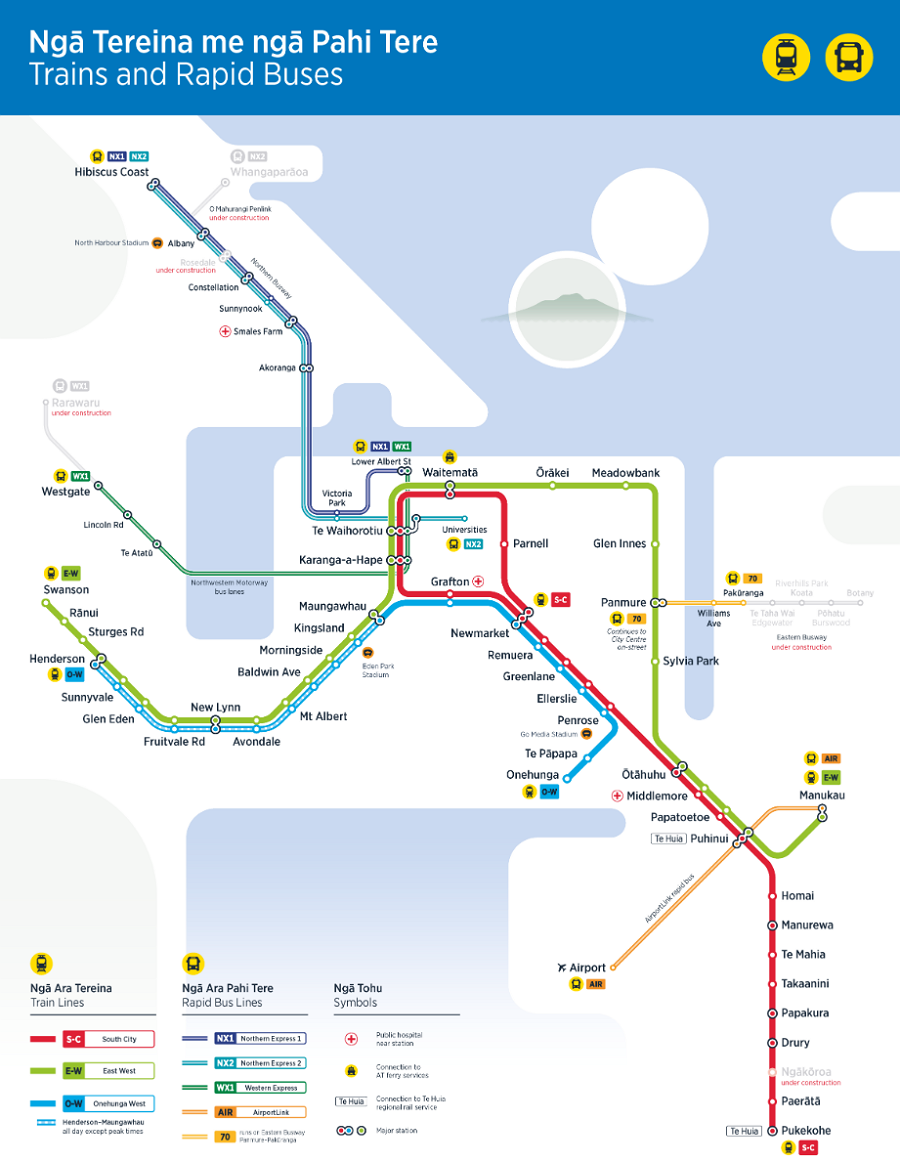
The new map, via Auckland Transport
The map may look largely similar to what we’ve seen before but there are a couple of key changes which reflect the outcome of the timetable testing that has occurred.
- The E-W line no longer has peak-time service to Newmarket
- The Southern Line terminates at Newmarket – along with a much clearer representation of how this works.
But the changes are more extensive than that. To understand them, let’s dive in a bit.
As we’ve previously highlighted, AT’s original plan was to run at least eight-trains-per-hour in the peak direction on what is now the Southern, Eastern and Western lines once the CRL opens. Following the test in January we’d heard AT were looking to scale this back to six-trains-per-hour (6TPH), the same as today. AT have now confirmed this is the case.
The intention of this is to help bed in the changes to the network. And this is not just about bedding in the CRL but also all of the changes to the network as a result of all of KiwiRail’s improvement works, as well as the roll out of the in-cab signalling and safety equipment to their locomotive fleet.
They’ll then look to increase services in the future – they say this is targeted to around six months.
While dropping frequencies back isn’t ideal, it is probably acceptable in the short term – as long as AT stick to their 6-month timeframe to increase them.
With the core network staying at 6-TPH per direction, this has some key impacts, especially to the plans for how the western part of the E-W line operates.
E-W changes
One of the things AT told us they learnt from the January testing is that having those additional peak-time services terminating at Newmarket added complexity and unreliability to the network. So they’ve simplified the network design, and now all trains from Manukau will flow through to the Western Line. This is good.
You may recall that the reason for some services going to Newmarket was due to the Western Line level crossings. At peak, there are currently 12 trains per hour that need to cross the 20 level crossings along the Western Line. Due to concerns about the impact of additional trains, AT’s plan was to run 8-tph in the peak direction but only 4-tph in the counter-peak direction. However, this left 4-TPH from Manukau needing to go somewhere… and Newmarket was that option.
With services staying at 6-TPH per direction for the CRL launch, it will be no different to today and so all services from Manukau will head out west. But what happens when it’s time to increase frequencies? There’s good and bad news here.
The good news is that AT say they already have plans to address the immediate safety concerns at level crossings. One example they gave us was adding median barriers to some roads approaching a level crossing. This would mean they can theoretically run 8 trains in each direction.
S-C changes
The key issue we had with the S-C line was the complexity, with multiple different service patterns including all stop, limited stop and express services. While these services did save a little bit of time, it wasn’t all that much overall – our limited network doesn’t offer the opportunity for those kinds of services to skip ahead, so they end up just trailing a train not far up the tracks.
We have also not been fond of the old map design, which didn’t show well that services would travel from Pukekohe, into the city via Grafton then out to Otāhuhu again.
As AT have previously noted, the January testing revealed a lot of congestion issues in the Westfield to Puhinui section. They also found the complexity added to the unreliability, because when issues arose, it often resulted in trains and crews being out of place and had flow-on effects – and this applied to the variations on the E-W line too.
To address this, AT have decided to cut out the complexity and stick to an all-stopping service. This will have the added benefit of improving legibility. They’re also going to terminate the S-C line at Newmarket after travelling around the CRL. This gets those additional trains out of the Westfield junction and improves reliability there.
These changes, along with the changes to the map will make the network much more reliable, easier to understand and therefore much more likely to be successful.
It’s great that AT are moving in this direction, and as long as they’re are able to deliver the timetable improvements to have 8 trains an hour in each direction at peak within six-months of opening the CRL, then it addresses most of the most immediate concerns we’ve had.
Note: we’d still like to see changes such as faster services as a result of reduced dwell times, and better all-day frequency.
As a reminder, this is the previous version of the new map:
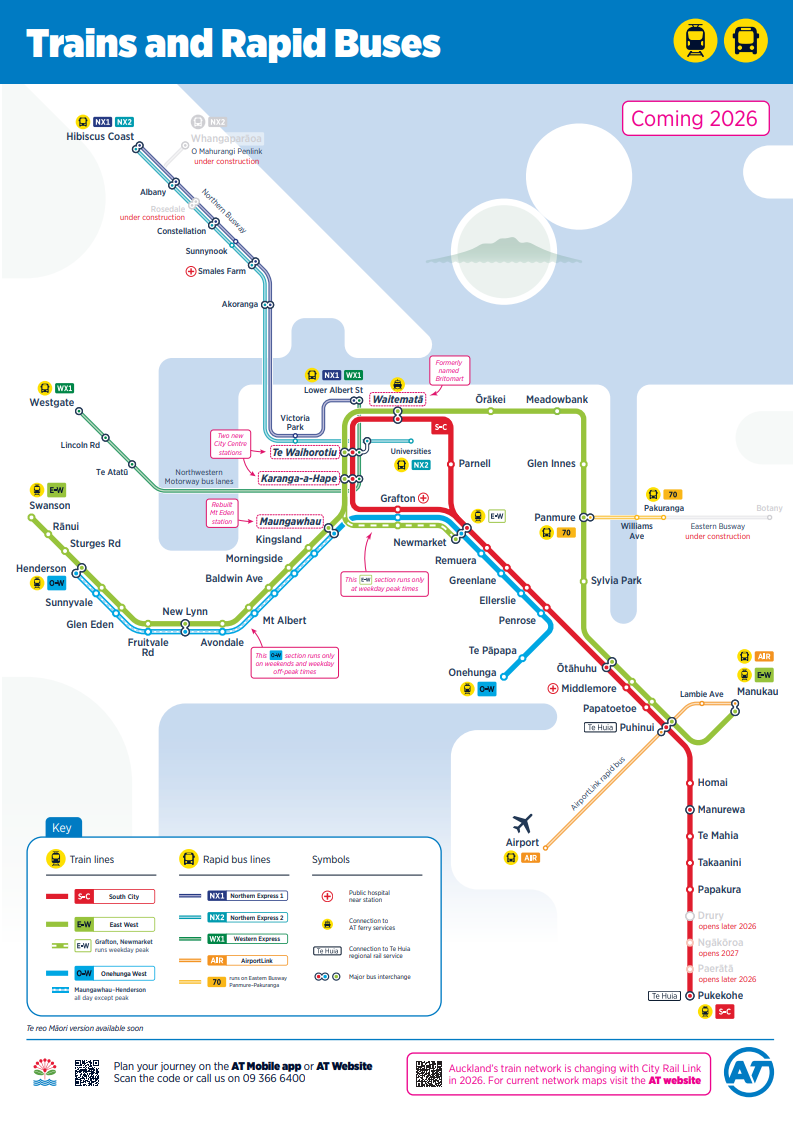
The previous version
Finally, AT provided us this statement on the changes and the outcomes of their more recent mid-April timetable test.
April’s testing went well and gave us confidence we can run the planned timetables reliably, including trains every 4-5 minutes through the city centre at peak times from opening.
The testing demonstrated strong teamwork across the network and confirmed that systems and processes are working well, bringing us an important step closer to opening.
It also confirmed the plan to open with a temporary timetable and then build to full frequency within six months is the right one to ensure reliable services, in line with other major rail projects around the world.
Services will be better from opening day – trains will run every 5 minutes through the city centre at peak and every 15 minutes all day and at weekends across the network. From the west and the south at peak there be a similar average 10 minute frequency to now – although wait times will sometimes be shorter or longer.
Testing of the planned ramp up to higher frequencies confirmed it is achievable – but we’re still analysing the findings. We aim to increase frequencies within six months of opening, for example extending to 8 minute peak frequencies in both directions on the Western Line.
Auckland Transport considered the full range of options for the service pattern for our region’s rail network after CRL opens.
The East West Line and South City Line connect through the city centre. The Onehunga West Line will provide a direct connection from Onehunga to stations in West Auckland as far as Henderson.
We have tested different options for the timetable at launch of the CRL.
The base all-day service pattern comprises:
- East-West Line (Swanson to Manukau via the city centre)
- South-City through the city centre looping back towards the south
- Onehunga-West (Henderson to Onehunga via Grafton and Newmarket off-peak)
The option of running some trains, during peak times, from Onehunga, to Newmarket then onwards to the city centre via Grafton as part of the E-W Line was explored during testing. The main purpose for exploring this was to help with train and crew positioning and congestion at Newmarket. However, the option was discarded after testing. It didn’t allow an easy to understand service pattern for passengers. Because of the maximum two trains per hour limited to 3-car trains (rather than 6 or 9 in the future) it also limited capacity provided through the city centre compared to other options, or fit with the long- term network plan.
During the testing, we encountered some unexpected challenges such as fire alarms, trespassers, infrastructure faults, technology issues and the impacts of severe weather. These sorts of issues will happen after we open City Rail Link, so they allowed teams to practise contingency plans and confirmed the network can respond to unplanned events.
The unexpected events helped identify areas where the network can be made even more reliable during disruptions, so passengers’ journeys continue as smoothly as possible. These learnings will guide the next steps and we will continue to tweak operating processes to ensure the best service for customers.
Greater Auckland’s work is made possible by generous donations from our readers and fans. Support our work by joining our circle of supporters here and setting up a reoccurring donation.

 Processing...
Can’t really see the point of the Otahuhu service, if it does not access the city centre.
Either way its of marginal use with the current single-tracking dictating low frequency.
It might be better to improve the pedestrian ramps at Penrose and run a set of shuttles (similar to the – much shorter – Stourbridge Town branch line in the UK).
Perhaps one day the Avondale-Southdown line will even get built (putting the problem to bed once and for all).
Onehunga guess you mean?
yes , sorry .
It hasn’t accessed the City Centre in years. Transferring at Newmarket hasn’t been too bad.
I just don’t understand why it isn’t a shuttle between Onehunga and Penrose and nowhere else.
With only one locomotive on the line going back and forth you would actually get more services per hour. Its quite normal overseas, why can’t AT or NZ for that matter, do it?
Note that the Onehunga and Southern line platforms at Penrose have a trek over an unsheltered footbridge between them so not an ideal situation.
Because that would an utterly terrible and pointless serivce that would require 5 minutes walking to transfer. May as well just cancel the line.
I’ve often wondered how this could be made to work. There are lots of places where a bus or train shuttle to the main bus or train line seems worth considering
Here, we’d need better walking (and wheeling) connections to both the main rail platforms and the bus stops for the 66 going east and the gsr buses for starters.
Amenities, too, including small stores.
Frequency is key, and transfers work… If they’re attractive.
AT want a direct west to south service as a fairly high number of people travel between the Western Line and Southern Line. The Onehunga service was chosen because this service route can provide this and also operate with 3 car EMUs which the Onehunga Line is limited to.
However, the limitations on the number of trains able to operate on the Western Line with all the road level crossings, means the Onehunga-Henderson services can’t operate in the peak periods. Presumably the plan now will be to revert back to having the Onehunga services terminate at Maungawhau during the peak period. This means during the busiest periods when most people are travelling between the Western Line and Grafton, Newmarket and the Southern Line, there will be no direct west-south service.
A better solution would be to run the Western Line services through the CRL then south to Manukau via Parnell. This would then have Western Line services running through Newmarket and along the present Southern Line route to Manukau (with Southern Line services running from Pukekohe via Panmure through the CRL to Newmarket and Onehunga).
There is a direct cross-platform interchange at K Rd between the western and southern lines in any case. Every regular train from every station at the west connects to every train to every station in the south, and vice versa.
The off peak only Henderson to Penrose and Onehunga thing doesn’t even service half of the stations, and running every half hour… why would you bother? Just catch the normal line and connect.
Agree. This will be the the key transfer for West to South. I’m not convinced the O-W from Henderson Maungawhau should be on the map until the western level crossings are removed. It will be interesting to see what changes after the latest round of testing.
Thanks, Matt. Thanks AT. Good to understand. And it’s all quite exciting. We’re getting closer.
Great they unexpectedly encountered all of: fire alarms, trespassers, infrastructure faults, technology issues and the impacts of severe weather during testing. Putting it another way, it’s great these systemic problems were reliable enough not to unexpectedly miss out on the testing fun.
Not sure if AT’s comment that the timetabling for peak E-W trains via Grafton was discarded after testing because it “didn’t allow an easy to understand service pattern for passengers” quite makes sense. That the service pattern wasn’t easy to understand didn’t need an on-the-tracks trial. Was it that the testing showed the intended benefits were minimal? Or perhaps a robust challenge is a welcome part and parcel of the testing? 🙂
It looks like Newmarket is the key to the whole network. So the SC trains will terminate there but then what happens. Do they just reverse and run the next service back through Parnell around the loop then onto Pukekohe. Or will they have to go somewhere else and return back to Newmarket when they are required. Still they are reporting that it will work so I expect they feel they can manage it. I see a lot of crew changes happen at either Pukekohe or Wiri perhaps this will change.
I’d imagine trains would terminate in Newmarket then start a service back to Pukekohe thru Parnell, with crew changes prolly in the CRL stations. If not then they’d prolly stable at the Strand, and OWL trains could start stabling at Hendo
They will run it like the Northern Busway where they display a Not In Service sign and rattle past everyone standing waiting.
No they won’t, they’ll run back through Parnell as a pukekohe bound service
True.
But unless there is clear signage is on the platforms I can see people boarding on the wrong side taking the long way to Pukekohe and making a scene when they head into the tunnel instead of heading south.
There is a third platform at Newmarket. I would assume that would be used almost exclusively for this turnaround.
I wonder… will they be able to use the central track to terminate? That allows cross platform transfer in both directions and would make that loop really useful… but means crossing over the other tracks at the junction.
Probably easier to just keep to the eastern track and skip the other two, but means half the people transferring have to go up and over.
They are going to load the trains onto trailers and truck them back to Pukehoke
SC doesn’t terminate at Newmarket. It goes clockwise into CRL, then comes back around to terminate at Newmarket (i think). Not sure about getting home from Newmarket to any points south
Great result here. Thanks, GA, for your pressure on points public and private to help get us a more legible and sensible running pattern and timetable.
Let’s hope ‘within six months’ translates to ‘before the end of February 2027’ so that everything is ready for March Madness.
Whakamihi on this result and ngā mihi nui for your contribution to the improvements.
Thanks Matt. Couple of things I don’t quite get. Firstly, where will the Onehunga trains inbound during Peak go? If they don’t run on to Henderson, do they terminate at Maungawhau or maybe Newmarket. Secondly, If you are wanting to go South from Waitemata station will it be quicker to catch a terminating train to Newmarket and change or go right round the loop (seems a much longer trip)?
Onehunga peak service terminates at Mangawhau.
From Waitematā south it will probably still be faster to go through Parnell and change at Newmarket.
I say probably because the train travel time will be faster so it depends on how well the connection lines up. Perfect outcome would be cross platform interchange with both trains lining up. Worst would be ten minutes wait and having to change platforms.
All depends I would say on the exact timetable and time of day, use the App once it’s all open, and see what it suggests! probably via CRL stations is faster but if really far south may be the green line/ aka currently Eastern line might be faster.
Thanks Matt. Couple of things I don’t quite get. Firstly, where will the Onehunga trains inbound during Peak go? If they don’t run on to Henderson, do they terminate at Maungawhau or maybe Newmarket. Secondly, If you are wanting to go South from Waitemata station will it be quicker to catch a terminating train to Newmarket and change or go right round the loop (seems a much longer trip)?
> _”The bad news is that with all of the governance changes at AT, they’ll be handing the decision on whether to increase frequencies over to Auckland Council.. The key consideration now is the impact those additional trains would have on road congestion.”_
The new governance entities haven’t even been formed yet and we’re already finding examples where we’re worried about calamitous political interference from councillors.
Why did some progressive urbanists support Simeon Brown in culling an independent transport agency again?
Yeah, it’s like everyone forgets why we all wanted something like AT in 2008; back when the memories of the ARC and the six local councils pulling against each other and trashing public transport for ideological/pork barrel reasons were fresh.
The problem with AT was not that it was powered up, but its internal culture. It should have been restructured, not gelded.
I love the notion that some organising progressives believe they can be on the same side as Simeon and friends on this issue, and still be political winners at the end of the day. A minister who effectively rolled back safer speed limits, deferred PT spending and hates cycleways!
Guys! He might just be better at politics than you are!
AT brass in a year or so:
https://www.youtube.com/watch?v=p2THgnbpgsM
Probably because AT got caught ignoring policy, process, consultation and plans too often.
Yes and of course local politicians are famously consistent in following their own policy and process when it comes to making decisions.
Most of the problems with AT come from politicians meddling with it, external political pressure, and nonpartisan bureaucrats unable to fight back.
The solution isn’t to give more power to the ratfucking politicians lol.
It would be a great idea to give politicians more power from an urbanist perspective and progressive politics perspective if those groups actually consistently won their elections in this city.
Unfortunately, the last two elections in Auckland have proven that’s rather not the case. And the one term there was a progressive council, it barely did anything to budge AT to move on actual infrastructure. All talk, all principles, no actual action when the rubber meets the road.
If anything there’s too much consultation. The everyday public don’t know jack about transport planning.
Glad I’m not longer the lone voice crying out against the stupidity of getting rid of AT rather than fixing it. Regional impacting decisions made by elected members who only care about getting re-elected by a small local electorate is never going to give us nice transport things.
A comment that also applies to the majority regional committee control by central government.
AT have informed us the part of handing over the decision making to council wasn’t correct so we’ve removed it from the post.
New CCO Board for PT under the reform.
I am looking forward to using the new EW route later this year – I hope that AT is not washing their hands of the frequency question on the western line with passing the decision to AC.
CRL network is the best transformative solution for future transportation, offering a way to bypass surface constraints and connect landmasses directly
A simpler network and a map that shows the full service pattern are both good news.
Services terminating at Newmarket is an interesting development, presumably on the centre road there with convenient cross-platform interchange with both Up and Down through trains. But these trains are largely on the same red S-C line, meaning that most passengers can avoid that change by staying on the same train, perhaps (depending on connection times) taking just a few minutes longer. I suspect that a lot of fresh air will be conveyed through Parnell!
Having the trains from Parnell terminate on platform 4 (eastern-most platform) would mean a lot fewer crossing movements of train, enabling higher frequency.
No so, as if trains from Grafton use the Centre platform at Newmarket for their through moves, then they will clash with trains coming into P1 from Penrose at the south end of Newmarket due to the layout of the crossovers there which don’t allow parallel moves into P1 and center platform at same time.
Plenty of room for them to add 100m or less of track to address that.
Agreed that reversing in the Down platform would make railway operational sense, but it would be much less convenient for northbound transferring passengers; and I’m not sure that the signalling permits a reversal there.
As a Māngere Bridge to CBD (311 to Ōtāhuhu to Waitematā) user, I am curious to know what this’ll feel like.
Exciting, glad to see AT listen, test, iterate etc.
Why won’t the South-City line stop at Maungawhau? It’ll have to go through that station to go between Grafton and K’Station, right?
There is no Maungawhau station on the Red line.
Train announcements like the opening of ‘Airplane’?
The service would use the eastern side of the junction, avoiding Maungawhau entirely.
Maungawhau sits on the western side of the CRL junction
S-C line doesn’t go through Maungawhau Station, runs just to the east on a shrp curve in tunnel.
They didn’t bother to build platforms for the South – CRL leg of the junction. Dumb, but it’s what they decided, and arguably it’d be faster to do the cross platform transfer @K Rd anyway.
The curve would be too tight.
A station at Newton was the original plan, but that was deleted due to the expense of building a 42m deep station, the fact it made the complete grade-separation of the Maungawhau junction impossible (the Up Main from Grafton and the Down Main to Kingsland would’ve had an at-grade crossover). It also likely would have indefinitely limited train lengths to 6-car trains (150m platforms) and needed a 1% gradient on the platforms at Te Waihorotiu and Karanga-a-hape too
Nah the southern line tracks skip Maungawhau, the junction is north of the station and the tracks from the Newmarket side go direct from Grafton to K Rd.
Maungawhau is effectively just a regular station on the western line.
Credit where it’s true. Sometimes I’m skeptical about whether anyone in charge listens to GA (they certainly didn’t re: light rail), but you guys pulled it off here.
I don’t think they pulled it off. The timetable is improved, sure, but it’s still far more complex than 2 lines with Western going via CRL then Southern and terminating @Manukau, Eastern via CRL then Southern terminating @Pukekohe + Onehunga as a shuttle.
Here’s hoping GA managed to stop Western Line frequency from getting worse.
GA did not pull it off. The changes were only made after AOR tested the timetable AT wanted to run with the CRL and found it to be flawed and unreliable.
A real win for GA would have been AT adopting GA’s CRL timetable proposal (or other similar better proposals), but AT won’t listen to any ideas other their own -which AOR then have to demonstrate they won’t work with testing them.
I’d add a Yellow circle line in the CRL connecting Waitemata-Parnell-Grafton-K Rd-Te Waihorotiu-Waitemata and vice versa.
I can see the appeal, but the inner stations are readily accessible using the other lines and having a inner loop line would take capacity from the total network.
That service is already in this plan-the SC line does that pattern and accesses Newmarket too. Your line is only better for travel from Parnell to Grafton, which is a very small number of passengers. It would be much better to just boost the frequency on the two lines.
what is the obsession with loop lines? they aren’t efficient, they are prone to delays that they have no ability to recover from with no end-points to layover at (and if interlined with other radial services, the delays will carry over onto *those* services too), and they are known to cause driver fatigue and uneven wheel wear on one side of the train.
we have the InnerLINK for a fine-grain inner city circulator, besides
This won’t work well and will make the whole network unreliable with the amount of conflicting movements at the various junctions, particularly if any train is delayed – as was found in the first lot of CRL timetable testing earlier in the year.
This sounds like an overall good result, even though there’s still some room for improvement.
Glad to read some positive news 🙂
This operating configuration is still more complicated than it needs to be and is not going to be as user-friendly as it could be.
A better operating configuration from day 1 of the CRL being opened would be to instead run Southern Line services from Pukekohe via Panmure through the CRL and terminate at Newmarket, with some 3 car services running onwards south to Onehunga. This could be simply known as the red line.
The Western Line services could run via the CRL, then south via Parnell to Manukau. This could be known as the green line and would at least have Western Line trains running through Newmarket and running south.
Operationally, it would be much simpler for everyone to understand with just two lines across the network and fewer conflicting movements at junctions.
When the Avondale-Southdown Line gets built, a new direct west-south service could be established between Henderson and Otahuhu via this line.
If the Onehunga Branch line were to be extended to Auckland Airport, the tail end of all Southern Line services could continue onwards south from Newmarket to the airport via Onehunga.
Peak direction express services should later be introduced running via the red line between Pukekohe-Paerata-Drury-Papakura-Puhinui-Middlemore-Otahuhu-Sylvia Park-Waitemata-Te Waihorotiu-Karangahape to take advantage of the Third Main and could replace Te Huia services north of Pukekohe with running with 9 car EMUs. 9 car platforms would only need to be built at these express stop stations. This would provide a better service than the current Te Huia service for Waikato and Franklin passengers, whilst freeing up the Te Huia trains to either run more services between Hamilton and Pukekohe, ideally with new additional stations at Te Kauwhata and Pokeno, or to extend services to run to Cambridge and Tauranga / Mount Maunganui.
The Northern Explorer service stop at Papakura should be removed and replaced with a new stop at Pukekohe, which is a large four platform interchange station at the southern end of the Auckland public transport network, where it is safer than Papakura, and remove the impact to metro services currently caused with stopping at Papakura.
Commuter rail services also need to be extended during weekday peak periods to run between Swanson-Helensville and Pukekohe-Waiuku, which could use SA/SD carriage trains, once refurbished.
Would that not remove the advantage of Southern Line trains to get to the city centre faster? And what are your plans for the Eastern line?
Trains from Pukekohe (red line) would run via Panmure into the CRL to Newmarket / Onehunga.
Additional in-fill peak services could run Papakura to Britomart during peak periods, terminating at the vacant platform 2 and 3.
The travel time to the CRL stations would be the same with whichever route they come in from the south. There will still be trains running south from the CRL and Britomart via Newmarket to Onehunga and Manukau.
For ease of use for passengers, as well as for operational simplicity and reliability, it makes more sense for southern trains from Pukekohe to run via the NIMT through Panmure and the CRL to Newmarket, with some 3 car trains running onwards to Onehunga. One train runs the whole red line route from Pukekohe to Onehunga. Same with the green line from Swanson to Manukau via Parnell – no need to change trains and no need for trains crews to have to change mid-route.
This idea is definitely not common sense. Having trains that have come from Pukekohe that will potentially already be full stopping at Panmure, one of the busiest stations in the network is a recipe for overcrowding.
Te Huia can fill the express function for the Southern line, no need for AT to run it. They should just contribute towards Te Huia so there is a higher frequency, and in the interim while they haven’t got electric locomotives terminate @Mt Eden on the spare platforms there.
https://www.greaterauckland.org.nz/2024/11/18/a-clearer-network-for-the-city-rail-link/crl-map-jc/
https://www.greaterauckland.org.nz/2026/03/02/a-metro-for-auckland/
Logic of starting empty trains on the Eastern line is it allows the Eastern Busway passengers to fill the trains without crowding.
A 9 car EMU express service would take people from the Waikato and Franklin more quickly and directly to more popular destinations such as Middlemore Hospital and Sylvia Park, as well as the CRL stations in the central city, as opposed to the Te Huia just terminating at the isolated Strand Station.
The limited funding resources for the Te Huia would be better spent on providing more services and/or extending the service, along with building much-needed new stations at Pokeno and Te Kauwhata.
There won’t be any empty trains starting on the Eastern Line now according to this post. Additional capacity could be provided for the Eastern Line with providing additional in-fill services between Papakura and Britomart, utilising the vacant platform 2 and 3 there.
until there is triple or quadruple tracking all the way from Westfield to Papakura, limited stops services will just get caught behind all-stops services on the Southern Line, and offer very little time advantage.
With hourly all-day service and the same tri-mode stock that the Capital and Wairarapa Connections will receive, Te Huia could operate into Waitematā station’s terminating platforms on electric power, fulfilling the role of a Southern Express service
Expresses need to only stop at a few places to be faster. An express wouldn’t stop @Middlemore or @Sylvia Park, Te Huia has the number of stops correct. We have limited slots on the Auckland network, Te Huia has the advantage of two birds with one stone, where it serves both the express function and the interregional one, while expresses would be competing for slots.
Te Huia isn’t controlled by Auckland, and wouldn’t stop going to the CBD as that is where the demand is, if they forced passengers to transfer @Pukekohe they’d lose patronage. So the best way to increase expresses is to have Te Huia serve that function, and Auckland contribute towards the costs so that the frequency can increase.
With trains every seven or eight minutes along the whole line, the best you could save by skipping stations is about five or six minutes total before you’re hitting all the red signals of the train in front anyway.
Pukekohe–Waiuku is not going to be viable as a commuter rail service while speed limits on the GVR seem to be inherently limited to 50km/h… including the agonisingly slow speeds through the Pukeoware yards and crossing tracks from the GVR to the Mission Bush Branch at Glenbrook.
Much better value for money to expand the Franklin bus network and increase bus frequencies
People will not get out of their cars to use bus services which run on the same congested roads during peak periods as buses. People will however use rail services if provided as trains have much greater appeal with being more comfortable to ride and are safer.
the roads to Waiuku, and Clarks Beach are congested? that’s news to me
Just remember ANY calander weekend or any time frame (school holidays ) that includes the word “HOLIDAY” and none of this will be running.
Auckland transport is an embarrassing joke and this expensive ego trip won’t fix anything.
I’m staying with the bus at least I can get off that when it breaks down .
Cheer up Cheryl. Rail closures will be history from September this year.
Agree. AT train services should stop running earlier in the evening after 9pm, with all trains off the network by 10pm, Sunday to Thursday, to enable more time overnight for infrastructure maintenance work to be carried out. Very few people use train services after 9pm and it would be better to have a rail replacement bus service running in the late evening which would inconvenience very few, to benefit the vast majority who use trains during the daytime – including on weekends and public holidays.
You realize it’s KiwiRail that does the rail shutdowns not AT, right?
Future improvements in dwell times – yes please. I read during the April tests they worked with 75 seconds. On a visit to Berlin, I measured the underground dwell times there at an average 25 seconds. Nobody was getting squashed in the doors. If people needed more time to enter (prams, wheelchairs, elderly people) they could press a button next to the door to get it. No obsolete final conductor check; train drivers had screens. Doors would fly open within a second after standstill. There is so much potential for time savings – a mind boggling 20 minutes between Swanson and Manukau…
75 seconds is absolutely insane, I thought I read this somewhere too but was hoping it was a joke. Even if the accessible carriage was full of 10+ wheelchairs all trying to leave at once I cannot see why it should take this long to board/alight a train.
I have just got back from Seoul, and even on packed trains with standing room only the train is stopped for 30-40 seconds max. If you know you need to get off, you get ready before the train stops, else youre gonna be riding to the next station whether you like it or not.
The dwell times at each station are indeed excessive. They have been created deliberately by the rail operator Auckland One Rail to help ensure they meet their KPIs with the contract they have with AT. The contract requires every train departs every station at the scheduled time. By creating a timetable with excessive dwell times at stations and running times between stations, it makes AOR look good with running to time. This, however, at the expense of longer travel times for passengers. If you compare travel times of timetables from the 2000s when there were slower diesel trains, to today with new faster EMUs, the travel times now are the longest they have ever been, including painfully slow dwell times at every station. The delay has got nothing to do with Train Managers operating the doors.
Auckland One Rail? Are you sure? At one stage I thought AOR were actively trying to have them reduced. Did something change, or am I mistaken?
It can’t be true that dwell times “have been created deliberately by the rail operator Auckland One Rail to help ensure they meet their KPIs with the contract they have with AT”, because no party to a contract can act unilaterally. The timetable (including dwell times) to be delivered will have been agreed by both parties, not “created deliberately” by one to “make it look good” in the other’s eyes – that’s not how contracts work.
“The delay has got nothing to do with Train Managers operating the doors” may be the case if Train Managers are required by the process, but in many urban rail operations round the world the driver is in complete control of the doors, which is clearly faster because drivers can open doors immediately on arrival; there is no communication delay between staff; and staff do not have to alight or use two-stage door closing. So the involvement of Train Managers in door operation is clearly a factor in dwell times.
18 seconds in moscow from train stopped to train moving https://www.youtube.com/watch?v=DiWtD9CqHMU
Lol that’s fast but crude.
inb4 will mckenzie returns to make an essay-length comment about how Parnell needs to be served by trains that go south past Newmarket because “that’s the way it was, so that’s the way it should always be, change is bad.”
AT – please change your naming convention, those letters are very confusing to some of us. Please be normal and call then Green, Blue, Red, Orange etc or Line A, Line B, Line C, etc.
Those descriptive letters make makes my head go round, they are meaningless noise.
Agree.
Fears of ‘backlash and mockery’ played into new Auckland rail line names.
https://www.1news.co.nz/2026/05/02/fears-of-backlash-and-mockery-played-into-new-auckland-rail-line-names/
Great to see common sense prevail. And 8tph each direction in due course out West – simple and legible – is a massive win. Very similar to the pattern I have been advocating. Well done AT.
The final point I would like clarity on is at Newmarket. The whole point of terminating S-C there is to avoid conflicts which massively increases resilience. If that requires a new crossover South of the station so the middle road can be the through platform, is that something that could be planned and done before CRL opens? I tell you now, it would make an enormous difference.
It’s a shame this is all coming so late after the massive closures and investments in track layouts etc. To state the obvious, Puhinui had a much more pressing operational need for a third platform than Henderson (third main currrbtly basically useless for passenger/express services), and Newmarket junction needs maximum flexibility.
No changes need to be made to any of the infrastructure at Newmarket Station for any operating configuration – all lines to all platforms all have crossovers at both ends of the station.
Agree, a platform needs to be built on the Third Main at Puhinui Station.
Excellent. I assume Newmarket terminators will be max 4tph? Will peak overlay to reach 8tph be Quay Park terminators (destination Waitemata)? Probably the least worst option.
Agree that Southern expresses should be hourly bi-mode Waikato trains into Waitemata bay platforms. That’s then a pretty good network.
Text above suggests at least 6pth would terminate at Newmarket.
The track needs to be reconfigured south of the station so that red line trains in opposing direction dont conflict. Currently its physically possible to run the service, but will be unreliable.
I think they are underestimating the number of people who would want to ride within the loop itself, if service was frequent enough.
To this end I would add service clockwise around the “loop” , using the Grafton to Parnell leg of the Newmarket triangle. Clockwise so it doesn’t need to cross over another track at either junction.
This won’t work well and will make the whole network unreliable with the amount of conflicting movements at the various junctions, particularly if any train is delayed – as was found in the first lot of CRL timetable testing earlier in the year.
There’s very little befit from that.
Grafton to K Rd, Waihorotiu and Waitemata will be faster through the tunnel.
Waihorotiu and Waitemata to Parnell will be faster through the tunnel. K Rd to Parnell will be about the same either way.
Newmarket to Parnell and Waitemata are already covered off with the Newmarket terminating end.
Really only thing that would benefit would be Grafton to Parnell trips, that would save four or five minutes. That’s a pretty small market and not worth layering in a whole other train line to serve.
I am thinking the benefit will be frequency on the crl itself, without road crossing or junction interference.
I struggle to see the point of a red line (thanks Tessas) service terminating at Newmarket. Why not continue south? It’s already picked up passengers on its journey around the loop, keep moving in the correct direction.
With the current plan what would the platform sign display as the service passed through Waitemata the first time? If it shows Pukekohe how dumb is that? Yes, you could board this service but it will take you to Newmarket before reversing and taking you back through Waitemata again ten minutes later.
The earlier network map for the red line just needs an arrow to indicate services go clockwise around the loop.
Because of the capacity issues at Westfield Junction observed during the trials of the peak hour CRL operating plan. Operating the Pukekohe-Grafton-CRL-Parnell-Otahuhu pattern is not viable, so the Otahuhu leg is getting truncated to Newmarket to avoid that conflict.
It’s really not that hard. Red line trains on Platform 1 at Waitemata, headed east, will be terminating at Newmarket. Red line trains on Platform 5 at Waitemata, headed west, will be going all the way to Pukekohe.
Parnell is one of the least used stations on the rail network as a result of the poor location Mike Lee pushed for, so it is the necessary sacrifice to make. Passengers from Parnell can either transfer at Newmarket, go the long way round the central city from the northbound platform, or catch an InnerLINK/OuterLINK bus to Newmarket if they are heading to a southern line station
So are those 3 middle platforms at Waitematā just useless now?
probably
the plan i think was to reduce them to 2, in order to widen the platforms
i had assumed that they would be used to terminate Pukekohe expresses, but that’s a moot point now. perhaps Te Huia, one day, if that gets the Tuhono train stock?
I agree with most commentators:
– Kill the Onehunga line and replace it with a shuttle service that starts at Penrose.
– Extend the terminus of the South City line from Newmarket to Penrose to beef up service on that corridor.
This might not be possible to achieve immediately when the CRL opens, but there seems to be plenty of real estate available near Penrose station for a third platform and to build a proper interchange station.
The Onehunga Branch Line needs to be extended to the airport, which would be an ideal continuation of the end of the red Southern Line service route south from Newmarket to Auckland Airport.
okay, if you’re willing to fork out in the region of $6-10 billion dollars for what surface light rail could do (and more) for half the price
I think for now, sending it back to Waitematā as a shuttle is probably a fair compromise – direct City service, adds some frequency to the inner core and Parnell especially – and there are spare platforms for it. Easy changes at Newmarket or Waitematā for the loop.
Longer term – possibly converted to Light Rail which on the other end goes to Penrose and out? And the other way, to the airport, converging with a Dominion Road line?
But if Avondale-Southdown was ever built, the Onehunga line could dive down and spin around via Mount Roskill, and create some type of loop service – with ‘minor’ civils