We hope everyone is doing ok after the storm. Here is a roundup of stories that caught our eye to cap off your week.
This week in Greater Auckland
- On Monday, we had a guest post by the esteemed Darren Davis, on what is next for Te Huia.
- On Tuesday, Jolisa asked what can we do ourselves to have resilience to the current fuel crisis.
- On Wednesday, we had our annual plan feedback, which was adapted from a presentation Connor gave to Councillors on Monday.
- On Thursday, Matt took a look at some of the new cycleway connections that were recently finished, and what should be next.
This roundup, like all our work, is brought to you by the Greater Auckland crew and made possible by generous donations from our readers and fans.
To support our work by setting up a monthly donation, you can join our circle of supporters here. We’re now a registered charity, so your donations are tax-deductible.
Greater Auckland in the media
Matt spoke to 1new’s Justin Hu about our concerns for the CRL timetables.
Prominent Auckland transport advocate Matt Lowrie told 1News that western line commuters would face materially worse peak frequencies in the transitional timetable.
“You’re going to have some services, where you might have six or seven minutes between trains, and then you’ll have nothing for 15 minutes,” said the director of the Greater Auckland advocacy group.
Lowrie said that uneven spacing would cause a cascade effect – trains arriving after longer gaps would be more crowded, slower to load, and more likely to cause downstream delays across the network.
The concerns are compounded by a separate earlier cut already flagged for counter-peak services on the western line – trains heading away from the city in the morning and toward it in the afternoon – which were initially planned to drop to four an hour.
And Matt also spoke to RNZ’s Ingrid Hipkiss, about the same.
Patrick spoke to The Post, about news of a large maintenance investment case for the Auckland Harbour Bridge was going to the NZTA board.
Director of the advocacy group Greater Auckland and former NZTA board director Patrick Reynolds told The Post the bridge was facing pressures as an ageing piece of infrastructure but it was getting regular maintenance.
“The only sort of scandal here would be if they stopped maintaining it.”
Reynolds said when he was board director of the agency he spent a day visiting the bridge with the engineers responsible for its maintenance.
“They assured us that so long as it is continually maintained and it is, its life is effectively limitless.”
Matt was also on The Detail, to talk about the proposed road rules changes.
They come in two packages with the first including:
- Allowing e-scooters in cycle lanes
- Kids 12 and under being allowed to bike on the footpaths
- Mandatory passing gaps around cyclists and horses
- Drivers in 60 kilometres or under speed zones to allow buses to merge into traffic
- Better signage for berm parking
The second package relates to heavy vehicles.
This article is focused on the first package and what it means for drivers, riders and pedestrians.
These changes aren’t a new concept.
National announced similar rules in 2025 and the previous Labour government proposed changes to footpath rules in 2020.
Matt Lowrie, who is an avid cyclist, said these changes had been a long time coming.
“A lot of these are quite common sense changes and so the government are now getting back to it again and looking to get them approved.”
Where are the public transport incentives?
With a lot of focus on fuel prices right now, why aren’t the government encouraging people to use public transport more (other than ideology).
Dr Timothy Welch, an urban planning researcher at the University of Auckland, says the Greens’ proposal has merit.
“We are effectively 100 percent reliant on imported transport fuels. When supply is tight and prices spike, the only real lever we control domestically is demand reduction and mode shift,” he says.
“Free or heavily discounted public transport is one of the fastest demand-side tools available.”
Welch says the fiscal comparison writes itself.
The government’s relief package will cost $373 million over up to a year. National fare revenue before Covid-19 sat at $320-350 million annually, meaning three months of free fares would cost roughly a quarter of that.
“The government’s own officials advised against cutting fuel excise tax because it would encourage people to use more of something in short supply. That logic is exactly right,” he says.
“But a $50 tax credit doesn’t change anyone’s transport behaviour. Free public transport does. It gives people a real alternative, at a fraction of the cost.”
Other countries are intervening more directly. The Herald have looked at some and while many are effectively subsidising fuel or cutting taxes, some are looking at demand.
Some Asian countries have also taken steps to curb fuel consumption.
Thailand and Vietnam are encouraging remote work, while the Philippines has introduced a four-day working week for government employees to reduce commuting.
NZ at 5 year high for oil consumption
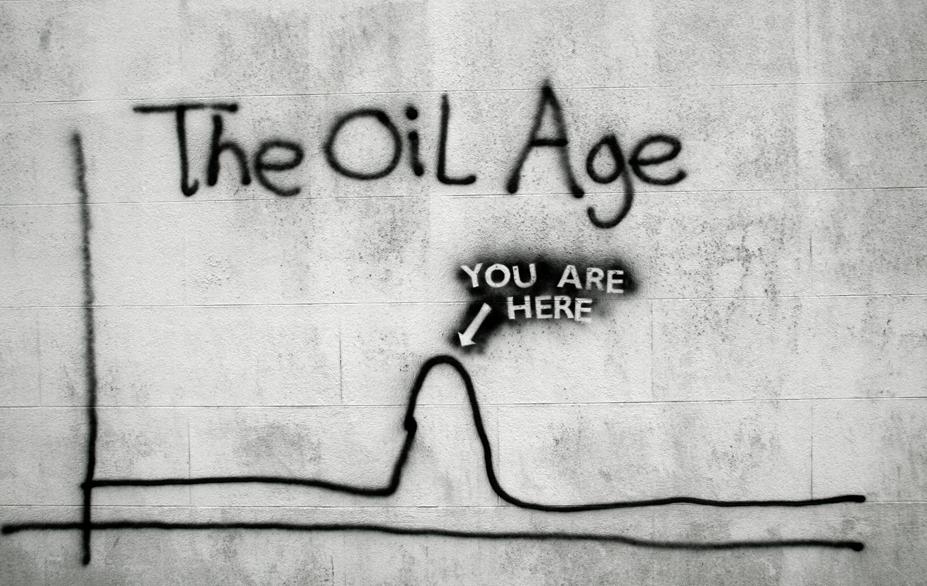
With a lot of focus on fuel right now is highlighting how dependent our economy is on it – and why we need to get off it as soon as possible.
New Zealand’s latest quarterly energy report shows electricity production was above 90% renewable and emissions from generation fell to the lowest level on record.
But it also shows New Zealand’s oil consumption, which had fallen markedly after the COVID pandemic, has crept back up to reach its highest quarterly level in five years.
Oil now comprises its highest quarterly share of New Zealand’s overall energy emissions on record.
We didn’t learn the lesson in the past, with more viable options than ever to get off oil, will we learn from this shock.
Parts of New Zealand’s economy, particularly inflation and tourism, remain strongly linked to the price of oil.
During two previous periods of high oil prices, New Zealand missed the chance to weaken the country’s dependence on oil.
The 1978 oil shock was a severe hit to the economy; New Zealand’s oil consumption did not recover to its previous level until 1990.
…..
The 2008 financial crisis also involved extreme oil price spikes and a prolonged recession. Oil consumption did not recover until 2015. One planned response was to introduce fuel economy standards for new cars – a form of regulation already in place in most OECD countries.
Had these standards been put in place and gradually strengthened over time, New Zealand would now be in a much better place, with less pollution and less economic dependence on oil.
However, a change in government in late 2008 led to the cancellation of the planned standards. New Zealand now uses nearly twice as much transport oil per capita as the UK, where such standards have been in place since 2001.
Palmy buses immune from fuel spike
Auckland might have the biggest fleet of electric buses in Australasia but they represent only about a third of all buses on our streets. With fuel prices soaring, Palmerston North’s bus operators don’t need to worry though.
The decision to have an all-electric bus fleet in Palmerston North has potential to help households wanting to manage rising fuel costs.
City councillor Brent Barrett has applauded Horizons Regional Council’s choice, saying the Middle East fuel crisis underlined its foresight.
He told the regional council’s passenger transport committee that with diesel prices rising by 45%, the decision was proving to be “absolutely brilliant”.
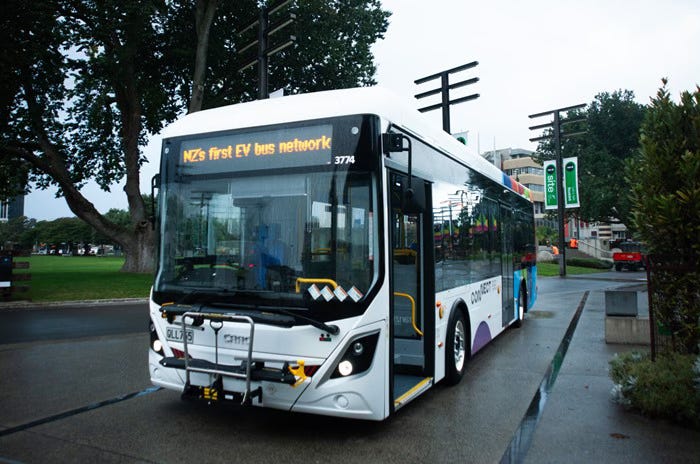
E-bus in Palmerston North. Image credit: Horizons Regional Council.
Solar Power
Speaking of energy, while the focus of concern is on liquid fuel, here’s a good piece from Jessie Mulligan on getting solar power.
It is a truth universally acknowledged that a middle aged man in possession of a good house must be in want of some solar panels. Like home brewing and road cycling, the acquisition of a household solar system requires deep research, growing fluency in an unfamiliar technical language and, eventually, buying some shiny new gear. The only thing better than installing solar is forcing your friends to hear about it. The only thing better than that is forcing your substack readers to hear about it too.
AT App safety changes
AT have announced a new feature on their mobile app – letting you share your journey with others
Auckland Transport (AT) is introducing a new feature within the AT mobile app, designed to give public transport users greater peace of mind when travelling on the network.
“Share my journey” enables customers to share their planned route, expected arrival time, and vehicle details with trusted contacts, friends, and loved ones.
The feature has been developed in direct response to feedback from customers who want to feel more connected and supported when using public transport.
AT Director Public Transport and Active Modes, Stacey van der Putten says, “Everyone deserves to feel safe when travelling with us. Share my journey helps provide that extra layer of reassurance by letting friends or whānau see your travel plans and know when to expect you.”
While the feature shares a customer’s planned journey, it does not track a person’s real-time GPS location—something AT emphasises is to protect customer privacy.
“If you miss a service or decide to change your trip, you can simply replan and reshare to keep your contacts updated.”
How it works
- Plan your journey in the AT Mobile app
- Select the new “Share my journey” option
- Choose a contact, and select a platform for communication (SMS, WhatsApp, email etc)
- Your contact can now see your route, estimated timings and the services you’re expected to board
Share my journey builds on existing safety measures already in place across the network and is part of wider work to improve customer confidence and support safe travel throughout Tāmaki Makaurau.
Share my journey is the second safety focused feature added to the AT Mobile app in recent months. Late last year, AT added a function enabling customers to directly report incidents on the network via a new “Report feeling unsafe” feature.
Penlink delayed
NZTA announced this week that the completion of Penlink has been delayed by about a year and that it’s likely to go over budget
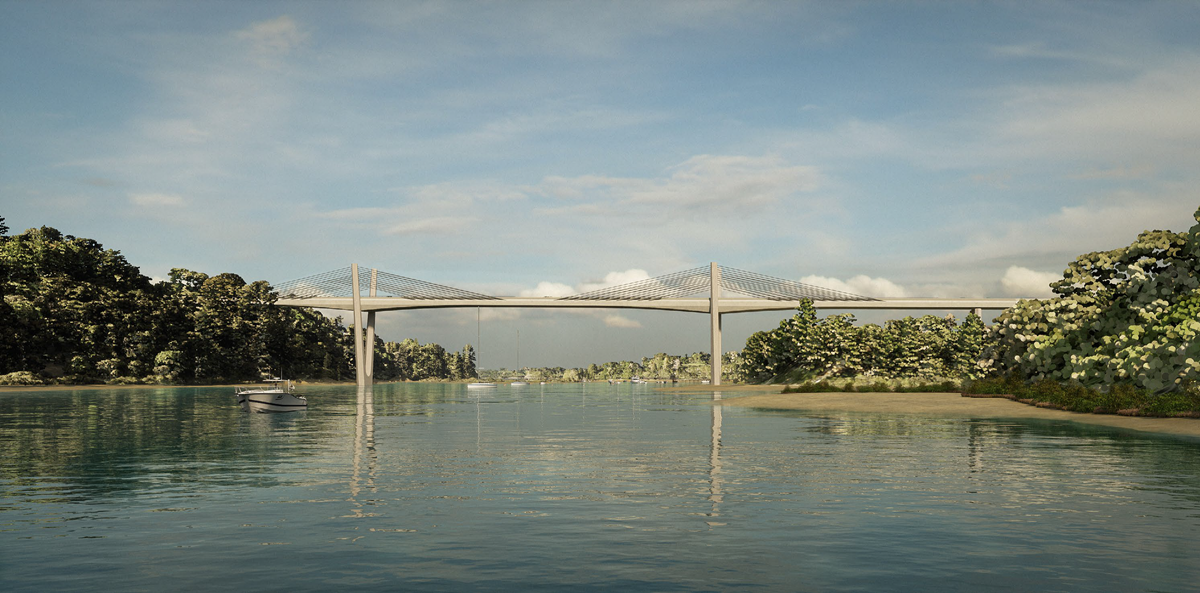
The opening of the Penlink highway, delivered by the O Mahurangi Alliance, has been revised to late 2029, around 12 months later than previously anticipated, due to challenging construction conditions affecting progress on the Wēiti River Bridge.
The Wēiti River Bridge is the largest and most complex structure on the project and is critical to connecting the new highway to the Whangaparāoa Peninsula. Its construction has proven more time consuming than expected due to the complexity of the construction, difficult ground conditions, and constrained site access.
…..
“The forecast completion of the new highway is late 2029. We remain committed to delivering a high quality new state highway that will make a real difference, and we will continue to look for opportunities to safely accelerate delivery where possible,” says Mr Collett.
…..
Background
- Penlink will be tolled once the highway is fully completed and open.
- The original cost estimate of $830 million is expected to increase due to programme delays. NZTA is currently assessing the cost impact.
Will the cost now exceed $1 billion?
Christchurch Mass Rapid Transit route protection
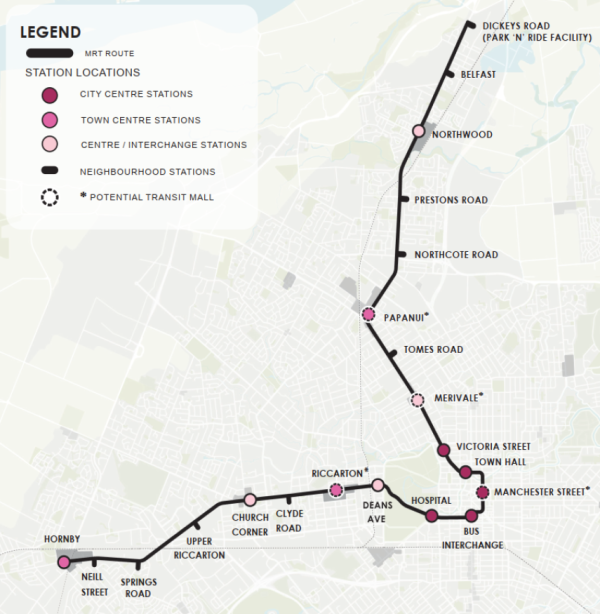
The current government might not be supportive but it seems Christchurch City Council are pushing ahead with work to protect the route for a rapid transit line through the city.
Work is underway on the route protection process required to secure land for the proposed 22km route between Hornby to Belfast, via the central city. Route protection involves identifying any additional land needed for MRT and securing it through a legislative process to prevent future development.
General Manager Strategy, Planning and Regulatory John Higgins says the focus is on using publicly owned land wherever possible, although some private land may need to be designated to protect future options.
“Where land designations are required, we’ll follow the formal consultation process set out in legislation. This would involve us working closely with property owners and stakeholders during the process.
“It’s important we plan now for the future. Mass Rapid Transit is a generational investment that will support the city’s growth, manage traffic congestion, and improve how people get around.”
Finally time for voting reform in local elections?
The Spinoff’s Hayden Donnell looks into special votes and why almost 2000 weren’t allowed in the last Auckland election
Look at the reports on special voting in Auckland from 2025 and a few things jump out. One is the number of people who used that method to cast their ballot. People cast special votes for a range of reasons. They might have moved house and forgotten to enrol in their new area or missed the deadline for putting their voting ballot in the post box. It’s a slightly more complicated process that involves filling out a declaration at a polling place. Despite that, the number of special votes rose 33% to 9,306 in 2025 in an election where overall turnout declined by 6%.
The second standout number from the report is the number of those ballots that were chucked in the recycling. Only 5,896, or 63%, of the special votes cast in Auckland were actually allowed. Don’t worry, it gets worse. Of the 3,410 votes that got binned, nearly 1,700 were disallowed because aspiring voters left the occupation field on their special voting declaration blank.
With all due respect, what the shit?
Paris and saying no to cars
Bloomberg has a fascinating article looking at the changes to Paris under now former Mayor Anne Hidalgo.
Honking horns and screeching tires used to be a cliched scene-setting device for writers describing Paris. Those sounds no longer define a city where cars have taken a back seat. Visitors will discover that it’s a dramatically different place than a decade ago: lines of bikes and throngs of pedestrians where lanes were once jammed with cars, greenery encroaching on former pavement, summer swimming in the once-grimy Seine river — and a corresponding drop in air and water pollution.
The shift is the result of a spate of policies under outgoing Paris Mayor Anne Hidalgo intended to make the city more walkable and bikeable while reducing emissions. Internationally, Hidalgo has become one of the best-known promoters of green urban change.
They noted that (last) Sunday’s election would determine her legacy. Well it seems voters like it.
Barnes Dance
Stuff asks what it’s like to drive through a barnes dance intersection – about the same as any other light controlled intersection.
The chance of encountering a Barnes Dance in Dunedin’s CBD is high. Very high indeed.
Nine of the city’s 18 Barnes Dance intersections can be found within 10 blocks of George St and Princes St, running through the heart of the CBD.
…..
By the 1980s, Dunedin had done away with the last of its Barnes Dances… until 2018 when two were installed to bookend the Octagon.
Now the city has 18 Barnes Dance intersections, EIGHTEEN! They represent 22% of traffic light-controlled intersections, with the newest installed in 2024.
But while they were designed to make it easier for pedestrians, how are they for drivers?
The article notes that Auckland has 100 Barnes Dance intersections
Enforcement and AT
It’s not just South Auckland that has this issue.
Ranjeet Sidhu, a resident of Manurewa, filed a complaint with his local board.
“We are increasingly concerned about the impact this is having on liveability of our streets and community,” Sidhu said. “Roads intended for families and local traffic are being used for informal truck parking.”
Manpreet Singh, who lives near Sidhu, agreed.
“These big commercial trucks also cause a lot of noise disturbances, particularly early mornings and late evenings, disrupting the entire neighbourhoods – more so, the elderly,” Singh said.
“Our daily school runs have become a nightmare.
“We have made several complaints to the relevant authorities many times over the past year or so, but nothing seems to change and the commercial vehicle parking goes unabated.
“Our neighbourhoods should be safe, quiet and liveable. These should not be used as unofficial truck depots.”

Yet AT are saying:
“The are some streets in Māngere and Papatoetoe that have entry signs stating no trucks, but we cannot enforce those signs.“
Videos to check out
Connor had a chat with Kasey from Welly Climate Nerd about local politics and the Annual Plans for Wellington and Auckland
Check out this video of some high speed trains!
And some vids on bikes:
That’s it from us this week, have a good weekend and stay dry
Greater Auckland’s work is made possible by generous donations from our readers and fans. We’re now a registered charity, so your donations are tax-deductible. If you’d like to support our work, you can join our circle of supporters here.

 Processing...
How can there be signs but no enforcement to back them up, that’s absurd
Ancient signs, current bylaws.
So what happened?
Was the bylaw changed on the basis of sound rationale, or were the decision-makers captured by the trucking industry?
Was there appropriate discussion about the change, with staff ensuring councillors understood the probable impacts on liveability, and the clear disconnection between the bylaw change and the city’s liveability goals?
Who advised the bylaw be changed?
Were the signs not removed because the cost of doing so wasn’t flagged as an input to the decision making process, leaving staff with no budget to remove them? Or was it a decision to leave them up in the hope of hiding the change for a while? (Eg until there were different councillors and staff and no one had to take responsibility.)
Was the bylaw change drafted by the same lawyers who drafted the bylaw change that took responsibility of enforcing illegal parking on parks from council, to AT, but did it in a way that AT then claimed they couldn’t enforce it?
What steps did AT take when it was becoming a problem?
There’s a lot of talk and no action on this issue.
These trucks are a road hazard and need to be moved on.
Te Huia will most likely be restricted to 80 km/h max when ETCS compatible DL locomotives replace the current DF locomotives.
I’ve been told the DL locos are quite unreliable and that we would have been better off spending the money refurbishing the old DX locos (before many of them were sold to overseas buyers)
They were only purchased to appease the Chinese government.
Fifteen withdrawn from service according to Wiki.
So why not use the (hopefully) more reliable and faster DM?
(Or talk to Dunedin Railways about their DJ’s?)
Given the widespread voter fraud in last year’s local body elections, its eminently sensible that non-conforming special votes get discounted.
Its remarkable (but not surprising) that an article from the Spinoff deliberately fails to mention this.
Unfortunately the occurrence of this mass-fraud means that the whole system of postal voting needs to go.
It depends on a level of civic responsibility that is no longer widespread across the various peoples populating the country.
Lacking this corrective force, postal voting is now only a tool for various groups to balkanise the New Zealand political system for their own ends.
There was fraud in one local board area, that’s not widespread fraud and is completely different to special votes
Special votes are cast via the mail.
Thank you.
No they’re not
ohhh, you are spreading the ‘mail-in ballots are complete fraud’ conspiracy theory? I thought that was only prominent in the US.
The High Court has recently upheld Manukau District Court decision to overturn the result of the most recent Papatoetoe Local Board election.
This was because supporters of the ‘Papatoetoe-Otara Action Team’ were intercepting people’s postal votes and interfering with them.
“Mass fraud”.
Imported fraud.
Time we start deporting people involved in these activities if they are recent arrivals and haven’t become NZ citizens.
@Vance that’s just straight up racism isn’t it you “£%”
Ah. The ‘race card’.
Used by people who don’t have the intelligence to debate an issue.
Feel free to point me to the news stories of those convicted for the fraud and confirmation they are not from NZ
What racism? How is it discriminatory when stating the facts? We know there was fraud committed, but no way to prove who did it. But given who benefited, it’s pretty obvious to assume who it was.
The funniest thing about this comment is that the special votes are actually done *IN PERSON*
The funniest thing about this comment is that the special votes are actually done *IN PERSON*
A week or two ago Mat L wrote about the state of the Harbour bridge that it is in good condition but the clip ons may need attention later. Today Patrich quoted Waka Kotahi engineers “They assured us that so long as it is continually maintained and it is, its life is effectively limitless.”
So my suggestion is to upgrade one of the clip ons with new supports or whatever and add an extra wide lane for busses and bikers. Or reallocate the lanes.
No need for a new harbour crossing and $billions saved!
They should also close Curran st. Means you can have an actual bus lane north without all of the afternoon congestion.
I think they should close both Curran and Wellington St.
Anything CBD can just go on @Fanshawe and it means all the motorways won’t be anywhere near as clogged. They tested it and found having Wellington St shut made everything run far smoother. The SH16 merge onto SH1 wouldn’t be such a crawl, and there would be 0 merge conflicts.
Offramps don’t seem to have the same negatives (as long as they don’t back up and have proper calming so people aren’t driving motorway speed off the motorway).
As long as it doesn’t get too windy
Couple other things to note:
– No new crossing also means no rail connection to the north shore, unless we were to put it over the existing bridge
– Nothing lasts forever, spalling and impact loading degrade these structures over time and eventually extended lane or full bridge closures will be needed for major remediation
– Same thing with renewing the bridge deck, closures will be needed to carry out work
– The motorway on the northern side of the bridge is prone to flooding in major weather events
No alternative crossing means all traffic has to be diverted out west when the bridge is closed for any reason.
I decided to cycle to Mt Smart two weeks ago for the last Warriors home game. Even though it was one of the worst routes I’ve ever taken in Auckland – unprotected down Dominion Road where multiple cars turned out in front of me, then along the hellish dual-carriageway, narrow lanes, flush median of Mount Albert Road, then through the Royal Oak round-a-deathtrap to Mt Smart Road. Not very pleasant, but as I’m a confident cyclist I’m going to try again tonight. Does anyone know a quieter route to take from CBD/Mt Eden area? The AT cyclemap has no tips.
Not sure if this works for you but you could head down the South Western Cycleway to Mangere Bridge then along Waikaraka Cycleway to Hugo Johnstone Drive up that and across to O’Rorke and WAHtown! Might be too much of a roundabout way for you? Up the WAHS 4 from 4 tonight!
Not sure exactly where you are starting,
I used to do this journey daily and it is mostly safe.
but if you are on Dominion Road
Cut across (depending on how north you are) to try to get to Puriri Dr, and then go to Cornwall Park and through Oranga.
To cut across to there (again depending on how north you are), I would go from
Full route (screenshot at bottom)
-Dom Rd,
-left down View Rd
– right down esplanade road
– continue to Lovelock, and go up to mt eden road
– right down mt eden rd
– left down either Windmill or Pencarrow
– through King George Ave towards Manukau Rd
– Left onto Manukau, and then right onto Campbell Cres
– Right onto Puriri Dr around the back of the showgrounds
– Across GreenLane W into Cornwall Park
– Exit Cornwall Park down Bollard Ave (left once you cross the bollards)
– Down Rawhiti (Steep Road, be careful)
– Left onto Oranga Ave, right onto Waitangi Rd.
– Then left onto Mt Smart Rd, where traffic is usually slow for a Wahs game, and then right onto Maurice, where the road is usually closed.
https://imgur.com/a/QbSoYBM
Thanks for the suggestions! I’m near Kingsland so the south west route is too big a detour. Went the Puriri/Cornwall Park route suggested above and it was miles better. Boggles my mind though that Puriri has no street lights. I kept thinking two weeks ago, anyone who decided to give it a try taking the bike for the first time and following Google (like I did) would probably think never again, especially any kids. In London they have these official “Quiet Routes” which are marked as good crosstown journeys for casual cyclists with road markings telling you where to turn to stay on Q1/Q2 etc. Feel like we need that here with the lack of cycleways across the central isthmus. Tough result tonight though 🙁
I often cycle from town to Cornwall Park this way, and then it’s mostly quietish roads to Mt Smart, save for a bit on Station Road. Hope this helps, map at the end.
– Out of town on Northwestern Cycleway
– Left onto New Bond Street connection to Bond Street
– Left onto Bond Street then straight across New North Road onto Sandringham Road
– Left onto ‘checkerboard’ path towards Eden Park
– Left onto Walters Road
– Right onto Marlborough St
– Left onto Burnley Terrace
– Right onto Dominion Road
– Immediately left onto Grange Road
– Right onto Mt. Eden Road
– Immediately left onto Disraeli St
– Right onto St. Andrews Rd
– Left into Melville Park
– Follow path around southern side of park
– Down ramp then right toward Gillies Ave
– Stright across Gillies Ave onto Kimberley Rd
– Left and immediately right over Manukau Rd, onto Campbell Crescent
– Right then left onto Puriri Drive, through Campbell Park
– Straight across Green Lane West, onto Pohutakawa Drive, through Cornwall Park
– Straight across roundabout onto Twin Oak Drive, through Cornwall Park
– Left onto Bollard Ave through Cornwall Park
– Stright across Campbell Road, onto Rawhiti Rd
– Stright across Oranga Ave, onto Olea Road
– Left onto path through Fergusson Domain, toward Waitangi Rd
– Right onto Waitangi Rd
– Left onto Mt Smart Rd/Station Road
– Right onto Maurice Rd
Map: https://imgur.com/a/whXrOmJ
If you want to go the long but much more enjoyable way, do the southwest path. Maybe pop out near the Epic brewery for a pre drink. You can get on the path at Mount Roskill Grammar, not that far from Mt Albert Road. And then go along the Waikaraka Cycleway. If you don’t have an e-bike don’t go back that way though, big hill at Hillsborough.
Wonder if it’s possible to speed up completion of the new train stations to encourage more people to use trains.
Interesting articles and comments except for the troll Dr Spins.
This 2018 article on Barnes Dance a good read:
https://www.stuff.co.nz/dominion-post/news/106445651/flashback-the-rise-fall-and-rise-again-of-barnes-dance-crossings
Would shifting people to PT really help the fuel situation? Diesel is the real problem, wouldn’t it increase bus diesel usage while mainly displacing private car petrol usage?
If our PT system was electrified then sure.
Many (some) busses are already electric as are all trains in Auckland.
My guess would be that the increase in fuel consumption due to an additional passenger is pretty minor. The first search results suggest that a typical city bus weighs at least 11 tons (could not find Auckland-specific numbers). So adding an average 80kg adult comes in at 0.7% of total weight. That seems pretty minor to me.
There are also all the extra stops and boardings it would need to make adding to the time the bus is on the road. Especially off peak.
The routes with the easiest passenger uptake will be already well used, so I doubt that there would actually be that many new stops needed. But yes, technically you are right, more passengers means longer boarding times, more fuel/energy consumption of busses/train, and more bus-induced wear and tear on the roads. However, it will most likely take a car off the road.
And as there are now less cars on the roads, what a great time to increase bus priority, more bus lanes and longer activation times, to speed up those now more important bus journeys.
We await, and wait some more, with our current, doing nothing, other then looking, government.
Phase 1, translate = Procrastinate.
As diminishing diesel continues to be burnt with absolutely no government imposed restraint.
Shifting regional passenger travel to rail would help cut jet fuel, diesel and petrol
Adding passengers to existing service has near negligible fuel increases, a few percent to go from half full to full.
But if the average bus trip of 9km replaces a single occupant drive there and back, each passenger you shift saves around a litre of petrol.