Feedback on Auckland Council’s Annual Plan close 11.59pm this Sunday (29th March). If you want to make a submission and haven’t yet, you need to get onto it now. Giving feedback is easy – and you don’t need to answer every question if you don’t want to!
Here is our written feedback, which has been adapted from a presentation I gave to Councillors on Monday – you can check out the slides here.
In general, Greater Auckland supports public transport, walking, and cycling projects, including those from the Climate Action Transport Targeted Rate [CATTR].
However, the context for this Annual Plan has changed with the current crisis around fuel supply caused by geopolitical conflict. We would encourage council to show leadership and consider reallocation of more funding towards supercharging walking, cycling, and public transport to ensure that, where possible, Aucklanders have better alternatives to get around our city.
Rapid rollout of cycle lanes and bus lanes can be cheap and quick. This will allow us to reduce demand on fuel, and ensure those in areas without practical alternatives to driving (such as Rodney or Franklin) will have better access to fuel, while those who are able to shift the way they get around will be able to. Additionally, these changes can be adjusted to become more permanent, building resilience and lowering costs for Aucklanders, while providing a better transport system.
We also support increasing residential parking permit fees, and would like to see further increases so the price of permits reflect the value of public space used for storing private vehicles.
While we strongly support the rate rise required to fund the City Rail Link project, we note that the majority of the increase is due to debt repayments and depreciation, rather than operating costs, due to Auckland Council paying for 50% of the project.
This differs from other major projects, where central government funds the vast majority of cost, and this highlights the unfairness of Council having to fund half of the City Rail Link. We would strongly support more funding mechanisms for Council, or a higher level of central government funding, when it comes to these major capital projects, and would encourage Auckland Council to continue advocacy for this.
However, as we have outlined in our presentation to councillors at the regional stakeholder and interest groups feedback event, we are extremely concerned in relation to the proposed post-CRL service plan. We are encouraged that Auckland Transport is looking to make adjustments after the issues were exposed during the initial test, but we want to ensure that the service pattern will allow for improvements over time – particularly on the Western Line, where we have the greatest concern.
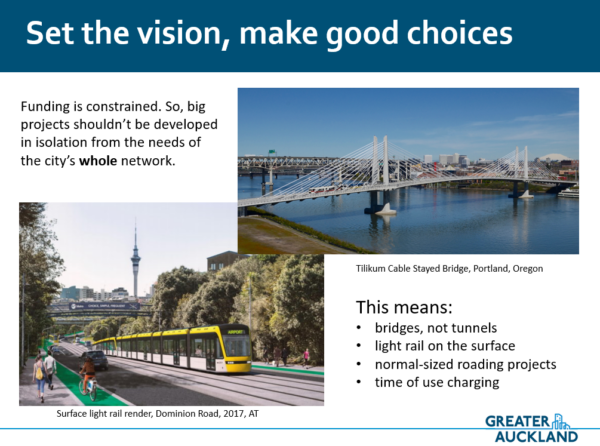
The upcoming transport reforms present a good opportunity for Auckland to have better strategic control over our transport network, especially when it comes to transforming and improving the network for the 21st century. Of particular note, is the 30-Year Integrated Transport Plan. We recommend to Auckland Council that staff are resourced sufficiently, and given a strong mandate, to produce meaningful progress on this plan, and ensure all projects, including State Highway projects, are well evidenced, affordable and right sized.
The development of this plan should include decisions on preferred modes in key transport corridors, notably the Additional Waitematā Harbour Crossing, and the City Centre to Māngere corridor. It is important that right-sized solutions are drawn from, and justified by, the plethora of existing work, so we get affordable and deliverable projects into Auckland’s plans (such as a bridge for the AWHC, and surface light rail for the CC2M corridor).
Finally, in regards to the long term vision for the City Centre. We strongly support the vision laid out in the 2020 City Centre Masterplan [CCMP] refresh, and its transport component Access for Everyone [A4E]. We have no issue with updates or reviews due to the opening of the City Rail Link, but believe the zero-emission, people-friendly approach remains the best principle to follow.
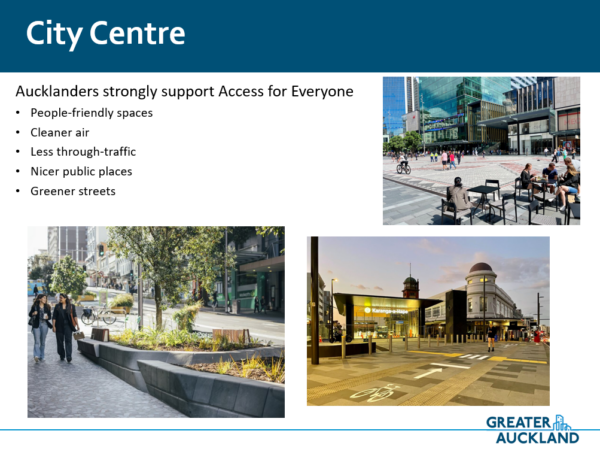
Additionally, it is vital that lessons are taken from the delivery issues of the CCMP and A4E over the last six years. It is extremely important that any vision and strategy with the high level of support that CCMP and A4E has had since 2020, is followed with bold and cost-effective delivery – rather than endless cycles of predatory delay.
Successful cities internationally have been transforming following similar strategies and visions to those outlined in the CCMP and A4E. In Auckland, the areas that have already been transformed, namely the waterfront, have also proven successful. We hope to see the Council continue to take leadership in making our city a greater place to be.
Greater Auckland’s work is made possible by generous donations from our readers and fans. We’re now a registered charity, so your donations are tax-deductible. If you’d like to support our work, you can join our circle of supporters here.

 Processing...
If you want to advocate for your ideas, one way of doing it would be avoiding unexplained acronyms. Make what you write readily understandable by all.
Every single acronym in this article is explained.
All easily understood by me, and I don’t even live in Auckland. Maybe it’s just you, PJ ?
Thanks for this.
Talking of acronyms, no mention of the TERP, Connor? It seems a wildly missed opportunity, given how useful it would be.
J.K. Rowling?
TERP would have saved Aucklanders a fortune, and sped the city up.
Less deaths due to air pollution
Its the policy we funded the development of, got approved, then deep sixed. We’d be better off the council didn’t try to do the right thing in the first place.
Now we have the Trump Emissions Reduction Plan, way more cycling…
I would love to see a better breakdown of capital expenditure for Auckland Council’s Annual Plan.
Palmerston North City Council’s consultation document shows a good breakdown of costs showing that almost 3/4 of capital expenditure is allocated for transport/water projects, note that roading and water infrastructure projects are often combined in practice because you have to rip up the roads to access the pipes. https://www.pncc.govt.nz/files/assets/public/v/1/documents/have-your-say/annual-budget-fees-and-charges-2026/annual-budget-2026_27.pdf
When filling out – consider noting your support for further funding for the Te Whata pathway between Te Atatu and Green Bay.
Its probably not an essential commuting route (in that its utility is probably mostly to do with its amenity value) – but the portion that has just opened from Te Atatu to Robert’s Field is already being enjoyed by the people around it.
Last few minutes to submit on this. Just looking at the slide presentation mentioned, very simple & clear, very good comms.