Welcome to another roundup of all things cities, we can’t believe it’s already the last Friday of February. How time flies!
This week in Greater Auckland
- On Monday we ran Connor’s op-ed on what is going wrong with the next Auckland Harbour Crossing
- On Wednesday Matt did a deep dive into the Northwest busway fast track application
- On Thursday Jolisa asked for help to make sure AT gets it right on Green Lane West
This roundup, like all our work, is brought to you by the Greater Auckland crew and made possible by generous donations from our readers and fans.
We’re now a registered charity, so your donations are tax-deductible. If you’d like to support our work you can join our circle of supporters here.
Karanga-a-Hape Neighbourhood Improvements complete
This week the Karanga-a-Hape Neighbourhood Improvements were officially completed. The result looks fantastic but it pays to remember we very nearly didn’t get this after AT tried to water the plans down at the last minute. They might have succeeded too had it not been for the heroic efforts from Connor and others.
The area around the new Karanga-a-Hape Station has been reshaped to make it easier, safer and more welcoming for people moving through the area, completing another important step towards opening the City Rail Link (CRL) later this year.
Karanga-a-Hape Station will play a key role in Auckland’s wider public transport network served by both the East West Line and the South City Line on the new rapid transit network. This means whether you’re coming from Pukekohe, Papatoetoe, Glen Innes or Glen Eden – K’ Road is an easy train ride away with trains running every few minutes at peak times.
Earlier today, representatives from Ngāti Whātua Ōrākei, Te Ākitai Waiohua, and Ngāti Te Ata Waiohua led a blessing in Mercury Lane, on behalf of mana whenua. This formally marked the completion of the Karanga-a-Hape Precinct Integration Project.
The Auckland Transport-led project was supported by Auckland Council and NZ Transport Agency Waka Kotahi and includes better, brighter public spaces and upgrades to Pitt Street, Beresford Square, Mercury Lane, Cross Street, Canada Street and East Street.
…..
“The improvements will make connecting to transport services easier for those who visit or live and work in the area, as well as opening up new public spaces leading to local restaurants and shops.”
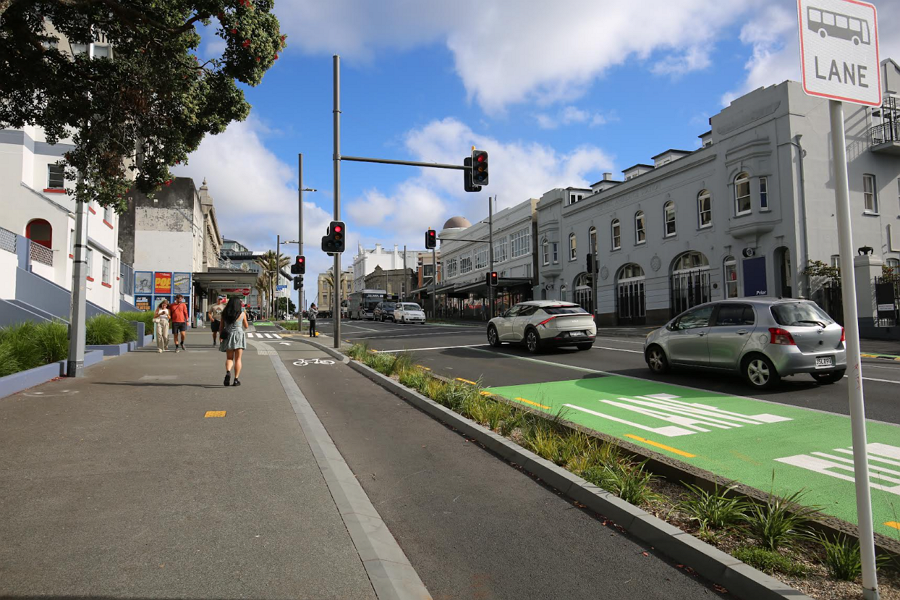
Relocated bus stops, road resurfacing, new pedestrian crossings and wider footpaths have created a more functional and user-friendly area. Garden beds and native tree plantings add bursts of green through the area.
Cyclists can navigate more safely through the busy streets by using new separated lanes on Canada St, East St, Pitt St and Vincent St which link up with existing cycle routes such as Te Ara I Whiti – The Lightpath.

Promoting or hurting the City Centre?
The Spinoff’s Hayden Donnell asks if Heart of the City’s Viv Beck is dragging down the city centre she’s supposed to be promoting?
As Auckland Council was talking up its “magical pathway of festive light” along Queen Street in December, the person whose job it is to lure shoppers to the high-profile thoroughfare was on the radio complaining it had been undermined by anti-car officials. Heart of the City chief executive Viv Beck told Newstalk ZB’s Ryan Bridge the council had been overzealous in setting up low-traffic areas on Queen Street. Bringing cars back to a section between Wellesley and Wakefield Streets after 7pm was a necessary corrective.
…..
That explanation isn’t convincing to everyone. Mayor Wayne Brown, when told by The Spinoff that some businesses and politicians appeared to be fed up with Beck, replied with “everyone is”. His response hints at the growing frustration over Beck’s media appearances. She has regularly criticised the council’s plans for the city centre and opposed its proposed sale of the downtown carpark building despite the fact that Heart of the City’s single-largest member, Precinct Properties, was looking to invest $1.5bn into redeveloping the site. The exasperation came to a head last October, when Beck released what the Herald billed as a “scathing” Heart of the City survey of city centre businesses. The story, which came out ahead of the Black Friday and Christmas shopping periods, painted a picture of a “lawless” area overrun by homelessness and drug use.
…..
Beck seems undeterred. Recently she’s been helping out a new incorporated society set up to represent lower Queen Street businesses. The Spinoff understands the society’s goals include restoring car parking outside luxury stores like Louis Vuitton and Dior along that stretch, which could mean scaling back some of the council’s pedestrian-friendly upgrades to Queen Street. In a text to The Spinoff, Beck said she was working with the group “and will continue to support them as we do with other precincts”.
On “move on” orders
Somewhat related, another example how not all city businesses think homelessness is the biggest issue in the city centre.
At Vixen Vintage Boutique, store employee Roy Irwin said rough sleeping in the area had not been “as much of a problem as some people make it out to be”, and didn’t believe move-on orders were the answer.
“I think [the proposal is] abhorrent. Homelessness is a problem the government has created in my opinion,” Irwin said. “You look at the price of groceries, it’s insane… I think it’s a way for mass incarceration. Who homeless is going to be able to afford the fine? They’re homeless for a reason.”
Asked about the impact of rough sleepers on businesses, Irwin said he believed wider economic pressures were the bigger issue.
“I think the problem with the retail slump doesn’t really have anything to do with homeless people, it’s the economy.”
Irwin said most people sleeping rough near the shop were “really polite and happy to move on if you ask them nicely”. He believed conflict often stemmed from the way people were treated.
More on the National Infrastructure Plan
A good interview with Geoff Cooper, CEO of the Infrastructure Commission about the recently released National Infrastructure Plan. Like with the plan, he is pretty critical of the mega-projects we’re now seeing – though it did feel like he was trying very hard not to criticise the Roads of National Significance more than he might really want to.
What infrastructure do we really want?
There’s a lot of talk about infrastructure right now and some new polling shows what kinds of infrastructure we support.
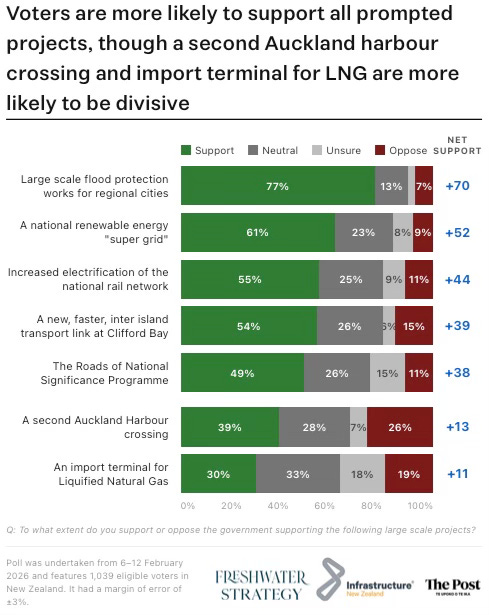
New data shows Kiwis overwhelmingly back the country building infrastructure “mega projects” – just as an official body throws cold water on them.
The polling also shows that flood projects and renewal of the electricity grid are far more popular than Government priorities like the Roads of National Significance and the proposed Liquefied Natural Gas (LNG) import terminal.
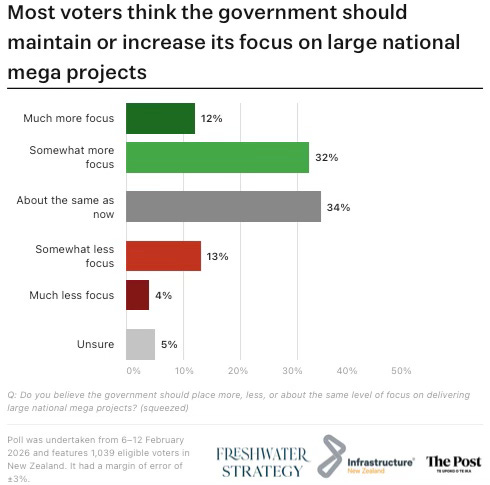
The headline of “Voters are more likely to support all prompted projects, though a second Auckland harbour crossing and import terminal for LNG are more likely to be divisive” buries the lede: the chart below shows three projects that are supported by fewer than 50% of respondents – the RONS (49% for/ 11% against), the Harbour Crossing (39% for/ 26% against), and the LNG terminal (30% for/ 19% against).
Conversely, at the top of the chart are:
- Large scale flood protection works for regional cities (77% support/ 7% against)
- A national renewable energy “super grid” (61% support/ 9% against), and
- Increased electrification of the national rail network (55% support/ 11% against),
Those top three projects also had the lowest proportion of people who were “neutral”.
When considering just “net support” (support vs opposed) all projects on the chart show more support than opposition…
…but even then, looking specifically at transport projects:
electrifying rail (+44) and a new interisland connection (+39) still outrank the RONS programme (+38) and a new Auckland Harbour Crossing (+13).
The RoNS are National MPs’ biggest enemy
Low-cost targeted solutions are exactly what we should be focusing on all over the state highway network, and that’s exactly what we could be doing if funding wasn’t all being sucked up by the RoNS.

Northwest Busway Alternatives
Reader Robin Capper linked to his views on the NW Busway plans, published the same day as our post – and looking more closely at what it means for people on bikes, identifying some good opportunities.
Land value of roads
Some fascinating research on the value of our local roads. Where this
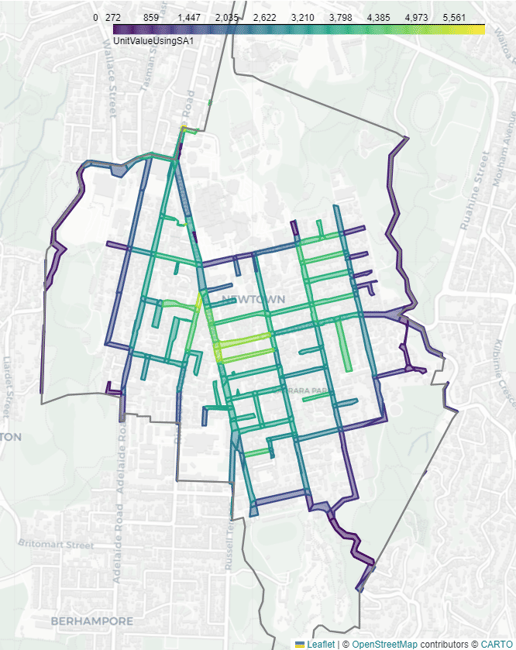
Roading is typically the single largest asset class on a council balance sheet. How it is valued affects depreciation, maintenance, investment, renewals and, ultimately, how councils understand the scale of the system they are responsible for managing – a key theme of the recently-released National Infrastructure Plan.
In 2024, the Ministry of Transport initiated a research project to improve these valuations by developing a nationally-consistent valuation methodology for local roads. Abley partnered with Anthony Byett to conduct this research, which has recently been published (summary, full report).
…..
Applying our land valuation approach to the nationwide local road network, we estimated total land value of between $215 billion and $260 billion. This represents a three‑ to five‑fold increase on 2018 council estimates. In terms of practical impact on councils, total reported council assets (all assets, not just roads) were $183 billion in 2023, meaning that applying this valuation approach could almost double council balance sheets.
Moving Melling Train Station
Pulling out of the station, here comes a train station!
Workers relocated the 19m long, 25-tonne train station building to a temporary home at nearby Marsden St on Monday, making way for a new State Highway 2 interchange and bridge crossing Te Awa Kairangi Hutt River.
In a few years, the building will be shifted again — this time about 300m south from its original location — where a new footbridge will link it to the Lower Hutt city centre.
The Melling Line terminus — used by about 370 passengers a day — has already been closed for three years as part of the $1.5 billion Te Wai Takamori o Te Awa Kairangi RiverLink project, led by the Government, local councils and mana whenua.
Ockham’s Mark Todd on PC120 and Parking Minimums
Developer Mark Todd from Ockham Residential has some interesting comments on PC120
House prices had dropped 30 per cent and with wage inflation over the last four years, houses are about 34 per cent more affordable than they were, Todd said.
The government would do better to focus on the cost of improving incomes than lowering house prices, he said.
“I think planning’s done the heavy lifting that it can to reduce housing costs and enable supply – the rest is on the income side.
“We need to seriously focus on how we can increase family incomes over the next 15 years, rather than trying to continually believe we’re going to lower the cost of housing.”
The cost of building houses had stabilised, he said.
“It’s not getting more expensive, but nor is it getting cheaper.”
Todd said the sector had definitely slowed.“I think that’s actually a good thing. I can’t see prices around rebounding in any significant manner or a steep rise over the next five years, but that’s actually success.
“What we need now is to focus on building, planning our cities properly and leveraging the billions of dollars that have been spent upgrading, things like the CRL, our bus lanes, our cycleways.
“We’ve got to start taking seriously the fact that the free market doesn’t plan cities never has, never will.”
The biggest issue Auckland faced was the lack of people living in the CBD, which was less than half of what it should be, he said.
When it came to calls for the return of car parking minimums, Todd said
It should be put to Aucklanders not mandated by central government, but Todd said the call had already been made during two years of hearings to pass the Unitary Plan.He was personally strongly against the move.“If you legislate two car parks for every house, what you get is a car-focused urban form.”“95 percent of all buildings in Auckland and all terraced housing have car parking, but at least there’s the opportunity to build buildings without car parking. Ockham Residential built five buildings in the last ten years that have zero car parking, all in appropriate locations.“I think it’s a matter of choice and free market. There’s many suburbs and high-value central locations that haven’t had parking for on-street parking for generations. Roads are not for private car parking,” he said.
The war on kids/ picking up the pieces of Simeon’s Speed Rule
A couple of weeks back we reported on how three Auckland children (that we knew of) had been hit by drivers in a matter of days. In Canterbury, there was a tragic fatality, as well as a high-profile miraculous escape. (The latter on a street with painted but unprotected bike lanes; the child in question was scooting on the footpath).
And in the news this morning: a child in Papakura doing the school patrol – presumably, while wearing hi-viz – was struck and injured by the driver of a car.
The Herald says this is the fifth child struck going to or from school since term began (that we know of). As noted on the socials: if these cars were going through dairies rather than children, would we see a swifter political response?
Meanwhile, around the country, councils continue to unpick the impacts of Simeon Brown’s Speed Rule, one street at a time. Including our own: Auckland Transport reports that it will reinstitute the original 50km/h zone through Hatfields Beach. Good result, but what a waste of time and money.
On Tuesday 24th February, the Hibiscus and Bays Local Board confirmed its unanimous support for reinstating a 50km/h speed limit through Hatfields Beach.
We will now submit the required documentation to NZTA Waka Kotahi for certification by the Director of Land Transport. This process can take several weeks.
The new 50km/h speed limit is expected to take effect sometime in April. Keep an eye out for new signs and road markings.
And there are moves back towards safer speeds in Hamilton:
[Hamilton City Council] consulted recently on other speed limit changes, and Denton said Hamilton residents had shown they are thoughtful and engaged when it comes to considering the impacts.
“We found that people had thought about the issues and weren’t highly emotive about it but actually put some good, reasoned thought to us which was really useful for helping us and our elected members make decisions,” she said.
From the socials
Got to love public transport!
Sehinne’s poem, titled “BART,” was the first to “break the nine barrier” at the 2025 Brave New Voices slam poetry festival, meaning every judge scored Sehinne’s piece a nine or above. Sehinne’s group, Team Youth Speaks Bay Area, took home first place. Thread ⬇️
And got to love riding a bike!
Unsurprisingly:
The Ford Pinto had a death rate of 85 people for 10 million cars sold. The Cybertruck hasn't sold 10 million, but the fatality rate so far maths out to 1,452 people killed per 10 million sold.The Cybertruck may be the deadliest road car, for the occupants, ever sold.fuelarc.com/evs/its-offi…
— Elf M. Sternberg (@elfsternberg.bsky.social) 2026-02-23T21:24:34.737Z
Relevant to the governments housing backdown is last months Stuff cartoon by Sharon Murdoch

That’s it from us this week, enjoy your weekend!

 Processing...
In NZ we are getting regular flooding events. They result in hundreds of landslides and millions of tonnes of topsoil lost to the sea every year. There are also thousands of heavy earth moving machines working in new developments and highways and is the cause of terrible sedimentation in the Hauraki Gulf, Porirua harbour etc. Just about every port in NZ (Taranga, Auckland, Bluff, Dunedin} are busy dredging their harbours and dumping the spoil out to sea.
NZ people want more flood protection. Much of NZ is low lying and already we are losing land at a great rate due to coastal erosion. When all that silt washes down from the hills people want it cleared away and sometimes it is dumped in the sea or dozed into the river. The trees are burned rather than put back on the land to decompose and regenerate the soil.
In Singapore the land area has been increased by 20% or more over decades. The government has been dredging sand from surrounding islands and taking it to Singapore reclaiming land.
In Auckland some land has been reclaimed at Wynyard Quarter out from Silo Park.
So when people want more “flood mitigation” they are really talking about concrete walls. Many km of them at very high cost will be required. All that concrete will come from more quarries and removing our hills. I wish that we could reclaim more land in these fragile times.
We probably need to ‘reclaim’ more of the land that is above the current high tide lines and flood plains. Building on either steep hillsides or flat river valleys has been the choice across so much of NZ. Now neither of these are truly resilient. Seafill is, if anything, worse than landfill.
Tricky in earthquake prone areas – some of Wellington’s worst earthquake damage from the Kaikoura Earthquake occured on reclaimed land.
The Karanga-a-hape station streetscapes look great
With respect to the Ockham comments on planning rules, perhaps they’ve worked out the current rules. Making it easier to build would increase new entrants and competition with Ockham. It would be nice to have the perspective of some small businesses that find the current rules onerous.
Its worth reading Mark Todd’s entire article.
One snippet of news – Bernard Orsman is retiring from the Herald next month. I’ll refrain from comment.
I never thought of him as an Orsman, just another cox
YYYESSSSS
Mark Todd may need to reflect on “choice and free market” when it comes to residential parking. Removing parking minima was supposed to leave it to developers to determine what parking supply might be needed for people to live well. Instead it turns into “choice” by developers to supply much less parking than residents may need today (even if they don’t in the future) – just supplying enough to get the banks to finance their builds.
I don’t include Ockham in that – but they are rather out on their own.
Along with only one parking space on site, so many new builds actually prevent on-street parking for additional household cars, and don’t even provide for one ute or trade van at home. Let’s not speak about visitors or deliveries.
Streets need to work much harder in a high-density enviroment. The includes kerbside uses, drop-off, loading, trees, footways, rubbish collection, etc. It can also include well-integrated on-street car parking.
There is no way to make this happen via the RMA. The only examples where this has been done well in Auckland are very large-scale developments, e.g. Unitec, Hobsonville, Wynyard Quarter, Britomart, where you have a deep-pocketed developer who understands this relationship and stands to benefit directly from the uplift in value.
In most parts of Auckland, this doesn’t happen. The result is just a bit of a mess.
If your not happy with the supply of parking, don’t live there.
Simple.
There really is nothing worse then the blight of on street parking. UK is a mess with it, so is much of NZ. Ban it as far as I’m concerned.
If you really need a car, you are probably living in suburbia which means you should have plenty of space to park your car off the road in a driveway/garage etc.
I’ve a tiny property in the UK by kiwi standards but own two cars. I can still park them both on my own driveway and these are big cars (Jag and Volvo).
@ street guy obviously.
How do new builds prevent on street parking?
Not everyone has a ute or van, plenty of non new build properties out there for those people
Choice is the big problem. When too much new development doesn’t provide for the current generation’s needs for transport choice, the result is too many cars. Aerial photography and Streetview reveal these problems. Rules don’t provide a check for good design. Too many – thankfully not all – developers just take advantage of the rules without addressing the real parking demand. We hope that transport options will reduce parking demand eventually, but we’re clearly not there yet.
These are alarming misconceptions, Streetguy.
Providing parking supply to match the current demand is how we ended up in this ever worsening spiral of car dependence.
Parking supply is in fact an important lever to pull in transforming our system away from car dependence.
What you’ve expressed comes from the classic “predict and provide” ideology, and doesn’t stand scrutiny.
We know parking induces driving, and driving must reduce. So the solution is to Decide (on the VKT, land use and modal split desired). Provide (that infrastructure, land use and level of parking supply). And enforce.
What aerial photography and streetview reveal is NZ’s neoliberalism aversion to enforcement.
“we estimated total land value of between $215 billion and $260 billion” – and people think public transport is subsidised.
I would love to see what a privatised road network would look like. Imagine if you owned that asset, what return you you want on it? I suspect mass transit would all of a sudden become very cheap in comparison to the private car.
On Mark Todd – he should be respected for being a big advocate for apartment development in Auckland. Ockham does good – by New Zealand standards – apartment development. But…. He’s pretty arrogant . And sometimes wrong.
Changes to the Unitary Plan – which I have requested in my submission on PC120 – could enable me to build and sell 2 bed apartments for circa $550k, in 3 storey walk up complexes, in fairly central locations. Compare that to the 2 bed apartments his company is selling, often north of 800k. That’s because of his mid rise development model, with high construction costs.
So he’s talking out of his backside when he says further planning changes can’t improve housing supply and affordability.
@ Zen man: given how poor building quality and design is NZ, I can’t help but think your places would be new build slums for the amount you quoted.
That the sort of low cost I expect to see in Asia and Africa, not developed nations like NZ.
Well you would be totally wrong. Certainly Medium spec, nit high spec. And Certainly compact floor plans, circa 55-60 square metres.
Auckland would benefit from a regulatory environment where responsible developers like Ockham can thrive.
I don’t think we would benefit from one that would allow your squalid sounding little huts to be imposed on the poor and vulnerable.
Would you do a play on the details and economics of your more affordable three storey walk ups, Zen Man? And in the regulatory changes required for you to be able to build them?
Is he keen to know:
Does your design approach leave more permeable land? And does it enable site by site development instead of having to put together several sites?
*post, not play
So many swipos sorry. Need to get into better light. Including
*I’d be keen to know:
‘Squalid little huts’ – that is priceless!
Having the supernatural ability to judge the quality of a stranger on the internet’s design ethos is quite impressive!
Look mate, good luck to you, but land prices are no longer the biggest issue when it comes to developing.
There are many other regulatory changes on the horizon that should serve responsible developers (the most important being the removal of joint and several liability when it comes to responsibility for shoddy works under the Building Act).
This third (?) iteration of changes to Auckland’s density allowances will also serve to make things easier for you (although thankfully not to the same extent as the most recent effort).
Chin up – you already have all the tools you need to make a go of it (with more coming).