Hey look, it’s another Friday and it’s been a busy week! And another roundup of recent news, to cap off your week.
This week in Greater Auckland
- On Monday Connor examined what AT is doing to ruin Queen Street and Wellesley Street.
- On Wednesday Matt delved into what it might take to build another Harbour Crossing, and what we actually need.
- Thursday saw Connor looking into who is pushing to ruin Queen Street.
This roundup, like all our work, is brought to you by the Greater Auckland crew and made possible by generous donations from our readers and fans.
We’re now a registered charity, so your donations are tax-deductible. If you’d like to support our work you can join our circle of supporters here.
Housing Target Changes
Yesterday Chris Bishop, Minister for most things urban, announced the long signalled changes to housing targets for Auckland. We’ll go into it in more depth later but here is our quick response to the news:
Everyone agrees we need more housing and that it’s best located close to transport, work, school and shops. The bickering over the hypothetical upper limit has been distracting us from the point: more homes closer to jobs, good transport options and other amenities.
Its been incredibly frustrating how politicians and some people in privileged suburbs of central Auckland have leveraged scaremongering and disinformation to create chaos in the process. We hope now Auckland can get on with enabling more housing without further interference so all of us can afford to live in our amazing city.
March Madness is almost here
We’re rapidly approaching March Madness, and RNZ had an interview with Matt to discuss the issue.
Director of transport advocacy website, Greater Auckland, Matt Lowrie told Nine to Noon travel times appeared to be normal.
“One of the things that happens is that we get lulled into a false sense of security of how easy it is when the traffic is low and during those school holidays.
“The numbers seem to suggest that it’s probably similar to last year … but it’s that we’ve often forgotten how bad it was at this time last year because even throughout after April when March Madness normally runs through to about Easter, it does drop off for sort of the rest of the year.
“We forget how bad it is at this time of year and I think that’s part of what is driving the experience that people are having is that we just forget that it’s super busy at this time of year and that creates a lot of pressure on all forms of transport.”
Auckland Transport have also highlighted what they’ll be doing:
Every year AT and the New Zealand Transport Agency (NZTA), via the Auckland Transport Operation Centre (ATOC), prepare for this increase in demand by reviewing network performance in real time and taking action to keep our city moving.
Group Manager Public Transport Operations Rachel Cara says AT has been planning for this period since March last year.
“Our main message to people is to plan ahead, regardless of how they travel, whether it’s on public transport or in their private vehicle.”
“Public transport is a great option to consider with thousands of services running daily, taking away the stress of driving and giving you some time back. Network changes in 2025 added capacity on a number of key routes, and we’re utilising larger buses at peak times to support the higher demand. We have 42 fast frequent bus routes across Auckland that run at least every 15 minutes, from 7am to 7pm, 7 days a week, and about 750,000 people live within a ten minute or less walk to one of these stops.
“With additional trains also in the fleet ahead of City Rail Link opening, we’re able to run more six-car services, including 40 peak services and some school trips.
“The recent tertiary concession increase, from 20% off to 40% off, has already seen a 25% increase in trips taken year on year, and we are likely to see more students onboard as they return to university.”
Some other GA in the news
You might have also seen or heard:
- Matt talking about potential tolling for a new Harbour Crossing on RNZ
- Patrick discussing the government’s changes to housing capacity and intensification
- Scott, in his role as spokesperson for the Coalition for More Homes, in various coverage, as well as speaking on ‘The Hoon‘ with Bernard Hickey.
Here’s how to speak up for Queen Street!
Connor’s deep dives into the mess Auckland Transport is making in Midtown, spurred on by a vocal minority, showed we need to take action. Here’s a reminder on how:
The shape of the trial is currently being locked in, so we need to speak up now, and demand:
- The trial is adjusted before it starts (or can be adjusted when it inevitably leads to bad outcomes – unreliable buses, congestion, unpleasant vibes for people walking and biking, etc.)
- The trial delivers the kind of transformations people continually ask for and support – a more pedestrianised Queen Street, 24/7 priority for buses on Wellesley Street, etc.
As with Project K, we can absolutely win this round – but it takes people power!
You can help by emailing the following people:
- Mayor Wayne Brown
- Deputy Mayor Desley Simpson
- Waitematā and Gulf Ward Councillor Mike Lee
- Chair of the Transport and Infrastructure Delivery Committee Andy Baker
- CEO Auckland Council Phil Wilson
- AT Chief Executive Dean Kimpton
- AT Chair Richard Leggat
- AT Acting Director Network Performance Melanie Alexander
- AT Director Public Transport and Active Modes Stacey Van Der Putten
- AT Engagement Email Address
To: [email protected], [email protected], [email protected], [email protected], [email protected], [email protected], [email protected], [email protected], [email protected].
And feel free to cc:
- the Waitematā Local Board (who were also blindsided by this trial, and as far as I know broadly do not support what AT is doing)
- the deputy chair of the Transport and Infrastructure Delivery Committee Shane Henderson ([email protected])
- any other elected members you feel should be included.
What to say? Firstly, state your opposition to:
- the undemocratic process that has led to this trial
- the trial’s premise – prioritising general traffic over public transport and people-friendly places.
You may also wish to mention:
- the trial as proposed doesn’t follow the vision of the City Centre Master Plan and its circulation plan, Access for Everyone.
- the timing is premature – with CRL opening later this year, a trial like this should have been considered only after we see how CRL changes the area.
- the trial is pushing for things that are the total opposite of what we, the people, have consistently said we want in every previous consultation.
So we’re asking Auckland Transport (and/or Auckland Council) to immediately adjust the trial, and:
- Implement 24/7 bus lanes on Wellesley Street, to prioritise public transport reliability and maximise the value of CRL
- Keep pedestrianising Queen Street – extend the AVO to Customs Street, and keep it 24/7
- Introduce logical pickup and drop off (PUDO) plans for ubers and taxis in Midtown
- Make Midtown mobility accessible, without allowing a free-for-all of private vehicles
It’s always great to include your own personal experience and perspective. For example:
- What do you like about the City Centre?
- What do you enjoy about people-friendly areas like the Waterfront, Te Komititanga, Freyberg Place, Te Hā Noa/Victoria Street Linear Park?
- If you take public transport, especially via Queen St or Wellesley St, is reliability important to you?
- Do you want to see Queen Street even more pedestrianised? If so, say why!
You can also mention that you value things like:
- public transport reliability
- walkability
- less noise pollution
- less air pollution
- pedestrian safety
- cycling
- the quality of the street environment for public life
- and more
As always, remember to be polite but firm in your views.
We can win this, just like we won Project K – but only if we take action!
So flick off an email and share Monday’s post and Thursday’s post as widely as you can. Thank you!
Paying when travelling in a group on public transport
AT has a webpage up, explaining:
How to pay for buses when travelling in a group. Information for sports teams, school groups, families and tourists.
Te Huia Lives
This is great news! The only concern that this is only a one-year extension, which feels very much like the government just wanted the issue off the board in an election year.
Waikato Regional Council has today welcomed the NZ Transport Agency Waka Kotahi (NZTA) Board’s decision to support a 12-month extension of the Waikato-Auckland Te Huia trial.
The council wrote to the board in December asking for the extension to the end of June 2027 with 60 per cent central government funding.
It would enable patronage to recover and test the impact of benefits accruing from opening of the City Rail Link later in 2026 as well as continued implementation of a series of measures to increase both passenger numbers and revenue, the council said.
The NZTA Board agreed when it met in Wellington this afternoon. It means regional councillors will be asked to support continued local funding at the current rate when they meet next week to consider the budget for 2026/27.
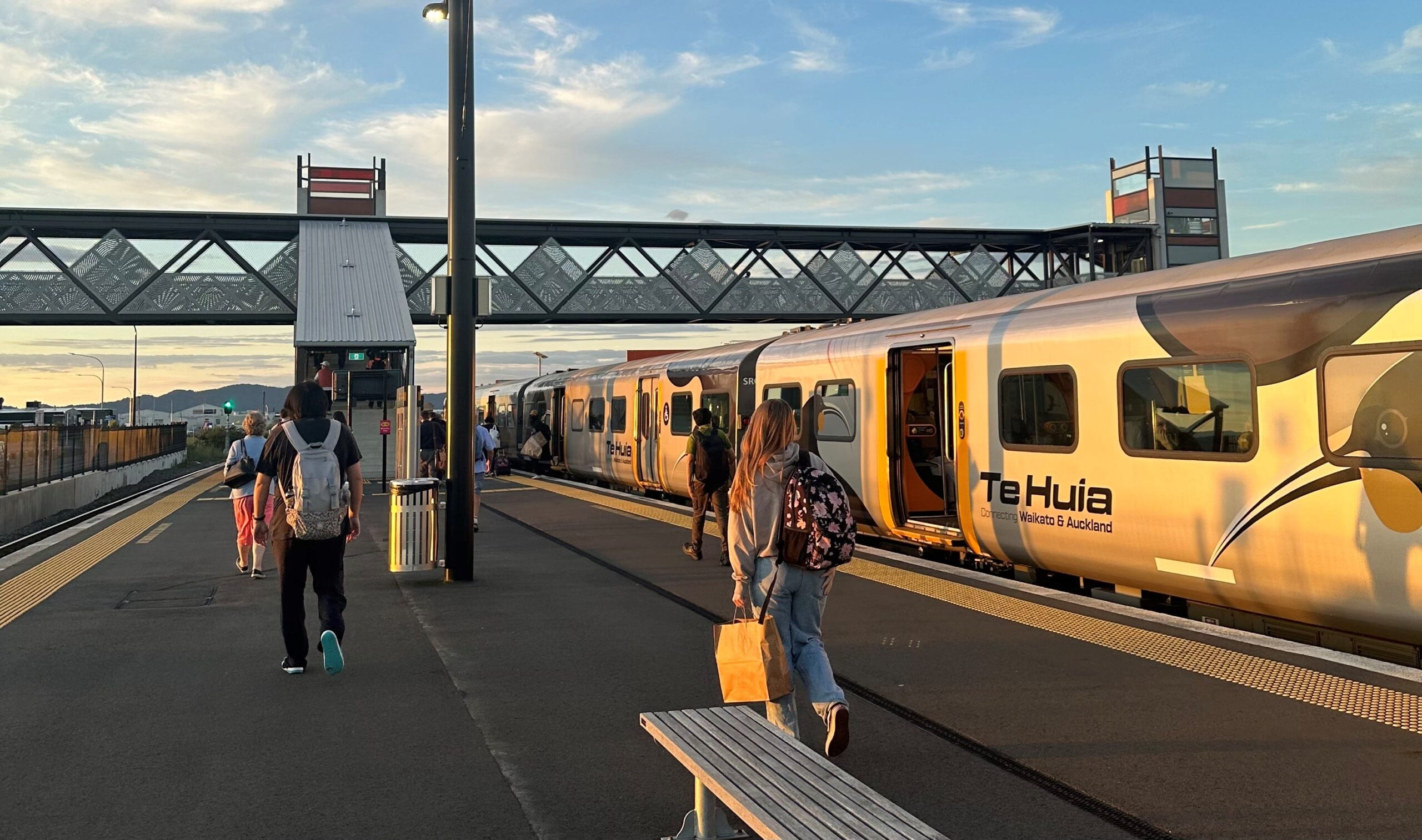
Te Huia at Rotokauri Station. Image credit Darren Davis
More Trails
While our urban cycleway networks often unfairly face criticism and resistance, tourist trails continue to get strong support.
The Whale Trail has finally begun to weave its way out of Kaikōura.
Once all the trail sections are complete, the 200km cycle and walking path will stretch from Picton to Kaikōura.
…..
Mr Muir said around 115km of the 200km trail has been completed with 90km already open to the public.
‘‘It’s exciting how many users are already utilising and using the trail.
‘‘We had some 80,000 users walking and cycling on the trail last year and it’s only going to get bigger for Marlborough and Kaikōura.”
Another 50-60km is being constructed this year.

Safety Corner
Why aren’t we making these bridges safer if we’re replacing them?
A new bridge on the West Coast will be too narrow and should have a reduced speed limit, cycling advocates say.
The narrow 90-year-old Coal Creek bridge on State Highway 6 near Greymouth is being replaced this year to include a 1.2m shoulder.

The latest proposed speed limit changes on Northland state highways have been met with gratitude and relief from locals and officials.
After reducing speed limits from 100km/h to 80km/h, then reversing them back to 100km/h last year under the coalition Government, NZ Transport Agency [NZTA] is again proposing lowering speed limits on some sections of the Far North’s state highways.
…..
“It needs to be 80 because those three bridges are so narrow, the trucks have gotten wider, there have been so many accidents on the bridges and between Taumatamākuku.
“It’s such a dangerous piece of road.
“I’m grateful they are relooking at this, because reversing it was a mistake.”
NZTA said the changes – being reviewed in line with the requirements of the Land Transport Rule: Setting of Speed Limits 2024 – are in response to “strong community feedback that current speed limits aren’t suitable for these stretches of road”.

So much time and money has been wasted as a result of Simeon Brown’s fatwa against safety. As community advocate Roddy Hapati Pihema notes:
“I’m happy we get another shot at it, but a lot of our routes are in a huge disarray.
“If you drive down SH1 and look around, you see blotches of tar covering up potholes.
“It’s sad we have to continue to waste money, whereas it could be used in other areas.
“If they got it right the first time, we wouldn’t be in this situation.”
Who’s meeting the Ministers?
Some new research on who is meeting our Transport Ministers – note, this is based on ministerial diaries from the last (Labour) government. It would be very interesting to see who’s currently meeting the Transport Ministers, and who hasn’t been able to.
For interest groups and lobbyists, face-to-face time with political decision-makers is the most valuable kind of access there is.
As one New Zealand politician once put it (speaking anonymously to lobbying researchers), “politics is so much about relationships”. In-person meetings help build trust, develop shared priorities and identify where influence is possible.
…..
Our newly-published research analysed the diaries of transport and associate transport ministers under the two most recent governments – the Labour-Green-New Zealand First coalition (2017-2020) and the subsequent Labour government (2020-2022).
It offers a useful snapshot with some clear patterns – but one that needs to be interpreted with care.
What the diaries tell us
For meetings with interest groups related to the transport portfolios (880 out of a total of 11,079 meetings) we categorised the interest groups two ways: the type of interest group and the group’s focus – that is, the specific area of transport it seemed concerned with.The first classification was adapted from a European approach to categorising interest groups. The second was developed by examining the groups’ websites and coding their main areas of focus, such as air travel, freight or consultancy.
Of the 974 groups we identified, 74% were commercial (56% firms and 18% business associations). Among non-commercial groups, citizen groups (9%) and trade unions (7%) were the most common.
Overall, commercial groups met with transport ministers about three times as often as non-commercial groups.
On Harbour Bridges
With all of the talk of a new harbour crossing this week, here’s Helsinki building exactly what we should have done here: a bridge for public transport and active modes.
The longest of the spans is 1.2km long – only slightly shorter than our existing Harbour Bridge. It is also a great example of just how out of scale our infrastructure costs are, with the Helsinki project coming in at under $600 million.
Learning from Africa
Ethiopia has banned the import of internal combustion vehicles:
The Ethiopia story is fascinating,” said Colin McKerracher, head of clean transport at BloombergNEF. “What you’re seeing in places that don’t make a lot of vehicles of any type, they’re saying: ‘Well, look, if I’m going to import the cars anyway, then I’d rather import less oil. We may as well import the one that cleans up local air quality and is cheaper to buy.
And, this is fascinating, on Africa’s rise through renewable energy:
It is quite likely that Africa will be the first continent that grows from a low level of development to an advanced economy using mainly renewables rather than fossil fuels.
The remarkable timing of Africa’s rising renewables coincides with global carbon emissions attaining an historic plateau. This is largely because of emissions of the world’s highest emitter, China, peaking and now decreasing, having followed a long-term progressive and planned shift from fossil fuels to solar, wind, hydro and nuclear. This fortunate alignment of two major but separate renewables stages in two parts of the world carries very positive messages for the future of the planet’s climate restoration.
Africa holds many of the cards for the future of the global climate. Although it is a developing continent, it is also a dynamic region in terms of energy evolution. Energy growth rates in Africa are high, which – starting from a low base – has been driven by high demand, and increasingly cheap solar and wind sources. It does have low levels of grid reliability but distributed micro-grids have rapidly gained traction to address this.
It is important to consider North Africa and Sub-Saharan Africa separately. The former is emerging as one of the world-leading regions for solar potential and development in providing green energy to European economies. Egypt, Morocco, Tunisia, and Algeria are moving rapidly into utility scale renewable energy and into grid integration. Solar and wind capacity has increased by about 300 percent since 2016 in the region. Morocco, for example, is now generating 40 percent of its energy from renewables.
In Sub-Saharan Africa – with Nigeria, Tanzania, Kenya, and Rwanda leading – renewables already account for roughly half of the installed power. Of this half, 80 percent is via legacy hydro but with solar capacity growing at up to 30 percent a year over the last five years.
…..
Africa now accounts for 70 percent of the world’s global solar home deployments.
On the Climate
Giving some hope on climate change:
But Marzeion’s presentation at the conference was not about that.
Instead, together with colleagues, he has been quantifying the impact that saving one tonne – or even one kilogram – of carbon emissions can have.
“People often really feel powerless when they’re thinking about climate change,” he told RNZ.
…..
He and fellow researchers always believed that way of thinking was “really wrong” – so they set about finding the numbers to prove otherwise.
“The main message is that small changes in emissions lead to changes in the climate system, in the Earth’s system, that are surprisingly big, actually.”
The average person on the planet contributes between five and 10 tonnes of greenhouse gas emissions each year, he says.
Reducing that by even 10 percent makes a difference.
“One tonne of CO2 reduction keeps, for example, nine tonnes of glacier ice in the mountains that would melt otherwise.”
The same reduction prevents 12 cubic metres of sea level rise.
It keeps 250 grams more fish in that sea, through averted increases in ocean temperatures.
By similar mechanisms, it protects growing conditions enough to create six more kilograms of rice, or a kilogram of meat.
…..
The research looked at the effect of even tinier emissions decreases.
“If I take my bike for around three kilometres instead of driving a car, I save one kilogram of glacier ice.”
Some striking data on states of emergencies, given all of the climate-change-fuelled weather events of late – and this was a day or so before some of the latest ones:
Can also do state of emergency declarations as year to date (to 15 Feb). In showing it that way I am including fires and floods with sever weather as climate connected. I also checked that it has all been under the same emergency declaration powers through the period, and it has.
— David Hood (@thoughtfulnz.bsky.social) 2026-02-14T22:39:22.562Z
and
Here is another way of approaching it – for the 0.1% (318) most rainy known hours at Auckland Airport (in north of country, has long run of data), when were those hours distributed through time.
— David Hood (@thoughtfulnz.bsky.social) 2026-02-14T23:42:53.155Z
From the Socials
How BART was built
And finally:
Have a great Friday and great weekend.

 Processing...
Not a big fan of Wayne Brown but sometimes he can be funny
https://thespinoff.co.nz/politics/20-02-2026/bishops-housing-backtrack-is-a-hollow-victory-for-parnell
‘Wayne Brown was having none of it. Speaking to The Spinoff after Bishop’s speech, he said he’d rather just keep the existing plan than submit a new one to be signed off by “a bunch of turkeys that don’t live in Auckland”. “I’m not interested in doing that. We’ll just stick with the two million houses,” he said, before adding a barb for Seymour. “Most of those will be in Epsom.” ‘
And he then gets voted back in with a huge majority. There is no need to pander to the minority whingers…
As I keep saying, Wayne Brown is like Trump if Trump had 50% decent human beings advising him as opposed to the current 0%
https://www.stuff.co.nz/home-property/360940903/national-has-not-heard-message-aucklanders-cool-housing-climbdown
“From 2m to 1.6m, National has not heard the message. Our message is we want proper planning of the city done by council planning engaging in consultation with residents, like we did with the unitary plan”
That consultation was the one where the residents said no to everything and the council decided to put the density in the outer suburbs. Surely that consultation is the whole reason the government has stepped in, because the council were too weak and only listened to the NIMBYs.
Suffer in your jocks, gentrification millionaires. You’re the people who ethnically cleansed Ponsonby/Freeman’s Bay/Grey Lynn in the 70s and 80s, buying up former rental properties and pretty much evicting the mostly Pasefika residence who were there before.
If the compromise is making these people squeal more at the price of letting the good burghers of Howick, aka Rhodesia-by-the-Sea, off the hook, then I can live with that
What is the difference between 1.6 and 2? NOTHING.
The Minister (flew?) to our magnificent city, to make another NOTHING announcement. Too much ParrotDog in that Bishop.
bah humbug
The problem for the NIMBYs isn’t the number, changing from 2m to 1.6m isn’t going to make a difference, what they are after is something that can’t really be done and thats changing the colours on the map of their suburbs which are most suited to intensification. The fact Seymour is so heavily involved shows how terrified he is of losing his seat, good on Wayne Brown for stadning his ground.
Disagree. A drop of 400k will mean more areas of special character, valued by many Aucklanders including me, will be retained.
There will still be huge opportunities for dense urban development near train stations, centres etc. 1.6 million provides more than enough development capacity ‘fat’ when the city is projected to need 300k more homes in the next 30 years.
I am not a David Seymour fan at all, but he is quite right when he says what is more important are the hugely drawn out, subjective, time consuming, costly and risky resource consent processes for urban development
It makes most sense to cut the 400k houses farther out though, right? So we can still have density improvements in Ponsonby, Epsom and Kohi 🙂
Some fairly simple but hugely meaningful tweaks to the rules could significantly increase capacity AND improve affordability in focussed locations. Ie. Near stations, centres etc.
Yep, anywhere within 5km of the CBD/1km of the edge of local centres/stations/frequent buses etc. The places that don’t make sense for density are places that either have Watercare constraints (but those are temporary), or are far from existing centres/transport links e.g. Huapai (which could be remedied if they do the rapid transit plans), or have significant natural hazards like Mt Roskill flood zone (they’re doing managed retreat there) or on cliffs etc.
The special character zones are nuts, basically importing HoAs telling people what they can or can’t do with their property, with rules so extreme that the majority of existing homes wouldn’t even be able to be built if they were created under the same rule scheme. People around there have gone nuts trying to create their perfect utopia, legislating against anything that doesn’t fit, and it’s not even a good vision.
Agree, the only way that this should work is by using a compass and drawing circles around city / train station / etc. Because realistically no one wants density next door to them, so no point consulting etc.
And then watercare / vector / etc can independently have a say, although I would prefer that happen when you actually go for the consent (sorry mate but your pipe is at capacity and won’t be upgraded until XYZ).
Massey gets a load of townhouses while Epsom is single house zone? Does Epsom even have any character? It just seems like any rich neighbourhood to me, nice but not what I would call heritage or anything. Ponsonby I can understand why people want to save it because it is pretty cool, but I suspect if it was still a slum area no one would give a toss.
Nice, so lots of development around the stations near Epsom, Mount Eden Remuera and Kingsland. Glad we are on the same page.
Super news re: Te Huia. We all have a duty to support it IMHO, or regional rail is just not going to happen.
I’m planning on riding the bike to Britomart or one of the other AKL stations served, boarding Te Huia, then riding the amazing Waikato River trail. Hamilton Gardens could be another nice day trip. Good times!
Would love to see revitilisation of Hamilton’s Central Station on the govt’s list of priority projects, this news is one step in the right direction
I’ve often thought I’d like to do this, but unfortunately the timetable doesn’t allow for it. Unless I’m missing something, the only southbound trips at the weekend are in the afternoon (with no return northbound service in the evening), and even on a weekday, taking the earliest southbound train and the latest northbound one only allows for about 2 hours between arrival and departure.
Is staying overnight out of the question for you? On my most recent trip we then took the bus to Cambridge, stayed overnight there, and went kayaking in the morning.
Those friends hadn’t used Te Huia before, but are keen to repeat the exercise with their (adult/nearly adult) offspring. Being able to chat in a relaxed way was really lovely.
Great news about the extension, agree on the logic behind the year extension but regardless it’s not being canned, so that’s a win.
Te Huia still has a terrible timetable for day trips from Auckland to the Waikato, i.e. the trips Waikato should be wanting. They’ve focused the timetable instead on bringing people from the Waikato to spend in Auckland, which is great for taking money out of the Waikato, but they should work on the other direction especially for weekends, so that they can bring money into local businesses.
Pretty sure Te Huia’s timetable issues are largely due to network capacity limitations, which is why double tracking (and electrification) of the route needs to happen
Just need more frequency in the end to solve the issues. Think it’s more a matter of funding (train numbers, staff & other running costs) rather than just network capacity. That funding, organisation & push is largely from the Waikato apart from NZTA (60%) so another reason the Auckland to south direction is less convenient.
I’d like to see hybrid trains, more of them, so more frequency, an extension of routes & ability to come right into Waitemata Station. Then as mentioned the Hamilton City end needs probably a revamped underground station with provision to continue to Tauranga etc. This would be a game changer and really is needed as both Waikato & Auckland populations grow. Not even accounting for climate reasons.
Time for Auckland to step up with some cash too, especially given Te Huia benefits it more then the Waikato financially.
Its the lack of focus on the intra-Waikato services that astounds me.
Trains should be delivering people from the northern Waikato towns into The Base and Hamilton central each morning and back again at night. Along with getting cars off the road imagine the boon for those towns with the cheaper house and land options available to buyers and high quality PT going north and south.
@Herriot
Yes, I’m planning to do the same thing at some stage, so glad it wasn’t cancelled.
How Auckland Council handles the PC120 Hearings process is much more important than the total opportunity number. Any hidden tweaks by Cabinet in addition to that fairy-tale number change may be more important.
It does at least give AC the opportunity to look at the whole infrastructure cost evaluation and funding (recent report on that, wasn’t there?). The cost to all of Auckland for building Dairy Flat City and servicing it is important, as well as how much the Orewa and Warkworth balloons get blown up.
Narrow Bridges:
1) Simon – by no means as narrow as Viv Beck. We should hear more from the wider Auckland business group.
2) Waitematā – apart from someone floating it up the harbour to land in hillside of forested Kaipātiki, it should be the cheap, sufficient option.
3) Rural highways – whether flood recovery or asset renewal done ‘like for like’ ends up ‘dislike for dislike’. A consenting and funding pathway that allows those pinchpoints to be replaced with safe and resilient culverts or bridges needs to be in place for routine improvement to be included. Auckland Council sees the value in Flood Resilience projects at Walmsley Road and Don Buck Road, for example.
Stuff has an article open for comments on opening Queen Street up to cars again.
https://www.stuff.co.nz/nz-news/360940790/private-vehicles-set-be-allowed-back-section-auckland-street-brought-millions-fines
Re the picton to kaikoura whale trail. There is still going to be a gap from picton to the top of the elevation, which is the hill leading out of picton. Why? Because the change to transport funding by simeon meant they lost the funding to do the trail in this section as it was to be funded by nzta.
So trail cyclists still have to bike up or down the hill using an insanely narrow shoulder on a 100kph passing lane. As far as I know there is still no funding to complete the trail here.
Sub Saharan Africa was an essay topic when I did Development Economics back around 2005. I just remember it as being depressing. There was stagnation and poverty and lists of excuses or reasons to try and remember. But since that time GDP per person shot up. If they can reach developed status then that would be a rare event. Very few countries managed that in the 20th century (South Korea and Singapore but I can’t think of many others). If they can do it without oil that would be amazing.
Singapore and British investment and Korea, Japanese. They do not represent good examples here.
Most of the sub-saharan nations doing well are using British funds too and often already had decent standards of living by African measures.
There have long been some good news stories in Africa in terms of economic development. For instance, Botswana has long had comparable growth rates to Asian tigers. Since 1980 China has also experienced dramatic growth. Oil is often a mixed blessing as it can result in corruption and unstable growth. Some of the Saudi students I knew at university got told by their parents to get a degree in NZ and not come back, although I’m not sure they saw their long-term future in NZ. Prioritising life-style factors, such as sea views and not allowing anyone to build anything high enough to see into your swimming pool, may mean that in the future cities like Wellington and Christchurch, where people are less concerned about views, do better than Auckland. Indeed, Texas has boomed, despite a terrible climate, partly because there are so few constraints on building new housing.