Earlier this week, I detailed how Auckland Transport is messing up Midtown with a proposed trial on Queen Street and Wellesley Street.
AT’s trial will:
- Reopen the section of Queen St between Wakefield and Wellesley to general vehicles, from 7pm – 7am (Currently, this is a 24/7 AVO zone – Authorised Vehicles Only – used by buses, bikes, mopeds, motorbikes, emergency vehicles, and registered goods vehicles.)
- Propose that bus lanes on Wellesley St, one of the busiest bus corridors in the city, and on the brink of completing a major upgrade, only operate between 7am – 7pm.
These changes go against official advice from AT’s Public Transport team, and the visions and strategies that govern the city centre – as well as all previous public feedback, plans, consulted projects, expert advice and evidence underpinning normal decision-making
If the trial goes ahead, it will run for two years, starting in March and overlapping with CRL opening.
Bizarrely, as confirmed by documents I received via LGOIMA request – AT has done a total U-turn on its initial intentions.
And as far as can be gleaned from the documents, as well as not reaching out to city residents via the City Centre Residents Group, nor trusted voices from the on-hiatus City Centre Advisory Panel, it also seems that AT didn’t speak with walking or cycling or disability advocacy organizations, nor with the Waitematā Local Board (other than telling them in December it was happening, with no opportunity for input), nor with FENZ, who may have concerns about adding overnight traffic to that stretch, nor with Police whose job it would presumably be to keep an eye out for boy racers.
Or if they did, it’s not recorded.
So why would AT pull such a dramatic U-ey on their original direction?
Or to put it another way: who is making AT do this?
Maybe the Mayor?
One of the loudest voices on the city centre is former city-centre resident Mayor Wayne Brown. He often shoots from the hip, irritated over things he identifies as dysfunctional and poorly thought out. He’s not always wrong.
In September and October 2025, emails went back and forth between the Mayor and Auckland Transport on various matters, including a callback to the mayor’s request in his Letter of Expectation that AT inform Council about ‘ways to traverse the CBD east to west by car‘.
Auckland Transport’s response was pretty good for what it was: it defended the core principles of the City Centre Bus Plan and the idea of improving circulation plans (a core component of Access for Everyone). But it lacked a lot of details, leaving that up to further discussion.
And so, as the Mayor continues to pressure AT, combined with AT’s ongoing struggle to explain and deliver Access for Everyone… it makes me suspect that senior leadership just don’t understand, like, or care about these key strategies enough to be able to explain what needs to happen and why.
See for example this November 2025 memo to AT’s Design and Delivery Committee from AT senior leadership. All of a sudden, the traffic circulation plan is about giving priority to the ‘20% of general vehicles’ that cross the Queen Street valley, instead of to public transport, walking, and cycling.
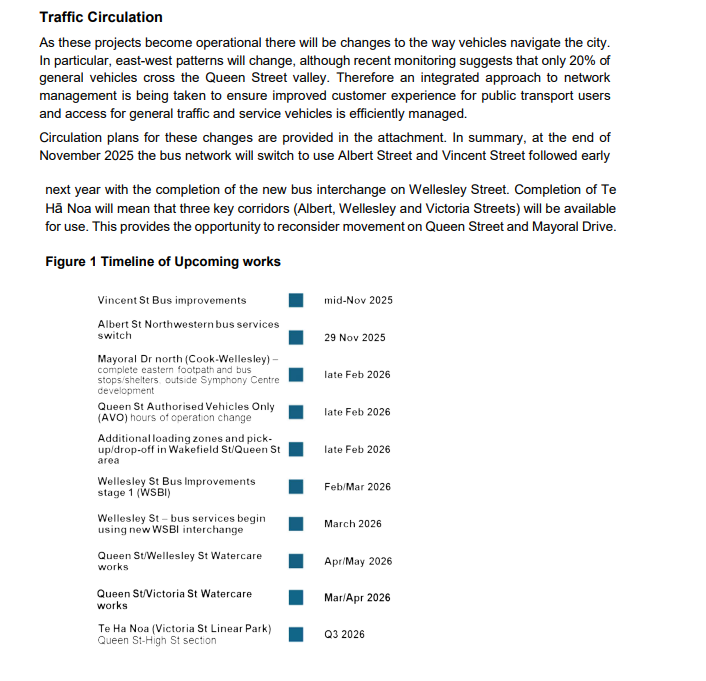
Excerpt from November 2025 Memo (cropped and edited as this section crossed over multiple pages)
If AT were following the Access for Everyone plan, they’d have moved the east-west traffic onto Mayoral Drive and Customs Street, as planned. Which is better for public transport, better for pedestrians in the area, and crucially better for people driving as it provides clear, logical ways to get around the City Centre without disrupting other people in the network.
A properly ‘integrated’ approach to transport, to use AT’s own terms. But instead, AT folded, completely against the advice of their own public transport team.
Such a wasted opportunity, especially given the Mayor is known to change his mind when given a proper technical explanation – and is fond of saying buses are the only good part of AT.
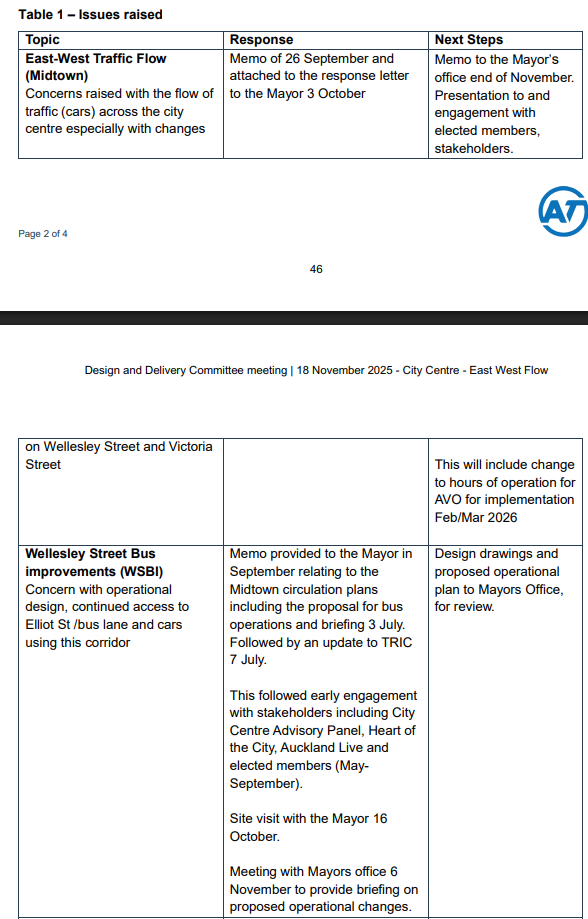
Excerpt of key issues the Mayor raised about Wellesley Street from November 2025 Memo
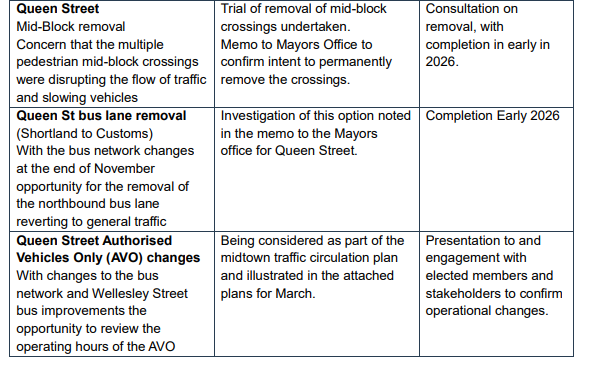
Excerpt of key issues the Mayor raised about Queen Street from November 2025 Memo
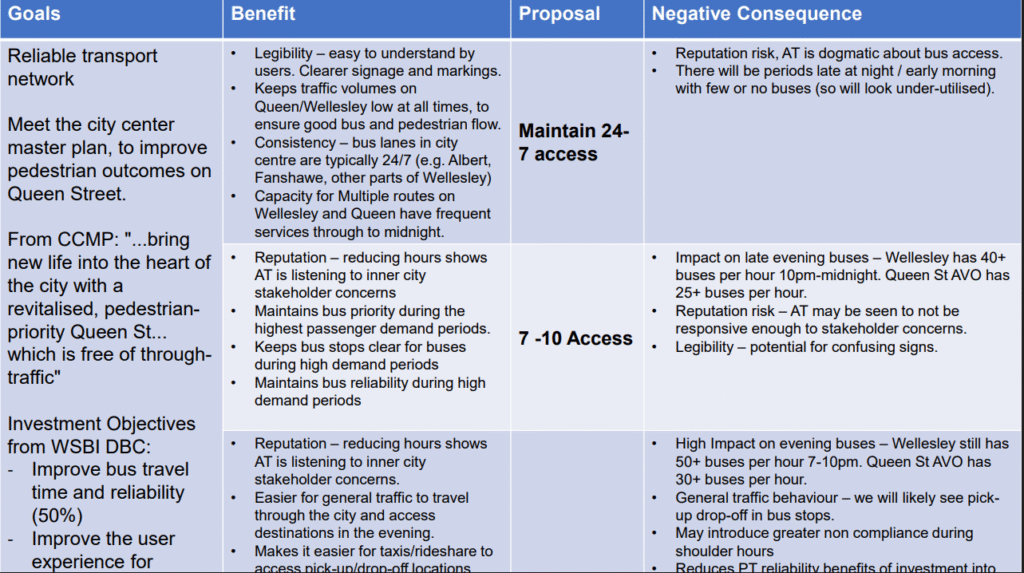
But the Mayor, while important, is only one person, and he seemed to care a lot more about Wellesley Street than Queen Street, with AT seemingly bringing up the AVO of their own volition.
So who else was pushing AT to do a 180?
The Beck in the room
As highlighted in the November 2025 Memo, the only parties AT consulted in detail about the trial proposal were Heart of the City and Auckland Live.
(The City Centre Advisory Panel had been stood down after the 2025 Local Elections, and is still waiting for the Mayor to reform it, leaving no official channel for broader views of city centre stakeholders.)
With Auckland Live, my gut feeling is they may have expressed genuine concerns – Pick Up and Drop Off, access for those with disabilities – and that they either suggested, or were given, poor solutions. They’re not the transport experts, after all, and while AT has decent plans for these concerns, they didn’t make it into the current trial.
So that leaves Heart of the City. HOTC represents over 15,000 businesses in the city centre, and as with the City Centre Advisory Panel, there’s bound to be a variety of views.
But you wouldn’t know that if you just heard from its Chief Executive, Viv Beck, who consistently paints a relentlessly negative portrait of the city centre – with an apparent tendency to go rogue, as covered by Hayden Donnell in an in-depth piece on The Spinoff yesterday.
Take the unrepresentative and misleading survey, released without approval of the HOTC board:
The Spinoff understands Heart of the City’s board didn’t approve the survey’s release and were blindsided when its results were sent out to the media. The story’s timing caused consternation. Businesses rely on Christmas sales to see them through the year and headlines about drug use and crime don’t exactly paint the picture of an alluring shopping destination. There have also been questions raised about the survey’s methodology. A Heart of the City statement said it sent its questionnaire out to 500 businesses of “varying types and sizes in and around Queen Street” and received a “statistically sound response rate of 18%”. But those 102 respondents only make up a sliver of the 15,500 businesses in the area Heart of the City is tasked with representing.
Or the marketing approach that’s making people scared to come to the City Centre:
Heart of the City board member Les Morgan told The Spinoff he had seen first-hand how much some of the city centre coverage had impacted people’s perceptions. Though he works in the city as chief operating officer at Sudima Hotels, he lives in Pukekohe. His wife went for a stay in town recently with friends. “They decided to go out of the hotel for dinner, and they were both clasping my wife’s arms,” he said. “People out here are afraid of the crime.” Auckland Central MP Chlöe Swarbrick, meanwhile, recounted a conversation with a Wellington Uber driver. “He said ‘you’re from Auckland central. Isn’t it dangerous?’.”
HOTC’s work is part-funded from public money, a significant chunk of which goes on wages:
Auckland Council’s planning committee chairman Richard Hills echoed the sentiment. “It constantly makes me confused that someone who is in a position called CEO of Heart of the City, which is about promoting how great the city is, usually does the opposite,” he said.
Hills said his confusion was compounded by the amount the council was investing in Heart of the City. It received $5.9 million from Auckland Council last year, most of which was levied through a targeted rate on central city businesses which is meant to go toward efforts to “develop economic activities… and provide value to the business community”. According to Heart of the City’s audit report, the largest share of that funding went towards events and advertising, but the organisation has nine staff members and a wage bill of $1.59 million. That averages out to $180,000 per employee, though The Spinoff understands some staff are part-time. “The public and especially the city centre residents and businesses are investing significant amounts of money into promoting positive things in the city. So when it is undermined, sometimes on the day that money is being spent, it does call into question the return on investment,” Hills said.
Most relevant to the Midtown Trial mess is Beck’s unwavering belief that the only way to fix things is to bring back cars and parking everywhere. In pursuit of this mission, as Donnell notes, she has helped set up a new incorporated society (possibly in rivalry with HOTC?): the Lower Queen St Association Incorporated which is focused on… you guessed it, bringing back cars and parking.
Beck seems undeterred. Recently she’s been helping out a new incorporated society set up to represent lower Queen Street businesses. The Spinoff understands the society’s goals include restoring car parking outside luxury stores like Louis Vuitton and Dior along that stretch, which could mean scaling back some of the council’s pedestrian-friendly upgrades to Queen Street. In a text to The Spinoff, Beck said she was working with the group “and will continue to support them as we do with other precincts”.
And if the only voice AT is listening to is Viv Beck’s, you get the mess that is the Midtown Trial.
It seems the AVO zone on Queen Street is Beck’s enemy number one. Take this email from June 2025, which builds on previous actions including a presentation to the AT Board in late 2024.

June 2025 email from Viv Beck to Richard Leggat, chair of AT, about the Queen Street AVO zone.
Usually, Beck’s views are balanced by the broader, more holistic views of the City Centre Advisory Panel. But with the CCAP silent since the election, from November 2025 Beck’s voice has roared into the vacuum.
The exasperating thing is, her claims are totally disconnected from the data she has access to. HOTC’s own footfall counts show Downtown bouncing back after its people-friendly transformation – suggesting Midtown will experience a similar bounce, if it’s allowed to.
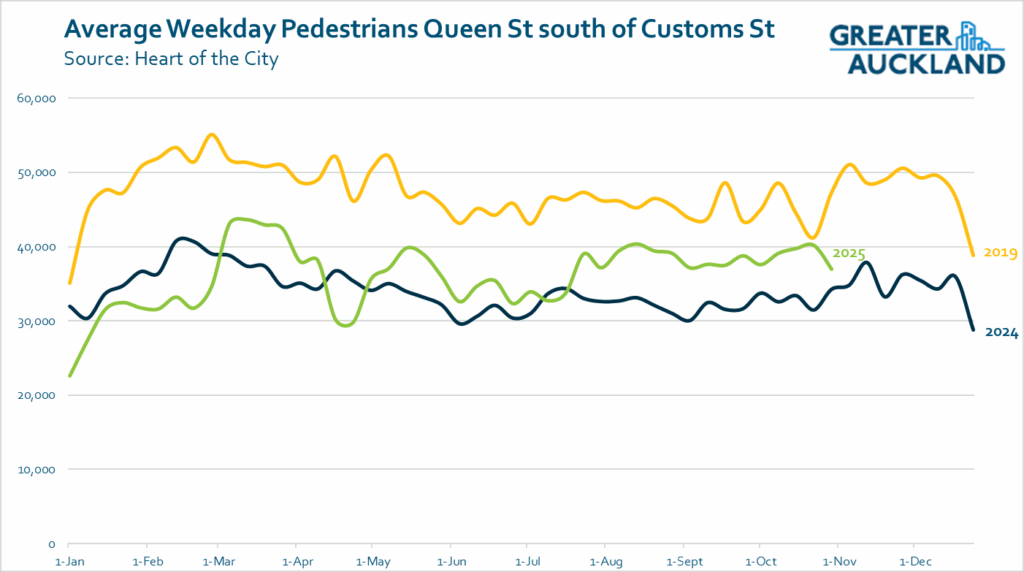
Footfall around Downtown, via HOTC’s counters.
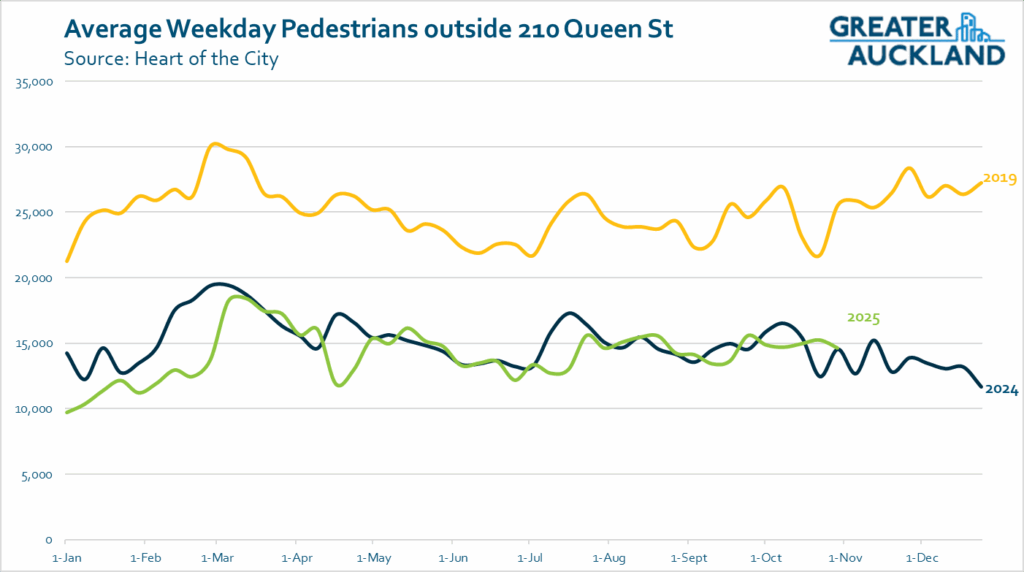
Footfall around Midtown, via HOTC’s counters
As Midtown’s streets reopen – Wellesley St, Victoria St/ Te Hā Noa linear park – people will return. And once CRL opens, they’ll be a direct train ride right into the heart of the city. Thousands of people per day, pouring into Midtown, without the need for a single extra car on Queen St.
And as AT’s own monitoring shows, people driving across the Queen St valley are only about 20% of all vehicles, and there’s no reason those trips couldn’t move to Mayoral Drive.
Moreover, the number of people driving into the city centre has been stagnant or declining since long before the Queen St AVO was added – and still, the city centre GDP outpaces the rest of the country
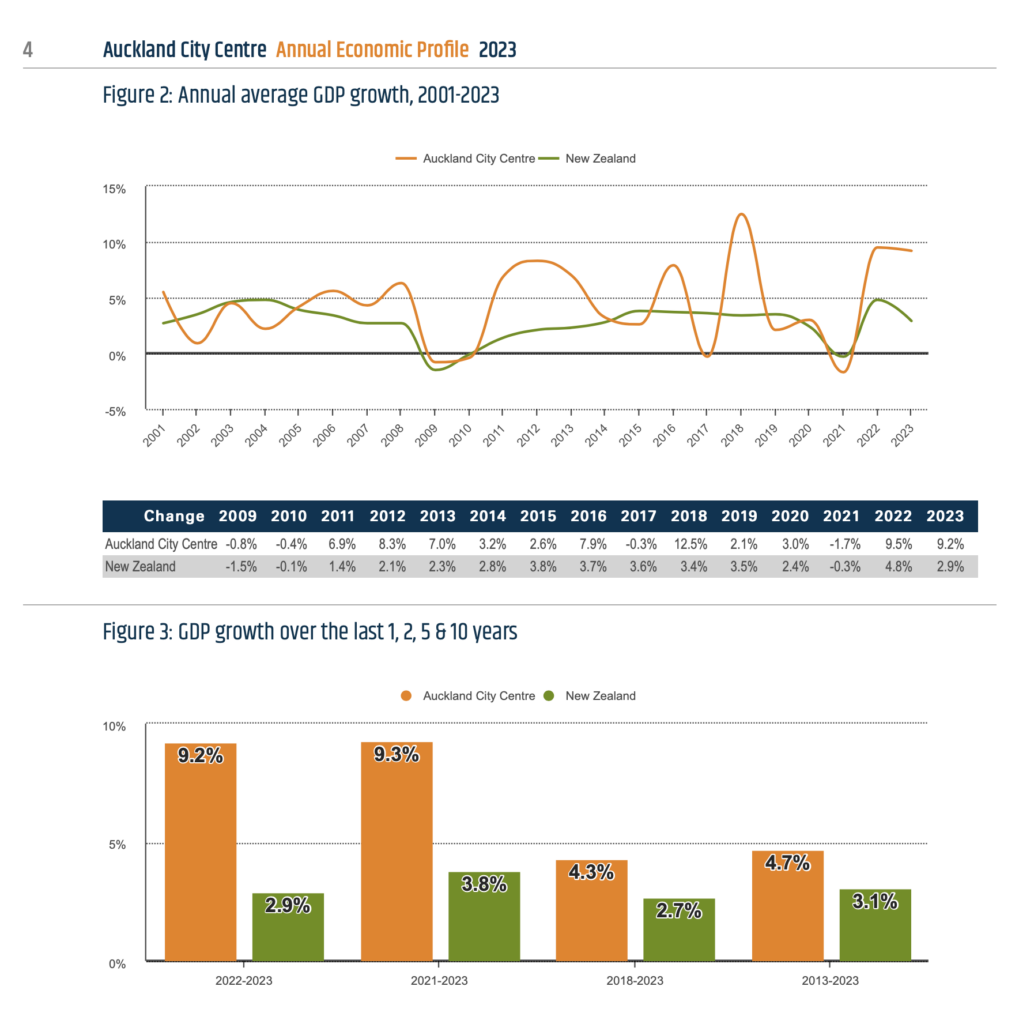
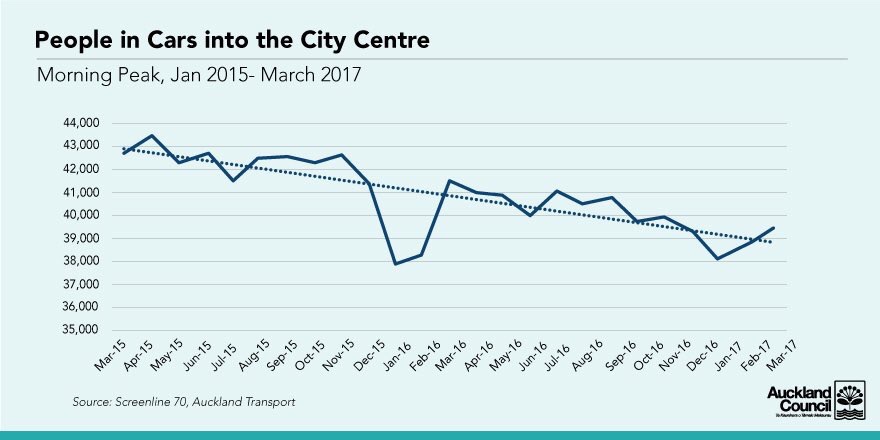
A fun graph from pre-Covid, showing the decline in people going into the City Centre by car between 2015-2017 – before the Queen Street AVO, before Access for Everyone.
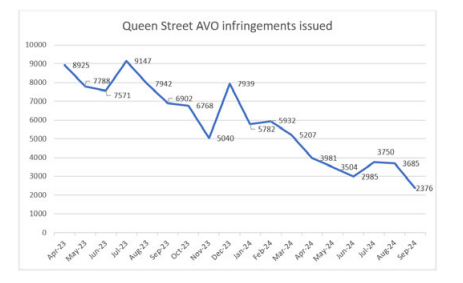
Even the number of infringements (people driving into and through the AVO zone by mistake) is steadily falling – so the grumbles about “confusion” and “revenue grabs” just don’t stack up.
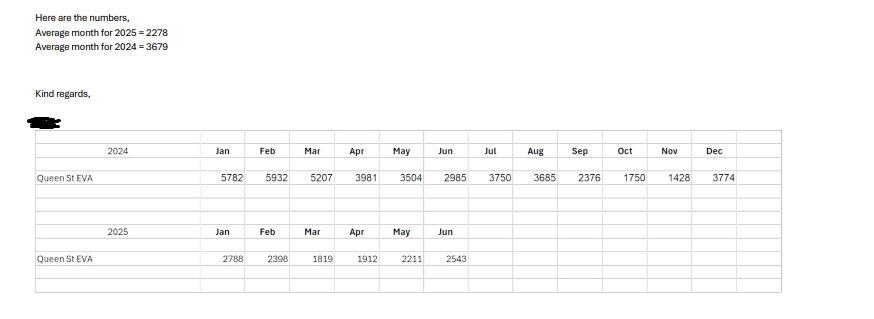
This has continued through 2025:
Long story short, Beck’s constant claims have no factual basis, and show a flawed understanding of what makes a 21st C city thrive. So why is AT prioritising her views over everyone else’s?
And let’s be clear. This isn’t about urbanists and advocates versus hard-nosed business people.
You just have to look at how buildings are being marketed in Midtown. The key selling points are access to public transport, and walkability (which equals high foot-traffic). We’re told “retail is returning”!

An article in the NZ Herald, fittingly published on 14 Feb 2026, brimming with love for Midtown.
When places let people thrive, businesses thrive too. Just to give a few examples:
1. The space left by the closure of Smith and Caughey’s is being filled with Faradays… a retail store:
You won’t be standing there looking for someone to help you out; you’ll be engaged with immediately. The digital to retail language and energy will be almost seamless. We’ll be very focused on an amazing digital and in-store experiences, we’re investigating the way those two things speak to each other, and dedicated to hospitality because we understand retail is an experience; it’s like an event. The product you leave with is only part of the product that you’re kind of purchasing. I feel that’s been lost in the past,” Von Dadelszen said.
2. The owners of Queens Arcade are spending $5 million transforming the historic building into a retail and well-being hub. If you listen to the interview on RNZ, there’s not one mention of cars – instead, extolling the value of things like the City Rail Link.
3. Look at the billions invested into Downtown Auckland from various businesses redeveloping the precinct around the CRL.
Of course development and recovery are discontinuous. We should have empathy for business owners who are struggling, and they should be supported through disruptive changes. But knee-jerk reactions and blanket pushback – inflamed by people who should know better – hurt us all.
So I have no idea why senior leadership in AT have acquiesced to Viv Beck.
Because the real answer for Midtown is to keep going, and get on with the transformations that we can see are already working elsewhere in the city. Build it, and they will come.

Te Komititanga: a crossroads of transport, people, and shops. No traffic. (Image: Patrick Reynolds)
Want to help save Midtown? Take action!
The shape of the trial is currently being locked in, so we need to speak up now, and demand:
- The trial is adjusted before it starts (or can be adjusted when it inevitably leads to bad outcomes – unreliable buses, congestion, unpleasant vibes for people walking and biking, etc.)
- The trial delivers the kind of transformations people continually ask for and support – a more pedestrianised Queen Street, 24/7 priority for buses on Wellesley Street, etc.
As with Project K, we can absolutely win this round – but it takes people power!
You can help by emailing the following people:
- Mayor Wayne Brown
- Deputy Mayor Desley Simpson
- Waitematā and Gulf Ward Councillor Mike Lee
- Chair of the Transport and Infrastructure Delivery Committee Andy Baker
- CEO Auckland Council Phil Wilson
- AT Chief Executive Dean Kimpton
- AT Chair Richard Leggat
- AT Acting Director Network Performance Melanie Alexander
- AT Director Public Transport and Active Modes Stacey Van Der Putten
- AT Engagement Email Address
To: [email protected], [email protected], [email protected], [email protected], [email protected], [email protected], [email protected], [email protected], [email protected].
And feel free to cc:
- the Waitematā Local Board (who were also blindsided by this trial, and as far as I know broadly do not support what AT is doing)
- the deputy chair of the Transport and Infrastructure Delivery Committee Shane Henderson ([email protected])
- any other elected members you feel should be included.
What to say? Firstly, state your opposition to:
- the undemocratic process that has led to this trial
- the trial’s premise – prioritising general traffic over public transport and people-friendly places.
You may also wish to mention:
- the trial as proposed doesn’t follow the vision of the City Centre Master Plan and its circulation plan, Access for Everyone.
- the timing is premature – with CRL opening later this year, a trial like this should have been considered only after we see how CRL changes the area.
- the trial is pushing for things that are the total opposite of what we, the people, have consistently said we want in every previous consultation.
So we’re asking Auckland Transport (and/or Auckland Council) to immediately adjust the trial, and:
- Implement 24/7 bus lanes on Wellesley Street, to prioritise public transport reliability and maximise the value of CRL
- Keep pedestrianising Queen Street – extend the AVO to Customs Street, and keep it 24/7
- Introduce logical pickup and drop off (PUDO) plans for ubers and taxis in Midtown
- Make Midtown mobility accessible, without allowing a free-for-all of private vehicles
It’s always great to include your own personal experience and perspective. For example:
- What do you like about the City Centre?
- What do you enjoy about people-friendly areas like the Waterfront, Te Komititanga, Freyberg Place, Te Hā Noa/Victoria Street Linear Park?
- If you take public transport, especially via Queen St or Wellesley St, is reliability important to you?
- Do you want to see Queen Street even more pedestrianised? If so, say why!
You can also mention that you value things like:
- public transport reliability
- walkability
- less noise pollution
- less air pollution
- pedestrian safety
- cycling
- the quality of the street environment for public life
- and more
As always, remember to be polite but firm in your views.
We can win this, just like we won Project K – but only if we take action!
So flick off an email and share this post and Monday’s post as widely as you can. Thank you!
Greater Auckland’s work is made possible by generous donations from our readers and fans. We’re now a registered charity, so your donations are tax-deductible. If you’d like to support our work you can join our circle of supporters here.

 Processing...
The mayor lives in Three Lamps in Ponsonby (unless there’s another elderly doppelgänger there). In his mind he needs to drive to work on the corner of Wellesley and Albert Street. Presumably he’s become irritated by the bus lanes and this is his reaction
I don’t think he does live there. I’ve seen him walking to work.
Give councillors an exemption – problem solved.
No reason why the mayor shouldn’t be able to use bus lanes.
By being a passenger on the bus of course.
Why? Just because they’re elected officials? They should follow the same rules as the rest of us. It’s really not that difficult.
Having just been in Auckland – staying just off Queens Street downtown – it puzzles me why any cars are still driving in the area. It also seems strange that there seem to be no cafes on lower Queen Street, plenty up the side streets through.
That would match my experience of Melbourne though. The cafes are not, generally on the main streets but in the laneways and side streets, and in the corners.
You see the same pattern in central Auckland. The pubs and cafes are mostly in smaller streets off Queen Street (Fort St, Vulcan Lane, Tyler St, etc) which helps to keep Queen street busy. Tiny streets are the interesting ones.
It’s a different story south of Mayoral Drive. There is basically zero secondary street grid in this area; permeabibility is dreadful and it’s just an in-between space, with a fragile veneer of activity from one or two venues that manage to survive.
Key question: “So why is AT prioritising her views over everyone else’s?”
AT managed to shed one of its worst senior managers recently, but the organisation seems to be doing nothing to clear out his legacy. This man had shown publicly many times that his understanding of what he was supposed to be an expert in was ‘incomplete’, to put it politely, and that he had zero understanding of how modeshift works. He’d become a running joke in the world of advocacy and progressive bureaucracy. There was even an emoji created from one of his worst graphics.
With him gone, it seems the people who enabled him still pull this antidemocratic shit.
Some cities in Europe were cleaning out their city centres with A4E type schemes as early as the 70s. Here we are, half a century later, and Auckland’s held back by this embarrassing incompetence.
The local board were informed at different stages of this and had an opportunity to ask questions and share thoughts but we were never asked to give formal feedback. In the middle of 2025 the plan was for 24 hour bus lanes on Wellesley St. This came with significant infringement fines. My comment was that the signage had to be very clear where Wellesley St became bus only so people didn’t get caught out. And then the goalposts shifted in October: general traffic would be allowed through after 10pm, which sounded not so bad (easier for young people grabbing ubers late – but there are negatives so I’m not that supportive – taxis circulating, speeding, dangerous drop offs). And then in December it was down to 7pm. There are so many annoying aspects to this. It is against agreed policies like Access4All. It delivers worse outcomes than agreed policy – it compromises public transport, safety and placemaking opportunities, without particularly improving pick up and drop off or servicing and loading. But it is also galling that AT talks about avoiding reputational damage by responding to key stakeholders when they don’t include the city centre residents group, or the local board or anyone but a few people, and It is unclear whether they consulted with the community safety teams inside council who manage compliance. It doesn’t sound like they spoke to the police before going down this track – who, I hear, are not supportive at all – because there’s enough going on without having to tackle boy racers down Queen St. If the trial goes ahead it is important that there is a pathway back to a sensible, evidence-based approach – or, even better, follow the evidence and best practice now. I sympathise with the staff trying to get good outcomes who are being forced to swallow dead rats. Some good news that is being ignored in all this – PUDO, servicing and loading, coach parking improvements have been rolled out in Wakefield, Mayoral Drive, outside the town hall etc, following the central city kerbside strategy work Room2Move that another team in AT has done. This is what will improve customer experience and functioning businesses not blocking up the busways.
If they’re making changes for PUDO, they can make changes for bike safety too. Can you fill us in on what they’re doing for that, Alex?
I started living in the city around the creation of Britomart, via a private investor who could actually envisage a positive city centre. With Commercial Bay, Te Komititanga appeared. Formerly part of Queen Street, now a paradise for young and old alike, without the constant threat of being killed by an errant big wheeled machine.
AT must mean ANGRY TRANSIT. Because everything that AT does, causes angst, rage, and discontent within certain communities.
There are progressive people, and there are those with a nostalgic connection to the automobile, among other groups; but as a long term city centre resident, private motor vehicles have always been my greatest HATE, even before I become a father.
Now I am even more frightened because I have kids.
Queen Street is considerably more pleasant with the reduced car space. If we cut traffic completely, it would be more pleasant.
If we are intent on creating a WORLD CLASS city, we need to make WORLD CLASS investments.
These are boulevards, trams, and all those “fancy” European things that we are so fond of visiting.
We need to bring these things HOME.
bah humbug
There really ought to be a mandatory bedding in period of some kind once the council has made such an important and (apparently) informed decision.
What a waste of money revisiting this is.
“restoring car parking outside luxury stores like Louis Vuitton and Dior along that stretch”
My understanding is that a significant portion of these stores trade comes from cruise ship passengers. Perhaps they would benifit by restoring the original foreshore so these ships can moor up closer.
Viv Beck always gives the impression of serving vested interests other then inner city businesses. Namely the motoring industry. The Heart of the City and now her Lower Queen Street Association Incorperated are just vehicles she has commandeered to achieve her other interests.
Bollux car brain stuff aside, its great that AT are embracing “trials” to see what works
Seems they got the “tactical urbanism” memo, and are trying new things.
“hey – lets see what would happen if we reduce public transport…” seems to be the question.
A 2 year trial for mode-shifting a lane across the harbour bridge would deliver massive outcomes. Tactical in the sense that NZTA operate the bridge in AT territory.
Reserving a lane on the bridge for pedestrians should definitely happen, but I’ll believe it when I see it
Viv Beck really needs to go. This new Lower Queen St Association she’s involved with are presumably the same people (Andrew Krukziener et al) who lobbied for a VIP lane in Queen St so their customers could drive to shop at Dior, Louis Vuitton etc.
It’s shocking that AT caves in to these people, aided and abetted by Mike Lee, who hilariously rushed into print when Marbecks announced they were closing to claim that it was because you can’t park outside their store anymore.
Seems he hasn’t noticed that most people don’t buy music tapes, LPs or compact discs any more. Or that Queens Arcade is closing for major refurbishment because their owner sees the immense value uplift brought about by pedestrianisation in the area.
Good to see Malcolm McCracken is the new chair of HOTC. Hopefully there’ll be some movement soon.
Meanwhile keep up the good work Connor. This appalling trial needs to be halted.
A few things to consider when lobbying on this:
1) Don’t forget mobility access for those who need Authorized access to reach destinations in the city centre.
2) Civic Theatre access is a factor in what to do, especially for mobility needs.
3) Weird time limits on access to some streets will make use of Google for navigation unreliable, on the shoulder of change times. People being led into an infringement is not good, if they believe their phone and don’t see and read the signs that contradict the route they had planned.
Does anyone remember Hayden Donnell’s article “The Trouble with Auckland Transport”.
https://www.metromag.co.nz/city-life/city-life-transport/the-trouble-with-auckland-transport
“A transport planner says AT is occupying the worst of both worlds — asserting its independence from progressive council plans on the one hand and caving to regressive feedback on the other. He wants it to focus on following evidence rather than trying to divine community will from small consultations.”
AND
“These complaints are linked by a common thread: AT’s reluctance to take road space away from cars and use it for dedicated cycling and public transport lanes.”
It was written almost 4 years ago but the Project K and Queen/Wellesley St projects show that the trouble hasn’t gone away.
I recall a few years ago it would take the city link bus 40 minutes to go up Queen St at 10pm because there were so many cars allowed and green traffic lights were very short durations
This is going to be a disaster and these problems will only get worse when planning shifts to council where Mayor flip flop will have even more power to direct decisions by his every whim.
A NZH article from yesterday states:
“Brown accused AT of ignoring his letter instructing it to improve east–west movement on Wellesley St and Victoria St, saying it had not done anything and argued that once he has control, it should finally become easier to cross the city, because, in his view, it certainly couldn’t be any harder than it is now.”
https://www.nzherald.co.nz/nz/auckland/wayne-brown-plans-dramatic-overhaul-of-auckland-roads-after-auckland-transport-break-up/TUX2UGFLSFFX5FFKXWZH55JTY4/
Once upon a time this would have been edited into shorter sentences.
So … looks like Wayne hasn’t read the Access 4 All plan, which proposes to prioritise walking, cycling and transit by reducing car traffic passing through the central city – and which was approved *unanimously* by the council.
AT management talking about the Queen st AVO and its justifications in the 25/2/26 council transport and infrastructure meeting.
https://youtu.be/yiKGPDLGZKo?t=1710
no answers? lots of hedged comments – and heart of the city is mentioned.
Not really on point, but was back on Queens St at night for the first time in many years. It all looked very sad and was a very poor advertisement for the city. Pavement was littered with rubbish and it felt very dirty. But I am not sure how allowing cars back will improve matters. It will simply add more noise and pollution and make it even more unattractive as a place to linger. AKL council desperately needs some new thinking rather than harking back to a time that has long passed. Every city needs to reinvent itself from time to time and AKL is no different.