Just before Christmas, Auckland Transport (AT) let slip a plan for a two-year “trial” of bringing back overnight traffic along Queen Street.
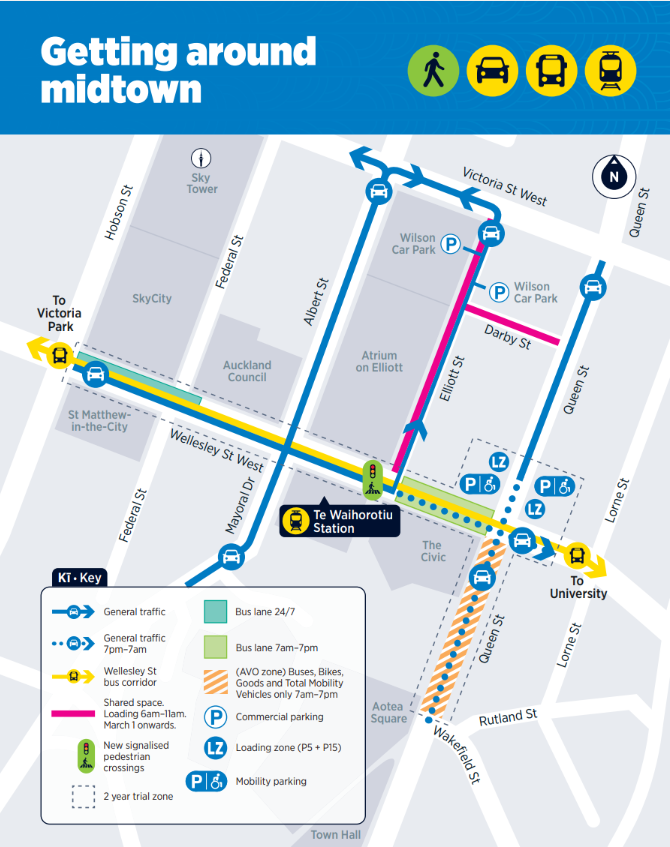
Specifically, they want to reopen the section of Queen St between Wakefield and Wellesley to general vehicles, from 7pm – 7am. Currently, this is a 24/7 AVO zone – Authorised Vehicles Only – used by buses, bikes, mopeds, motorbikes, emergency vehicles, and registered goods vehicles.
It also proposes that bus lanes on Wellesley St, one of the busiest bus corridors in the city which is near completion of significant upgrades, only operate between 7am – 7pm (to align with the Queen Street free for all).
The trial also includes minor adjustments to mobility parking and loading zones, which are fine, but could be a lot better.
But re-opening Queen St to night-time through-traffic is the shocker, because:
- it runs in direct opposition to the overriding vision for the City Centre
- it flies in the face of all the public feedback, plans, consulted projects, expert advice and evidence that underpin normal decision-making
- it’s a U-turn from AT’s initial intentions – as confirmed by documents I’ve just received under the Local Government Official Information and Meeting Act (LGOIMA)
- this “bring back traffic” trial will run for two years, starting next month – overlapping with the opening of the CRL later this year, which will pour tens of thousands more people into this part of Queen St.
And guess what: AT only came up with the shape of this “trial” after talking with a tiny handful of stakeholders, before quietly revealing it in a Local Board workshop.
What’s more: the proposal is up on a “Have Your Say” page – but is not open for public feedback. Just questions. Oh boy do we have questions.
So once again, it’s time to make some noise. For details about how to take action, see the bottom of this post.
What on earth is happening?
As I outlined last year (see details on AT’s project page), AT is proposing to allow general traffic through the current AVO area, from 7pm -7am.
This represents a huge deviation from the City Centre Masterplan, and its transport component Access for Everyone, with major consequences for public transport reliability and the feel of Midtown.
And it’s being rushed through, with the ‘trial’ set to begin in early March once the Wellesley St improvements are done – and before City Rail Link opens.
Whose idea is this, and is it a good idea?
Great questions. After the plan went public, I put in a LGOIMA request for the thinking behind it.
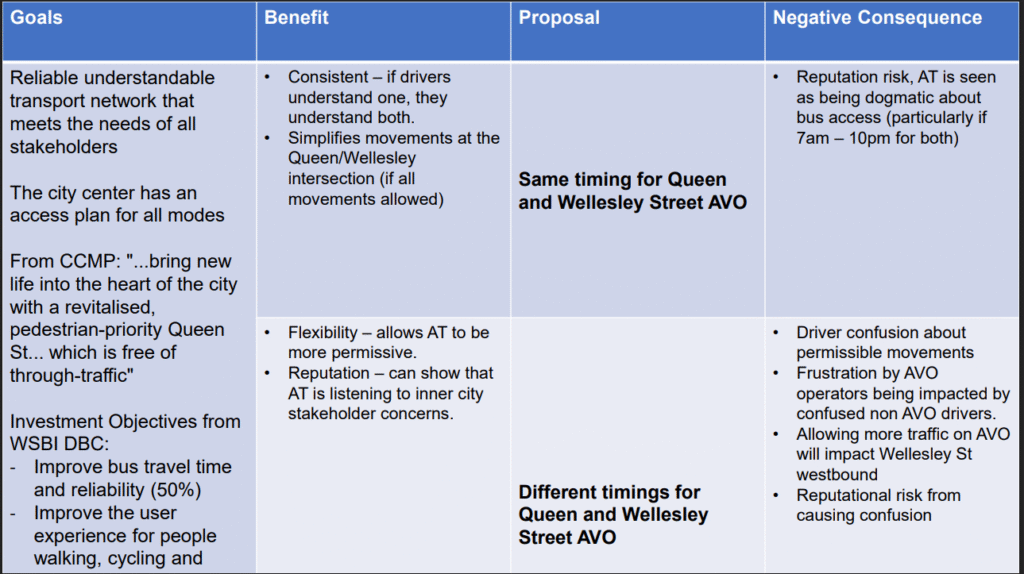
I received the documents last week. One of the most significant, produced by AT’s Public Transport team, outlines the benefits and consequences of options for Queen St and Wellesley St. It has two parts, the first being options on timing for the Queen Street AVO and Wellesley Street Bus Lane.
Unfortunately, the bottom of each page is cut off. But you can clearly see the negative consequences of allowing full vehicle access from 7am-10pm, with even worse consequences for 7am-7pm.
So AT’s decision-makers chose the worst option, against the advice of their public transport team.
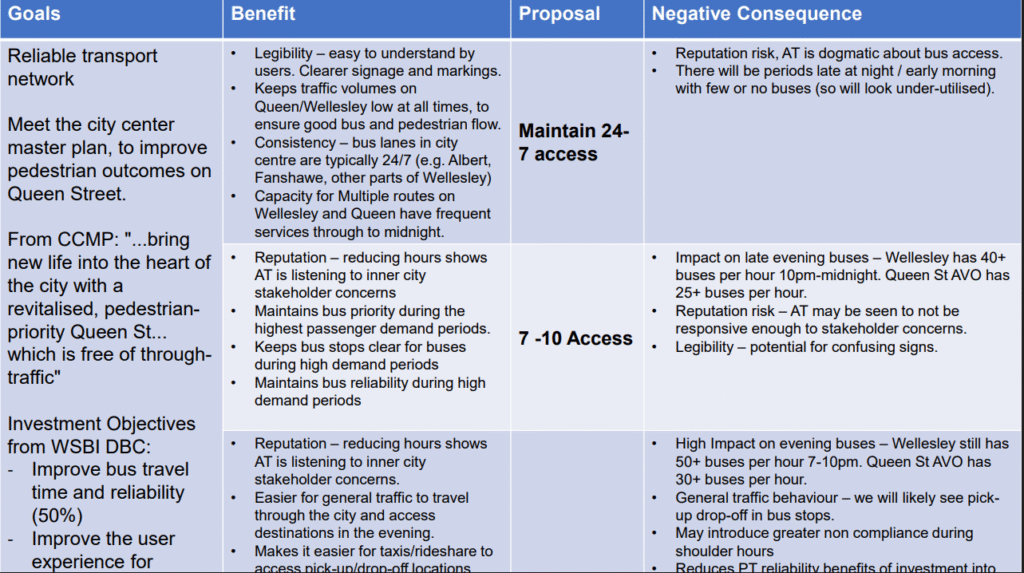
Note the references to “reputation” and “reputation risk”, in the context of “listening to stakeholders.”
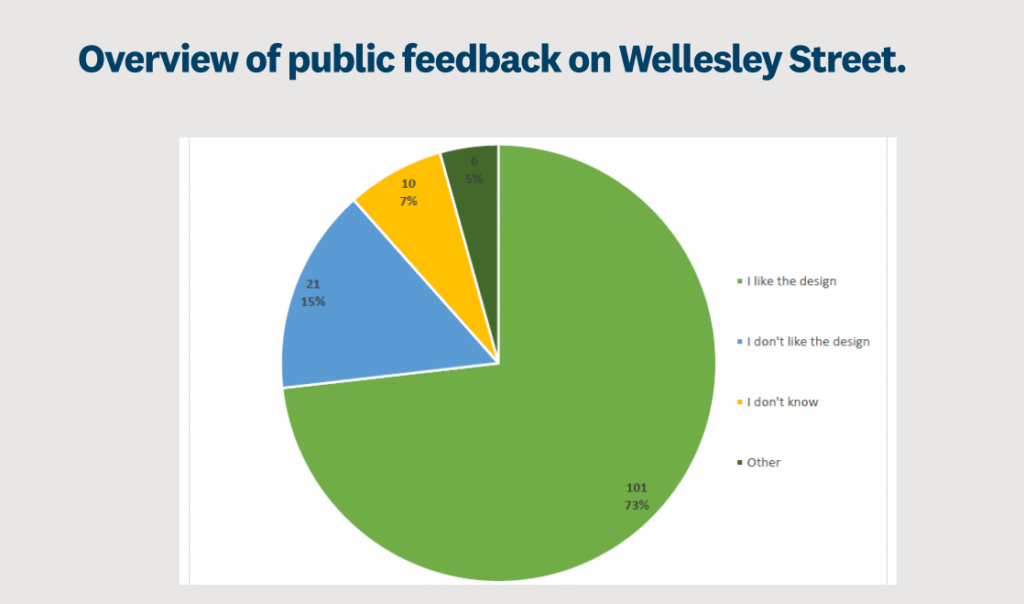
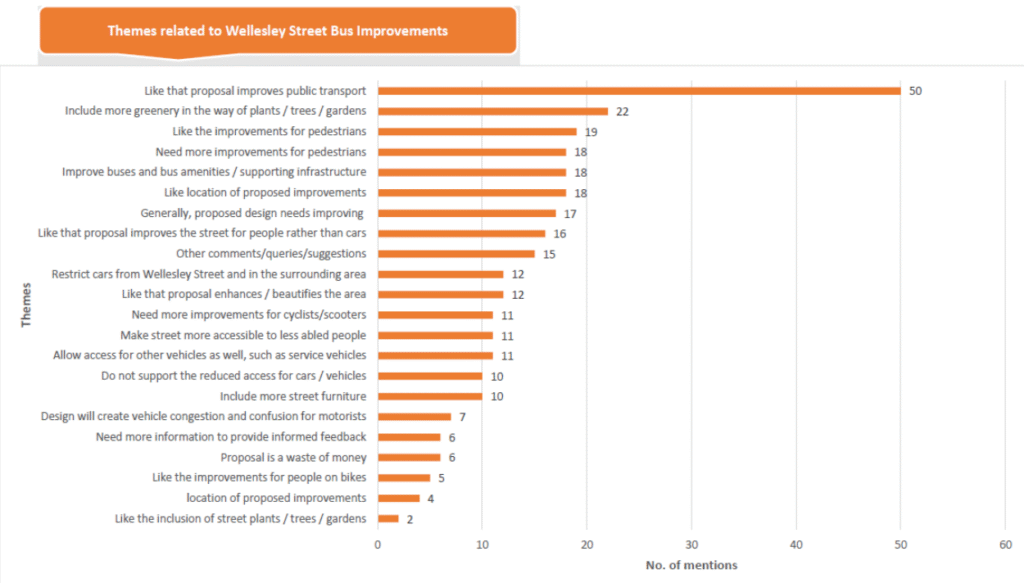
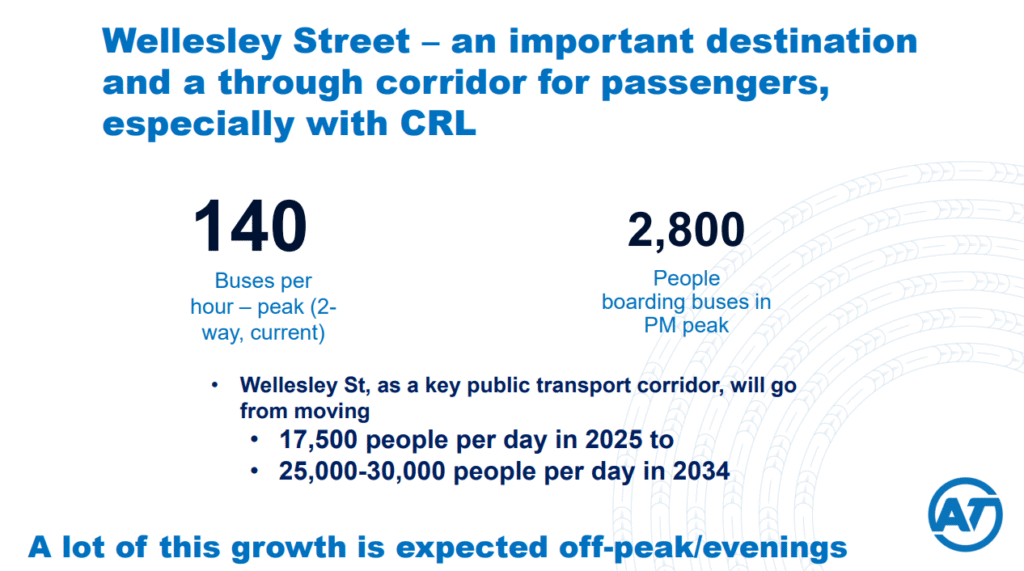
But which stakeholders? Helpfully, one of the documents I received – a November 2025 update on plans for Midtown – includes the 2022 feedback on plans for Wellesley St. As the graphs below show, public feedback was 73% supportive, and people were enthusiastic about public transport, greenery, pedestrian access, safety and comfort.
And this is just one of many examples of public support over the years.
So wouldn’t it be good, actually, for AT’s reputation if they delivered what people overwhelmingly want for the city centre – prioritising public transport and people access over general traffic?
That November 2025 document is full of other good points, like how people will mainly flock to the area at “off-peak/evenings”, especially when CRL opens. Which is exactly when this trial will be making Queen St and Wellesley St much worse for buses and people.
The other thing AT’s Public Transport team provided advice on was whether Queen St and Wellesley St should have the same timing for restrictions:
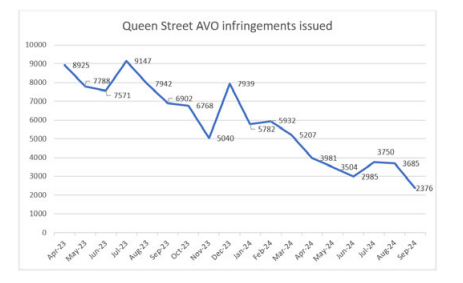
A major complaint about the Queen St AVO is that it’s confusing and unclear, and I don’t disagree, although the number of infringements has been falling month on month.
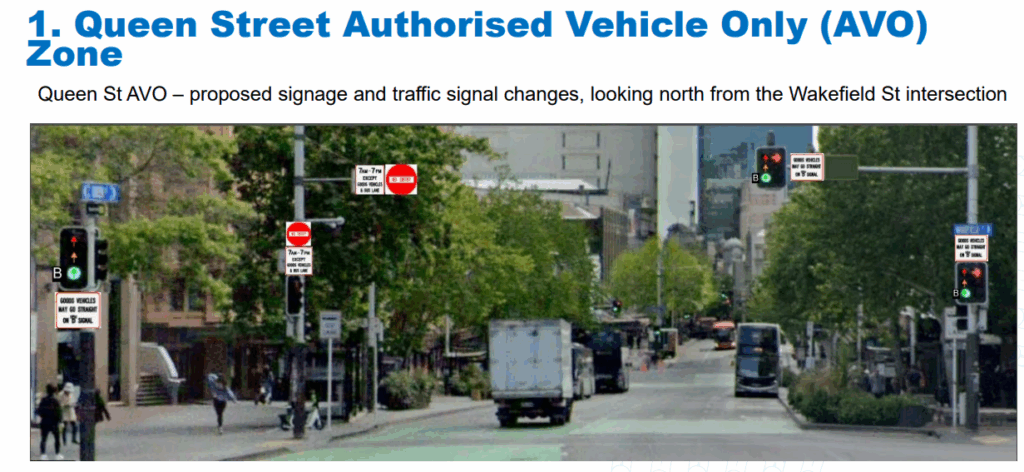
But I would love an explanation of the proposed “fix” (see pic below from last year). Not from the unfortunate staff at AT and Council who are carrying water for this mess, but from the senior decision makers who seem to be pushing the shape of this trial.
The solution is not to make the AVO more confusing by only opening it to through-traffic at certain times. It’s to make it as intuitive and clear as possible. If you want people to stop complaining about getting caught in an AVO, make the whole of Queen St an AVO, from Mayoral Drive to Customs Street.
Basically, “pedestrianise” Queen St. Which people have repeatedly said they want. Yet every time we take a step towards it, the same people come out, again and again, to block and complain.
And the tragedy is, there’s some good stuff in the information AT sent me. This includes plans for Pick Up and Drop Off (PUDO) areas around the Town Hall, which address genuine needs and concerns for the theatres on Queen Street, while minimising traffic. A win-win for accessibility that fulfils the vision of Access for Everyone. Some of this appears to be happening, but not all.
So why isn’t the rest of it in the trial?
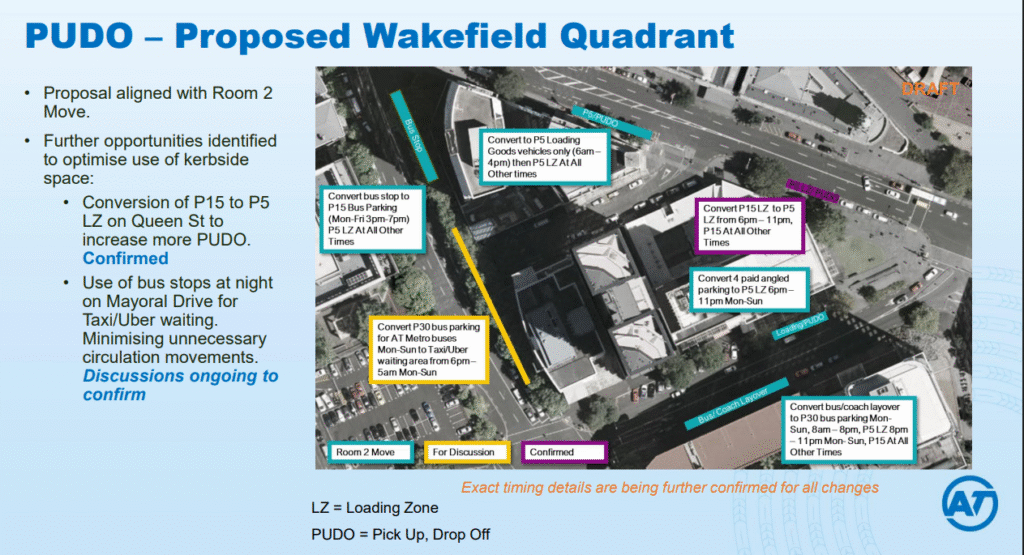
Another document I received – an April 2025 presentation to the City Centre Steering Committee – proposes expanding the AVO on Queen St, bringing it closer to full pedestrianisation.
The map on the top right (below) is from the Access for Everyone Business Case, and references extending the AVO on Queen Street. Much closer to what people actually want than the farcical “trial”.
So why didn’t this make it through?
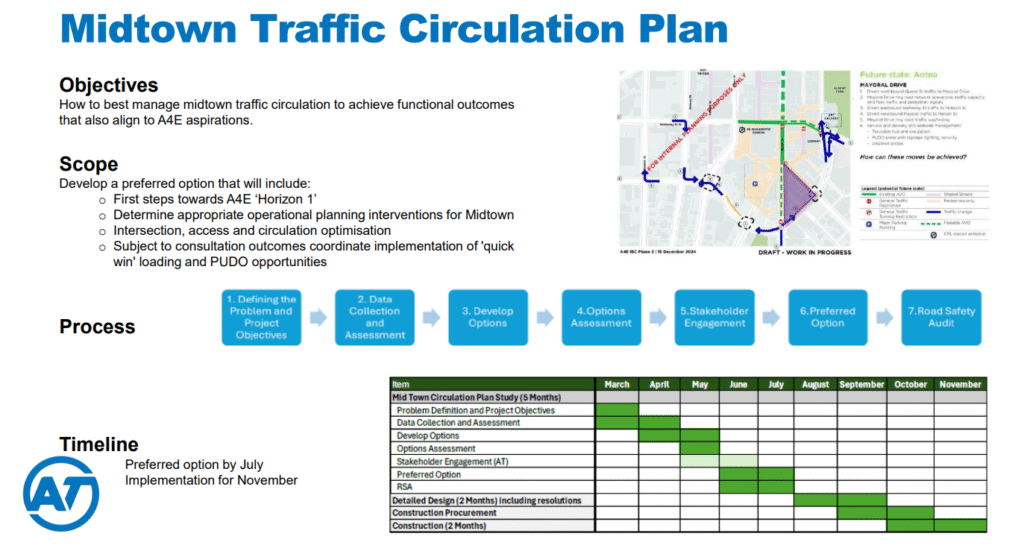
Going through the documents, what you can see is that every such move in the right direction… is eventually gutted by AT at the last minute in late 2025 – in an attempt, it seems, to find ‘balance’ or ‘compromise’ with the views of a tiny few.
Again and again, the decision-makers (aka senior AT leadership) go against:
- the advice of their public transport team
- the democratic consensus on strategy and vision
- and the wishes of the public
… in the process, actively undermining the promise of CRL, our nation’s single biggest infrastructure investment.
And all in a pointless attempt to appease a vocal minority who never have and never will stop complaining, even when they get their way.
Sound familiar? Yep, shades of Project K.
Frankly, it’s not exactly been a good-faith process. AT’s complete lack of engagement with anyone outside the small number of people they talked to shows that.
So later this week, I’m going to dive into that process, to explain who is pushing behind the scenes for this, and when exactly AT senior leadership folded to them.
In the meantime, while this trial is going ahead, there is hope we can shape it to be something better!
It’s time to take action – here’s how!
As far as I understand, the exact shape of the Midtown trial is not yet locked in, but we don’t have much time.
Which means we have an urgent opportunity to drastically improve it!
So it’s really important we speak up, as quickly as possible, to make sure:
- The trial can be adjusted as soon as possible – either before it starts, or when it inevitably starts producing bad outcomes (poor public transport reliability, traffic congestion, unpleasant experiences for pedestrians and people on bikes, etc)
- The trial instead delivers the transformation people have continually asked for and support (pedestrianised Queen Street, prioritisation of public transport on Wellesley Street, etc)
But, as with Project K, we’re going to need people power to win this, so we need your help.
Please send an email, addressed to the following people:
- Mayor Wayne Brown
- Deputy Mayor Desley Simpson
- Waitematā and Gulf Ward Councillor Mike Lee
- Chair of the Transport and Infrastructure Delivery Committee Andy Baker
- CEO Auckland Council Phil Wilson
- AT Chief Executive Dean Kimpton
- AT Chair Richard Leggat
- AT Acting Director Network Performance Melanie Alexander
- AT Director Public Transport and Active Modes Stacey Van Der Putten
- AT Engagement Email Address
To: mayor.wayne.brown@aucklandcouncil.govt.nz, desley.simpson@aucklandcouncil.govt.nz, mike.lee@aucklandcouncil.govt.nz, andrew.baker@aucklandcouncil.govt.nz, phil.wilson@aucklandcouncil.govt.nz, chief.executive@at.govt.nz, Richard.leggat@at.govt.nz, Melanie.Alexander@at.govt.nz, Stacey.VanDerPutten@at.govt.
Feel free to cc:
- the Waitematā Local Board (who were also blindsided by this trial, and as far as I know broadly do not support what AT is doing)
- the deputy chair of the Transport and Infrastructure Delivery Committee Shane Henderson (shane.henderson@aucklandcouncil.govt.nz)
- any other elected members you feel should be included.
In your email, state your opposition to:
- the process that has led to this trial
- and its starting premise, which is about increasing access for general vehicles at the expense of public transport and people.
You may also wish to mention
- the trial as proposed does not follow the vision set out for the City Centre in the Masterplan, nor its transport component Access for Everyone.
- the timimg is premature – with CRL opening later this year a trial like this should have been considered only after CRL has had time to settle in.
- the trial is pushing outcomes that are the opposite of what the public have consistently said they want in previous consultations.
Therefore, Auckland Transport (and/or Auckland Council) should immediately adjust the trial to instead:
- Implement 24/7 bus lanes on Wellesley Street, to ensure public transport is reliable and to maximise the value of CRL
- Progress pedestrianisation of Queen Street by extending the AVO all the way to Customs Street, and keep it 24/7
- Implement logical pickup and drop off (PUDO) plans for ubers and taxis around Midtown
- Ensure mobility access is enabled around Midtown, without allowing a free-for-all of private vehicles
Additionally, it’s always good to include your own personal experience and perspective. For example:
- What do you like about the City Centre?
- What do you enjoy about the city centre’s people-friendly areas (such as the Waterfront, Te Komititanga, Freyberg Place, Te Hā Noa/Victoria Street Linear Park)
- If you take public transport, especially via Queen St or Wellesley St, is reliability important to you?
- Do you want to see Queen Street (more/ fully) pedestrianised? If so, include why!
You can also mention that you value better outcomes for these factors:
- public transport reliability
- walkability
- noise pollution
- air pollution
- pedestrian safety
- cycling
- the quality of the street environment for public life
- and more
As always, remember to be polite but firm in your views.
We know we can win this – and, as with Project K, we can ensure that we get the city we want and deserve. But only if we take action!
So send an email to those above, and share this post as widely as you can. Thank you!
Greater Auckland’s work is made possible by generous donations from our readers and fans. We’re now a registered charity, so your donations are tax-deductible. If you’d like to support our work you can join our circle of supporters here.

 Processing...
Its just so odd isn’t it. Why do we need cars down Queen Street? Virtually no one wants it. There is almost no parking there, it couldn’t make the slightest difference to businesses. And it actually slows traffic using the cross roads; there are right turn phases into and out of Queen Street which wouldn’t be needed if it was bus only. It makes no sense at all.
Unfortunately there are still people in positions of influence that just know that only people who drive really matter, they’re the ones that spend money and run the economy. So naturally if they can’t be lured into the city with the promise of abundant driving on every street and lots of parking, the city will fail.
Have a look at the campaigns from
heart of the city. Their solution for transport is a fully subsidized taxi to drive people from Ponsonby Road to Queen Street.
Utterly laughable, why is City leadership such a joke
I am confused. Why, when evidence from virtually any city in the western world (and Asian for that sake) show that pedestrianisation increase turnover and foot traffic, are these people so stuck in wanting traffic on a few streets in the city centre. What is it about these people that makes them so anti the creation of a desirable living space in our city centre. A space that becomes a destination in itself offering F&B, entertainment and premier shopping. It works in Sydney, Melbourne and even on the gold coast. So why are they against it over here when all evidence shows it helps retail, helps F&B and our entertainment business.
This is not a partisan political project. This is about revitalising Queen Street and turning it into the commercial egine and parade street that it should be. Were the biggest city and commercial hub of New Zealand (and the south pacific). Our city centre needs to reflect this,
The smalltown mindset where happiness is to drive up High Street and park right outside the hardware store for the weekly supply run needs to end.
Something I’ve picked up with a lot of ‘change’ projects, is that after the initial round of consultation, announcements, plans, etc, the people who support the changes quieten down – because they believe its going to happen, and so don’t see the need to continue saying they want it.
But because it often takes a lot of time between planning, announcement, and delivery, in the period between plans and delivery the people who oppose changes will continue to complain, pressure, speak up, against what’s going on. Often those who oppose something will use legitimate concerns or things that need adjustment, but blow them up to try and destroy the core purpose of a project/plan. I really don’t know why they do this, its usually the same people who are most vocal with opposition, regardless of the success of other changes or evidence in general.
However, for a lot of decision makers, whether elected members, or senior leadership in bureaucracies, or even project teams, all they hear for a sustained period of time is opposition, which makes them believe they don’t have the social licence for delivery.
It’s why you need people in these positions who are brave (or at least willing to ignore the complainers), and understand and know the results of previous consultation, polls, public mood etc, and then act on it.
Unfortunately, its been a consistent trend that those who seem to be in charge of these decisions are not willing to be brave, and keep listening to the vocal minority of complainers. Which is why those who support the changes (and know its backed by evidence!) have to speak up when they falter!
So true. Is a similar dynamic undermining the CRL service design process?
This points to a major problem at leadership level; defensiveness instead of an inclination to reflect on process pitfalls.
It worked in Sydney, Melbourne or Tokyo etc. becoz sufficient and reliable mass public transport already in place, there is a lot for AKL to catch up even with CRL running. Which works together with pedestrian friendly policies.
There is no doubt the only solution for high density city core traffic is mass public transport infrastructure, and AT’s current plan to granular introduce these polices with CRL opening makes great sense to me. The ‘smalltown’ mindsets just wouldn’t believe it until they saw it
Thing is, AT isn’t doing ‘granular’ changes, they are going backwards!
We have enough accessibility in the City Centre now to progress these things, even before the CRL opens, Auckland’s bus network is extremely good. And implementing progressive changes on this also feeds into improving accessibility and reliability of that network (ie Wellesley Street).
Also, we have successful examples of pedestrianisation in Auckland already, see Downtown (or Freberg Place, Vulcan Lane, Fort Street, etc etc).
Sorry I should be more specific, before AT decided to change mind on Queen St Bus only policy, all these changes in the CBD in last 5 years seems good transformation to me. Maybe the frustration before dawn of CRL drove some ppl’s impatience to a limit. Just like the same group of ppl keep saying CRL is pointless and a waste of money, however I’m sure there will be praise after it actually opened and changed train frequency in CBD forever. Even the most stubborn car enthusiast ‘smalltown’ mind set drivers will be happy to see the motorway traffic not getting further worse bcoz the train brought more cars off the road.
I work in in downtown area and lived in isthmus, my personal experience with AKL train/bus in terms of efficiency and reliability is still far behind other international cities in Europe or Asia, we need more coverage of mass public transit in isthmus and more dedicated bus lanes in outer mid-high density corridors.
Oh sure gotya! Yeah I agree we need that stuff as well (am working on light rail!) misinterpreted what you were meaning!
“Gas rabies” is the condition inflicting these so-called leaders and “stakeholders”, I believe. Coined when drivers first started to arrogantly take over our public spaces.
These senior bureaucrats and politicians are undermining bureaucracy and attacking the rights of the public with this constant barrage, project after project. They need to be shamed.
Thanks for this update. Will def submit feedback including all your suggestions.
My biggest issue with the current situation, as a regular theatre goer, is practical access to the Civic, especially with older or less mobile patrons who can’t get from the Civic carpark or outside the Town Hall even. There really needs to be some closer pick up and drop off access for these folks rather than the current situation of having to pull in and then back out of the backstage access way.
The trip from the civic carpark to the civic theatre (350m) could potentially be resolved with wheel chairs or other mobility assistance, since it’s a specific location and concerts and shows are held frequently.
I wonder if you would generalise your advocacy on the point? If this distance (350m) is too far for people with less mobility, then the transfer distance between AT’s bus stops at major intersections is often too far as well. Given these transfer locations can impact people with less mobility every day, when they don’t have the benefit of someone like you assisting them, it’s possibly the more urgent issue to be addressed.
In fact, from the lift to the civic theatre it’s only 260m. A distance that’s very much smaller than people with mobility concerns have to contend with throughout the transport network.
I haven’t been in the carpark for years. Are there improvements that would make a difference to you? Are there seats next to the pick up and drop off parks on Level 1, for example?
Two points:
1) Transfer distances are sometimes annoyingly far even for able-bodied people, e.g. when you have to go from Lower Albert St to the other side of Waitemata Station to catch a bus to Mt Eden.
2) On the other hand, even the epitome of car-centric design, the suburban mall, makes you walk more than 350 meters if you don’t have mobility parking and only visit the first 2 stores inside.
AT is about to cease to exist in its current form. It should be in the process of winding down and absolutely not making any policy decisions whatsoever. Senior management should be sacked as of now.
How many of them have been transferred to jobs in Council instead?
Connor, do you know if the intention is to bring bus stops for the Outer Link in the eastward direction back down to the Queen St level?
Shifting the bus stop up the hill has been a right pain in the arse… and has prevented some people from taking up my suggestion of using the bus at all.
Sorry. Westward direction. The bus stop they removed was on Wellesley St, on the East side of Queen St.
Not sure sorry! Can try find out
In Christchurch, parts of Cashel St and Oxford Tce, in the heart of the city, work very well as low/no traffic main shopping and F&B streets. They even have a toy Tram running down the middle. Maybe those who are pushing this change need to go visit to see how cities smaller than AKL manage sans auto, then jump the ditch to see how bigger cities do it.
Aucklanders visit Christchurch and comment on how lively the CBD, the return to Auckland and rubbish the CBD and complain about “the war on cars”
“later this week, I’m going to dive into that process, to explain who is pushing behind the scenes for this, and when exactly AT senior leadership folded to them.”
Thanks, Connor. Looking forward to that.
I’m keen to learn about Melanie Alexander and Stacey Van Der Putten’s actions, as your list includes them, alongside the usual CEO, Board Chair and various Council people. Are these two senior AT people committed to evidence-based planning or swayed easily by politics? And where will they work after Council picks up the strategy work?
The reason for this is in your post. Infringements are going down so they need to make it more confusing so get the fines back up again.
Seems nuts, have them both as 24/7 rather than adding confusion. I just don’t understand the benefits, there are no driveways on that stretch, and Albert St/one ways already exist for traffic going inside the CBD, and at that time any trips outside of the CBD it’s far faster to drive round it than through.
People that desperately want to drive that stretch can already do so (and pay a fine for it).
If you look up ironic in the dictionary it has a screenshot of this page where the first ‘important link’ is Auckland Council’s Access for Everyone masterplan
Leadership in this country seem to have no vision for the future beyond their steering wheel
Who has a trial for 2yrs?
Thats basically a permament change that everyone will forget about after a year. And it would be so much harder to change it back if AT even wanted to.
What has happened at the Queen St end of Fort St? Was that a trial that ‘ended’ with no plan for continuation? Or was it a victim of other problems not being adequately addressed?
A permanent version with plants in the ground would’ve been great. Instead, it seems to have become a place for construction vehicles to park next to “no parking” signs. I haven’t seen enforcement in action.