What’s faster: a less frequent direct service or a more frequent service that requires a transfer?
In my post last week about needing a metro timetable to match our upgraded rail network, a few things came up that caught my attention:
- That the testing didn’t go well
- There were a number of suggestions about west-to-Newmarket services – with some similar comments I’ve seen from time to time in other places.
So let’s look at these.
First up, AT has admitted that testing didn’t go well; hopefully this means they will make changes to remove some of the complexity and give us a more metro-style timetable.
“The testing was a valuable learning curve”, Ms van der Putten says.
“It highlighted several challenges, particularly around network congestion, which our teams are now working through. We’ll tweak a few things before we run the simulation again in the April school holidays, to help us finalise a robust timetable and provide reliable services from day one.”
The main focus of this post, though, is about west-Newmarket services. Talk about retaining some services for this journey is understandable given it’s been an important destination for Western Line rail users up until now. It’s also personal for me – not only do I live out west near the rail line, so I have an interest in the connection, but my wife works in Newmarket so any change will impact her.
However, nostalgia and individual benefit alone isn’t a good enough reason to keep direct services to Newmarket, in the face of such a transformative change as the City Rail Link.
As a reminder, the CRL does three fundamental things for the rail network.
- It adds two new stations in the heart of the city and at K Rd, significantly widening direct access to so many more destinations from the current sole downtown edge point – making it easier to get directly to tens of thousands of jobs, and also to the universities and other education facilities in the city.
- It increases the capacity of the rail network – currently 18 trains an hour arrive at Waitematā, but with the CRL, from day one up to 32 trains an hour (16 per direction) will access the city. Eventually, with additional investment around the network, this could go as high as 48 trains an hour. More trains means more capacity – but often overlooked is that more trains also means faster journeys, because it reduces how long you need wait for a train at a station. Even just moving from 6 trains per hour to 8 is like being a station closer to your destination.
- It significantly shortens travel times from the Western Line to the city. With the CRL up and running, a trip from Maungawhau to Waitematā should take around 9 minutes – that’s about half what it does now via Newmarket. For trips to destinations near the new stations, the total travel time saved will be significantly higher.
When it comes to the Western line, there are three general options for how services could be run:
- All services into the city, and then out to either the Southern or Eastern lines. Passengers needing to get to Grafton or Newmarket would need to transfer.
- A loop around around the city and Newmarket, and then back out west again. This could be either all in the same direction, or some having alternating directions e.g. half go via the city first and the other half via Newmarket first.
- Some services go to the city, and some run a west-south pattern.
See below for what this would look like:
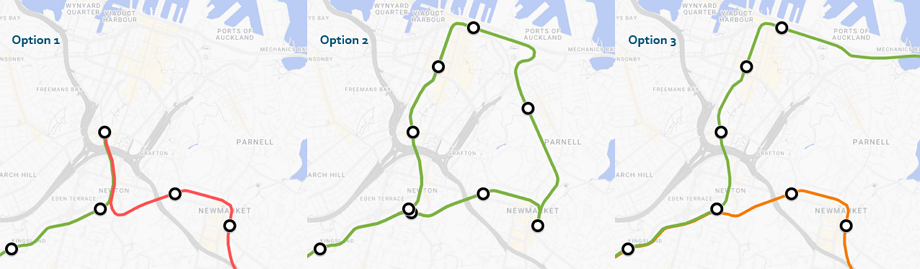
To help explain why I think Option 1 is the best, let’s dive into some numbers.
Limited train slots
In a perfect world we’d have a far more developed rail network, with additional tracks on our lines to enable more services to run, and no level crossings flat junctions to create constraints.
We don’t live in that world and mostly we’re limited to one track per direction. The Western Line has the additional disbenefit of having a lot of level crossings.
AT is concerned that more trains on the network means level crossing barriers will be down for longer, and that this will result in more people taking risks around crossings. There is currently no funding to replace those level crossings, and current projections are it will take decades to remove them all.
Currently, at peak there are six trains per hour in each direction, or 12 tph in total. Once the CRL opens, AT has said that due to the safety concerns they can’t increase the total number of trains crossing those level crossings. So they’ve opted to redistribute how the trains are used, with eight trains per hour in the peak-direction and four tph in the counter-peak direction.
So, eight trains per hour in the peak direction is our limit – and the question then becomes: where do we send those eight trains?
As an aside, I think there’s more AT could do with things like enforcement to reduce the safety risk at crossings. If the CRL is as successful as expected, I won’t be surprised if they resort to other measures in order to enable more services.
Changing Passenger Demand
To help answer the question of where to send the trains, looking at where people currently catch them to is a useful starting point. The station boarding and alighting data I have is about six years old now – and while the exact numbers might not be the same, the general trends for where people are travelling to/from are likely still relevant.
Looking at all people boarding at a Western Line station (west of Grafton) and heading in a city-bound direction, we get the following breakdown of destinations:
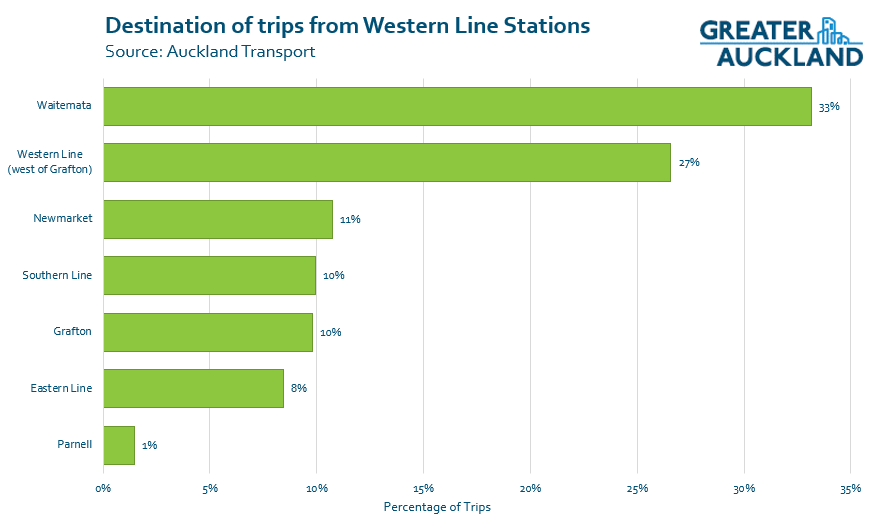
The numbers might be slightly different at peak times but as you can see, about a third of all boardings are heading to Waitematā, with over a quarter heading to another station along the Western Line.
Trips to Grafton and Newmarket account for just over 20% of all boardings. Notably, that’s off-set by the just over 8% of people who would directly benefit from the currently proposed CRL service pattern.
Interestingly, Grafton and Waitematā also have the largest (and near identical) discrepancies in the number of people boarding and alighting, i.e. how many people get on trains vs how many get off.
This is due to something we call ‘downhilling‘ – where people (most likely students) are getting off at Grafton and catching a bus down to Uni, then at the end of the day, continuing downhill – walking, scooting – to catch a train home from Waitematā. I suspect there are a lot of trips currently using Grafton that will likely be replaced by travelling to Karanga-a-Hape and Te Wai Horotiu and a short walk or sometimes a bus.
With the changes noted earlier in the post, the CRL will significantly change demand on the Western Line. For example, currently public transport use from the west to around Midtown (the Civic, Aotea Square) and the Karangahape Rd ridge is lower than it is around Waitematā. Clearly, the CRL will change that by creating direct access to both of these zones.
It would not be unreasonable to expect that over the short to medium term, that overall ridership via the Western line would double. I’m not sure what the modelling is predicting, but let’s assume that within that doubling of usage, those non-central-city trips increase by about a third – a not insignificant number.
The percentage of trips to Grafton and Newmarket would therefore drop – and even if you included the inner-Southern line stations like Ellerslie, overall that will make up likely less than 20% of all trips. That’s because it would mean trips to the city would increase from about a third now to well over half of all trips.
Notably, currently about 54% of boardings on the Southern and Eastern lines are destined for Waitematā – though you’d expect their share of trips to the city centre to also increase.
The point of all of this is that while it may seem like a lot of people are going to Grafton and Newmarket today, once the CRL opens, a lot more will be wanting to travel to the city centre.
The question then becomes, is it worth diverting some trains to service what might be 10-20% of trips?
At 10-20% of trips that’s maybe two trains per hour.
Would it actually be any faster, anyway?
A key feature of Auckland’s public transport network development over the last decade or so has been the focus on making much of our PT network frequent enough that it becomes “turn-up-and-go”, meaning there’s no need to remember a timetable. That’s really important for making public transport easier for people to use.
To start to answer our question: in terms of time spent on the move, of course a direct service from Western Line stations to Grafton and Newmarket will always be faster than one that requires a transfer at Karanga-a-Hape.
Based on existing timetables and planned frequencies, the alternative – a train from Maungawhau to Karanga-a-Hape, then transferring to another train to Grafton – would take between 3 and 10 minutes longer than a one-seat ride to Grafton. On average this is likely to be about an extra seven minutes of travel time compared to a direct service.
But with perhaps just two trains an hour running the direct route – so, one every 30 minutes – what option is actually faster for your overall journey time?
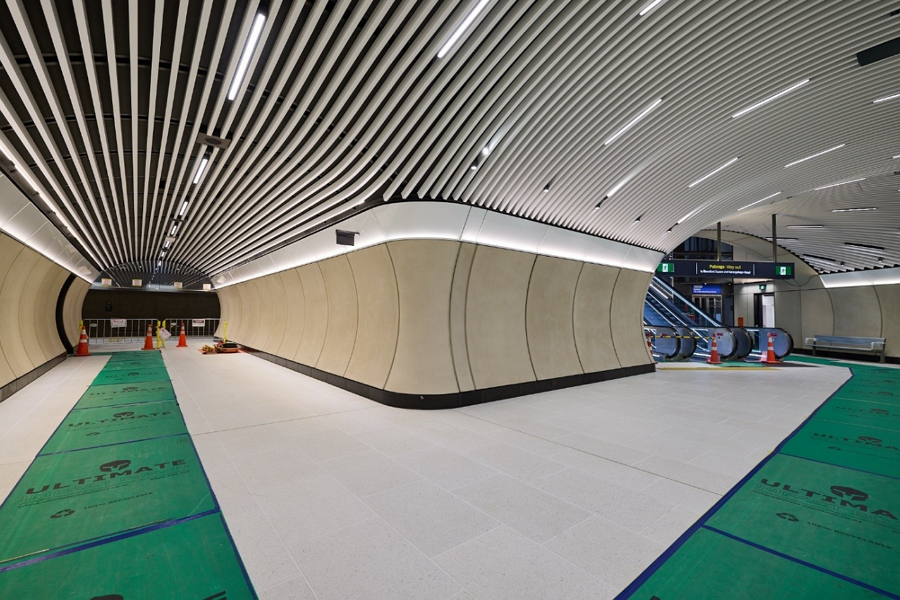
One of the cross passages between platforms at Karanga-a-Hape, showing access to the escalators up to Beresford Square
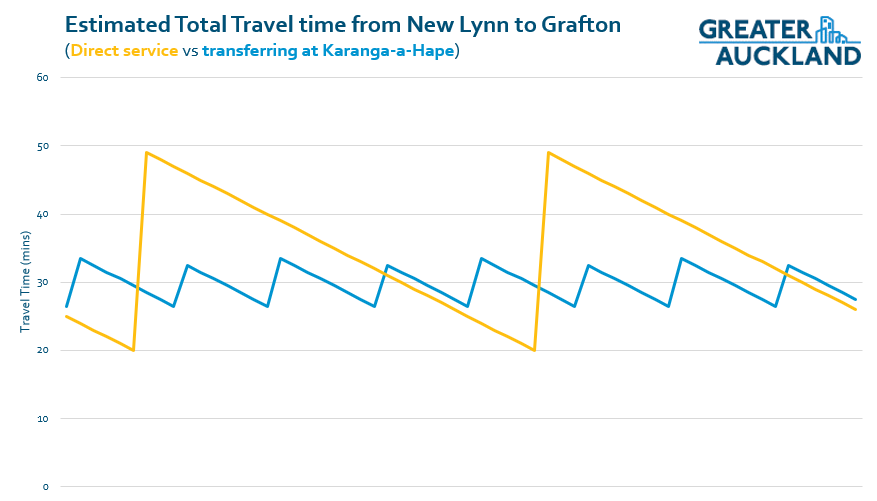
To answer this question, I built a little model to compare the two options: direct journey vs transfer at Karanga-a-Hape. The model assumes someone just turns up at a station hoping to go to Grafton or Newmarket, and wants to know: which option gets them there faster?
Even in the worst case scenario – you catch a train to Karanga-a-Hape intending to transfer, then discover you’ve just missed a train heading to Grafton, leaving you a 7 minute wait for the next one – still, for 60% of the time the transfer will be a faster option than the less frequent direct service.
If, on the other hand, you’re lucky with timing – you step out of your first train, stroll across the platform, and your next train turns up within a minute – then the transfer journey will be the faster option 83% of the time.
Remember too, Karanga-a-Hape offers a short, all-weather, level, cross-platform transfer. The easiest of all transfers.
Focusing in on travel times like this is also why options like the loop pattern won’t work in this situation like ours. The loop is big, so people travelling to the far side of the loop have to go the long way around – which again would be slower than just transferring. And attempts to answer that by alternating trip directions around the loop to give every destination a one-seat ride would not only makes the network much more confusing to operate and to use, but would halve frequency for everyone.
Frequency is freedom: provide enough of it, on a regular and legible pattern, and people will transfer – because overall their journeys will be quicker, easier, and more predictable.
No one likes a (slightly) longer journey but mastering the option of the Karanga-a-Hape transfer seems like a pretty decent trade-off for 10-20% of travels, given the wider benefits of CRL for everyone.
And furthermore, as frequencies go up, the transfer option becomes even more likely to be the faster option every time.
Greater Auckland’s work is made possible by generous donations from our readers and fans. We’re now a registered charity, so your donations are tax-deductible. If you’d like to support our work you can join our circle of supporters here.

 Processing...
Yep, until the level crossing situation is resolved, Option 1 appears to be the best interim solution. Not only does it allow a higher frequency but, I’d suggest it potentially offers more reliability.
Didn’t the new network do away with all these weird low frequency overlapping services already? Like the eastern line used to alternate half the trains to manukau and half to papakura, and buses used to do all sorts of crazy stuff.
Why are they going back to the old inferior model that was so successfully done away with?
Like I can’t for the life of me understand why, when they’ve just spent five billion dollars building a tunnel to access the middle CBD and stop the trains needing to go around via Newmarket… the first thing they do is send trains away from the CBD via Newmarket?!
Another consideration – regardless of which is actually quicker we need a system that is easily understood – only a minority are likely to be timetable nerds.
As to level crossing removals on the Western line I am assured that public consultation about options for each of the existing crossings is coming though nothing definite just now. Some of the business case documentation is becoming available though with numerous redactions.
My concern is the way they’re approaching the level crossing removal is it will be too broad – do you want a lump of coal or a pony type stuff – without proper costs or trade-offs. Everyone will want the crossing they used separated which is simply unaffordable, especially in any reasonable timeframe.
AT’s narrative on reducing the frequency of trains to reduce vehicle risks at level crossings isn’t at all transparent. It is not, and never ever was, about “safety”. It has only ever been about limiting disruption to cars. “Safety” is always a an easy way of justifying measures that could genuinely benefit PT users but instead used to satisfy drivers.
The limit on train movements over the level crossings on the Western Line is not an AT “safety thing”. NZTA communicated that restriction i in 2016, on the basis that the removal of (some / a number) level crossings would need to take place before an increase in moves would be permitted…… in the intervening 10 years, only Normanby Road and a couple of pedestrian crossings have closed. On this basis I think there’s a while to go before the Western Line see’s a high frequency service.
did NZTA cite a hard limit on train movements per hour on level crossings? presuming it has to be around 12TPH each way given the post-CRL rail operation plans
The statement at the time was “no increase”.
On the flip side if you’ve ever looked at the layout of the crossings and the adjacent roading layouts on the Western Line, working out which crossings to close and which ones to replace with either a bridge (expensive) or an under pass (often even more expensive) is a massive challenge. Now that would make a great article….. “How to address the Western Line challenge”!
– pedestrian overpass at Kingdon Street
– close the George Street crossing (and accelerate replacing the Dominion/New North flyover with a sensible at-grade intersection)
– bridge crossing for Morningside Dr
– consolidate Azquith and Rossgrove crossings into a single underpass, or close altogether and make the suburb around Baldwin Ave station two distinct LTNs
– Pedestrian overpasses at Baldwin Ave station and Lloyd Ave
– bridge for Woodward Rd
most of the crossings past there seem like a nightmare to grade separate
It seems like they’re planning to stop trains @Mt Albert, which seems dumb to me. For the cost of Woodward Rd, you could stop trains @Avondale and connect with the Avondale Southdown, rather than spending the money adding tracks to Mt Albert which won’t be as needed in the long run as the expanded Avondale.
if only the New Lynn trench had been built with triple/quadruple tracking provisions… a metropolitan centre zoned area would’ve been perfect for short-stopping peak trains.
just St Georges St and Portage Rd to grade-separate (or in the case of the latter, close?)
“Even just moving from 6-trains per hour to 8 is like being a station closer to your destination.”
Matt this is a great way to communicate the power of increased frequency in PT.
The proposed post CRL network design appears to me to have wandered away from the target of higher frequency, on a regular pattern, clearly communicated.
Instead they seem to trying to run an over-complicated, harder to use, harder to operate fiddly pattern to attempt to satisfy lots of infrequent one-seat rides.
Probably the model is in charge.
Modelling and technical work should always be checked back to the higher order strategy, so what is that, or what should it be? Most simply put: Metroisation.
Running our little urban railway as much like a Metro as possible. So on a regular, un-complicated, high frequency pattern, clearly and simply communicated.
Remember everyone agrees the CRL is “transformational”. Yes that is an overused term, but one that i believe is appropriate in this case, as you’d hope for the size of the investment!
Let’s be clear what transformational properly means – it means this changes everything. Modelling is heavily based on extrapolation, on the continuation of what there is now.
Even when new assumptions are added, increased population etc, these almost always remain bounded by what there is now. Modelling is very poor at picking discontinuities, by definition.
We don’t know how people will respond to the changed opportunities offered by the CRL. A key strategy in this situation is to remain flexible, to not try to second guess and predict use.
Of course railways are pretty inflexible things, especially heavily interlined mixed railways with a lack of track, like ours. All more reason to start with the simplest most regular, and highest frequency pattern possible, with a plan to review after a decent period of operation.
This is not a call to react immediately to early ridership patterns- it will take a year or more for people to get into new rhythms, but it is a call to keep it super simple and clear and direct. Easy to communicate to new users, this is a once in a lifetime opportunity to gain new riders.
Or to phrase it in governance language: what is the bigger risk: some current users will lose their direct ride (that is certain from the west) be grumpy, and get amplified by media searching for clickbait, or that through complexity and/or outages appeal to new riders falls flat?
Given that the number of non-users of the Auckland train system is a way bigger than the number of current users heading to Newmarket/Grafton, and that THE WHOLE PURPOSE of this massive investment is to significantly grow ridership, clearly the strategic intent of the opening operating pattern should be simplicity, frequency, easy of use. Make it simple, repetitive and as reliable as possible.
Frequency gives shorter journey times, that will get new users coming back, so that is the killer app here.
Of course no operator wants to disappoint current users, but there are trade-offs and
1) a frequent transfer is not a terrible alternative (likely to be better, as Matt shows).
2) eye on the prize! New users, in volume, spreading praise by word of mouth…
Additionally (apologies- I really should write a whole post), the barrier to all day 8 trains an hour (8tph) on the Western Line are not the level crossings, this is something of a misdirection, but rather Kiwi Rail reserving slots for freighters off peak.
These are unused, KR has very little business north on the western line. A couple a day, and these can and do run very early or very late, eg 5am and 10pm.
All day 8tph direct through the CRL from the west is exactly the simple clear pattern that would sell the CRL. Coupled with 8tph on the southern/eastern, gives 16tph per direction through the CRL, 32 trains per hour all day at every CRL station- a train going somewhere every 2 minutes!
This is a Metro-like pattern. This fulfils the strategy.
Also these frequencies mean that transferring is always easy, never a risk for the vast majority of times of use.
This is what I learnt when first living in London, all those years ago, when completely new to real urban transit- no need to ever run for a train, keep sauntering, there’ll be another by the time you get to the platform edge….
Now this is what giving effect to the transformational possibilities of the CRL means.
+1000
Overseas experiences for me are always positive if you don’t have to stop walking when you are transferring. If you can navigate from one train to another without breaking stride, you’re onto a win. Simplicity, frequency, and very clear signage you can follow*as you’re walking* is how it should be. As an infrequent Auckland train user, I feel like I find myself stopped in confusion about what platform I should be making for, more than I find myself waiting at a platform. We need to aim Metro for sure.
“no need to ever run for a train” should be a comms campaign line.
As a Shoreite I agree with this. The CRL is the Spaghetti Junction for public transport. It will be much easier for us to reach much of the rail network. Partially due to western line services not detouring via Newmarket, and partially because we can already connect to the rail network at Te Waihorotiu on Wellesley Street.
It is a shame though, the most expensive rail system on a $ per km basis in the world has not dealt with the level crossings on the western line. They have been a known issue with multiple studies done over the last 25 years going all the way back to ARTA. The fact is fixing them is never going to be any cheaper than now, when the CRL works were being completed. The idea of building network reliability and demand then shutting down again to fix a known issue makes no sense. The fact the majority of Aucklands intensification has happened and is happening on the Western line further raises questions about lack of investment in level crossing removal and limiting train frequency as a result. Putting it in the too hard basket is shifting the costs to another generation and is mostly a cowardly approach. The level crossings on the Western line need to be sorted. Until then shift intensification somewhere else.
You are so right, the level crossing at Glen Eden has very high foot and vehicle traffic every day. We need some remediation for this crossing, it cannot be indefinitely put off.
I take your Britomart tunnel and give you HS2. I’m pretty sure the later is far more expensive per mile/kilometer:
https://www.theguardian.com/news/ng-interactive/2025/dec/16/we-hate-it-its-desecration-the-real-cost-of-hs2
Where is this idea that the CRL is the most expensive in the world per km from?
Sure it’s expensive but it’s not even close to the worst in the world. Eg the second ave subway in New York is NZ $2.8b per km, twice the CRL.
The new railway between New Jersey and New York is also nz$6b per km
Swanson to Manukau via Newmarket? And run the S-C loop to Ōtāhuhu via Ōrākei instead. The O-W would still be the direct but less frequent connection, and still maintain the ability to terminate peak services from Manukau at Newmarket. Westies could also transfer to another E-W train to Newmarket like option 1 as well (during peak)
For the S-C Loop are all the trains going to alternate going via Grafton or via Parnell, or all go via CRL first and terminate at Newmarket? If alternating won’t that half the frequency in the loop stations?
Trains will run from Pukekohe to the CRL via Newmarket and Grafton, then loop around via Parnell, back to Newmarket and return to Otahuhu; then run the whole thing in reverse.
Your piece reminds me of an observation from a Hong Kong-based transport enthusiast Jacky Lim (I don’t like his Hong Kong political stance after 2022, but let’s put it aside and that issue doesn’t concern non-Hong Kongers anyway). He made a remark on social media a few years ago that in his opinion, Singapore’s bus (and public transport) service is objectively worse than that of Hong Kong, because there are fewer point to point services, you have to travel to nodes then transfer to the final destination. In Lim’s view this is less than optimal from end user experience.
I think you all had written an article many years ago that the best practice for a sustainable public transport network involves users/passengers often needing to transfer between services just to reach the final destination. This improves efficiency. Your article here seems to be running on the same theme. But to someone like Jacky Lim he thinks the end users of public transport dislike such best practice design around transfers between modes and/or services.
How would you respond to Lim’s misgiving about the whole concept of having to transfer just to get to one point to another? Surely we can strike a balance in between?
Thanks.
(PS: Jacky Lim does YouTube programmes and also writes on Facebook. I don’t think his podcasts or social media contents are in English) https://www.youtube.com/@JackyLimChannel
Frequency is key. For me, I like to feel moving. So if I get off one train K-Road, have a quick walk inside a nice station to the next platform, and then catch the next train with barely any waiting time, that is great. Ideally, the frequency of both trains is so high that I can catch it immediately and a slower person (handling a stroller or walking aid) would be able to catch the next one with limited waiting time.
If there is only one bus/train every half hour from the station where I need to switch, I have very long wait times, and even nice stations will get boring quickly. In those situations, I would prefer a one-seat ride (even if it is just every 30 or 45 minutes), so I can do the waiting at the beginning/end.
That probably explains some differences: given Hong Kong’s population density, even least frequent public transport runs every 20 minutes at the minimum, so waiting between services is not an issue in Hong Kong’s contexts. But it doesn’t work in most other countries and certainly not New Zealand.
The majority of users post-CRL won’t be transferring. This discussion is about a relatively small portion of of users that will lose a direct frequent service as a result of an overall network improvement.
‘How would you respond to Lim’s misgiving about the whole concept of having to transfer just to get to one point to another? ‘
– Do some proper evidence based modelling of options, costs and benefits, to reach a preferred option, like the author of the post did in a rough and ready way.
Don’t just fall back on intuitions about what ill-defined ‘people’ prefer.
This is the very point raised by Lim. He was claiming that Singapore relied too much on experts’ opinions, based on numbers analysis when it comes to public transport service planning. In his opinions he put it as a negative.
I think it depends a lot on whether or not you can reliably catch those connections. Eg. in Auckland your last connection is often going to be on a 30 minute headway, and that will regularly leave you stranded for half an hour. That is a terrible experience for anyone, and it is completely out of the question if you have kids.
In a lot of situations you have to arrive at a set time (eg. many jobs, doctor appointment, restaurant booking, etc etc), and then a 15 minute headway on a connection turns into at least a 20–25 minute penalty, depending on how often buses are a bit delayed and how likely you are to miss that connection.
If it works, people will figure it out. You can live in one of the most car dependent places possible (like exurban Belgium) and then you stay in Paris for a week and it only takes one and a half trip to figure out how to catch the metro and connecting between lines.
One assumption in the article is a bit questionable. It’s not such a short walk from the Karanga-a-hape station to the university. There’s no direct bus. You’d have to change at the Karangahape-Symonds corner or hike from Albert St up through Albert Park.
Bereseford Square -> Alfred Street is 8-9 minutes. A direct bus at peak time would take longer.
According to Apple Maps it’s 22 minutes.
Why would you use Karanga-a-Hape to get to Uni and not Te Waihirotiu with a short walk along Victoria or Wellesley Streets
It is a short walk to the unis from Te Waihortiu, and there are a gazillion buses running up and down Wellesley st if that is too much.
K Rd is a nice level walk or a short frequent bus ride to the hospital and Medical School.
Surely you would get off at Te Wai Horotiu to go to the Universities.
K Rd is flat/downhill.
The good thing is both are options.
Yes, there is also Whitecliffe College & The University of Auckland English Language Academy etc etc on Symonds St north of K’rd. Maybe you would grab your favourite Sushi or coffee on the way to the main University areas from Karanga-a-Hape station.
Another option is downhilling from Maungawhau, either transferring to your choice of buses on New North Rd, Mt Eden Rd or Symonds St, or biking/scooting down Symonds St (about the same distance as from Grafton).
From Te Wai Horotiu Alfred street is a 9 min walk (Victoria street exit), or a 4 minute bus ride (Wellesley St exit).
Nobody will be using Grafton station to get to the city campus when the CRL is open
What happened to the simple clock-face timetables and predictable patterns? AT seems to be able to do it for buses very well so the principle is clearly well understood. Yet for the trains we’re going to end up with weirdly spaced timetables (judging by the number of photos of the departure boards at the stations taken during the trial and posted on social media) and weird running patterns. Is there something else at play here? Like KiwiRail forcing some freight train slots on AT (particularly for the western line?)
Within AT the rail team is a bit of a silo so tend to ignore what happens in other parts of the org (or PT team).
We’ve raised issues like these directly with the team but been told they know best.
Hopefully the trial results have punctured their overconfidence.
Great summary, I have been trying to get my head around all this! One question: According to KT, the issue with changing trains at K Rd to go to Newmarket is that there will be no train going in that direction at peak times – is that not right?
Yes there are trains going from K Rd to Newmarket
He is absolutely wrong, there will definitely be trains going from K Road to Newmarket at rush hour.
This is partly AT’s fault for creating a service pattern so bloody confusing.
OK that’s great, thank you both!
Surely AT could do the timetabling so Western Line trains arrive at K’Rd 2 or 3 minutes before the Southern line trains arrive to make for an easy transfer
Ideally yes but the challenge is in Auckland we already have quite a few locations where we need to balance timetables for, notably all of the flat junctions, like Quay Park, Newmarket, Penrose, Westfield, Wiri etc. timetabling to hit K Rd for quicker transfers might cause other issues around the network.
So grade separating the Westfield and Wiri junctions is something that would help improve timetabling and reliability
I wouldn’t time anything if I was AT, I wouldn’t even have a timetable. It just ends up slowing things down and causing dwell times. Just send another train 10 minutes after the last one left (or whatever the frequency is).
Even the tube has an operating timetable, it’s just not displayed on the public boards.
yes there has to be a timetable for operations, but it is frankly a fail if users need to consult one.
Wait, so Western line in leak is 8 one way and 4 the other….
Does that mean 4 are empty running back or are they deliberately not being run and used somewhere else?
That’s mental
This is why at peak times there’s an eastern line service that runs though the CRL to Newmarket, if the level crossings weren’t there they’d be being sent out west
If you run single unit trains then they could be doubled up at Newmarket for the return less frequent journey.
The limit is a rule that they can’t have more than 12 trains per hour (both directions added together) through a level crossing. This restriction begins at the George Street level crossing and continues west.
So in order to have 8 trains per hour in the peak direction (instead of the current 6), the frequency of trains the other way has to be cut from 6 to 4 to keep the total for both directions at 12 or fewer.
I guess they achieve it by just gradually emptying out the Henderson depot during AM peak, and fill it up again at PM peak.
It’s not a rule, it’s an assumption by AT that the regulator won’t allow it but they’ve never actually tested it with them or explored ways to mitigate the expected concerns (other than assuming full separation/closure).
We know it’s an assumption because we asked the team directly who made the rule and were told there wasn’t one but that’s the answer they expect.
This kind of thing is rampant at AT, one person will make an assumption and it quickly becomes treated as fact and becomes very difficult to unwind.
That is insane, they aren’t even sure what the limit is???
i’d bet it’s just the “nothing can impede the holy automobile!” complex
interestingly, in this report they seem to treat the upper boundary of train frequencies over level crossings to be every 5 minutes/12TPH in each direction (24TPH total)
https://www.kiwirail.co.nz/assets/Uploads/Our-Regions/Auckland-Metro/Strategic-Rail-Programme-PBC/Documents-Appendices/AppendixH_Options-Development-Report-Part-2-REDACTED.pdf
@Burrower that report is quite interesting, as in it they essentially rubbish having express services from South as the bulk of the load is from further out.
Also seems dumb to have Mt Albert being the stopping point for peak rather than Avondale – as with the Avondale – Southdown line you can actually run services along that essentially unlimited with just removing Woodward Rd extra.
Also – looks like 12TPH in both directions, so every 5 minutes post CRL pre level crossing improvements, you can see it on page 25. Can understand how AT would’ve been confused, but it says 12 per direction being the level crossing constraints. So no need to reduce frequencies counterpeak/do weird workarounds – they can run a train every 2.5 minutes through CRL, half going to the Western Line, and half going to the Southern line – however the stretch between Wiri and Westfield is the main constraint on the metro network – as only has 20 to Otahuhu and 16 to Wiri, and they’ve also got additional freight/interregional trains to go through that chokepoint. So they’ve got to take away slots from the Southern/Eastern line to fit the trains through.
You can still fit 8TPHPD on the East/West, but with the Westfield – Wiri constraints it’s really 6TPHPD, but extra along everywhere but the Westfield – Wiri section.
Re the crossings, they also said it wasn’t a hard limit, but more of a risk based one. Like, the constraints they’re telling us vs the constraints they have are quite different.
I thought the rule was self imposed? It feels like they made a guideline then have just treated it as gospel rather than changing it. UK has level crossings with 16+ TPH off peak.
I seem to remember there was triple tracks at Avondale back in the day when it was single track I am just wondering if crossing loop or a third line could be used to increase frequency to allow for more west south trains to run without interfering with trains travelling through the loop
As passing loop isn’t going to solve the capacity restriction caused by level crossings.
Does it help if the Onehunga trains just run down to the Strand like they do now. And Western line trains to Newmarket just terminate at Newmarket.. This would make Newmarket a transfer station. It does have three platforms after all. Also run single unit trains from the west then join them up for the return journey as I have suggested above.
I think that introducing these sort of complex running patterns (some services run during peak, some off-peak, different directions around the loop etc) is actually bad for everyone. Running single EMUS on the Western line is not great either. This sort of patter makes the whole setup unpredictable. With the limited number of slots per hour AT should stick to a clear pattern and relay on frequency. It already works well for buses.
If anything the one missed (IMHO) opportunity is better connectivity at Karanga-a-hape station for transfers between buses and trains. It’s going to be quite a hike in unsheltered space.
From Beresford Square to K Rd is not that far. Bunch of awnings too. Tbh I think Beresford will be the main one, and Mercury Lane entrance is better to hook NW rapid transit into once it moves on from buses until the budget expands to put it into the city.
I am thinking there would be a Henderson Newmarket line and an Onehunga Newmarket line. The Onehunga line could also service Parnell then change direction at the Strand. It already does that although Parnell is not a stop. Crossing loops between Henderson and Newmarket would allow for some trains to be held back while others could run ahead so as not too delay trains running through the CRL. I imagine trains through the tunnel would be given priority because they would have the greatest knock on effect across the network . I know this means there are more lines and probably more units and crew but it might be simpler to operate. Maybe all change at Karangahape which is the greater Auckland solution would be better but it’s going to upset a lot of passengers and the purpose of this post was to explore options so just putting forward a possible solution.
that is what’s in the current plan, after 2028.
Half hourly trains between Henderson and Onehunga via Newmarket, with additional peak services just between Henderson and Newmarket to create a 15 minute rush hour frequency between those two stations. I believe the long-term proposal is for a siding at Remuera for trains to layover.
The Strand lacks accessible transfer opportunities to get to the central city so it probably isn’t a good idea to terminate suburban trains there – especially when passengers want to go *to* downtown and midtown directly. It’s clear light rail was supposed to fulfil that purpose for Onehunga residents before it was cancelled.
Turning the Onehunga line into a Penrose–Onehunga shuttle service, building a passing loop halfway so trains can run every 15 minutes instead of half hourly, and improving the Penrose station layout so transfers are easier will give more benefits and make transferring
I doubt passengers will be upset by a transfer that’s as easy as crossing less than 100m between two underground platforms.
correction on the last point – less than 50 metres between the two platforms
Just seems like a waste of resources when they could instead use those trains on the E-W line to increase overall frequency?
well the CRL will already have 16 out of 18 trains per hour each way running at peak, so a part of me wonders if part of the crosstown line compromise is to give Western Line higher overall frequency while adhering to the CRL’s initial capacity
Run a frequent bus with bus lanes from Mt Eden Station? Newmarket is just down the hill.
There is one already, route 64 Maungawhau Station to Newmarket via Grafton.
But the rail team wouldn’t know about that, because it’s a bus.
KISS, Keep It Stupid Simple.
Manukau via Eastern to West, West to Manukau via Eastern.
Pukekohe to Otahuhu clockwise via CRL. Otahuhu to Pukekohe anticlockwise via CRL.
Onehunga to Penrose, Penrose to Onehunga.
3 lines, everywhere is covered, no complexity. Any additional train slots used to improve frequency.
AT have already done the hard yards figuring out what works for Auckland, which is fast, frequent services with transfers. Feels like they’ve tried to please person A who wants to commute to Newmarket (who can transfer @K Rd), person B who wants a 1 seat ride from Onehunga (who can transfer @Penrose), person C who wants an express from South (already exists in the form of Te Huia).
All the tradeoffs to attempt this just result in lower frequencies/worse service for everyone and a nightmare for the control centre routing everyone when something inevitably gets delayed.
If they want more frequent express services on the Southern Line, improve Te Huia, as it helps both the local and regional network, not everything needs an AT sticker on it (and if they want they can afford to add one).
As an aside. The southern express train they are running seems to be stopping at too many southern stations right up to Otahuhu (squinting my eyes and zooming up the tiny graphic I have of that). I was thinking it could be because it would only be able to go so fast anyway before catching the all stoppers ahead of it even with a 3rd main in some of that area. I think ideally if that isn’t the issue it would be better to only stop all southern stations to Papakura, then just Puhinui so then you have “Eastern” line access at that point along with Airport bus shuttle of course…then Finally Waitemata. Maybe a Panmure stop too but where do you draw the line…actually that would be good for Panmure express if you got on there but maybe train would be too full at times.
To stretch this logic out further I know of people who were impacted by services moving from the old Auckland station to Britomart and Panmure station being relocated from Ireland Rd to its current location.
Both of these were significant improvements for the overall network.
100% – My first year of university the walk from The Strand station was shorter and easier than when Britomart opened.
I probably should have campaigned for Britomart to never open, then this CRL running pattern problem would have never eventuated. (sarc of course).
Side question: do we think we will need a Strand station on the E-W line in the near future?
Would it be possible to instead redevelop the Strand station site to remove the dogleg turn so there isn’t such a bottleneck on train speed through that area?
Anon – The designation is there but I think the cost would be prohibitvely expensive to go underground and connect with Britomart, especially when this section will have only 4tph in each direction later this year.
What Patrick said.
In any business, if you change your offerings some existing customers will be unhappy. That’s inevitable – they are self-selected as the people who are happiest with your current offerings.
But if you want to grow the business you can’t think only about your existing customers.
You need to think about the much bigger number of people who are not your customers, and how your changed offerings can be best for them.
As a politician or bureaucrat, you need to accept that any change will make some existing customers unhappy. You need to work out how to manage that. If you’re not willing to make some people unhappy, you will never make any change.
Yep Southern Death Cult- Death Cult – The Cult – I’m still angry!
Option 1.
Frequency is freedom.
Surely the obvious simple service pattern is clockwise through the city –
– from Swanson to Newmarket/Pukekohe
– from Onehunga to Glen Innes/Manukau
and vice versa.
If there are capacity constraints on the Onehunga branch some of those trains can turn back earlier, for example at Newmarket or Penrose.
I’m guessing that change at K Road from Swanson to Grafton will be the only significant demand for reverse direction interchange on the network, so it should be possible to decide a suitable interchange time (say less than five minutes) and make that the anchor for the entire timetable.
If that causes conflicts at other flat junctions, that can be resolved by holding a train back for a minute.
Great post, clearly explained.
Question: Are they planning to run the Pukekohe express service running only at peak times or all the time somewhat?
based on Page 131/133 of this (https://www.kiwirail.co.nz/assets/Uploads/Our-Regions/Auckland-Metro/Strategic-Rail-Programme-PBC/Documents-Appendices/AppendixH_Options-Development-Report-Part-2-REDACTED.pdf) it looks like it’s only going to be a peak hour overlay until Wiri-Pukekohe gets quad tracked
Thanks. Oh yeah that’s detailed. Turns out I have that saved and others, main document 350 pages long agh.
CRL is a white elephant that has cost the auckland ratepayers & taxpayers huge $$$$
agree and people who will never have access to it are being forced to pay for it. why should we be subsidizing this? Only 16% of Rodney rates are spent in Rodney. No train (but plans for bus way that will be costly, take a long time to build, cause disruption, increase flooding & more development has already been approved). Council over a billion in debt, interest on debt 1.4 mil per day and this will cost over 600k a day to run. Not a wonder so many are leaving the country.
Most kiwis are leaving to Sydney, Melbourne, and Brisbane. All three are currently building or opening major rail tunnels across their city cemtres. Kiwis are leaving to move to real cities.
So then they enjoy the things in that overseas city that some other tax payer has spent all their life paying for. Also people come from, say for example the UK and live here to enjoy our things. Come on, I’m sure you can share more besides it’s a fact that generally the more dense areas, ie Auckland City Centre subsidise the rural ones. Auckland as a whole subsidises the rest of the country, particularly, say the South Island as it is a lot less dense population wise. Another example: Auckland tax payers proportionally pay more for flood damage on the East Coast.
Actually not showing the limited stops southern route on this map highlights the complexity of this timetable for such a relatively small system. It completely doesn’t show or say anything about it.
No. I live out west and work in Newmarket. I’m one of MANY. Stop shortchanging us.
Sounds like a good scientific reason with evidence as to why it should go direct to Newmarket. /sarc
Did you actually read the article? The author and his wife also live out west/need to use Grafton/Newmarket.
$5.5 billion has being spent on the CRL, many billions more have been spent on the rest of the railway network, and even more billions more will be spent on the network in the next ten years. What existed before plus what has just been built is what it is; a three-line railway network connected at three points to a two-track loop around central and inner Auckland which has six stations; three underground and Parnell, Newmarket and Grafton above ground. The question is how to best use what will be there when the CRL opens.
Given that AT states that the maximum frequency of the CRL is 18 TPH per direction, it is a serious mystery how it was decided to grade separate the track intersections around the Maungawhau Station, adding years to the build time and adding hundreds of millions to the cost. Flat junctions can accommodate 18 TPH easily, as flat junctions do at Newmarket and at the entrance to Waitemata Station, and could accommodate 24 TPH without difficulty as flat junctions do in railway and transit systems around the world.
It will not be the case that trains on the CRL Loop will be so frequent that passengers will be able to flit between services as they would in London, Paris or New York. Information released by AT shows that with its proposed service pattern the CRL will operate at 15 TPH per direction and that there will be a train from Karanga-a-Hape to Grafton every 10 minute at most frequent. If AT’s proposed service pattern is implemented, it may be decades before there is a train from Karanga-a-Hape to Grafton more frequently than every 10 minutes; it may not be more frequent this century.
Most of the passengers who currently get off at Grafton when travelling into town, and board at Waitemata Station for their return journey, will use one of the CRL underground stations when they are open.
AT’s ‘rules’ about frequency of level crossing use were written by people, and can be rewritten by other people. Many cities around the world have two track railway lines with busy level crossings that only carry passenger trains between midnight and 5am, and have train frequencies higher than AT’s limit of 12 TPH. At one minute per train, 18TPH results in the gates being closed 30% of the time, 24 TPH 40% of the time and 30 TPH 50% of the time. Thousands of traffic light-controlled intersections have one direction closed 60% of the time without trouble.
The Western Line has 28 grade separated road crossing and 16 grade separated pedestrian only crossings. There are 15 level crossings, but only a few of them are busy. An important factor is that only one of the level crossings allows more than one vehicle at a time to cross in each direction. At Glen Eden station two vehicles at a time can cross from north to south, other than that every level crossing is single file only. Increasing the busy level crossings to two or more vehicles at a time in each direction would mean that level crossings closed 40% of the time, for short, quick moving passenger trains, would have less adverse effects on communities that intersections with traffic lights do.
Many living on the Western Line are thrilled that many trains from the west will quickly get right into the middle of the central city once the CRL opens, but are outraged, or will be when they find out, that their regular direct service to Grafton and Newmarket will be summarily discontinued, after 140 years. If they want to get from the west to Newmarket they will have to get off their train and spend 15 minutes on an infrequent bus from Manugawhau Station. Their other option is to stay on their train while it goes in the other direction as far as Karanga-a-Hape Station and then wait for a once every 10 minute train to take them right back to where they just came from, Maungawhau Station, where they couldn’t get on and can’t get off because a platform wasn’t built on that segment. Eventually, our Phileas Foggs will arrive at Newmarket up to 15 minutes after they would have got there on the direct service that was provided for over 140 years. And then they face the prospect of trying to do it in reverse. Not happy.
Newmarket is easily the second most used station in Auckland, and will continue to be a critically important trip origin and destination after the CRL opens. In 2018-19, pre-Covid, Newmarket had more than more than 25% as many boardings as Waitemata Station had. A significant proportion of Southern Line passengers disembark and board at Newmarket Station, even though it is a clear run for their trains between Newmarket and Waitemata Station with only one stop. Some may argue that Newmarket is more popular now than it will after the CRL opens because of the current long journey to get to Waitemata Station via Newmarket on the Western Line, however that is more than offset by the Eastern Line not serving Newmarket at all.
AT has decided that one of Auckland’s three railway lines will loop alternately clockwise and anti-clockwise and two of the three lines will run through to each other. This is a sensible way to deal with Auckland’s three lines giving the efficiencies of two lines through running the central city, and one line looping alternately in both directions so that CRL train slots in each direction are equally used, and so passengers have a choice of direction, even if it at times means waiting five minutes for the next train.
However AT’s choice of the Eastern Line through running with the Western Line would provide a poor service pattern. Passengers on both lines would only be able to get directly to three of the six CRL Loop stations and would have to transfer to an infrequent service at Karanga-a-Hape to get to Grafton and Newmarket.
In contrast, the Southern Line and Eastern Lines through running each other would provide an excellent service. All passengers would be able to disembark and board at all of the CRL Loop Stations other than the little used Parnell Station.
The Southern Line is a poor line to be looped. Only the few passengers travelling to Parnell would prefer to be on the anti-clockwise Southern Line trains because for other passengers those trains would take a long time to get to Te Waihorotiu, Karanga-a-Hape and Grafton stations; the clockwise trains would get to those stations very quickly. Passengers heading to Waitemata Station would likely have no preference as looping in either direction would take about the same time from Newmarket.
The Western Line is an excellent line to be the loop line. After 140 years of service, land use and transport patterns are deeply imbedded; a significant proportion of Western Line passengers will continue to WANT / DEMAND to be able to travel directly to Grafton and Newmarket.
With its two platforms, Maungawhau Station is perfectly set up for the Western line to loop from in both directions. If passengers on the Western Line wish to change to a more direct service at Maungawhau Station, they will be able to step off the Western Line train they are on, take the escalators to the other Manugawhau platform and board the train which is their preference when it arrives a few minutes later.
When the Newmarket West Station is rebuilt, and Auckland’s trains stop creeping around the central city as if the rails are made of eggshells, it will only take five minutes longer to get from Maungawhau to Waitemata via Newmarket West than via Te Waihorotiu so many passengers headed for Waitemata Station will get on and stay on the first train to turn up at their station.
The number and arrangement of Auckland’s railway lines means that, whatever service pattern is used, many station platforms will not always have the same service arriving at it and departing from it, as happens with many transit systems e.g. the Paris Metro.
The Southern and Eastern lines through running each other , stopping at all CRL Loop stations except Parnell, and the Western Line looping through the six CRL Loop stations, alternatingly clockwise and anti-clockwise, is a service pattern that is as clear, logical, legible, uncomplicated, easily communicable, transformative, high frequency, turn-up-and-go, flexible, simple, direct, easy to use, popular, strategically coherent, repetitive, reliable, metro like and useful to the travelling public as is possible with the railway network that Auckland will have when the CRL opens.
https://www.facebook.com/share/v/1CFUBDZLoc/
All lines are a poor line to be looped.
It would take 28 minutes to go around the loop. So why would anyone want to do that?
Because Will doesn’t seem to want to admit that Grafton will decrease in demand as a Western Line station once the CRL opens, that transfers at high frequency are superior to single-seat rides at low frequency, or that he’s using a misrepresentation of the technicalities of the Southern Line looping back on itself while propping up a best case scenario of his Western Line loop concept
The southern line looping onto itself is dumb idea, or at least a wasted opportunity to through route to somewhere else. Weird they talk about the value of through routing east west, then decide the southern should dead end.
Doing the same this with the western line is even dumber because of Newmarket. It’s literally the worst way to run that line.
the CRLs inherently optimised for through-routing an even number of routes, and for the longest time it seemed like the assumption was that the OBL would be double-tracked and extended to Mangere and the Airport. Logistics and costs of that extension aside that would’ve made for a very neat operating pattern (Southern-Eastern and Western-Airport)
Yes, good point about the original thinking was to have the Onehunga Branch Line as part of a very neat operating pattern (Southern-Eastern and Western-Airport).
Your understanding of the problems in Will’s argument or idea is very perceptive, a succinct rebuttal.
2010 called, they want their City rail “Loop” propaganda back. The City Rail Link was always a ‘link’, not a loop as misrepresented by anti-rail ideologues. Parnell, Grafton, and Newmarket are not City Rail Link stations as they are not in the tunnelled section of track between Waitemata/Britomart and Maungawhau/Mt Eden
For all you type these essays Will, you seem not to actually read or understand the article you’re replying to and are just repeating your agenda like a broken record.
Grafton station has had more ppl getting off in the mornings than getting back on trains in the evenings, showing as stated in the article that a lot of people get off at Grafton to transfer or walk the universities, then continue downhill to get on a train at Waitemata/Britomart for their return commute. The City Rail Link will eliminate this by giving Western Line commuters the option to get off directly at uptown or midtown.
Hospital bound passengers from the Western Line will be able to transfer at Karanga-a-Hape to an InnerLINK bus, using the Mercury Lane entrance. Parnell bound passengers from the Western Line could do the same at Karanga-a-Hape or Waitemata/Britomart, or could change to the OuterLINK at Te Waihorotiu; on top of a same-platform transfer to a clockwise Southern Line service at any of the three City Rail Link stations.
And as the graph provided in the article very much proves, 83% of the time it will be quicker for a Western Line passenger getting to or from Newmarket to change between the red and green lines at Karanga-a-hape, than to wait for the less frequent, direct blue line crosstown service.
Also, your misunderstanding or misrepresentation of the (admittedly shoddily communicated) Southern Line loop pattern is very much apparent. It is 4 trains per hour, Pukekohe–Newmarket–Grafton–CRL–Parnell–Newmarket–Otahuhu, with an additional 4 trains per hour peak overlay that only runs as far south as Papakura, and splits at Quay Park into 2TPH limited stops to Pukekohe via Panmure, and 2TPH to terminate at Parnell. The Southern Line will match the Western-Eastern Line’s frequency through the CRL in both directions (every 15 minutes off-peak, every 7.5 minutes at peak), making transfers at Karanga-a-hape convenient and timed for those transferring to get to Grafton and Newmarket. This is not going to be a case of “transferring from a high frequency service to a low frequency service”
Page 131 of this presentation should inform you clearer what the currently intended rail operating pattern is, than AT’s rail network diagrams. https://www.kiwirail.co.nz/assets/Uploads/Our-Regions/Auckland-Metro/Strategic-Rail-Programme-PBC/Documents-Appendices/AppendixH_Options-Development-Report-Part-2-REDACTED.pdf
Yes there are not “6 loop stations”, that idea assumes some sort of equivalence in importance between Parnell and Te Waihorotui, or Grafton and Waitematā. This is of course not the case, and is very unlikely to change much. There are four significant stations in the centre- the three CRL stations plus Newmarket. Grafton and Parnell can happily have half the service of the other four.
This is also easily delivered by running a clear two line base pattern of
1. Swanson-CRL-Parnell-Newmarket-Manukau City
2. Pukekohe-Newmarket-Grafton-CRL-GI-Otahuhu
Both lines of course run both ways.
Assuming the same frequency on both services, lets say 8tph this means the CRL stations and the southern line from Puhinui to Newmarket all get 16tph each way.
Parnell and Grafton, Meadowbank to Sylvia Park, and the southern south of the Wiri junction, all get 8tph each way. Being the un-interlined sections of the network
The eastern line inbound benefits from empty trains starting at Otahuhu, so have plenty of capacity for Sylvia Park, and especially all the bus transferrers at Panmure.
But anyway, peak overlays, and/or expresses, can be added on the same routes as needed for service, and as possible by available slots.
Onehunga line can either be a higher frequency shuttle to penrose, though that needs capital investment, so can’t happen soon, or a direct service terminating at Waitematā via Parnell, or a returning loop through the CRL if slots available, 2tph.
I’m probably wrong, but looking at the current Onehunga Line timetable, it takes 6 minutes Penrose to Onehunga… with a 4 minute layover at each end it looks like a 20 minute service frequency *could* be possible with a single train and a single track? obvs a passing loop at Te Papapa, and two EMUs running back and forth would be better for frequency (15 mins or better?) and timekeeping
Onehunga residents would probably disagree with me but I say leave those remaining CRL slots free for peak overlays on other lines… particularly the Western. I wonder if there is merit to trying to increase peak train headways as the post-2028 operating plan seems to do with the Onehunga & Western line adding 4TPH between Maungawhau and Henderson
Yes needs a passing loop, but more importantly a new platform parallel to the NIMT platforms at Penrose for much easier transfers.
Transfers, especially compulsory ones, need to be easy, all weather, and fully accessible.
hmm… if AT acquired the Honda motorcycle dealership and used car dealership yard at 8 and 10 Station Rd, that could allow the Onehunga line platforms to be shuffled north to be more parallel with the mainline platforms?
The OBL platform would still be on a slight curve, but it would be much closer for transfers and it might even be possible to not have to demolish and rebuild the existing pedestrian overbridge
Minor point so people not confused: “I wonder if there is merit to trying to increase peak train headways”
I think you mean decrease, ie increase frequency of the trains.
Yes, pity Penrose Station has that gap with Onehunga line / OBL or there could be some more easier/flexible options for running patterns or when there is disruptions and or events on at Mt Smart.
They have already spent a bit I presume on extending the platform and access for mass crowds there fairly recently.
The idea of moving the southern line Platform 1 & 2 further south (this blog has covered in the past I think) and having an nice walkable path through to the stadium areas is a good idea in itself but more money of course. Then that would muck up transfers with the OBL and connections with the frequent 66 bus
Platform 3 on OBL not sure (or what other ideas where off top of my head) but ideally, longer term the whole OBL would be part of a light rail network I think.
“Thousands of traffic light-controlled intersections have one direction closed 60% of the time without trouble.”
Good comparison. Others have already responded to the rest of your comments.
If all Western Services go to the city, none through Newmarket (Option 1), and then go either East or South, and presumably no Western Services go via Newmarket, then what services go to Grafton – have I got something wrong?
Southern services do.
Alternating destinations for western line trains complicates turn up and ride.
Mt Eden Station has been rebuilt with no platforms on the Southern line tracks, preventing the possibility of quick efficient transfers.
As it is, somebody wanting to go to the CRL who got on a train to Newmarket would have to transfer at Grafton, then back track. Similarly the transfer at K’Rd and back track.
The Mt Eden platforms on the straight through western line should have been built on the CRL-southern line to allow transfers
+1 lack of a southern line stop at mt eden seems like a huge missed opportunity. Could it be added later?
No it could not. The curved track and tunnel geometries do not allow it.
Commuter: alternating destinations does complicate turn up and ride, but with the network we have, some platforms will have trains leaving to different destinations. Alternating destinations on a loop is probably the least worst differing destination option because if you are not in a particular hurry you can stay in your seat and you will eventually get to where you want to go. If you are in a hurry you can just get off the train and catch the next train which will be going through the loop in the other direction, your preferred direction.
If someone on a Western Line Train heading for Newmarket wanted to go straight through the CRL, they would have to get off and catch the next train at any station up to Mungawhau. If they missed changing then, they could change at Grafton or Newmarket and backtrack. If they miss that they should pay more attention.
The third platform should have been built, not so much for transfers, but so that every train through the CRL would stop at Maungawhau. As it is, depending on service pattern, at least a third of CRL trains won’t stop at Maungawhau, which will have a significant adverse effect on land development around the station.
If the optimal service patten is implemented, all trains will stop at all CRL Loop stations, other than Parnell, so there will be limited need for transfers.
It is unfortunate that the third platform at Maungawhau wasn’t built. It is likely not too late to set aside the land for a future build.
Newton station would have made things easier for such transfers… if not for the extra cost, the flat (not grade separated) junction, and probably shorter platforms that couldn’t have accommodated 9-car trains?
It’s hardly any further to the K’Rd station to transfer, it’s more about frequency than distance & actual trip time. Transfers are a normal part of a transit system all around the world. One seat rides form everywhere to everywhere = trains every 30 mins or something.
As someone with a disability, every transfer is a pain (in more ways than one). I hope the stations are set up to make transferring between trains easy to do, and with adequate seating in case of a wait.
Karangahape is a very easy station to transfer at. Just strp across to the other side of the island platform, no stairs or lift, no crossing up and over the tracks, and hardly any wait.
Yay, Newmarket is a pain, and I’ve missed a few trains when they’ve changed tracks at the last minute and I haven’t had time to transfer to the other track.
seems that a possible solution could be to have trains at the centre track open their doors on both sides, Spanish-solution style; and dwell long enough to let passengers trying to get from Platform 1 to Platform 4 for a transfer cross through the train
Often when they switched plaforms it was to the far side (not the middle track) so sadly that idea wouldn’t work.
Having a timetable where whole train loads of passengers, such as school trains during busy peak periods, are required to change trains at Karangahape, is going to cause dwell time delays in the CRL. With the intended frequency of services, this is going to quickly cause a knock on effect to other services across the network. This real life scenario wasn’t present in the testing, which didn’t have passengers boarding and disembarking. The testing itself without passengers did not go well – it will be far worse with having whole train loads of passengers having to change in the CRL.
The timetable operating pattern needs changing before the next test. The Option 2 timetable should be trialled.
There’s not going to be whole train loads of passengers transferring. Even if there was by the time CRL frequencies are high enough for this to be an issue there will likely be a West to South via Newmarket service anyway.
Spending $5.8 billion to shorten the journey from the west to the CBD and then sending half of services the long way makes no sense at all.
From para 1: “What existed before plus what has just been built is what it is; a three-line railway network connected at three points to a two-track loop around central and inner Auckland which has six stations; three underground and Parnell, Newmarket and Grafton above ground.”
Para 3: “Most of the passengers who currently get off at Grafton when travelling into town, and board at Waitemata Station for their return journey, will use one of the CRL underground stations when they are open.”
With AT’s proposed service pattern, Option 1, hospital bound passengers could transfer to busses and trains to complete their journeys. With Councillor Turner’s Option 2 hospital bound passengers would not have to transfer to complete their journeys.
With AT’s Option 1 it would be quicker to transfer at Karanga-a-Hape. With Councillor Turner’s Option 2, passengers would be on the train that takes them to their destination most quickly or, if not, they would be able to change to the train that does, running a few minutes behind them, at any platform up to Maungawhau.
The Southern Line needs to have twice the East-West Line’s frequencies to have the same frequency through the CRL due to the alternating loop.
As Jacky Lim observes, what works in theory doesn’t necessarily work in practice.
Public transport passengers will transfer if they need to, but prefer not to. That is an aspect of human nature some believe should be changed, but human nature is constant. Public transport users prefer one seat rides to two seat rides and prefer two seat rides to three seat rides. Option 2 provides one seat rides between all railway stations and all CRL Loop stations, other than Parnell. Passengers may already have to transfer from a bus to catch a train. It is perverse to select a service pattern that MAXIMISES the need for transfers to get to CRL Loop stations when there is an available service pattern that provides high frequency, direct services and minimises the need for passengers to transfer.
The WSP report provides additional support for Option 2. The Eastern Line was built as a low gradient alternative to the Southern Line. The two lines are a pair; Auckland’s railway network will work best if they are operated as a pair.
AT’s Option 1 already has some trains through running the Eastern and Southern Lines e.g. according to the WSP report, the Pukekohe Express will approach the city on the Eastern Line, go through the CRL Loop anti-clockwise stopping at all CRL Loop stations other than Parnell, then head back south on the Southern Line. In the evening peak the journey, including through the CRL, will be reversed. The Onehunga Line could run clockwise in the morning and then anti-clockwise in the afternoon to use the spare morning and afternoon CRL train slots created by the Pukekohe Express. Trains in the Melbourne Loop change direction at midday.
The Eastern Line is slated to carry many freight trains and many express trains, and some works have already been completed on a third track to accommodate them leaving the other two tracks for commuter trains. There is 2.5 km of triple track out of the 15 kms between the junction at the entrance Waitemata Station and the junction at Westfield. The land for the third track is owned by Kiwi Rail and it may be only a matter of time before the third line is completed.
Through running the Eastern Line with the Southern Line provides excellent service as all CRL Loop stations are stopped at, other than the lesser used Parnell.
However, the suggestion to also through run the Western Line with the Southern Lines would have significant disadvantages. Western Line passengers would no longer have a direct service to Grafton which is a very important station to those that use it because of its proximity of Auckland Hospital, schools and workplaces. The service to Newmarket would travel via the CRL and Parnell, a significantly longer journey than the direct service via Grafton that has been provided for 140 years.
Not a disadvantage necessarily, but worth noting that stations between Puhinui and Newmarket would have trains stopping at them frequently, and the trains would be going to, and would have come from, various different routes. That is life in the big city and passengers would have to have their wits about them in order to catch the correct train heading to, and when travelling from, the central city.
It is a sound plan to through run the Eastern and Southern Lines, but it would be better to keep the Western Line out of the already complicated east and loop the Western Line alternately clockwise and anticlockwise as in Councillor Turner’s Option 2. The Western Line would be a model of simplicity compared with the complicated service provision on the Southern and Eastern Lines whatever service pattern is chosen.
A lot of words to just to say you don’t like transfers and you don’t like change.
Again, the facts state it plainly: the option for the less than 10% of Western Line passengers who will get off at Grafton (not factoring in many of those passengers are CBD-bound and transfer to buses, or walk, or cycle from Grafton Station to the universities or midtown) to transfer to the Southern Line at Karanga-a-Hape will be quicker the majority of the time than waiting for a direct service.
Grafton Station is also almost equidistant from the hospital as Karanga-a-hape station will be. Hospital bound passengers would be able to transfer to an InnerLINK bus at Karanga-a-hape station and disembark right outside the hospital entrance.
It is not going to be possible to run 16TPH between Maungawhau and Swanson, because of the level crossings that seem to be capacity-capped to 12TPH; so where are you and Ken Turner planning to short-turn the looping services, and how much will the infrastructure to allow stabling and short-turning cost? Or are you planning to fight AT and KiwiRail tooth and nail to get them to allow higher train frequencies across level crossings?
Newmarket West is a poor station site, disconnected from bus stops and the main Newmarket Station for transfers. To stop Southern Line trains at both Newmarket *and* Newmarket West would be incredibly inefficient when those stations are so close and have an overlapping catchment.
A model of simplicity would be to avoid looping, especially loops with directional change which forces complexity and illegibility on to a network. A model of simplicity is one with as few lines as are necessary, running at the highest frequencies possible. A system that depends on transfers is also the one that caters to a true diversity of journey types, rather than being optimised for a single, specific commute.
The City Rail Link does not need any complicated, direction-swapping looping patterns running through it. The Onehunga Branch would be better off being run as a shuttle service with a passing siding installed at Te Papapa, to enable an all day 15 minute service run by two EMUs. Transfers at Penrose to trains every 7 minutes or better citybound would be seamless.
We survived on the North Shore when the new bus network replaced direct expresses from the suburbs to the city centre with the hub-and-spoke network feeding into the NX1 and NX2 busway services. In fact, ridership *increased.* The same has clearly happened with the Northwestern Motorway bus services. Grafton-bound passengers will survive a transfer too, Will, and it is suboptimal to prioritise catering to them above all else.
also an additional debunking point: Grafton train station is not right on the doorstep of Auckland Hospital; it’s a 800m walk away, including a short uphill between Grafton Station and the Carlton Gore Rd intersection. Ergo, Grafton station is not truly a “hospital” station, not in the same way Middlemore station is.
so i imagine hospital bound Western Line passengers may very well already transfer to the InnerLINK, 70, 75, 321, 866 and 966 bus routes to get from Grafton Station to the hospital bus stops; if a bus is imminently arriving when they reach street level. To improve transfers, bus timetables should be adjusted so that buses arrive at equally spaced intervals (every ~3 mins off peak), and it may be advantageous to increase the frequency of the InnerLINK and 866 (NX3) routes for the sake of connecting Karanga-a-hape and the Hospital directly via bus.
I’m a current Grafton user who’ll be travelling to Karanga-a-Hape or Te Wai Horotiu as only get off their (and cycle to Victoria Park area) to avoid Newmarket delays. One thing seems overlooked by many is most of the Western level crossings are next to stations where the crossing closure time includes station dwell (not just train passing) time due to proximity to stations (Morningside, Avondale, Glen Eden, Ranui). Designing a rail system timetable for car drivers seems wrong on many levels
16 TPH on the Western Line, at least.
Newmarket West is an excellent station location and was successfully used by millions of Aucklanders in 2008, 2009 and 2010. Reinstated as an island platform it would be an extremely popular station, including because there is no western pedestrian entrance to Newmarket Station. Most westies will get themselves on the train of their preference so there is no desperate hurry to reinstate Newmarket West.
Railway and transit systems often have stations close together in places as, while there is an increase in journey time, the stations enhance ridership and network integration. Stations on the Paris Metro within the old city walls are typically 500 to 600 metres apart. Stations on the New York Subway on Manhattan Island are typically 200 to 800 metres apart.
The nature of Auckland’s rail network means that looping and complexity cannot be avoided. The CRL Loop is going to have looping patterns, and the plan for the Pukekohe Express appears to be for it to loop in different directions at different times of the day.
An option for the Western Line, at least off peak and at weekends, is for two 3 car units to depart from Swanson, uncouple at Kingsland, go in different directions around the CRL Loop, and recouple at Kingsland for the joint trip back to Swanson and, hopefully, before long, Waitakere, Taupaki, Kumeu and Waimauku. Decoupling and recoupling electric passenger units is standard practise in many rail systems around the world.
Under Councillor Turner’s Option 2 the great majority of passenger journeys on the Western Line would get to Grafton and Newmarket quicker, and importantly more reliably, by passengers waiting for the next train than by transferring at Karang-a-Hape Station which would add between 5 and 15 minutes to journey time, depending on the luck of the transfer draw. Of course half the time, by chance alone, the next train to turn up would be the right train, so those passengers wouldn’t have to wait for the next train. At off peak times and at weekends, without decoupling and recoupling, depending on service frequencies, AT’s app may at times advise passengers to transfer at Karang-a-Hape rather than wait for the next train, which passengers would have the choice of doing.
Again, Will – you seem blissfully unaware that as per present, KiwiRail and AT are reluctant to raise train frequency at level crossings to greater than 12TPH in each direction – and initially 8TPH in one direction and only 4TPH in the other. Are you going to short terminate these trains at Maungawhau and have them return to Swanson
Are you and Councillor Turner going to fight this? It is misleading to promote your proposal as if it could just magically be enacted tomorrow – if anything I would expect AT, if they adopted it for some reason, to mishandle it as much as their current planned operating system.
To jog your memory: Newmarket West station was a temporary affair while the current Newmarket station was under reconstruction. There was a separate Newmarket South station a few hundred meters south, behind the current New World building. It was clearly never intended to keep either of these bare-bones stations permanently open, and it doesn’t serve a role in an optimised network. It seems you’re only proposing it to suit your “looping” Western Line.
I thought heavy rail dogmatists/advocates touted speed as the great advantage of the mode over light rail? In any case, it’s
“ An option for the Western Line, at least off peak and at weekends, is for two 3 car units to depart from Swanson, uncouple at Kingsland, go in different directions around the CRL Loop, and recouple at Kingsland for the joint trip back to Swanson” – oh now this is completely ridiculous. Unneeded complexity, travel delays, and the huge chance for passengers to get on the wrong train and face delays getting to the city centre and uptown.
Let me state it again. *Grafton station WILL decrease in boardings once the CRL opens*. The passengers currently using it to “downhill” to the universities WILL be using Karanga-a-hape and Te Waihorotiu stations instead. It is perfectly fine for passengers to transfer between the Western-Eastern line and the Southern Line at Karanga-a-hape. Again, you seem to be not reading the graph, but it will be quicker than the direct half-hourly service more than 60% of the time.
There is no need to significantly disadvantage and confuse a vast majority of city-bound Western Line passengers for less than 20% of the Western Line’s ridership. The MAJORITY of riders should come first, the untapped market of people travelling to K Rd and Midtown, and the Waitemata/Britomart bound passengers who make up the majority of Western Line ridership already.
Patrick’s proposed network of combining the Southern Line with a short-stopping Eastern Line service that terminates at Otahuhu, and the Western Line with a rerouted Manukau line via Newmarket, is the most simple and legible network. Two lines, zero looping, zero confusing directional changes or split services. A train every 15 minutes on each line off-peak, every 7.5 minutes at peak. Combine that with an optimised Onehunga shuttle line, which, with a passing track could handle two EMUs running a 15 minute frequency just between Onehunga and Penrose; and city bound Onehunga passengers gain more frequency and transfer opportunities than they currently have, and better service frequency than they had in the past.
An additional 4TPH on the Western Line at peak could be desirable, as would limited stop Southern Line services running via Panmure; though the CRL only has 2TPH slots with the Southern-Otahuhu and Western-Manukau lines combining for 16TPH in the CRL at peak. Maybe there is a place for Henderson–Newmarket services, if there must be, to bolster capacity on the Western Line – 2 trains per hour from Henderson via CRL interlining with the Pukekohe express services (running under the Western Line label until they reach the CRL, and 2 trains per hour from Henderson running to Newmarket, marked as its own line on transit maps.
This is a network that adheres to much of the current thinking in AT, and *can be done* with minimal cost; unlike yours which demands more radical changes (loss of direct connectivity between services at Newmarket) and infrastructure works to the network, requires a change in operating philosophy away from the international standard hub and spoke.
in short I believe it’s disingenuous to prop up your and Councillor Turner’s proposal by covering up the holes and flaws it has, refusing to accept or acknowledge criticism of it, or claim that the status quo of travel patterns will or should persist, and refusing to engage in good faith with alternative solutions to increase train frequency and capacity on the western line (such as peak hour overlays, simpler Newmarket-terminating crosstown services, and fighting to bring forward the increase in level crossing train frequencies from 8TPH peak/4TPH counterpeak to 12TPH in both directions.
The number of western line users wanting to travel to and from K rd, Waihorotiu and Waitematā will be literally five times the number wanting to travel to or from Grafton, Newmarket and Parnell.
There’s no justification for sending half the trains the wrong way round for 5/6th of the users.
It would make about as much sense as sending half the eastern line trains via Parnell and Newmarket instead of going thru Waitematā.
+1
and it’s not like there aren’t going to be plentiful opportunities for different transfers; both to other trains or to buses. Heck, if you wanted to get to Parnell you could change from the East-West Line to the Southern Line at any CRL station, from the same platform.
That’s not to mention that per the current plan there *will* be an infrequent direct Henderson to Newmarket service that should eventually run 15 minute headways at peak, if some people would really rather wait (or schedule their trip around) the one-seat ride.
Plus in terms of buses – Maungawhau will have the 64 running to Grafton and Newmarket. Karanga-a-hape has the Inner Link to the Hospital, Grafton and Newmarket every few minutes, with stops quite close to the Mercury Lane entrance. Te Waihorotiu has lots of bus routes going to the Universities, and the OuterLink to Parnell. And Waitematā has the Inner Link again – all high frequency routes.
It’s not a be-all, end-all. There are plentiful public transport options.
I agree with option one as the best one for now. I’m one of those people getting off at Grafton to bus in to the city. Once CRL opens I’ll be almost exclusively using Karanga-a-hape and aotea.
I don’t think the number of travellers who go to Grafton and Newmarket will drop . There are lots of people who work in the Auckland hospital ,Uni Grafton campus and Newmarket shopping area. Those commuters DONOT go to the city centre .
Back in March 2014 boarding stats showed a discrepancy at Grafton Station between boardings and disembarkations – 5,000 more people getting off the train at Grafton than getting on a train. Waitematā/Britomart station had ~5,000 more people boarding trains that same month than there were people disembarking. It’s logical to conclude that these people were the same ones who got off at Grafton, probably to get to the universities or midtown.
So a quarter to a third of Grafton Station’s patronage is headed to the city centre proper, and will switch to getting on and off at the CRL stations instead of needing a crosstown train service.
https://www.greaterauckland.org.nz/2014/05/02/rail-station-boarding-stats/