Welcome to 2026. After wrapping up 2025, here’s a look at some of the things we can expect to see this year – along with a few predictions.
Greater Auckland’s work is made possible by generous donations from our readers and fans.
We’re now a registered charity, so your donations are tax-deductible. If you’d like to support our work you can join our circle of supporters here.
You can also follow us on pretty much every social channel, or find us on Substack.
City Rail Link
We’re finally here, the year that the City Rail Link opens. A project we’ve advocated for and supported for the entire existence of this blog. The CRL will transform our rail network with its new (and rebuilt) stations providing easier access to the city and especially faster journeys from the West.
The first plans for something like the CRL were first approved by the New Zealand government over 100 years ago (in 1924, to be exact) so it’s exciting to finally see it become a reality.
We do have to wait a little bit longer, though. As we learnt last month, it won’t be till the second half of this year that the line opens for use.
September is currently thought to be the mostly likely month. It can’t start running until KiwiRail has upgraded enough freight locomotives with the in-cab signalling system needed to operate on the Auckland network (currently expected to be August), plus some time to adjust driver and train manager rosters etc.
Cutting ribbons before the national election is also bound to be a goal.
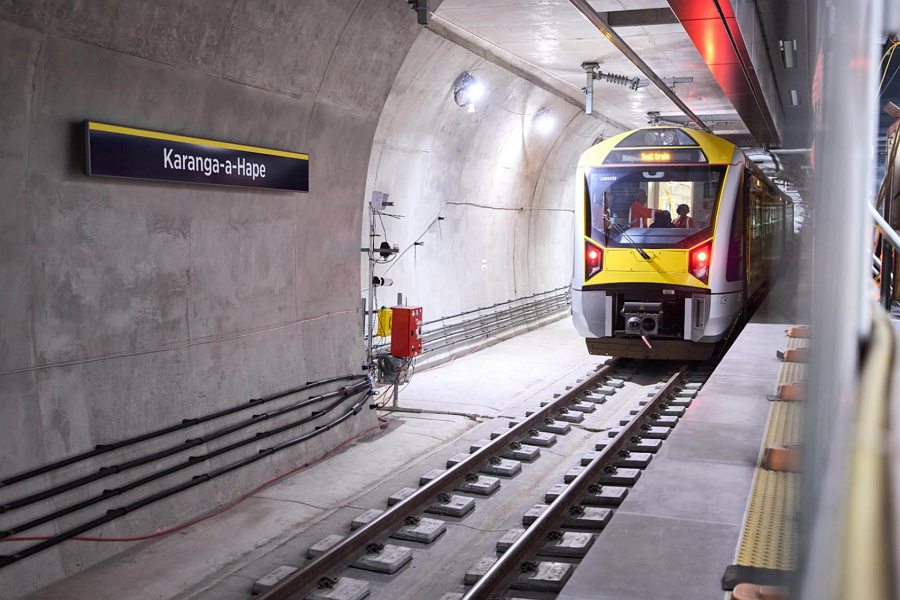 The CRL opening should also finally bring an end to six years of significant rail disruption – not just from building the tunnels, but also the work to bring the rest of the network up to a modern standard. This ongoing disruption has absolutely had a negative impact on rail usage, over and above that seen during the early pandemic years, so it will likely take some time to earn Aucklanders’ trust back in the network.
Level Crossing Removal
There will, however, still be some rail disruption in the coming years as Auckland Transport works to remove level crossings from the network. Construction is already underway on removing at-grade pedestrian crossings at Glen Innes, Te Mahia and Takaanini stations.
Enabling works are expected to start later this year on the the first of the road crossings at Takanini, with actual construction not due to start till 2027.
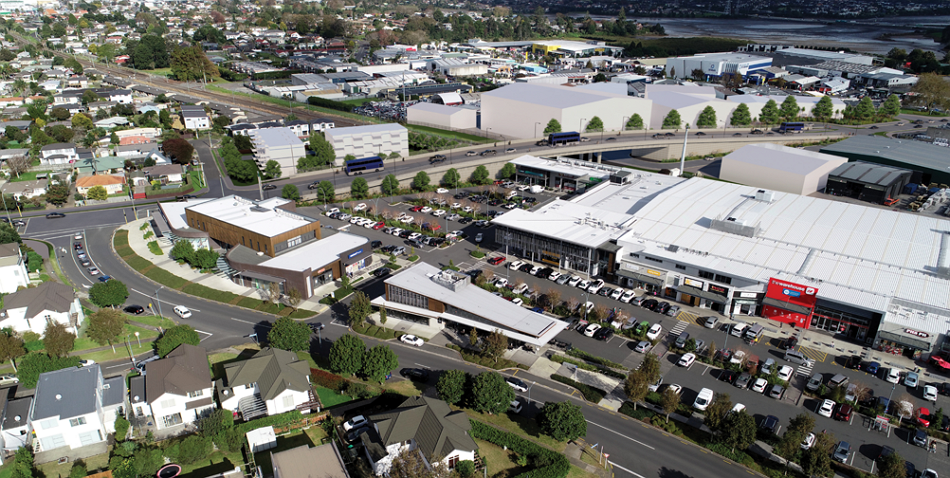
The proposed Walters Rd level crossing removal
Hopefully we’ll also hear more this year on what AT plan to do about level crossings on the Western Line. They’re cited as the reason the west will only see limited improvements to train services, but I’m not holding my breath that we’ll get too much.
New stations for Drury
As well as the CRL, this year will also see the opening of two of the three new stations down south – Drury and Paerata, with Ngākōroa expected to open in 2027.
If you include Maungawhau reopening – plus Karanga-ā-hape and Te Wai Horotiu in the city – this makes for five new stations opening in 2026.
The last time we had that many stations open on our rapid transit network in a single year was 1930, when the Eastern Line opened.

An aerial impression of the new Drury Station
Rosedale Busway Station construction
Despite the Northern Busway extension being completed in 2022, construction on the Rosedale Busway station has been frustratingly delayed multiple times. That should hopefully resolve this year, with AT saying they will begin construction in early to mid-2026.
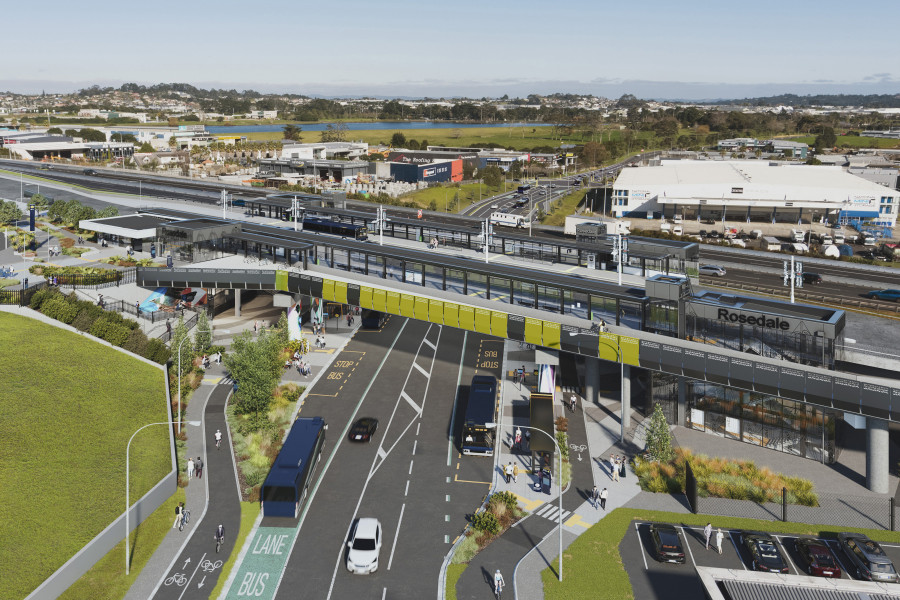
The Rosedale station is awesome, but not every station can be this. Nor needs to be.
Eastern Busway progress
Now that the Rā Hihi flyover has been completed, we should start to see significant progress on the rest of the Eastern Busway this year, with completion due in 2027.

Auckland Transport governance changes, and Council Plans
In March, a six-month transition period begins: Auckland Transport will be split up, with most of its functions integrated into Auckland Council, with everything expected to be completed by September.
Auckland Transport will remain as an organisation, but focused on the delivery of public transport. If nothing else, this change is going to be incredibly disruptive to those working at AT. And, while all of this is going on – and even for some time after – I do wonder what impact it is going to have on the planning and delivery of projects, such as the planning for those Western Line level crossing removals.
There’s also a huge question mark hanging over the smart, integrated, cost-effective planning of things like the citywide bike and micromonbility network, and the kind of pedestrian improvements essential to safe and frequent use of the public transport network.
Giving Local Boards some more say over some aspects of local streets is also a part of the changes. So it will also be interesting to see just how the council ends up splitting responsibilities with local boards, and whether those new responsibilities come with budgets, or what.
Related: one of the key elements the council will need to deliver as part of these changes is a 30-year transport plan for Auckland, made in conjunction with central government.
This is expected to build on the work of the previous Auckland Transport Alignment Project (ATAP), the original version of which – under the previous National government – came up with the right outcome despite asking the wrong questions.
Will this coalition government arrive at an outcome that follows the evidence?
This year, we’re also likely to see refreshes of the councils’ Long Term Plan; and it’s possible we’ll see a refresh of the City Centre Masterplan, too. We’re concerned at some of the noises Mayor Wayne Brown has been making about some aspects of the current CCMP, including a yearning to make the city more (!) car-friendly, and this is something we’ll be keeping a close eye on.
Central Government Elections
The election will be a huge focus in the second half of the year, especially with polling looking tight. (This is assuming a regular election, the date of which is usually set early in the New Year – and that we’re not about to be surprised by a snap election.)
Will we see the current government propose more crazy and unaffordable road projects, on top of the tens of billions of projects they have on their list and can’t afford? And will Labour actually stand for something tangible, maybe even bringing some detailed smarts to the interrelated questions of transport, liveable homes, the cost-of-living, and climate resilience?
Or will it be down to the smaller parties to deliver some right-sized, nuanced, balanced policies that take these issues seriously, and talk up the massive opportunities available when approached holistically?
Also, before we even get to the election, will Prime Minister Christopher Luxon make another cabinet reshuffle, and will that have any impact on the portfolios that impact our cities.
Active Modes: how to keep the pipeline flowing?
As I reported in our 2025 review, the last year saw a flurry of good projects delivered – many of which had been pointlessly delayed for years, often by AT and politicians reacting to tiny number of loud voices.
Costs continued to rise, co-funding evaporated, communities waited, whole cohorts of children grew up, and Aucklanders as a whole were robbed of the opportunity to see this kind of infrastructure in action, and that it’s actually great, and works fine.
With the current government’s outrageously ideological GPS tightly restricting investment in basic walking and cycling facilities, a challenge for Auckland this year will be how to keep the pipeline of projects going.
A couple of obvious opportunities: the Climate Action Transport Targeted Rate (CATTR), and of course leveraging the renewals budget to build back better – every time a road gets resealed, logically it should be made fit for purpose for <checks calendar> a quarter of the way through a climate-critical century.
Some ongoing and upcoming projects to keep an eye on…
Te Whau Pathway
The first stage of Te Whau Pathway – which will ultimately link Te Atatū Peninsula (at the NW path) to New Lynn and onwards to Green Bay – has been making great progress, and should open some time this year.
Note that as a largely off-road pathway, this is largely funded by Crown funding and Auckland Council, and is coming together slowly in sections over the years.
Hobsonville Rd Cycleway
Next week, AT starts work on delivering the first section of cycleway along Hobsonville Rd. This one is funded by Council’s Climate Action Transport Targeted Rate (CATTR).
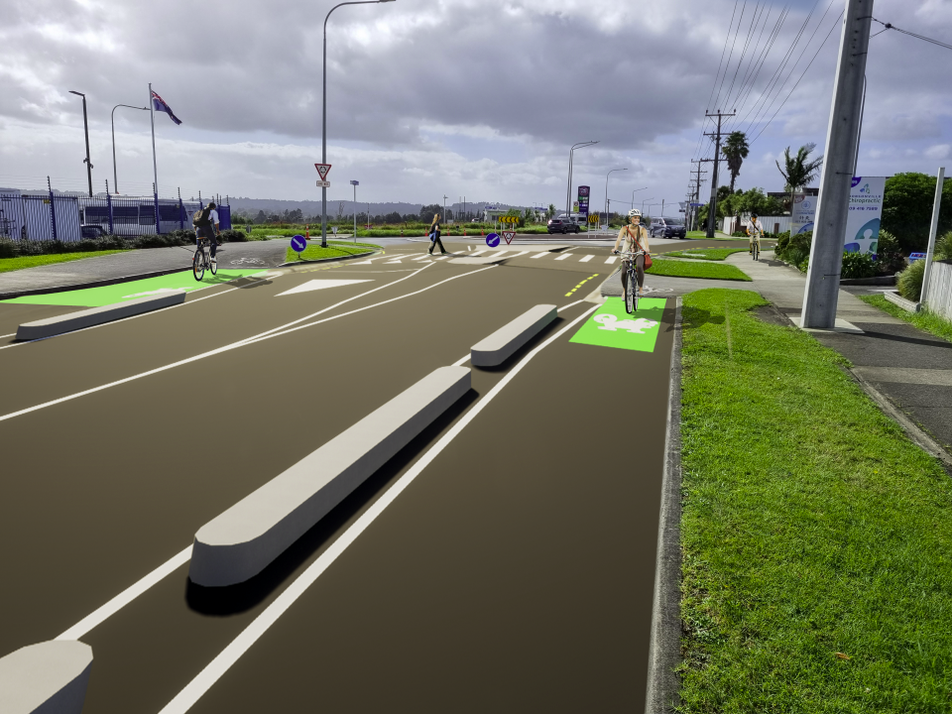
Green Lane West
As Bike Auckland noted late last year, Auckland Transport is advancing plans to improve Green Lane West, which include a (slightly wider) painted bike lane on the road plus sections of shared path.
This is conspicuously unfit for purpose – especially as Green Lane is a key regional route on the cycle and micromobility network, not to mention, filling up with lots of new housing. The recent redesign of Great North Road offers a more appropriate approach for arterials.
Expect to see more discussion of this critical route early this year when AT reports back on public feedback. We also understand there is an existing design for a bidirectional protected cycleway. Watch this space.
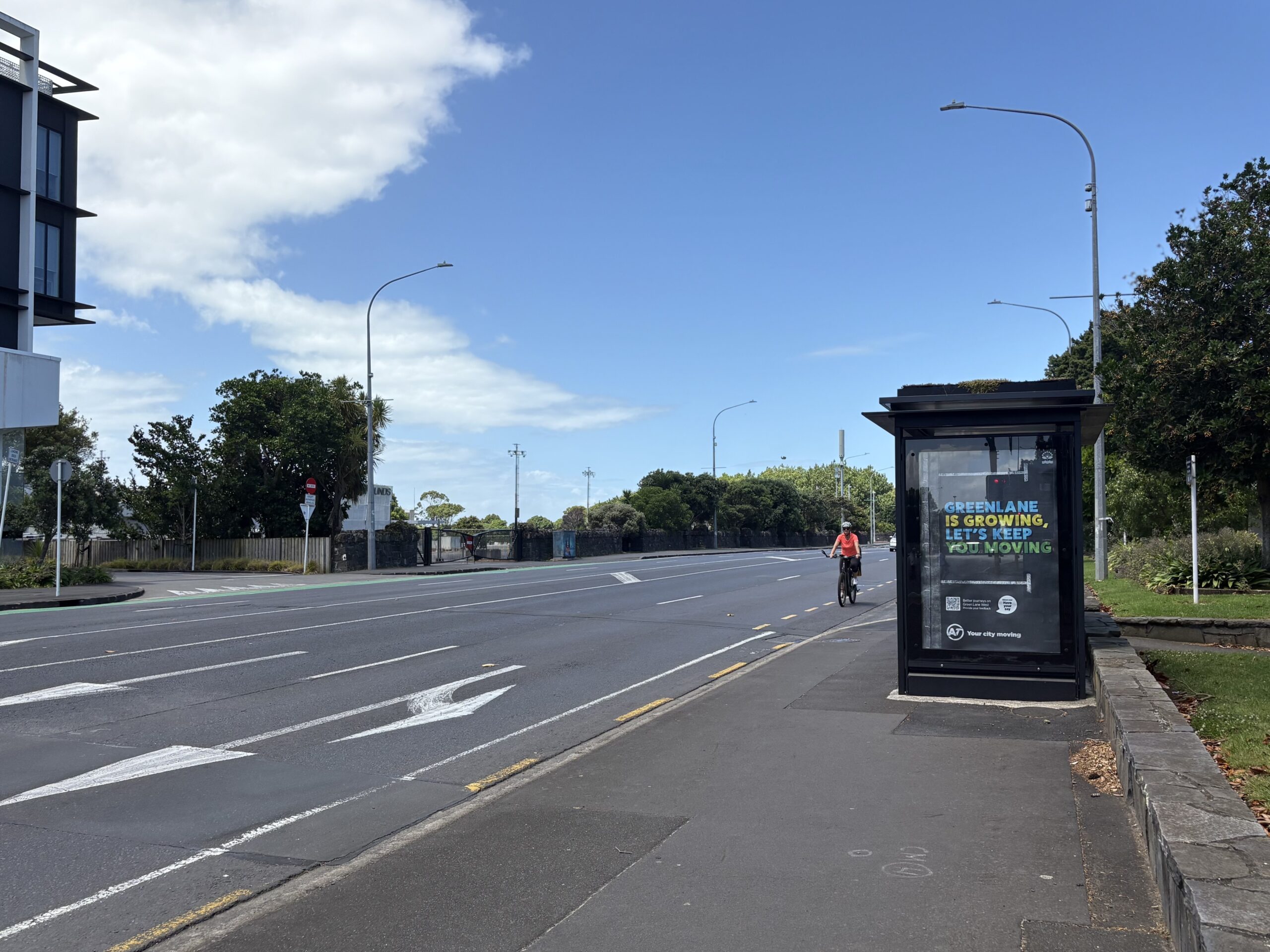
Green Lane West, outside the hospital, showing an existing bus stop, a person on a bike using the narrow painted lane, and a glimpse of the new housing for hundreds of people over the road at Alexandra Park. Plenty of room for improvement here. Image: Jolisa Gracewood
Roads
RoNS reality biting, hard
Last year, the reality of the scale of this government’s Roads of National Significance programme became clear, with news the hand-picked projects are currently expected to cost up to $56 billion. This is far more than what can be funded from existing fuel sources or even tolls.
Already, a lot of transport projects are funded directly by the government, but this programme would require significantly more crown funding to be poured in. And that is money that then can’t be invested in other areas where it’s desperately needed, like health and education.
There also still needs to be funding for all of the many smaller transport projects that need delivering – including safety upgrades, and repairs to critical links damaged by increasingly intense weather. These smaller projects, combined, are likely to have far greater impact and more widespread benefits than the shortlist of mega-projects.
I suspect this year the full reality of how unaffordable the RoNS are will continue to hit home. And I wouldn’t be surprised if we if start to see some scaled back, in order to make them more deliverable.
Warkworth to Te Hana
One of the first of the big RoNS projects to get underway is actually a hangover from the original RoNS programme. Now estimated to cost around $4 billion, it will be one of, if not the, most expensive road projects New Zealand has ever built (so far).
Like the Puhoi to Warkworth section, this project is being delivered as a PPP, and the contract is expected to be awarded by the end of July with construction starting by the end of this year.
The project includes an interchange larger than the town it is serving. Make it make sense.

The proposed interchange at Warkworth will be larger than the town it is serving.
Additional Waitematā Harbour Crossing (AWHC)
The government can’t even begin to fund their all of the mega-roads currently on their wishlist – and on top of that, this year they’re expecting to make a decision on plans for another Waitemata Harbour crossing. Which, if built, would easily eclipse Warkwoth to Te Hana in terms of cost to the nation.
The big question is whether they’ll opt for a bridge or a tunnel. Given there’s been a bizarre obsession with tunnelling for many years, my guess is the scales are currently being heavily leaned on by planners and engineers to get that outcome. Whether or not it’s best for Auckland.
There’s also the question of whether such a call would bind future governments, given how long these things take to get off the ground.
And, just as importantly as the question of what shape the crossing takes is the increasingly urgent question of when and how (or indeed if) people will be able to cross from one shore to the other using active modes.
It continues to beggar belief that – as far as we know – Auckland is entirely alone among world cities built around harbours and rivers, in legally forbidding people direct access over the water on foot or by bike, scooter, wheelchair, etc. It’s extra weird, given how much we make of our beautiful harbour and sparkling views as an attraction for visitors.
When he was Transport Minister, Simeon Brown explicitly ruled out including active modes in any new harbour crossing – an oddly specific and frankly embarrassing stance to take.
Will that have changed under a new transport minister? And/or might it change under a new government this year? Let’s hope reason re-enters the picture.
That’s our initial overview of what’s on the horizon. Are there any major projects we’ve missed? What are you most looking forward to this year?
We also welcome your predictions, from the logical to the wild-card. For example:
- How will the new council shape up, and besides the Papatoetoe re-election, will there be any by-elections this year?
- Will Mayor Wayne Brown enjoy a road-to-Damascus moment cycling along Great North Road’s great new bike lanes, and suddenly demand all arterials get the faster, better, cheaper treatment?
- Etc, etc.
Feel free to weigh in, in the comments below…
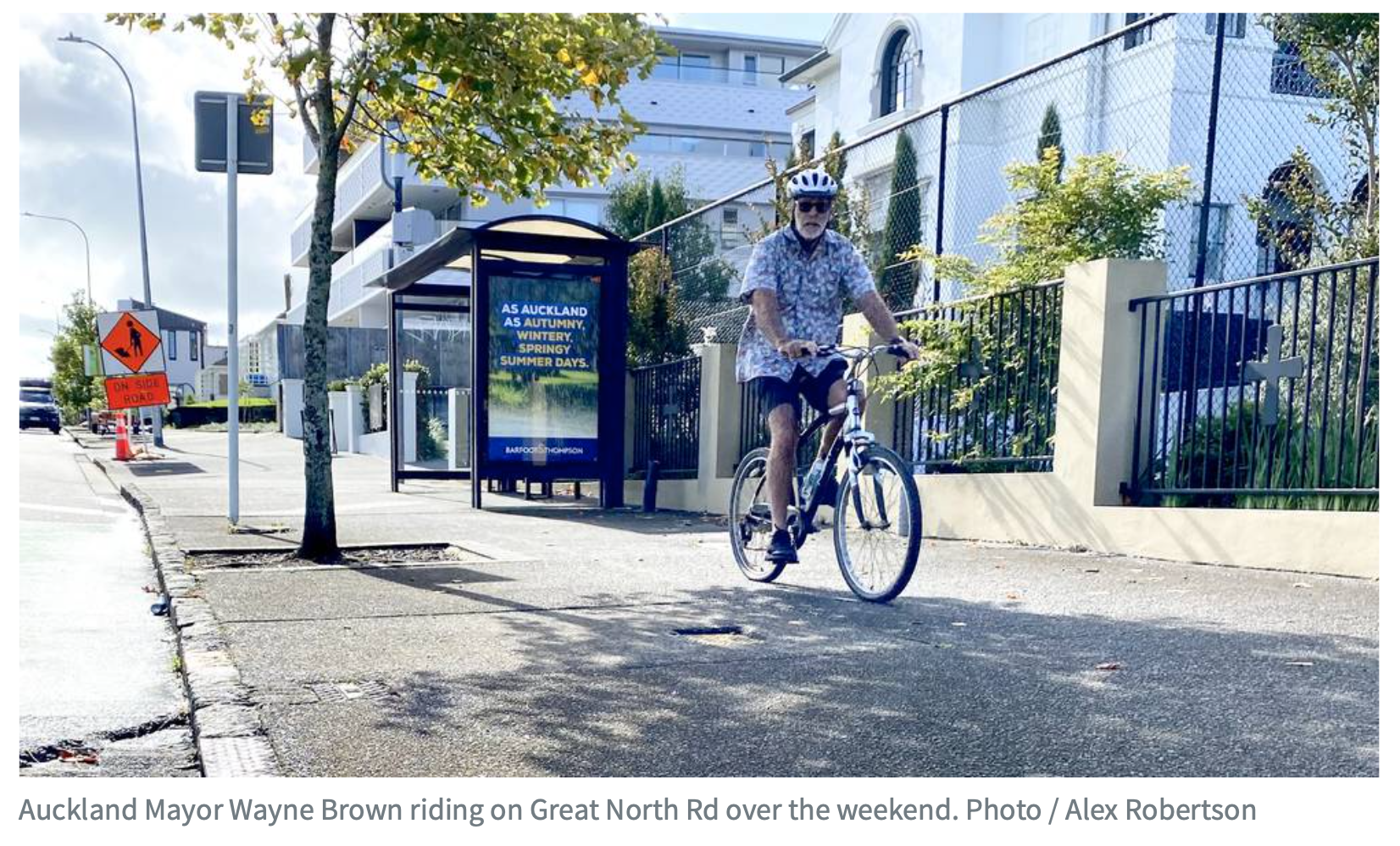
The Mayor cycling on the footpath on Great North Road in 2023 (via NZH).
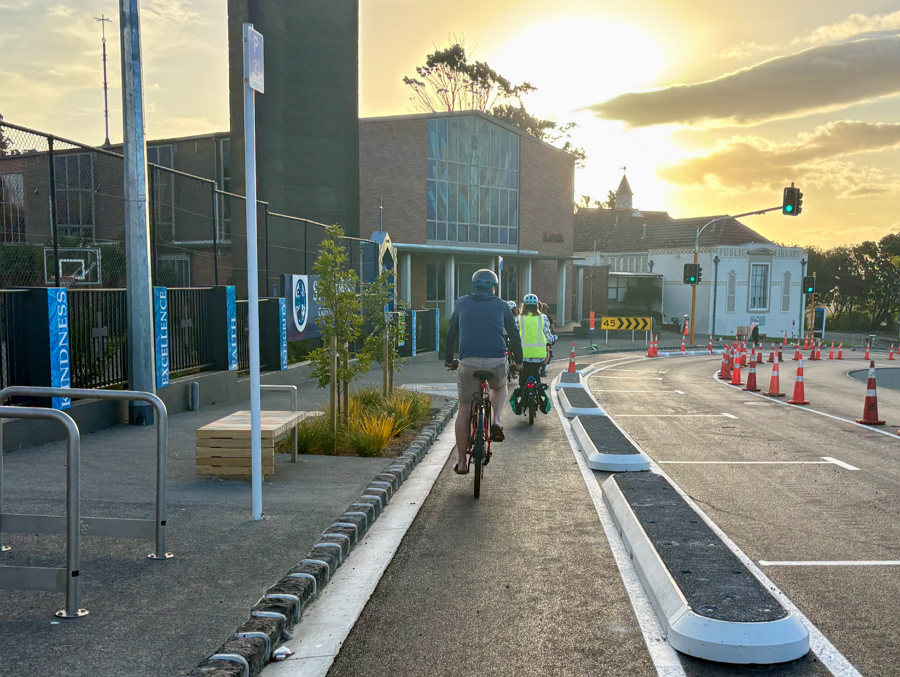
December 2025, construction just about finished: same corner, new protected cycleway, nicer surface for driving, better bus stops (just out of shot).

 Processing...
I regularly catch a bus or bike into town and notice how the city is looking very attractive and bright. Walking or busing down Pitt St to Albert St is a joy. Many new buildings are very colourful. Not drab grey. White, orange, blue, green. Several have had facelifts including the Art Gallery, the town Hall, the old customhouse building. A 2 story corner bulding on K Rd has been recently beautifully restored. The University precinct is busy with rapidly increasing numbers of students, The new internationally rated sports complex on Symonds St, with its outdoor changeable hockey field/Tennis courts on the top floor is attracting 5000 visits a day.
I agree with the mayor who says the city is safe.
Intensification has significantly lower infrastructure costs per dwelling compared to urban sprawl. I feel that we are focusing on building roads and rail out to distant places at great cost. Many of our suburbs such as Middlemore, Morningside, Panmure, Greenlane, Ellerslie, Sylvia Park are building apartment buildings and people are enjoying the benefits. Clusters of tall apartments is preferable so that 5 or 6 tall buildings on 1 city block will have good separation and public spaces. There is some opposition to 3×3 housing developments but to me many of them are quite attractive and mostly built in places where they don’t intrude such as on the south side of a city block where they shade the road only.
Biking numbers in London city have doubled in the past 2 or 3 years. Auckland biking numbers are slowiy increasing.
In Auckland we should be supporting a 20 minute city rather than sprawl where people are commuting for 2 or 3 hours a day at great cost to families, emissions , peoples health and the productivity of NZ.
If we achieve 20 minute cities and towns, it would knock us off being the world leaders in our cars per person. And it’s associated car based infrastructure provision.
We, instead may find other things to spend our time, taxes, rates, and personal incomes on. Better things.
Yes, biking in London is booming. No reason we can’t do the same here.
I work in the central city, and while things are improving, it still doesn’t feel that safe to me.
I’m pro density, and since living in Auckland I have lived in attached units, attached townhouses, and apartments. These have always been quality buildings built in the 1970’s and 1980’s.
Regarding apartments, I live in one, but it is older and well built – designed well for sun, a decent size, and it has carparking. I worry about many of the newer apartments being built. They are often poorly built for the sun (and therefore have heat issues), they are poorly designed with minimal storage, and I think they still need to have off-streak parking, at least if they are outside the city. I generally use public transport, and don’t drive a lot, but I still own a car as I have family scattered across the city. Something like 90% of households own one or more cars. Most people I know who are regular users of public transport are the same, so we need to be realistic about parking requirements or our streets are going to get more and more clogged with cars than they already are. We do need to keep encouraging people to use public transport (or walking/biking) as much as possible.
Coming back to apartments, I still know of people being caught out with big bills for remediation, and some of these are relatively new buildings. Before going all out on building more, we need to look at what is going wrong and fix it. Paying expensive remediation costs has financial and mental health impacts, along with environmental impacts as well.
I think with the new developments we need to think carefully about who we are building these for. For example, we have an aging population, and according to statistics, about 60% of our elderly retire with little or no superannuation. This means they are going to struggle to pay a bodycorp in retirement. Many may not want to live in a multi-story dwelling either – as someone with a disability this isn’t an option. So we need to ensure that we are building a range of building types in each area, otherwise we will have the sitation that people can’t stay in their local areas as they age, and many want to.
This is probably NZ’s worst problem with new housing: poor design of space. Since design ‘acceptability’ is determined by acceptance by banks as collateral for debt, only flooding the market with good design would decrease the acceptability of poor design, especially of design for rent.
There appears to be no appetite for assessing design for approval of construction or financing.
Control by regulation of density without control of design continues the delivery only of minimum viable product in bulk, with ‘Grand Designs’ in relatively small numbers for the wealthy.
Only if genuine care for functional quality of design prevails, as it does for social housing, can affordable housing of liveable quality begin to appear.
I lived in apartments for 25 across the Asia-Pacific and I just don’t know how NZ got this so wrong.
Outside of a few exceptions I had space for storage, great layouts, size options (500sq ft studio to 3000sq ft duplex), complete with pools, gyms, cafes and great communities. Even when I owned (and I still do) there is no remediation issues and the leasehold ones I do, the ground rent only has minimal increases every few years.
I guess we built for the student market in Auckland first when it scaled up, and design was thrown out the window. That has set the minimum benchmark.
If we continue to build apartment buildings that provide space for cars, people will continue owning cars.
I’ve lived in Auckland for just under 3 years, in apartment buildings the whole time, and have never owned a car. For everyday travel walking, cycling, e-scooters, and transit are more than enough, and for trips that may require a car, carshare services have been more than adequate. No reason to cater to those who would prefer to own their own vehicle just because.
Not a mention of the North Western bus station, or the SH 16 improvements.
This road apparently carries more traffic than the Pōneke Transmission Gully, and the two year improvements have also created significant disruptions over the first part of the upgrade.
I don’t think the obsession with tunnelling is bizarre. Metro systems are great from a user experience POV, and we in NZ like to compare to our Aussie neighbours – Sydney and Melbourne have both recently opened new metro lines. Also, people who work on these metro projects (CRL included) want more work in future, so we need tunnel projects in the infrastructure pipeline.
When completed more of the Sydney and Melbourne metros will be above ground than below ground, even the Tube has significant sections above ground.
The question of whether the harbour is crossed with a tunnel or bridge should be what’s best for Auckland not how to keep tunnellers in employment.
That’s a fair point. Also remember it will be connecting to lines that are already underground, and getting them above ground for a bridge with CBD space constraints would add to the complexity.
Yes, if it’s heavy rail it would definitely go underground across the harbour, if it’s light rail or bus the bridge becomes an option.
I think scenario 3 makes the most sense: https://www.greaterauckland.org.nz/wp-content/uploads/2023/03/Waitemata-Harbour-Connections-Scenarios.pdf
LR is going to be a tough sell after the last debacle. LR in a tunnel twice as long as it needs to be by going via Birkenhead? No chance.
Option 2 for the cheaper bridge and drop the Takapuna leg to save further costs. They are a hop, skip and a jump to the CBD via bus priority to Aotea.
We won’t be doing ‘light’ rail anyway since the ALR project was cancelled, just connect the rail tunnel to the (recently revamped!) existing network.
Running the line westwards means it can be built with a wider turn angle for higher train speeds, and it would be running to a part of the city with lots of buildable land area instead of along the coastline for the views. where people live?
Also, you don’t just build a single train station right at the end of the line, so making your project as short as possible ‘as the crow flies’ doesn’t make sense for a transport project of this size, even if it would be cheaper.
So its not Option 3 then (LR). Its HR which is even more expensive. If you think LR was a tough sell, try HR. And the cancelled LR proposal was south of the CBD, anyway. Doesn’t rule out going north with it.
LR can “connect” with the current network via interchange stations (e.g Aotea). It drops people off at street level and then people hope onto a bus or head down the escalators to a train, like a proper network.
“and it would be running to a part of the city with lots of buildable land area instead of along the coastline for the views. where people live?”
Option 3 seems to spend most of its time under water.
not to mention the routing while on the shore seeming to have a pitifully low number of stations after Belmont, Takapuna, and Smales.
Surely adding to our existing rail network would be cheaper than building a new light rail network from scratch
For example, who would operate the new network? You would also have to buy new trains rather than using those on the existing network, and you would need to buy enough land for a rail yard (where would this go?). Then you would have to have a build separate power delivery infrastructure, the list goes on…
Anon – many of those things require expenditure either way such as extra power infrastructure and stabling as the network and size of the fleet goes.
There are a number of advantages to having a separate network such as being able to design trains and platforms specifically for passengers rather than a network that also carries freight.
Joining the North Shore to the existing network is also likely to be very expensive.
Sure, but we already know how to build on the existing network so there will be time savings when working with known rail design specifications. Also it would be silly if had to transfer to a new train every time you wanted to the North Shore IMO
The reality is there is going to be a transfer to go to the North Shore anyway as the design of Te Wai Horotiu station has allowance for a line from the Shore to run perpendicular below the existing platforms.
The reality is any form of heavy rail to the shore will require significant tunnelling for line once it is across the harbour due to gradients on the North Shore. This cost will likely mean nothing happens if heavy rail is the preferred option.
There is also the issue of the capacity of the current network. Even with the CRL that will top out. So a complimentary network makes sense. And HR is just more expensive anyway.
Rail across the harbour could be LR or LM, but I highly doubt it will be HR. But hey, I’d take any of them.
You did not mention congestion tax which could have a big effect on car travel in Auckland. Just read this which is encouraging:
Yesterday marked the first anniversary of New York City charging drivers US$9 to enter Manhattan below 60th Street during peak hours, and the data shows that congestion pricing is doing what it intended.
Open roads: There were 27 million fewer car trips into the congestion zone compared to the previous year, according to the Metropolitan Transportation Authority (MTA), creating faster commutes into and around the city.
Mass appeal: Ridership rose across subways, buses, and railroad lines, although only some of it can be attributed to fewer cars entering the city per day.
More money: In its first year, the toll is projected to raise ~US$550 million, which will be allocated to public transit infrastructure improvements.
Safety: The number of people seriously injured in crashes is down by 8.6% in the zone compared to down by 1.6% in the rest of the city.
Jury is still out on pollution: A Cornell study found a 22% improvement in air quality. But two other reports, including one from the MTA, found no significant changes in pollutant levels.
What’s next? In November, President Trump said he wanted to kill the congestion pricing program. Judges have so far sided with the initiative remaining in place, although two cases remain pending.
The surge in electricity costs imposed in 2026 by overseas controlled electricity monopolies to Auckland consumers needs push back by Council as a major user on behalf of all its ratepayers
Who are the overseas controlled electricity monopolies?
None of them.
If you break down where the cost increases have come from, its (mostly) not energy! Price increases are from the regulated distribution / lines business, which is owned by a public trust which most Aucklanders get to vote on. Elections with abysmal turnout and are dominated by people who want to charge as much as possible in power so that they can mail out the biggest cheque “rebate” every year. A big transfer of value from big households to small ones.
There are 5 distribution lines companies in NZ and they surely hold hands despite Commerce Commission oversight. Yes Jack consumer owned lines-trusts pay a dividend around Christmas each year which is a real benefit to Auckland Consumers but not to Wairoa Gisborne where the trustees sold out to Clarus International which is now on selling to WhoKnows. As you say in Auckland there is big transfer of value from big households to small ones and to businesses like the Councils. Consider for a moment the unregulated meter reading charge of 4%. Every time there is a price increase for distribution approved by the Commerce Commission Vector get a bonus. Now meter reading is automated that 4% of every bill is money for old rope. Vector have already “bundled” part of the income stream and sold it to an offshore investor approved by Overseas Investment Agency and Grant Robertson
So no overseas controlled electricity monopolies operating in Auckland then.
The largest part, roughly half, of your electricity bill is the cost of the energy.
Moving the electricity around is much less, recent increases notwithstanding (transmission costs are 8% of a typical residential electricity bill and distribution upwards of 20% depending where you live). Those costs are regulated by the Commerce Commission (not by Entrust, which owns 75% of Vector).
Electricity prices will come down as and when we transition away from expensive fuel-based forms of energy to renewables – which are much lower cost, mainly because they are fuel-free – a mix of grid-connected solar, wind, batteries and geothermal as well as smaller residential / commercial rooftop solar and batteries.
Connecting the renewables requires investment in new transmission and distribution assets hence the increases there.
“KiwiRail has upgraded enough freight locomotives with the in-cab signaling system needed to operate on the Auckland network”
By August?
Frustrating to read that at the same time CRL has been in planning for a very long time, and building for years, Kiwirail are only now rolling out upgraded signaling systems, so might be the critical path in opening
Agree, you would think this would have been one of the easier issues to resolve. There must be a bit more behind it?
Like, only one of the current coalition knows anything about the value of funding for trains?
The park n ride at Paerata looks huge so can act as overflow for Pukekohe. I would love to see more people using the train out there. I was talking to a women who was moaning about sitting in traffic between Pukekohe and Highbrook. I would thought train to Otahuhu station and bus 351 would be a viable alternative.The bus stop is right outside her work. I will suggest it the next time I see her.
It’s still going to be a long while before Paerata and Drury have enough new housing occupied to support all the rail service from Pukekohe, so P’n’R now will give those new stations a boost until more people arrive there locally by bus. Albany P’n’R shows how fringe stations allow this kind of transfer, avoiding car congestion.
Jezza It is correct to say,” There are no overseas controlled electricity monopolies operating in Auckland.” I would add “yet…” because the executives and consultants who negotiate these sales get wonderful bonuses and golden handshakes from the munificent sale returns
Entrust (formerly the Auckland Energy Consumer Trust) owns 75% of Vector, under the terms of an 80 year deed, which runs to 2073. After which ownership reverts to Auckland Council. It’s hard to see Vector becoming “overseas controlled”.
Good info Bigwheel. In Gisborne Wairoa EastCoast Tairaawhiti we had the same 1993 “Bradford Reform” electricity trust deal with the trust capital at the expiry of 80 years down to pass under the trust deed to the Gisborne District after 80 years. Well, the trustees sold the trust’s electricity assets to an overseas outfit two years ago for a pittance. What is to stop Vector doing the same? It’s a trustee decision not a beneficiary decision
Beneficiaries can vote for trustees whose intentions match their preferences…
Good info Bigwheel. In Gisborne Wairoa EastCoast Tairaawhiti we had the same 1993 “Bradford Reform” electricity trust deal with the trust capital at the expiry of 80 years down to pass under the trust deed to the Gisborne District after 80 years. Well, the trustees sold the trust’s electricity assets to an overseas outfit two years ago for a pittance. What is to stop Vector doing the same? It’s a trustee decision not a beneficiary decision
Forearmed is forewarned. Kia tupato Tamaki Makaurau