Recently, under its new Mayor Andrew Little, Wellington City Council voted to delay the Golden Mile street project for yet another review.
This is despite the Golden Mile being well supported in (repeated) consultations, with a benefit cost ratio of 5.8, and with millions of dollars of central government funding sitting there ready to use – plus the obvious fact that this part of Wellington really really needs the spruce-up.
It says a lot about Little that he thinks another review is a good idea, and that it will result in anything but the project becoming either more expensive due to delays, or worse, cancelled due to being more expensive due to delays.
Meanwhile, in New Zealand’s primary city Auckland, our own Mayor has recently starting ramping up the anti-urban-improvements rhetoric. But because it’s Wayne Brown, it’s a little different.
You see, whenever Wayne Brown speaks about Auckland’s City Centre, it’s like flipping a coin. Will you get urbane Wayne, or small-town Wayne?
Half the time he sounds like someone who loves and understands cities and all the potential they bring. And other times, he sounds like like an even more extreme version of Andrew Little.
If the coin lands heads-up, he’ll laud our city centre, boast happily about great projects such as Brownie’s Pool, spread the glad news about the virtues of a compact city, and support popular street upgrades like Te Hā Noa, the Victoria Street linear park.
But if the coin lands the other way, as seems to be happening more often lately: Brown will grumble on tediously about preserving the sacred flow of car traffic. moan about road cones, or suddenly turn tail and claim to be against popular street upgrades, like Te Hā Noa, the Victoria Street linear park.
And this is the paradox of Brown, when it comes to the City Centre.
I think this paradox is best represented by the almost completed works on Victoria Street.
Te Hā Noa/Victoria Street Linear Park has transformed Victoria Street from a glum traffic sewer into a beautiful and welcoming green street, which is now pumping with people every day of the week. It was extremely popular when first proposed in the City Centre Masterplan (check out this 2016 post by Patrick on the subject) – and despite repeated attempts to stop it over many years, it’s been funded and built (well, almost).
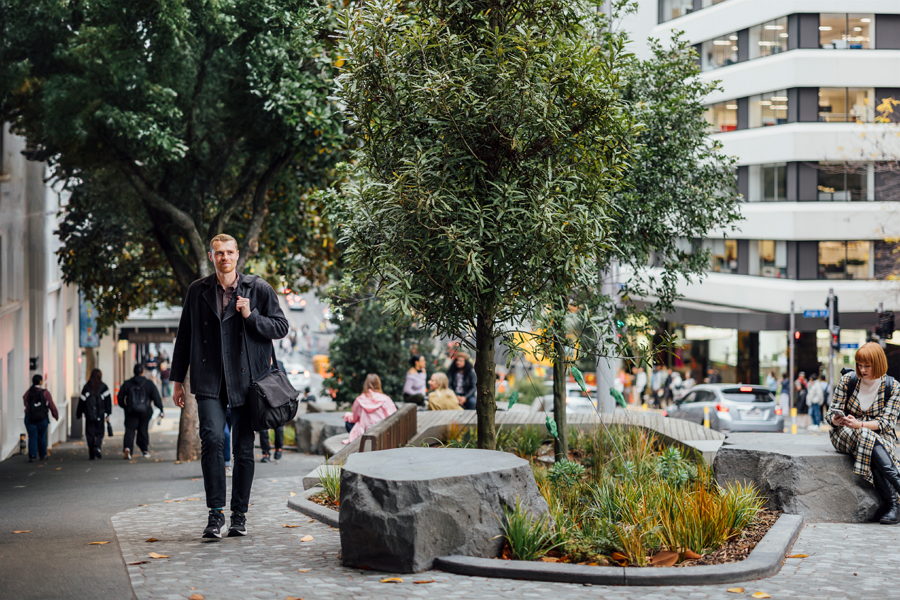
In fact, in 2023 Wayne Brown was almost fanatical in his support of the project.
In response to Councillor Mike Lee putting forward a motion opposing the project, Brown exclaimed: “Anyone who seconds that is going to be threatened within an inch of their life”.
And to the naysayers speaking against starting construction, due to funding coming from the City Centre Targeted Rate, the Mayor proudly state that “as the only city resident and the only one who has contributed to it, I have to declare an interest, I think it’s a bloody good thing”.
It is indeed a bloody good thing that this project has happened – especially with City Rail Link set to open next year, which will pour thousands of people out onto this very street. Not to mention all those getting on and off buses, or biking or walking from one side of town to the other, and of course those who live and work in the area.
So it’s bizarre that more recently – in the first Governing Body meeting, and on his social media accounts – Brown has suddenly taken to attacking the Victoria Street upgrades, among other projects in the City Centre Masterplan. In particular, he’s taking issue with how cars travel around the city centre, and seems to be more concerned about the flow of traffic, than about the thousands of people who move through this area daily.
Given his previous support, it’s hard to know how seriously to take these latest fulminations by our Mayor. And, if he’s serious, it’s hard to know exactly why he’s suddenly flipped to be so adamantly against projects like Victoria Street.
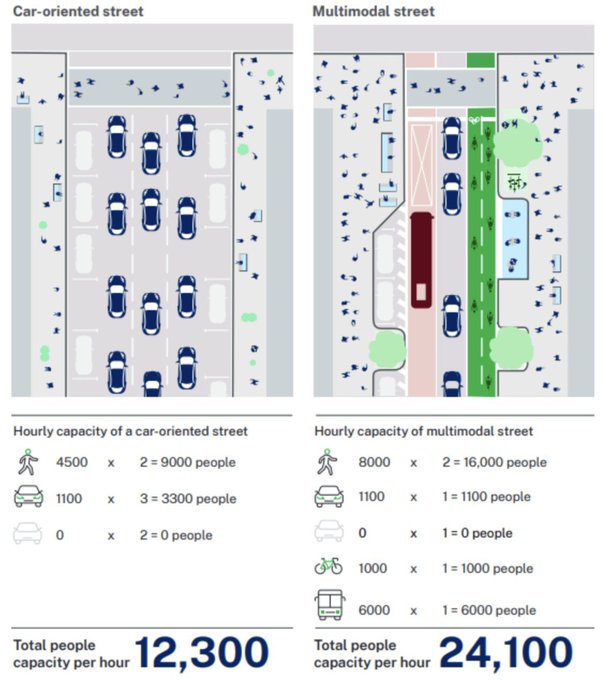
The Mayor keeps saying he has never got a proper explanation of how transport is supposed to work with the changes.
It is all there in the City Centre Master Plan, essentially: people walking and lingering are the key economic force in city centres – not high volume or speed vehicle traffic flow. It could just be that the organisation in charge of delivering much of these transport projects – Auckland Transport – has struggled to explain the transport strategy outcomes of the City Centre Masterplan, let alone deliver them. And so, projects like the Victoria Street upgrades are taking shape in a bit of an information vacuum.
When I was writing about the City Centre’s transport issues a year ago, I always came back to this fundamental issue.
We have a world-class transport strategy for the City Centre as part of the Masterplan, known as Access for Everyone. And there are a lot of really capable staff in both Council and AT, who are in the perfect position to tell the story of what’s happening and why. And yet, as I wrote a year ago:
When we look at all these issues in the City Centre, and we think about how we are currently able to travel within (not-withstanding construction), it feels like a hodge-podge of things that has no logic to anyone – however you travel. Bringing order to this chaotic approach is found in A4E’s circulation plans.
A4E is a pertinent example with how we seem to keep doing transport in Auckland – a lack of boldness and will to truly transform our city. This lack of vision, and refusal of our agencies to accept any, creates a vacuum that wastes our city’s potential (and money).
In my opinion, A4E is currently trapped in the cycle of business case hell. In other words, it’s being delayed out of existence. If we lose it we lose the foundation of the circulation plans that will create areas that can unleash our streets as spaces for people. A4E is vital as it will make our City Centre the place to be and create an intuitive transport network for everyone.
And fundamentally, while individual projects and individual AT staff are valiantly trying to solve problems – they are doing so without a solid foundation. This means any actions are merely tinkering on a flawed system that no one is happy with.
In short, while individual staff in Auckland Transport work hard on delivering great pieces of the full puzzle, the overall picture has been blurred by the rudderless management in AT.
In a situation like this, we are lucky that a lot of transformational work has already happened in the City Centre, so people can see for themselves what’s possible, can experience the difference, and can get on board with the plans to expand these great vibes even further across the city.
But this good luck was created via very hard mahi from a wide variety of people and groups, which made it easy and logical to make the right calls at every step of the way. It was the right call in 2023 to push forward with the Victoria Street Linear Park, and it was the right call even earlier to proceed with Quay Street.
Nobody would voluntarily go back to how things were before. And those who made the right calls can rightly bask in the reflected glory of the completed projects.
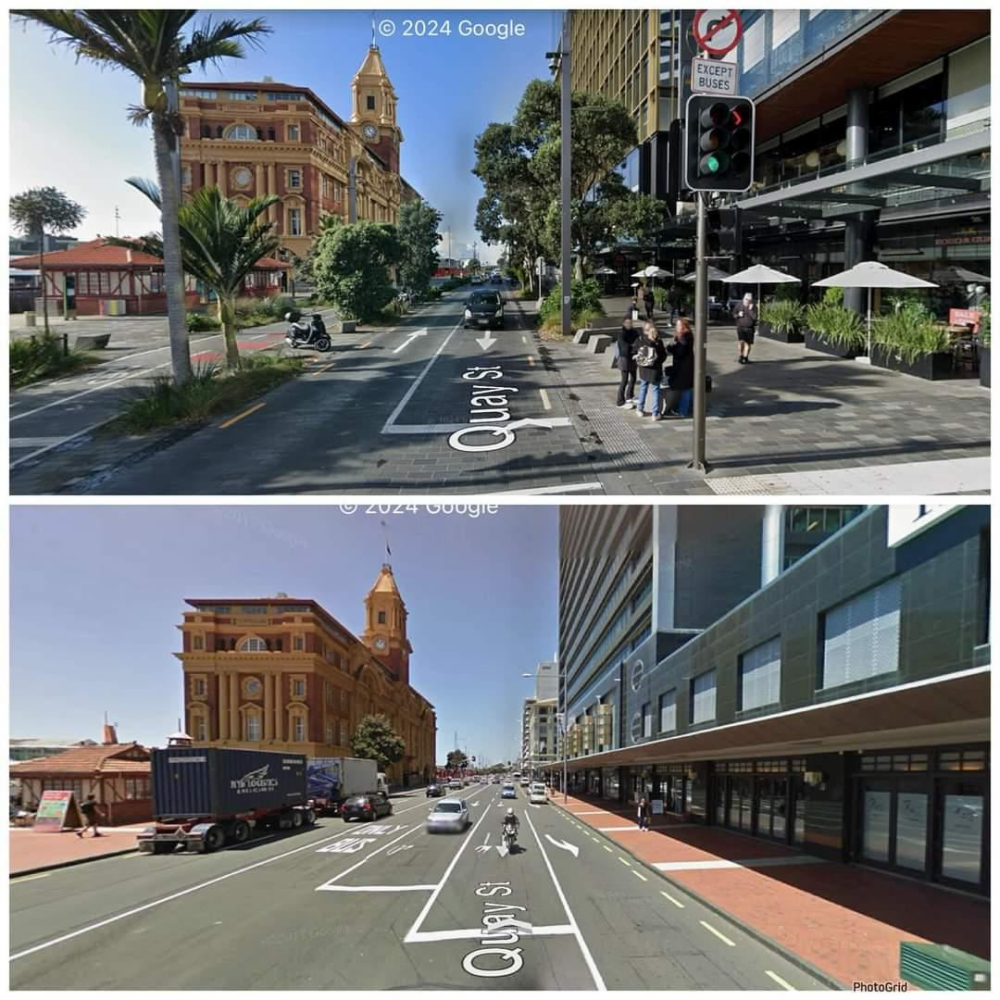
It’s still the right call today to continue with the rest of the planned transformations in the City Centre Masterplan.
With the Mayor calling for a review (or a refresh?) of the City Centre Masterplan – which isn’t itself a bad idea, as time moves on, and we learn more about how to do these things – there’s a really important lesson to keep in mind.
If you hit pause on projects, momentum will stop. Even under favourable circumstances, it’s hard to start up again – and harder still to keep the momentum going when times feel tough.
But it would be completely bonkers and wasteful to reverse amenity designed to optimise new pedestrian patterns shaped by the CRL before the stations even open. It is best practice to evaluate new (and existing) work but only once they’ve been in operation for a couple of years.
After its transformations in the 1990s, Wellington hit pause on investment after the turn of the century. The resulting stagnation means that even when momentum starts to rebuild, as it has in the last few years, and progress gets going again, it’s a lot more vulnerable to being stopped in its tracks.
Which is exactly what is happening right now, with the Golden Mile Project, under Wellington’s new Mayor Andrew Little.
So I have a simple question for Mayor Brown.
Do you want to make the same mistakes as Andrew Little, and delay progress, wasting time and money and miring our country’s premier city in suburban gloom, by stopping the momentum for positive change?
Or: will you continue to be bold, backing the popular plans and projects that are so visibly transforming our City Centre into a livelier, lovelier place – thus ensuring Auckland continues to lead this country and become the efficient green city you so proudly aspired to, in your inauguration speech?
This post, like all our work, is brought to you by the Greater Auckland crew and made possible by generous donations from our readers and fans. If you’d like to support our work, you can join our circle of supporters here, or support us on Substack.

 Processing...
Wayne Brown displayed his true colours when representing Council at the Select Committee hearing on the Transport Amendment Bill last week. During the QA hearing had an opportunity to elaborate on his presentation but digressed into a rambling complaint about AT not taking notice of his repeated complaints about roadworks slowing cross-town traffic. His approach is a worry on multiple levels.
1. He.may be the Mayor but that does not make him the sole arbiter about how transport improvements should be done.
2. By arguing against plans to make the inner city more pedestrian-friendly by reducing traffic flows through its streets he is actually trying to undo long-standing policies.
3. His particular focus was on “cross-town” traffic which he appears to want to facilitate rather than discourage.- current policy is to divert cross-town traffic around rather then through the Queen Street valley.
4- His tendency towards decision-making by dictat from on high (shades of Trump) rather than through a well thought out collective process.
Andrew Little is the first Wellington mayor in a hell of a long time to understand the need to cut spending. It really doesn’t matter how high a benefit cost ratio is if capital is constrained. The unnecessary spending has to stop. The money ratepayers could have spent on titivating some streets has already been wasted on a crappy old town hall and a sludge plant and a hundred other useless projects.
You have to spend money to make money, Miffy.
Cities don’t make money, they provide a service. The benefit cost ratio isn’t real. It isn’t a cash return to anyone. If a city spends on one thing then the money isn’t there to spend on another, they can’t take the ‘benefit earned’ and reinvest it like a company can. Auckland is about to discover that with CRL. At least companies that screw up go broke and stop wasting their investors money. Cities just go on and on wasting.
What are you on about? The whole point of cities is to enable interaction, transaction and connections; this is how businesses grow. Urban infrastructure provides the growing medium. Fail to invest and you get a failing city, e.g. Auckland in the early 1990s.
Please don’t just take it from me – I’m merely a goon on Greater Auckland. Listen to the experts. There is a good three-day course in Urban Economics that you might wish to consider taking: https://www.motu.nz/about-us/public-policy-seminars/events/three-urban-economic-short-courses
I am correcting your statement. Cities make no money from these projects. Nada. They just end up paying out more for maintenance and end up costing ratepayers even more. They are nice to have if the budget allows but when the money is spent there isn’t any money. Wellington has already wasted their ratepayers money to a point where they should face a rates cap. They didn’t even put aside enough to fix necessary pipes so of course they shouldn’t be wasting money on roads.
Once more for the kids at the back (Miffy):
‘Makes money’ is a financial phase
‘Delivers value’ is an economic one.
Public investments like city street upgrades or PT systems, or big highways cost money (financial loss) but are intended to deliver value (economic gain) which enable others to benefit in both intangible (be healthier, happier, save time, meet new people) and tangible ways (make money).
These are a category known as macro-economic investments – the evaluation of which can be pretty fraught, but if a project has a BCR of 5.8 given our usual processes and costs a couple hundred million, not several billion, then that isn’t the project in Wellington that we should be sceptical about.
By all means criticise a proposed public investment by showing why you think it likely has low value, especially too low for its costs, but it is irrelevant to say it doesn’t ‘make money’. It would not need to be a public investment if it did, it would be a business. The money here will be made by others, as will the more intangible benefits too – the public, the people, citizens, the wider ecionomy.
This is the entire neoliberal misunderstand of the world in one huge simplification: what else doesn’t ’make money’? Police force, the military, hospitals, the education system, vaccination programmes…. Etc. Any public services.
I agree Patrick the higher BC ratio projects are the ones we should focus on. The problem is Wellington spent all their money on low value but high cost projects so now they will have to delay projects that would have made more sense. Just like Auckland has by wasting its current and future funds on CRL, which is a perfect example of a high cost low value project.
But he bigger point is that Council’s don’t grow the economy in any meaningful way. They increase spending which is part of G in GDP=C+I+G+Nx but the increase in Government spending crowds out more productive spending. Growth is due to increases in Capital through saving and increases in Labour or labour productivity and that occurs through technology and know how. Fiddling around with streets is a cost, a worthy one if you can afford it. A hopeless waste when you can’t. Wellington can’t afford it.
Productivity is also spatial, these investments enable real spatial efficiencies and qualitative uplifts which attract transactions. It seems you run your evaluations (thumb suck) on narrow assumptions then jump to unsupported but super confidently expressed opinions.
So it goes.
Why are the types of people/companies that will invest in productivity/technology going to choose crap city X over good city Y?
Rates is a funny issue. For many working people its a small percentage of the tax they pay. In our household rates is ~$4k and income tax is many times that. And we use council services all the time, hardly ever use government ones. But for pensioners, rates is a big expense, and they have more time to complain (although don’t they get a big discount anyway?). I am not sure what the solution is, but there needs to be one.
The solution is a poll tax. That way everyone in a city feels the pain of overspending so they will vote out wastrels. At the moment most people don’t see a direct cost to voting these idiots in, so the idiots are actively encouraged to spend more public money. Don’t get me wrong, Councils can remove bottlenecks to growth, but most of their spending is more akin to consumption than investment.
Poll Tax? Because that famously worked in the UK…ha! More like the LOL Tax.
Or the Troll Tax.
Miffy would be out of pocket if there was a Troll Tax.
It is either a poll tax or close the councils down like they are with Regional Councils. Taxing a small group directly while having a larger group voting in people to spend money as fast as they can doesn’t work. Many of the voters see no connection between the spending and the cost of that spending. The slogan should be ‘No representation without taxation”.
I am sorry Miffy you really are a suburban dinasaur, wanting nothing more then your 1/4 acre on the outer fringes, and multilane roads to connect you there to big car parks at your limited destinations.
But city life, and city economies, are not just about roads, pipes and wires.
It is also hugely about amenity. Now some of that amenity is gifted by nature, the setting and the weather. In Auckland’s case that is significant, Christchurch, and Wellington, on account of it’s weather, much less so. A huge amount amenity is the public funded, “nice to to haves” The nice public spaces and parks, the good civic amenities. The libraries, swimming pools, and playgrounds. A good public transport system to reduce the extremly detrimental effects of motor vehicle clutter, And the publicly facilitated events, to keep locals amused and visitors to keep coming.
Here, Christchurch is interesting, in the very largely publicly funded, post earthquake rebuild, it’s now high standard of public amenity is making it, the big NZ city that is closest to currently flourishing.
Hamilton too, is emerging from dull, to desirable. And that includes desirable to do business. Though here, at considerable cost to council debt.
Wellington is struggling, it’s overall relitive amenity is in decline, the waterfront and city centre very little changed in the last 3 decades. Even the weather hasn’t improved.
It is a less desirable place to both live, and do business.
God knows why Miffy, why you want to live there.
Rates and insurance costs are insane, and heating bills.
By contrast Central Auckland and it’s waterfront amenity is unrecognisably improved over the last three decades.
As are more and more of the outer urban centres, notably Takapuna most recently. Car clutter,would by now, have been insane if it had not been for the massive improvement to public transport in those three decades.
Yes to pretty much all of that. Except if a series of idiot leaders have spent not only the current funding but also the future money through borrowing then it doesn’t really matter how good a project is, you simply can’t have it. Why did that happen? Because the people who vote them in don’t see the cost as a direct charge on them. Do you want a pony? Sure, I’ll have a pony. Do you want to pay for a pony? Shit no!
Wellington and any other buggered up city also presents opportunities. Houses there are now really good value. We can buy there and keep the Auckland house as a rental for passive income. Wellington is well connected so I can get anywhere. Before covid I tried to do no projects outside Auckland, now I work all around the country. Wellington’s weather is actually wonderful. I like the wonderful sunny days and the easy access to everything. I like a good stiff wind. A couple of weeks ago I watched a seagull flying backwards before it gave up. Wellington is in recession because of the government, not because it lacks anything. National always does this, John Key did. No amount of waste by the Council will fix it, but they could make it worse. Auckland’s beauty requires a boat. Wellington’s beauty is right there.
I’ve seen companies run like that. The CEO stops all investment, even if it has a really positive return, because the last CEO overspent.
What happens to that company/city? It stagnates, customers choose the better options. Then they need to cut more costs, and they are only left with the budget consumers (pensioners). It becomes a never ending round of cost cutting because the revenue is reducing too.
Agree, Wellington is loosing the battle with Christchurch at the moment.
One thing Wellington really has going for it is the compact city centre, money spent there will be an investment in the long run.
Bang on miffy!
It’s not an endless pot of gold for the council to spend as it wishes. This is people’s rates that they are paying ever-increasing amounts of, sometimes from a fixed income.
Nearly 10% of ratepayers are in arrears. If this doesn’t tell you something about how disproportionate (to increases in CPI, let alone incomes) rates rises have been recently, you need to get out more.
https://wellington.scoop.co.nz/?p=175205
It’s called cutting your cloth to suit. WCC is already up against it’s debt limit before getting a credit downgrade (i.e. borrowing becomes MORE expensive). Pressing pause and reviewing is the very least the Mayor should have done.
One of the most important things that makes a city special, is its physical spaces, and when it comes to businesses that is the key differential between online and brick and mortar.
It means street revitalisation projects are must do things in 21st century cities. If you don’t, then these areas will continue to decline and eventually fail because people won’t go to them. Then starts the spiral of urban decline, with less ability for people and businesses to pay rates, therefore less investment, therefore more decline and so on.
If a project is good enough (as Golden Mile is given the years of prior delays and reviews), and the funding is there, you have to hit go. All waiting does is result in more cost – because the price of doing these things only goes up. Once its going you can figure out where any escalation comes from.
Little delaying this project will result in a bunch of money wasted for no reason, and a more expensive project (assuming it even goes ahead now as the window of opportunity is only open for so long).
Last time I went to Wellington (it was a while ago), the city centre seemed to be getting dated, it was no longer the best city centre in NZ. I haven’t been back.
If that continues, what is the long term outcome for the city, and also for rates?
I guess not everyone can have the best city centre in New Zealand. Maybe only one city can have that and maybe the benefits of having the best don’t exceed the costs. The problem Wellington faces isn’t a lack of short term visitors from other places. The problem is rates that are so high they are forcing people out. Practically everyone who has lost their job in Government cuts has to leave and go somewhere cheaper. I don’t envy Andrew Little. It must be hard to be in charge after all of your predecessors have made a complete dog’s dinner of the place.
It’s not just the short term visitors, its people in general, particularly the types of people that have money. If a city isn’t as good as others, but it has cheaper rates, it would attract people who don’t have much money and other’s would leave over time. That would spiral as the rates revenue would drop as the money leaves, so cost cutting needs to increase or rates increase.
Not really. I don’t think anyone selects a city to live in because it has higher rates (or spends more money, the other side of the same coin). Most of us choose to live where our earnings minus our costs are highest and where we have access to what we care about. Most people in Wellington couldn’t give a monkey’s about the ‘golden mile’. They would prefer to have more cash in their pocket and not feel so poor.
City realm investments are surely about building higher value places; higher density, higher occupancy, and by extension higher rateable value.
Run it as a dosshouse and you’ll get dossers. If that’s all your location can support, fair enough. We have plenty of traffic sewers full of vape shops.
The city should absolutely be cutting its cloth to suit, one way to do that is to give it more and better pockets to catch that sweet, sweet cash.
Maybe some money should be saved not building an unnecessary expressway through the CBD and making the Basin effectively an island.
It’s utter BS. They only managed to get a BC ratio of 1.0 and they only got that with a ridiculously low discount rate and by including dodgy agglomeration benefits. We can only hope nobody would be so stupid as to actually build it.
https://www.stuff.co.nz/nz-news/360898306/wellingtons-latest-transport-mega-project-costs-benefits-and-caveats
Agree, when capital is constrained, spend money on the essentials only. Like a functioning water supply system. Lambton Quay looks a lot nicer and has a decent bus service as opposed to Queen Street, which is a ghetto. That BCR wouldn’t make it through a treasury audit, $140m is not pocket change.
Does that fossil still want to take a sharpie to a map to redesign the bus routes around Maungawhau station?
Two things that could and should be reviewed immediately are the signals, which seem poorly optimised currently, and the huge number of right-hand vehicle turns for small numbers of vehicles with their whole own phase, delaying everyone.
It’s great to see combined pedestrian and bike phasing, that’s a good start, but there’s clearly other opportunities to optimise.
That and improving traffic movement by reducing turning options is at the core of A4E, which is to say it needs a full traffic circulation plan for the valley. This will involve some routes becoming more circuitous, it has to be understood that that is necessary and not a cause for catastrophe. It is literally impossible to have efficient traffic flow and every possible turn and direction enabled at all times for vehicles, just as it is impossible to have a vibrant city centre for people and speeding through traffic.
Priorities and trade-offs are everything in cities. Driving through cannot be optimised without losing everything else. It is literally the lowest priority, after people, PT (buses), service and delivery, and place, etc. We tried to optimise the city for vehicles, it doesn’t work, it just keeps people – the key economic driver – away. No successful city prioritises this now.
If you spend any time driving a car overseas (but not Australia) and then come back, the thing with the signals is PAINFULLY obvious. Rumour has it we actually have a traffic light management system. Do we pay for that? If that is the case that is a wildly transparent example of corruption.
How much time do you spend at a traffic light and think “hm I don’t think we need a 60s green phase there.” For example the lights on Wellesley Street East are diabolical.
SCATS is a really efficient traffic light optimization tool. The problem isn’t the tool, it’s what AT use it for. They still prioritize traffic throughput even at the busiest pedestrian streets.
That is how I see it when I am a pedestrian.
And when I am driving, I see it as always prioritising everybody who wants to cross my path.
The most effective traffic management tool is increasing the availability of viable alternatives, and effective time of road use charges, for the hugely space hungry motor car use.
I assume Wayne recently tried to drive across town which is why it is top of mind for him.
Guess who moved home and drives to Ponsonby.
Early dementia?
Early?
Wayne Brown in mode 1 is all for vastly reducing the size of Port of Auckland relocating the trade North, West, or South, just anywhere.
Wayne Brown in mode 2 is all for lauding the contribution that Ports of Auckland was making to the City of Auckland’s finances.
The best that can be said of him, was that he was the best of the alternatives that stood in the last election.
Yes let’s move the port because it’s hogging some of the best Auckland waterfront real estate
Best for what? Surely as having the very rare conditions, deep sheltered waters, to be able to host our major port as close as possible to both NZ’s biggest markets, and to all our trading partners, is more important then turning community funded land into a one off opportunity for private developers to provide more posh housing?
Pity the ballot paper didn’t give us a choice of which Wayne Brown to vote for. Plenty of good, but there are other things in the packet. Representative governance should be about listening, balancing, choosing and leading in a clear direction. Please stick to that, Wayne, and we should do well.
Back in 2020, Victoria Street Linear Park was the most strongly supported part of the Auckland City Centre Masterplan. Here’s what the Planning Committee report says:
“All eight Transformational Moves were supported by the majority of respondents. The highest support was for Move 5 – Rapid Transit Oriented Development (86 per cent) and Move 6 – Green Link [i.e. Victoria St Linear Park] (86 per cent).”
“Among the highest-supported moves, the most consistent theme was one of impatience. Respondents overwhelmingly support the idea of a pedestrian-priority Queen Street, a Victoria Street Linear Park, with people able to access the whole city through well-connected rapid transit.”
Victoria Street Linear Park is one of the most popular things ever to be proposed in Auckland and now it is nearly finished. The Mayor needs to pay attention.
https://infocouncil.aucklandcouncil.govt.nz/Open/2020/03/PLA_20200305_AGN_9579_AT.PDF
Councils face the grim prospect of ‘back to basics’ rate capping. This always looks good for central government, champions of cost saving while preventing local democracy from being able to choose community investment alongside prudent capital and operational budgeting.
It is difficult for mayors to speak up for flagship projects while negotiating to survive this knee-capping.
It was a disaster in Conservative-led UK that had to be freed up as soon as the country could make the choice. Local Government is how communities can choose to work together on local stuff and be answerable to themselves on how they share money gathered among themselves.
Rates are a difficult way to fund local investment, but until Central Government allows a better way, at least leave ratepayers to choose how much and where to spend.
Speaking in favour of major schemes for anything beyond bare minimum infrastructure (which does still need decent investment) only fuels the government rhetoric against local government freedom just now. I think this is what is guiding Andrew Little.
People that don’t ever cycle in an urban environment find it hard to comprehend the benefits of cycle infrastructure. The crumbs that we get a greatly appreciated by those that use it. The planet and future generations will thank us for battling on to get more of it.
I wonder if bike infrastructure would be less controversial if instead of saying ‘We’re building a separated bike lane’ say, ‘We’re creating separated motor vehicle lanes’.
Indeed. Keep the cars safe 😉
Miffy:
“CRL, which is a perfect example of a high cost low value project.”
Depends on how far ahead you’re looking and what discount rate you choose to value the stream of future benefits..
That’s a bit of a wildcard as we can’t confidently predict the value of the benefits far into the future.
In the 1920s people had the same grumbles about the cost of the Sydney Harbour bridge.
miffy’s a miser who seems to think we should all live in dirt shacks with no public infrastructure, in order to save money
Miffy is loaded and lives a lovely lifestyle gained because previous generations invested in civic improvements. He was an early entrant and benefitted form the investments of his predecessors. Now he just doesn’t want anyone else to have a nice lifestyle if it means him having to cough up his fair share towards new civic improvements. Boomer generation 101.