Tāmaki/Auckland only has a few public institutions of national significance: the Art Gallery, the Museum, and Auckland University, each housed in nationally significant buildings. Plus only a few truly high quality landmark buildings of similar value: Waitematā Station, Customs House, Ferry Building, West Plaza, and the Sky Tower, say.
There are other good buildings, but for a city of 1.8m Auckland is light on historic and contemporary architectural power. So what, you might say? Well this is one of the ways good cities become great, a high quality built environment does help drive love and attachment from citizens and cement international reputation. Cities literally are, along with their geographic settings, their buildings, streets, and places. These set the stage for the real purpose of cities: attracting people in quantity.
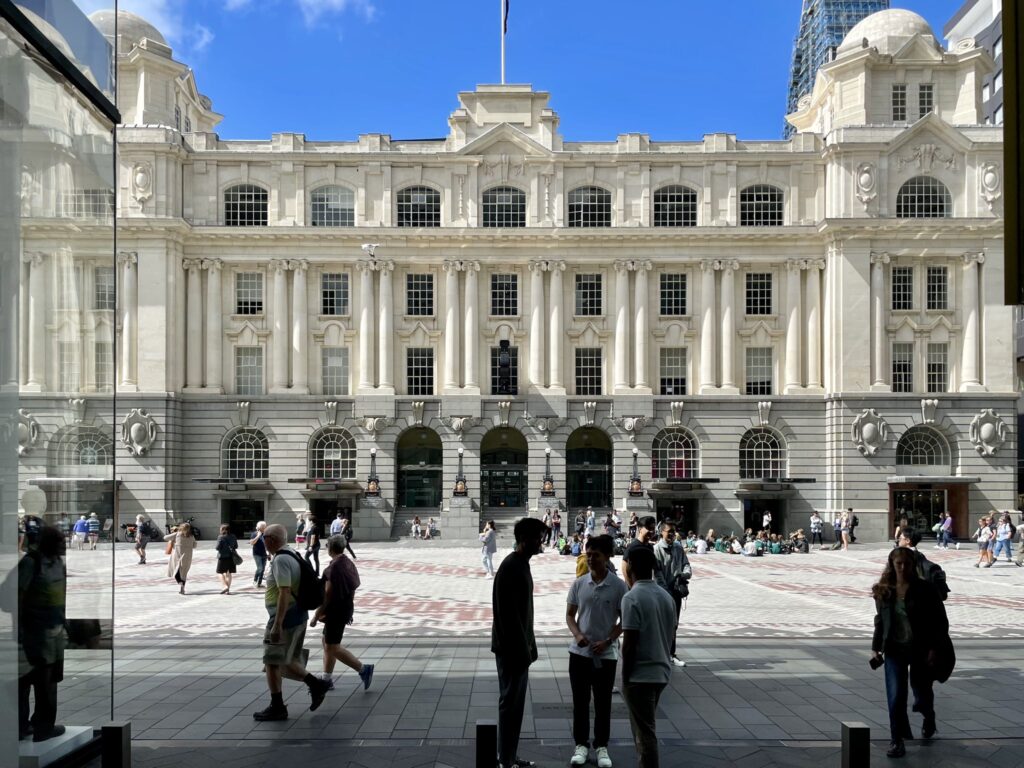
Te Komititanga and Waitematā Station. World class additions to our city’s quality.
The relative lack of great architectural moments is in part a function of Auckland not being the capital, despite being our primary city. This is best illustrated by comparison with Australia. Not with Australia the nation, but rather by comparing New Zealand with Australia’s states. Yes, in my view it is useful when thinking about Auckland to consider NZ as missing Australian state. In this context Auckland is an outlier as the only primary city among these ‘states’ that’s not also the capital.
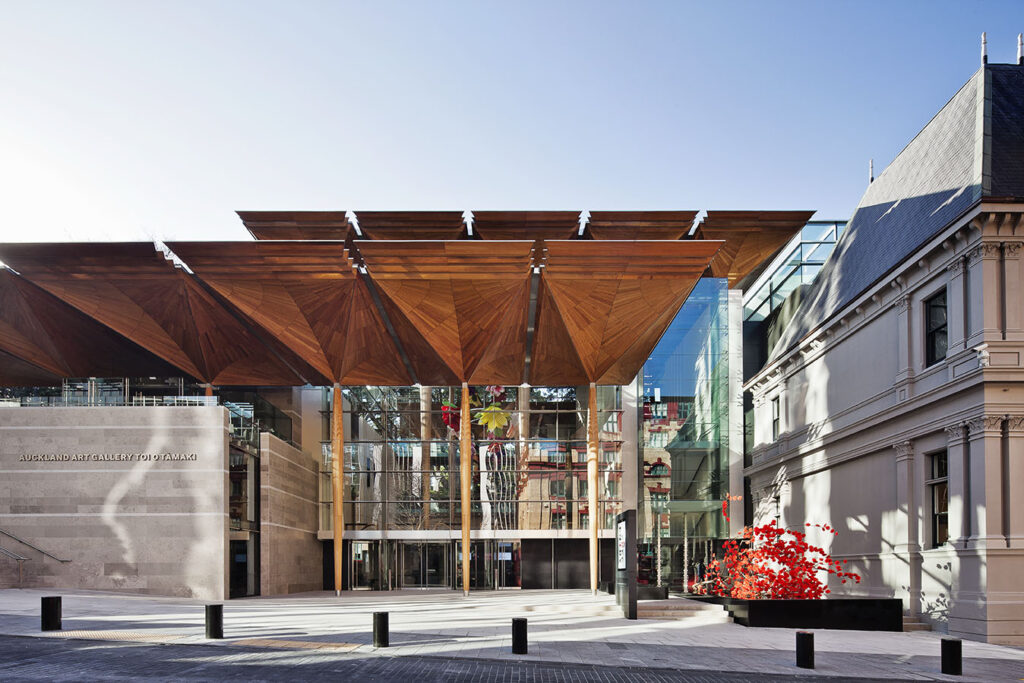
Auckland Art Gallery
Great buildings, and great urban spaces take a huge collective commitment – they aren’t just built without real purpose, and nor are they usually sited randomly. No, how, when, and where they occur are functions of wealth, power, and politics. Which are concentrated in principle cities, especially capital ones. Australian primary/state capital cities all boast the full list of national level public institutions, all housed in significant public buildings. The State Libraries in both Sydney and Melbourne for example, the National Galleries of each state etc.
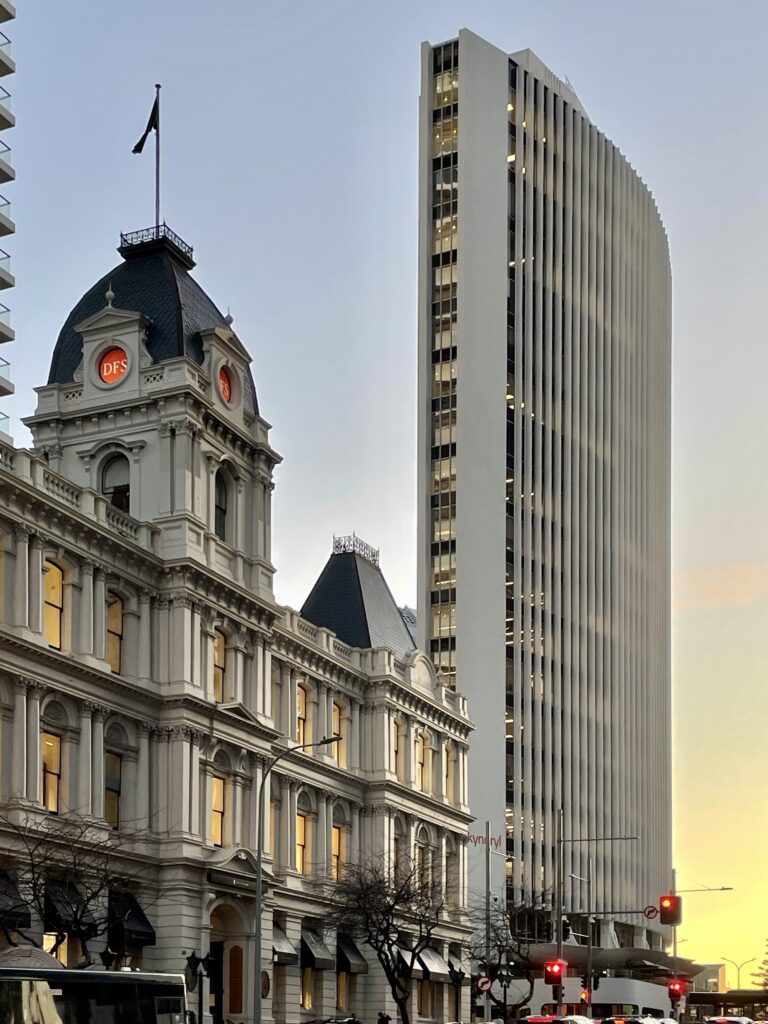
Customs House and West Plaza buildings downtown.
In this context it is really pretty impressive that Auckland built and continues to operate the three institutions listed above to a national standard, by itself, as institutions of this scale and quality normally take the full power and wealth of a state to sustain them. The vast bulk of our nation’s taxes flow to Wellington where the big organs of state create and maintain key institutions in landmark buildings to house them: archives, galleries, museums, government head offices etc.
It isn’t just a case of Australia being richer than NZ. See here for just how impressive the accumulation of stand-out public architecture in Wellington is, despite its small size, in a new updated edition of the city guides I do with John Walsh for Massey UP: Wellington Architecture Guide.
These great buildings and the institutions they host make huge contributions to the quality of their cities. They are like coral clusters on a reef, attracting and sustaining life in great scale and variety, spawning additional activity all around them. Even more valuable when clustered together in precincts, generally in the very heart of their cities.
So it is an additional blow for our city centre’s quality and vibrancy that one of these three key institutions, with its globally rated collection, and the very grand neo-classical building it occupies, is all alone, out of the city, on the tihi of Pukekawa. Commanding a great view and set in fine grounds. Exquisite apart.
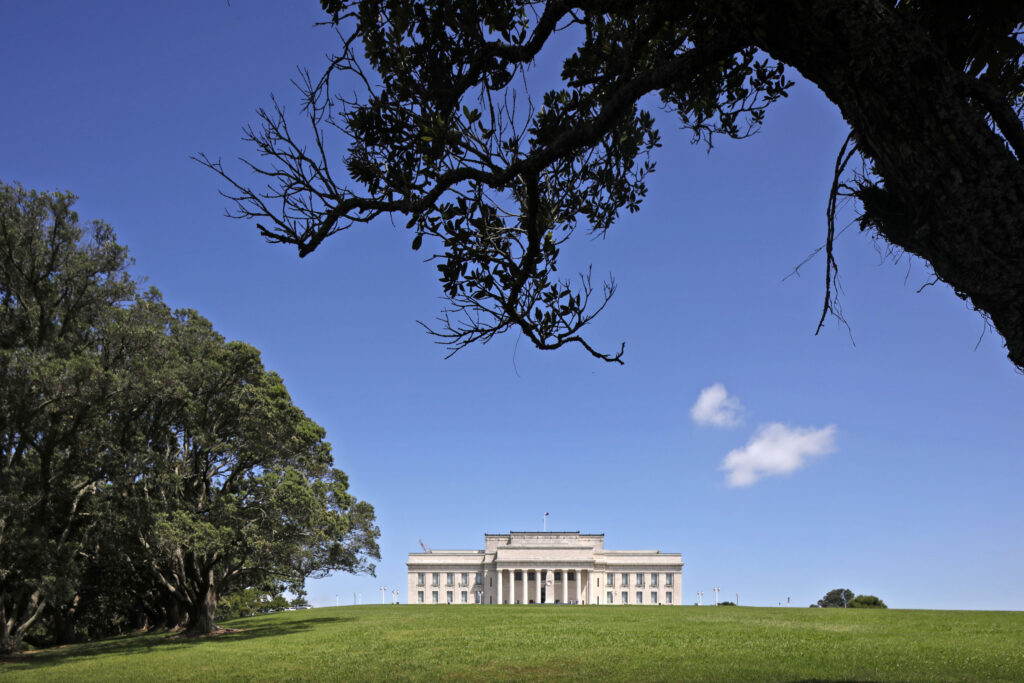
Tāmaki Paenga Hira Auckland War Memorial Museum
Not only distant from the urbs proper, but actually very awkward to get to from there or anywhere much else. Particularly by public transport. Ringed by train stations (3), positively circumnavigated by bus services (many), but these all keep a sort of hygienic distance, as if our Parthenon were too holy or otherwise to approach, at distances too far for most to want to walk (except for the plucky 781 – more on this below). Triangulated at a remove by the three near-but-far train stations. Too far especially for the old, very young, those with limited mobility, or on rainy days (perfect time for a Museum visit).
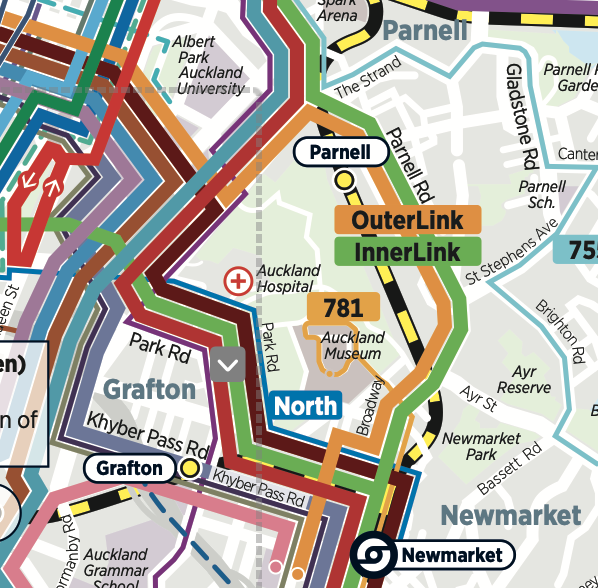
The three popular and highly legible colour-coded Link services get close.
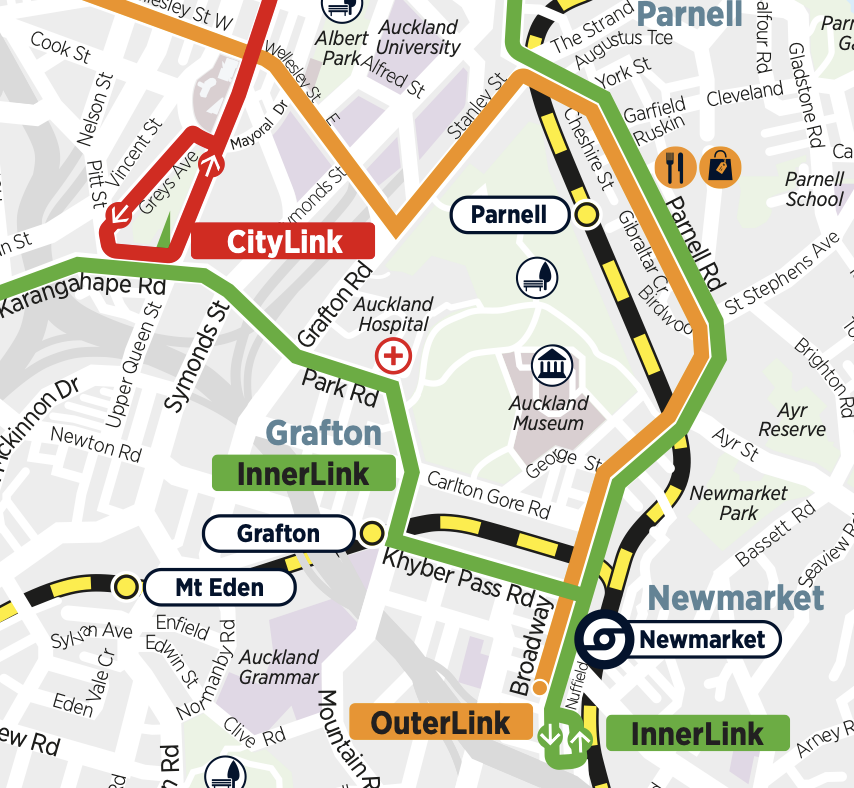
Link bus routes and rail stations all surround the Museum
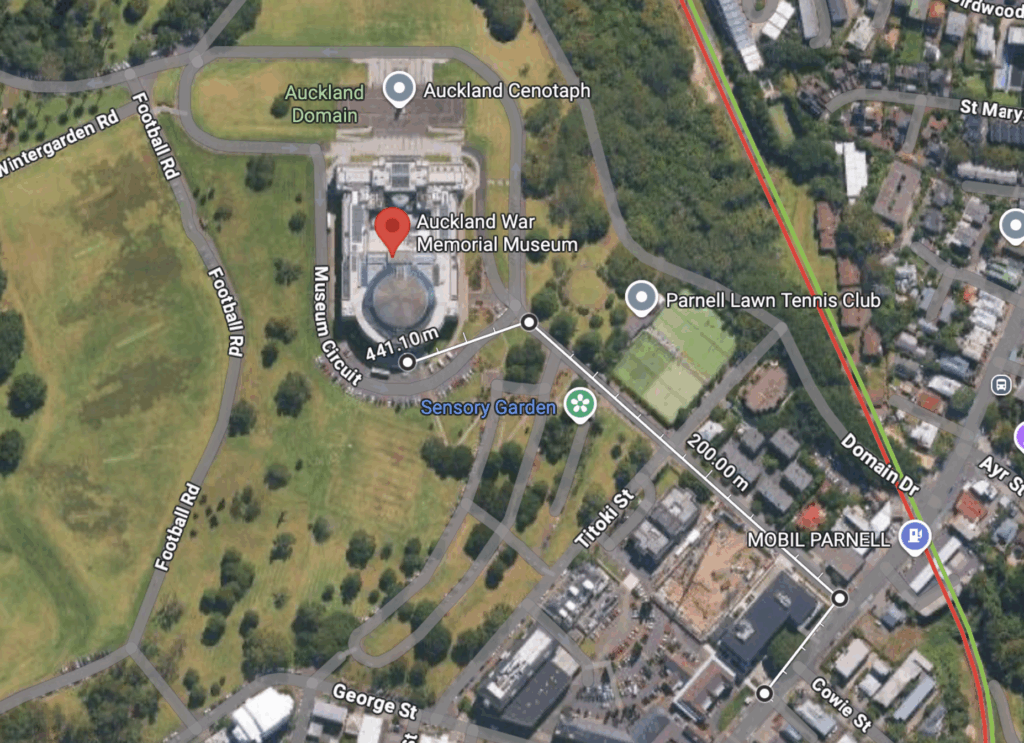
The Orange (Outer) and Green (Inner) get the closest. But even at best these stop some 400m away on Parnell Rd:
There is one scheduled bus service that actually reaches the building itself. A strange and infrequent rambler through Remuera from Mission Bay, the 781, running at 1/2 hour intervals between 7:20 in the morning to 7:20 at night. Which at least does stop at Newmarket and Ōrākei Stations so if lucky it could be used to extend the RTN to the Museum. Though really here the museum is just an add-on to what is a (probably quite useful) posh-schools collector service. Though I do know at least one senior Museum executive who is a regular user for their commute.
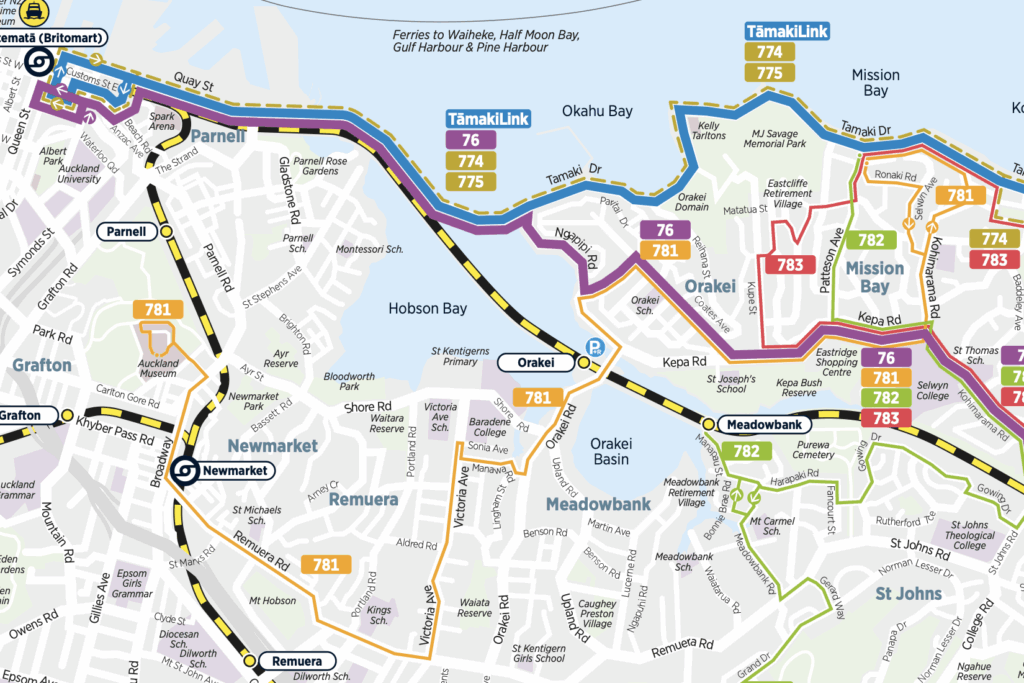
The 781
This is an issue that I’ve long felt should be addressed, and it appears it is on the minds of others too:
“The train station is quite far away and the bus as well. That’s one of the reasons why we funded this bus tour, to get our older people who might not have gone because of those accessibility issues,” he said.
He said the local board’s trial bus trips had worked.
“What we’ve heard from the museum is that it’s been a really good success. Our community love it. They’ve seen the impact that it’s had, and those are the discussions we can continue. How can we work with Auckland Transport? How can we fund more regular services?”
Apulu said the shared experience mattered: “Going as a group is important. The stories that were shared afterwards, after they had gone to the museum, those are valuable as well.”
Local boards funding tour buses to take their community direct to Museum is certainly a work-round. However as that is a solution for one community and only on special occasions, what we should be really seeking is a scheduled solution to the issue of museum access (Wintergarden and Domain). Taking the philosophy of our connected network, and the fact that the RTN is getting quite the qualitative uplift next year with the CRL opening, here’s what I’ve come up with:
The Culture Line
Extend the existing City Link to the Museum and back, via the hospital and the Wintergarden. This has the virtue of connecting all the RTN routes via all three CRL train stations, the Northern and North-Western Busway services, plus the downtown ferry Terminal, to the museum and hospital. Not to mention city centre hotels, and wandering tourists from cruise ships, and all with a frequent and highly legible red electric bus. A bus and route that’s easily explicable even to short-term visitors (“only get the red bus”), is frequent and highly visible on Queen St. Also passes by the Art Gallery and the Maritime Museum. For locals from all over the city it connects with every rapid transit line and every mode. This would become a great service to market these city attractions with too.
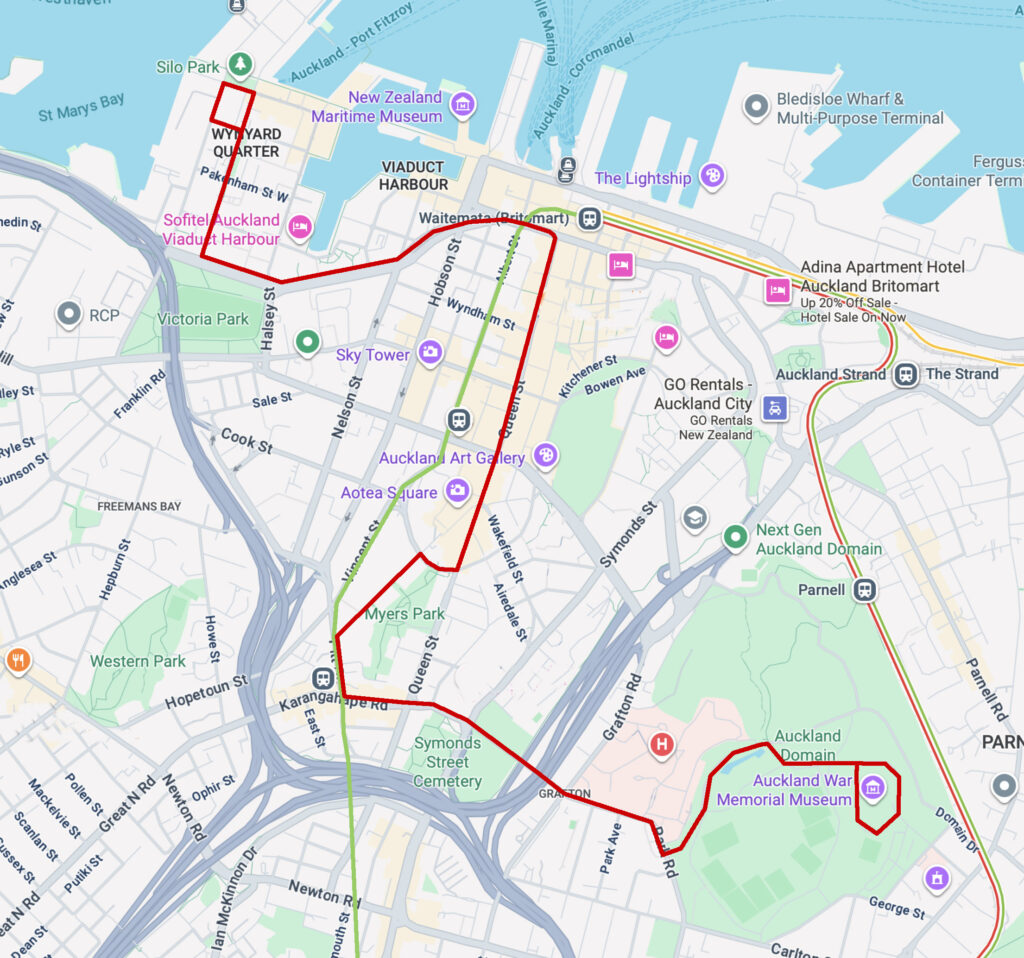
City Link to Museum
Below is its current route. As a local distributor this looks to me like making an already well used hop-on/hop-off “walking accelerator” and hill eater into a much more useful thing. Especially with the hospital/Med School as a happy bonus destination along the way. A good surface level complement to the new city stations, connecting to key parts of the city centre that the CRL doesn’t visit directly; Wynyard and the Hospital/Domain.
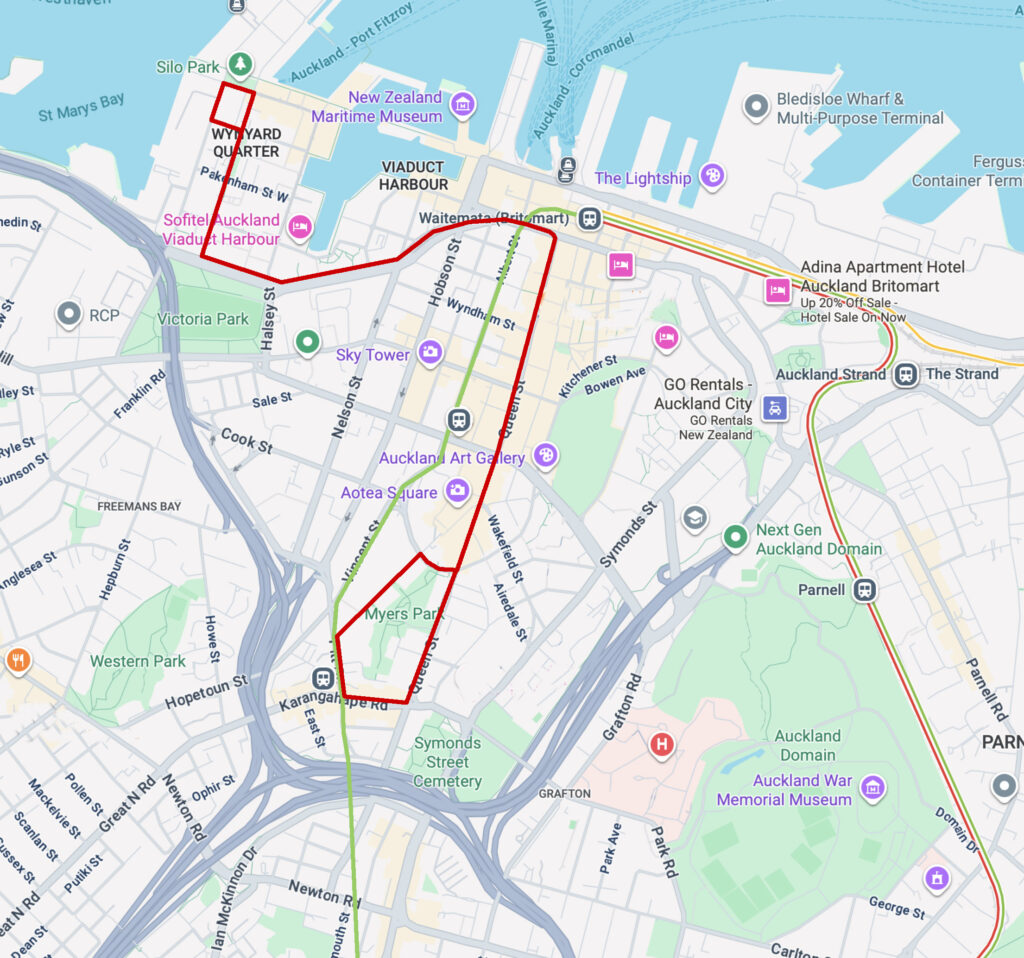
City Link and CRL
There are likely some changes that may need to be made to street pattern in the Domain to make this work well, but an upgrade there is long overdue anyway.
Auckland is not likely to become our capital, suddenly host to a whole bunch of grand central govternment funded institutions, so we have to be smart and ambitious with our urban quality. There are a number of small to large-ish moves we should work on, and in doing so always being mindful the quality of city we are making. Many are in our break-through city shaping blue-print, the City Centre Masterplan. A living plan that has given us so much already, like Te Komititanga, our first great truly urban collective space, so long over due. The CCMP should always be evolving, but it is important to note that everything imagined in it that we have managed to complete so far has added so much to the city, elevating it into a much better state. A truly visionary document by a visionary team at the Auckland Design Office.
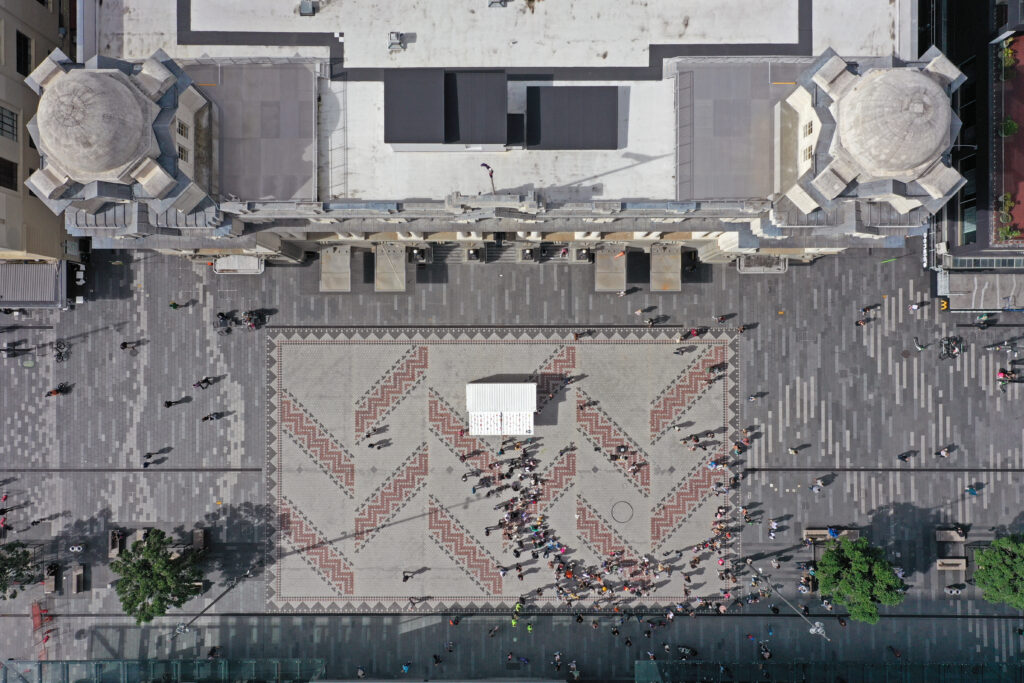
Te Komititanga aerial view.
There are two other great moves we should be working on: Light Rail up Queen St through the Isthmus, and fixing the highway to the port with a multilane boulevard, to improve the efficiency of port access while humanising, greening, and reducing severance between the city and Parnell.
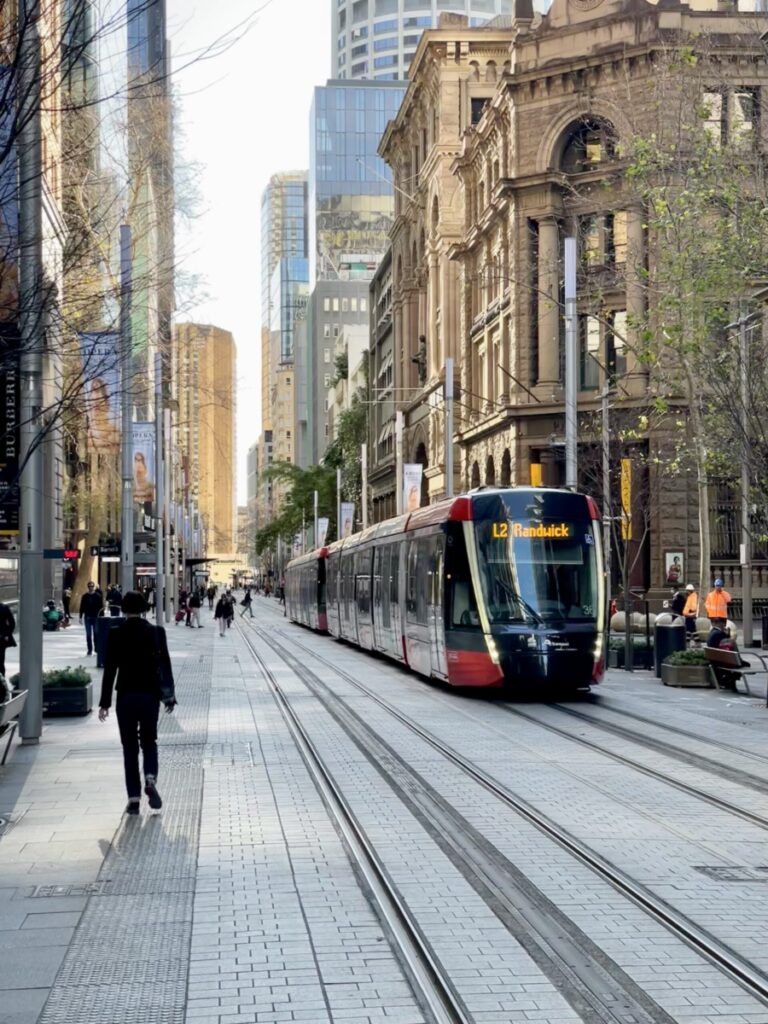
George St Sydney
Plus there is a pressing need to complete the Green Link across the barrier of the motorway in Grafton Gully, so there is a high quality and direct walking and wheeling route across our city centre too.
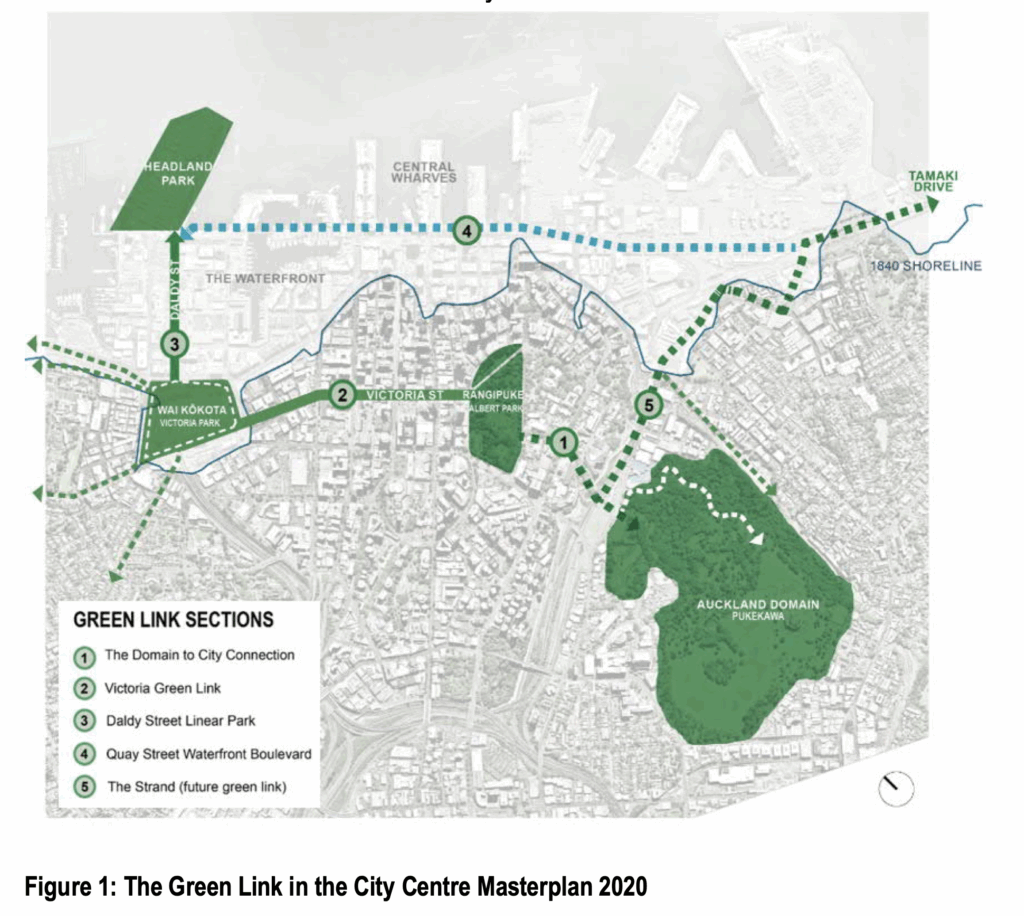
There are things we can do, and lead central government towards, to make Tāmaki/Auckland a greater and better city to call our own. Let’s get on with it.
Photographs Patrick Reynolds.

 Processing...
Brilliant visionary concept as always from Patrick. Why isn’t this man on council, instead of the incumbent who wants to get rid of all the upgrades downtown to create more space for cars.
One suggestion: extend the red line to Newmarket station to provide a strong trip-generating anchor. The museum on its own wouldn’t justify full frequent service from 6.00 am to midnight, but an extra Nmkt-City link would.
Newmarket already has so many buses adding another frequent one would just cause even more problems.
Yes I chose this explicitly not to go to Newmarket, as both other Links do that. The purpose of this extension is to fill an unmet need efficiently and not try to do too much more. Especially as that would take a long and unreliable extra length of time.
Wynyard -Queen St – K Rd- Domain is elegant and balanced, with easy loops at each end.
Park Rd could be made bus/bike/delivery/emergency only to improve efficiency and place making. Divert general traffics to Grafton and Khyberpass rds
This looks like a very good idea. One issue that would have to be addressed is the all day congestion on Park road due to the hospital carpark getting full. All the routes through there get hopelessly stuck in traffic. That would be a killer for the relatively frequent service the City Link is.
They have a plan for this in the works.
https://haveyoursay.at.govt.nz/improving-traffic-flow-on-park-road
Park road: “On weekdays, nearly 28,000 people drive down here”
State Highway One north of Wellsford: ~12,000 vehicles a day
Which one of those is planned to get a four lane motorway and which is getting a suicide lane?
Hint: The one closest to the Hospital gets the suicide lane.
Be fair. A Suicide Lane was the discredited 3-lane arrangement that didn’t assign a single direction to the centre lane. Dynamic lanes do require people to pay attention to the VMS. The investment comparison is valid. Getting traffic past the queue for turning into the hospital is horribly difficult.
Mr Plod – 28,000 people drive down here, half of these are on the bus.
So approx 14,000 cars per weekday.
Christ, this is horrible. Removing a bus /cycle lane for 200m is just shovelling cyclists into a meat grinder. I see they say they are looking at mitigations – I imagine that will be putting in a pathetic shared path and making life worse for the pedestrians.
“Why isn’t this man on council, instead of the incumbent who wants to get rid of all the upgrades downtown to create more space for cars.”
Because a plurality of Ponsonby gentrification millionaires and Waiheke sea goblins want to get rid of all the upgrades downtown to create more space for cars.
Upzone the hell out of Ponsonby/Westmere/Herne Bay or we get nothing good ever.
Actually I think Patrick would have won comfortably if Gen Sage hadn’t split the vote
Mike Lee won because the progressive vote was split. Under STV it is likely one of Patrick or Sage would have been the councillor.
It has always struck me that Auckland does not, by neglect, want tourists/visitors to actually, you know hang around. I remember when I first arrived back in the mid 90s and visited the tourist information office ( remember them) and was shown a brochure for Rotorua.
Looks like this is a good move for the bus route.
To be fair, Auckland in the mid 90s was pretty crap
This is the second good public transport intitive Patrick Reynolds has backed recently. Both have the advantage of being relatively easy to implement in a short time frame. Pragmatism wins out over grand plans every time. Remember that Patrick and you might even end up as Mayor.
If you ask me, this calls for a gondola (with a luge down to Parnell Station so the stupid thing finally gets some use).
Some sort of a funny-cula down through the trees could be a good idea. Is there a Councillor who might be interested in what Parnell Station is for?
Gondola and Luge gets my vote for going to and from work in Auckland. That would be brilliant !
Might need signals at Maunsell Road/Parnell Road to extend to Newmarket, but could be a good idea.
Bright idea to workable service needs modelling of journey time and occupancy at all stages of the route, but the Cultural Connection looks good.
Don’t forget the theatres (including ASB) and K Road as cultural destinations. Not sure about the cultural status of Westfield Newmarket, though.
Numbers of buses and drivers to double the route need to be justifiable.
I sometimes wonder what NZ would have looked like if Nelson had been chosen as the nations capital in the 1860s. Especially if the new parliament and other capital buildings meant the city centre was moved to a more central location in relation to the coast line between Motueka and Nelson Port.
Another possibility is NZ moves its capital to Hamilton for earthquake resilience reasons and because half the population live north of Taupo.
Also if NZ did join the Australian federation could we negotiate that we get two states. North NZ with Auckland or Hamilton as the state capital and South NZ with christchurch as the capital (unfortunately Nelsons opportunity has passed).
Frankly I like the Hamilton idea. Could start with a total renewal of the city centre based on a purpose built government precinct. It is pretty much blank right now. Could be absolutely amazing for the city and the nation. It is now the centre of the nation’s population distribution. Of course all centred on a great new intercity rail station and system. Though South Island MPs would still be flying, but most NI MPs would be much closer to home to make this worth while .
We do have to accept that Wellington is a strictly temporary city. Inter-tectonic plate faults tend to go big when they go. As shown by the 8.2 magnitude Wairarapa quake of 1855, with up to 20m horizontal and 8m vertical movements!
I even would support the investment in some sort of reserve govt infra there, as even a smaller disaster in Wellington will be crippling.
+1000
Since Covid, the number of public servants outside Wellington has increased dramatically thanks to the adoption of video conferencing and a willingness to have dispersed teams. It’s not just Nicola Willis’ axe that put paid to the public service in Wellington. No matter where you put the capital, you’ll find you might not get much more than a new parliament building. All the bureaucrats in Wellington will keep their jobs while their senior managers move to Hamilton.
Great that will make the transition easier as many mid-level civil servants can initially stay in Wellington where they no doubt have significant ties – extended family, children’s schooling, partners with non-government jobs….
If the goal were resilience to earthquake (or volcanic event) , the better answer is to spread government roles around the country, minimising the effect of damage to any one city. Yes, we should also have a plan to move parliament and cabinet when use of Wellington ceases to be viable.
Thanks Patrick. Waikato is on track to overtake the population of the Wellington region, so Hamilton already has great potential.
Shifting the capital would be a chance to improve infrastructure to really make this process work for the whole country.
As you say Hamilton is closer to more people than Wellington and it is inevitable that Wellington will face a devastating earthquake. As a nation we should be planning for it.
As a South Islander I don’t think there would be any loss of political attention or governance problems should the capital move further away to Hamilton. There really is little difference in flight times.
Yes and sadly, as you often remind us, the South Island is already thoroughly ignored, certainly in terms of transport investment.
Yes Patrick. Actually, I think the distance might help the South Island and Christchurch because there could be more devolution of budgets and service delivery. This process could be more transparent and fairer than Wellington claiming to understand and care about the South Island because it is close to us but then screwing us over.
Good point. I tend to agree.
I would support Hamilton as the future capital, but only if it was renamed Kirikiriroa.
Problems not in Wellington are not problem people in Wellington have to deal with. I remain skeptical just what can be achieved in some places in the South Island given the population base and how much work there is to do elsewhere where far more people live, but Auckland and the South Island can at least share the experience of ‘out of sight, out of mind’ when it comes to urgency around infrastructure and planning issues that justify central government intervention.
Nelson would have been a bad choice then, and would be a bad choice now.
Then, the only access to the rest of the country was by sea, to Auckland either via North Cape or the hazardous Manakau Bar crossing.
Wellington, Lyttleton, Dunedin, and the North Island all via the challenging Cook Strait. Inland access to the rest of the South Island remains challenging even today.
There is a reason that Nelson Airport remains as the biggest, or second biggest, purely domestic airport in the country, in spite of not even being jet capable.
Well the War Memorial Museum looks great from the outside, but honestly other than an early school trip, and taking an overseas visitor for a once-er, is this museum really worth the bother? It’s a long stretch to Te Papa and it sure ain’t the Hobart MONA or Melbourne Vic State Gallery.
It’s set up well enough for cars and tourist coaches as it is.
Would be great if Te Papa lifted a finger to help, but over 30 years it just shows a finger. So Auckland War memorial will just stay looking great from afar. Perhaps actually it needs no transport alteration at all.
Te Papa suuuuuuuuuuuuuuucks. Huge dark galleries of empty space is not good museum-ing.
As to Auckland, in the last ten years AWMM has essentially lost five whole galleries.
#1
The old special exhibits area in the extension is now a giant empty hole in the lobby. Having seating areas is important but you need a much, much busier museum to justify having a lobby that you could fit a fairly sizeable house in.
#2
The new special exhibits area has just taken over the space that was formerly two separate exhibits both of which were really good. So whenever that’s occupied, there’s three missing and when it’s not there’s four missing. What were the two replaced galleries?
#2.1
I can’t remember its name but this was one of the two material culture through time displays that you used to walk through to go from the old to new parts of the museum*.
#2.2
Again, I don’t recall the name but it was the area where Rajah used to be.
#3
Speaking of Rajah, he’s now in Origins where they used to have the little library and computers. I don’t know what happened to those books but if they got moved to the museum library, its hours are now way down and is now only open twice a week. This is a museum that charges international visitors $30 btw.
Origins, of course, used to connect to the sea life exhibit. Depending how you look at it, you could argue that there’s a fifth missing gallery involved here because you used to walk through all the bird stuff to get from the one to the other.
I was in the museum the other day and this one is strictly speaking being refreshed. I don’t know what it’ll look like when it comes back but I strongly suspect the density of stuff will be reduced. I’m still counting it as a lost gallery because it’s been taking forever and a day to do the refresh.
#4
The top floor used to have a sort of miniature colonial era town. It was really cool. Counting it as a lost gallery may be controversial because the new armoury and military library spaces basically add up to a gallery in their own right.
—-
I will say the Auckland stories bit is relatively densely packed with stuff. If you compare the Maori court area for a second that’s very much the “dark empty space” model and I do wonder how long that’s been the case, certainly as far back as I can remember it’s always looked like that. Auckland stories isn’t remotely as dense as the WWII and WWI displays (which I also can’t remember as having changed in the last twenty years) but it could easily have been caught in a minimalist thrall.
But the new seating area is just a joke. AWMM really can’t afford to use its space so inefficiently. It’s not just a museum, it’s a war memorial and as a consequence huge parts of the top floor (quite rightly) can’t be used for display.
*The other is a different, and quite interesting, permanent gallery now so is gone too but without any loss of gallery space.
I think we should build a grand new road through the Domain for our bicentennial celebrations in 2040. We could call it “Bicentennial Drive”. It could be a work relief project for people who don’t have jobs and we could celebrate our nation by driving our motorcars from Stanley Street to Parnell.
City link to the museum is a good idea.
My daughter works casual there and wanted to use the 981 bus but with the city centre zone it cost too much for such a short distance.
Great vision Patrick, especially the aspiration to connect the green link from Te Ara Tukutuku to Pukekawa- the whenua connection that makes Tamaki Makaurau the special place it is, and creating a great Auckland Walk
Thanks Duncan, yes that link: Wellesley St East, under Symonds and over the motorway, connecting to the Grafton Gully path, is surely high on the list of low hanging fruit…
That’s a great idea!
I like it for an additional reason than everyone else though. It would mean school trips could catch public transport there relatively easily once the CRL opens. The museum has a great selection of educational programmes as well as being a good school trip destination just for the exhibits. But a school now has to hire buses to get there which would often be more expensive than public transport. You don’t want to walk a pile of kids there from the closest stops – and the museum is an awesome winter option and you really really don’t want to try and walk kids from the closest stops in the rain. School trips have got increasingly expensive and therefore increasingly rare. All the Council owned places have great not that expensive programmes (presumably partly subsidised by our rates) and the buses tend to cost the same or a bit more.
It’s not just the school kids. The museum is a great and free and dry and warm and big place for preschoolers with a decent kids area. It’s the perfect rainy day excursion. But for that you need to drive. I’ve done it as a public transport adventure once with a little person from Onehunga. It’s too far to walk from Newmarket or Grafton so we took the link and then walked – but not a good option in the rain.
I can see why you don’t want to connect your route through to Newmarket but that would make it easier to access for people coming from the south & east by bus. You could extend your route towards Newmarket but not as far as Broadway – go through the Domain and up Carlton Gore road. That puts it at not a big walk from the bottom of Broadway or Grafton station for people with little legs and feels like it could be a connection with all the buses which go through Newmarket.
The museum is heavily funded by our rates and I’d love to see something like your bus route which might get more people there – tourists & visitors but also schools. It’d be great if schools could get around on public transport to the places they wanted to go.