It’s Friday and it’s spring, what’s not to like. Here is our regular roundup of things that caught our attention this week
This Week in Greater Auckland
Unfortunately life got in the way a bit this week, as it does sometimes, so we only had one post this week. On Wednesday Matt took a look at the latest CRL update and plans for more bus and transit lanes.
This roundup, like all our work, is brought to you by the Greater Auckland crew and made possible by generous donations from our readers and fans. If you’d like to support our work, you can join our circle of supporters here, or support us on Substack.
Transport announcement incoming
We’ve heard from a few sources that there’s likely to be a big announcement today about the next stages of the plans to reform Auckland Transport. We don’t know what that will be but it is due to be revealed at 11am.
Tolls and the funding of our transport system
While the article is nominally about the plans to toll the Woodend Bypass, this piece from The Spinoff’s Joel MacManus is fantastic at talking about many of the key issues of transport funding in New Zealand.
A proposal to toll the Woodend Bypass, a new highway extension north of Christchurch, has riled up Cantabrians more than the idea of giving the Crusaders a less racist name.
…..
This debate has played out several times before: Transmission Gully, Penlink, Manawatū-Tararua and Ōtaki to north of Levin. Whenever governments suggest tolls, it gets messy. People get really mad when you ask them to pay for something they’re used to getting for free, and politicians tend to roll over pretty easily once the Facebook comments on the local community page turn against them.
…..
However, starting with the Roads of National Significance programme launch in 2009, successive governments have pumped enormous amounts of money into projects with extraordinarily low BCRs. A business case in 2018 estimated Ōtaki to north of Levin had a BCR of between 0.22 and 0.37 (and that’s before costs blew out by more than double). Transmission Gully had an initial BCR of 0.6 (ditto). The Woodend Bypass scores a 0.95.
So why do these projects keep getting funded if they’re such money pits? Politics. A town grumbles about the state of its roads, politicians rush to promise a fix, and parties ignore the BCR in favour of chasing votes. (This has historically been more associated with National, but Labour is also guilty.) However, there is little evidence to suggest this is an effective tactic. Even at the last election, where potholes were a major talking point, transport infrastructure failed to break the top 10 most important issues in the Ipsos Issues Monitor survey. Promising a billion-dollar highway has a terrible ROI in terms of winning votes.
Roading Priorities
As is highlighted in the article above, it’s not just about building new infrastructure but we have to maintain it and as this Radio NZ article highlights, we’ve got some bills due.
Official documents show 39 bridges on the state highway network are already past their 100th birthdays. By 2030, this number will increase to 260 bridges and by 2039 to 500 bridges.
Thirteen aged at least 50 – described in the documents as being “on life support” – have been prioritised for replacement by 2027 and Waka Kotahi has warned it will need more funding before 2030 to do further work. Otherwise, it warned the country would be faced with an “unrealistic” replacement programme.
Of the 887 bridges that are more than 80 years old, the agency told RNZ that 17 are considered degraded enough to have speed or weight restrictions in place.
Just six of these are currently programmed for replacement, less than one percent of the state highway network’s octogenarian bridges. That doesn’t include any ageing bridges that are off the state highway network, like Rotokautuku, which was built in 1964.
Climate economist Belinda Storey says building replacement bridges to withstand the next big cyclone is crucial.
“Because we’ve got a wave of bridges that are up for replacement, we’ve now got an opportunity to build them sufficiently resilient to withstand our future climate,” she says.
How many of these bridges could be replaced if the government didn’t have such an obsession with low-value motorways.
Ferry News
Auckland to Coromandel ferry services are set to return this summer, but it’s not yet confirmed who will be at the helm.
Fullers announced in October 2022 it was removing its Coromandel ferry service for the summer season until staffing levels allowed it to resume.
A push from Thames-Coromandel District Council and the Coromandel Colville Business Association has seen the service return for a summer trial.
…..
The trial, which will run from Christmas through to Easter, will link Auckland’s downtown terminal with Hannaford’s Wharf at Te Kouma, just outside Coromandel township with a complimentary shuttle bringing passengers into town.
Meanwhile The Post reported that a shipyard has been chosen for the new interislander ferries, but they won’t say who yet.
The Government has chosen a shipyard to supply two new ferries that will plough the Cook Strait, but has not revealed who the successful bidder is.
Rail Minister Winston Peters said Government-owned Ferry Holdings, which has been managing the purchase, had signed a “letter of intent with the preferred ship builder to start the final stage of technical negotiations” after a closed tender that saw it approach six shipyards.
The Government expects a contract to be signed by the end of the year.
Ferry Holdings has agreed to pay an as-yet undisclosed fixed price for the ferries, which are due to be completed in 2029 and have a design life of 30 years.
The letter of intent means the price and the key specifications for the ships have been agreed, but not all of the technical details of the arrangement.
I wonder what the chances are it will be Hyundai Mipo again but costing us much more than what we would have paid for the previously planned ferries – which also have cost us $222 million to cancel.
Another great reason to get on a bike
Now, a recent study has revealed that individuals who use bicycling as their primary mode of transportation may have a reduced risk of developing dementia
…..
In this study, researchers examined data from the U.K. Biobank. They analyzed over 480,000 individuals with an average age of 57 who had not displayed any symptoms of dementia. The participants were from various parts of England, Scotland, and Wales.
Through surveys and exams, the researchers acquired detailed information about their primary means of transportation, demographics, lifestyles, health issues, and other factors. The researchers tracked participants for an average of 13 years.
…..
The study contrasted nonactive modes of transportation, such as driving, with different modes of transportation, like walking, cycling, or a combination of the two. According to the findings, cycling or cycling in combination with other forms of transportation significantly reduced the incidence of dementia in general and later-life dementia in particular.
For example, mix-walking mode decreased the risk of dementia by 6%, whereas cycling alone or in combination with other modes decreased the risk by 19%. Cycling or mixed cycling seemed to reduce the risk of younger-onset dementia by 40%. Conversely, walking alone appeared to raise the chance of Alzheimer’s by 14%, but cycling or combination cycling helped lower the risk by 22%.
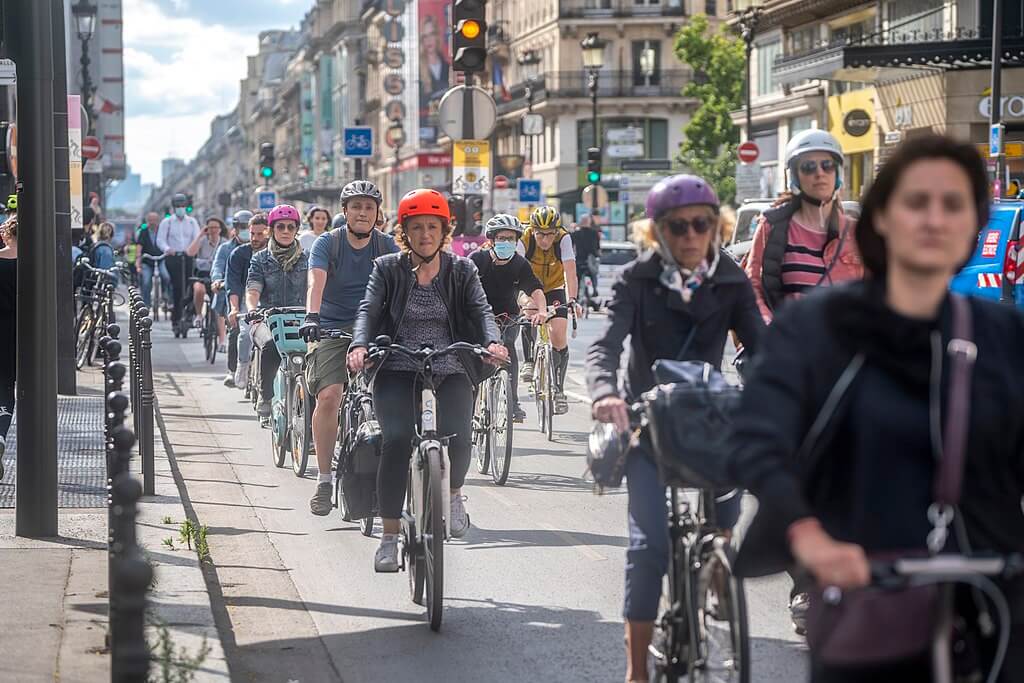
It didn’t happen overnight, but Paris is forever changed, and now local residents of the French capital are reaping the rewards. Top of list? Cleaner air. A lot cleaner.
Over the past two decades, the French capital has undergone a remarkable transformation — and cyclists are riding at the heart of it. A recent report by Airparif, the independent organization that monitors air quality in the Île-de-France region, delivered the kind of news that would have seemed unimaginable 20 years ago: between 2005 and 2024, levels of nitrogen dioxide and fine particulate matter — two of the most harmful pollutants to human health — have been slashed by 50% and 55%, respectively.
So how did Paris, once choked with vehicle traffic and notorious for its smog, pull off such a turnaround? The answer lies in a bold mix of policies, infrastructure investments, including a cultural shift toward cycling as a preferred mode of transportation.
The Travel section
Sticking to bikes, here’s an interesting article about bikepacking in New Zealand. It’s notable how much we celebrate cycling in the country but so often demonise it in our cities.
Bikepacking in New Zealand has experienced a surge in popularity in recent years, primarily driven by the expansion of its remarkable trail network. The new Shotover Gorge Trail, along with other trails under construction, contributes to this.
The Southern Lakes Trail Trust is connecting the five Great Rides in Otago, forming over 500km of an off-road network. The ongoing project involves expanding over 32km of Kawarau Gorge Trail, linking the Queenstown Trail with the Lake Dunstan Trail at Cromwell, thereby bringing together 500km of cycling and walking trails across Central Otago.
In the North Island, the Hangāruru Cycle Trail (9.1km one way) opened in June 2025, featuring two suspension bridges, a vital piece of the vision to complete a 320km journey from Mt Ruapehu to the Tasman Sea in Whanganui. Similarly, a new cycling route, Te Ara Tupua, is being constructed to connect Wellington and Lower Hutt and is expected to open in 2026.
In the Canterbury region, the 64km St James Cycle Trail near Hanmer Springs can now be ridden as a complete loop thanks to a new 68m swing bridge crossing the Waiau Uwha River which opened in August.
With a $9 million investment from the government announced earlier this year, several cycle trails across New Zealand are undergoing infrastructure upgrades and replacements, including enhancements to connect existing cycle networks, which will encourage bikepacking to thrive and attract enthusiasts.
Here’s a cool video on some of the interesting infrastructure supporting the New York Subway
Oversized Cars
I wonder what it would be here, especially if double cab utes were included.
The number of SUVs in England is on the rise, with more than 800,000 registered in London alone, as of 2022.
The number of SUVs in England’s cities has increased from 3% to 30% of cars in the last two decades.
In physical terms, London’s SUVs now take up the same space as the entire borough of Kensington and Chelsea, while the entire country’s SUVs would cover all of Manchester.
…..
The growing prevalence of SUVs is a particular problem in urban areas, with them known to be much more dangerous for children and other road users in the event of a crash.
Recent research showed that SUVs are 14% more likely to kill a pedestrian or cyclist, and 77% more likely to kill a child.
This is because of the extra weight of an SUV and design features like taller and squarer bonnets, making them dangerous in collisions.
Similarly, a Land Rover Defender driver cannot see children aged up to four and a half, leaving the youngest of pedestrians vulnerable if they run out into the road.

That’s us for the week. As always feel free to share links and stories in the comments, and have a great weekend!

 Processing...
The government has announced they are using Toyota Corollas for the inter-island ferry run. Toyota has said they are not sure they will float, but Nicola Willis is convinced.
Well, unless the ferries come with a Koru lounge (access maybe limited to $5m or above investment foreign residents), how are they even fit for purpose for the New New Zealand?
New Crusaders name suggestion: the Canterbury Runoffs
Transport announcement incoming..
3 people walk on stage, 2 Government ministers, and a Mayor
We’re announcing 50/50 transport decision making with Wellington… says the local.
“The new Auckland Regional Transport Committee that will be established to guide long-term planning will consist of an equal number of Auckland Council members and Ministerial appointees, alongside an independent chair. The committee will be responsible for a new 30-year regional transport plan.”
https://www.stuff.co.nz/nz-news/360814523/auckland-transport-stripped-back-council-takes-citys-transport-responsibilities
“Giving new powers to the local boards was “critically important,” Simeon Brown said. “Because we’ve seen in recent years the infestation of speed bumps on local roads, carparks being removed in favour of cycleways, local businesses and local communities being unable to have their say when it comes to what happens on their streets” – will be interesting if he still holds to that if local boards and their communities say they want safer streets for all.
Then he will just make it illegal like with 30 kph speed zones.
My thoughts exactly, Vinny. Plenty of communities had their say in large numbers in favour of speed bumps and 30k limits… it will be difficult for Local Board elected reps to ignore these voices.
In his car centric area he will get his car stuff, and in my more progressive area we will hopefully get the opposite. Win/win
Thank goodness. Even a useless government can get something right. Auckland Transport exists because Mark Ford thought transport was like water, something everyone agreed on. Transport is political so there needs to be political accountability.
It does seem sensible. PT needs to be regional, but roads / roadspace can be local.
political accountability ?
Not sure we voted in team Simeon, or blanket speed limit resets.
Not much accountability when Wellington shut down Aucklands ability to fund infrastructure via a regional fuel tax.
This Government, and Miffy too, perhaps? seem to have extraordinary difficulty in understanding that motor vehicles, are just a subset of transport solutions.
“roads / roadspace can be local.”
It depends. Why should a Local Board have a vote in basic design standards for safety and compliance? Not just for local roads, but also for Collector Roads, which are actually pretty important, large roads – some of them arterials in all but legal designation.
Because that’s what it will end up – safety and amenity for some groups will be overriden because some politicians don’t like it.
If you are in one of those local boards, tough luck if you aren’t driving all the time.
And if you are in one of the more progressive areas, opponents will still be able to weaponise the high-level opposition to anything traffic calming, active modes etc to stymie footpaths, bikeways and safety features anyway. Sounds more like lose-lose to me.
For consultant meanwhile: YAAAAAY. Your jobs are safe from AI. Even before making everything even more confusing, there was no way that a computer could get things right. Now every single project will have to re-litigate basic design decisions, and have to go through even more consultation processes, and you will never know what pops out at the end.
I really wanted to see the data with all the state Highway bridge ages but couldn’t find it anywhere. Annoyingly it wasn’t included in the rnz article. Anyone know where it can be found?
“However, starting with the Roads of National Significance programme launch in 2009, successive governments have pumped enormous amounts of money into projects with extraordinarily low BCRs. A business case in 2018 estimated Ōtaki to north of Levin had a BCR of between 0.22 and 0.37 (and that’s before costs blew out by more than double). Transmission Gully had an initial BCR of 0.6 (ditto). The Woodend Bypass scores a 0.95.”
How can the current government pretend that they even have a semblance of economic nous to spend money on roads with BCRs as low as this?
And then they have heaped the Roads of Regional Transport Significance (RoRTS) on to.
The situation will get worse as an increasing number of adverse weather events cause repairs to be “necessary”. In many cases this will be spending with almost no economic merit, like for the bach owners in the Sounds.
“The NZTA Board has approved funding for Phase Three repair works for the five Sounds zones at a Funding Assistance Rate (FAR) of 71 per cent. The work is estimated to cost $141.4M meaning NZTA will contribute $100.4M.”
Little wonder the government doesn’t have any money to spend on things that the electorate really cares about such as health.
Simple. Economics isn’t taught in schools and even less is taught now than five years ago, due to Labour’s misguided NCEA reforms (which were such a startling success they put NCEA back on the menu as a talking point and have seen the new government decide to can NCEA altogether).
It is perverse that a country can ostensibly run itself according to the prescriptions of an academic field it systematically refuses to teach.
Update on “AT Transport to be stripped of most powers” yesterday:
https://www.youtube.com/watch?v=19NSoEuDihA
“Wellington” to appoint 50% of the new committee deciding Aucklands mobility future.
Not sure Mayor Brown campaigned for more Wellington decision making for Tāmaki Makaurau
Does Central and Local government have the same goals for Auckland ?
Which i guess is why he looked like he was wearing a bomb in that standup press announcement, out flanked by Simeon and Bishop.
Yes, it’s going to be a bit hit and miss as to whether we will be better off or not.
It can’t be any worse…
I thought Simeon Brown’s take was a little weird and maybe he was saving face. Giving voice back to boards to negate speed limits, speed bumps and cycleways? Thats exactly what their communities have been asking for and he had to legislate to stop them actually giving people what they want.