Another week almost down and to go with it, another weekly roundup for your Friday morning delectation.
This Week in Greater Auckland
- On Monday Matt looked at the government’s obsession with a Northern Expressway.
- On Tuesday Matt reviewed AT’s first official map of the CRL.
- On Wednesday we had a guest post from Charmaine Vaughn on how her community chooses 30km/h.
- On Thursday Matt covered the government’s announcement about replacing fuel taxes.
This post, like all our work, is brought to you by the Greater Auckland crew and made possible by generous donations from our readers and fans. If you’d like to support our work, you can join our circle of supporters here, or support us on Substack!
Why wouldn’t you go electric?
Recently, Auckland Transport revealed that it planned to buy a new fleet of diesel ferries instead of more electric or hybrid ones (as are due to start operating soon), citing cost and reliability. This is at odds with at odds with the approach AT has been taking up till now. It’s also the opposite of what Fullers, the city’s biggest ferry operator, thinks. From the NZ Herald.
[Fullers chief executive Mike Horne] makes it clear that when he’s spending his own company’s money, he sees electric as the only way to go.
“Everyone gets a bit confused with the cost of building a boat and the cost of operating a boat over time,” Horne says. “I look at the whole-of-life. And if I’m investing commercially, which I am, I’m going to the electric boats every time. Over time they are materially cheaper than running a diesel boat.
“I’m certainly not looking to build new diesel boats for my commercial fleet for exactly that reason. They make no economic sense”
 One of AT’s soon-to-be in service electric ferries.
Crazy Costs
The projected cost of the Otaki to North of Levin highway has blown out yet again, this time to $2.1bn. It’s also incredible that the NZTA is able to suddenly find a spare $400 million down the back of the couch to fund this project, just to keep a few locals happy.
The budget for a lower North Island highway has increased to $2.1 billion after the board of the New Zealand Transport Agency tipped in $427 million of extra funds.
Last week, Transport Minister Chris Bishop said contracts had been signed with two alliances to construct the northern and southern sections of the 24-kilometre Ōtaki to North of Levin (O2NL) highway.
The project is one of 17 roads of national significance (Rons).
When it was first included in the NZ Upgrade Programme under the last Government, the highway was estimated to cost $817m.
By 2021, the budget had increased to $1.5b. In a business case completed the following year, the New Zealand Transport Agency (NZTA) said the preferred option had a benefit-cost ratio of 1.2.
In May this year, when the agency went out to the community with several cost-saving proposals, it had escalated to around $1.7b.Scope reductions, no thanks
Following pressure from local groups and politicians, NZTA reinstated most of the proposed scope reductions, including a grade-separated interchange with Tararua Rd. The NZTA board had to approve additional funding to retain the consented design, adding hundreds of millions of dollars to the budget.
…..
The NZTA spokesman said the estimated $2.1b delivery cost was coming from the Crown and the NLTF.
The cost works out at around $87.5m a kilometre, although the budget also includes a contingency allowance.
“The construction price represents good value for money compared to other projects within New Zealand, particularly when considering differences in scope and location,” the spokesman said.
“While construction costs can vary significantly depending on project scale, complexity, and regional conditions, the Ō2NL project’s pricing remains competitive and reasonable for the outcomes it is set to deliver.
“In addition, the delivery programme has been carefully maintained to ensure the project remains within budget.”
This is pretty shameless by the NZTA to suggest this is good value for money, at $87.5m per kilometre. The section immediately south of this – the Otaki Expressway – cost about half that on a per-kilometre basis after adjusting for inflation. Even the recently completed Te Ahu a Turanga – Manawatū Tararua Highway, which is over far trickier terrain, came in at around $73m per km. What’s going on here?
For a different type of blowout, another example of why separators are needed
As we’ve seen in Auckland in places like Upper Harbour Drive, a few drivers in New Plymouth are proving why separated cycleways are needed, as Stuff reports. Of course, the article itself is classic of the genre, suggesting that it’s the fault of the barriers, and not that some drivers are clearly incapable of paying attention to the physical conditions of the road.
Cycleway barriers are wrecking wheels, smashing undercarriages and creating chaos in New Plymouth, locals say.
The barriers, nicknamed “Tim Tam” for their resemblance to the biscuits, are proving a costly hazard for many drivers.
Installed to keep cars out of cycle lanes and protect cyclists, a trail of concrete bikkies line one of the city’s busiest routes.

Elric Aublant, a member of the North Taranaki Cycling Advocates Group, said the barriers make him feel safe.
“I moved to New Plymouth about four years ago and riding here used to be pretty unpleasant,” he said.
“There were lots of cars driving inside the painted lanes so it felt sketchy, not enjoyable. You had to constantly watch out and try to anticipate drivers’ moves.
“[Now] I can ride without fear. I’m no longer scared of a car drifting into the cycle lane.”
…..
“These barriers are encouraging children to cycle to school… even a small reduction in speed is worth a million in safety,” added another.
New Plymouth District Council’s senior infrastructure project manager, Liz Beck, said the separators were introduced to improve safety and encourage more cycling on one of the city’s busiest roads, a state highway which serves six schools.
The design was based on an Auckland Transport model and approved by NZTA, which also funded the $3.8 million project.

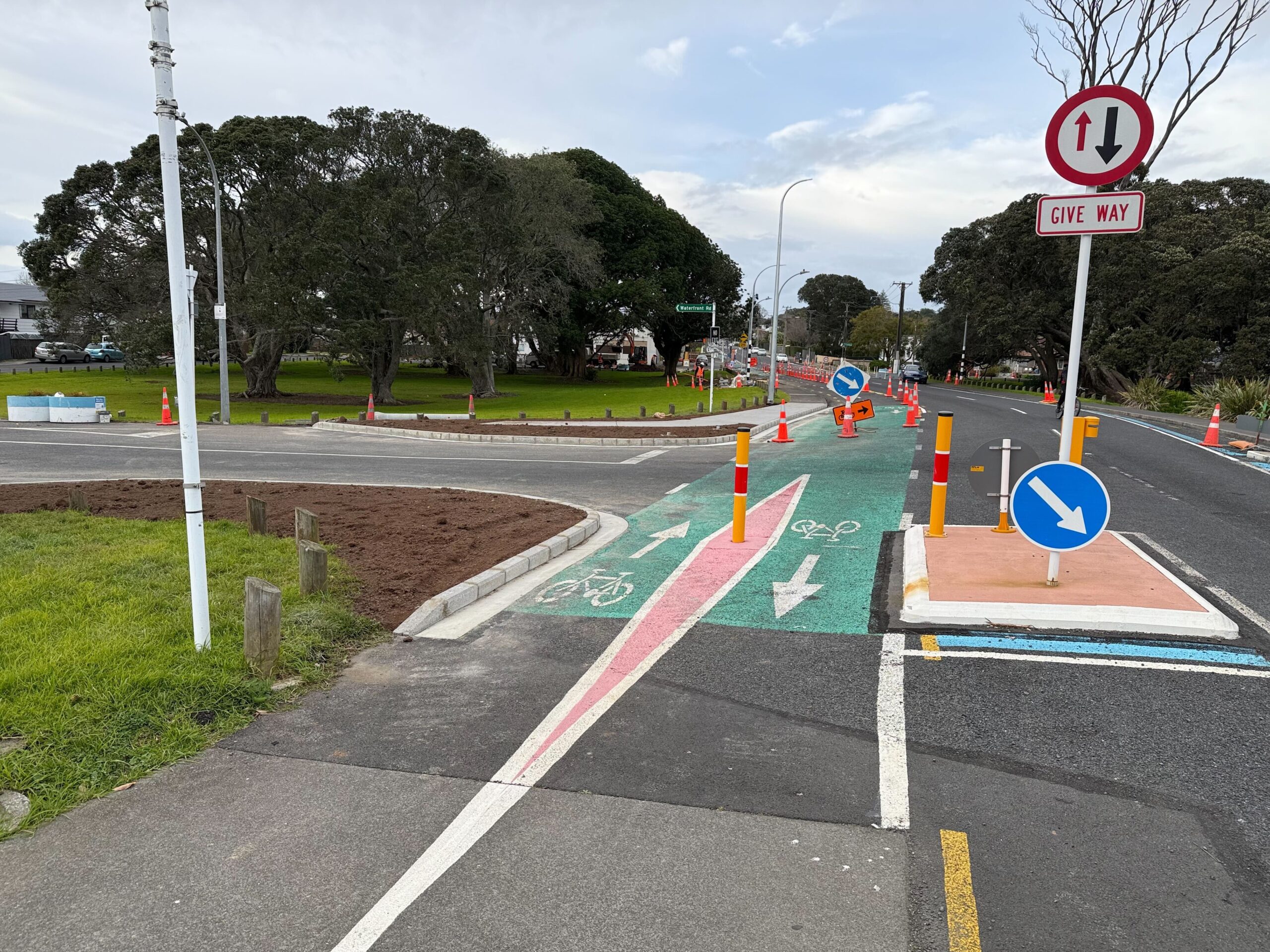
From tactical to permanent: Auckland’s cycleway network quietly expands
Just to hand, from a friend: this is Coronation Road in Māngere Bridge, where a tactical cycleway is being upgraded to permanent. Every new piece of the network is good news.
Planning Talk
This looks like a great event next Thursday August 15, 5.30pm to 7pm at Objectspace, at the top of Rose Road just off Ponsonby Road. The event is free but filling up fast, so be sure to reserve your spot.
Hayden Donnell, journalist and writer at The Spinoff, examines the unintended consequences of urban planning in this Ockham Lecture.
Hayden introduces his lecture:
Current planning rules are meant to stop ugly buildings getting built and ensure new construction is easy on existing residents. So why are so many of the suburbs we see as beautiful and worthy of protection the ones we built before those rules were put in place? Why are the places we condemn for their poor urban form so often designed with council directives in mind? For decades we’ve tried to micromanage our cities. There’s a case that in doing so, we’ve actually sabotaged them.
We’re keeping it short and sweet after a busy week, but as always feel free to share relevant news stories and links in the comments. Have a great Friday, and a great weekend!

 Processing...
Those cycleway separators are too tall. I understand they follow an AT standard for kerb height. But it doesn’t follow that what’s appropriate for a kerb at the edge of a footpath makes sense for a cycleway separator. For one thing, the height means you can’t cycle next to them because you risk grounding your pedal, which narrows the useful width of the lane. And it puts vehicle tyres at risk, which is unnecessary and a safety hazard. There’s a simple solution: use a lower height, like they do in Christchurch. (Or in Netherlands, Denmark, etc )
An alternate option is to use separators that are sloped on the side that faces cyclists, similar to the tiles used on K Road.
Not sure anyone sells precast separators that look like that at the moment, but feels not beyond the ken of man.
Like these in Guadalajara?
https://tinyurl.com/4hv7manv
The problem is that a robust separator to attach to the road surface (cheaper than cutting into the surface) needs to be thick enough to avoid breakage in handling and under (accidental) wheel loading. Rubber is not as durable as concrete, but does allow better profiles. Supplier opportunities are there for Better, Faster, Cheaper product and installation.
When resurfacing of the road occurs at the same time, the standard separators can be installed on the base course, with wearing course reducing the upstand height.
I haven’t personally measured those separators though have recently been to New Plymouth to see them but from their profile I am pretty sure they are 120mm high. Standard kerb heights are usually 150mm high. The separators also have a more generous chamfer than a standard kerb. I’d be interested to know how many actual incidents have resulted in damage to vehicles in New Plymouth, only sporadic evidence given in the article (if any)
Sorry only read the second article linked, from the first article looks like lots of people are saying there is damage to vehicles occurring regularly. I didn’t notice many scrapes or tyre marks on separators when I was there though…
I almost killed myself riding over one of these on Sandringham Road. Wanted to turn right into a side street, was looking over my shoulder to check no cars were coming, pulled into the road and ran over one of these, fell off in the middle of the road doing 33kmh on my e-bike. On Sandringham they are very sporadic, maybe where they are more continuous they are safer for cyclists, but I suspect they are actually more dangerous.
Coronation Road is a cheap win linking over the bridge to the South West up to Waterview and then to the city on the Northwestern, or the path that goes to Penrose.
A probably forlorn hope is that there is thought behind maintenance and cleaning of the path. So many of our new cycle paths are almost unridable due to glass and other garbage in them. Cavendish Dr and Taniwha St (uphill) being two good examples.
Maybe worth calling out a bit of progress on the Eastern Busway too. The (admittedly useless) flyover is opening 5 months ahead of schedule. Hopefully the rest of the project is also on or ahead of schedule.
Looking forward to the local MP cycling along the new path on Ti Rakau Drive to cut the ribbon on the flyover.
Let AT or NZTA know. They’re not perfect but they do try usually. The contractors usually don’t care, but they have a responsibility and generally jump when anything threatens their gravy train.
I have to retract my suggestion yesterday of dividing the cost of a cycleway by the number using it and sending them each an invoice. The photo above of the New Plymouth cycleway would require a division by zero which might fracture the space-time continuum.
Some suggestions:
https://www.youtube.com/shorts/9Bl7G3spf7Q
https://www.youtube.com/shorts/7OEwlSnKXDo
shh, shh, miffy doesn’t want to hear facts or evidence; they want a libertarian country where noone spends any money and we all live in isolated shacks connected by dirt tracks
Yes evidence. Like the photo above showing 19 cars, 1 pedestrian, 2 people waiting for a bus and not a single cyclist.
A photo is not sufficient evidence if the bikes can move freely while the cars are stuck in gridlock, see the videos above.
There still may be less cyclists than driver on this stretch of the road because cycling infrastructure is really shit compared to car infrastructure in New Zealand and generations of investments have focussed on making more space for cars and not bikes. This does not mean that this cannot change – see small cities such as Amsterdam, Paris or New York. I admit, the weather needs to be great all the time though, like in tropical Bergen, Norway (see https://www.youtube.com/watch?v=JCedclz03uI ).
i think miffy’s going to have to admit NZers are weak and lazy. apparently we melt in the rain and physical activity is bad unless it causes a concussion (*cough cough* rugby)
I often take pics of cycle lanes, stations etc empty as people often don’t want to be in your photos so wait until they clear.
I won’t retract my suggestion of sending every driver the true (ecological, economical, social, injury and opportunity cost) bill of their driving as long as people like you keep making bad faith comments about cycleways but ignore BCR problems for motorways costing literally two magnitudes more. So, really, nothing new in the state of Denmark.
Absolutely!
Motorway users before motorways were constructed = 0
Internet users before the internet = 0
Public funding built out both of those completely unused networks and continues as they languish, sad and empty to this day.
Apparently Miffy hasn’t learnt about the classic way for media to stir up cycleway hate: wait until no-one is cycling along one and then take a photo of it… For good measure that article also threw in an old photo of some car parking markings behind a separator before they were removed, just to get a few more people wondering about the stupid design of that…
“It’s raining and I was going about 40kph. When I pulled in to go to a fish and chip shop, I went straight over a Tim Tam.
“It lifted my whole car. The whole left-hand side of my car was lifted off the ground. I was really annoyed as I could not see it in heavy rain.”
Wow, white marked tim tams yet what about normal paths that aren’t? Does he run over those in heavy rain? If he can’t see in heavy rain then at 40 km/hr then I’d suggest 30 which is probably what the speed should be there I’m guessing if people can’t actually drive properly.
In any case, it’s often a matter of the motorists (often locals) getting used to the new road being more narrow (and or layout) and the collisions will reduce.
Good video on the case against one-way streets, he talk fast, so gotta concentrate lol.
https://www.youtube.com/watch?v=eNslRSeP7Cw
We are now a month from the election of new representatives for Tamaki Makaurau. We have a sitting mayor, who is pushing octogenarian status, and we have always been blighted by old man mayors, at least as long as I can remember (Christine Fletcher seemed old manly to me at the time).
Apparently the sitting mayor is refusing to engage in debates, and he was voted in by barely a fifth of our citizenship last time around.
As democracy is disappearing around the world, it continues to disappear in our city.
This is very concerning for those of us who believe in the democratic ideal.
All I read is the mayor saying unpleasant things about Pasifika people, and it seems odd in the largest Pasifika city in world.
Last time, a mayoral candidate promised free public transport. He is no longer in this life, but he demonstrated that our city could lead through inclusivity, rather than the bully tactics that old men cannot avoid using.
I always vote, because I am a dreamer, and I believe that as the country where women first successfully achieved suffrage, it is disrespectful to my tupuna to not vote.
We need more people to vote in our local elections, or we may as well be living in Venezuela.
Democracy only maintains respect for as long as it represents the people it should represent, and we are not a city of ageing white people. We are a multicultural, multi-ethnic city, and a shining light to the world for the respect we demonstrate to all cultures and beliefs. We need political representation that reflects this.
Bike paths are hard to win in a car dominant culture, but with help from our elected representatives, the future could be possible.
bah humbug
Can AT not just defer buying new ferries until they figure out electric ones are better? Ignoring the obviously worse pollution, it’s about the OPEX. A few solar panels on the roof can contribute to charging on journeys as well, saving electricity costs.