The government look set to make things easier for big gas guzzling vehicles with the announcement yesterday that they’re progressing with plans to replace fuel taxes with road user charges.
Cabinet has agreed to a series of important legislative changes to enable the transition of New Zealand’s 3.5 million light vehicles to paying for our roading network through electronic road user charges, rather than petrol tax, says Transport Minister Chris Bishop.
“The abolition of petrol tax, and the move towards all vehicles (whether they be petrol, diesel, electric or hybrid) paying for roads based on distance and weight, is the biggest change to how we fund our roading network in 50 years,” Mr Bishop says.
“Right now, New Zealanders pay Fuel Excise Duty (FED, or petrol tax) of about 70c per litre of petrol every time they fill up at the pump with a petrol car. Diesel, electric, and heavy vehicles pay Road User Charges (RUC) based on distance travelled.
“This revenue is funnelled into the National Land Transport Fund which funds the building of new roads and maintaining our existing ones.
“For decades, petrol tax has acted as a rough proxy for road use, but the relationship between petrol consumption and road usage is fast breaking down. For example, petrol vehicles with better fuel economy contribute less FED per kilometre towards road maintenance, operations, and improvements.
“We are also seeing a fast uptake of fuel-efficient petrol hybrid vehicles. In 2015, there were 12,000 on our roads, while today there are over 350,000.
“As our vehicle fleet changes, so too must the way we fund our roads. It isn’t fair to have Kiwis who drive less and who can’t afford a fuel-efficient car paying more than people who can afford one and drive more often.”
“This is a change that simply has to happen. The government has recognised reality and is getting on with the transition.
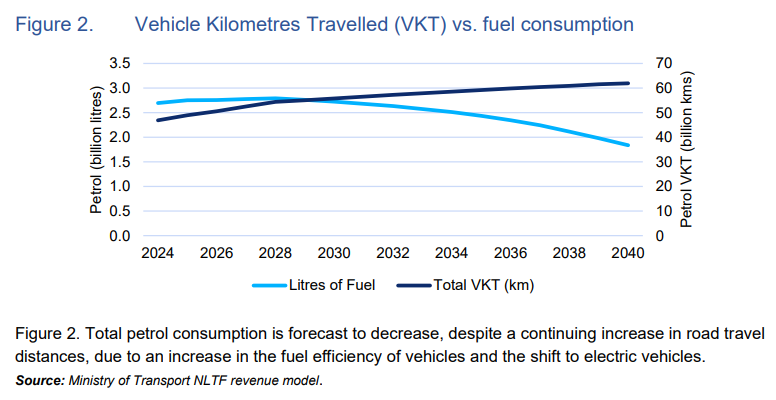
That we’ll need to eventually replace fuel taxes as vehicles get more efficient has been known for some time and the government highlighted this work in the (awful) 2024 Government Policy Statement on Land Transport, which included this chart of their predictions on fuel use.
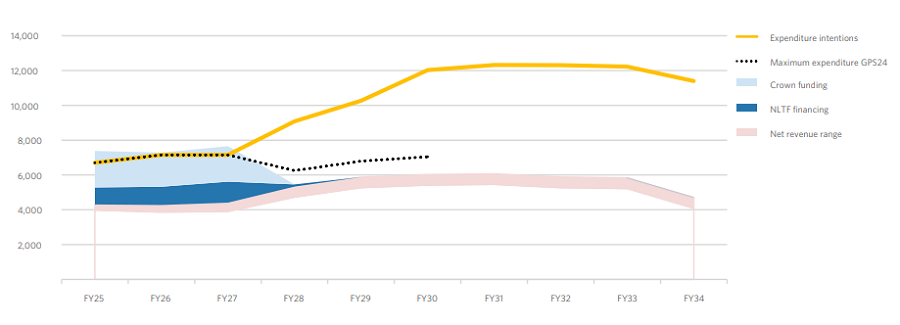
Even before this decline in fuel use occurs, the National Land Transport Fund (NLTF) no longer is sufficient to cover the quickly growing costs of costs of the transport system. This is from the National Land Transport Plan and shows that revenue from the NLTF (pink line – includes both fuel taxes and road user charges) is half to a third that of what the government’s spending intentions are with all of their mega roads they have planned.
Fuel taxes have always had the advantage of being an easy way to raise money for the government because there was very low overheads and was one that no one who drives a petrol vehicle could avoid.
The taxes also had somewhat of an emissions reduction benefit too. By being added to the cost of fuel, the fuel tax also added an incentive to drive a more fuel efficient vehicle. As such, one concern I have with the change is that unless more refined weight classes are introduced for light vehicles, it could help encourage bigger, more polluting vehicles. That’s because someone in a small hatchback would end up paying the same as a giant double-cab ute.
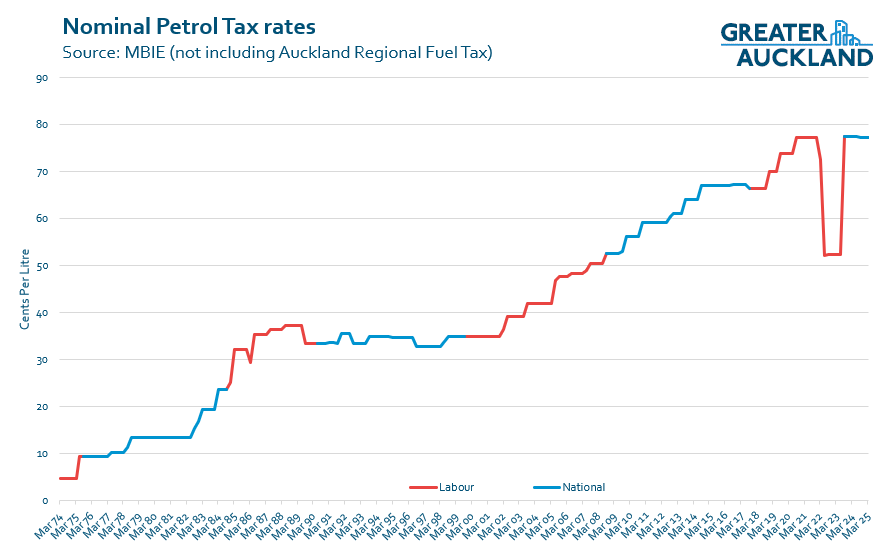
Fuel taxes over the last 50 years
The government do say they’ll make the current RUC system easier but it also looks like most likely you’ll be having to pay a third party to collect RUC.
“The transition will happen in stages, beginning with legislative and regulatory reform to modernise the current RUC system and enable private sector innovation.
“The current RUC system is outdated. It’s largely paper based, means people have to constantly monitor their odometers, and requires people to buy RUC in 1000 km chunks.
“We’re not going to shift millions of drivers from a simple system at the pump to queues at retailers. So instead of expanding a clunky government system, we will reform the rules to allow the market to deliver innovative, user-friendly services for drivers.
“A handful of E-RUC companies already do this for about half of our heavy vehicle fleet and there are several companies, both domestic and international, with innovative technology that could make complying with RUC cheaper and easier.”
Key legislative changes the Government is progressing include:
- Removing the requirement to carry or display RUC licences, allowing for digital records instead.
- Enabling the use of a broader range of electronic RUC devices, including those already built into many modern vehicles.
- Supporting flexible payment models such as post-pay and monthly billing.
- Separating NZTA’s roles as both RUC regulator and retailer to foster fairer competition.
- Allowing bundling of other road charges like tolls and time of used based pricing into a single, easy payment.
“The changes will support a more user-friendly, technology-enabled RUC system, with multiple retail options available for motorists,” Mr Bishop says.
“Eventually, paying for RUC should be like paying a power bill online, or a Netflix subscription. Simple and easy.
“I expect to pass legislation in 2026, followed by an updated Code of Practice for RUC providers. We will also engage with the market in 2026 to assess technological solutions and delivery timelines. In parallel, NZTA and Police will upgrade their systems to support enforcement in a digital environment.
“By 2027, the RUC system will be ‘open for business’, with third-party providers able to offer innovative payment services and a consistent approval process in place.

 Processing...
Without including pricing for other negative externalities by vehicle type, particularly the climate and air quality burdens created by burning unnecessary lethal crap to get around, this change will impose devastating additional burdens on society.
Plus will almost certainly will lead to increased VKT, with concomitant increases in congestion, death and injury, and even lower productivity. In turn this will incentivise further sprawl, feeding back into more of the above.
But it needn’t be so. This change could be done smartly by finally pricing all the costs of driving properly, nudge the vehicle fleet towards a better overall size (modeshift), and a less harmful composition (ev transition). And can still, price signals are powerful, are key levers of good governance.
As a general rule fuel tax benefits longer trips, while RUCs benefit shorter stop-start urban trips.
I’m not sure it will encourage sprawl, more likely shorter trips to the shops.
The emissions issue could be dealt with by increasing ETS charges, but I can’t see this government doing that.
“Plus will almost certainly will lead to increased VKT” How?
The total price for a km travelled across the fleet will be the same. If anything it will be marginally better because of the significantly underpriced hybrid loophole will be fixed.
I will also note that Euro 6d is coming. To be required on new models by the end of the year, all imports by 2028. Removes a lot of the toxic emissions effects.
I think even if your position is that the rate setting needs to be better, that can just be done next time lab / greens are in power. Shifting to RUC’s for all will enable much better pricing in the future.
I don’t think many people give a stuff about VKT- I certainly don’t. VKT doesn’t exist, it is just a mathematical product of some things that do exist.
Someone made a good point yesterday, Ford Rangers should probably pay less RUCs as they generally follow closer thus take up less road space…
I saw a BMW indicate a turn last week.
Good grief!
Isn’t that illegal?
They also take up less space parking on roads because they usually are on the foodpath anyway 🙂
Do they ever listen to themselves- so scrapping fuel tax and replacing with a RUC because vehicles are now more efficient and in terms of E vehicles don’t pay at the pump. They need the money raised by fuel tax or now RUC to pay to build more roads and keep maintaining them. Have they ever thought about looking at PT and Active modes which can move more people efficiently so do not require building more roads and associated maintenance is reduced. And this is without considering the great damage and costs associated with making more polluting, emissions producing vehicles favourable.
That’s a great idea. They could sum the cost of cycleways and divide that by the number of cyclists and send them each an invoice. They might need to set up a system like the student loans so people can pay it off.
The good news is there’s so few cycleways that it wouldn’t take long to pay off.
not to mention how little wear and tear cycling causes on pathway surfaces.
miffys fallen prey to the road lobby propaganda that a 100kg bike and rider somehow produces the same damage to the road surface as a 2 tonne car.
It isn’t about pavement wear, it is about the bellyaching and whining we all put up with from the cycle lobby. The day they start paying for the construction of cycle lanes will be the day they might start thinking about benefits versus costs.
Yeah, the bloody cycling lobby and their billion dollar industries. Always asking for 4-lane bicycle paths to the north with low BCR! Or making this project in Wellington so bloody expensive just so they could include a sea protection wall as well. Those bigots don’t even believe themselves that their actions would slow down climate change or why would they want flood protection anyway?
I get your point, miffy.
typical “centrist” brainrot on miffy’s part; 1% of the transport budget is somehow just as bad as $20 billion in unneeded highways. doesn’t seem like “balance” to me
I personally think horses and dogs being walked get undercharged.
Neighbours golden retriever should have to have an EROAD collar to be out and about.
Well, if we take externalities into account, then we should pay cyclists and charge motorists a lot more.
Overall, the “cyclists should pay” argument is still silly and shows lack of thought. Cyclists pay with their rates. If they pay around 5% of their costs and motorists pay 50% of their costs, then people may think that motorists pay more.
But the absolute cost per motorists is a lot higher. Let’s say that the overall cost of maintaining a road per vehicle travelled is 10 cents – for a bike it may be about 0.2 cents. The the community pays 5 cents per motor vehicle per km and 0.01 cents per cyclist per km. Which one is the one is heavier on the public purse?
Miffy hasn’t considered the externalities of NOT having cycleways and ignores the fact that the roads belong to all of us. Not just motor vehicles.
Case in point, I was hit by a car, from behind, when cycling roughly 30 years ago.
The medical and dental treatment at the time ran into tens of thousands of dollars all covered by ACC.
The dental work is near end of life and recent quotes estimate $30.000 plus. All covered by ACC.
The road where I was struck now has a cycleway.
Shame the driver got away scott free.
Miffy, any comment on farmers using the roads to move stock and leaving urea on the roadway?
Ah great point to make on a post that shows roads are coming in at six billion dollars short every year. Perhaps we could start by sending that two thousand dollar a year bill to every car owner in the country?
the day they cost cycle ways honestly, and don’t lump in roadway improvements into the cost of a ‘cycleway project’, we can think about this
If the RUC component of fuel is to be removed, it must be replaced by a Carbon Tax.
It is not fair on we who breathe exhaust fumes every day, and are slowly dieing because of them, that persons who pollute on purpose do not pay for their farts.
Electric Vehicles are not the solution, but they at least do not poison us, through noise or noxious fumes as they cause damage to our roads.
Public Transport is the only viable way forward for our motu, and it must be funded by everything possible, or we will be washed away.
We live in this la la land of powdered milk that kills Chinese babies and private motor vehicles that poison the air we breathe while the Wellington man in suits that are destroying our democracy want us to drive faster?
bah humbug
There already is a carbon tax on fuel – the ETS.
Carbon is only one emission, plus doesn’t cost in all the other externalities. Here is an opportunity to for a more rational pricing of burdens. User pays, and polluter/killer pays.
The ETS should be replaced with a proper Pigouvian carbon tax. The ETS allows this country to avoid any reductions and pay for dodgy off shore credits instead- the whole thing is a sham. A carbon tax at least allows the money to remain in this country.
+1
Except this government has said that they are not going to pay for offshore credits.
How will they meet the shortfall? If anyone in government knows then they certainly aren’t saying.
One of the options appears to be to store carbon in empty gas wells in Taranaki. Apparently the economics don’t stack up, so the government would have to pay Todd to do this.
Who needs money to spend on hospitals anyway? If you were sensible you’d have health insurance.
The ETS exists and will remain on all liquid fuels, it is paid by the importer. IE Diesel RUC users pay this already, and of course petrol users too.
Exhaust fumes are one of the primary underpriced externalities I agree. RUC’s would in theory allow individual vehicle models to be charged different rates depending on the engine model and toxic emissions output. Although I doubt that would happen. Euro 6d is being mandated a the end of the year for new model cars, and 2028 for all vehicle imports which is a massive improvement. Close to EV levels of toxic emissions (not carbon obviously), tire wear becomes the primary issue.
Taking the numbers from the post and using very crude maths.
For year 2026; $8 billion of roading expenditure divided by 50 billion VKT gives an average RUC required of $160 per 1000km. The present EV charge is $76/1000km.
Assuming that the RUC is based on weight and size, a 2,000kg vehicle will probably be near the mean. So should we expect a charge of $160 for the double cab ute and say $100 for a $1000kg car?
Would expect that there would be some sort of carbon/health charge on liquid fuels.
Taking the numbers from the post and using very crude maths and assuming that the expenditure graph includes local roads?
For year 2026; $8 billion of roading expenditure divided by 50 billion VKT gives an average RUC required of $160 per 1000km. The present EV charge is $76/1000km.
Assuming that the RUC is based on weight and size, a 2,000kg vehicle will probably be near the mean. So should we expect a charge of $160 for the double cab ute and say $100 for a $1000kg car?
For vehicles under 5000kg there is negligible pavement wear. Nearly all the costs are periodic maintenance, policing, storm repairs, upgrades etc which are split up evenly among all road users. So a 2000kg ute and a 1000kg car will almost certainly end up in the same RUC band, as they are today.
While from the Government POV the focus will be on weight for wear on the state highways. Whereas from a Local Government POV there is a greater cost associated with the larger vehicles with more space required for parking etc.
If the RUC is intended to fund local roads as well, how will money be distributed to councils and will roads be taken out of rates. It has already been announced that congestion charges will be included in the RUC.
In which case can we assume that the mean base charge will be in the vicinity of $200/1,00km.
Councils already receive co funding from the NLTF which is where all RUC’s and Fuel taxes go. Depends on the council, but the average “Funding Assistance Rate” is 53%. ie local roads are just over half paid for by road user charges. A significant contribution from rates, ie the property owners benefiting by having their property serviced by the local roads, also makes sense to me.
There is a vehicle size adjustment in the RUC scheme already, to recognise that some vehicles take up more road space, but it only really matters for heavy vehicles. The difference between a toyota aqua and a prado is again negligible.
Local governments are under no obligation to provide parking. If they feel like subsidising parking and undercutting private parking operators that’s fully up to them, but it would create bad incentives to encourage them by making road users pay for it.
Bringing all powered road vehicles under a single road user charging system removes the biggest of the current road tax anomalies, and is therefore to be commended. Tweeks can be made for different vehicle weights at any time as better research better allocates roading costs between the creation of road space, to mitigate congestion, and road strength and wear costs. These latter costs are highly dependent vehicle weights,
The current plague of potholes and their expenses in remediation suggest that road user weight charges are not reflecting the additional road wear caused by the increase in allowable gross vehicle weights. It seems that heavy vehicles are not currently paying for their damage caused, not only to state highways, but particularly by logging trucks to rate payer funded local roads.
A funding anomoly that needs addressing in our current road user charging regime.
Emissions should be additionally taxed as duties on all fuels thus collecting all users including off road users. Perhaps even coal, and firewood sellers as well.
Or like the UK taxed (RUCed) based on tailpipe emissions.
Polluting cars, utes and trucks should be paying more then electric/Hybrid/Euro 5/6 vehicles. My UK car tax is heavily effected by my emissions.
Apart from the fixed costs of maintaining the licensing system, all other costs to our society of motor vehicle use on our roads are proportional to the distance covered. So the further you travel the more you should pay.
Emissions, Road occupancy/ vehicle size, Road wear, and accident propensity and personal injury costs, are all classifications, that can ascribed to vehicle types to set an appropriate per km rate to much better approximate a user/congester/polluter pays regime. Paying for the real estate they occupy, the road wear they cause, the pollution they are causing, and the consequences of accidents to our health and compensation systems.
Having multiple distance rates depending vehicle type, and licenced maximum weights is easily accomplished on a RUC system
It is absurd that a licenced motor bike very incurs a huge ACC only because it is licenced. The exposure to injury is proportional to the distance covered and vehicle type.
E-Road, Teletrac, RUC monkey.
I’m sure these guys will appreciate the bung.
I’m looking forward to the government really getting to grips with the possibilities for automatic speed limiting, camera footage and other functions to identify people who should exit the fraternity of drivers.
If AI can spot an individual by their walk, it can certainly identify impaired or banned drivers by their habits.
Future left-wing coalitions will change and/or create categories of RUC pricing rates to correct this.
Then right-wing coalitions will change them back, and so on.
The main effect this has is that flipping a dozen little pricing switches every 3-6 years will be easier.
I think you are right on the first point, wrong on the second. The latter will just blame the earlier decision if ever called out on it.
However, it would not totally surprise me if ACT pushed for the former in a second term.
I can see the bloated utes coming in the same weight class as small, efficient cars, continuing the manufacturer-driven advantages they receive. Length x width might be better, since weight only affects road wear at HCV size.
Chris Bishop was right to recognise that people less wealthy than himself don’t have the funds to swap to a low-emission vehicle. Equity needs serious examination.
Going from pre-pay fuel tax to post-pay RUC is going to lead to adding RUC to the food-rent-electricity decision for low-income families.
Outside the discussion so far is where all the GST goes.
Ease of collection? Leave it all to private companies who are only working with logistics companies is fairy dust. Roll RUC in with tolls and time-of-use? Look how well single national PT fare collection is going.
“Going from pre-pay fuel tax to post-pay RUC is going to lead to adding RUC to the food-rent-electricity decision for low-income families.”
Good point. Could be lots of people who run the gauntlet and don’t pay, like rego and WoF.
They can then send fines to not pay
Will a prepaid system be required? Meaning, if a vehicle hasn’t prepaid and attempts to access the road network then it is quickly identified and travel on the network is forcibly denied.
“Outside the discussion so far is where all the GST goes.”
Also to roads, RUC’s and FED are only covering 1/3rd of land transport expenditure at the moment.
The road network is made of local roads that are the responsibility of local councils and state highways that NZTA are responsible for.
If the idea is that in the future motorists will use a new eRUC system to pay for using the road network how exactly will that be calculated?
Will there be a base rate per for a given distance and weight? Then additional charges can be added for congested time periods. Will some roads (say high speed motorways) have an additional charge?
Will the eRUC system network collector transparently pay NZTA and local councils for the exact amount of road network use of their respective networks?
Will the base rate charge plus any additional charges be calculated to fully cover NZTA costs.
Presumably payments from the new eRUC system to ACC will continue to account for the health costs of road accidents and ETS charges on petrol and diesel fuel will remain to account for GHG emission pollution.
Road user charges is just one form of infrastructure funding and financing for just one mode of transport (motor vehicles). Other forms of transport need their own network funding mechanisms and their own specialised organisational structures.
What about using land value capture mechanisms – taxing land, betterment taxes, land readjustment etc.
What about the productivity income gains from larger urban areas having improved transport connections so more people can connect to each other.
People who study cities agree that larger cities have greater productivity and higher incomes, because firms can take advantage of greater economies of scale, there is more innovation and knowledge spillover between firms, there is better matching between work skills and labour requirements, and there is more capacity to supply specialisation in manufacturing production, retail outlets, public and private services, and even recreational activities. Larger cities have better network effects, such as, a better online dating scene.
It makes sense that a proportion of that income gain is returned to the network transport organisations that made it possible so they can maintain and upgrade the networks as needed.
See https://medium.com/@brendon-harre/christchurchs-roads-are-as-fast-as-they-will-ever-get-7cbe7d66d757 for more details.
this is how we pay for 4laning everything. If the integrated ticketing system cost well over $1B to be late, overbudget, and on track for a no show, then the countrywide RUC system won be running before 2030, well too late to pay for the new LA style motorways.
Can anyone tell me how the transponders on vehicles will register trips to the dairy, the school run, travel on back country roads, private roads?
Will rates still pay for local roads?
Will general taxation simply end up paying a greater proportion of transport costs?
Any scheme needs to start from First Principles.
Universality – the scheme applies to all motor vehicles whether powered by ICE or Electrics.
Equity – no person or group of person should be disadvantaged by the scheme. Any such person or group of persons shall be afforded relief through lower charges.
Disabled – disabled people reliant on private vehicles shall pay lower charges.
Proportionality – heavier vehicles shall pay proportionally more in charges to reflect the higher damages to roads caused by heavier vehicles.
Public Good – Operating vehicles for public good, e.g. buses, district nurses, shall attract minimal charges in recognition of the public good services provided.
Privacy – data collection shall not disclose a person’s name, address, make of vehicle, or any other identifying information without prior active consent of said person. Every person’s privacy is automatically protected.
Government – the Government operates a large vehicle fleet. Only those in service of the Public Good (DoC, Police, Dept Health, Schools) are exempt from charges under the Public Good principle. The remainder are subject to the Universality principle.
RUC for fossil fueled vehicles is a terrible idea for many reasons.
All fossil fuel is imported. Our balance of trade improves as we use less fuel, so efficient vehicles should be encouraged. Charging RUC rather than fuel tax does the opposite.
If the government collects less tax due to the increasing efficency of vehicles, then simply increase the % tax on fuel. No transponders, 3rd parties or complicated calculations necessary.
Why don’t they just have an individualized rate for each model year of car?
Formula should be that hard.
Base Rate +
(
Variable Rate
* Weight Factor in 50kg increments
* Pollution Factor
* Size Factor
* Risk based ACC factor
)
What other factors should be in there?
Good idea we sure need to keep some form of pollution/ emissions / fuel tax too as we transition and forever or this is so bad.
So .. drivers of “muscle” cars, speeders and illegal street racers should be pleased with the proposed RUC system, because they will no longer be subsidizing the use of fuel efficient cars and EVs. This could end up as another example of our current government back sliding on climate warming concerns.
Whatever way to charge, my concern is not to waste tax payers money on unnecessary spending; NZ Government are known for inefficient, big spenders, money spent not for value. NZ road conditions is worse, not reliable, outdated but tax is high. We should look at how the money is spent instead of how to collect.
Land transport emissions from petrol fell 15% from 2019-2024 (mostly from driving less, not from EVs), while emissions from diesel rose 9%. Petrol has fuel excise duty and diesel does not. Switching petrol vehicles from FED to RUC would reduce the effective carbon charge from $448/tCO2 to $50/tCO2.
Very few other countries use RUC. The ones that do only do it for trucks and even then they use both RUC and a fuel tax.
For example in Switzerland, Euro 0-V trucks pay NZ6.4c/tonne-km (e.g. a 40 tonne truck pays $2.56/km) & Euro VI, 4.7c/t-km. EVs are exempt. There is also a fuel tax of $1.49/l on diesel and a carbon tax of $248/tCO2.
Thus the proposal here is to make an unusually anti-climate road pricing system even more anti-climate.