This guest post by Darren Davis originally appeared on his great blog Adventures in Transitland, and shared here by kind permission.
Now that it’s only three shopping months until Christmas, here is my top ten list of what I want Santa to give to public transport in Aotearoa/ New Zealand.
Starting from the top of the country, which in Te Ao Māori [Māori world view] is the Lower South Island, and heading north to JAFA-ville (aka Tāmaki Makaurau/ Auckland) and beyond, here are my top ten wishes for a festive season chock full of public transport essentials.
Trains for the Lower South Island
A regular daily bi-directional passenger rail service from Aotearoa’s second largest city, Ōtautahi/ Christchurch to Ōtepoti/ Dunedin on onwards to Waihōpai/ Invercargill. The periodic Mainlander service between these cities has clearly demonstrated a latent market demand for such a service.
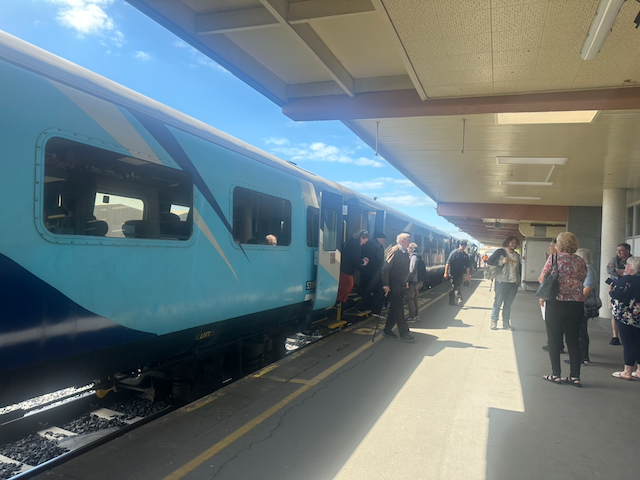
Mainlander at Tīmaru Station, Photo credit: Darren Davis
Any public transport for the West Coast
The South Island’s West Coast is the only region in Aotearoa to have no publicly funded public transport service and fairly barebones Total Mobility for people with disabilities. Transport poverty does not magically end west of the Southern Alps.
Better buses for outer Christchurch
The fast growing outer communities of greater Christchurch, such as Rangiora, Ravenswood, Pegasus, Prebbleton, Lincoln and Rolleston deserve better than at best half of a frequent route and often only an hourly not particularly fast and sometimes not particularly direct bus service. Improving this situation would be a good first step towards future mass rapid transit.
Non-sleeping trains for the Lower North Island
The wrapping up of the long and winding road of the Wairarapa Line upgrade in early 2027 should open the path to faster and more frequent bi-directional train services. Currently only one of the three trainsets used on this line operate outside of peak periods. Over on the Manawatū Line, the Capital Connection should awaken from its lengthy diurnal (and nocturnal) slumbers and run a second return trip on weekdays and at least a single return trip on weekends and public holidays. Waiting until 2030 for battery electric trains in the Lower North Island doesn’t cut the mustard when the market can be built up with better service sooner using existing rolling stock. Let sleeping trains awaken and do what trains are supposed to do – provide train service.
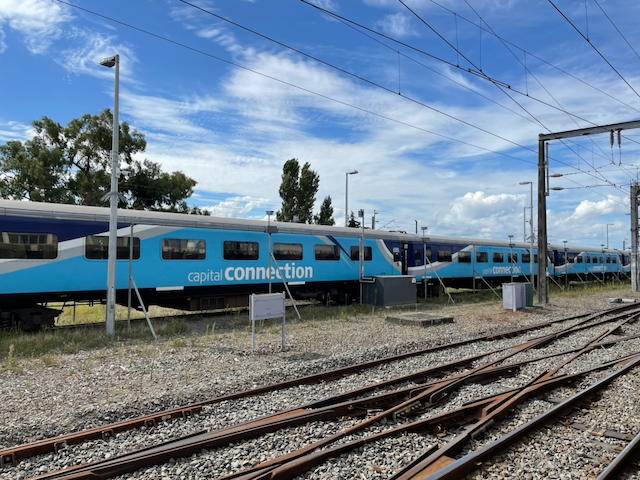
Don’t let sleeping trains lie. Former Capital Connection rolling stock stabled at Palmerston North Station. Photo credit: Darren Davis
A second public transport spine for the nation’s capital
A second public transport spine on the Quays is an indispensable prerequisite for increasing the role of buses within Wellington City Centre. Finding room for space-efficient bulk people moving on one of the capital’s finest traffic sewers doesn’t seem to be too much to ask.
Better buses for the Hawkes Bay
The Hawkes Bay did not win public transport lotto and didn’t even get the sort of quality of new bus network of other cities such as Te Papaioea/ Palmerston North and Whakatū/ Nelson. While a bunch of useful service improvements were made, this was only a fraction of what was originally proposed. The Hawkes Bay deserves better.
Baby steps towards passenger rail in the Bay
New Zealand’s reputation as a fly/drive country is epitomised by the Bay of Plenty which almost treats its low non-car use as some sort of perverse badge of dishonour. Getting passenger rail back to the Bay, as existed up to 2001, will be a long journey. But a long journey can only end if it begins. So it’s high time for the Bay of Plenty to begin that journey.
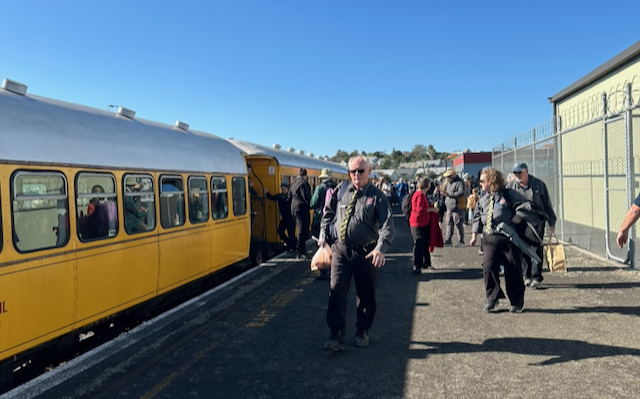
There would appear to be latent demand for passenger rail to the Bay of Plenty as attested by this one-off excursion service. Photo credit: Darren Davis
Te Huia as a permanent service
Five years after its launch, the Te Huia regional rail service between Hamilton and Auckland is still a trial. Up to the end of August 2026, Te Huia has carried 354,541 passengers which kinda indicates that there is some sort of demand for the service. Given that, making Te Huia permanent would seem to be a no-brainer.
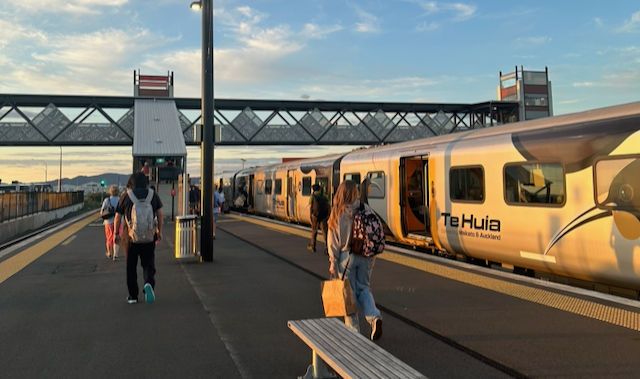
Here’s hoping that Te Huia is going to continue sailing into the sunset with passengers on board. Photo credit: Darren Davis
City Rail Link
Auckland got its Christmas present early in the form of City Rail Link. So now is the time to build on the momentum and buzz generated by City Rail Link to make public transport much more part of the city’s furniture. At the moment, it’s a very nice add-on to what is still a very car-oriented city, notwithstanding the massive improvements to the city’s public transport over the past quarter century.

Two trains at Maungawhau. Photo credit: Greater Auckland
Northland
Aotearoa’s biggest roading project ever – the Warkworth to Te Hana Road of National [Party?!] Significance – doesn’t even cross the regional boundary from Auckland to Northland. But is seen by Northland as crucial to its economic future. At the same time, Northland’s deep-water port at Marsden Point is just about the only non-rail connected port in the entire country (although Gisborne’s rail connection is currently mothballed). The Marsden Point Rail Link, which would address this, is fully consented and pretty much all of its land requirements are now completed. If ever there was a shovel-ready project, the Marsden Point Rail Link is that project. (Ed: In June, KiwiRail selected three firms for a ‘design sprint’.)

The Marsden Point Rail Link. Image via KiwiRail
Final thoughts
While Santa mayn’t be able to stuff a train down my chimney (if indeed I had one!), it is election season which is its own form of silly season. The current state of campaigning indicates a sad lack of vision of what would make for a better Aotearoa/ New Zealand. And a better New Zealand would have more transport choices rather than our default setting of flying or driving. Here’s hoping!

 Processing...
A “sad lack of vision” from the main parties, but I don’t think that applies to this part of the Green manifesto –
1. Transform public transport networks, including building mass rapid transit in Auckland, Wellington and Christchurch, and providing comprehensive bus lanes in all cities.
2. Invest in nationwide rapid rail for passengers and freight to connect regions and major cities and contribute to economic development and decarbonisation.
3. Introduce targeted subsidies for e-cargo bikes. Introduce e-bike sharing schemes in community hubs, to allow more families to save on transport costs.
4. Fund affordable, reliable, interregional rural bus services, and on-demand public transport, including by-Māori forMāori public transport to serve kōhanga reo and rural schools.
5. Extend Community Connect to provide free fares for students and apprentices, community service card holders, everyone under 18, and all Total Mobility card holders.
6. Enable the provision of transport services publicly instead of for profit by replacing the Public Transport Operating Model.
7. Create safe walking and biking routes to all community hubs including schools through building more bike lanes and safe crossings, and lowering speed limits near schools.
8. Implement a phase-out date for the import of fossil-fuel powered vehicles, build more EV (electric vehicle) charging stations, remove regulatory barriers to EV car-sharing and re-introduce incentives for EV uptake.
That’s a heck of a shopping list to walk into coalition negotiations with. In what order would you rank them from “die a ditch for” to “hohum, just thought we’d ask”? Additionally, where would you rank the call for JAG as Transport Minister and what would be on the “stop doing right now” list?
We need any government of the future to continue electrifying our rail networks. Just keep going from Pukekohe.
Also, with Waitemata only requiring two through lines, what can we do with Platform Two and Three? Perhaps if Te Huia becomes electrificated when passing though Wiri, it could arrive directly to Waitemata? The Strand is stranded and should only be an emergency station, as it appears to have been designed.
Another idea could be simplifying the RED South City line. It currently causes some confusion, with it’s odd doubling on Te Tutahi Newmarket, leaving Newmarket still the worst station on the network, which the CRL should have resolved. The Onehunga Line is still hampering the network. Perhaps it could integrate into the RED line, with half hourly three train sets doing a Pukekohe to Onehunga, and vice versa. This would simplify our train network to an East West, which makes perfect sense currently, from any station it passes. Moving the Onehunga into the RED South line will return it’s full functionality, allowing it to pass through the CRL, and also potentially simplify the Penrose interchange, as as half hourly short train could only be Onehunga bound, and vice versa.
With only three directions and a half, we should only need TWO distinct lines. It is unnecessary complication, and many Onehunga persons would appreciate a Central City restoration of service.
Keep It Simple, reduce frustration and confusion, and our train numbers will continue to increase, which will help with the “business case” for further electrification to Kirikiriroa Hamilton, Tauranga, Te Whanganui a Tara Wellington Poneke. Both freight and passenger rail will benefit from this, and with no end in sight of less oil, and more expensive oil and gas, the logic of ending our little motu’s reliance on the big bullies makes obscene sense.
To get Back on Track, we need Rail. To Better Starts now, we need Rail. It does not matter what colour your political party is, electrified rail is the only thing that will save us from the machinations of mad old men in foreign lands.
bah humbug