This guest post by our esteemed planner friend Darren Davis appeared on his excellent blog Adventures in Transitland, and is reposted here by kind permission.
With City Rail Link opening this Sunday (13th September), it’s timely to appreciate the sheer breadth of Auckland’s public transport transformation since the turn of the century.
Tāmaki Makaurau/ Auckland is the city that non-Aucklanders love to hate (or is it hate to love?). And as us JAFAs* (yes, I am sorry to inform you that I’m an out and proud JAFA) like to say, we are Aotearoa/ New Zealand’s only city of international scale. Like it or loathe it, the city produces a third of New Zealand’s gross domestic product and around 40 per cent of the nation’s tax take. It seems that you can’t live with Auckland and you can’t live without Auckland.
The bad old days
Anyway, Auckland has turned around its public transport network in the past quarter century from global laughing stock to one of best designed (if not yet the most used) public transport networks in Australasia. Back in the day, things were so bad that Auckland’s rail network carried just over one million people in the entirety of 1992, something that Sydney does in a day, and Tokyo does in a few hours. The rail network was being set up to be shut down.
So it’s a very long journey from the bad old days to the turn-up-and-go rail network of City Rail Link, tightly integrated with a vastly improved bus network. Auckland is one of a very small group of cities in the Anglosphere to create rapid transit from scratch. This is no mean feat.
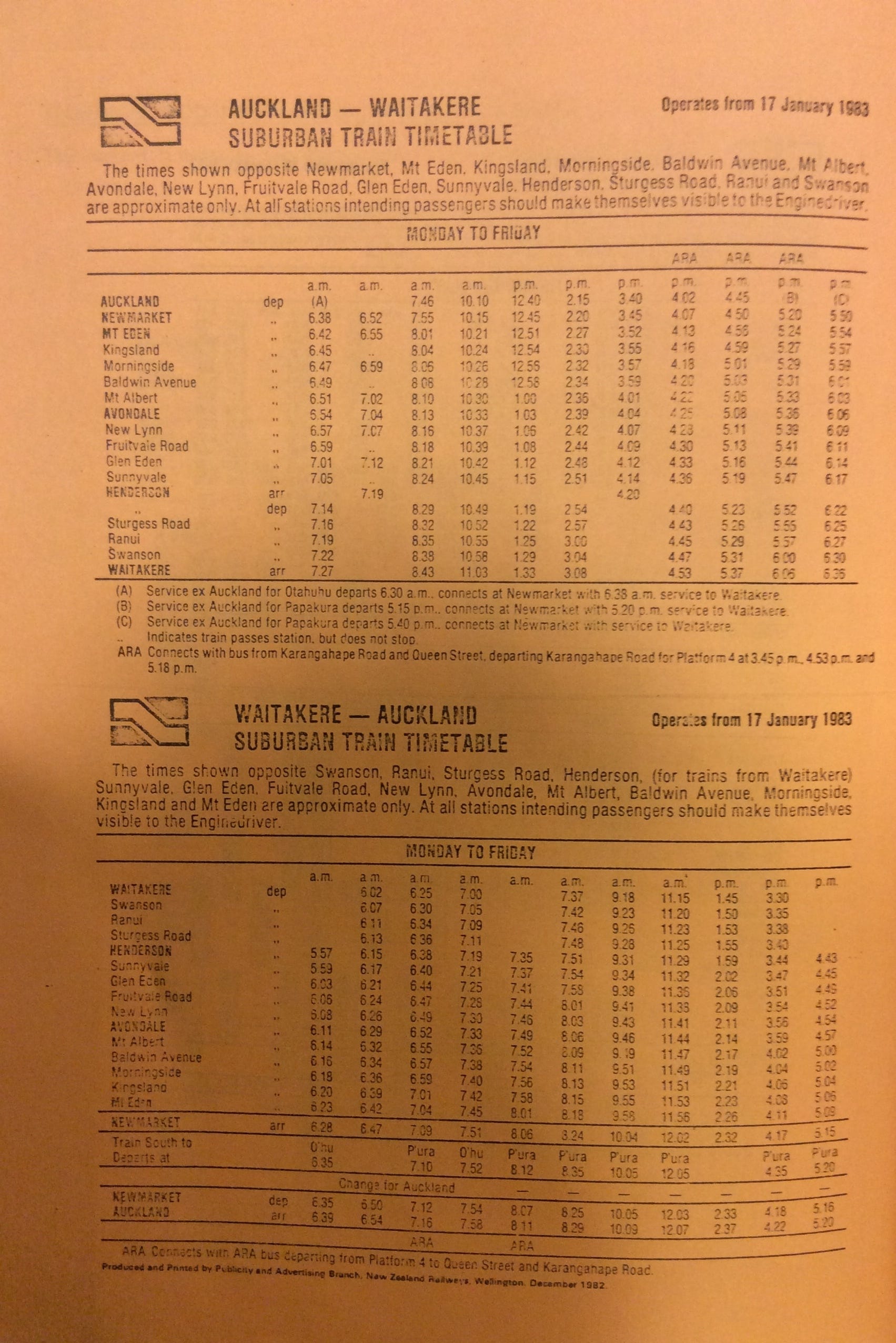
The entire Western line timetable in Auckland, from 1983-1994. That’s it; that was all. Image: Darren Davis
The turnaround
The turnaround was not a single moment in time nor a single project but a whole pile of effort by a whole pile of people each individually wanting to make a difference to public transport and collectively making a big difference.
But some key moments are worth reflecting on in the lead up to City Rail Link opening.
1993 – The Perth Rail Deal. The deal masterminded by the late Raymond Siddalls in 1993 to buy Perth’s cast-off diesel multiple units for Auckland when that city electrified its rail network undoubtedly saved Auckland’s rail network from being buried with barely a trace. It’s much harder to start a service from scratch, as Te Huia’s 10-year journey before startup attests, than to improve something existing.
2003 – Britomart (now Waitematā) Station. Auckland City Council, pre-dating the Super City, funded the vast majority of the $204 million cost of the bringing rail back to Auckland City Centre, with only a $20 million central government contribution from Transfund (now part of NZ Transport Agency Waka Kotahi). The station itself is a masterpiece of repurposing a heritage building and significantly elevated the public transport arrival experience. Mario Madayag as its architect deserves huge kudos for this.
2006-2012. Project DART (Developing Auckland’s Rail Transport). This was the core rail network upgrade including double tracking the Western Line to Swanson, including trenching rail in New Lynn; reopening the Onehunga Line to passenger service; building the Manukau rail line and station and a major upgrade of Newmarket Station.
2008 – Northern Busway. While hardly a shining example of transit oriented development, it is a major public transport success story and means that we could put off for 20 years having yet another conversation about an additional Waitematā Harbour crossing. It is also a great demonstration that it is the quality of service provided rather than the mode per se that is the most important element in successful public transport.
2014-2015 – Rail electrification. Electrifying 75 kilometres of track (recently extended by 18 kilometres from Papakura to Pukekohe) may not sound like much but it brought Auckland’s rail network from the 20th century of diesel multiple units and diesel locomotive hauled passenger carriages into a 21st century electrified rail network with state of the art electric multiple units. And it was an indispensable prerequisite for City Rail Link.
2016- 2018 – New Network for Public Transport. This first principles review of the entire Auckland bus network turned a 1970s era resource-driven “network” of slow, indirect, infrequent, non-clock face timetable bus services – in what I termed the “spaghetti thrown at the map” network – into a modern hub and spoke network built around a core of frequent radial and crosstown bus services across all of Auckland. The largely unsung architect of this transformation was Anthony Cross, who shepherded the whole project through Auckland Transport, taking stakeholders and elected members on the journey. City Rail Link will be all the more successful because it’s backed by an integrated bus network that feeds to and from rail, not competes with it.
2022 – the Auckland Council Climate Action Transport Targeted Rate provides $573 million in funding over 10 years. Together with central government co-funding of $344 million and with fare revenue, it supports a $1.045 billion investment in buses, ferries, walking and cycling, including a further major expansion of the frequent transit network with services at least every 15 minutes, 7am to 7pm seven days a week (and less often at other times).
2026 – City Rail Link. As the Mainland Cheese ad says, good things take time. And this project was a century in the making from first proposal to final delivery. But it will have a major impact on the city for the next century and more.
Auckland ponies up the cash
While there may be a perception out there that Auckland likes nothing more than sucking on the central government public subsidy tit, the truth is somewhat different.
To give a few examples from the list above:
- Britomart Station – Auckland – $184 million; Government – $20 million
- Rail electrification – Auckland ≈ $440 million; Government share ≈$660 million**
- Transport Targeted Rate – Auckland – $573 million; Government share – $344 million
- City Rail Link – Auckland – $2.7 billion; Government share – $2.7 billion
Just for these four items, Auckland ponied up just under $4 billion. And for ongoing public transport operational expenditure Auckland, like other large cities, pays for roughly half of all public transport service investments while smaller centres typically get a higher share of funding from central government.
Final thoughts
There are a few key takeouts from Auckland’s enormous public transport development over the past quarter century.
A willingness to acknowledge past failures and take decisive action to address those failures.
A willingness to think big and invest Auckland money at significant scale to address the challenges. Ambition meets funding to match the ambition.
The self-confidence to advocate for ongoing significant investment in public transport, backed by local co-investment.
Auckland’s self-confidence and ambition is sometimes mistaken for arrogance. And while us Aucklanders can at times enjoy watching the sunshine emerging from our posterior, the city is prepared to put its money where its ambition is.
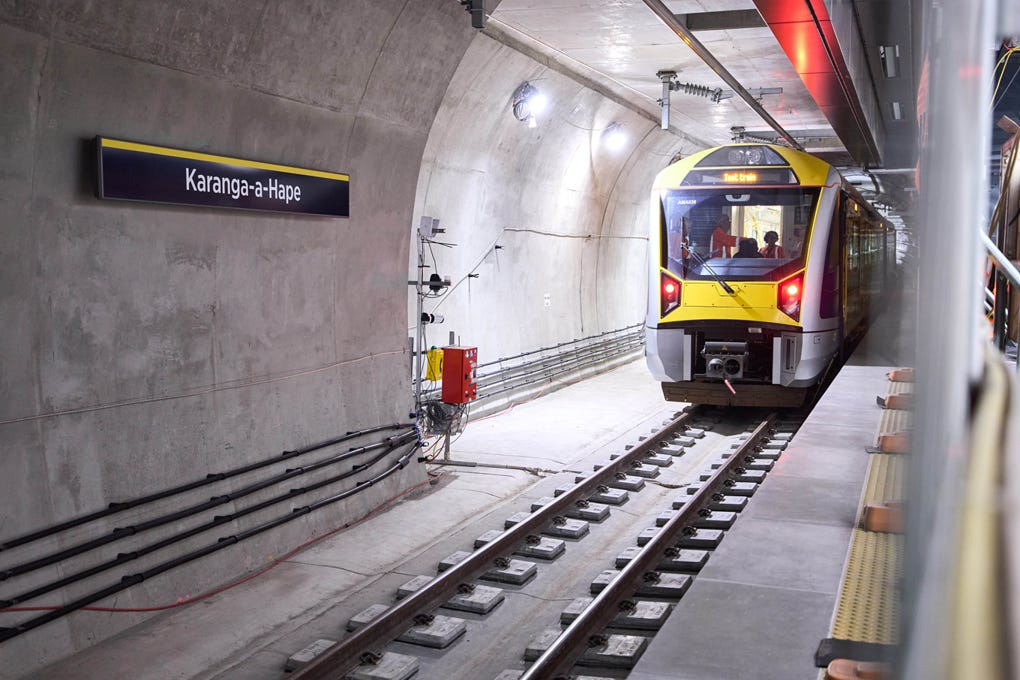
City Rail Link is the next step in Tāmaki Makaurau’s emergence as a truly great city. Image: Our Auckland
City Rail Link is the culmination of a long period of public transport development where the city has built very solid foundations, in terms of a solid bus network including 47 frequent bus routes, as well as an emerging focus of growth around areas with good public transport. Perfect the city is not but Auckland is a city well on its way to being great. And City Rail Link is just the next stage in that journey.
*JAFA = Just Another Fucking Aucklander, a rather unkind epithet for Auckland from non-Aucklanders.
**This is an underestimation of Auckland’s share as the central government funding assistance rate for rail infrastructure dropped in steps from 60 per cent to 50 per cent in this period.

 Processing...
Furthermore. Auckland being around 38% of the NZ economy, means Auckland is also funding that proportion of the government share. So say in the case of the CRL we have funded 50% + 38% x 50% = 69% of the total.
Wellington regional trains, for comparison, are funded 10% by the region, 90% government. Therefore Auckland funds more of this than the locals.
I am not complaining about this, the dense centre should cross-subsidise the regions.
What I am saying though is any idea of Auckland being funded or carried by the regions has no basis in fact. It is the reverse in practice. This is just one example.
I don’t think your conclusion is necessarily wrong. But I reckon that approach of just adding the “Auckland share” to government contribution is kind of meaningless in this context. Auckland is big, so it funds a high share central government revenue, but also, it is big, so it naturally gets a high share of central government investment/spending. This basically just cancels out and doesn’t provide useful evidence about who is ‘carrying’ who. You’d need a lot more detail about exactly what places put in and get out of the central government in total.
Simplicity did something on this a few years back, long story short Auckland was the only net positive region. Which tbf it needs to be, part of being a big city is subsidising the areas not able to carry their own weight.
Everywhere in the world people seem to have the misconception that small towns and rural areas “subsidise” big cities instead of the other way around, as if that makes any sense.
It’s one of the dumbest common arguments I hear. Yeah, Bob from Frasertown, I bet your tax dollars pay for both your road upgrade AND CRL. The place with 10,000x your population definitely isn’t pulling their own weight.
The rural areas ‘share’ their surplus of fresh air, water, food, and construction materials with the cities. These reckons aren’t about dollars but concrete resources.
You can’t eat cash or credit.
Well I remember travelling out to Waitakere on an old Auckland “Subbie” in the early 1970’s.
I think we were the only passengers on the train!
It is great to see the massive turn round in transport around Auckland in the last 40 years. I hope to visit sometime soon and catch up with all the improvements. In fact, although I live in the South Island, I have a “Hop” Card, soon to be replaced by a universal, all of NZ pass I hope.
Incidentally, as the most populated area of the motu, we are the most important citizens, JAFAs or not.
Poneke should be ponying up much more putea for us; they are a backwater struggling to survive, we are the future of all things wonderful, including our motu’s first underground rail system.
May it be only the first piece of marvellous infrastructure, to be followed by further regionally electrified passenger rail, urban electrified light rail, and other mass transit options that actually move people, not individuals.
In a motu beset by loneliness, isolations and siloism, we must celebrate things that bring us closer to other humans, and trains truly do this.
Communal apartment style living in a mass transit with excellent little wheeled options are our future; and on Sunday, no matter who complains about the cost, we will have our CRL, and anyone complaining about money can shut up for a day and let us enjoy this magnificent piece of city!!!
bah humbug
We recently got a bus service (catr !) Its game changing. Yesterday jumped out of a colleagues car, who was backtracking to drop me off (adding 30m to their journey) into a bus that was following us. I spent a dollar (maybe who checks) and my colleagues saved a dead end drop off. Transport options are a wonderful thing.
Thanks AT PT AC and everyone who grasps the concept of community and sharing.
More of this please auckland – and we’ll save a fortune in new road building.
Now to get the CATR ferry, walking and cycling funds delivering outcomes.
The Auckland Council Climate Action Transport Targeted Rate is a great thing as was the Auckland Regional Fuel Tax until killed by Simeon. I’d like see some candidates support the re-introduction of the ARFT until decongestion charging is up and running.
Auckland is the most populous city in Aotearoa for a reason: geography. Harbours on both coasts and proximity to the rest of the world. Geography shapes the city’s form and transit corridors.
We bought into the American new world vision that oil powered cars, trucks and planes are ‘superior transport that does everything the old fashioned railways do but better’ at our own expense.
Also to consider is historic electric railways in this country i.e. regional tram networks were hardly ‘clean transport’, typically powered by local coal fired power stations. Steel rails, power lines and rail vehicles also require a lot of energy input to create, and a lot of work to maintain. Rail vehicles are not the only vehicles made of metal of course.
NZ’s volcanic geography was also a major factor in the demise of New Zealand Railways Corporation, with massive obstacles to navigate around like the Central Plateau, the Cook Straight and the Southern Alps.
Railway geometry and grade requirements are strict (so tunnels are needed often), and the decision to use a narrow gauge has constrained the network to relatively low top speeds for potential high speed passenger services in the future (ignoring current track conditions), making development of the network a less attractive proposition.
Why was it faster to travel from Swanson to Auckland in 1983 than now? We’ve had electrification and double tracking, yet a 1983 train left Swanson at 11.20 and reached Newmarket at 12.02 and Auckland at 12.07. Today’s timetable shows an 11.20 from Swanson (Waitakere long closed) reaching Newmarket at 12.08 and Waitematā at 12.16.