Kia ora and welcome to our weekly roundup of stories about what makes cities great, including our own. Today’s header image shows a skateboarder enjoying Dunedin’s George St: image via NZIA/ Jasmax, see related story below.
This Week in Greater Auckland
- On Monday, we took a look at the Mayor’s Meola musings, and why they’re a distraction
- On Wednesday, a guest post by Darren Davis shared thoughts on what he’s learned in Queensland
- On Thursday, we ran a throwback post on the long history of options for the next harbour crossing
Greater Auckland in the News
Patrick spoke with RNZ’s Checkpoint about the benefits of de-congestion pricing, and followed up with Stuff on the same topic:
Greater Auckland co-founder and director Patrick Reynolds supports the idea, saying fewer cars would mean faster journeys for motorists who chose or needed to drive, while money could be invested in public transport and cycleways.
“All of this adds up to a more efficient, prosperous and happier city,” he said.
He suggested it should instead be called “de-congestion charging”.
Hayden Donnell for the Spinoff discussed business case limbo, with the Waitematā Harbour crossing as one example:
… the transport minister said officials had only managed to find the crossing’s “why”. A detailed business case was still needed to establish its “how”. “You would say ‘well, how are you going to pay for it?’ And then you’d say, ‘how much is it going to cost?’ And then you’d say, ‘when’s it going to start?’ And then you’d say, ‘how’s it going to be delivered?’”
Those do seem like important questions, so it’s a bit surprising none of them appear have been answered by, gird your loins, the Waitematā Harbour Crossing Study (1988), the Waitematā Crossing Study (1997), the Auckland Waitematā Harbour Crossing Study (2008), the Additional Waitematā Harbour Crossing form assessment and preliminary business case (2010), the North Shore Rapid Transit investigations and strategic case (2016), the North Shore Rapid Transit programme business case (2018), the Additional Waitematā Harbour Connections preliminary business case (2020), the Northern Pathway business case (2021), the Northern Busway Enhancements detailed business case (2021), the Waitematā Harbour Connections draft indicative business case (2023) or the detailed options assessment phase (2024).
… and asked our own Matt Lowrie for thoughts:
Greater Auckland’s Matt Lowrie agrees [business cases and studies] can be a delaying tactic. “They’ll do a business case or a study, come up with a solution, and the solution is to do another business case because they don’t want to make a decision,” he says.
But he thinks the processes themselves are also fundamentally flawed. Our business cases don’t always come with a project budget or a properly defined scope, he says.
…
There’s also what Lowrie thinks of as the Harbour Bridge myth. You still hear it all the time, including from public officials. It goes something like: the Auckland Harbour Bridge was built with only four lanes. We had to widen it later and we don’t want to repeat that mistake.
Though there were problems with the bridge’s design, most notably the exclusion of walking and cycling, Lowrie thinks that’s the wrong message to take. It’s led to officials and politicians trying to future-proof projects for 50 or 100 years, which only leads to the kind of scope blowout that stops anything getting built at all. “We get this paralysis of ‘we can’t do an appropriate size solution because what if it’s not big enough?’, and it stems from the Harbour Bridge,” he says.
Lowrie says we’d actually be better off if we emulated the Harbour Bridge process in many cases: starting small and adding as we go along. He thinks about light rail. If we’d built a surface level track from the city centre to Dominion Road, we might be talking about how to extend it by now, rather than still wondering if it will ever happen.
Photo of the week
Auckland Transport and Auckland One Rail are leaning into the trainspotter demographic – look what Matt picked up at one of the City Rail Link “first look” open days. This wasn’t on our bingo card, and yet!
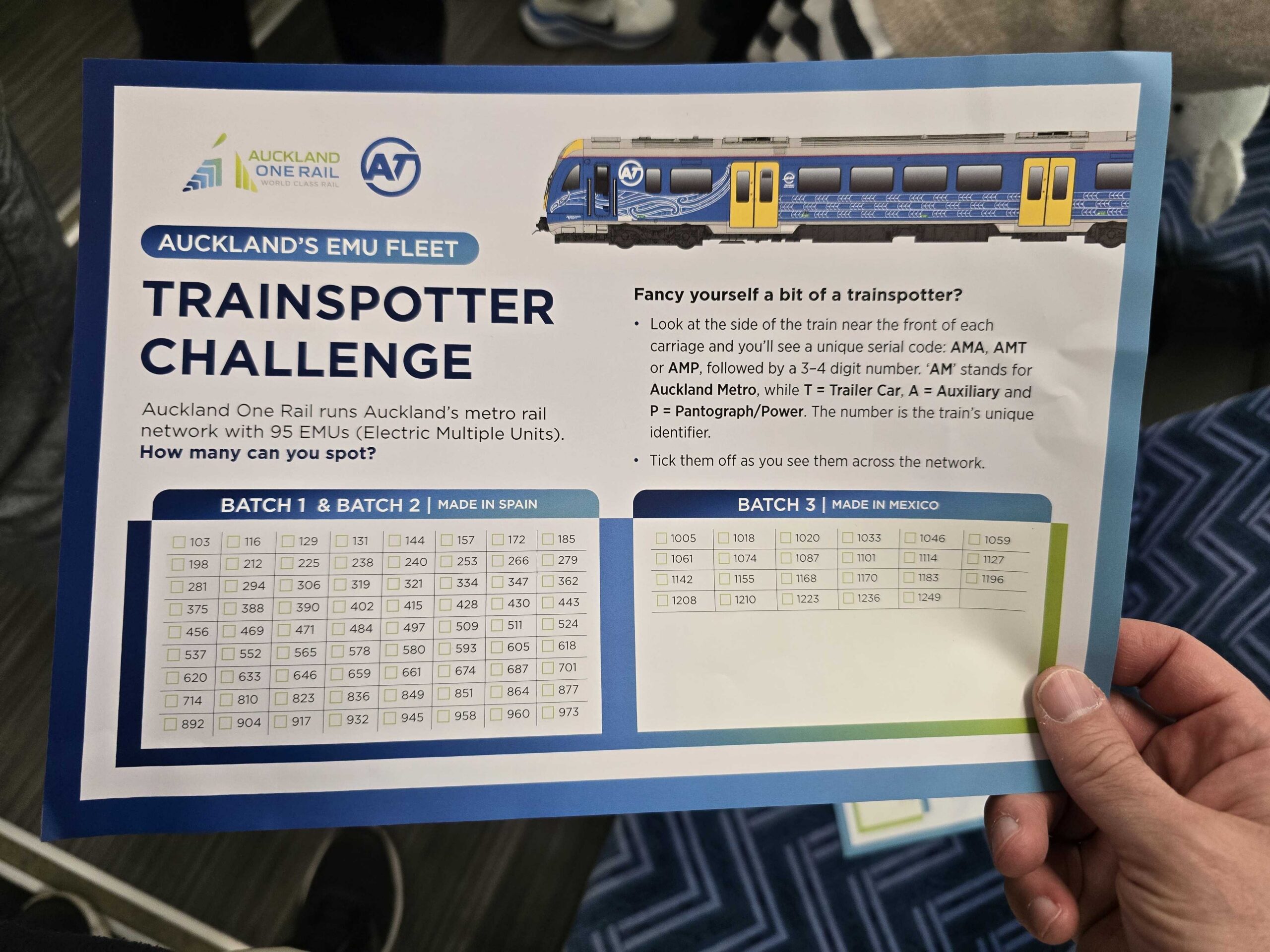
As scored by Matt at the Te Waihorotiu open day.
One more image of the week: hot off the press, these are the times of the first trains on Sunday 13 September, which will run through the newly opened CRL stations. Off you go, earlybirds!
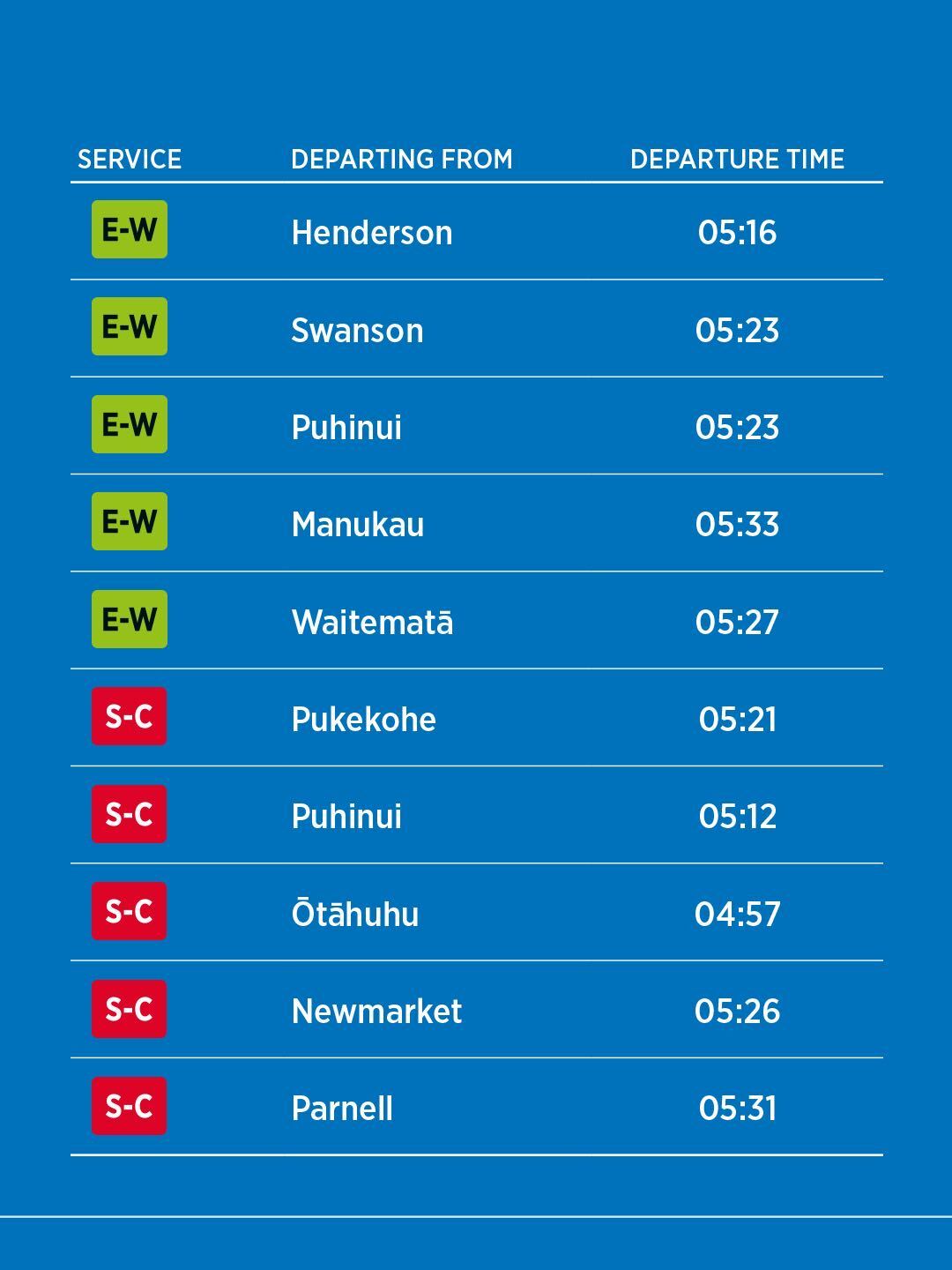
The earliest trains on Sunday 13 September will depart from: Henderson at 05:16am, Swanson at 05:23am, Puhinui at 05:23am, Manukau at 05:33am, Waitematā at 05:27am, Pukekohe at 05:21am, Puhinui at 05:12am, Ōtāhuhu at 04.57am, Newmarket at 05:26am, and Parnell at 05:31am.
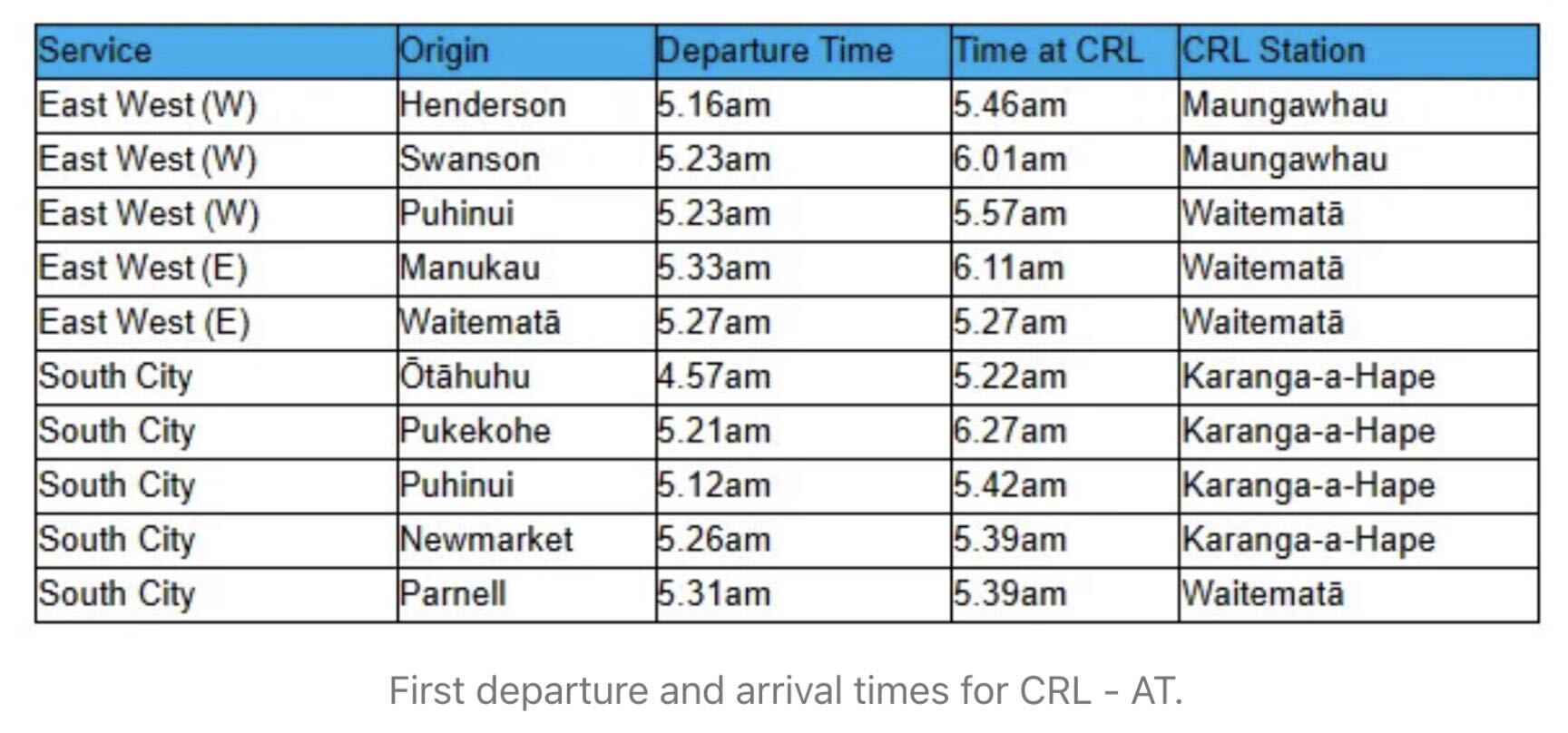
News just to hand: this shows the arrival times of the first trains through the new CRL stations on Sunday 13 September.
Greater Auckland’s research and advocacy is powered by hundreds of hours of work each month, and your support helps keep us going! We warmly welcome your donations, and are always open to offers of guest posts, practical help, and pro-bono expertise.
Another great way to support the kaupapa: Greater Auckland merch. Allow a week for delivery – and these are print-on-demand (no returns possible), so double-check your sizing before ordering. If you want to be wearing your CRL-themed gear on 13 September, get in quick!
Two neat new ways to get to know neighbourhoods
One Less Car Auckland is a very cool project that’s right up our alley. A work in progress, it aims to highlight the great places you can get to in our city without needing to own a car.
The key launch feature is “a guide to every rail and busway station in Auckland, covering cafes, bars, restaurants, playgrounds, community facilities and other local attractions.” Have a poke around and see what you think – it’s fascinating to see a focus on both major destinations (like Karanga-a-hape Station, opening 13 September!) and lesser known ones (did you know Baldwin Ave has a wine bar?).
Says the anonymous creator of One Less Car Auckland:
Those of us who don’t drive every day have figured out how to get around the city: understanding the buses and trains, finding the hidden bike paths and shortcuts, and learning all the great spots that are easy and fun to reach without a car. But it can take a long time to discover it all — you often have to change your mental map of the city.
So One Less Car Auckland is designed to make it much easier to find all this hidden information, and to help people start making more journeys without a car — and maybe, eventually, having one less car in their household, or even going car-free altogether.
And, Auckland Council’s time-travelling GeoMaps are a fun way to dive into the history of the city, including what was there before your home ever appeared. Via Our Auckland:
Recently added imagery from the 1940s through to the 2000s lets you compare decades of change across the region. Whether you’re a history buff, urban development enthusiast, genealogy detective or simply curious about where you live, there’s plenty to explore.
From growing suburbs and disappearing orchards to changing shorelines and new transport links, the images reveal how dramatically Auckland has transformed over the years.
Ready to see what your suburb looked like decades ago?
- Visit Auckland Council GeoMaps.
- Click the clock icon with the circular arrow to open the aerial timeslider tool.
- In the search bar, select Places, Road or Address, or simply zoom in to the area of interest on the aerial photograph.
- Type the name of the suburb, road or even the address you’d like to explore.
- Once the aerial image appears, use the timeslider to move backwards and forwards through the decades.
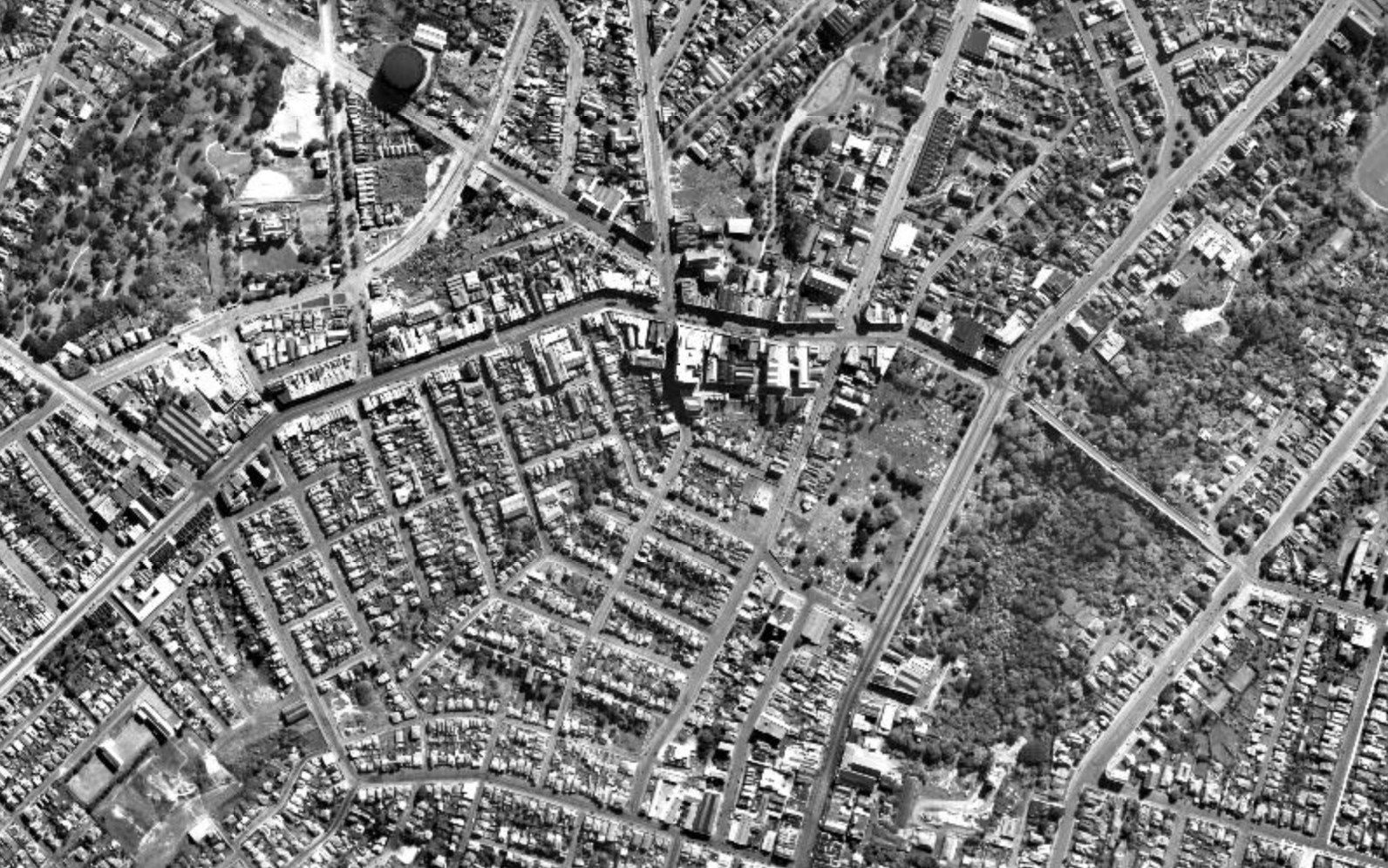
Karangahape Road from the air, 1940s, with Western Park to the top left, and Grafton Gully on the right, and no Central Motorway Junction to speak of. Auckland Council GeoMaps.
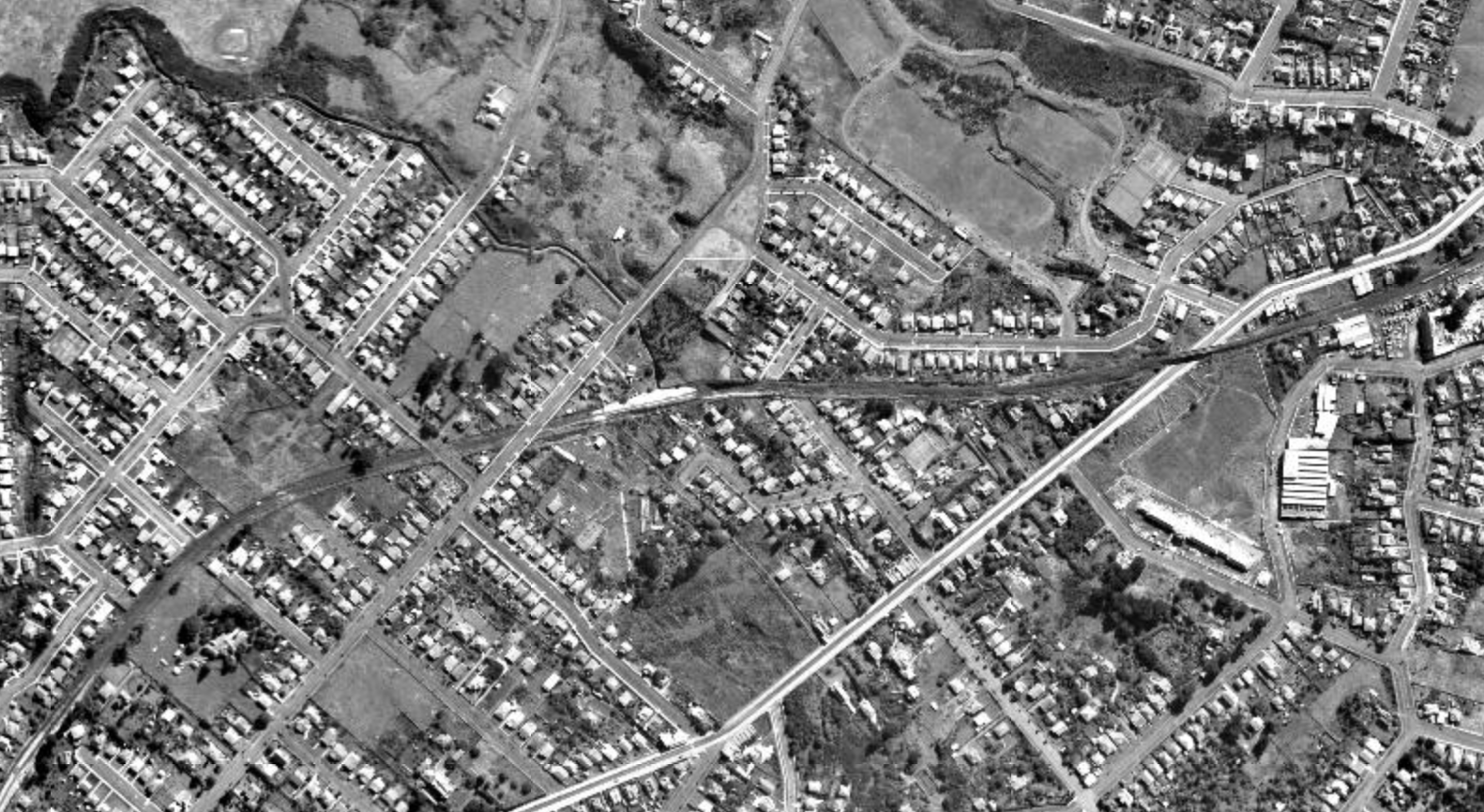
Baldwin Ave Station area, aerial view 1940s (pre-wine bar!), with the western rail line and New North Road slicing through. Auckland Council GeoMaps.
Deliberative democracy in action
Some nice in-depth reporting from RNZ on Auckland Council’s use of a citizens’ assembly approach to decision-making. The story includes a useful take on one of our favourite questions: cost vs. value. As in, the value of demonstrably including a representative range of voices, versus the cost of (not) doing democracy in a way that builds trust:
Programme co-director and senior lecturer in global studies at the University of Auckland, Tatjana Buklijas, said council decision-makers needed to value Deliberative Democracy for it to be worthwhile.
Auckland Council confirmed the average cost of a Deliberative Democracy process, including using a third-party agency to recruit a random, representative sample of Aucklanders, was about $60,000.
But Buklijas said other decision-making aids the council used often produce less helpful insights.
“Other ways of making decisions, calling for more expert reports, repeatedly inviting consultants, or doing different kinds of public engagement also cost money but might not actually result in good quality input from people, and then also there’s also the question of the cost of non-action.”
That last paragraph in particular applies in so many other contexts Looking at you, “RoNS”, and you too, Additional Waitematā Harbour Crossing…
Speaking of sound design choices…
Residents who live near the Beresford Square entrance to the new Karang-a-hape Station are troubled by the volume of the circulation fans. This does seem like something that could potentially have been “designed out”, e.g. by locating and/ or facing the fans towards the nearby motorway, the noise from which is also relentless.
In any case, Auckland Transport is taking steps, as the NZ Herald reports:
An AT spokesperson said the fans were operating within permitted noise levels, but changes would be made in the coming weeks to make them quieter. […]
The testing found the noise was below the permitted night-time limit of 60 decibels, they said.
The fans were needed to circulate air through the tunnels when trains were not running, particularly while KiwiRail workers carried out maintenance at night.
After residents’ complaints, AT reviewed how the fans were running and had decided to change their settings, the spokesperson said.
The new settings were expected to “significantly reduce” the noise and residents were told about the planned changes last week.
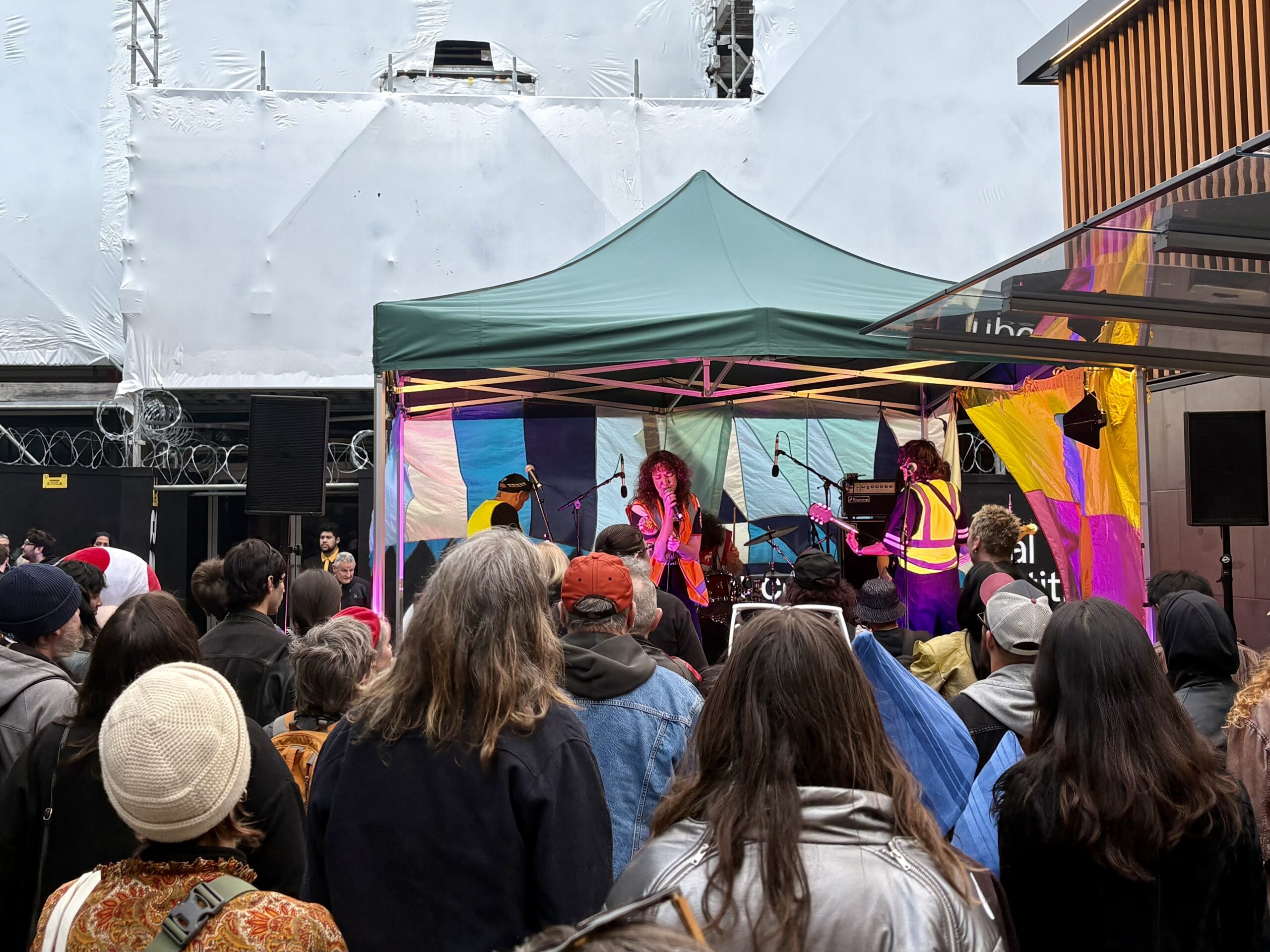
Dick Move playing in Beresford Square as part of the Karanga-a-hape “First Look” event, 15 August 2026, with the ventilation fan structure visible on the right. Readers might particularly enjoy Dick Move’s song “Up The Bus“, with its chorus “Thank you, driver!” Photo: Jolisa Gracewood
Upcoming additions to the bike network
Good to see some recent updates about filling in the bike network. Albert-Eden Local Board reports that a package of transport projects to be delivered in the 2026-2029 period includes plans for a new shared path through the western end of Chamberlain Park, linking Rawalpindi Reserve to the Northwestern Path.
The plans are viewable here. Our take: make the path wider than 3m, given the volume of travel through here. Also, why not add a bridge over the creek to Chatham Ave/Parkdale Road (top right of the image below), which would expand local access to green space, for even more people, in a neighbourhood of cul-de-sacs?
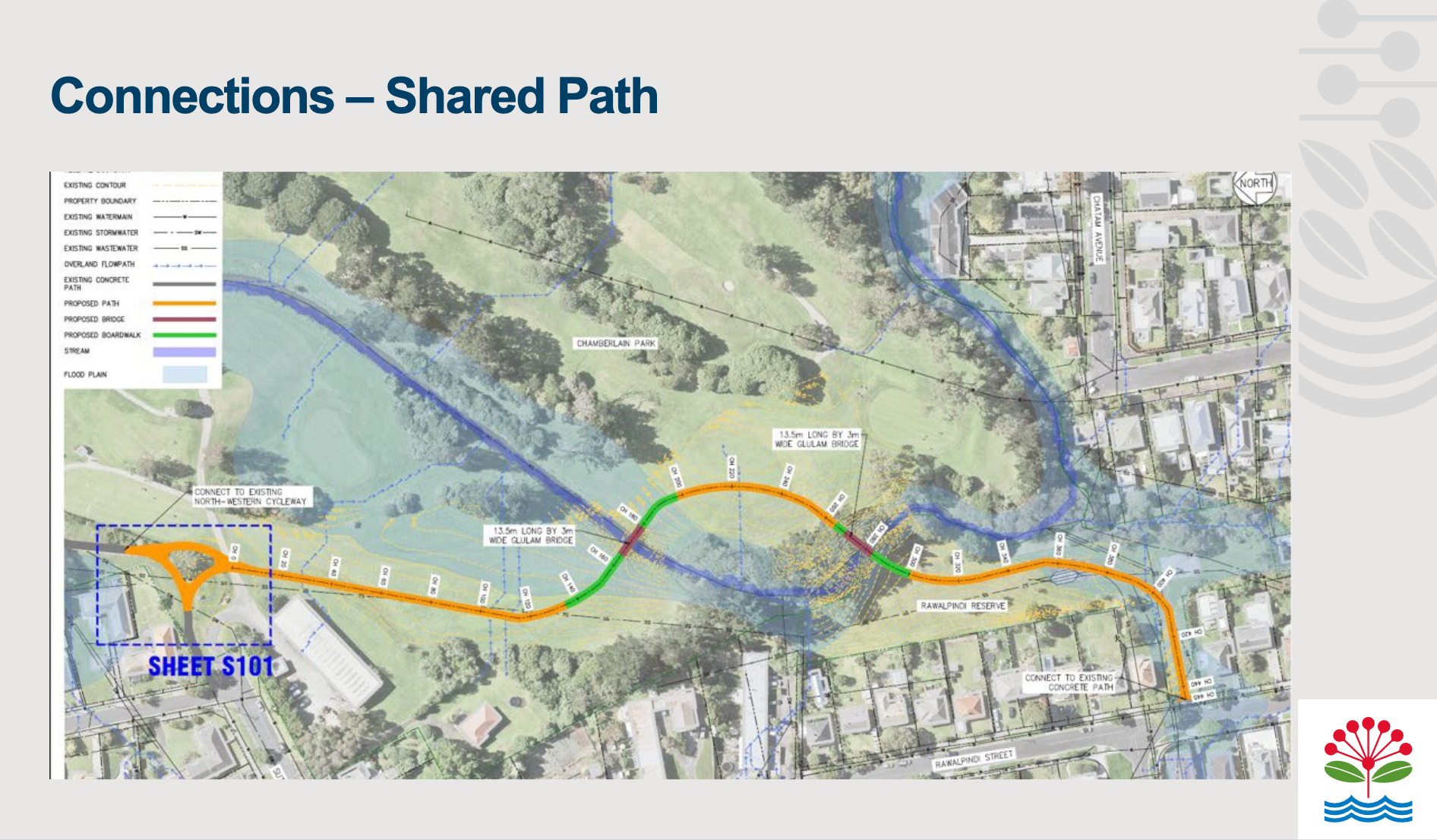
The proposed shared path through Chamberlain Park from Rawalpindi St. Source: Albert-Eden Local Board Workshop 13 August 2026.
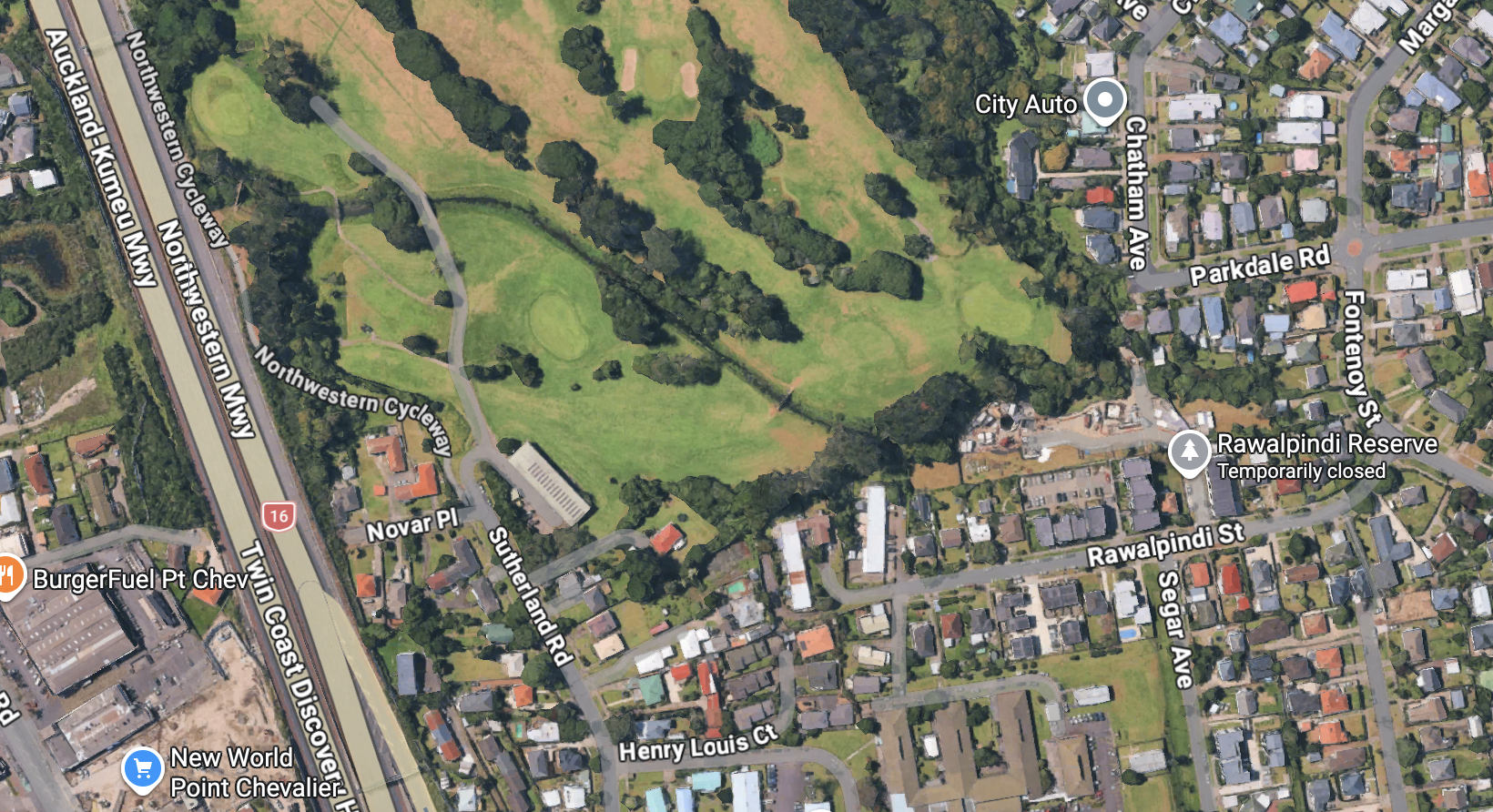
Google Maps aerial view of the area, same orientation as above. Lots of cul-de-sacs and neighbours who would be glad of easier access to the green space.
Also on the Albert-Eden list: some funding towards some Western Springs to Sandringham cycle improvements (mainly back streets and greenways through parks) and some active modes improvements around the St Lukes shopping area (see here for more details of both).
Meanwhile, in the Waitematā Local Board area, a plan is taking shape to compete the long-delayed remaining Waitematā Safe Routes. This is such a no-brainer, with just a couple of key gaps to sort: Garnet Road, past Westmere Primary School between Meola and Old Mill, and a short stretch of Richmond Road, from the West Lynn village to Surrey Crescent.
A paper from Tuesday’s meeting of Council’s Transport and Infrastructure Committee lays out the missing links and timeline for completion, and the project page has also been updated:
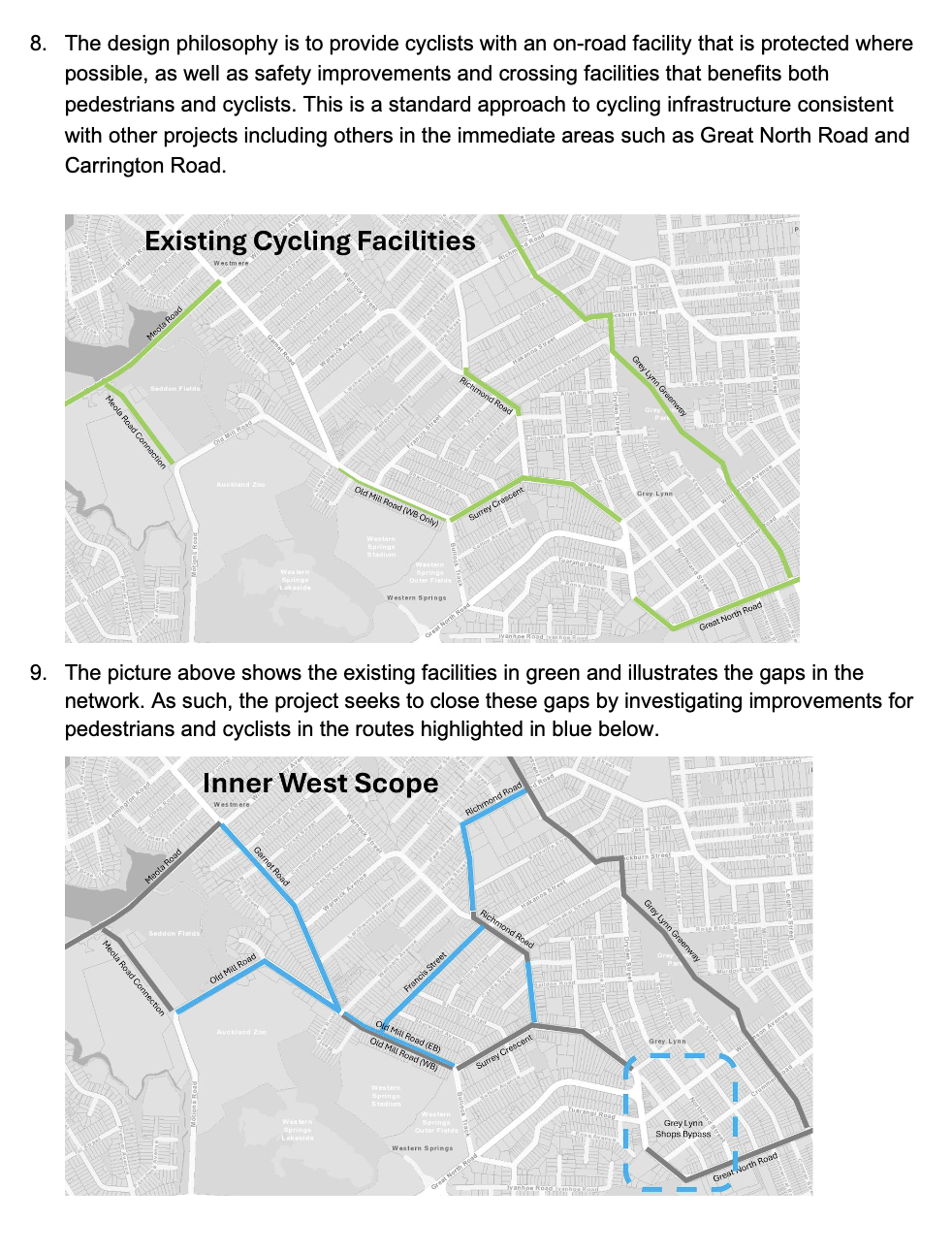 Interestingly, the memorandum notes that under the new governance structure, most of this work will come under Council’s purview, rather than the Local Board. A taste of things to come…
It is noted that under the Auckland Roading Classification Framework the majority of the Inner West route scope is identified as an Arterial. As a result, appropriate decisions will be brought to Governing Body under the expected decision-making framework.
Government caps local rates, does U-turn on fees and tourism tax, what next?
The Government came out against a tourism tax, only months after signing a City Deal with Auckland (and other cities) that includes it. The Mayor and councillors are pretty mad, as is to be expected. As The Post reported on Monday:
[Mayor Wayne] Brown came out swinging about the implications for the city deal. “The deal is meaningless if the Government cannot honour even a relatively modest commitment to explore an agreed proposal.
Other councillors also have been left frustrated and disappointed by National’s actions.
“Why did we bother signing a deal four months ago?“ asked Richard Hills when contacted by The Post. “I was in the room when this was signed. So was the Prime Minister.”
Hills said the Government had made a point of increasing the number of events that could be held at Eden Park to “bring people back to Auckland“, but was now undermining that.
He said that in conjunction with a rates cap, the assumption appeared from the government to be that ratepayers would just pick up the tab for bringing events to Auckland.
Meanwhile, the Government is indicating it will charge ahead with capping rates rises for local government to a maximum of 4%. As Joel Macmanus reported for The Spinoff, this would effectively tie future councils’ hands behind their backs when it comes to keeping up with costs (including the compounding costs of years of deferred maintenance and investment)… and would only save the average New Zealander $34 a year.
This policy too, does not please the Mayor. (See also Hayden Donnell’s coverage of this).
“The government’s offering a slogan, but the reality is that a rates cap won’t solve the underlying problem, in fact, could make it worse” Mayor Brown says.
“Councils still have to fund the infrastructure and services their communities need. Auckland also has major commitments such as the City Rail Link, which arose from decisions made by previous governments and councils.”
…
“The audacity of a rates cap when the Government’s tax take has gone from $77 billion to $115 billion over the past five years, and rates have only gone from $1.9 billion to $2.7 billion is baffling.
“The government also pays little or no rates on many of their properties and facilities that Auckland Council services. Ratepayers are effectively picking up the tab for this.”
The announcement was quite messy, with the Prime Minister seeming to accidentally announce a surprise cap on user fees and charges as well, to the shock of local leaders (see Newsroom), which was corrected later in the day by Minister for Local Government Simon Watts (see RNZ), and then by the Prime Minister himself (see Newsroom again).
Given the proposed rates-cap wouldn’t be fully implemented until 2029, does that perversely incentivise Councils to raise rates in the interim so as to start from a higher base once the cap kicks in?
Chipping away at Simeon Brown’s lethal speed legacy
News of more speed reductions in line with evidence and community preference, this time on three sections of state highway in Wairarapa. As Stuff reports:
A spokesperson for NZTA said the changes, which included highway[s] in the south of Featherston and the north of Masterton, were intended to reduce the risk of crashes and improve safety for local communities.
…
Emma Speight, NZTA director of regional relationships, said higher speeds increased the likelihood and severity of crashes.“The changes are evidence-based and are the result of careful consideration. They will make these sections of the state highways safer for people who live in and travel through the areas.”
…
Speight said the changes responded to local concerns about speed, safety and the way these sections of highway were used.“These are targeted changes for specific locations where communities have told us current speeds do not feel safe or suitable.
Meanwhile in Auckland, AT’s memorandum to Tuesday’s meeting of Council’s Transport & Infrastructure Delivery Committee lists the Local Board areas that will see speed management plans in the years to come.
Speed management and local boards
12. The six Local Boards for speed management plans are:
a. Waitākere Ranges
b. Henderson-Massey
c. Whau
d. Albert Eden
e. Waitemata
f. Devonport-Takapuna
Note: Under the current Speed Rule, 40km/h will be the lowest available overarching limit for local streets and neighbourhoods, after former transport minister Simeon Brown heavily restricted the use of the evidence-based global standard of 30km/h in urban settings.
Grave weather impacts continue
The metaphors keep coming: Stuff reports that a disused cemetery is at risk of tumbling onto a highway, if slips occur. NZTA says the sit isn’t a priority, so the costs will fall locally:
…approximately ten graves from the historic Tararu Cemetery in Thames are “at risk” of slipping onto the road below, according to a Thames-Coromandel District Council report.
The report, published in December last year and presented to the Thames Community Board in August, highlighted how memorialised burial plots with “human remains” could “move downhill at velocity to the road below” if land movement occurred.
“Such a movement would sever SH25, possibly cause harm to passing motorists and result in significant reputational damage to TCDC,” the report added.
And as New Zealand looks ahead to a major El Nino summer, Londoners are experiencing subsidence-related cracks in their homes, as the ground hardens. (Readers might recall similar issues here with underground water pipes cracking in our recent dry years, notably in 2020.)
Londoners have taken to social media to express their dismay. On Reddit, people offered personal accounts telling of “horrendous cracking” in their homes, and “doors sticking” due to subsidence. One said it was “genuinely scary” to discover that their kitchen had moved as the foundations of the home shifted.
Another Reddit user described the response of a structural engineer they contacted for help. “Before I could finish explaining, he laughed and said, ‘You and 20,000 other people in southeast London’,” the person wrote.
“It’s crazy, what’s happening now,” said Otso Lahtinen, chief executive of Geobear, an engineering firm that’s regularly called in to repair damage caused by subsidence. “It’s the new norm, and it seems it will happen more often in the next 20-30 years.”
Data provided by Aviva show that the areas of London that are most at risk are some of the UK capital’s most sought-after, namely the boroughs of Westminster, as well as Kensington and Chelsea. While subsidence has been affecting homes in the British capital for decades, climate change is making it worse. London clay is especially sensitive to fluctuations in moisture, expanding when wet and contracting when dry.
Yesterday’s shocking news from the China/ Nepal border, where an apparent glacial collapse led to horrifically destructure flash flooding, is beyond description. Our hearts go out to everyone affected.
Skateboarding is not a crime
Two photos shared on social media recently caught our eye. How cool is Dunedin’s George St? (As covered in this guest post from a couple of years back, by Jessica de Heij.)
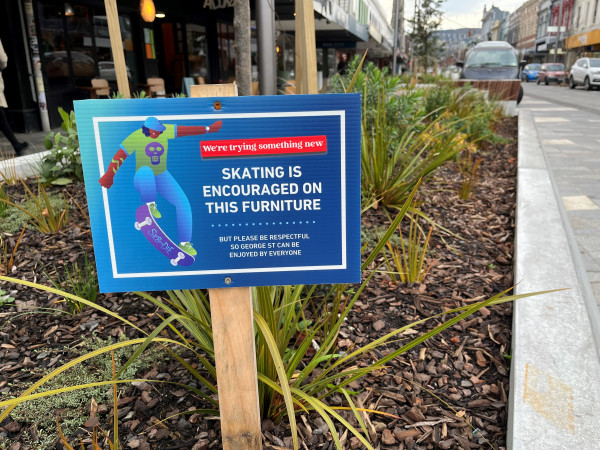
Yes skateboarding. Image via Royal Society of NZ/ James Berghan
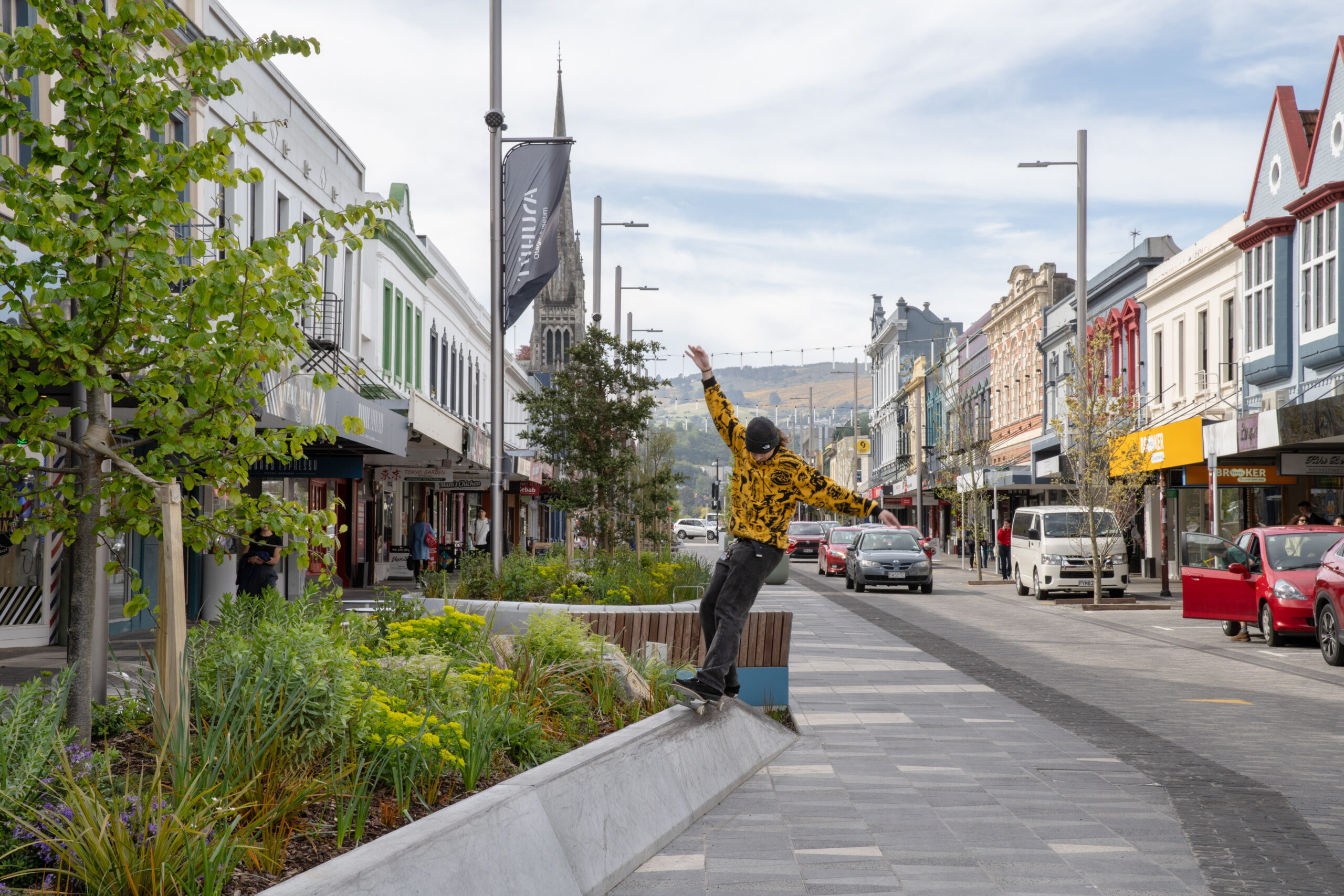
Just following the instructions. Image via NZIA/ Jasmax.
Videos to enjoy
NYC Mayor Zohran Mamdani continues to never miss a trick.
This clip – from Stuff and Engineering New Zealand’s “Big Infrastucture Debate” a couple of weeks ago – contains some interesting admissions from National’s Chris Bishop and NZ First’s Shane Jones about the Greens’ Julie Anne Genter’s longstanding view on right-sizing motorways. (You can rewatch the full debate here).
View this post on Instagram
And this is a very wholesome example of tactical urbanism, outside our Central Library:
View this post on Instagram
That’s us for the week – have a good weekend, and feel free to drop your own links and observations in the comments!

 Processing...
“Emma Speight, NZTA director of regional relationships, said higher speeds increased the likelihood and severity of crashes.”
Preach. We shouldn’t have to, not in 2026, but preach it.
“to be delivered in the 2026-2029 period includes plans for a new shared path through the western end of Chamberlain Park,”
Oh my gosh, another cycleway coming finally to a place I live in years after I left? I must have been worse for Auckland cycleways than I thought as an advocate 🙂
I thought the recent second Harbour Bridge idea was well thought out, and would do what it says on the box.
So why is the Minister wanting to do another report when we know a second crossing is vital.
Get the designers on the drawing boards, cost it out and build it.
It could be ready by 2030/31, but no the politicians have got their dirty fingers all over this yet again.
All politicians must buy into all the infrastructure that is needed and then leave the planners and constructors to get on with it.
I thought it was agreed a second Harbour Crossing was wanted.
The recent suggested plan will probably do what it says on the box.
So why does the Minister want yet another expensive report to tell us what we already know?
Already $100 million spent and no plan, no costing and no bridge!
Get the designers cracking, cost it out and build it.
It could be ready by 2030/31 if we stopped going round in circles.
All politicians should agree the long term infrastructure NZ wants, and see that the plan goes ahead without any outside influence.
Good that AT is looking at reducing noise from the exhaust fans at Beresford Square.
Have they looked at reducing the noise from the exhaust fans for the Civic Carpark yet? (It’s one of the reasons I haven’t spent time at Aotea Square recently, and it put me off the CAB apartment building, too.)
If not, perhaps they could solve that problem at the same time.
This sounds really promising in terms of an ambitious CRL ramp-up.
“The first round of improvements was due in November and December. Lambert said that would extend the eight-trains-an-hour service west from Kingsland through to Henderson, and stretch evening services on Friday and Saturday nights.
“”Friday and Saturdays in that November and December improvement, we will increase the 15-minute frequencies through to around 11.00 to 11.30pm,” Lambert said, with last services then running at 30-minute intervals through to between midnight and 1.30am.
“He said the operator was also in talks with KiwiRail about improving Thursday nights.
‘”We are … engaging with KiwiRail as to whether they can reschedule part of their maintenance, that they would do early ramp downs on Thursday evenings as well.”
“A second round of increases is planned for around February, before the six-month mark, lifting southern line services between Ōtāhuhu and the city centre and, “subject to engagement” with KiwiRail, extending improvements through to Pukekohe.
https://www.1news.co.nz/2026/08/26/success-until-cancellations-councillors-warn-of-crl-opening-risks/
So with the “no new taxes” campaign by National, and I think Labour too (other than CGT), no chance of congestion charging for at least 3 years? Same with the move from petrol tax to RUC? And no new toll roads?
Possibly good politics. But bad policy.
A fundemental weakness in our tax system, central and local government, is that our tax base is far too narrow.
We have too few taxes, meaning the tax rates for those left are too high.
Incentivising avoidance, even to the extent of providing a disincentive to engage in productive activities.
A wider tax base would allow reductions to income taxes, gst, and local body property rates, and give government, local and central more levers to pull to direct the path of the country and better align taxes with services provided.
Bringing all motor vehicles under a common RUC system is rational with fuel taxes being reserved for incentivising emissions reductions.
A bed tax is rational to help fund the regional facilities that attract and are used by visitors. Accomodation providers have no difficulty in hiking prices when Local Government financially supported events create accomodation demand.
But there will be plenty of new fees and levies
Pretty sure they called a Labour increase to fuel excise a “new tax” once.
And of course the Auckland fuel tax.
That is a levy/charge/fee/toll, not a tax.
National will definitely pull something like this if elected.
(Not that I am against it, just cannot stand their dishonest rhetoric)
As Winston Peters pointed out, the agreement on the Bed Tax was with the Government of the day (the Coalition, as of today), not National individually.
National can campaign on no new taxes as a standalone party but has an out in that there has been a City deal and that a government of any colour will adhere to that. They could also claim that it is a charge levied by Council, not a tax levied by central government. Plenty of wiggle room.
Two things that come to me from this roundup…
1- The Jones, Bishop and Genter clip is really interesting. To me it shows how, beyond what the media often portrays, many (some?) of our politicians are fairly reasonable people. I think extremists like Simeon Brown get too much oxygen which then amplifies and polarises the wider debate.
2- The skating permitted sign makes me feel old… I’m only in my 30’s but when I was a teenager us skaters were treated as absolute menaces, and that was a big part of the thrill. It’s bittersweet to see street skating now being encouraged.
I think Bishop is one of the best going around at the moment. And yes Shane Jones was quite surprising too. Simon Bridges had some very good moments when he was transport minister. But most other right wing politicians are very fixated on their beliefs and not evidence. I guess that applies to most left wing politicians too.
There was a LOT of moral panic about skating in the 90s. There’s a few solid metal plaques from that era banning skating E.g. close to Waitemata Plaza in Viaduct, and on Federal St side of ASB (now council building). It’s funny to see older people on their electric scooters whizzing past. Wonder if there are still some anti skater bylaws or laws on the books?
haha I have good memories of telling mum we were just going to Takapuna to skate, then getting on the bus to Sky City and skating the ASB plaza. Being chased by security was half the fun. Aotea Square had some cool spots too. I remember the Viaduct was a bit more heavily patrolled back then, probably because it was newly built for the yacht racing.
“I think extremists like Simeon Brown get too much oxygen which then amplifies and polarises the wider debate”
As someone who’s work is nearly daily affected by the draconic changes Simeon Brown introduced while a minister – “no you are not allowed to propose proven safety features, in fact, I’ll make sure they are left unfunded, while increasing speeds” – your comment to me misses the fact that when extremists have power, they tend to actually do extremist things. If his party hadn’t given him that free reign, I’d feel less harsh about them. But they did, and when I raised it with other MPs of his party, I got platitudes about National not making any excuses for getting NZ moving etc etc…
Yes, Bishop is pretty great, but even he has to walk a lot longer before he has undone the damage – not improved things, just undone the damage done.
Re: earliest train departure times, another question is which train will be the first to arrive at each of the new stations? Some people will want to be the first to disembark. Does GA know?
Great question, Major Major – we’ve added a graphic to the main post, showing the arrival times of the first trains through the CRL stations on Sunday 13 September.
Looks like if you wanna be “first” through Karanga-a-hape, you’ll want to catch-22 (see what I did there) the 4.57am citybound train on the South-City line from Ōtāhuhu.
A silly patai, but why do we call bikes “cycles”? Obviously bicycle is the true word, made famous by Queen, but listen again… ‘I want to ride my bicycle I want to ride my bike’
Cycle is an overused thing. Recycle, upcycle etc.
I ride a bike, my kids ride bikes, their grandpa cycles.
Make It Bike
Bikeways sound way cooler than cycleways.
Bah humbug
Gosh, you remind me of the loooong discussions we had back when Cycle Action Auckland changed to Bike Auckland. Sure, it made sense, and yes, sometimes words and their perception change, so you gotta roll with it. But sometimes it felt like such a waste of time (still, people like Jolisa did convince me that “people on bikes” was better than “cyclists”. I just never felt that it rose to the level of needing to actively avoid the word).
Personally, I prefer two-wheeled fun machines.
Love Mamdani. And I’d love any NZ politicians bold enough to stop kicking cans.
I like to keep thing positive but how could the current government do so much wrong in so little time about so many thing related to local government/urban planning transport? It’s obviously election season.
They so should front up with 75% – 100% funding for the CRL then a 4% rates cap wouldn’t be out of the question.