This is a guest post by Heidi O’Callahan, about one way to improve the sorry state of climate leadership in Auckland.
For a frank and fair assessment of where Auckland is at, have a read of the Committee for Auckland’s recent report The State of the City, as covered by Patrick here. The report shows we’re failing relative to other cities, particularly when it comes to our climate response. There’s no room for complacency. This is not ‘just the way things are’; it’s poor performance.
Remaking our city as a low-carbon climate-resilient city matters: to our health, our opportunities, and to our economy. Conversely, the political and economic repercussions of climate delay will be severe. The Era of Climate Impunity is Over.
With local elections soon [Editorial note: now’s a great time to check you’re enrolled to vote at your current address – today 31 July is the last day to confirm this, unless you are happy to cast a special vote], our immediate democratic task is to vote in a Council that stops dithering, and starts to govern rather than micromanage.
The report card: F for failing
To recap, The State of the City reports that we’re trailing badly behind our peers when it comes to reducing transport emissions:
The high rate of emissions built into the transport system – where volume of emissions is among the bottom 12% of all cities…
over 350 cities worldwide are decarbonising transport faster.
The heart of the problem is that Auckland just keeps on sprawling, with:
more built-up surface area than any of its peers… Auckland’s pace of built-up area expansion… is… third fastest amongst its peers
This has clear impacts on health and liveability:
the city’s density configuration is rated last in support for healthy living, rated bottom of 84 major international cities…
Auckland’s urban layout remains the least favourable for walkability among its peers, and in the bottom third globally…
Future quality of inner-city air is a question mark. Auckland is only 87th globally here and is the only one of its peers to have seen NO2 pollution increase over the past five years.
Isn’t Council already fixing this problem?
No. Council simply hasn’t ‘got this’.
Auckland should be at the top of the charts on planning for climate. The Auckland Plan 2012 embraced:
developing a quality compact Auckland… supported by sustainable transport choices
And in 2014, the Low Carbon Strategic Action Plan said:
Establishing a quality, compact urban form is critical to reducing the number and length of trips and encouraging cleaner, healthier alternatives to driving such as public transport, walking and cycling.
Since 2015, we’ve been a member of the C40 network, an international alliance that supports cities to take climate action regardless of the level of support from their central government. Other cities in the same “innovator city” group as Auckland, eg Oslo, made good use of their access to world-leading advice and mentorship. By contrast, Auckland Council has just developed plans, like Auckland’s Climate Plan and the world-class Transport Emissions Reduction Pathway (TERP).
Image: via C40
So what’s holding us back from taking action?
Remember when Auckland Council argued in court that the Councillors didn’t need to give consideration to their own Climate Plan?
And when Council strove to undermine the “quality compact urban form” policy by seeking loopholes to avoid densification of the leafy areas, using dodgy assessment methodologies, and all while continuing to support sprawl?
Council has even excused their lack of implementation of policies adopted by the Governing Body with the cry that “not all Councillors support” that policy.
Council is frequently deprioritising the policies on land use and transport that make climate action possible. To home in on where exactly things are getting stuck, I sent a LGOIMA request to Council which focused on four key Council decisions:
- The declaration of a climate emergency in June 2019.
- The approval of the Auckland Climate Plan, Te Tāruku ā Tāwhiri, in 2020.
- Committing to the new C40 Leadership Standards in February 2021.
- Approving the TERP in August 2022.
I inquired about the roles and responsibilities after each of these decisions, asking:
Whether it was the CEO, the Mayor or the Governing Body who had the responsibility to provide immediate leadership action? That is, whose role included the responsibility to translate the Governing Body’s political decision into immediate and effective executive direction, and the responsibility to ensure the direction led to success?
The rather leaden response described back to me the long-standing Council processes:
Implementation of the strategic direction adopted by the Governing Body is implemented by the council over time as budgets and priorities allow. Funding allocations are made in the council publicly consulted annual plans and long-term plans. This process starts with the Mayoral Proposal which sets out the mayor’s vision and priorities. The Governing body is responsible for adopting the Mayor’s proposal and any amendments to it, which forms the Long-term Plan or Annual Plan…
Final decisions on strategic direction and funding are the responsibility of the Governing Body.
So there’s the first problem. The CEO isn’t even mentioned. When was our CEO stripped of the responsibility to implement the Governing Body’s decisions?
Image: Heidi O’Callahan
I also asked what action was actually taken after the four decisions:
What immediate leadership action was taken by any of these three entities [the CEO, the Mayor, and the Governing Body]? That is, what directions were given that were intended to translate the Governing Body’s political decision into immediate and effective executive direction?
This was the answer:
At the time of the climate emergency declaration, the governing body resolved (ENV/2019/72) to include climate impact statements on all committee reports to improve transparency regarding the climate impact of projects and enable informed decision making.
The following long-term plan (2021-2031) reflected this commitment with investment of $152 million over 10-years in a dedicated climate investment package.
Further investment was committed to in the following Annual Plan 2022/2023 in the form of a Climate Action Transport Targeted Rate (CATTR) (adopted 7 June 2022). The CATTR provides $573 million over 10 years with additional co-funding from central government. CATTR supports bus, ferry, cycling and walking programmes to reduce emissions across the transport network.
Please refer to Annual Plans and Long-term Plans for further information on commitments to climate action.
And that’s it?
The Councillors’ decisions had set the stage for real leadership. Instead, climate action was kept within fringe programmes. It’s an extraordinary answer, given the four political climate decisions I’d chosen offered a multitude of opportunities to immediately update the way Council does things.
Let’s look at an example – to show what’s possible but has been left on the table, rather than seized as an opportunity.
Mainstreaming Climate Action, or how Auckland didn’t
One of the C40 leadership standards Auckland promised to adhere to is:
Mainstream. City uses the necessary financial, regulatory and other tools at their disposal to address the climate crisis and mainstreams their equitable climate targets into the most impactful city decision-making processes;
Mainstreaming is the process of redesigning every part of Council – throughout decision-making, policy, and operational functions – so that every Council goal is pursued in line with achieving the climate targets. This is a big shift from thinking of climate action as an isolated body of work that competes with other Council considerations. Mainstreaming involves a paradigm shift at both institutional and personal levels.
Councillors were in a position to make checks on progress, but no further political debate or direction was required; the commitment had been made. We should have immediately seen timely advice and reporting from staff on not if, but how they planned to mainstream the targets. For example:
- A stocktake of what tools (financial, regulatory, other) were available for mainstreaming the targets, and what other tools needed creating immediately.
- Inclusion of climate mainstreaming into the climate impact statements.
- An education programme on mainstreaming, for internal use.
- A strategy for ensuring climate remains ‘mainstream’ within the Council debating chamber. (Facilitation tools exist for keeping people on task. But this could have been a proposal for a citizens’ assembly to hold the Council to account on climate action.)
C40’s advice on mainstreaming includes pursuing “legally binding policies” to stop our biggest problem, sprawl:
Urban planning is not a separate emissions sector, but a cross-cutting enabler of emissions reductions and increased resilience. It is a powerful way for local governments to mainstream their climate priorities and transpose them into legally binding policies.
The response to my LGOIMA request shows there’s a vacuum of executive direction to staff to embed the climate targets in their work. It’s no wonder the advice being brought to Councillors has made poor use of existing climate policy.
‘Business As Usual,’ and its undeserved veneer of respectability, have sheltered the councillors and officers who tend towards climate denial and delay.
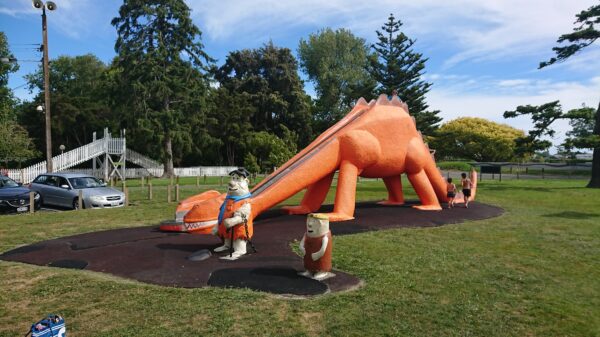
Image: Heidi O’Callahan
In contrast, climate-focused officers and councillors had to work far harder, to achieve far less.
I’ve shown how ignoring just one of the five leadership standards meant climate considerations were sidelined. Had each of the five standards, and all four major climate decisions, triggered a full swath of ‘immediate leadership actions’, we would have seen rapid results.
Here is the full LGOIMA response.
So how do we bring Climate Leadership to Auckland?
Electing a climate mayor would definitely help, but that relies on the luck of who happens to step forward for election. A truly robust democracy instead develops systems that consistently advance and support evidence-based decision-making, planning, and implementation.
Two key responsibilities have been lying dormant and unfulfilled:
- The responsibility for translating the Governing Body’s political decisions into immediate and effective executive climate action. This lies with the Council CEO.
- The responsibility for appointing a CEO capable of climate leadership and holding the CEO to account. This lies with the Councillors.
The role of CEO for Auckland is important, so the salary and continued employment status should be contingent on performance. This strong approach to accountability, surprisingly perhaps, can shield the CEO from criticism, by clarifying the mandate for action. This helps to satisfy guidance about providing a safe working environment.
So does letting the CEO set their own Key Performance Indicators (KPIs). The CEO is a professional, and can set these KPIs to pre-empt those moments when political support might waver. The CEO should also propose strengthening the KPIs whenever Councillors are making decisions intended to have a climate impact.
If the Councillors will not agree to a pathway of accountability, precisely when they are basking in the glory of apparent climate decision-making, they are just grandstanding.
Consider the major benefits for elected representatives. Sure, a CEO focused on delivering a successful climate programme will push the councillors into climate leadership themselves, having to publicly defend the change happening. Equally, entering this ‘action’ stage of decarbonisation (after such a long ‘talking’ stage) would also rebuild public respect, trust and engagement – leading to stronger voter turnout, and growing support for those willing to lead on climate.
In this upcoming election, we should ask every single candidate: how will they…
- Lead Auckland to become a thriving and liveable low-carbon city?
- Appoint a CEO with star climate leadership credentials?
- Equip the CEO to succeed, hold them to account, and back them consistently when they deliver?
As Auckland’s Climate Plan says, “we have an opportunity to deliver a low-carbon and resilient Auckland that is better for everyone”.
It’s undemocratic that Council has been letting this opportunity slip away. We need better governance from our Councillors, with proper pathways for both delivery and accountability.
This post, like all our work, is brought to you by the Greater Auckland crew and made possible by generous donations from our readers and fans. If you’d like to support our work, you can join our circle of supporters here, or support us on Substack!

 Processing...
Thanks Heidi, yes we need leadership to give effect to our plans and to create an organisation that understands and works toward making changes. One example that always stands out for me was a Council event here in Te Atatū, in the promotion they talked of how to drive to the event and the large amount of green space they offered for parking. I asked why they hadn’t mentioned the walking and cycling path that goes to the park, or the newly opened PT connection close by. Their response a comment added to the post saying, ” and greenies you can walk or ride to this event”
Ouff. That’s an indicator of denial culture right there.
Staff working under the leadership of an effective CEO would never have made the initial error, not have responded so dismissively.
That is outrageous.
Great article. But this is not just an Auckland only problem, we see this across most New Zealand towns and cities not helped by a government that are climate change deniers. When the most strongly promoted solution to climate change currently seems to be rooftop solar with an EV then the other solutions seem to get forgotten. And the really challenging changes in TERP, such as halving domestic aviation emissions by 2030, become simply fantasy.
Yes, it’s not just an Auckland problem. And the so-called leaders around the country prop each other up in their inaction. It reminds me of the research showing people won’t get up to save themselves if the room starts to fill with smoke if other people in the room are carrying on with their business normally.
It’s Auckland, though, for which I’ve “kept the receipts”. Many, many examples.
Great post, thanks Heidi. The header image says it all, too many downward-facing dinosaurs!
A reminder that we can and must nudge every would-be leader to move beyond the usual swings-and-roundabouts of plans and chatter, towards definitive action.
“People wonder why the dinosaurs became extinct although it’s hardly surprising when you see the barbaric conditions they were kept in..underfed and starving, some of them little more than skeletons.” – Philomena Cunk
Pump up the jam
The across ones mostly ate grass. The up and down ones ate the across ones.
Political leadership on climate change is a bit of a lottery – while about a third (my guesstimate) of elected representatives in Auckland do take the issue seriously (some more so than others) they tend to be outnumbered by those who do not – and a handful of climate change deniers. Real leadership may or may not come from the politicians – in my view it needs to come from the organisation itself. The example given by Vinny of casual acceptance by Council staff of the status quo is quite common despite official acceptance of the climate emergency we are all facing. I have long advocated that the Chief Executive and his Directors should be required to have and to regularly use a hop card. I recall Ludo Campbell-Reid, Auckland’s Design Champion for just over a decade, who came to work each day by ferry and his own scooter (before the first Lime scooters). We need a few more exemplars like him.
It is the same with politicians who suggest that we do not need inter-regional trains – that buses are fine. I suspect they never have used these buses, waited in open air cold or non existent bus shelters or hung on for the next toilet stop. If MPs had to get around New Zealand by InterCity bus for just a week a year they might become keener on trains and certainly would put some effort into improving the bus services and supporting infrastructure.
I do wonder if the term “climate emergency” requires actions that are much quicker than planning and physical changes. For example:
– Create a large congestion charge, but exempt for EVs
– More user pays, such as rubbish, roads
Planning and transport changes will take decades to create any meaningful reduction in emissions.
Yes, my focus on immediate actions is because they illuminate the barriers. Good steady progress through incremental changes is also needed, but becomes impotent without the immediate actions to challenge the paradigm.
Other cities are making meaningful reductions in emissions through planning and transport.
It’s important not to conclude it can’t happen here. We are an outlier on emissions reductions, for a city that’s supposedly committed. This occurs for the same reasons we’re an outlier on safety and car dependence: lack of good governance.
Mostly because we’re bumpkins I think
as an EV driver, exemptions from congestion charges seem nice, except… EV congestion will be knocking on our door. Congestion is too many vehicles fighting for the same piece of road. Deal with the problem, (cars) not their fuel.
Or in the case of Auckland, just talk about it.
We are living in a gerontocracy. This is problematic as our older population are majoritarily from the Baby Boom Generation, who were tasked with rebuilding following World War Two.
For the most part, they have done an excellent job, but unfortunately climate responsibility was denied by the big coal companies for centuries, and oil companies (not to mention tobacco etc.).
We know that we are destroying the planet with our lifestyles, but we also know it is not our fault.
We need to unlearn many things, including using private motor vehicles, living in private houses, and enduring the commute, for the sake of the commute.
Our city suffers because we have never implemented an apartment building plan. We have never defined density as an upward feature. We occupy the same space as Los Angeles, but hardly anyone lives here.
It is sad for those of us who have experienced living in Sao Paulo, Tokyo, Seoul, London, Berlin, or any other serious city in the world. Those cities have real traffic problems, and have implemented real solutions. We continue to tinker around the literal edges.
We need to make it easier to build quality apartments, and to knock down buildings that do not serve our city well. Lest we remain the sleepy little backwater of the Pasifika that we really, truly are!
How to not live in a gerentocracy – and fix Aucklands conservatism
compulsory voting registration for those over 16
compulsory voting for those over 16 and not on superannuation
two votes for everyone who has 3 decades of life expectancy remaining
one vote for landowners – not a vote in every district they own property.
(fun fact, a friend said he got only 1 vote despite owning many properties in Auckland, he nodded when i asked if they were all in the same trust)
I’m all for regional trains but your problem could be solved mainly with better bus terminals.
For Paul, above.
And for the record, we should have both regional trains and better bus terminals.
Agree. Taupo is a classic example. A brand new airport terminal, hardly used with now no flights directly to Wellington. The well used ‘bus terminal’ is a roadside park for the buses, an open air bus shelter and a long walk potentially in the rain to public toilets.
I have often wondered what a dollar spent on a Cycle Way impacts as a benefit to Road Users?
Is it greater than the dollar spent on Roads?
A lot of MPs and Councilors have their heads in the sand.
I’ve heard BCR’s of cycleways being treated as a joke (17:1 really !)
when they are fantastic, they are laughed off
Wrong people are making transport decisions. Pending AT deckchair reshuffle yet to be seen to deliver any changes
To answer your question – reduced congestion on roads as cycleways load up. Extra road lanes being deferred due to mode shift saves NZ inc $B, but strangely – the “make cyclists pay their fair share” never seems to result in massive payments to each rider.
The problem here is a lot bigger than just the council’s lack of action on climate. Local Democracy has been progressively eroded as it is simultaneously both starved for funding, and asked to do more with less. The majority of people who vote in local elections are the kinds who grumble about rising rates and are inclined against making any measurable steps to combat climate change, unless it is to fortify the cliffs below their million dollar houses so the sea doesn’t wash them away. What’s truly needed is a wholescale sea change, people to get out there, vote and change the makeup of local boards and councils, participate in local democracy and make the change happen directly. That’s easier said than done, but it’s the only real way to upend the current status quo that’s existed arguably since 1989 and Labour’s Local Government reforms of the period.
Yes. And it has been clear for a long time that a strategy is needed. Now the current central government is making it much worse, so it’s past time for this sea change. This post describes one concrete step towards that sea change.
My central point is that it was unprofessional for the CEO not to have a strategy to solve these big, solvable problems. And it was undemocratic for the councillors to keep approving good plans they already knew from experience wouldn’t get implemented, without using governance to resolve the continued failures.
Thanks Heidi – please run as mayor – you’ll have (at least) my vote.
Why do climate leadership ? save the world is a good answer, but save a fortune in penalty payments is a more direct motivator. Not losing international trade agreements is reason enough.
Root of all evil ? – Treasury NOT including the Paris commitment liabilities in its budgets.
Missing our Paris targets has been costed at $2B-$23B in 2029. Budget wrecking !!
If we miss our reduction targets (which we set – Paula Bennett/John Key) then we need to find & fund the difference – from the international carbon market.
Why doesnt treasury include the liability? – because its not clear if we need to pay it.
Why not? – we may pull out of the Paris agreement, or other mechanisms may appear. Paris is not legally binding etc
If treasure included the liabilities – then VKT reduction, TERP programs would suddenly be a good thing – saving us a fortune (and delivering new tech mobility). An investment in the future, and a massive cost saving.
Sadly, we cant always have progressive governments like Bennett/Key – progress cant always be forwards. (yes /s – but its a relative thing)
https://www.treasury.govt.nz/sites/default/files/2025-01/oia-20240825.pdf
Thanks.
What is so good about the International Court of Justice ruling is their confirmation that climate action is required under other international legislation – eg on human rights and environment – and not just for the Paris Agreement.
Also, it’s like a direct challenge to some of Dropkick Seymour’s intentions with the Regulatory Standards. The ICJ said the obligation to help stabilise the climate cannot be overridden by investment protections for private investors.
ICJ judgement is a wake up call. Not many upsides to delaying climate action. Definitely liabilities that will be cascading (who pays – ha!)
Re Council and NZ govt in generals response – Sir Geoffrey Palmer for the win
“Former Prime Minister of New Zealand Sir Geoffrey Palmer has emphasised the short-term nature of climate change thinking to date, saying, “[p]olicy makers have discounted the future in favour of the present, not wishing to face up to the real and adverse political consequences that effective action will require”
https://www.courtsofnz.govt.nz/publications/speeches-and-papers/climate-change-and-the-law
seems to sum up and even predict our councils position perfectly
Dear Heidi and the GreaterAuckland readership.
Following on the thinking on how to turn a climate leadership mandate into delivery…
TERP was approved August 2022
AC CEO Jim Stabback was tasked with delivering on the program.
CATR was the program to drive TERP outcomes with total $1B funding .
CATR budget and processes were established .
CATR cycling deliveries are here :-
https://at.govt.nz/projects-initiatives/region-wide-auckland-projects-and-initiatives/climate-action-transport-targeted-rate-cattr/cattr-cycling-programme
Specifically how did $B of climate action funding with a 10x increase in cycling goal turn into 18km of mostly (or entirely?) undelivered cycling infrastructure !! ??
This is a follow the money moment, because clearly there is some gold plated infrastructure about to be revealed, any minute now…. (or maybe not so much)
The CATR was slightly modified in 2023/2024 and was renamed Climate Action Transport Targeted Rate (CATTR) to reflect the change in focus to transport initiatives. This targeted rate is expected to generate $573 million over 10 years, and with central government co-funding of $344 million and public transport fare revenue, the total investment will be $1.045 billion. It is to be used for buses, ferries, walking and cycling. In 2023/2024, we invested $34 million of this targeted rate together with $25 million of co funding received from Waka Kotahi in CATTR programmes
source : https://www.aucklandcouncil.govt.nz/plans-projects-policies-reports-bylaws/our-annual-reports/annualreport20232024/vol-4-annual-report-2023-2024.pdf
Ggg
It’d be interesting to track the money intended for these climate programmes: how much was whittled down by subsequent decisions? How effectively was it used when it was spent? My observations:
1/ Money from climate and modeshift and safety funds is being wasted steadily by AT because they still have BAU priorities. Projects are an order of magnitude more expensive than needed, due to this problem.
2/ Money for progress is always the first thing to be knocked out of the budget, again because of BAU priorities and lack of mainstreaming. Hence the constant pressure to strip programmes funded by targeted rates.
3/ Our current mayor doesn’t get these problems, but under the previous mayor, we had a good balance of councillors who understood most of it. Unfortunately, they rarely took on board the detailed information offered to push back on, for example, AT’s flood-response plans and budgets. Or to ensure, for example, the VKT-reduction programme went ahead. And fair enough, they were working hard on details, themselves. But if they had resolved the governance problems, and used the tools of accountability, they would have been able to lift their heads up from many of those details, reducing their own workload.
4/ Unless the systemic governance problems are understood widely and resolved, even a really good line-up of councillors at some point in the future will fall for the same traps. Conversely, is the systemic governance problems were resolved, we’d make better progress even with a poorer line-up of councillors. Because decisions would be more logical.
Sorry about the “Ggg”. It was a placeholder to allow me to paste text from an easier text editor without losing the nesting location. I forgot to delete it.
Could mean “Great good game”.
Anyway finally caught up on some older GA posts and thanks for this great one.
Meh can’t do much about it now unfortunately. That ship sailed a long time ago.