Tomorrow’s meeting of Auckland Council’s Transport and Infrastructure Delivery Committee (TIDC) has some interesting items. One that particularly stands out for me is in the Auckland Transport update.
And it’s on the Safe Speeds Programme.
Aucklanders yearn for a return to evidence-based speeds
A year on from Auckland Transport’s mindbogglingly widespread implementation of Simeon Brown’s 2024 Speed Rule, they report that they have recently been hard at work on – and making some progress on – returning some streets and roads to more safe speeds.
Auckland Transport says it has:
- Met with all 21 local boards between March and June 2026, presenting speed limit options tailored to each board.
- Received overwhelming support for safe speeds, particularly around schools, town centres, parks and aged care, with greater acceptance of 40km/h on local roads.
- Identified over 370 priority areas covering more than 1,600 km of network
Interestingly, the work draws directly on Auckland Council’s new (and unanimously adopted) Transport Policy Statement.
And this time round, Auckland Transport’s approach looks to be using wider area plans, with more direct implementation (which is presumably quicker) for areas deemed most urgent.
- The Transport Policy Statement gives us a clear obligation to deliver safe and appropriate speed limits as a cost-effective, value-for-money strategic investment.
- We are progressing two delivery approaches: Speed Management Plans and the Alternative Method which is delivering speed limit changes on a case-by-case basis
- The lowest limit we can set is 40 km/h, with some very specific exceptions for lower speeds such as shared areas, civic spaces or beaches.
- Areas of growth and development, particularly in Franklin and Rodney, require speed limit changes to respond to changes in land use. It is the RCA’s obligation and responsibility to set safe and appropriate speed limits.
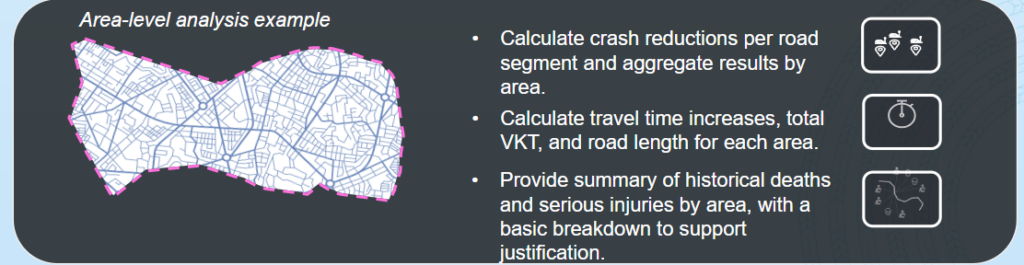
Example map given in the AT Update slides for Transport and Infrastructure Delivery Committee 28/7/26
It’s also notable that AT explicitly talk about Franklin and Rodney as priority areas for speed limit changes given their significant rates of Deaths and Serious Injuries, especially on rural roads.
And it is quite stark to see in writing that 40km/h is the lowest limit available to AT (or any local road-controlling authority) under the 2024 Speed Rule, when 30km/h is universally recognised as the most appropriate safe speed for urban contexts.
Arbitrarily ruling out 30km/h as an option for towns and cities is – as Simeon Brown’s Speed Rule did – is out of step with local knowledge as well as international best practice. It’s a worryingly politicised approach to something that should be a matter of science.
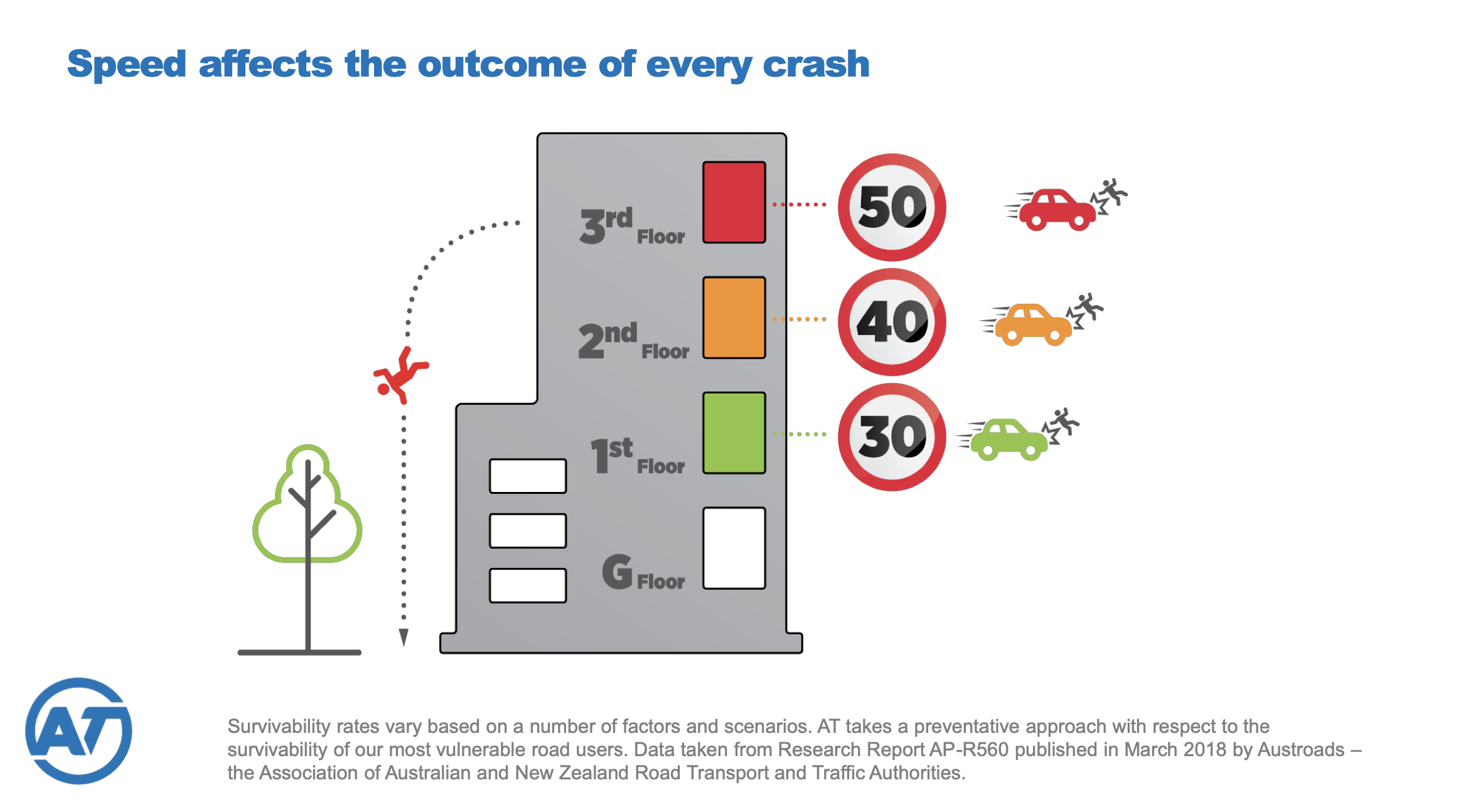
Safe speeds again soon? Not so fast
The report is promising to read, as it establishes general support for safer streets and an intention to get back there.
The downside is that the extremely cumbersome and lengthy process required by Simeon Brown’s rewriting of the Speed Rule means a lot of this will not happen anytime soon.
Indeed, AT estimates some local boards could wait up to five years for safer speeds, with the process taking 10-18 months per change.
Risks and challenges
- All local boards are highly engaged and agree on safe speeds around schools, but differ on preferred approaches
- Delivery to be phased by local board readiness with a focus on avoiding ‘patchwork of limits’.
- The new Speed Limit Setting Rule makes the process lengthy (10–18 months per change); with current resourcing some boards could wait up to five years for delivery.
And even then, Auckland Transport will still not be able to implement the recognised safe speed of 30km/h. (Not unless or until there’s a more rational update to the Speed Rule, which would require either a change of government, or a return to evidence-based policy by this one.)
Editor’s note: These risks and challenges were highlighted to Auckland Council and the Auckland Transport Board back in June 2025, in a briefing paper put together by Bike Auckland, Walk Auckland, Living Streets Aotearoa, and Brake the Road Safety Charity.
The labyrinthine path back to logic and local preference
So, our city faces an arduous process that will burn up staff time, budget, and public goodwill, just to return to publicly favoured speeds originally achieved via years of work… which will be a bit safer, but still not the safest, and not as safe as they were before Simeon’s blanket rollback.
The ridiculousness of the situation was starkly outlined last June by Auckland Transport executives, when Councillor Shane Henderson asked what would be needed if communities wanted to reverse Brown’s blanket speed increases.
Councillor Shane Henderson: So can I just be super clear, with communities that are really concerned – and in a lot of cases it’s primary school principals, things like that, that contact me about this… We’re embarking on a consultation period. Can I get crystal clear on what a community would need to prove, to [reduce] the speeds back to where they were before the reversal? What are the checkpoints that they’ve got to meet?
Teresa Burnett, GM Transport Safety, Auckland Transport: Okay, so here’s what we need to look at, as it’s specified in the Rule. We need:
- the role and function of the road
- how the road is used, including different types of road users
- why a speed limit change is being proposed, rather than a different speed management intervention
- a cost-benefit disclosure statement, which estimates the safety impact of the proposed change, the number of and severity of crashes [and] estimated impact of the proposed speed limit change.
We also need to include estimated time impacts of the proposed speed limit change, which includes:
- current mean operating speed
- estimated mean operating speed
- and the impact of the proposed speed limit change on individual journey time and collective journey time, accounting for average daily traffic volumes.
So, when I said it’s quite a lot of information we need to gather, per road – so that’s how it’s written in the rule at the minute.
At that meeting last June, Councillor Henderson also asked if Auckland Transport would be able to refer to previous consultations – given a significant amount of work had been done to implement safer speeds in line with evidence and community support. The answer was no, all future speed changes would have to go through this new process.
And don’t forget: there’s also the cost of removing and reinstalling speed signage all over the city. As Joel McManus reported for the Spinoff recently, raising speeds per Simeon Brown’s dictate has cost millions of dollars for councils across the country: “Auckland Council put its share of the direct cost of design, construction and replacing existing signs at $2.53 million.” Expect as much again, to put them back to where they were.
So, what comes next?
As for next steps, AT says it plans to:
- Complete area-level analysis and prioritisation based on safety improvements, travel time impacts, road use and length.
- Progress Speed Management Plans (around 18 months) for six committed Local Boards. These take longer as they address whole local board areas and prepare for a three-year programme of work.
- Deliver Alternative Method changes (around 10 months) for individual roads and catchment areas. These case-by-case approaches apply to one road at a time.
- Keep local boards informed and confident, partnering with advocates and building community readiness for speed limit changes.
- Maintain momentum to avoid a patchwork of limits and continue reducing preventable deaths and serious injuries across the network.
So the next 18 months will see area-wide plans progressed for six committed Local Boards, which will then take three years to fully implement. Meanwhile, we may get some quick wins (within a year) for some individual roads and catchment areas.
All the while, staff will be working to “maintain momentum”, “partner with advocates” and “build community readiness”, helping to keep everyone confident and informed that change may be coming (back).
Long story short, it’s good to see something is happening, even given the state of the Speed Rule.
But one still thinks about how many people might be harmed on our city’s roads before the tangible changes actually appear.

Flashback: a chart from the NZ Herald 16 July 2024, on support for safer speeds.
Related coverage by Greater Auckland
Note: if you value our research and advocacy on this and other topics, your donations (recurring or one-off) will help keep the kaupapa going. We also warmly welcome guest posts, practical help, and pro-bono expertise.
Why is the Government flooring it on unsafe speeds? (10 July 2024)
A blanket of misinformation (17 July 2024)
Speeding toward a lethal legacy (11 November 2024)
Some questions for the Government on speed limit increases (30 January 2025)
Fixing the Kafkaesque speed rule impacts in Auckland (3 March 2025)
Pressure grows for commonsense correction on safe local speeds (20 March 2025)
As AT races to raise speed limits, strange cracks appear – our report on Auckland’s bumpy rollout of Simeon’s speed raises (20 May 2025)
The (illegible) fine print: speed reversals hit train, bus, bike networks – the unintended impacts of speed reversals (22 May 2025)
Our community chooses 30km/h – a neighbourhood expresses its own preference, one sign at a time (6 August 2025)
See also this important briefing paper highlighting the risks of AT’s approach to speed reversals, presented in June 2025 by Bike Auckland, Walk Auckland, Living Streets Aotearoa, and Brake the Road Safety Charity, to Auckland Council and the Auckland Transport Board.

 Processing...
The lack of localism in New Zealand is quite shocking to me. I always find it slightly embarrassing when I see MPs elected to Parliament, ostensibly to make the big national decisions, getting involved in local choices like the speed limit on a specific road or parking restrictions outside a row of shops. I will support anyone who tries to bring about a new political settlement to get these types of decisions made locally, or at least regionally, rather than a sweeping one size fits all across the whole country.
I agree, for some local decisions.
But not for safety. Speed limits shouldn’t be local nor political, just entirely based on safety.
No traffic controls should be in the hands of politicians – it is all science and should be left to experts. That is why the destruction of AT and spilting the RCA powers between 22 groups of politicians is the worst thing that has ever happened to transport in Auckland.
We don’t left politicians design the layout of operating theatres in hospitals, design the protocols for air traffic controllers, or invent building earthquake standards based of their whims and what they think will help them get re-elected so why on earth do we think they should have anything to do with any decision-making about traffic control – having a drivers licence isn’t the same thing as being a traffic engineer
Yes; it’s a sign of the level of dominance and control that the automotive / road construction lobby has that politicians assume inappropriate decision-making about traffic controls. And I don’t disagree with you about the destruction of AT. Yet it’s interesting you mention traffic controls, because the traffic control committee is a good example of why deeper change is critical, and worrying about the destruction of AT is wasted effort without it.
The traffic control committee need to be satisfied proposed works “will not unduly impede vehicular traffic entering or using the road.” They have, throughout AT’s history, interpreted the word “unduly” inaccurately and with complete bias. The word has been their excuse to stop works that evidence is clear would improve safety and liveability and public health. That is, works that would impede vehicular traffic for very good reason, and not “unduly” at all.
For thousands upon thousands of decisions small enough to avoid political scrutiny, the TCC made these evidence-defying decisions. This created the situation where, to get better outcomes, politicians would be required to step in. That is, the TCC were the ones making the situation political.
AT had opportunity after opportunity to step up. Since I wrote this document, there’s been the TERP and many other moments of political direction they could have harnessed: https://www.greaterauckland.org.nz/wp-content/uploads/2022/08/Opportunities-for-Changing-Direction.pdf
So I think, rather than bemoan the splitting up of AT, which I agree was probably a bad move, we need to acknowledge that AT’s ineffectiveness came from core systemic problems in the sector that are still not being addressed. We need to work on removing problem people at high levels in the sector (and we’ve seen in recent times that the HR department in Council isn’t up to speed on this, so needs an overhaul) and on promoting those with the abilities to make the process changes needed to deliver improvements.
Heidi I’m sorry but I feel compelled to challenge you on your accusations against the Traffic Control Committee. You have stated that the TCC has stopped thousands of projects that would have improved safety, liveability and public health by misinterpreting the term unduly impede traffic. That is demonstrably untrue and it is unworthy of your usual high standards. I cant imagine any situation where a report would have been put to the committee to make the formal legally enforceable decision about traffic controls and the committe would have declined to approve the report for such a reason.
As you know all of the agendas a minutes of the TCC are available online and those minutes provide the reason for every report that is declined. I bet you can’t find any reports that the committee has declined on any grounds that would fit the criteria you have set out. You wouldn’t even be able to find a thousand reports that they declined. Things don’t get to the committee until they have gone through a lot of work – so very little is found to be so badly proposed that it gets declined.
Now is it possible that proposals have been blocked at earlier steps in the process on such grounds – quite possibly (and if so it will as often as not be because of opposition by politicians not AT management). But that has nothing to do with the Traffic Control Committee. The TCC can only consider the proposals that are put to them for decisions. They cant stop things being put to them. In the near future it will be the Local Boards and Governing Body that get those reports to make decisions on. That decision-making end point in the process won’t fundamentally change – it will just be vastly slower, more inconsistent, subject to the whims and grandstanding of politicians more interested in getting votes from the type of people who vote in local elections than in doing the objectively best thing for transport.
I think if you found AT a disappointment you will be devastated after the new ridiculously inefficient system has been struggling for a while to come anywhere near as good.
I’m sure the staff involved will do their best but the legislation is setting them up to fail.
Yeah, I was a bit sloppy in my comment about how in the process the TCC has its effect. You make a fair challenge.
I agree with you that the rejection often happens well before the TCC group. I have witnessed firsthand, many times, that worthy improvements to projects are not even proposed by design teams to the project control group because they believe there’d be no chance of approval. Occasionally I’ve witnessed staff proposing them anyway, and having the improvements rejected. So that happens well before the TCC process, as you say.
However, is it a surprise to learn that staff often say is that there’s no point discussing, for example, modal filters or road reallocation ideas, “because the PCG would never accept it, and if they did, the TCC never would” or “because we cannot legally impede vehicular traffic”.
Elected members, too, have told me over many years that this misinterpretation about “unduly impeding vehicular traffic” stems from the TCC.
So if the TCC is genuinely not a big part of the problem, there’ll be quite a few people to explain the facts to…
… and if that is the case, then we’re left with another thing that needs explaining.
Resolutions are generally worded like this:
“The Traffic Control Committee, in accordance with its delegated authority, and being of the opinion that these controls are a justified limitation on the right to freedom of movement on roads which will not unduly impede vehicular traffic using the road, resolves…”
Project after project, the TCC resolved to approve controls that are NOT a justified limitation on the right to freedom of movement on roads for people on foot or bike. Our right to freedom has been stolen, bit by bit, by these approvals.
Similarly, for all the people on small “vehicles” that are not actually cars, and are only safe if given a lane protected from cars, the TCC has resolved to approve projects that WILL unduly impede them.
Think of the road widening, Translex. The intersection widening. The hideous stroads created where pedestrian crossings and bike lanes simply don’t exist.
If the TCC had bothered to interpret these words in a more progressive light, a new paradigm could have been developed, spreading throughout the whole organisation.
And yes, local boards could indeed be worse.
Remember when National ran on the plan to return control to local bodies – but what it really meant was push all the shit down and have a good place for blame.
I challenged the local MP in the Waikato area when he and Luxon made a big play of putting the speed limit up from 80 to 100km/h between TePuna and KatiKati.
I checked the time it takes to drive the 28 km (26 minutes) and the difference is only a few seconds saved at the higher speed.
I have a logic I call “Road Dynamics”.
You can drive a section of road in so many minutes one day and on another day it will take either more or less time for that same section.
The reason is not just the speed limit. It is many other things that affect your journey: getting behind a truck and not being able to pass for a while, having to stop for road works at a lollipop or temporary traffic light and so on.
Any suggestion that higher road speeds will increase productivity is sheer nonsense.
@Phil Quite. The whole notion that the economy revolves around carting physical objects is archaic.
Maybe we need speed limits on how fast ministers are allowed to go round changing legislation
Too late. The fact that these things CAN be changed fast is now the only scenario to reduce the 5 years timeframes given above…
The speed limit setting rule isn’t horrible just for urban areas. I live on a narrow gravel road in the Waikato. Anyone fast than 40 is definitely speeding, and likely to run head-on into another car on one of the many blind corners (you have to go into the swale to pass in many places, so keeping left isn’t enough). I usually drive 30ish. Yet according to the new speed limit rule, if Council ever wanted to put speed limit signs on my road, the lowest they could go is 60-80…
Yes. True in so many parts of New Zealand. It’s another way New Zealand hasn’t even tried to keep up with what’s possible.
When people started using our roads for motor vehicles, their speeds should never have gone above what’s safe for all the other people using the road – walking, biking, riding horses.
If they did want to go faster, they should have paid for a separate network.
What I find odd is that here in New Plymouth the council has just kept the 30kmh limits in the CBD and suburban town centres, they never changed them as a result of Brown’s interventions. Maybe they were created under different legislation.
There was a specific part relating to schools, if the change was due to a school it needed to be reversed(believe it or not). Cbd and town centres in Auckland not changed
Thanks Connor – this issue speaks volumes around nz politics
I just read the 2023 article linked selling nationals position on speed limits.
“But National’s transport spokesperson Simeon Brown said the Labour Government had “exposed its anti-car ideology” through the speed limits.
“National will repeal and replace the rules that set speed limits so that economic impacts – including travel times – and the views of road users and local communities count, alongside safety,” he said in a media release.”
https://www.1news.co.nz/2023/09/24/national-to-spend-at-least-30m-to-reverse-speed-limit-changes-if-elected/
The article is worth a re-read as our PM at the time suggested this was mostly labours policy also, since the changes he made in March
“Labour leader Chris Hipkins has suggested National’s proposed changes aren’t all that new, saying that he had already announced changes to Waka Kotahi’s plans in March.”
Hipkins rescoped “road to zero” to “the top 1% of the most dangerous roads” it states in the article also. This is not just National wanting to go faster.
Until our kids lives are not in the hands of the politicians and populist anti-car culture rhetoric, until NZ’s voters chose lives over time-savings we’re on a rinse-and-repeat cycle doomed to burn through our nations mobility budget resetting speed limit signs
“Hipkins rescoped “road to zero” to “the top 1% of the most dangerous roads” it states in the article also. This is not just National wanting to go faster.” I remember groaning when Hipkins suddenly veered away just before the election. But from memory he mainly phrased it as “money is tight, so we got to prioritise” (arguably wrong when a lot of the financial pressure was due to climate change damage, and he was cutting… climate-change relevant transport investment). Whereas National made it explicitly into an ideological thing. So while Labour’s transport attitudes at the last election were disappointing, lets not make it a “both sides did…” kind of comparison. At some point, the contrast differences in two shades becomes so different again you might as well see them binary again. Under Simeon Brown, that was very much the case, and we will suffer from that for a long time yet.
It’s interesting how many crimes you are allowed to commit if you do them while driving a car. Endangering the lives of pedestrians and cyclists isn’t a crime because it was their reckless decision to not drive.
Indeed.
Exercising a right versus abusing a privilege.
And if you make a complaint via an official channel (Police, local government) you’ll be lucky to receive a reply.
It’s telling that many drivers are so dependent on their oversized mobility scooters that they can’t exercise their rights unless they first drive to an indoors exercise facility.
The best way to improve our streets, safety, and return some degree of appropriate localism, is to vote out this shockingly disingenuous and careless government.
Who, let us not forget, ran on more local control but at every turn did the reverse, and under urgency.
It beggars belief that so many barriers have been put in the way of a) science and evidence-based policy, and b) demonstrable public and economic good, and c) communities being able to do what’s best at the local level.
One thing that’s not quite clear year: given the transport governance changes so ardently fought for by both the Mayor and the former Transport Minister…
…who’ll be doing the ongoing work to restore Auckland’s safe speeds, and from what positions?
Presumably, if AT is a PT-only organisation, this kind of work shifts to inside Auckland Council. But does this make it easier or harder to resource and accelerate the process, disentangle it from politics, and bring more Local Boards into the picture – in order to keep more Aucklanders safer, sooner?
Perhaps Councillors could ask questions along these lines tomorrow, on behalf of all of us.
Councillors will now be responsible (well, technically they were so even with AT, but at a big remove). So I guess the only excuse they have now is if they don’t do it is that they aren’t *allowed* to by Wellington (whether or not that is true for any given situation).
I remember listening to Christine Fletcher saying, as Councillors agreed some awful backtracking step on safety a few years ago, something along the lines of, “We do have to remember that we had the Safety Review and the public are expecting us to take action. So while we have to make this decision now, we will be reminded that this is happening on our watch. We will have to make progress at some stage.”
This myth they love to bring up all the time about how their hands are tied.
They are not brave people.
Interesting from your pro cycling POV. It’s just down to acceptable risk. Should covid lock down have lasted as long? Especially the last Auckland one. More people would have died but consensus is that it would have bern be acceptable as it is right now. Same with speed. Fewer deaths and injuries if there were no cars at all or 10 k universal speed limit even on open road. 30 ks is very slow and frustrating and should only be in very high risk situation imho. Many of our larger suburban road can take 60ks. I would like to see a proper wide population survey scientifically informed. We are a democracy after all. Not sure the councillors you speak of have that mandate for their opinions.
That did happen Bunny and the results were ones that the blog didn’t like. They are trying to argue in bad faith completely ignoring democracy to push their agenda of slower speeds thru.
Anyone else think “James / Mount Colon” is also “Bunny”?
James / Mount Colon, Why don’t you just go away and make engine noises to yourself and leave the adults to discuss the important things.
And you can take your juvenile understanding of “democracy” with you as you obviously didn’t read the post which demonstrates democracy in action.
They’re not happy with just making engine noises by themselves, they need everyone else to either be making engine noises along with them or forcibly silenced.
Cagers are still sore and spiteful that they don’t have the whole transport funding pie to themselves, like Dudley Dursley whining about getting 35 presents instead of 36 in the first Harry Potter book.
I propose not to have random distances from a school but use a radius scale say 300m at 30km/hr, a radius 301-500m at 40 km/hr and greater 50km/hr we had a 30 km/hr restriction 2.5 km from a school and two speed cameras….. revenue gathering? Likely.
Don’t want to be political, but Simeon….
What the whole nation needs is regulation that enables good, not legislates against it.
MPs who make a big noise just days before an approved project is built are not following a process to save money and improve outcomes.
The 2024 Setting of Speed Limits Act, in particular the reversals, is quite possibly the most irresponsible and ideological piece of legislation in living memory. The reversals of permanent speeds around schools, in favour of variable limits around start/end times (I refuse to call them drop off/pick up times) and at strict 150m distances from school gates totally ignores the research that permanent limits strongly outweigh variable limits in both safety and economic sense. In some cases, fast speeds would only increase journey by a few seconds, and mostly would be at night when there is far less traffic and pedestrian activity.
Simeon Brown tried to justify variable limits with the example of shift workers driving home at 4am “penalised” by having to take a few seconds longer to get to their home or workplace.
Speed limits should be set according when the most people are active on the roads, not the fewest.
“shift workers driving home at 4am “penalised” by having to take a few seconds longer”
Shift workers at 4am already get home faster than anyone else. That’s really unfair to the rest of us, Simeon. We should force everyone to drive at peak hour speeds all the time of the day, that would be fairest.
Indeed, and to further punch holes in his argument the amount of enforcement at those times is going to be at a bare minimum.
It’s like the guy has never heard of discretion.
Safer speeds is bad for the roading lobby businesses.
Considerably less accident damaged cars to be replaced or repaired. And less pressure for providing multilane super highways as the only way to reduce road fatalities. We must remember that Howick residents and representitives have a disproportionate influence in setting nz transport priorities.
Perhaps the most car dependant suburb in Auckland. A dependency larglely because of their own strident opposition to any degradation of car privilige. And a prevalent aversion to sharing transport with the general public.. A “don’t do busses”
Auckland Transport would do better to focus on the opening of the CRL. This has dragged on too long already, and the costs are mounting. The silence from AT since the last round of testing is alarming. Clearly there are some major issues that are preventing AT from committing to an opening dates. The least AT could do is to be open with the public. The public has a right to know exactly what is going on instead of PR releases and petty politics.
He could be used as a guinea-pig for road speed decisions.
Perhaps he could be tied to the road / asked to stay in place on a typical 30kph road to test out the 50kph theory on:
• why a speed limit change is being proposed, rather than a different speed management intervention
• a cost-benefit disclosure statement, which estimates the safety impact of the proposed change, the number of and severity of crashes [and] estimated impact of the proposed speed limit change.
Come on Simeon! Stand up and Volunteer! 50kph is safe, remember?! You’ll be fine…!
Yes!!! Even Luxon had the ‘insight’ to move him on.
Well, considering he as far as I can tell remains in good graces in National Partly leadership, I doubt it was a punishment. And right now he’s making lots of friends in the medical field. Maybe he is the kind of person who likes to kick over the baskets and then leave before the apples need picking up. Heck, National may even *want* him to do that, albeit that may be (a bit, maybe) too cynical.
On your bike Simeon! More meat for the grinder also keeps the hospitals in business so maybe it was a business decision.
No, I agree. Mess things up, blame it on Labour, defund the rest (clearly it’s not working!) and suddenly you have a nice private health system with lots of profits for shareholders (and ballooning costs for everyone else, but hey, it is all about compromise!)
If Simeon Brown is literate, he should read Crash. If he previews film versions of excellent novels, he should watch Crash.
Fast cars and pornography go hand in hand.
Either Simeon Brown is the usual “wanker”, or he is an evil “mini me” type of person.
Our suicide rates are ridiculous, not exactly because of cars, but causally cars are often used for life termination. Springsteen makes a reference to “suicide machines” in his great “Born to Run”.
Why are we always in such a rush to move around? What exactly do we achieve in this time space continuum by moving faster through space, and not allowing time to relax?
I have a cousin who is a police person, and he loves to drive, he finds it very relaxing. But why? I find sitting on train, or a ferry, or riding a bike, or walking, relaxing, because they allow one’s mind to relax, and wander, and dream, and all of those wonderful things that make life liveable.
Or CCTV’s “Big Wheels”. Cars isolate us from reality, and move us very quickly though spaces that really should be enjoyed at walking pace.
As a parent, I am terrified by the ability of machines to crush my children; as a human, I would rather breathe, deeply, than take control of a machine that could harm other humans.
bah humbug
30kmh wasn’t “arbitrarily” ruled out it was consulted on and at the time the vast majority decided to scrap it. Just like how the vast majority voted in favour of one off speed reversals. The wokes just aren’t equiped to deal with the fact it’s majority rules.
Anyone who uses “woke” as a pejorative is most definitely a moron.
And anyone using multiple psuedonyms is a lying loser. Right Mount Colon?
See this is why there can never be any reasonable debate because people like Cinder insult rather than respond to the very valid point made (probably because they don’t like the outcome) and then fly off the rails with a bunch of stuff that isn’t true and calling me names. Lovely. Why do you keep calling me Mount Colon is that some lame attempt at a joke?
Thank God for James, the arbiter of reasonable debate
Assuming James even is his own person, and not the Australian troll from last year who went by the name of a different Aussie town or suburb every time they commented. Probably to try and support their point that a privately owned blog exercising moderation rights is “violating free speech” and therefore “discrimination”
The fella doth protest too much methinks
He’s frightened that his precious, unpopular anti-public transport government might get voted out.
When have you ever engaged in “reasonable debate”.
You have been told REPEATEDLY about the metrics of the select committee you refer to.
A headmaster representing 100s of families in their community was counted the same as
1 petrol addled insecure man-baby like you.
I’m calling you Mount Colon because that was the pseudonym you used previously. As I told you, your communication style is identical, the facile juvenile arguments and talking points are identical.
And given your opinion of the disabled, the elderly and other vulnerable communities impacted by higher speeds I feel ZERO need to be nice to you. I would happily whip you through the streets as a warning to other weaklings who can’t understand the difference between a right and a privilege.
And until you do understand the difference you should keep your ignorant mouth shut when it comes to matters of governance and “democracy”
“The wokes just aren’t equiped to deal with the fact it’s majority rules.”
There is so much wrong with that statement.
A) the reversed speed limits had been consulted (they were actually NOT blanket changes, unlike the reversals). At the local level, individually, with the people most affected. They had support in essentially all cases, often quite high support. They were then overruled from Wellington, by a “vote” which attracted “yes lets do it!” support mainly via a campaign divorced from the real situation on the ground.
So even if you think “votes” matter here, its really two votes against each other. You may feel it’s fine that such things are handled via nationwide social media as political footballs. Many of us feel this is a horrific way to make local decisions.
B) Even ignoring the above, these decisions are (increasing speeds) are proven to cost lives. Deaths and serious injuries should not be “voted okay”. Sure, the reality is different. But if you know – and they did – that your decision to “speed up the economy” risks killing (will kill) people, they should have acted much more carefully. People have rights to not be harmed – the speed limit setting rule change essentially says “sod off” to that.
This is what the motordom people like you don’t get. Instead you castigate opposition as woke, and tell us to shut up. Well, as you showed – if National can just simply overturn existing consultations and processes… then so can a future govt. If you folks have the right to force people to speed up, then we have the right to slow things right down again.
It’s not ideal, but sod off with your claims that democracy has made the call and therefore from now on its speed up!
@Damian that’s just it they shouldn’t be local decisions 50% of the road is paid for by taxpayers therefore I can write in and override some pesky resident wanting slower speeds outside their driveway but faster everywhere else. Yes you have the right to slow things down again no f**king s**t what do you think happened when Labour was in power. Omg its majority rules get over it.
Also most of us have seen the evidence but still want faster speeds what are you going to do about it?
I haven’t seen the evidence that most people want faster speeds, got a link?
Happy to provide multiple links with evidence craw! Here’s the one I was talking about earlier in regards to the SOSL rule that quite a significant majority supported reversals and most supported dumping 30k zones! https://www.transport.govt.nz/assets/Uploads/Summary-of-submissions-Draft-Land-Transport-Rule-Setting-of-Speed-Limits-2024.pdf
https://www.thepost.co.nz/politics/350074748/public-politicians-dont-lower-speed-limits
4000 people might be the majority of Drury, did they say where the people were from?
Here’s a classic one AT asked for speed limit feedback on Pakuranga Road it received 7 people that wanted the reduction and 63 that wanted it kept the same but the corrupt bastards still lowered it. https://at.govt.nz/media/1990057/feedback-report-local-board-howick-local-board.pdf
ah yes, “corrupt” is when the evidence is followed and a bunch of gormless brainwashed morons who’d be happy to run over a pedestrian or transit advocate don’t get higher speed limits which do bugger all to get them to their destination any faster when their too-wide ugly stroads are clogged with cars carrying 1 person each.
You cagers are good at doublethink.
Burrower I’ve just provided evidence that AT arrogantly ignored what the majority wanted. There’s evidence there to say they didn’t have a mandate for that particular reduction.
I’d love to see you show the specific example where AT had evidence for reducing the Pakuranga Hwy speed limit. I remember at the time they didn’t use safety as the reason it was “to make the speed consistent” which was a lie because they were making some streets 30 or 40 etc. Which btw if changing speeds simply to make them “consistent” isn’t blanket I don’t know what is.
I’ve provided evidence with Links to source now where’s yours!
@craw, here is another example from Hamilton. 58% in favour of a return to 80 ignored by a council running under agenda 2030 guidance. https://haveyoursay.hamilton.govt.nz/cobham-drive-speed-limit-reduction
This is black and white 58 is a bigger number than 41. More people want higher speeds even when presented with the benefits of the reduction. We do not care about evidence!
sorry James, I don’t care if a bunch of lowbrow thugs like you (and the “majority” of below-average so-called “great” apes they call humans) want to hoon and pollute around everywhere. I’m quite concerned with being able to have a comfortable future, and i can’t do that if your ilk royally f*ck over the planet for me and my generation by inducing natural disasters, mass crop failures, famines and more deadly heatwaves from the noxious gas that spews from your car and your mouth.
Billions of lives are at stake (trillions if you count animals and plants). What about that majority?
We have a bridge in town that was built on a state highway, so built without a footpath (for cars only because it was cheaper). Then a couple of kids were killed biking across it, so a footpath was added to the bridge anyway. I know what people are like, they won’t see the benefit of lower speeds until it directly affects them.
To be fair I have been labouring under the naive assumption that the Ministry of Transport have a mandate to provide a transport system for all, not just for car enthusiasts.
Oooh, sounds like you’re projecting, James.
Let me guess, the only time you think the majority getting their way is a good thing is when they agree with you, right? Cause if the majority want better public transport and safer speeds, that can only happen because they’ve been “misled by woke greenie lefties” with their pesky facts and evidence and empathy for future generations who deserve prosperity and comfort.
Incorrect you little troll. I support higher speeds where the public wants them and support lowered speeds where the public wants them evidence is a waste of time and money the public gets a vote based off vibes.
I fully support individuals having their say if they want a lower limit in all for Deemocracy. The issue is many council are under the UN Agenda or some other commitment. Last time I checked this blog was in favour of localism following international masters orders is NOT in anyway localism. I mean Auckland Council quite literally shows what forcing the speed reductions through has been about conveniently linked on their website.
https://www.aucklandcouncil.govt.nz/en/plans-policies-bylaws-reports-projects/our-plans-strategies/topic-based-plans-strategies/environmental-plans-strategies/climate-plan/response/international-commitments.html
Sorry, ya little scumbag. The UN’s right. Lower speed, less cars – that’s what humanity needs, and if dullards misled by the alt-right disagree, they can go suck on an egg.
This is the issue with some on the left they can’t think for themselves. I haven’t been mislead I know the UN has some valid points but after trying the safer speeds agenda I couldn’t stand it a minute longer. I was one of the few who actually slowed down and got tooted at many times for doing 30.
Ultimately I came to the conclusion I couldn’t give a damn what the evidence said and wanted to go back to the old speed. I weighed up the potential time savings vs the potential loss of life which since I’m an attentive driver who never drinks or goes on their phone and never takes illicit drugs I decided the small risk of increased speed for the time savings it bought me was fully worth it.
yes, yes, let the lead & CO2 poisoning do the thinking for you.
And a toddler races out of the road in front of you?
Their survival chances are immensely better in front of a car at 30kph then 50kph.
“I wasn’t breaking the speed limit” would only be a very minor consultation..
And any parent who always had total control of their toddlers when out and about is a liar.
OH…
MY…
GOD…
The UN?
Aren’t you tired of embarrassing yourself in public “James”?
@DonR like I said it’s a small risk but when weighed up against the increased travel times it’s a small risk I’m prepared to take.
However I do think painting yellow lines outside this median density housing which usually means the entire street or in some cases the minor arterial is just a massive line of parked cars would help with the issue of not seeing kids or even adults on their phones walking out.
I would be prepared to get rid of more on street parking for safety but not reduced speeds.
@Cinder yes the UN it’s linked on many councils websites either openly or by stealth many councils are under agenda 2030 guidance. Now I’m not saying they can’t be it’s just they haven’t been very honest with the public about it.
Remember AT didn’t have a mandate to lower speeds they were doing it to appease stupid international commitments like C40 cities etc.
To distract from the fact they weren’t really doing this for safety (Many of the 60K arterials were lowered not for safety for example) they hired Abley which stuck an engineer WHO WORKED ON ATs SAFER SPEED PROJECT TO PEER REVIEW IT!
This is why I don’t listen to evidence and come up with my own conclusions.
I’ve provided multiple examples with links to source of times when the majorty didn’t want a lowered speed but they were ignored. See that’s the thing about being evidence based yes lowered speeds can potentially save lives that’s probably true but what is DEFINITELY true is that a majority didn’t want Pakuranga hwy to be reduced but that didn’t fit the C40 cities agenda so it was lowered anyway.
If your selfish, scummy “majority” deserve to get their way, then this sorry excuse of a species deserves to go extinct, and I’ll be glad to see selfish gits like you suffer the consequences of your own greed.
Maybe it’ll break your brain to realise you can’t blame the UN, or “leftists”, or “greenies”, when you starve from the famines. I’d like that.
The needs of the many outweigh the wants of the few, and this planet and all the species on it deserve life far more than a worm like you has any right to hoon around at unsafe speeds on a ugly tarmac stain on the planet.
James / Mount Colon/ Bunny etc ..
“I tried driving to the limit but a single motorist honked at me…”
You really are a child aren’t you.
Using “woke” is just admitting you’ve lost the argument, or can’t put forward a credible, coherent alternative. It’s usually backed up with “anti-car”.
careful, you’re going to get a big “anti-car is real and it is the worst discrimination that’s ever happened in the world” rant from James/MountColah/Fassifern
“They’re trying to make it safer for everyone, including me.
It’s political correctness gone mad!”
This is when James / Mount Colon really needs to check that his exhaust is not entering the passenger compartment.
I now have 5 different speed limits within 1.5km where before it was all 30km. I leave my house and get 30km-50km-30km-50km-30km while driving up to my gym. BTW Just for a change if i turn left i get a 40km for a change.