As we’ve highlighted before, when the City Rail Link opens later this year the Western Line is set to benefit the most. Not only will it see the addition of two new city-centre stations (which all lines will benefit from), it also gets a significantly upgraded station (Maungawhau).
Mostly importantly, the Western Line will enjoy significant travel time improvements, thanks to having a more direct route to the city.
For all these reasons, we believe usage of the Western Line will surge much more than the other lines on the rail network.
However, we’re concerned that – even before Auckland Transport (AT)’s January timetable failed, resulting in AT scaling back their planned Day-One services to be worse than they are today – the Western Line will be hamstrung with how many trains can operate.
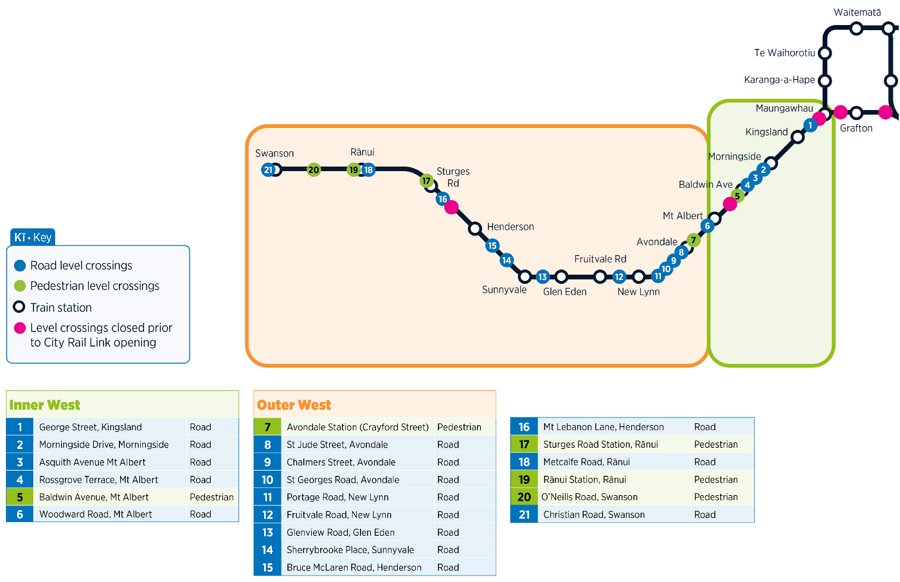
AT says this is due to the constraints of the remaining 21 level crossings on the line.
It’s been apparent for decades that these level crossings need addressing, but it’s only in the last year that any serious attention has been given to the issue. AT argues they never had any money to progress the work until recently. At the same time, they never really pushed decision-makers on the importance of removing the level crossings, perhaps because they didn’t fully understand it themselves.
Before any crossings can be removed, AT first needs a plan for what “removing” them means – will the location be grade-separated (with crossings going up and over, or below the rail line) or will they just be closed.
AT has been talking about a business case for this for some time now. As far back as July last year, I was briefed on some of the things they were looking at though a briefing last week said they’ve only had funding approval in the last few months and will be looking to appoint consultants to deliver it shortly.
So I was excited when a press release turned up on last Tuesday, titled: Planning underway to replace more rail level crossings. Did this mean we’d finally get a bit more detail about the crossings, and the costs and viability of the different options for replacing or removing them?
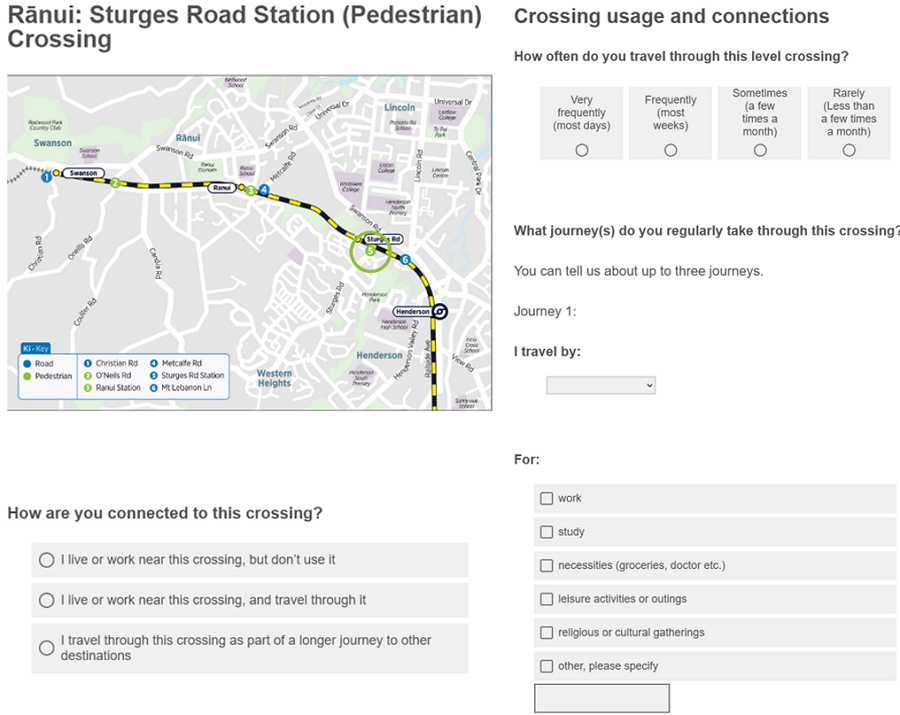
Unfortunately not. We just get a survey asking how people currently use the crossings.
Here’s the press release in full.
Replacing remaining rail level crossings on Auckland’s Western Line with safer connections to unlock the full benefits of City Rail Link is the focus of work on the next stage of the Level Crossings Programme that’s now underway.
Auckland Transport begins public engagement today (7 April) for the investment case that will identify solutions for 21 level crossings across the Western Line and get ready to start construction of the first new bridges or underpasses from the early 2030s.
The Level Crossings Programme is jointly funded by Auckland Council and NZ Transport Agency to maximise the City Rail Link’s ability to transform travel across the city.
Mayor of Auckland, Wayne Brown has been a strong advocate for the replacement of rail level crossings to improve safety and get Auckland moving.
“Rail level crossings are not easy fixes and to be frank, it’s a problem that was added to my fix-it list when I became Mayor,” says Mayor Brown.
“This work will take time to deliver, but we need to get started as soon as we can.
“The City Rail Link is opening later this year, allowing for more trains on the network. Getting rid of the level crossings and building new road and pedestrian bridges makes sense. It will cut congestion, make it safer for people to walk and drive, and allow us to add more train services as demand grows.
“It’s a good deal for Aucklanders and an example of how we partner with government to get work done and improve safety.”
Auckland Transport Head of Level Crossings Tom Willetts says: “Opening City Rail Link later this year will mean big cuts in journey times for the West, more frequent trains and easier new journeys across Auckland. Replacing level crossings with safer connections will allow even more frequent trains while keeping traffic moving and keeping local communities safe around rail tracks.
“Level crossings, where a road or footpath crosses the train tracks, are a common source of frustration for drivers waiting at barrier arms and people walking to catch a train only to see it leave from the other side of the tracks while gates are closed.
“We’ve made strong progress on the Auckland wide programme to remove level crossings, including building new pedestrian bridges at three stations to allow their level crossings to be removed in time for City Rail Link opening. In Takaanini, construction enabling works will start later this year for new road bridges.
“The next step is deciding how to replace rail level crossings on the Western Line to be ready for future growth in train passengers and significant housing growth expected along the rapid transit corridor.
“Grade separating all level crossings would be unaffordable and have significant community impacts, so a mix of separated strategic road crossings and pedestrian/cycle crossings is likely.”
“There are a number of challenging trade-offs and impacts on local areas to consider, so it’s really important we get feedback at every step of the projects from people living, working and doing business near the railway,” Mr Willetts says.
More information and a survey to give feedback can be found on the AT website at Western Line level crossings. There will be 11 drop-in events, including at Avondale Market, Bunnings New Lynn, Kings Plant Barn St Lukes, libraries, community centres and cafes.
The Western Line level crossings investment case will identify when and how each level crossing will be replaced or removed. They will be delivered in stages, in line with funding availability and the level of passenger growth in the years after City Rail Link opens.
The main options available to replace level crossings range in costs and impacts on local areas. They are:
- Walking and cycling bridge or underpass
- Road bridge or underpass
- Road bridge or underpass in a different location to the current level crossing
- Closure and replaced with safer connections on an alternative route
- A rail trench or rail bridge.
So, about all we know (and we already knew this last year) is that the priority will be the inner west, from Maungawhau to Mt Albert, with the outer west happening later.
The survey itself is fairly basic, to the point that it makes me wonder if we’ll get a consultation report that says things like: “75% of you told us you cross here to get to school without having to go 15 minutes round the block. Our plan: we will close this crossing, so it will take you longer to get to school and it will be ‘safer’, cheers!”
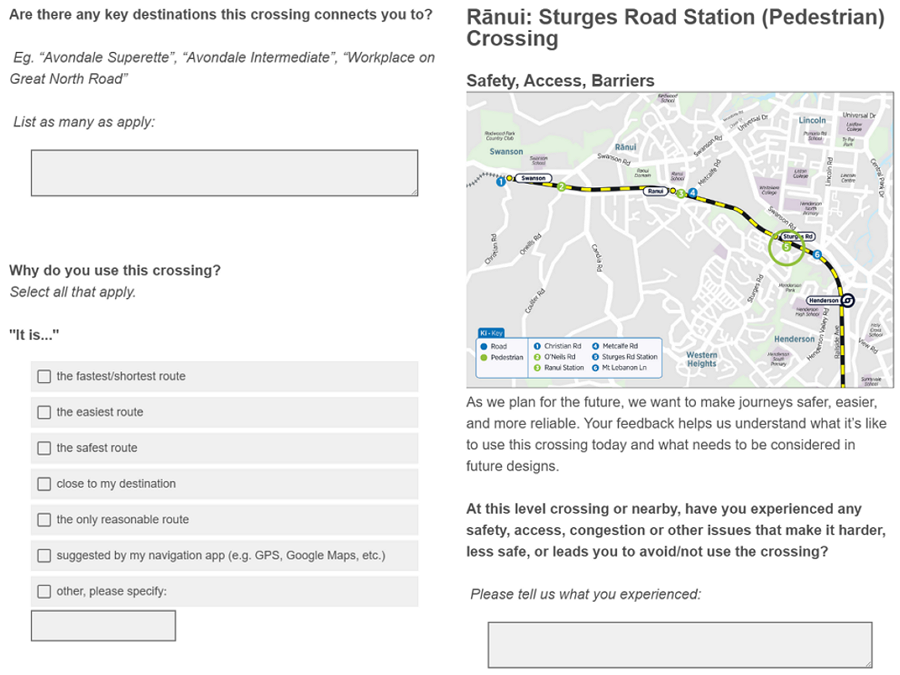
As well as the survey, there are also a number of drop-in sessions over the coming weeks, the details of which can be found here. The survey is open till 31 May.
AT needs to get on with this. Having plans sorted for which crossings they’re closing or replacing will make it much easier should Council or government (or both) throw money at solving the problem – something they might be quite keen to do once the CRL opens and the issues become all too glaringly obvious.
Greater Auckland’s work is made possible by generous donations from our readers and fans. We’re now a registered charity, so your donations are tax-deductible. If you’d like to support our work you can join our circle of supporters here.

 Processing...
Dropped into a session on Saturday, briefly as was cycling elsewhere, but it seems the whole AT focus is on minimising impact on existing use, not optimising the PT assets. As an example, I think adding good pedestrian, cycle access and maybe retaining emergency services road access (surely some sort of on demand coordination with the train network is possible) but otherwise closing the Glenview Rd would probably improve traffic on West Coast Rd as that intersection + train interruptions constantly clogs it. ‘Round the block using Gt Nth Rd/West Coast Rd is ~2.5km vs 1km direct, maybe 3 minutes driving.
I can see the firefighters at Glen Eden objecting to getting that southern access cut off
but honestly it seems like building a new fire station elsewhere would be more viable than trying to force a road overbridge and demolish goodness knows how much of the Glen Eden shops
Firefighters have terrible takes. Right now Glenview is routinely chaos, car traffic would benefit from it closing. The fire fighter heading down Clayburn won’t be too much slower.
It could be closed to general traffic with emergency crews having ability to override and lifts gates for call-outs. Depending on frequency that may be too disruptive to rail ops. Though with the station right there, at least would only mean holding west bound trains a bit longer at stations.
Preventing drivers from tailgating emergency vehicles may be harder however.
If the fire station is the only justification for not closing Glenview Road to vehicles, then close the crossing. A better use of public money would be building a new fire station on West Coast Road somewhere near the existing rail overbridge instead of grade separating the road crossing at Glenview Road
Patrick.
Look at a Map, going via Clayburn is going to be like one 1 km longer for any trip. That is not worth having some system and then calling up kiwirail, One rail and/or AT to ruin the entire rail network for a bit.
If it is so important let them have park an engine on the other side of the tracks. If that won’t work, they can move.
The only interruptions is caused by the trains,lower the train tracks and build an overbridge.
And add the $5 billion to regional fuel tax?
Once the survey results are in, the planning for removing level crossings needs to be centred on creating Low Traffic Neighbourhoods given their enormous, all-issue benefits.
Do this properly, AT, please.
Absolutely!
An absolute waste of time and money.
I wonder when the Maungawhau western line station will open. It is separate from the tunnel and has been idle for several months now.
Will open with the rest of the CRL, still ongoing systems integration and touch-up’s inside the station itself.
still, it does seem like there was a missed opportunity not to have an interim setup with the NAL platforms reopening before the CRL platforms and new station building
I completed the survey, but there is no option to say you take the train through the area. Seems wild they would exclude one user group that is impacted the most by level crossings.
I noticed the same and made it clear in my comments that I was a train user.
Hard to look at this and not see consultation as an excuse to kick the can down the road a few more years. Would be happy to be proven wrong, but a target of starting early 2030s is pretty vague.
AT have now proposed taking away a proposed active modes bridge in Takanini and adding an extra lane to great south road.
Have a look here: https://aucklandcouncil.resolve.red/portal/Meeting/10954/88148?type=2&docId=41885
Doesn’t exactly instill much faith in the process down the line
That is disgusting but classic Auckland
I think this largely comes down to consultation and understanding what the local context will actually support. In South Auckland, there is still a strong preference for cars over active modes, whether people like that reality or not. Against that backdrop, proposing an active mode bridge in the middle of an industrial area, with HCVs parked along the streets and very little sense of comfort or amenity for pedestrians or cyclists, was always going to struggle to gain meaningful support. It is not hard to see why locals, and the local board, would be reluctant to back that kind of solution.
That is disgusting if true, especially in this day and age or understanding the role of different modes.
Did the survey, it’s horribly designed, and I doubt will illicit very much useful data. Kinda feels like a set up for a ‘status quo’ scenario.
AT have known about this issue since Britomart was built. It’s appalling that they are only starting to make any real effort now – thank god they are being restructured.
In fairness AT didn’t exist when Britomart was built, while the Western line was single tracked, so level crossings we’re least of anyone’s concerns.
The real date when this became an issue was 2013 when CRL was given the go ahead. In saying that I’m not sure CRL would have been funded if people had shouted too loudly about the need for level crossings to be removed.
plus it seems that at the time (and still today in some quarters) people seemed to assume that we’d never have to consider frequency constraints on suburban passenger services, let alone suburban passenger and long-distance freight coexisting on the same tracks.
During Covid when money was flowing and the trains were having issues, was the time when they should have got a team to work out grade separation.
How long a single trench take out most/all of CRL enabled western line?
Absolutely. And really, is there a need to consult on every single crossing? Just make a decision on some (most?) of them.
No need to consult, people will be furious regardless
I find it outrageous that the only road level crossing being removed for CRL is a cul-de-sac in Penrose…
Recently visiting Melbourne, I’m impressed with how serious they’re taking them as an issue, versus us kicking the can down the long road, again.
Just been in Melbourne as well. The results they have managed with their level crossing removals is world class. Makes us look like absolute muppets….
Can someone explain what the issue with level crossings is? Is this just prioritizing cars at the expense of trains?
For every level crossing in normal operation, trains are slowed down, delaying potentially thousands of people.
Cars and people are also delayed by trains of course as well, but perhaps less so
Biggest issue is probably when things go wrong; and things go wrong. They become a safety hazard as you are allowing people and vehicles to cross in front of very heavy and relatively fast moving trains.
The entire network is affected as for every train trip in every direction on the western line, train drivers have to take care for 21 intersections, and barriers/lights have to activate in advance and lift afterwards etc
A fully grade separated rail line vs this line with many level crossings is like the difference between using a motorway and a busy arterial road with 21 sets of lights
I would have thought that every level crossing in Auckland should have been flagged for possible removal/improvements 20 years ago. Not feasible within budgets to simple remove them all, but things like pedestrian crossings could be upgraded to underpasses/overpasses at less expense, and when other work was being done in the area, every level crossing should be examined to see if it could be improved/bypassed
Thanks for the detailed answer! I didn’t realize that trains slow down for level crossings.
sad irony is that the level crossings that would be most beneficial to replace – pedestrian rail crossings, the sorts that have seen the near misses and the deaths and the wheelchair users getting stuck – are the ones i get the impression AT would be happier to close
even though a system of sturdier level crossing gates for cars would probably do just as much for safety if you absolutely had to keep level crossings open – but no, we can’t have letting the higher-capacity transport mode take priority over the lower-capacity one
I think its good but should be safe and have security around to keep the people safe when there catching the train
This part from AT doesn’t make sense:
“Inner west from Maungawhau to Mt Albert – passenger growth after CRL opens is expected to require more trains and associated level crossing replacements or removals from the 2030s.
West from Mt Albert to Swanson – passenger growth is expected to require level crossing replacements or removals to support more trains from the late 2030s.”
If the Western Line requires more trains it’s not going to matter if it’s inner or outer West unless they’re planning on stopping the trains at Mt Albert somehow, the same number of trains will be passing through? So why distinguish at all? All of the crossing along the Western Line need to be considered at once and divvied up between those that require grade separation and those that can be closed.
Just makes me think they are not really thinking seriously about this.
They are planning on stopping trains some trains at Mt Albert, and running more out west. Probably fine in the interim, as avoids the big upgrade Avondale will need.
I initially thought Avondale made more sense (Avondale Southdown line) but for now it saves likely hundreds of millions by deferring Woodward Rd/Avondale Station, and eventually the St George’s/Jude’s etc crossings so that the extra services can stop @New Lynn. Mt Albert is my closest station so the frequency from there is really all I care about.
Where is this detailed?
https://www.kiwirail.co.nz/assets/Uploads/Our-Regions/Auckland-Metro/Strategic-Rail-Programme-PBC/Documents-Appendices/AppendixK_Capital-Cost-Report-REDACTED.pdf&ved=2ahUKEwi-nfeLruyTAxVyjK8BHbPXHmoQFnoECCoQAQ&usg=AOvVaw3B62Mhow4VYS4YPQQPgMg3
Mentioned here, Ctrl F Mt Albert – it’s the turnbacks.
Weirdly I can’t link to it.
AUCKLAND RAIL PROGRAMME
BUSINESS CASE
ECONOMIC CASE – 30-YEAR RAIL
PROGAMME
CAPEX COST REPORT
30 AUGUST 2023
I don’t really understand the turnbacks? Is this a result of having 8tph in peak direction and only 4 in the off-peak direction? I guess I am looking for where it says some trains will terminate at Mt Albert.
Also interesting in that document that the business case already outlines pre-design phase options for those crossings. Glen Eden for example has road over rail (I assume that could only be achieved through trenching).
I think the logic behind it is that they’ll run services from Mt Albert to Glen Innes as that’s the section that’s expected to hit capacity, and is relatively cheap to add the turnarounds vs upgrading all the stations to 9 car trains. Plus they can then have freight services to Northland run via Avondale – Southdown, Western line west of Avondale, and have the spare capacity on the Avondale – Southdown line run into the CBD and balance all 3 lines. I do think their whole planning is a mess with their lines, and doesn’t really look like they’re properly future proofing or planning. They are make some efforts though, which is better than nothing.
I found the reference in another one from around the same time, has more info:
AUCKLAND RAIL PROGRAMME
BUSINESS CASE
FINAL REPORT
11 DECEMBER 2023
https://www.kiwirail.co.nz/assets/Uploads/Our-Regions/Auckland-Metro/Strategic-Rail-Programme-PBC/Documents-Appendices/Auckland-Rail-Programme-Business-Case-Final-REDACTED.pdf
Weirdly, it’s pretty black and white that they can handle 12 TPHPD (trains per hour per direction), including with level crossings on the Western Line. That’s easily a train every 5 minutes, in each direction, so even if you did a normal service every 10 minutes (with every 5 minutes at peak by displacing freight/interregional if desired) with freight/interregional in between using this map:
https://www.greaterauckland.org.nz/2024/11/18/a-clearer-network-for-the-city-rail-link/crl-map-jc/
If there was no desire to short run the Onehunga line you could run it along the Southern line and terminate it literally wherever on the Western Line, as there is spare capacity along the entire network – with that section of the Southern at 20TPHPD, while you could only get max 2TPHD from the Onehunga line until upgrades, so that leaves 6TPHPD along the Southern for extra peak services/freight/interregional trains until the Westfield junction.
I feel some of the KR/AT silos have got confused at one point between per direction and total and literally halved the available capacity on our network, and now their plans are to reduce services until they increase capacity by reducing crossings. All because no one has picked up on the error.
I agree with closing the level crossings, but they already have the capacity at present to run a train every 5 minutes in each direction, even with running 50% of the services as freight/interregional trains, that’s every 10 minutes, and if you don’t have freight/interregional at peak on the western line you can do every 5 mins which is fine until they improve the signalling/grade separation.
AT confirmed to us last week that they can now run more than 12tph (both directions combined) as have mitigation plans for the crossings. Only constraint now is they’re concerned about impact on car traffic and won’t go ahead till they have political agreement that it’s alright to hold cars up a little bit.
@Matt L
That’s still the same issue though – where AT is thinking the 12 trains is total in both directions, and they’re trying to mitigate it, where it’s actually 12TPHPD, or 24 total in both directions. At present they already run 6TPHPD at peaks in both directions (https://at.govt.nz/media/q2pdxp2x/auckland-transport-western-line-train-timetable.pdf).
If their Day 1 timetable was literally the same just running the https://www.greaterauckland.org.nz/2024/11/18/a-clearer-network-for-the-city-rail-link/crl-map-jc/ pattern with 10 minute frequencies in both directions, then they’d have plenty of slack to play with so they could get late/early trains through the Westfield junction and have room for freight and interregional trains in the form of Te Huia
(which also fills the express function).
@Freddy I think Matt is saying they know they can run more than 12 total, but are waiting for some blessing to inconvenience cars.
I fully support making maximum use of our rail corridor and also acknowledge that rail corridors (and motorways) divide and separate communities.
We must find a way of financing grade separation of all or most of our level crossings and even adding additional pedestrian crossing points.
Could most level crossings have the arms down at all times apart from a mechanism for emergency services. Trains could be stopped in these instances. Pedestrian bridges could be added to key crossings.
Easier/cheaper to just close them entirely. Ideally replace with ped bridge.
This won’t work or be needed. The is another crossing within a km of most of these crossings. Emergency vehicles will almost always be faster to just drive around, rather than cause millions in delays to the entire railway nextwork.
I have seen too many near accidents on these Western line level crossings. Still hard to get into some people’s heads that there are trains on both lines.
Would prefer an over bridge.
I was at a Green Party meeting about Auckland’s transport future last week and Julie Anne Genter was asked about this. She slightly pithily answered that the level crossings should be left in at first to wait and see if people changed their habits and maybe money wouldn’t need to be spent.
Interesting line of thought.
That’s her saying she doesn’t give a s++t basically.
No, was there, the context was that the current AT approach seems to be preserving current vehicle access (at billions of dollars cost) and takes no account for change in behaviour in response to changing conditions.
It’s interesting there was not the same consideration given to removing human level crossings when that was done recently. In those cases, the entire consultation was about improving alternatives, not contesting the removal.
$4/L fuel has shown how people respond to conditions, it’s entirely likely just running the train schedule would induce the same.
A trench ought to be built for the rail line through Glen Eden, like what was done in New Lynn. This was reduce the grade for trains climbing the present grade and would reduce the noise from the railway on the surrounding community around Glen Eden.
A new route for the rail line ought to be made for the rail line in conjunction with removing level crossings between Avondale and New Lynn to reduce the current steep grade for trains and remove the sharp slow curve near the Whau Creek bridge.
U-troughs can be cheaper if we take the Melbourne approach. And you free up a whole lot of land below. We need the full removal of level crossings on the western line so we can move to ETCS level 2. The only way that happens quickly is to se up a dedicated authority to do it.
Rail trench = $$$$$ and also makes it much harder to eventually expand and add another track.
Hey let’s address the enormous elephant in the room here. Society and agencies accept orders of magnitude greater risks on our road network every day with pedestrians expected to dash across four-lane arterials with no more than a refuge or less. We accept right turns out of side roads onto high-traffic arterials with no more than a give way sign and trust drivers and cyclists to wait for a gap before gunning it. And yet we’re so worried about safety for completely auto-gated level rail crossings we’re willing to comprimise the usefulness (via reduced frequency) of our entire train network we’ve just spent billions upgrading that can unlock city transformation!? This is insanity. Solution – just open the CRL with optimal frequencies and leave everything as is until the funding is there for some grade separated solutions that offers the same or improved active mode connectivity. We trust road users to wait at traffic signals and not run red lights on other parts of the network, why are waiting at level crossings any different? If waits are too long, basic mode logic says road users will take an alternative route on their own.
Yes I agree. This has long been the case.
It is a big mistake to pander to “driver frustration”, instead of facing it with the full weight of enforcement.
However I do think that installing double boom gates at level crossings (block both sides of the road) would also greatly reduce the suicidal option of driving around the half arm and chancing it.
So be firm, but also clear-eyed.
Crazy isn’t it. Just put enforcement cameras on each crossing and fine the sh*t out of any morons that block or run the crossing. Something that should already happen
Very much agree with leaving Western Line level crossings in place, with improvements.
“Auckland Transport, with support from KiwiRail, is removing or replacing all remaining level crossings in Auckland, including 21 on the Western Line, in a staged approach to help unlock the full benefits of the City Rail Link. “
That is some business case for a $5 billion plus spend.
On the west coast of the USA at the moment, a country with a million kms of what we call highways, expressways and motorways and quarter of a million kms of what the Americans call railroads. It is some setup.
The LA basin once had the Pacific Electric 1,600 km electric freight and passenger network with ridership that peaked at 110 million in 1945. The last line was closed in 1961. Much of the track and most of the right of way remained. Since 1990 lines have been slowly reinstated. Whilst the process is slow, LA is rebuilding the system in style; 100% high floor trains (unlike Aukland) with an operating top speed of 90 km/hr, quick to stop, quick to accelerate, doors that open and close in seconds not minutes, 177 route kilometres so far and a 3.5 km tunnel under the central city, LA’s CRL. The track, stations, associated works and rolling stock are magnificent, and magnificently heavy duty; it makes Auckland’s setup look flimsy. A standard three car Metrorail train is a touch longer and heavier than a three carriage Auckland EMU.
Some of the 70 stations have grade separated pedestrian access however most are at grade. Passengers get to most platforms by walking across Metrorail and freight tracks.
To determine if a track crossing of a road can be at grade or needs to be grade separated LA Metrorail uses a risk-based, multi-factor assessment framework through its Metro Rail Design Criteria (MRDC), overseen by the California Public Utilities Commission.
In summary, at-grade crossings are permitted where risk can be mitigated to an acceptable level using engineering controls (gates, signals, design). Grade separation is required where that cannot be achieved.
In practice there are well over 100 level crossings on the Metrorail network and innumerable at grade pedestrian crossings at stations and elsewhere. The northern segment of the Blue Line was opened in 2003, is 40km long and has around 40 level crossings.
Metrorail level crossings have two Metrorail tracks, none, one or two freight tracks, up to six vehicle lanes and up to eight barrier arms for vehicles, and four barrier arms for pedestrians. The alarms start and the barrier arms start coming down 30 seconds before a train passes, 10 seconds is estimated for the train to pass and 5 seconds for the arms to come up; 45 seconds in total.
There are 16 trains per hour at peak, and a number of freight trains a day, so the barrier arms are down for around 12 minutes an hour at peak. In San Diego there are a number of crossings with 28 trains per hour at peak, excluding freight trains, so the arms are down for around 21 minutes an hour.
Level crossings in LA, San Diago and other cities work well for reasons including; they are built to the highest reasonable safety standard including at least four vehicle barrier arms, the crossings accommodate as many lanes of vehicles are the approaches warrant and there are lots and lots and lots of level crossings so rail lines are extremely permeable to vehicles, cyclists and pedestrians so crossings do not become overloaded.
If the LA Metrorail criteria were applied to Auckland’s Southern and Eastern Lines post CRL opening almost certainly all level crossings north of Papakura would qualify for grade separation due to the modestly frequent passenger services combined with a reasonable number of freights trains per day which are often longish and slow moving. LA is careful to keep long freight trains separated from vehicle traffic. The main route for freight trains through LA is the 32 km, mainly trenched, 100% grade separated, 3 track Alameda corridor opened in 2002 for US$ 2.4 billion.
If the LA Metrorail criteria were applied to Auckland’s Western Line post CRL opening likely none of the 21 level crossings would qualify for grade separation due to hardly any freight trains and a passenger service that, even at 24 TPH, would not of itself warrant grade separation by its criteria. Likely more than half of the 21 two lane level crossings would qualify for significant redesign and improvement works including reworking the street network, increasing many crossings from two only to three or four vehicle lanes and installing four or more barrier arms at each crossing to prevent vehicles trying to drive around the barrier arms in the 25 seconds between the arms coming down and the train arriving. Opening more level crossings to improve permeability is a possible recommendation.
Guess what. California as a state is richer then all bar 3 of the world economies.
NZ, never mind Auckland is destitute by comparison.
You’ve done a lot of typing tocompe gold plates Cali oranges with rotten kiwi pears .
Exactly why destitute Auckland should not spend $5 plus billion grade separating the level crossings on the Western Line, something that gold plated California would consider a complete waste of public money.
Explains a lot of your weird transit takes if you think California is the gold standard worldwide for urban rail public transport…
California is the golden state, not the gold standard worldwide for urban rail public transport…
The potential consequences of train-car or train-ped/cyclist conflicts are much worse than those at your everyday traffic light.
Just temporarily close all the road crossings and have pedestrian bridges over where needed. See what happens. Plan to make grade separation where shown to most be needed after traffic has adjusted to a new route.
There’s way too much consultation here. A big reason why things take so much longer and cost so much more in the Anglosphere.
I think AT should really just abandon the CRL. This will benefit me and the greater community. Fill the tunnel with dirt and maybe put a kings plant barn there too.