Another week, another roundup of all things cities and transport. Plus, it’s a busy month in our city – Comedy Festival! Writers Festival! Music Month! And more! Get amongst.
This week in Greater Auckland
- On Monday, Patrick artfully explained why ART is the best name for the Frequent Transit Network in Auckland
- On Tuesday, Connor delved into what is set to be the country’s most expensive road, Warkworth to Te Hana – if it’s built
- On Thursday, we threw back to Matt’s post from 2013 scrutinising the so-called benefits of the so-called “Holiday Highway” from Puhoi to Wellsford
This roundup, like all our work, is brought to you by the Greater Auckland crew and made possible by generous donations from our readers and fans.
To support our work by setting up a monthly donation, you can join our circle of supporters here. We’re now a registered charity, so your donations are tax-deductible.
To get our posts straight to your inbox, sign up to our email list here.
Header image is of the inside of the Kaimai Express, taken by Shaun Baker. You can check out more from Shaun on his blog, Multimodal Adventures.
All aboard the Kaimai Express!
For the first time in 14 years, a passenger train ran between Auckland and Tauranga. As the Spinoff’s Hayden Donnell reports:
Saturday’s trip, put on by the Glenbrook Vintage Railway and promoted by the lobby group The Future is Rail, was a novelty. It was also a wormhole back to a time before we gave our transport system a firm kick in the goolies. New Zealand’s threadbare lattice of intercity passenger train services is the product of decades of decisions to prioritise cars over other means of travel both in and between cities. Since the 1950s, authorities have invested heavily in motorways while tearing up formerly popular tram lines and allowing train networks to slowly rot. That decline only accelerated after New Zealand’s rail system was privatised in 1993. When the last passenger train between Auckland and Tauranga reached the end of its line in 2001, it was only carrying about 30 people per trip.
Tickets sold out so quickly that many of us who’d loved to have gone didn’t have a chance. Time to make it regular? And one of the first steps to proper Regional Rapid Rail?
Shaun Baker also covered the trip on his blog Multimodal Adventures, with enthusiasm and lovely pictures (including a whistle-stop tour of Tauranga and Mount Maunganui by foot and bus). And here’s a great video from Stuff’s Lloyd Burr:
Auckland’s transport roadmap
Auckland Council has adopted a “road map” for transport investment, reports Our Auckland. Described as Council’s “first-ever transport policy statement”, it will sit alongside (and, occasionally, perhaps in productive tension with) the Government Policy Statement of the day. It focuses on:
- Affordable, quick and reliable public transport
- Cutting transport emissions
- Improving safety for people using the transport system
- Getting the best value for money from transport investment
…
Over the coming months, the transport policy statement will help guide work on a new 30-year regional transport plan. Auckland Council will develop this plan alongside central government.
The long-term plan will identify the specific transport projects Auckland needs. Work on it will begin once new national transport legislation comes into force.
You can be sure we’ll be watching closely how that 30-year regional transport plan shapes up, with a view to making sure Auckland’s transport options are the best they can be!
Climate Change Commission report urges ‘decisive’ action
A stark read on the Climate Change Commission’s report, via RNZ (we strongly recommend reading the whole thing):
Urgent, decisive action is needed on how communities will pay for the costs of adapting to climate change, a major new report says.
Climate-driven severe weather events were already causing “long-lasting hurt, grief and fear”, and tens of thousands more people would likely be exposed to hazards by 2050, the Climate Change Commission said.
However, there were “extreme” shortfalls in policy to address some of the biggest risks, including vital decisions about how to fund and guide adaptation and relocation.
Commission chief executive Jo Hendy said that had left the country in “react and recover” mode where too much money was spent cleaning up after events, instead of on proactive measures to limit damage and build community resilience.
The commission’s National Climate Change Risk Assessment, released on Thursday, identified what it said were the 10 biggest risks to the country from climate change.
Threats to buildings, road and rail, and water infrastructure are all on the list, but it also includes social and community wellbeing, emergency management, funding and decision-making.
And more indepth coverage from Newsroom’s Marc Daalder:
Climate change is already putting New Zealand’s buildings and roads, natural ecosystems, bioeconomic sectors like forestry and agriculture, social cohesion and democratic decision-making at risk, according to a landmark new report.
Even worse, the country was doing little to prepare for most of these risks, with action in most areas deemed insufficient or containing significant gaps.
Marc Daalder has a follow-up piece at Newsroom, the main point being the (second) best time to take action on Climate Change is right now, and politicians of every stripe need to take notice.
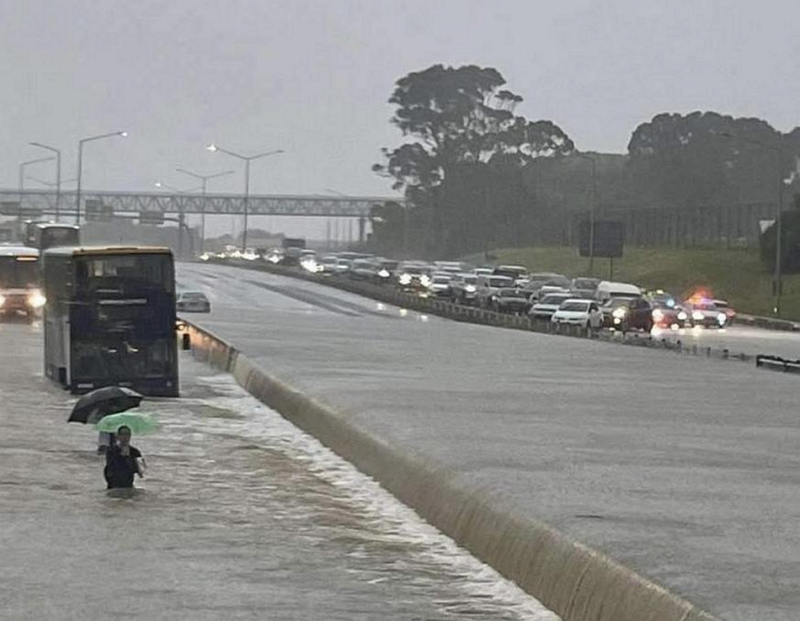
Auckland Flood Jan-2023
Calls for road safety
At the end of April, NZ Police made a strong call for greater road safety after a brutal few weeks on the roads.
Preliminary findings highlighted 16 of the 18 deaths over the past ten days occurred on open roads with 100km/h speed limits and no traffic safety barriers.
Police urge all road users to take extra care on roads with speed limits greater than 80km/h that have no traffic safety barriers in place. Any mistake on those roads can quickly end in tragedy.
The larger tragedy is that this Government chose to hit the brakes on proven and practical safety measures that protect us all, like safety barriers, and safe and appropriate speeds. This puts the burden back on individuals who, as we all know, make mistakes.
Freight debate
Fox Meyer at Newsroom reports a bit of a kerfuffle between the Prime Minister and Winston Peters around the best way to boost freight during the fuel crisis. Peters is pushing for putting more freight on rail, rather than increasing the weight allowance on trucks (which as wen pointed out is a bad idea, as heavier trucks cause more potholes).
A new report on the freight sector suggests New Zealand could significantly bolster its fuel reserves by expanding rail transport.
The Maritime Union report says diesel stocks could be extended by over two weeks under the most radical scenario, but acknowledges any significant change would require upheaval of the national transport sector.
The suggestions come as Rail Minister Winston Peters clashes with the Prime Minister over the coalition Government’s proposal to favour road, not rail, with targeted relief amid a fuel crisis.
The trucking lobby, whose use of the roads is subsidised by hundreds of millions (if not billions) by the rest of us, chimed in – claiming that road freight was more efficient than trains, so should be prioritised. But Meyer does a great job of pointing out the facts:
Total rail freight has decreased over the past eight financial years. In the most recent year, it carried 3.4 billion tonne-kilometres, down from a peak of 4.5b in 2019. The biggest drops have come in the past two years, with Peters’ coalition Government in charge.
Transporting NZ, an industry group for road freight, thinks the underperformance is evidence of rail being less efficient and less optimised than trucking.
Chief executive Dom Kalasih provides the declining rail freight data, obtained under the Official Information Act, and says rail freight has “generally trended down” over the period.
What he does not mention is that road freight also posted its lowest numbers in the two most recent years, with total freight volumes down across the sector.
Maybe we should spend a few billions on rail, and then compare which one does better? Fair’s fair!
CRL opening update expected
Recent testing seems to have gone well, reports 1News, and we could be hearing soon about a specific opening date. The article also harks back to a March report, which was sparked by Matt’s work illuminating the vagaries of the proposed timetable:
1News reported in March that commuters on Auckland’s western rail line would not get more rush hour trains when the CRL opens later this year, with emerging plans for a “temporary transitional timetable” to run for the first six months.
Additionally, train services would come at uneven intervals within the timetable.
There’s a lot of great talking up of CRL in the piece, along with some bold quotes from the Chairperson. Has he been reading some of our work? Truly, we’re flattered!
Bridgman described the CRL as “the biggest transport transformation in Auckland since the Harbour Bridge” and said it would “challenge the notion that our infrastructure should only be minimalist and functional” – making Auckland feel “more like a grown-up city”.
Also check out this behind-the-scenes video with Jack Tame:
Meanwhile, Minister of Transport Chris Bishop is announcing a review of what it’s cost to build the CRL. Which, fine, but do the Roads of National Significance as well.
The need for regional leadership
A piece by Dr Deon Swiggs, chair of Environment Canterbury, on the role of regional councils during tough times like the fuel crisis and floods.
The war in Iran is showing no sign of easing, and each week it continues the effects of global fuel disruption are increasingly being felt here in New Zealand.
This week’s decision by our national airline to scale back regional flights is the latest warning of how exposed our regions are to fuel insecurity and rising costs.
This is shaping up to be one of the most significant disruptions New Zealand has faced since Covid. It is happening at precisely the wrong time to be stripping away experienced regional governance through the Government’s proposed ‘simplifying local government’ reforms.
Let the sun shine in!
Lots of talk of solar energy lately, sounds like a bright idea, no? RNZ reports we’ve already crossed a tipping point and things can only get better from here:
New Zealand has passed the “tipping point” where most people buying solar panels will save more money than they spend on them, researchers say, but more could be done to unlock households’ ability to make use of solar power.
Josh Ellison, research lead for Rewiring Aotearoa, said the country was one of the first where the electrification of homes and vehicles could deliver cost-of-living savings and reductions in emissions at the same time.
…
He said it was cheaper to put solar on houses than build solar farms but only about 20 percent of households had access to green loans from banks to do so, because they often require sufficient equity in a house and for the homeowner to have an active mortgage.
Just under 84,000 customers now have solar power, up from 20,000 in 2018.
Also timely, this piece by Rebekah White for Newsroom, on why we aren’t making more of our sunny-side-up situation.
But in New Zealand, the up-front expense of installation remains a hurdle – the average household solar system costs $16,500. While numerous national or state governments overseas offer subsidies, rebates, feed-in tariffs, tax credits, or other incentives for households to install solar, New Zealand stands out for its lack of support.
This week the Government announced a review aimed at “removing red tape” to make it easier to install household solar set-ups, although commentators noted that upfront cost remains the main barrier.
Meanwhile, the NZ Labour Party hinted at a household solar policy to come:
Hipkins also spoke about solar energy, and said he had installed solar panels at his home with the help of a 0% loan from his bank. However, there were only 15 to 20% of households who could access that kind of credit.
Labour would make an announcement on solar for households shortly, he said.
DIY bike park demolished in Christchurch
A bike park built by kids in Christchurch was demolished by Council. If there were actually any issues, it seems quite odd they didn’t try and talk to those who’d made it, before taking action?
During the Easter school holidays, groups of South New Brighton kids gathered near Estuary Rd to dig, shape and test bike jumps and tracks.
While the kids were at school on April 30, Christchurch City Council workers, acting on complaints, went in to remove the park.
The council said it was open to discussing such projects, but they needed to be safe for everyone.
Myah Harlick, 19, whose younger brother helped build the jumps, said the kids would spend as much time there as possible, playing and “being boys”.
“They spent the whole school holidays down here in the sun, just texting each other or knocking on doors, saying, ‘Come to the jumps!’ It was something really good they had for themselves.”
Now her brother’s spending a lot of time at home.
Have your say on shaping Auckland’s (legit) skate parks
Auckland Council is currently consulting on the future of skateparks in Auckland
We are developing a regional skatepark plan to guide how skateparks and skate spaces across Tāmaki Makaurau / Auckland are:
- planned
- upgraded
- connected.
The plan will also support a coordinated, long-term approach to providing skateparks across Tāmaki Makaurau.
Have your say by the 1st June 2026.
Videos to check out
An outsider’s eye view of New Zealand’s railways…
From the socials
Excellent animation of the timeline of how EVs have taken over in Norway. That could be us!
Petrol and diesel cars fought for their lives in Norway but, as you can see, that smelly old Victorian technology ultimately lost the battle to EVs forever.I'm all for it and I love that's happening here too now. I also love how this is frightening some pretty evil businesses. Good.
— Gavin Shoebridge (@kiwiev.bsky.social) 2026-05-06T18:35:20.466Z
Eye-catching data-vis on road safety, from Albert-Eden Local Board member Emma McInnes:
View this post on Instagram
And a related smart take on designing the harm out of our streets…
Lastly you may not see a cuter video this week, or possibly year, than the Mayor of New York City, Zohran Mamdani, riding out with the children as part of a Brooklyn bike bus.
That’s us for the week. We hope you all enjoy your weekend, see you Monday!

 Processing...
So, the Climate Change Commission have asked how communities are going to pay for the costs of adapting to climate change.
They should now ask Wayne Brown:
Has Auckland Council publicly released the economic analysis outlining the enormous economic benefits of delivering the TERP?
Without it, pathetic and destructive disinformation about affordability from industry shills in AT and AC was allowed to stand. This made the councillors too wary to actually deliver what we needed.
Might be worth dusting it off now. And maybe asking why it’s been kept in the shadows.
Does anyone know why the Council Transport Policy Statement doesn’t include the words Vision Zero?
Don’t know for sure, but embedding the principles of Vision Zero without the political risk of naming it seems prudent, especially with the weather-vane language of GPS.
Yes I hear that often, about both safety and climate, but I’m not actually convinced burying concepts for ‘prudence’ leads to anything but further dilution.
In any case, is that what they’re doing here? What it says is:
“The Safe System philosophy has been central to Auckland’s approach to transport safety for more than a decade. This approach recognises that users of the transport network sometimes make mistakes, but death or serious injury shouldn’t be an inevitable consequence of such mistakes. Giving effect to this framework requires investment across four key pillars: safe roads, safe drivers, safe vehicles and safe speeds.” Etc.
A decade ago, Auckland did not have Vision Zero (which was only grudgingly adopted by AT in 2019 after a protracted period of “due diligence” subsequent to the searing Road Safety Business Improvement Review.)
Anything that was “central to Auckland’s transport safety” prior to the official adoption of Vision Zero is a far cry from the systemic all-level changes required for Vision Zero.
What AT rolled out was a big step up for a while, but it too was a long, long way from Vision Zero.
Vision Zero remains official Council policy, I believe. It’s still in the Auckland Plan 2050. The public need Council to outline how it’ll be achieved. In particular, how the next step towards Vision Zero will be more fundamental than the last, and will build on the knowledge about institutional resistance that the last step revealed.
We don’t need cowardice, and it’s time the mayor brought Vision Zero into the topics he’ll fight central government on.
That is strange, I think Safety is well covered in the document so I’m leaning towards Street guy’s explanation. Why name something that triggers a big proportion of the population when you can embed the mechanism for delivering it (safe system) without taking a political hit.
New Zealands population does not support nationwide decisive climate action.
Our politicans are just reflecting that fact.
Not true.
Given the facts in a deliberative democracy setting, NZers do choose decisive action. Don’t adopt the mistaken mindset that our automotive industry-supported “clickbait and backlash” media, which amplifies dissent and regressive views is somehow a normal setting. It’s a manipulated setting, and not anything like the democratic forum needed for making decisions.
“does not support decisive climate action”
Often that climate action information, or action that is needed, is portrayed as an extra cost to business as usual. This should not be the way climate action is portrayed. We have the money to do so, we are just adding it onto an already growing list of ‘things to do’.
The priority list of things to do needs to change. I’ll take the first step.
1. Remove all RONS from any budget forecast.
Decisive climate action will, unfortunately and due to insufficient response, need to include addressing hard questions of adaptation. Because of our small population many isolated communities are going to be faced with some rock-and-hard-place choices specifically because of increasing costs associated with maintaining network infrastructure.
New Zealanders are sensible enough to understand the law of unforeseen consequences – just look at the flooding issues that the Medium Density Residential Standards created for Auckland.
Aucklanders never wanted it, were ignored by Lambton Quay and the Beehive; who acted decisively anyway. Great result ….
Fair comment.
The most decisive action a person can take is to give up their car-dependent lifestyle and few have done that.
And how likely is a government to take decisive climate action when that would mean impinging on most voters’ car-dependent lifestyles?
I assume the road map mentioned on Our Auckland is the council’s new Transport Policy Statement: https://www.aucklandcouncil.govt.nz/en/plans-policies-bylaws-reports-projects/our-policies/transport-policy-statement.html
How about a radical idea – instead of cutting red tape and improving access to 0% loans for solar, Government could provide a free basic level installation ( with options to pay for upgrades). Huge savings around energy consumption and therefore generation infrastructure and also health and general well being benefits. And maybe some of the household savings will then be circulated in local economy.
This approach would also allow renters to benefit from solar. At the moment there is zero incentive for landlords to install solar on rental properties as they are not paying the power bill, while the renters don’t have the choice to install even if they wanted to/could afford it.
You don’t see how the presence of solar panels (and thus the possibility of lower bills) wouldn’t feed into the rental demand for a property?
It sounds like we have two effective incentives already – set to become even more effective due to Act’s clearsighted intention to remove unnecessary managerial-class driven red-tape!
It would be better if the Government first considered whether subsidising household installed solar would be as cost effective as subsidising / facilitating larger commercial facilities.
Labour’s proposed policy – at first whiff – seems misguided by equity considerations instead of being focused on NZ’s strategic need for more renewable energy. They have form with this.
If the goal is to circulate cash into the local economy the government could just take less money out of the local economy.
If the goal was to generate electricity with no infra costs, the government could just put the solar on tracking mounts in a big unproductive paddock near existing transmission. (they basically already are through their 51% ownership, https://www.meridianenergy.co.nz/new-projects/te-rahui-solar-farm )
Interim CE Van Der Putten in the Jack Tame video stressing public transport as “heavily subsidised” by local and central government doesn’t bode well.
It’s simply not true. Public money is used, yes, as it is for road building and crash hospitalisations and traffic enforcement and the climate event repair that wouldn’t have been necessary if driving had been curtailed. Etc.
But to consider that a subsidy requires tunnel vision. When you compare the outcomes and impacts of the investments into the different modes, it’s clear that funding for public transport is investment that leads to positive economic and social outcomes. Funding to support driving is where the subsidy lies, because it’s public money that leads to further car dependence, traffic trauma, and an increasingly unaffordable system.
Stacey should perhaps be equipped by her comms team with snappy explainers on this topic.
Yes, I enjoyed that video – but cringed when Stacey said ‘heavily subsidised’.
Even Stacey got caught using the s-word. This is really “funding share” and where the dial is set should be debated and decided in the full continuum of costs and benefits of public and private travel and contribution.
Talking about “subsidy” and “fare-box recovery” isolates the public funding of PT from the rest of the continuum and we just shouldn’t do it.
AH, I am struggling to understand what Stacy did wrong. She stated facts. Being evidence based is a key criteria for me in leaders so I give her a big thumbs up here.
And FYI, as of early 2025, the average subsidy per passenger has risen to roughly $6.30, with ferries costing the most to subsidize per user and buses the least and subsidies per mode are as follows:
Ferry: ~$18.07 per passenger.
Train: ~$12.01 per passenger.
Bus: ~$4.70 per passenger.
(The numbers are taken from NZ Herald, March 2025)
https://www.nzherald.co.nz/nz/auckland-public-transport-subsidies-soar-to-750m-over-five-years/CKYY43E2YZBBPGHF6RNJW3NZ4I/
I am sure cars, roads and other modes are equally subsidised, but that doesn’t mean that Stacy should skirt the question.
On a personal note, I think we should question the cost per ferry passenger. I am all for paying more subsidies to buses, but the high cost per ferry passenger (numbers are relatively small) does not sit right with me.
Well using facts is exactly what she did wrong obviously. Remember these people are all about facts but ONLY when it suits the narrative. Heidi clearly just is anti car and wants unlimited subsidies for anything else.
Heaven forbid we all pay for our own stuff. The way I see it we should trial removing ALL subsidies for cars,trains, busses, ferries, no cycleways etc and see which mode people gravitate towards my suggestion is cars and bikes would win and the other modes would go away. Since I like trains I’m willing to subsidise that (I mean who doesn’t like trains lol) but I agree the ferry subsidy seems too large to keep going.
I don’t think the subsidy for roads is as large as Heidi makes out anyway. See the thing is I think they bundle “raised crossings” and all the ghastly speed bumps being plopped everywhere as road “cost” but in reality if some common sense applied road maintenance would go back to basics and we would give even one cent to speed bumps or fancy paint.
Flatten all speed bumps and ban spending on building any new ones and we will save tons of cash not just in public money but private money from not replacing suspensions. The truth is a vast majority of Kiwis are always going to choose to get around in their cars. That’s not going to change in our lifetime or ever the public would never support that. If the CRL does not bring a big patronage boost there will be no political appetite to spend big on PT again which would be a great shame but not surprising given Auckland’s population actually should be shrinking given our birth rates.
Clearly not awareness of desths and serious injuries and what they cost. Safety features are not installed just for fun.
Oh I’m fully aware of the DSI and what they cost like I’ve mentioned before I’ve been reading the blog a long time. But I’m always very honest so I’m not going to lie and say I support the misery of speed bumps. I’m willing to take some self responsibility so when I’m walking around the streets I make sure it’s clear before crossing I don’t need a bump for me to cross.
Like everyone does everyday in their lives I weigh up the risk and I’ve decided to ignore evidence to save about 30seconds over a short trip and 5 minutes on a longer trip.
I believe that you think your opinion is incredibly balanced and fact-oriented but you are forgetting so many things that I don’t even know where to start.
Just one hint: A large part of the population cannot drive and a large part of the population that can drive often complains that the former spend too much time inside.
Our beloved Auckland ugently need a substantial change in municipal council governance, a better infrastructure and traffic improvement etc.. The Kiwi-rail and Metrosystem for the Auckland area is a move toward future for our city. Auckland has huge potential and a bright future, if the Municipal government the Council do their best effort to uplift our city. Auckland attract nowadays a substantial foreign capital invest and with this we can make a world-class place for our city.
Regarding the bike park in New Brighton, I think one of the issues for the council was that they didn’t know who built it, so they didn’t have someone to contact if there were any problems. Their message to the kids was basically “talk to us first”. Admittedly, when spontaneously creating bike features, “contacting the council” isn’t like to be top of mind for your average kid.
Longtime reader and enjoy learning everything on this blog. Just a question guys, will the southdown to Avondale line be started by the time crl opens?
Am abit concerned full capacity won’t be realized as freight and some passenger service need to bypass the bottleneck in the city with increased post crl movement.
Northland freight is currently one or two? trains a day.
Certainly not enough to justify it’s own very costly line through the city in the foreseeable future.
But a branch across the flatlands to the Marsdon Point Port could conceivably double the number of trains per day to that of about half an hours worth of commuter trains on the Western Line.
I’ve had several opportunities to price long distance transport of bulk material in NZ over the last 10 years. Rail has always come out significantly more expensive than trucks, even when everything is in its favour and logically it should be cheaper. I don’t know if existing users have some sort of historic pricing agreement, or justify extra costs for corporate image. It’s no surprise to me that volumes would be decreasing.
The only logical conclusion is that economics are not balanced, essentially RUC on heavy vehicles is too low. Increasing RUC significantly based on vehicle weight and proportion of damage to roads will increase costs to some parts of the economy but could be matched with reductions in tax elsewhere. I think it’d be a net positive.
RUC (and fuel tax) is underpriced generally due to not being adjusted for inflation over the last 5 or so years. But the proportioning to trucks is fair and there are good explainers that MOT / NZTA publish. The axle weight portion IS exponentially more expensive for trucks. It’s just most of the costs of the road network isn’t due to weight related wear. Its damage from weather, aging, water where it shouldn’t be etc.
There’s a more simple explanation, Kiwirail are just bad at their job. They cant manage costs, they aren’t hungry for new business, aren’t interested in growth, and they don’t want to provide a competitive service. Their incentives and structure is fundamentally different to the average road carrier.
It seems the less Kiwirail carries the more financial they are. Over the last five years most of the rolling stock has being replaced. In a couple of years time almost all of the older locomotives will be gone. So lower costs longer trains it’s all getting more efficient. Keep the prices up don’t worry if tonne kilometers is dropping. Similar sort of thing we are seeing with electricity. Scarcity means higher prices. Yes trucking is more flexible and more responsive to customer needs. Also faster transit times. Cars pay more than there share of road maintenance. Higher payloads for trucks cuts costs but increases maintenance. The argument has being going on ever since the internal combustion engine was invented. In the end it’s a political decision. It’s up to Government and local councils to put their hands on the scale and we get to vote for the politicians. But there is a third unaccountable player. Are we using the right financial model. I look at how China can be so much more productive than the west. No problems to build and operate railways there.
Royce you and I both know that kiwirail is still asset striping and in managed decline.
It couldn’t manage itself out of a brown paper bag.
The two biggest issues rail has in NZ is:
– A century of politicians and citizens being sucked in by the ICE snake oil sailsmen
and
More recently being run (poorly) as an SOE. That requirement to make money at all costs is killing our railways.