It’s the first day of May already, how time flies! Here’s a collection of stories about cities for you to enjoy.
This week in Greater Auckland
- On Tuesday, after the government announcement of plans to increase the weight of trucks on our roads, we had a guest post from Kasey McDonnell about the impact on wear and tear.
- On Wednesday, we had a guest post from Darren Davis about the planned gondolas in Queenstown.
- On Thursday, Matt covered how AT will be changing (and improving!) their timetable for when the CRL opens.
This roundup, like all our work, is brought to you by the Greater Auckland crew and made possible by generous donations from our readers and fans.
To support our work by setting up a monthly donation, you can join our circle of supporters here. We’re now a registered charity, so your donations are tax-deductible.
AT reforms confirmed
The government’s legislation to change how Auckland Transport is governed passed its third reading in Parliament yesterday. The formal changeover is likely to happen later in the year, potentially close to the election. It’s unclear what this means for timing of the city’s 30-year plan, but you can be sure we’ll be keeping an eye on it.
What’s in a name? The CRL by any other name would… hmmm
Jon Bridges wrote an opinion piece querying whether the name “City Rail Link” will stick around once the tunnels and new stations open – and whether it should:
With luck [the project’s results] will bring much-deserved life to a city centre that has suffered so much disruption during its construction.
And it will also be record-breaking because, as far as I know, we are giving it the worst name of any underground rail network on the planet: we are calling it the CRL.
Look around the world: the Tube, the Subway, the Metro, the L, BART…
OK, so none of them are super-imaginative, but ours will definitely be the very worst of a bad bunch. And with only about two metric grams of inspiration, it could easily be the very best.
Why do we have CRL as the name? Because we are totally shit at naming things. We have been since the first white person sailed past in a boat and said, “This big beautiful island is in the north, I wonder what I should call it?”
But the thing is: “CRL” is simply the name of a single (huge) project to expande one part of the existing network. CRL isn’t the name of our citywide rapid transit network itself – which, we’ve long argued, does indeed need an actual name.
On their own maps, Auckland Transport just refer to the system as “Trains and Rapid Buses”… which is exactly as unimaginative as Jon suggests.
Yesterday, AT’s incoming interim CEO – Stacey van der Putten – penned a good-humoured response:
In practice, the letters CRL won’t even appear on train maps.
What people will see, and use, are three new lines: East West, South City and Onehunga West.
It will be impossible to tell where the CRL begins and ends.
Yes, you could argue those names are boring. We’d argue they’re clear and easy to understand, which is exactly what our extensive customer research told us people value most when navigating public transport.
The same applies overseas. The Tube, the Metro, and the Subway -which Jon rightly celebrates – weren’t exactly names lovingly created.
They’re world‑famous not because of what they’re called, but because of the service they provide. Reliability and usefulness created the affection, not the other way around.
That’s what we’re aiming for too.
…..
We know the CRL nickname is likely to still be used. We’re OK with that.
Over time, we hope it will stop sounding like an acronym and simply come to stand for convenience, reliability and legibility across a whole public transport network, the things we want people to feel.
Fair enough. Although, as we’ve highlighted before, the proposed line names – East West, South City and Onehunga West – don’t exactly roll off the tongue:
With the changes to the rail network we get three new names for lines: Ewww, Ow and Sick. There are plenty of different naming conventions out there but even something as simple as a single letter might have been better e.g. the A, B, C lines etc.
Nor do AT’s names clearly describe what the lines do, and where they go. For example, South City kind of implies the other lines don’t connect to the city.
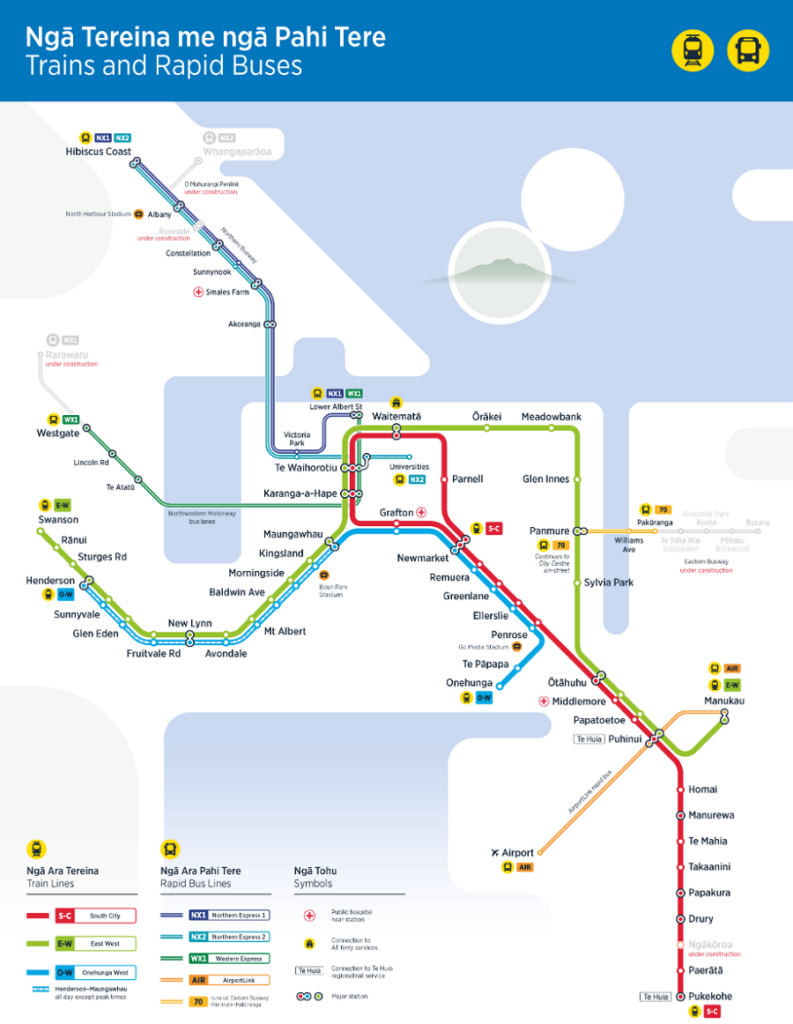
The new map
Te Whau Pathway wins accessibility award
In what is bound to be the first of many awards, Te Whau has landed an early plaudit:
On Friday, the Te Whau Pathway Environment Trust received the Outdoor Access Champion award from the Outdoor Access Commission, Herenga ā Nuku Aotearoa.
…
Commission chief executive Dan Wildy said the Te Whau stands out for the way it puts communities and accessibility at its centre.
…
Wildy said they were impressed with the high volume of users Te Whau has had, in a short span of time since it opened.
“Even though it’s not a fully connected pathway yet, there is still a way to go, they already getting, at key sections, a thousand users on average per day.”
…
“From our point of view, [the] award sheds some light on how significant the progress has already been, but also provides some encouragement to see it through to the full extent of the vision they have for the Te Whau Pathway.
“And that is really what we’re celebrating – the fact that such an incredible piece of outdoor, public access is being built right where people live.
“Not in the middle of nowhere where it takes a lot of money and time to get to, but it’s right on the doorstep of 34 schools, 18,000 students living within its catchment.”
…
[Te Whau Pathway ] Trust chair Tony Miguel said a key focus of their volunteer-led organisation had been their work with local schools and tamariki, in helping young people build the pathway and strengthen their connection to the river.
“Te Whau Pathway is being built with the communities it runs through,” Miguel said.
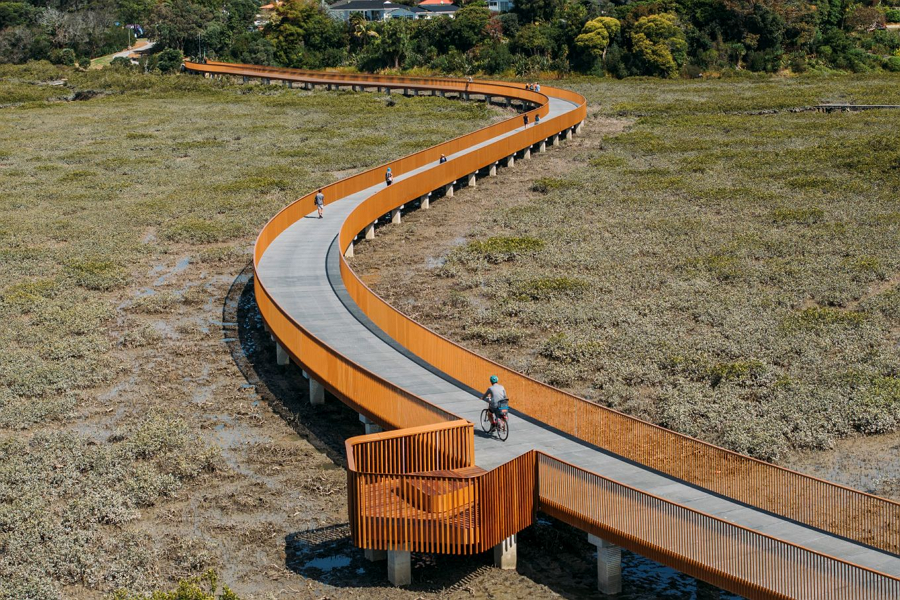
Te Whau Pathway. Image: Our Auckland
Myriad benefits of rapid interventions to tackle the fuel crisis
The Public Health Communication Centre has published a briefing on hoiw interventions to respond to the fuel crisis would also have huge public health benefits. Any governmment worth its salt would leap on the opportunity to improve the lives of its citizens while reducing the impact on the cost of living, right?
Right?
In this Briefing we detail five specific interventions that could be used promptly in Aotearoa New Zealand (NZ) to both enhance energy security and reduce fuel costs to households. All these interventions could also provide other benefits – particularly for health. These interventions are: (1) Improving access to public transport (eg, better scheduling, reliability, increased subsidies for fares); (2) Improving cycling infrastructure; (3) Subsidising e-bike purchases (eg, targeted programmes); (4) Reducing open road speed limits; and (5) Encouraging more flexible work hours and voluntary working from home (where appropriate).
We also describe potential barriers to implementation (eg, the upfront costs and the political difficulty of lowering speed limits). Nevertheless, we also outline options for meeting upfront costs, including cancelling the proposed LNG terminal and the $200 million gas exploration fund.
Adapting constructively to the current fuel crisis in NZ could yield enduring gains across health, household budgets, environmental sustainability, and resilience.
Tourist ships cruising for (our) bruising?
There is often a lot of push from the cruise ship industry for more support, but is it really worth it? As reported by RNZ, an expert in sustainable tourism says that “environmental damage from cruise ships far outweigh any economic benefits for local businesses”:
Studies have found cruise passengers spend less money than other tourists, while the ships themselves cause widespread pollution.
…..
James Higham, a professor of sustainable tourism at Brisbane’s Griffith University, had studied just that, with a 2024 paper weighing the benefits and impacts of cruise tourism in New Zealand.
“What we found was that cruise tourism accounts for approximately 1 percent of total New Zealand tourism expenditure, and that share has remained flat.
This is because they do a lot of their spending on board rather than on shore,” he said
While some regions enjoyed decent returns, he said others saw none at all.
One thing not mentioned is that in Auckland, when a cruise ship arrives or departs it often messes up our ferry network, delaying travel for thousands of people.
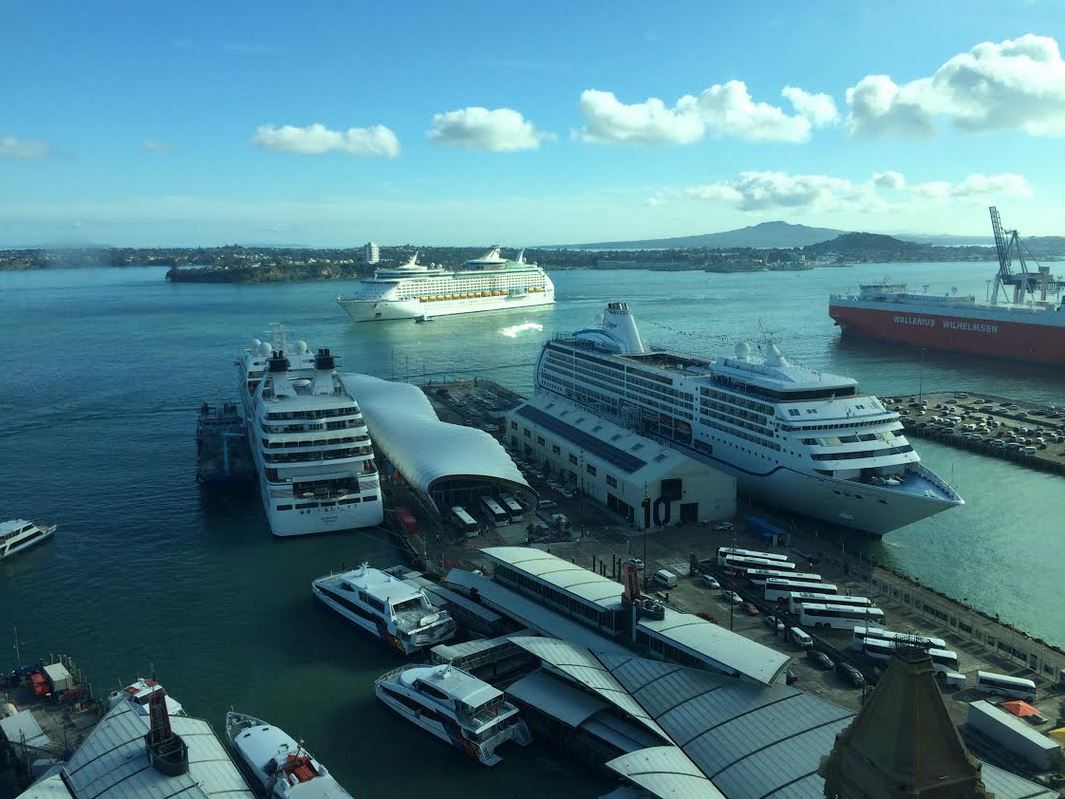
Cruise ships at Queens Wharf since ages ago: 2015 photo from our archives.
Reconsidering utes: it’s not just about the cost of fuel
Last week, Rebekah White wrote in Newsroom about the widespread negative impact of big utes, as shown in a study from the University of Auckland.
Utes and SUVs contribute more to air pollution, pose greater danger to other road users, and make an outsized contribution to carbon emissions compared to smaller vehicles.
“We know heaps about the effects of large vehicles on climate, on safety, on congestion, on local air quality,” says Woodward. “They are an incredibly inefficient way of getting people around, particularly when most ute trips are made by drivers who live in urban areas.”
Now, RNZ reports that the researchers behind the study are calling for a tax to address the disproportionate cost utes impose on our cities:
Health researchers at the University of Auckland have suggested a tax on utes in response to high emissions and more deadly accidents.
They said traffic accidents involving utes were seven times more likely to be fatal, burdening the healthcare system.
“There is a cost, we’ve got so much more air pollution and so much more injury associated with these things. Someone has to pay that cost,” senior researcher Dr Kirsty Wild said.
“We have a particularly polluted and dangerous transport system at the moment and it’s putting particular pressure on our healthcare resources.”
She noted a significant difference in emissions between utes and other cars.
“There’s quite a big difference actually, New Zealand research shows [utes] contribute about seven times as much social harm when it comes to things like air pollution, particularly toxic exhaust with diesel vehicles,” she said.
That was primarily an issue in cities, she said.
Why on earth would we want to keep this fossil-fuel system, again?
An interesting piece from RNZ, in which reporter Charlotte Cook travels along with a fuel tanker driver to see what they do each day.
One question the story leaves you with: is this how you’d design a system from scratch, to power so much of how we live and how we get around? Let’s get off the status quo and electrify:
[Cody] Munro has been behind the wheel for 10 years and starts his day at 12:45am. He likes it that way, the roads are quiet, and he can get to where he needs to go faster. When I meet Munro it is 6:30am and he has already taken about 40,000 litres to Masterton. He drives a huge Kenworth that weighs about 50 tonnes when full.
For this trip, he has a total of 38,716 litres on board for the two stops: 21,199 litres is diesel and 17, 517 is 91. At today’s average street value, that’s $150,000 worth of diesel and $60,000 of 91. 17,517 litres would be enough 91 to run a Hybrid Rav 4 for nearly two decades.
But, Munro says it doesn’t last that long at the fuel station.
“A busy station can sort of take a load a day, sometimes two loads a day.”…
But despite being in and out of gas stations all day, Munro needs to fill the tanker itself, after driving 580km. It costs around $1700 in fuel, just for a days work. Sometimes it’s more, sometimes it’s less.
People protecting bike lanes
An eye-catching activation in Wellington raised concerns about proposed cuts to the city’s internationally-recognised Paneke Pōneke bike network, given rising ridership and the fuel crisis.
The Wellington City Council’s most recent annual plan pushes out the Paneke Pōneke bike network project completion from 10 years to 20 years, and decreases the budget from $115 million to just under $67 million.
Cycle Wellington is advocating for the council to reassess cuts given the fuel crisis and weather events, also telling Morning Report today that they want the government to back widespread cycling infrastructure.
Patrick Morgan from Cycle Wellington, leading the human bike chain, said: “We think its appalling the city council is hitting pause on its cycle lane programme, especially at a time of high fuel prices.”
With the familiar catch-cry “paint is not protection”, human beings protected a lane with their own bodies, highlighting the importance of robust separation from vehicles. The images are amazing – more here.
There’s also a nationwide call to urgently roll out proper bike infrastructure in towns and cities, led by the Cycling Action Network with support from Bike Auckland and many other organisations (Greater Auckland signed the open letter too). As RNZ reports:
Cycling Action Network spokesperson Patrick Morgan said the tools for car-free travel were already sitting in the nation’s garages.
“Aotearoa is fortunate to have a fleet of over two million practical, fossil-fuel-free vehicles, bicycles and scooters, already distributed across the country. Ready to keep people moving and save households money, helping to lower the financial burden of fuel for where travel by car is still unavoidable. But to unlock this potential, the government must make the streets safe enough for people to actually use them,” Morgan said.
He said spending billions on new roads that increased dependency on imported oil was “foolhardy in the current climate”.
Reducing fare evasion in San Francisco
Some interesting results from San Francisco, after they changed the style of their fare gates:
In August, BART completed the installation of new fare gates at station entrances and exits: Six-foot-tall saloon-style doors, made of plexiglass with metal frames, have replaced the waist-high barriers of the 1970s that were easy to duck or jump. The new gates have compelled more riders to pay their fare—revenue is projected to rise by $10 million a year. They have also led to an enormous drop in vandalism. Workers spent nearly 1,000 fewer hours cleaning up after unruly passengers in the six months following the gates’ installation, compared with the six months before. Crime on BART fell by 41 percent last year. Most fare beaters may be just trying to get a free ride, but most vandalism was apparently committed by fare beaters.
Videos to check out
Well worth your time is this excellent presentation to Auckland Council’s Transport and Infrastructure Delivery Committee, from All Aboard Aotearoa’s Executive Director Tim Adriaansen. He explained why Auckland Transport (and Council) needs to reconsider procuring diesel ferries, and instead should opt for electric ferries.
A report is due to come back to the committee in June – but will it be too late to reconsider the two diesel ferries currently on the city’s shopping list?
Some takeaways from an American in London – always interesting to see one’s own cities through the lens of what other cities are up to:
The need for trees in New York City – a look at the launch of the city’s first Urban Forest Plan.
From the socials
Free PT fares in Melbourne – while popular, and lighting up the more visual social media channels – are not increasing ridership, it turns out.
The current Australian free fare experiment in Victoria (Melbourne) is theoretically tied to the fuel crisis. But it's doing nothing for ridership. Ridership is up the same amount in NSW (Sydney) where fares are normal. www.afr.com/companies/tr…
— Jarrett Walker (@humantransit.bsky.social) 2026-04-24T22:49:14.170Z
Here’s a look at trains moving through the CRL via Councillor Richard Hills:
View this post on Instagram
Bus drivers, recruited from overseas to deal with driver shortages, are at risk of losing their visas due to strict language requirements.
View this post on Instagram
That’s it from us this week – we hope you have a good weekend!

 Processing...
“The current Australian free fare experiment in Victoria (Melbourne) is theoretically tied to the fuel crisis. But it’s doing nothing for ridership. Ridership is up the same amount in NSW (Sydney) where fares are normal”
PT fares should either be free or income/wealth based (proxy paid by taxes).
Public transport is “public transport” first and foremost and there to serve those who have no alternates.
It’s also why I will continue to argue for a mix of on-demand transit feeding high frequency core fixed routes so that those without alternative transport do actually have PT access. Fixed route systems alone cannot do this.
The lack of on-demand + fixed route services is one of the reasons why PT patronage in Melbourne hasn’t gone up any further. Those that can “time afford” to get to and from the fixed route system are already doing so. Those that can’t “time afford” to do so will stay in their cars.
Support for low income and for families is not the same as zero fares. Everyone is willing to pay something for PT, so long as they have any money.
I was in Melbourne recently and caught a number of trams. My observation was that very few riders tagged on or off. Most people opt to ride for free unless a Transport Officer is spotted getting on the tram and then there is a flurry of tag ons.
As for a name for the whole train/rapid transit system, I have always liked DART, a la the early 2000s project. I guess the ‘D’ could stand for ‘Developed’?
Dallas and Dublin both use DART. Does that means in Tāmaki Makaurau we should use TART. 🙂
More seriously, a unique name would be lovely. I wonder if Māori would gift it a (short and snappy) name.
Maybe something like TARI (Tamaki / Auckland Rail Interlink)
An ideal name for the entire system would be the Auckland Rapid Transit system, or ART(s) It could advertise itself with an imaginative splash of paint etc.
Where lifts are used to access platforms (and there are multiple “B” levels) could you please suggest AT add alongside the button in the lift the platform number and “trains” Would help peole with low vision. Also try harder to get the train drivers to stop in the correct position so wheelchair users can easily access low floor entry. I notice the ride on the southern line is a lot less smooth these days, surprising after all the upgrade work.
Hi Cal – Auckland Transport seems to have two teams dedicating to consulting with community accessibility groups. They are called: the Public Transport Accessibility Group (PTAG) and Capital Projects Accessibility Group (CPAG); respectively.
In each case, they liaise directly with the likes of ‘Blind and Low Vision New Zealand’ and also ‘Blind Citizens NZ’.
Perhaps there is a way to bring these ideas to AT’s attention via these groups?
I got this information from the following AT page: https://at.govt.nz/bus-train-ferry/accessible-travel/public-transport-accessibility-group-ptag-and-capital-projects-accessibility-group-cpag
On the Perth Train network, where there is a lift between 2 levels the lifts have a simple large “GO” Button. I found it to be a positive change.
They also have a proximity sensor to Call the lift. Wave your hand in front of the Dark Spot. (It was probably a Covid thing!)
I like that
I suspect like ‘spaghetti junction’, ‘k road’, or ‘up the wahs’, some name will grow organically once people start using it
We just need to get people using it, and maybe AT will get creative with an advertising campaign using ART or similar.
Also love to see once it is open, and well proven encouragement for people to give it a try with some advertising . Had a workmate (originally from SA) who had lived in Auckland for a while, but had never taken a ferry, bus or train before.
Maybe take the ART and visit the art gallery.
Or a challenge to visit Silvia Park/IKEA, Mt Smart and Commercial Bay for people coming to town for a game; all via rapid easy train system.
I think FART would be far better.
‘F’ for ‘Frequent’ – an aspiration
But also FART for the likely sub-optimal nature of any public transport system in Auckland
Sorry for the cynicism
Far too much thought is being given to various names of the Auckland railway lines.
Keep things as they are, and if people want to make their little jokes about the names (‘EW’ ‘OW’ and so on) – let them!
People, even gormless tourists, will figure it out (most will be navigating with their phones anyway).
The alternative will inevitably (although inexplicably) require the spending of hundreds of thousands of dollars on bludging PR and marketing ‘professionals’.
That’s money better spent on physical infrastructure in every single instance.
Some people need utes for business or agriculture. Apart from that, there is a huge pressure from industry to get people to pay a lot for luxury utes as if they were cars and keep burning through expensive, rare diesel. Getting past the lobbying for status quo will be difficult.
It’s telling that business and agriculture managed fine without the oversized status utes until very recently.
Tradies tend to have them because they’re provided in the employment package, or the tradie is matching what his mates who are employed by a big company get.
Of course there are some who use them well, but the number would be very low. The tray decks are actually too high for good ergonomics. I know trades who’ve bought one when they set up their business, and then switched to a van once practicalities became obvious.
I think there is also something around how we have created the sub-sub-sub contracting model. When I worked for a builder I rode to his yard and we all hopped in one van with the tools and equipment to go out to site. Now we see 10 utes turn up and the tradies just have a tool belt in the back.
Two or three regular houses on my small residential street getting renovated resulted in sometimes a dozen or more large utes suddenly crowding the narrow road for months so I think you may be onto something.
Aggressive progressive tax scales based on vehicle weight for purchase and rego would be a good thing, for: damage to roads, energy and resource consumption, trade defecit, safety for the average person.
Small & kei cars are 2200kg.
Small & kei cars are less than 900kg.
Toyota Aqua hybrid 1080kg.
Ford Rangers are greater than 2200kg.
(I used less than and greater than symbols above, and the text between was ommitted)
The government treating bus drivers like disposables is inhumane. And revolting. They came to our aid when it mattered. They should get residency without all this hostility.
Introducing a mandatory stand down period (out of the country) of one year before they can reapply is deliberate nastiness. It’s all about ensuring people can’t put down roots, so they’re disempowered.
These are people, with families. Kids having made a big adjustment to a new culture, new friends at school, being forced to start over again.
I hope Auckland Council and AT will advocate to Government on their behalf. The bus companies, too.
Even from a position of self-interest, the situation needs to be fixed. It may be in the best interests of the big corporate employers’ cartel to “treat’em mean, keep ’em keen” but for Aucklanders, it means less resilience, with the potential for more bus driver shortages in future.
To be a pilot in NZ only requires IELTS Level 4. They are asking for 6.5 for bus drivers. That’s absurd.
But flying requires English literacy and all exams are done in English whether your an engineer, air traffic controller or pilot. I work in the industry for a company based in the Middle East and all staff need to speak fluently.
What should have happened was that the NZ government should have invested in New Zealanders and help train our own instead of buying in cheap foreign labour as a sticking plaster.
Current government’s back door way of preventing more public transport and keeping it’s car first agenda?
I’m not sure, Grant, actually. For sure, impacts on public transport wouldn’t bother them. But, something to consider is: how are immigrant truck drivers being treated? Is it’s the same, then maybe we should just put this down to the coalition’s general approach of keeping workers unsettled and disempowered.
Or Heidi instead of wanting to keep importing new Kiwis which most Maori are completely against we could actually target those who are on a benefit and get them into training to be a bus driver. Young Maori in particular are really good workers once they are given some mentorship and would be good to train up to drive long haul trucks. This is why NZ is in such a state more and more people turn to the benefit as both National and Labour keep importing “skilled” migrants most of which are jobs which with a little bit of support a Kiwi worker could have done. We’ve seen more and more kiwis leave as more immigrants move in it’s a cycle that we need to stop we keep suppressing wages by bringing in cheap foreign workers.
Why on earth does it need a name it’s not like there’s half a dozen of these tunnels in Auckland it’s just a railway line call it Railway problem solved isn’t there more important public transport issues in Auckland.
Good weekend reading: mass transit in Jakarta, the world’s biggest city.
https://indevelopmentmag.com/jakarta-transit-transformation/
Not sure if anyone has heard, but hot off the press last week, day one CRL won’t have peak time Onehunga to Sylvia Park services, instead they’ll run Sylvia Park to Kinglsand. Purely a timetable filler, to meet the 16 tph target through the tunnels. And the timetable has been set and confirmed – as of Friday.