We hope you’ve all had a good (short) week! With the four-day Easter weekend ahead, here are some of this week’s top stories in transport and urbanism a day early.
Our header image shows mid city, mid-Queen St, in midweek – a little breathing space for people.
This week in Greater Auckland
- On Tuesday, Matt asked some of the important questions around the government’s response, or lack there of, to the fuel crisis.
- On Wednesday, we had a little bit of fun delving into the ‘leaked’ cabinet paper highlighting the government’s U-turn on banning walking, and a few other ideas to tackle the fuel crisis.
This roundup, like all our work, is brought to you by the Greater Auckland crew and made possible by generous donations from our readers and fans.
To support our work by setting up a monthly donation, you can join our circle of supporters here. We’re now a registered charity, so your donations are tax-deductible.
Greater Auckland in the media
Connor’s op-ed from a few weeks ago on the government’s (first) backdown on planning changes in Auckland, was picked up in the Spinoff’s Bulletin this week. It’s aged well, given the government has since watered down minimum housing capacity targets again, to try and appease Nimbys.
Rewarding the Nimbys
Greater Auckland’s Connor Sharp, writing in the Sunday Star-Times, takes the opposite view. With housing and transport the two biggest household expenses in the city, PC120 is primarily a cost-of-living issue, Sharp argues, and he finds it “galling to see senior politicians (and coincidentally property-owners) like Christopher Luxon, Simeon Brown and David Seymour vehemently opposing the plan”.
The headline cuts from two million to 1.6 million (and now to 1.4 million) are largely symbolic, he says. The more serious problem is the signal each retreat sends: “it rewards NIMBY groups and councillors to keep scaremongering about PC120.” Yet he agrees with Todd on at least one topic: the pointlessness of most of the government’s interventions.“We need less chaos and interference, so we can finally see some progress.”
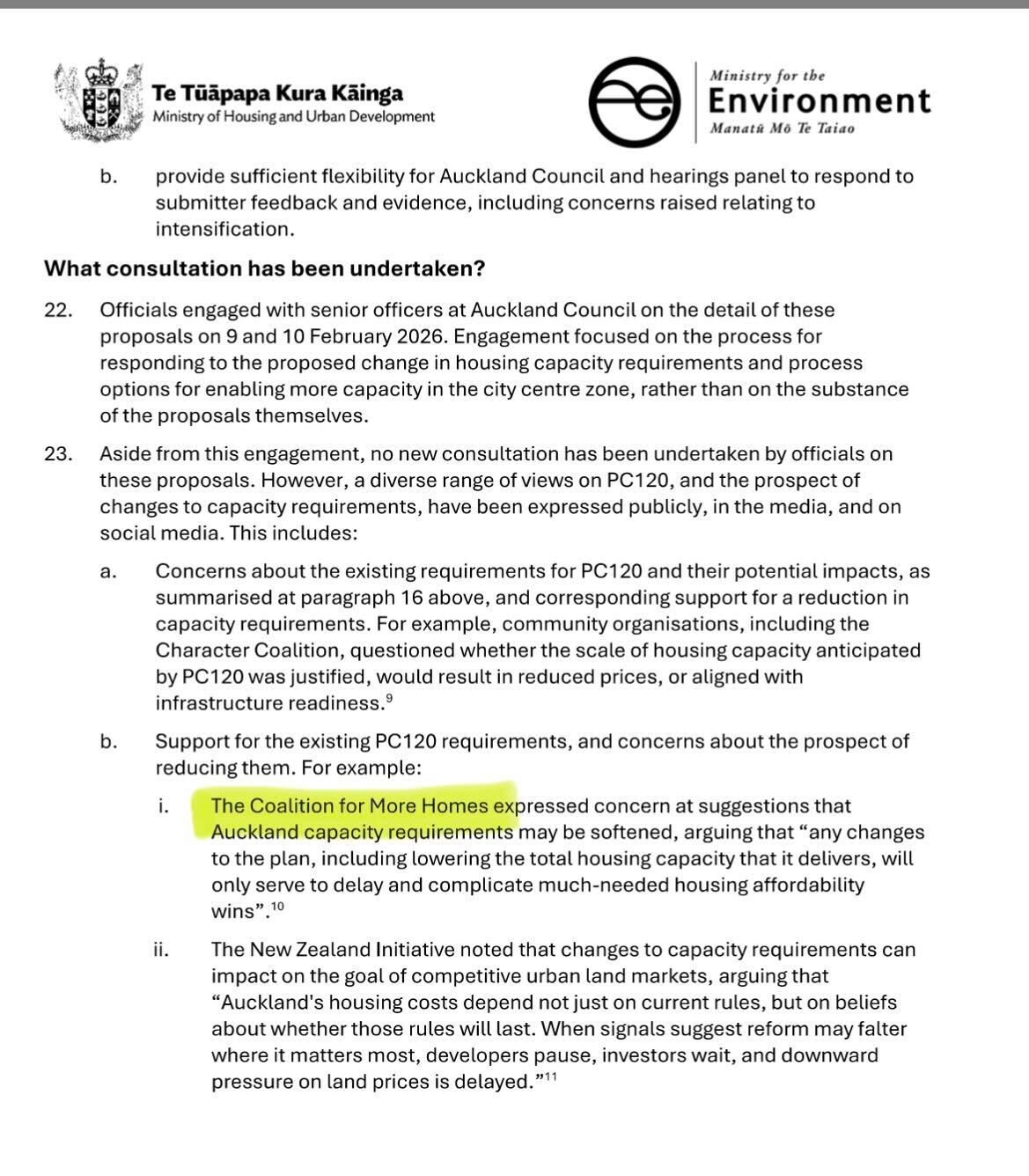
Related: our homies, the Coalition for More Homes, are quoted in the (scathing) Regulatory Impact Statement on the housing capacity backtrack.
For whom the road tolls
You have to read between the lines of this RNZ story about people reckoning with the proposed tolls for Warkworth to Te Hana, to see the impact of our recent work on the subject, by Connor and from Matt. But it’s absolutely there, in comments from regular commuters, the NZ Automobile Association, and the National Road Carriers.
For Anna Giddens – who lives in Mangawhai but works four days a week at the University of Auckland, it could mean around $2600 a year in tolls – if she had to pass through all three electronic gates.
If she could avoid the northernmost toll gate she would still pay $2100 a year.
…
Giddens questioned the equity of requiring Northlanders to pay tolls while other recently completed roads – such as the Waikato Expressway and Transmission Gully, both of which cost more than $2 billion – were toll-free.
“I understand that the cost of this is incredibly high. It’s probably the highest cost for a road construction project in this country ever, and I guess we don’t have the money. But it does seem disproportionate that the North is being tolled, compared to other parts of the country.”
It sure is one of the costliest proposed roads in this country, and maybe even the world (so far). And as Matt points out, even incredibly steep tolling won’t even touch the sides.
Taking the fuel crisis more seriously
While our government continue to pretend that everything is business as usual, around the world other countries are trying to reduce demand and accelerate efforts to get off oil. Will our government listen?
In Australia, Prime Minister Anthony Albanese is suggesting people use PT if they can (you can see his speech here):
“Think of others in your community, in the bush and in critical industries. And over coming weeks, if you can switch to catching the train or bus or tram to work, do so. That builds our reserves and it saves fuel for people who have no choice but to drive,” he said.
…..
“No government can promise to eliminate the pressures that this war is causing. I can promise we will do everything we can to protect Australia from the worst of it,” he said.
In Europe, there’s increasing talk of reducing demand:
The European Commission is asking member countries to consider cutting back on oil and gas use, especially in the transport sector, in preparation for “prolonged disruption” to energy supplies from the Iran war.
The request, made by EU energy chief Dan Jørgensen, reflects fears that the conflict in the Persian Gulf is graduating from a price problem to an all-out energy supply crisis, with serious implications for the global economy.
In a letter to national energy ministers, seen by POLITICO, Jørgensen said that national governments should consider “voluntary demand saving measures … with particular attention to the transport sector.”
That could mean governments asking citizens to drive or fly less to save fuel for more essential purposes, as is already happening in some Asian countries.
European energy ministers will hold an emergency meeting Tuesday to discuss how to address the energy crisis.
And if you want to see one of those “maps of the world without New Zealand on them”, here’s the International Energy Agency, with a list of what countries around the world are doing in response.
Meanwhile, these measures aren’t just a boon to those who need them most, they’re also a deep well of communications content, with people and countries sharing experiences and examples from all over…
The walking ban was an April fool’s joke here, but…
We may have been joking in yesterday’s 1 April post – but elsewhere, people have really banned from walking – to school. In Australia, a 32-year ban on kids walking to school in coastal New South Wales has just been overturned.
Carroll College Year 12 student Lukas Muir lives locally and catches the bus.
He said being able to ride to school would not only save time but also save him money on fuel when he gets his driver’s licence.
“I’ve got a mountain bike and not being able to take that into school has been a bit rough, especially since I live so close to school,” he said.“Fuel prices are crazy at the moment, so I reckon riding will be a lot cheaper [than driving].”
When you read the history… it seems progress does happen:
When the Catholic secondary school was built in 1994, the speed limit on the main road next to the school was 100 kilometre per hour.
“When this meeting happened, George Bass Drive was a 100-kilometre-per-hour speed zone, and there was not much infrastructure on the road,” Fr Scott said.
The speed limit has changed significantly since then.
“We now have a roundabout on Broulee Road, we also have a 40km/h zone in front of the college during school hours, and hopefully there’s the possibility of another roundabout in the area, which will slow down traffic,” Fr Scott said.
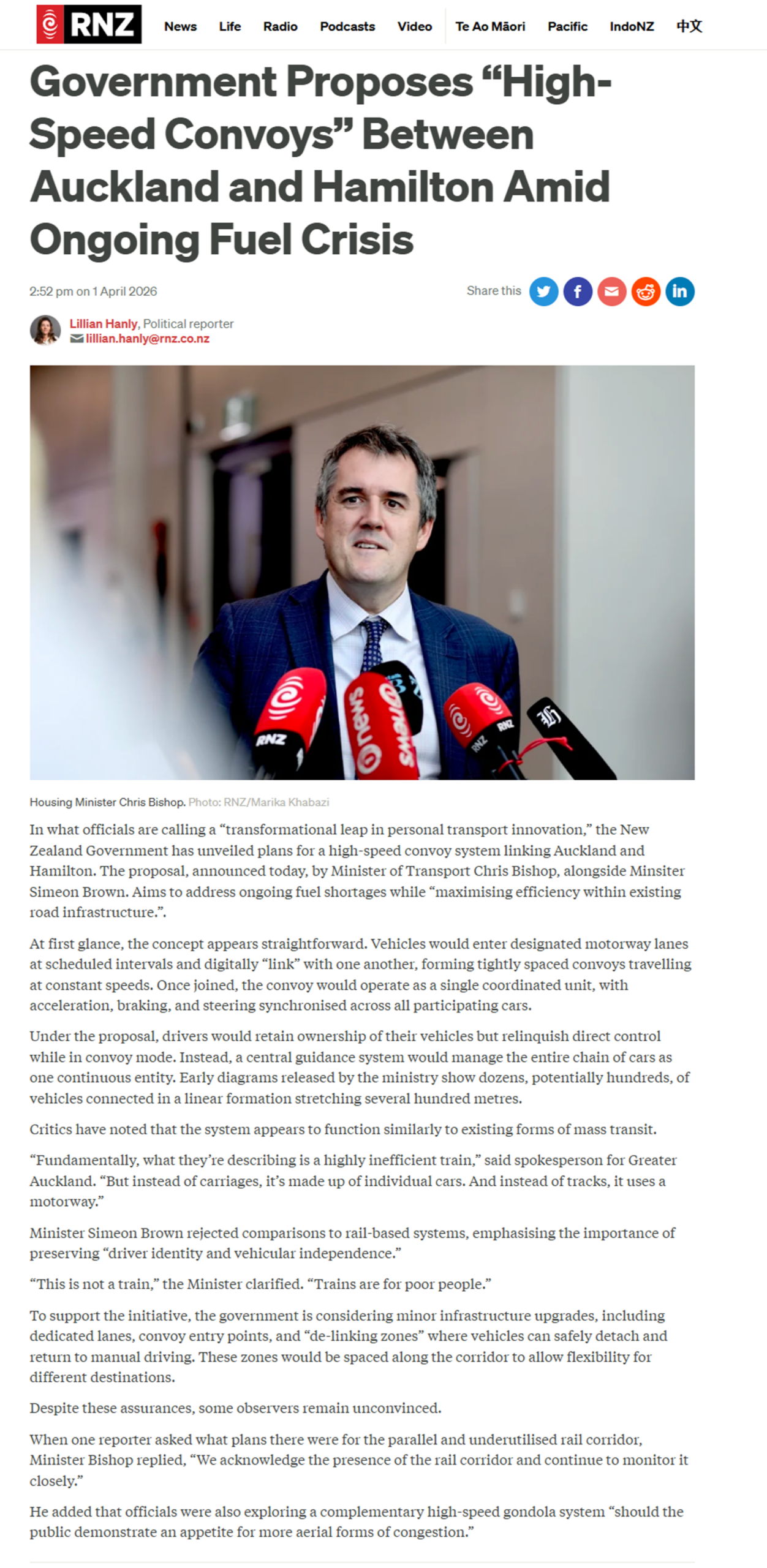
Speaking of April Fools
Here’s a few good ones from around and about. First, via one of the many great Auckland bus fan-accounts:
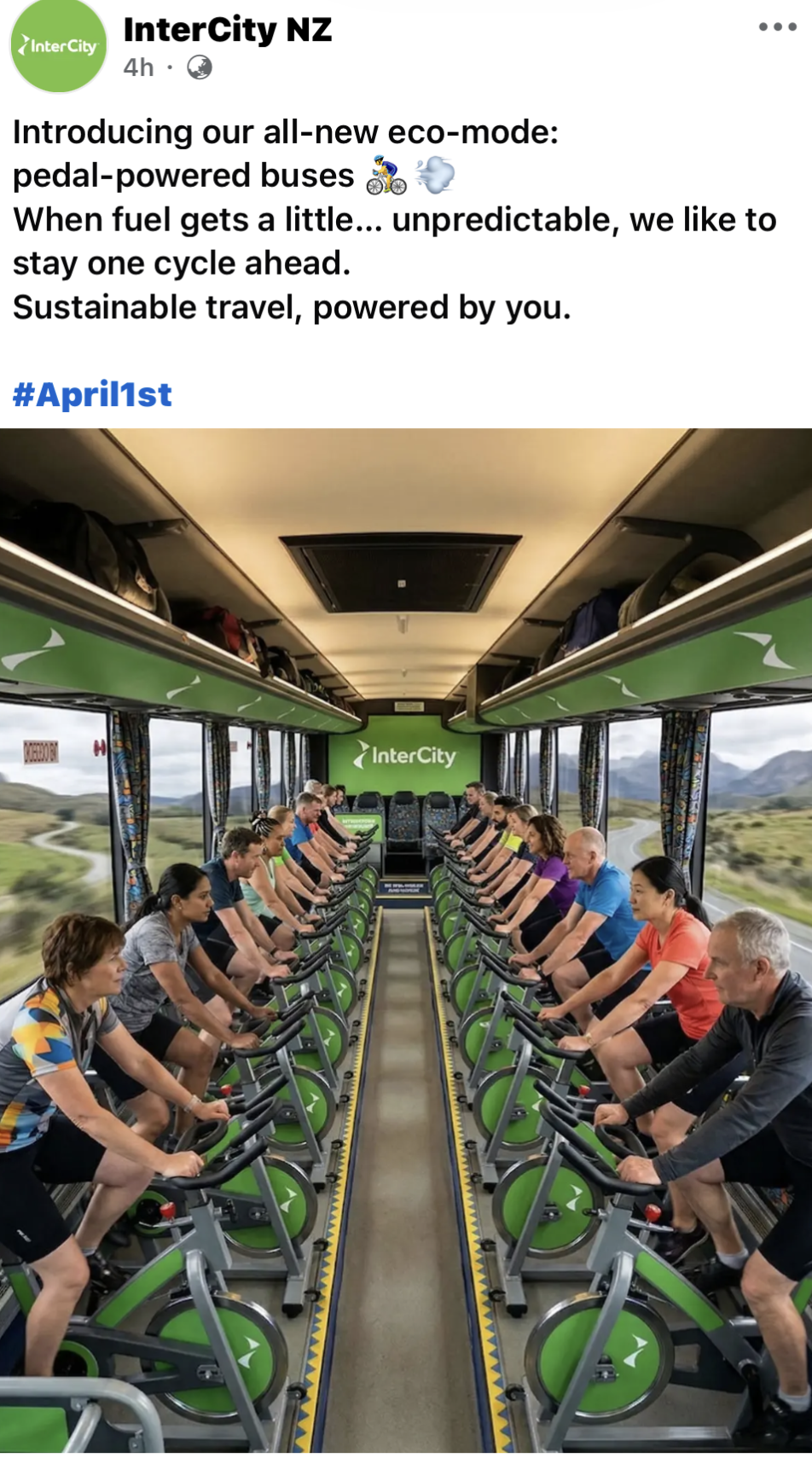
 And here’s InterCity NZ’s effort:
WorkRide, which backs businesses to empower employees to acquire e-bikes for commuting purposes, announced that it behooves them to add another option to the scheme…
The Opportunity Party came up with a high concept solution to the ongoing Cook Strait Ferry woes, using “abundant locally sourced atmospheric energy.”
And, coming in over the top, Rewiring Aotearoa set up a whole website about pivoting to becoming Refueling Aotearoa, based on the recent discovery of abundant proven reserves of snake oil (and a $200m anonymous donation asking them to “shut up about electric stuff”:
There has been a huge amount of independently verified research showing electrification beats fossil fuels on economics, efficiency, emissions and energy security and that there is a huge opportunity for New Zealand to electrify, but the discovery of an almost infinite supply of snake oil in New Zealand has changed everything, he says.
…..
We may not have snakes in New Zealand now, but we have managed to make what is the largest snake oil discovery in the nation’s history. It turns out what we’ve been needing this whole time is not cheap renewables, but cheap snake oil.
Rewiring Aotearoa
Speaking of Rewiring Aotearoa, they’ve launched a new campaign to highlight what EVs can do – as a constructive response to the lazy “Yeah well but can they [insert thing that a person does maybe once a year if at all].” Reckon we need an e-bike version of this, too?
Vision Zero works for train safety too
RNZ reports on a review of a 2024 freight-train near-miss incident, which urges KiwiRail to do better. Emphasis added, to highlight the Safe System approach. Given the history outlined in the article, KiwiRail can surely do more, sooner, than just “consider” the recommendations?
The Transport Accident Investigation Commission (TAIC) has called on KiwiRail to implement engineering controls that would stop trains automatically if they run red stop signals.
It said controls were already in place in some parts of the country, but had not been adopted nationwide.
…
The commission called for stronger action from KiwiRail, the New Zealand Transport Agency (NZTA) and the Ministry of Transport to address the high rate of SPADs.
TAIC’s chief investigator of accidents Louise Cooke said while there was evidence to suggest the driver was distracted by their mobile phone, the report was about a lot more than just distraction.
“It’s about distraction meeting a system when there’s just no safety backstop.”
Rules and procedures alone were not enough to prevent accidents, she said.
“People will make mistakes – that’s human nature – so the system must stop those mistakes before they turn into an accident.”
Western Springs to get a ‘bowl’ stadium
Auckland Council has made a decision on the future of Western Springs:
Auckland Council has endorsed a proposal to develop Western Springs Stadium for concerts, festivals and sport.
On Tuesday, the council’s Governing Body voted 15 to 6 to develop the 97-year-old venue and turn it into a boutique bowl-like stadium.
The decision included an investment of up to $2.5 million by venue owner Tātaki Auckland Unlimited (TAU) to enhance the venue for concerts and festivals, alongside continued community use and a lease extension to Ponsonby Rugby Club.
TAU will install semi-permanent staging and target festivals and concerts for up to 30,000 people at general-admission events, as well as an upgraded broadcast-quality sports configuration for events with up to 5000 fans.
Auckland Council said the model aimed to improve the venue’s use and address a gap in the region’s stadium network for mid-sized events.

What AT should be doing in the City Centre
While AT and Council continue to put more cars in Queen St, over in Melbourne they’re looking to get cars out of even more areas:
Several of the CBD’s busiest strips will soon be a lot more pedestrian-friendly, as the City of Melbourne has just announced a $5-million plan to make several thoroughfares more walkable, starting with Flinders Lane.
As reported in The Age, the soon-to-begin works will raise the road to the same level as the footpath, while adding cobblestone sections to provide passive obstacles that slow traffic. Yet the pedestrianisation of Flinders Lane is just the beginning.
Once works are completed, the council will turn its attention to the rest of Melbourne’s “Little” streets: Collins, Bourke and Lonsdale. Plus, popular laneways, including Liverpool Street and Crossley Street, will become pedestrian-first. The news follows another CBD infrastructure announcement, with $2 million budgeted for decorative lighting that reenergises key areas of the city.
Swapping driving (and a driver’s point-of-view) for a fresh perspective
From Ireland, a lovely read on how things look different when you move around in new ways:
One of the first things I noticed when I started driving less and walking or cycling more is how, at the end of a day, I often have an inexplicable sense of excitement, as if something remarkable has happened – and yet all I’ve done is cycle to a work meeting or take a circuitous walk to Aldi.
Some of this is the endorphins of exercise, but on the best days – when the rain holds back just for the right half hour, and milk-bottle-chested gulls swoop overhead as I ride the coastal bike path – it feels as if I’m on holiday in my own city. Seen on foot or bike, streets are detailed, different. Paths and short-cuts become as important as roads. Buildings, gardens, trees, flowers, people’s faces – the enormous ecology of city life is there to be studied up close as I move slowly through it.
Instead of visualising the city as a map of roads and destinations, where I have, for example, to get from point A (home) to point B (my children’s school), I see a whole landscape upon which a city has grown. The in-between parts are as alive to me as the destinations. I notice the gentle undulations as well as the steep hills, I feel the cobbles, tar and varying gravel mixes under my feet or reverberating under my bike seat. I can tell you the orientation of every street by remembering whether the sun falls on my face or back. It is as if an insulating layer around my body has been removed.
It’s pertinent to New Zealand, where we have world-leading car usage, as per this RNZ report which shares the latest data from Ipsos. Still, a third of us don’t actually use a car as our primary mode of transport – which gives us something to work with:
Ipsos’s latest mobility report, which covers 31 countries, showed New Zealanders were particularly reliant on their cars. Across the world an average 43 percent said it would be impossible to live without a car, but that rose to 51 percent in New Zealand.
Another 36 percent said they could live without their vehicle but preferred to have it.
Across the 31 countries, 39 percent of respondents said their primary mode of transport was car – but that rose to 66 percent in New Zealand, ahead of 64 percent in the United States.
That may be an issue when oil prices are rising fast.
A money-saving move
If you’re thinking of switching from car to bike (or e-bike, the handiest EV now that many dealers have sold out of the four-wheeled kind for the foreseeable future) or even walking, that might be the kindest thing you can do for your wallet (as well as for your health and the planet, etc).
Check out this handy made-in-New Zealand “Ride and Save” calculator to see how many dollars you’d save, and also how much CO2. All credit to the anonymous maker!
Ride & Save is a free, New Zealand-focused online calculator that shows commuters exactly how much money they would save by using active transport (cycling, walking, scooter) instead of driving.
Videos to check out
Not Just Bikes has an excellent video breaking down why car dependency is so bad for cities:
They also reference the most accurate car ad ever:
The beginning of this is worth watching, for a good example of how public officials can communicate the value of public transport:
From the socials
View this post on Instagram
View this post on Instagram
That’s it from us – enjoy the long weekend! And as always, feel free to share links and stories in the comments.

 Processing...
And a little pre Easter treat in the form of more train network issues ahead of a long weekend closure, why not.
The upside of living in regional NZ is we don’t have to deal with delays to passenger train services (can we please have passenger train services)
My parents live in Broulee! It is a tiny village of Canberra beach houses, surfers, and retirees. Completely car-dependent, the supermarkets in Moruya or Bateman’s Bay are a twisty hilly 15+ km drive away.
I always found it strange how that school is on the highway, tucked away from the village, and I didn’t know about the walking “ban”.
The police take the speed limits seriously. They’re often parked outside the school and I’ve seen them pull over drivers for speeding and overtaking school buses.
AT, AT, AT… Argggh
I thought I was going to be delighted by that video about footpaths being for people, not cars. I thought, Great, I can give some positive feedback.
But it’s not “Easy As” is it? Your video demonstrates that perfectly.
Do you think inspecting a car for all that information is stress-free, let alone photographing it, when there is a chance of abuse from the driver noticing you? Hard enough to use a phone for filling out a form outside as it is, with glare and so feel street trees to stand under. And as you have to declare it’s current, you can’t go back home or to work to report it.
There are better, easier reporting systems than this.