This is a guest post by Transport Advisor and Town Planner George Weeks, written in a personal capacity reviewing Happy By Design by Ben Channon Revised Edition.
You can check out past book review posts here.
Where’s your favourite place in Auckland? What about it makes you tick? How do you feel when you go there? Why do you keep going back?
These questions are all examples of Environmental Psychology, an established academic discipline that is not particularly well known, yet universally relevant. It’s a science that studies the impact of our surroundings on our minds and bodies.
We have all met cynics who dismiss emotions – particularly about buildings – as “nice-to-have”, “fluff” and “subjective”, but most people will agree that humans respond to their environments. Our relationship with the built and natural environment determines our memories, our behaviour and our lives. It affects our mental wellbeing and the success of a city, in a positive or negative way.
Architect Ben Channon turns theory into practice with his book Happy by Design. This pocket-sized tome examines seven themes that universally determine how people feel about their surroundings. These themes can inform the design of anything, from a bookshelf, to a building, to a city.
All – and I mean all – the assertions in this book are supported by academic and/or professional literature. Notes and references occupy 33 pages; roughly 20% of the book’s total length and are presented in the same accessible and readable style. While mainly focussed on buildings, the lessons contained within are equally applicable to the spaces in between them, i.e. urban design.
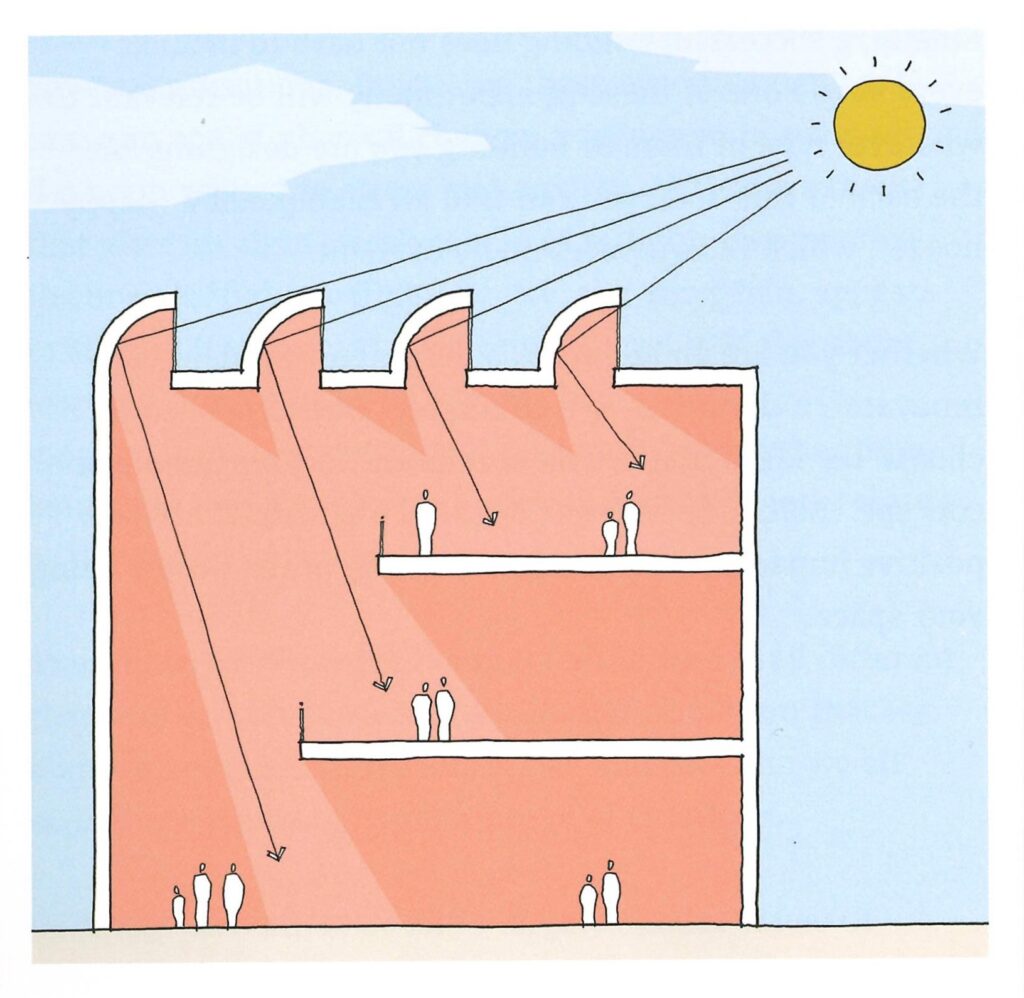
As with the Old Testament, we start with light. We need it – particularly daylight – just try staying in a hotel with no windows. Different colours and intensities of artificial light can generate different reactions, while a well-placed lamp can invite people to sit and relax. Look how the outdoor lighting at a luxury resort makes guests feel calm and welcome. Auckland’s Wynyard Crossing uses the same approach.
From light, Chapter 2 moves to comfort which (p.27) “…plays a vital role in helping us to reax and feel calm and safe, all of which are key to happiness.” Tactile buildings invite us to touch them; look at the popularity of the Kawakawa public toilets, designed by tactile architecture künstler Friedrich Hundertwasser. The sense of touch is often overlooked, but is fundamental to comfort; compare a warm soft chair with a cold hard bench.

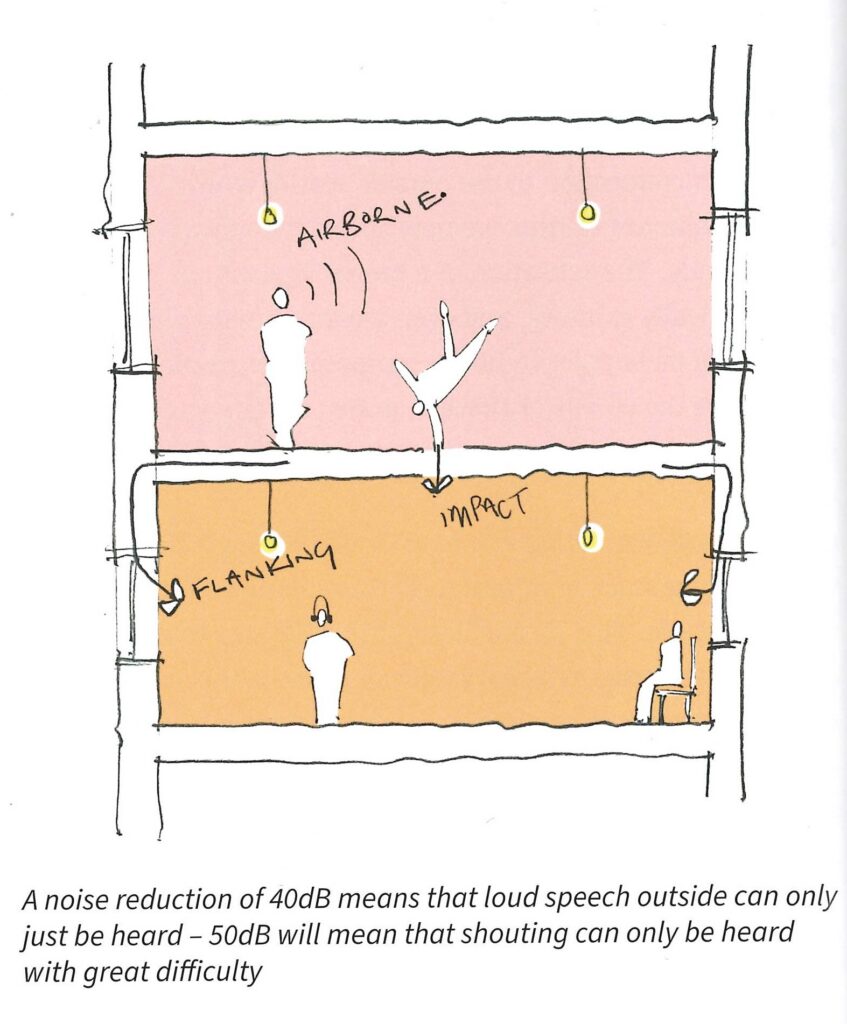
Discomfort can come from noise, which can ruin a person’s mental wellbeing. Acoustic insulation can make the difference between a happy building and an awful hellhole – architects should read Medium by Professor Guy Marriage. Want a happier place? Reduce or remove uncontrolled noise.
Chapter 3 develops this theme into Control of your surroundings. A lack of control in an urban area can be distressing, but control can be given via simple things like moveable public chairs. Feelings of control and choice bring happiness. At work, successful office design gives people control with different types of spaces. We learn also about privacy and personalised spaces; rare privileges in a world of open-plan hot-desking.
A good way to increase privacy, particularly in dense residential areas, is to use street trees, and this brings us onto Chapter 4: Nature, probably the best-known aspect of environmental psychology.
Humans’ innate appreciation of nature has been proven beyond reasonable doubt. Hospital patients who can see trees recover more quickly. Exposure to nature affects blood pressure, heart rate variability, pain levels and other physiological measures.

Cities have for centuries provided parks and greenspace to relieve stress and provide amenity. Even a small park can provide an “ahh” moment; respite and joy. It is no coincidence that the most desirable neighbourhoods in Auckland are characterised by the abundance of parks and/or access to water.
Chapter 5 tackles Aesthetics. While acknowledging that beauty is in the eye of the beholder, there are rules on colour, proportionality and design that reliably elicit happiness. Classical and Modern architecture both rely heavily on pleasing proportions. Aesthetics can deliver moments of joy and these can be as simple as a flash of colour as in Alvar Alalto’s Paimio Sanatorium or the Greenhouse by Ockham. The aesthetics of streets can make a city legible; easy to understand and enjoy

Physical Activity is essential to our wellbeing, and this is covered in Chapter 6. Design choices can enable us to use our bodies, such as wide footways to prioritise pedestrians. There’s also a page on designing for cycling, to enable independence, control and wellbeing. Spaces designed for inactivity are also vital for wellbeing; quiet, inviting and restful; a place to think; a phrontistery.
Chapter 7 – Psychology – examines the many other things that affect our wellbeing. The importance of storage in a home. The value of high ceilings in at least part of a building. Placing bedrooms upstairs, in a place of refuge (see: prospect and refuge theory). Entrances that are attractive and easy to find (it is amazing how often this is overlooked). Fundamentally, does the design enhance our humanity?

Happy by Design ends by drawing the threads together into a bulleted list of conclusions. For the hardened cynic who remains convinced that designing for mental wellbeing is “irrelevant”, we learn of a building by Landsec (one of the UK’s major commercial property developers) where a WELL certified building raised productivity by 20%. Similar savings occur from acoustic-insulation and other features that increase contentment, reduce turnover, increase desirability and add value.
This is important at a city scale. Places that are disengaging to people and/or fail to elicit positive emotions are throwing opportunities away. Happy by Design empowers us to assess the built environment objectively, from the perspective of the user (i.e. us).
Happy by Design is important because it explains how relatively small decisions about the built environment can have major impacts on our wellbeing. The quality of the human experience determines the appeal and viability of a street, neighbourhood, town or city.
Look at Auckland’s new City Rail Link (CRL) stations. Spacious, attractive and incorporating public art. Does this cost money? Of course. Will this attention to detail make millions of people feel good? Yes – every time they use the station, whether or not they notice it consciously. Civic design should generate civic pride.

The strictures of austerity and a joyless minimum viable product may satisfy those who preach ugliness as a “rational” response. But really, this is an irrational response. Human beings react to their surroundings. To expect identical behaviour in two completely different settings (e.g. a Moorish palace and an Ibizan moshpit) is highly unrealistic.
Tools within environmental psychology like behavioural and sensory mapping (as used by Willam Whyte and Jan Gehl) have shown what this means in more detail. Major architecture practices such as Foster + Partners employ environmental psychologists to add value to their clients’ projects, with specialists for the building/interior scale and public/urban interface. And it’s not just the big firms; it’s true for growing practices like 3XN/GXN and Perkins and Will. Environmental psychology is objective; we ignore it at our peril.
Happy By Design connects the science of environmental psychology to professional practice and does so in a thoroughly accessible style. A follow-up book could look in more depth at the public realm. It could also introduce the Circumplex Model, as a means to quantify feelings as positive/negative and activated/deactivated, thus helping the reader to make their own judgements. It would also be interesting to explore environmental psychology’s relationship with related disciplines, such as neuroarchitecture.
By understanding how our environment makes us tick, we can understand its human dimensions in terms of health and connections. We can choose to support our humanity with comfortable, welcoming environments, or fight it by creating harsh, impersonal, stressful spaces. In other words, humans shape our environment. Let’s create places that make us feel good.
All illustrations (except CRL station) by Ben Channon; taken from Happy By Design.
Greater Auckland’s work is made possible by generous donations from our readers and fans.
We’re now a registered charity, so your donations are tax-deductible. If you’d like to support our work you can join our circle of supporters here.

 Processing...


Thank you for the review, sounds interesting and relevant.
If you use the German word for artist (Künstler), please capitalise it, all nouns in German are capitalised.
Danke schön!
On a slightly different take I am currently reading Tender Maps: Travels in Search of the Emotions of Place by Alice Maddicott. It is a series of takes on atmosphere of place and I have just got to the section on cities in general, rather than specific cities and place. An interesting find on our council library shelves.
If you enjoy youtube videos, you might enjoy the channel of Londoner John Rogers (or perhaps already be familiar). He’s a great ambassador for the whole notion of psychogeography.
Oho! I shall take a look.
Its equally funny and depressing watching the architectural profession re-invent the wheel when it comes to recognising the utility of designing buildings centred around the needs and preferences of actual human beings.
This was all already understood for hundreds of years until the modernist movement and its slavish fanatics came along to blow it all up (thanks to post-modernism the situation is even more acute).
While its good to see attention focused on the human reception to new architecture, I can’t help but think this response risks over-complicating things by relying on some faddish new arm of psychology.
I agree fully with your assessment of the inhumanity of the Modern movement. It tended to produce austere, inhuman buildings and spaces in pursuit of an imagined “rational” ideal.
Conversely, I completely refuse your assertion that this is “…some faddish new arm of psychology.”
Environmental Psychology has been an established academic discipline since at least the 1960s. It is neither new, nor faddish. Have a read of the wikipedia article below. Please be more accurate in future comments.
https://en.wikipedia.org/wiki/Environmental_psychology
Very interesting piece. Sometimes it feels like we can romaticise the past a bit. We love gorgeous classical architecture, squares etc that have been preserved, but forget the slums around them that have been bulldozed. Modernism had many flaws but it was replacing unhealthy slums and raised much of Europe post-war lower and middle class (see the fab book “Four Walls and a Roof”). You’d hope we could arrive at some happy medium but the financialisation of housing means nice to haves are value engineered out or just the preserve of luxury developments. What to do…..
There’s no rule to say that a Modernist home will make someone miserable; it’s just that many of them did, and still do. An obsession with a machine-like aesthetic gives buildings that are rigid, mechanistic and unresponsive. If you don’t feel “at home” when you’re at home, this will lead to unhappy residents.
This is covered in Happy By Design under ‘Control’, which is a characteristic that I think is frequently overlooked. If your home gives you no control over your life and surroundings, it is horrible to live in, for example:
– relying on mechanical ventilation, lifts and services
– noise transmission
– lousy thermal insulation
– non-opening windows
– rules around planting, decoration, etc
Re. financialisation, Louis Hellman has a good cartoon: https://s3-eu-west-1.amazonaws.com/emap-nibiru-prod/wp-content/uploads/sites/4/2017/12/20115651/hellman9.jpg
I think the original commie blocks in the Soviet Union are also heavily underrated for being nicer than what they replaced. And lo and behold, here we are today in Auckland, building 6 storey apartments.
Regarding acoustic insulation, I have heard it isn’t that expensive, and given the ENORMOUS increase in quality of life it should probably just be part of the building code.
There is this disingenuous argument that “form follows function”. A lot of Modernist architecture sacrifices function for these austere forms. Eaves keep rain water away from walls. Awnings keep the sun out in summer, and the lack thereof is quite infamously a problem in many new townhouses over here. With the Cybertruck we now have a Modernist car, and its form makes it functionally worse in many ways. Eg. it is much more dangerous to its surroundings than other cars, and the bed is really awkward to reach from the sides.
And decoration, I am sure that making humans feel like they are in a place where humans are plausibly supposed to exist is also part of the function of city buildings.
Apart from Modernist architecture there was perhaps also a planning problem. Many of the residential high rises from mid last century devolved into slums, and have by now been demolished. Maybe it took some time to develop institutions that allow us to maintain high rises shared between many owners.
Good article – thank you.
Ta!
Fantastic review of Happy by Design, George!
A powerful reminder that good design helps equals good wellbeing. Even small changes in lighting, nature and aesthetics can totally transform how we experience our cities.
It is so true that the spaces around us shape how we feel, think, and live — and that thoughtful design shouldn’t need to be a luxury, but a pathway to healthier, happier cities.
See you around Te Wharau O Tāmaki, Auckland House.
Thank you Cara. Fundamentally this comes down to a basic quesion: Do we benefit from being somewhere, or not?
The answer to this question can largely be determined through design and management.
Great review. This also reminds me of the lack of colour we see in our private and public spaces now, in comparison to say the 1970s. Cars, houses, public spaces. Bring back bright yellow, orange and pink! To go with the beautiful blue and green of our natural world.
Colour is good. Greyness is pervasive and awful. Grey houses with grey furniture, with a grey car parked outside. Ubiquitous from Florida to New Zealand.
If you buy a new car you often have to pay a premium for a color other than white or grey.
And Resene can limit their color palette to Landlord Beige and Rental Grey and barely lose any business.
Part of that last one is probably downstream of people moving often. If people move all the time houses have to be kind of neutral, and not offensive to anyone. And most effort to make homes somewhat nice is wasted. Whereas if you own your home and you know you’re going to stay there for probably the rest of your life, then you can really make it yours. Pick colors, decorate, etc.
When house hunting if I walk into houses with stark white walls or in a gloomy shade of grey I don’t get the warm-fuzzies that make me want to buy it. Thankfully there are less grey interiors now, but still too many with stark white walls that feel too clinical.
I was attracted to my current house after seeing endless listings of clinical grey properties filled with clinical grey furniture. I couldn’t tell one from the other, but all felt like doctors’ waiting rooms.
Certainly possible to quantify daily experience in public places. Think of your journeys and activities as a string, with special beads for the special places, filler beads for the dull stretches and barbed-wire spikes for the truly awful spots (some huge signal intersections, however you’re travelling!).
Yes. Environmental psychology has great tools for doing this. The Circumplex model is excellent and is used widely: https://psu.pb.unizin.org/app/uploads/sites/251/h5p/content/8/images/file-5fd0e3d277b8b.png
Journal of Public Mental Health
4(4):10-20
To be discovered, I wonder what the acoustic environment of the CRL stations will be? One of my least favourite places in Westfield Albany, where the ambient noise is horrid.
Good question. They will definitely have calculated this but I have no idea. Ambient noise can really get up people’s noses: https://www.bluewin.ch/en/news/international/more-and-more-people-in-spain-are-fighting-the-noise-2780405.html
This is the best quote ever about this. Attributed to Enrique Peñalosa, Mayor of Bogotá, Colombia
“It is interesting that so much is known about good habitats for mountain gorillas and Siberian tigers, while, at the same time, only very little is known about a good urban habitat for Homo sapiens.”
Enrique Peñalosa is one of my favourite ex-mayors. I think this quote, while apt, isn’t strictly accurate. We know a great deal about the components of good urban habitat for Homo sapiens; we’re just not always very good at putting the knowledge into practice.
I listened to this interesting article on RNZ recently talked covered some similar points: https://www.rnz.co.nz/national/programmes/saturday/audio/2018997246/designing-with-nature-in-mind.
I wish our new developments put more effort into thinking about the wellbeing of future residents – designing for sun (but minimising heat issues), more storage, more green space, etc etc. I note the point above about storage, and most new developments have very little. In the past some people used garages for this purpose, but these have disappeared from many newer developments. When you look up at many newer apartment blocks the balconies are packed full of “stuff”.
I was interested in the comment on having bedrooms upstairs. I have a disability and it really restricts options when house hunting. I wish there was a bit more variation in the design of new housing to cater for the wide variation in wants and needs.
Yup. A balcony that contains a freestanding cupboard and one or more bicycles shows that there’s not enough space to keep things in the property.
Ben Channon (who wrote Happy By Design) said: “I started writing it almost ten years ago, in response to what I saw as a ‘demotion’ of the importance of the end user in many modern building projects.”
Re. upstairs bedrooms – point taken. This comes back to chapter 3: Control. Being able to choose where to place the bedroom is an example of control, and arguably a reason why people like the idea of building their own house and having control over this type of decision.
One of the first ( and pretty succesful) businesses set up on Hobsonville Rd after the new developments at the Point was Storage King. I guess it is a two way thing the developments have to be designed for residents but also at somepoint the residents have to adapt to the lifestyle of the development.
Ka pai
Thank you!
I read somewhere that the basic requirements for emotional and psychological health are, in order –
1. food
2. shelter
3. satisfactory social relationships
4. trees.
– as inherited from our remote ancestors on the African savannah.
Sounds logical, and consistent with other models like Maslow’s hierarchy of needs. Any idea about the source?
Really enjoyed this review. I’m very on board with the idea that the built environment shapes how people feel. You only need to spend time in a genuinely walkable, green, human-scaled place to know that design matters.
That said, I found myself wondering if the argument gets presented a little more cleanly than reality tends to allow.
There is solid research linking greenery, light, walkability and human-scaled environments to improved wellbeing. But most of that research is contextual and probabilistic. It shows influence, not certainty. The environment shapes behaviour and perception, but it does not operate independently of economic and social conditions.
You can build a beautiful public square, but if people do not feel safe there, or cannot afford to live anywhere near it, the wellbeing effect is going to look very different. In Auckland right now, housing affordability, commute times from affordable homes, and infrastructure constraints are major determinants of daily stress. It is difficult to separate “happiness by design” from those structural pressures.
Density is a good example. The urbanist case for intensification makes sense, and I support it. More housing near jobs, better transport efficiency, more vibrant neighbourhoods. All positive goals. But unless construction costs, land prices, and financing conditions align with what people can realistically pay, it risks remaining largely theoretical.
CRL is similar. It will absolutely improve accessibility and reshape parts of the city for the better. But whether it meaningfully improves wellbeing across a broad cross-section of Aucklanders depends on what happens around it. If housing delivered near stations lands at price points that most households cannot access, or if projects pause because pre-sales do not materialise, the happiness dividend becomes uneven.
Urban form can be persuasive in a diagram. The spreadsheet and the housing market still play a decisive role in determining who benefits.
I also think where we live shapes what we prioritise. Auckland is not experienced evenly. Someone in a stable inner suburb like Newmarket or Ponsonby will naturally experience the city differently from someone further out juggling high rents and long commutes. Those perspectives are not in conflict, but they do shift what feels most urgent in planning conversations.
The review does a good job explaining why the book’s thesis is appealing. I just think the argument becomes more interesting when we acknowledge how layered and contingent all of this is. Design absolutely matters. It influences behaviour, mood, and everyday experience in real ways. But it interacts with affordability, delivery, and market reality.
Happiness by design is a compelling aspiration. Delivering it in Auckland likely requires as much attention to feasibility, economics, and access as it does to street trees and seating layouts.