It’s Friday again, following a very wet few days. Our thoughts go out to all of the people impacted by the weather and flooding, as the growing impacts of climate change make themselves increasingly felt across the motu.
This week in Greater Auckland
- On Tuesday Matt took a look at road deaths last year.
- On Wednesday we had a book review from George Weeks.
This roundup, like all our work, is brought to you by the Greater Auckland crew and made possible by generous donations from our readers and fans.
We’re now a registered charity, so your donations are tax-deductible. If you’d like to support our work you can join our circle of supporters here.
AA on Road Deaths
On the topic of road deaths, the AA has an op-ed with some suggestions on how we can keep lowering the human toll:
For the second year in a row, New Zealand has recorded the lowest road death rates seen in modern times. Just 272 people died in 2025, down from 292 in 2024.
Once you account for the size of our population, you have to look back to the 1920s to find a lower fatality rate from crashes. It’s an extraordinary milestone and effectively means about 70 less lives are being lost in crashes annually compared to just two years ago.
The AA hopes this is the start of a new era for road safety in New Zealand after decades of being among the worst in the developed world.
They suggest more training for new drivers, more enforcement, including cameras able to detect phone use or people not wearing seatbelts, stronger penalties to improve driver behaviour, and more investment in barriers and intersection upgrades. (Safer speeds don’t get a mention.)
Trains on the tracks, but no passengers (yet)
We are thankfully rapidly approaching the end of the current rail shutdown, with full service returning on all lines next Thursday. The rail works themselves will finish on Monday and Auckland Transport will be conducting a full network test for the City Rail Link:
For two days after Auckland Anniversary, the train network will be closed for the first full trial of the new post-City Rail Link timetable. This milestone test will help ensure reliable, seamless services from the first day of CRL opening.
Bus replacements will be very busy, so Auckland Transport is asking commuters to plan their journeys and consider alternatives after the long weekend.
What is happening during the test?
Eighty-four trains—the most ever run across Auckland’s metro network—will put the City Rail Link’s high-frequency timetable to the ultimate test in one of its biggest milestones before opening later this year.
For the first time trains will run through the City Rail Link tunnels and right across the network, to ensure the CRL performs as designed and the new timetable is reliable.
“Up until now, we’ve only tested around the inner-city loop, but running so many trains right across the network is very different,” says Stacey van der Putten.
“Years of planning and modelling have gone into developing the new timetable, but real-world testing often throws up variables we can’t predict. Seeing it put into practice will be extremely exciting and a little nerve-wracking.”
“We’re also aiming to simulate real operations including peak and off-peak timetables and how AT trains will operate alongside KiwiRail freight trains. Carrying out these tests now gives us time to resolve any issues before we open the CRL and launch our new network later this year,” says van der Putten.
…..
While people will be able to see trains moving across the network, all AT rail services and stations will be closed.
“We know this will be inconvenient for those who rely on train travel, including those returning from summer breaks. We need to do this testing on weekdays, during the day, to have enough train drivers and train managers available, with more than 280 people required to simulate two days of full operation.”
Some people have already noticed the timetables being shown on the station display boards, such as these on display behind the gates at Karanga-a-Hape. (You’ll recall, we have some thoughts on those line names, which you have to hope are just a working title…)
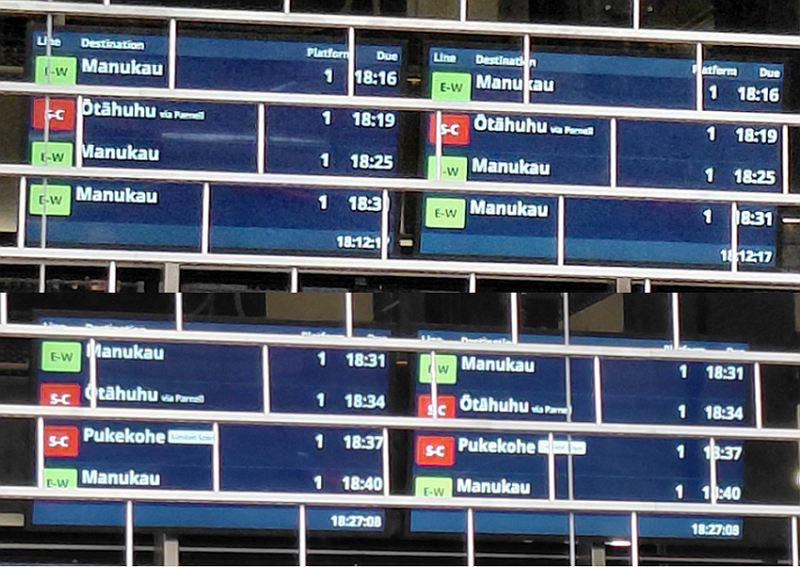
And here’s a list of the other currently planned upcoming closures:
- 6 – 8 February (Waitangi Day long weekend) – No trains running on all lines.
- 28 February – 1 March – Partial closure on the Eastern Line between Waitematā and Ōtāhuhu.
- 14 – 15 March – Southern Line closed south of Puhinui. Eastern Line closed between Ōtāhuhu and Waitematā (Manukau to Ōtāhuhu served by Southern Line trains).
- 22 March – Full network closure for CRL timetable testing
- 3 – 6 April (Easter long weekend) – No trains running on all lines.
- 7 – 12 April (School Holidays) – Southern Line closed south of Puhinui. Eastern Line closed between Ōtāhuhu and Waitematā (Manukau to Ōtāhuhu served by Southern Line trains).
- 13-15 April (Dates may change but will remain within the school holiday timetable) – Full network closure for CRL timetable testing
- 25 – 26 April (Anzac Day) – Trains will run in the morning on Anzac Day (25 April) until 2pm to enable people to get to morning services. From 2pm on 25 April and all day on 26 April, there will be no trains running on all lines.
The cost (benefit!) of cycleways
Hayden Donnell at The Spinoff highlights why even the most ardent fiscal conservatives should want us to be rolling out more cycleways, pronto.
It’s 8.30am and the cycleway running alongside Auckland’s northwestern motorway is congested. E-bike riders swerve around the slower pedal pushers on analogue cycles. Scooter riders hoon past them all in the direction of the city’s most recognisable and beloved building, the fluorescent yellow Grafton Golf Warehouse. The rush hour commuters are a diverse crowd. Lycra-wearing hardouts mingle with suited up businesspeople and students in T-shirts. Hundreds of them arrive here, without fail, every weekday for their commute into the city.
Ask some politicians, and these people don’t exist. National’s Simeon Brown consistently derided cycleways during his time as transport minister, calling them a waste of time and money and making a point of deprioritising them in government plans. “There’s less money going into cycleways, and I think New Zealanders are sick and tired of the amount of money going into cycleways,” he chirped happily while announcing the 2024 National Land Transport Programme.
…..
More people now use Auckland’s cycle network to get to work than its ferry system. According to figures provided by AT, the average number of people entering the city by bike between 7 and 9am was 2,448 in November 2025, compared to 1,841 by ferry.
They do so at a fraction of the cost of other modes. Though some commentators seem to think the cost of cycle paths is outrageous, Auckland Transport is investing $69m of its $1.5bn capital budget in cycling in 2025/26, compared to $70m in ferries, $105m in buses, $285m in rail and $588m in roads and footpaths.
But the real savings come after the cycleways are built. Upkeep amounts to a few cleared branches here or some repainting there. Every other mode costs what’s referred to by accountants as a “shit tonne” of money to run. AT’s opex budget sits at $84.5m for ferries, $181m for roads and footpaths, $351.3m for rail and $558.7m for buses.

Other benefits of cycleways include freeing up kids and parents to get around without cars. A daily scene on Pt Chevalier Road, May 2025. (Photo: Jolisa Gracewood)
Mad about cones
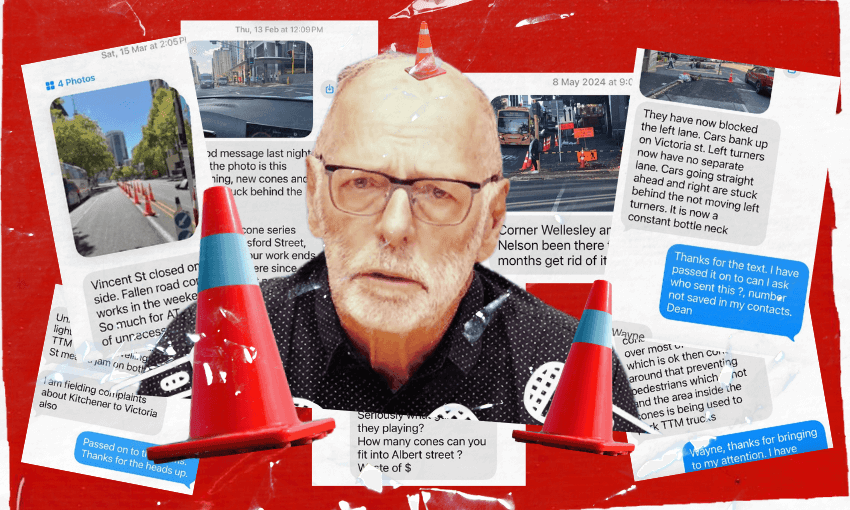
Hayden also had an article last week about Mayor Wayne Brown’s ongoing texts to AT CEO Dean Kimpton about road cones.
We have another trove of the Auckland mayor’s texts to Auckland Transport chief executive Dean Kimpton. If anything, they’re getting angrier and more cone-based.
…..
AT is set to lose most of its powers at some point this year, retaining only its responsibility for running public transport. Kimpton has been tight-lipped on what he plans to do next, only telling The Spinoff his role is fundamentally changing and he’s considering his future. But if he’s writing a pros and cons list for staying versus going down with the ship, it’s easy to imagine “diminished volume of cone complaints” occupying a high ranking when it comes to the potential benefits of a new role. With him gone, the mayor will likely need a new pressure valve for his bouts of rage. Something specially designed to field his most burning complaints. You could call it a hotline.
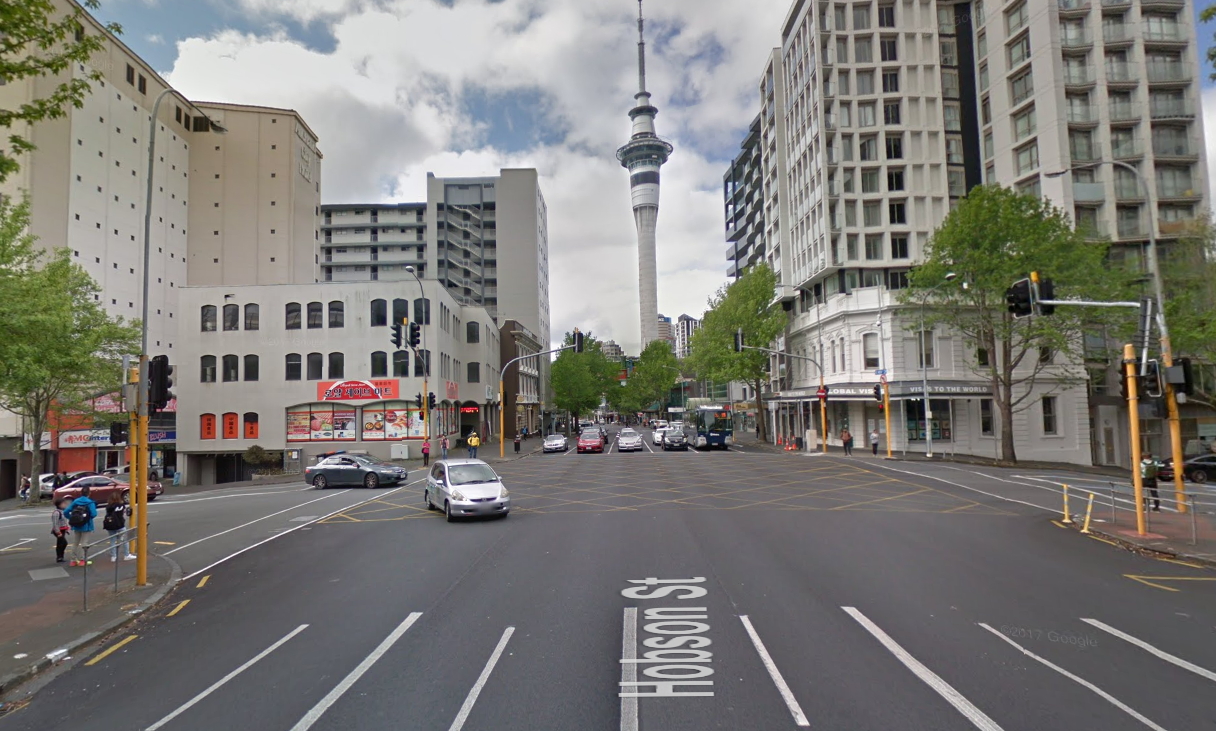
Thinking of Hobson and Nelson Streets…
This article, originally from the AP, looks at why cities are starting to revert large one-way streets back to two-way. Which is exactly what we should be doing with Hobson and Nelson Streets in the city centre… and with thoughts about removing the Hobson St flyover coming up, now’s the perfect time to talk about it.
Excessive speeding was so common on parallel one-way streets passing a massive electronics plant that residents in the US city of Indianapolis used to refer to the pair as a “racetrack”.
…..
The resumption of two-way traffic has been part of a trend in some US cities and other centres around the world.
Embracing the oft-repeated slogan that “paint is cheap,” transportation planners across America — particularly in midsize cities — have been turning their unidirectional streets back to multidirectional ones.
They view the step as one of the easiest ways to improve safety and make downtowns more alluring to shoppers, restaurant patrons and would-be residents.
A street design U-turn
Dave Amos, an assistant professor of city and regional planning at California Polytechnic State University, said almost no major streets in the US originated as one-way routes.
Two-way streets were the standard, before mass migration to the suburbs prioritised faster commutes over downtown walkability.
“One-way streets are designed for moving cars quickly and efficiently,” Amos said.
“So when you have that as your goal, pedestrians and cyclists almost by design are secondary, which makes them more vulnerable.”
Cities for Families
On the topic of redesigning our cities, here’s a great piece from Newsroom on why we should design cities for families.
Urban life can be enriching but exhausting for new parents. Between managing sleep-deprived nights, feeding schedules, and the daily logistics of moving around with small children, even short trips outside can feel like a challenge.
Yet our new research with 157 new parents across Aotearoa New Zealand shows walking during early parenthood is far more than a mode of transport – it can support mental and physical health, community connection, and belonging.
Parents in our study described walking as a way to restore calm, reconnect with themselves and their children, and feel grounded in their neighbourhoods. These walks were seldom only about exercise; rather, they were small acts of wellbeing woven into daily routines. As one participant said: “Walking is what keeps me sane as a parent.”
…..
Aotearoa’s urban planning systems have historically prioritised efficiency – how quickly we can move from A to B – rather than the quality of that movement. Decades of car-centred design and fragmented suburban growth have left many neighbourhoods ill-equipped to support the mobility of new parents and slow pace of walking with children in tow.
Yet it has long been recognised that supportive environments are key to promoting mental and physical wellbeing in cities. Bringing urban planning into closer dialogue with public health opens an opportunity to rethink cities as infrastructures of care: places designed not just for mobility, but for connection, health, and inclusion.
In our research, we introduce the concept of parent-centred urbanism – an approach that places caregiving at the heart of city planning and design, and recognises the everyday experiences of those raising children as central to urban health. This means valuing the small, slow, and often invisible mobilities that sustain family life: the daily walks, stroller trips, and park visits.
To wave, or not to wave?
From last week, but an interesting article on bus etiquette in different cities across Aotearoa, and if you need to wave to flag down a bus. Here’s Wellingtons:
The Metlink website said bus drivers would stop, if they saw someone waiting, but encouraged passengers to wave, so they could be seen by the driver.
Metlink senior operations manager Paul Tawharu said waving was helpful, but not a requirement.
“What we do ask customers is that they make themselves visible to the driver,” he said. “Passengers don’t need to wave.
“There’s some of our passengers that are visually impaired. You might have mums with babies in arms that just can’t do that, so that’s not expected.
“If the passenger is at the bus stop, then the driver is expected to stop.”
Interesting they note some folks can’t wave, where ATs response doesn’t:
Auckland Transport service operations manager Duncan McGrory said the transport provider had signs at every bus stop, asking passengers to indicate they wanted to board with a “clear wave of their arm”.
He said Aucklanders took up to 230,000 bus trips every weekday and the growth of the network over the last 15 years made hailing the bus crucial to keeping things running smoothly.
“It’s important for people to hail the bus that they actually want,” McGrory said. “We want to make sure that people are stopping the buses that they need and that every single bus is not stopping at every single stop.”
But in general:
So the message is, wherever you are in the country, when in doubt, put your arm out.
Videos worth watching
With AT starting to look at level crossing removal, here’s an video looking at Melbourne’s programme:
A look at one of the most important cities in the news this week (and maybe this century):
And, for ASMR fans, a summary by Bicycle Dutch of the reasons to let go of cars, especially in cities:
That’s us for the week. Have a great weekend, and stay safe out there.

 Processing...
A2B being pushed out to 2041 is an absolute disgrace and done on the sly it seems, for what is such an obvious gap in the city’s rapid transit network
https://at.govt.nz/projects-initiatives/south-auckland-projects-and-initiatives/airport-to-botany-rapid-transit-project
What was the previous date ?
“So the message is, wherever you are in the country, when in doubt, put your arm out.” AT’s message is problematic – as indicated by an advocate for the blind at a recent course I attended, when on a busy street, or at a stop with multiple different route services, a vision impaired / blind passenger can’t wave a bus down because you don’t know it’s coming / whether it’s the right one! So suddenly taking buses is not realistic for blind people because they can’t be sure the bus will stop!
Even for fully sighted people, reading the LED destination boards from any distance is problematic under many lighting conditions.
A problem exacerbated by any degradation from 20 20 vision.
Bus driver training must emphasise that prospective patrons may well be having problems reading their destination boards. Especially a stops used by multiple routes. Sailing past at 40kph just does not cut it, even 20kph can be too fast to read the boards in time to signal the driver.
I wish articles would avoid mixing $millions and $billions in the same context! $69m seems more than $1.5b at a quick glance… whereas $69m is definitely much smaller than $1500m!
“They do so at a fraction of the cost of other modes. Though some commentators seem to think the cost of cycle paths is outrageous, Auckland Transport is investing $69m of its $1500m capital budget in cycling in 2025/26, compared to $70m in ferries, $105m in buses, $285m in rail and $588m in roads and footpaths.”
Can hear Mike Hosking now “$588m on footpaths, that’s outrageous!” lol
unfortunately in this day and age of rampant right wing insanity, the “anti-woke” brigade might try and make that argument unironically
It’s good that you have written about the growing effects of climate change,
Climate events are happening on a weekly basis all around the world
Very damaging Albania floods last week Floods and landslides in Sydney and Victoria. Europe hit by severe winter weather and flooding. Floods in Northland and East Coast Terrible fires in Ruapehu, South Africa and Bathurst, NSW
The cost of climate events are increasing. Record-breaking heatwaves, tropical cyclones, and rainfall made 2025 one of the costliest years for climate disasters. The top-10 list includes wildfires, cyclones, extreme rainfall and flooding, and droughts spanning four continents. Together, they resulted in economic losses of $120 billion.
NZ is very vulnerable to climate change. Huge amounts of land are lost by landslides during floods. Sea levels are rising and coastal areas such as Dunedin, Christchurch, Nelson, Auckland will be lost. Roads are washed out and the cost to repair is a huge. New Zealand is losing significant topsoil, estimated at about 200 million tonnes annually.
Overall, a majority New Zealanders expect to be impacted, their concern is increasing, and they are prepared to take action. But there continues to be big gap between this sentiment and the amount of action people are taking.
Auckland, 05 July 2023 IPSOS – Significantly more New Zealanders are concerned about the impacts of climate change that are already being seen around the country (80%, up from 76% in 2022), while 82% of New Zealanders are also concerned about the impacts of climate change that are already being seen in other countries around the world.
There are ways that we can all take action to reduce climate change.
The interweb has many top ten lists on how 1st world people like us can reduce their climate impact. This is my favourite; https://davidsuzuki.org/what-you-can-do/top-10-ways-can-stop-climate-change/
1st on the list is “1. Urge government to take bold, ambitious climate action now”. We are so being let down by the bunch of numpties running our country I’m nearly as embarrassed to be a Kiwi as most citizens of USA are of their President.
I have been following the arctic sailing adventures of Juho and Sohvi at Alluringarctic.com. They have some great footage of the Greenland coast after sailing the North West Passage. They wintered over trapped in ice in a bay in Greenland. The horrible part was they sailed the arctic ocean through heavy smoke from Canadian wild fires cause by climate change.
It used to be that people made 1 overseas trip every few years. Now people are speeding around the world several times a year and emissions are high. NZ emissions are among the highest in the world. Rermember too New Zealand’s current 2050 climate target excludes emissions from international aviation and shipping. Another way, which some will strongly disagree with, is to give up you pet dogs or cats. Keeping a pet is high cost.
What we should go without dogs in our lives so Americans, Russians and Chinese can have larger engines in their vehicles and make more flights each year? Not likely mate.
Or you could respond to JFamilton’s point about flying. Certain demographics of current generations of NZers are flying so frequently they must believe it’s a normal activity. History, however, shows just how abnormal such excessive personal carbon use is.
The sector made commitments. Had they honoured them, the public could be excused for believing there’s a low carbon future for aviation. The actual situation, however – continuous airport expansion and ongoing subsidies – leaves any climate aware person with no choice: flying is climate destruction and, in 2026, with all we know, it’s unjustifiable.
In terms of climate change policies, they should have always focused on those that give tangible benefits to NZers, with the additional advantage of fighting climate change:
– push electric vehicles to reduce our dependence on imported fuel, and the cost
– big investment in better and electric PT (reduced running costs, better air quality, less congestion, less money tied up in private depreciating assets) and cycleways ( less cars, health benefits)
– big investment in green technology (eliminate ever-soaring energy prices).
The issue is the marketing, not the concept itself.
Green energy =/= cheap energy
Typically it does in today’s context. Obviously not always, but as a rule of thumb it does. Fossil fuels have advantages in energy density over batteries at present, but that will change as technology continues to improve.
Yeah/Nay. I have enough panels on my roof to pay down the investment in about five years on current electricity prices. That’s pay down, not some fancy depreciated asset calculation. After that most of my electricity will be essentially free for as long as the panels last which could be greater than another 20 years.
If Solar Power = Green Energy that makes Green Energy really cheap energy. Tell me what I’m missing here.
But hey, what’s $4bn for Winston to spend on opening Marsden Point refinery…
This government ‘promised’ to cover NZ with charging stations. That requires more (green) electricity generation, including transmission network capacity. Their excuse for cutting support for EVs. More coal, gas and cars, with petrol imports rising. Hmmph.
National with Simeon ‘Mor Roads’ Brown, also claimed that all the new nice shiny high speed motorways that they were going to pave over New Zealand to build, would not increase emissions as ‘most of the vehicles using the new roads would be low emission/electric’
Then has consistently tried to allow an increase in vehicle emissions.
He also doesn’t believe in induced demand.
I understand Simeon is ideologically opposed to anything that might reduce emissions, but bloody embarrassing to see other National MPs listen to that and not cringe, or media to just accept it. Imagine having children, and yet not do anything to fight climate change for their generation.
To be really clear to anybody who might read this comment from Nation; there is one main reason I will not vote for National and that is Simeon and the ongoing embarrassment that is Nationals climate response.
You might want to add to that the constant efforts to privatise the health system and to underfund the education system.
It will be interesting how the political parties handle the looming carbon deficit under the Paris agreement. The Herald says it could be between $3.3b and as high as $23.7b. Will any of the main parties actually want to go to the polls saying the will spend that much paying foreigners for some dodgy credits? Maybe finally there will have to be some honesty.
maybe in a few years the state of natural disasters will affect you enough that you realise capitalism is a scam and the environment was more important than “debt” or whatever nonsense of imaginary numbers you subscribe to
No but I will expect whatever money we can collectively raise through taxes be spent in my country to alleviate the changes due to climate as best we can rather than sending it offshore in a pointless attempt at holding back the tide. Watch Mark Carney’s speech. We all knew the great powers would always exempt themselves so the big polluters were never going to stop. Now we can stop pretending and look out for ourselves too.
you’ll eat your words when the crops fail. business as usual will not be sustained. collapse is coming.
I think you’ll find NZ’s ancient car, van, truck and bus fleet is far more polluting then a small number of people flying.
NZ would be better off with scrappage schemes for our ancient fleet of s++t boxes.
Stuff has a story about a tired old house with heritage protection and single house zoning in Auckland.
https://www.stuff.co.nz/home-property/360926798/roll-your-sleeves-rundown-ponsonby-villa-outside-toilet-selling
Comparing the flashback photo with the current image from Google maps, there is more white paint and 74 has gained a picket fence and perhaps been elevated to fit garaging in. Perhaps, for heritage reasons, the owners of 74 and 76 should be required to restore the original sea-green colour scheme and take town the picket fence at 74.
Election date finally set. Yay! It’s time to be setting out some PT policies particularly in Auckland. It’s very much needed in a ‘Cost of Living’ crisis!
‘Free PT fares for kids (5-12) scheme needs to make a comeback and increasing the age to 15/16 will make a tremendous positive outcome for youths. Prevents crime, reduces cost on low income households to afford in their children using public transport. Most low income family backgrounds can’t afford to buy their youths for indoor & outdoor entertainment Xbox, PlayStation or any related computer gaming due to the high cost of purchasing console and buying games. It results in youths committing crime, anti-social behaviour or harmful crimes like robbery as a result cause while using PT bus & train services. ‘Free PT fares for kids’ definitely need to return if curbing the ‘Cost of living crisis’
There’s a real need for more rapid transits(Busways & Heavy Rail) across Central Auckland area due to congestion and clogged up roads during peak which affects the buses running on-time and affects commutes.
There’s a real need to be ‘taxing more’ to startup rapid transit projects for Auckland. It’s not going to be possible to fund rapid transit projects with only Capital Gains Tax isn’t going to be enough to bring change and bring down ‘Cost of living’, Which is why there a real need for more taxes introduced in-order to raise ‘Revenue’. There’s a need to increase the Corporate Tax rate back to 30% or raise up to 35% or introduction of Pillar Two Global 15% Minimum Tax to fund a Dominion RD tunnelled Heavy Rail for example. Simply, creating more business tax-deductibles isn’t possible due to already placing deductibles on businesses assets and work related supples. Taking out regulatory requirements/standards will do very little impact or next to no impact. Only way to fund more Rapid Transit projects is to raise Corporate Tax rate back to 30% or raise up to 35% or introduction of Pillar Two Global 15% Minimum Tax.
No mention of the record amounts of Indonesian coal imported during Labour’s last term BlackSmith?
https://youtu.be/goj8CfRFOJ4?si=mohh5-1qivGQ5eoW
Stuff news vid on the CRL testing over the last two days (well Tues, Wed).