This is a guest post by Transport Advisor and Town Planner George Weeks, reviewing The Shoup Doctrine, a collection of 33 essays written in celebration of the career of Donald Shoup and parking reforms. It is written in his personal capacity.
This review was originally published in issue 186 of Roundabout, the magazine of the Transportation Group NZ in December 2025.
You can check out past book review posts here.
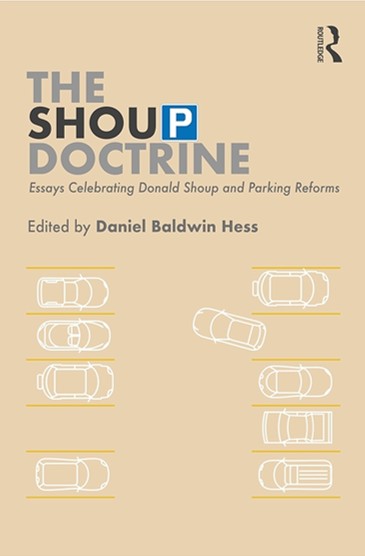
Book review: The Shoup Doctrine: Essays celebrating Donald Shoup and Parking Reforms (Routeledge, 2025)
The Shoup Doctrine provides 33 perspectives on how to manage car parking for a liveable city, all consistent with the work of the late Professor Donald Shoup.
Urbanists have many heroes and heroines. Typically the person on the pedestal is articulate, observant and imaginative, telling stories that give us the sense of a better city. Jan Gehl, Jane Jacobs and Janette Sadik-Khan, to start with the J’s, are all sought out. They tell stories and we think: “Wow, we could do this too.” The Shoup Doctrine tells 33 such stories.
Professor Donald Shoup was a Titan of transport. His fame came from academic expertise in that seemingly-humdrum topic: Car parking. His enormous tome The High Cost of Free Parking unpicked the well-meaning-but-disastrous nature of cities that seek to provide an endless supply of free parking spots. Packed with 750 pages of empirical analysis, examples and lessons, there were three main principles:
Cities should:
- Remove minimum parking requirements.
- Charge for kerbside car parking where demand exceeds supply
- Invest parking revenues to improve public realm on metered streets
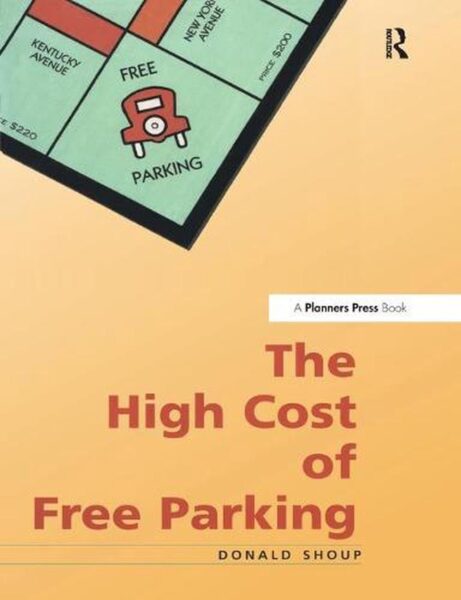
The High Cost of Free Parking resonated around the world, spawning legions of fans (“Shoupistas”)and a suitably punny website: ShoupDogg. It also led to the Parking Reform Network and the removal of car parking minima in New Zealand in 2022.
Shoup’s death in February 2025 coincided with the completion of a festschrift in his honour. This book, The Shoup Doctrine contains 33 essays from colleagues, pupils, protégés and fans, plus tributes from experts like Ed Glaeser. All were reviewed by the man himself.
The Shoup Doctrine is in six unequal-sized parts. After an introduction (by Shoup himself), we learn in Part II about his academic life. What prompted this electrical engineer to investigate car parking policies?
Part III covers the theories of parking reform, covering variously urban design, economics, transport planning and kerbside management. Jeff Speck’s In Praise of On-Street Parking explains how parked cars can provide a buffer between moving traffic and people walking or cycling. Road diets should remove traffic lanes over parking spaces.
Part IV, covering challenges and successes is (perhaps understandably) the longest – 11 essays putting the previous part’s theories into practice. These all come from the USA, the original home of car culture and parking minima.
Part V takes us to Switzerland, China, Australia and – yes – New Zealand! Scott Ebbett and Malcolm McCracken tell the story of Shoup’s 2010 visit, where international evidence and local experience combined to build cross-party support for removing parking minima in Aotearoa.
Part VI concludes with a future: A Golden Age of Parking Management. Fundamentally, car parking isn’t simple. It is neither a “human right”, nor reductible to “storage of personal possessions in public places.” It’s more complex and more important than this. Parking deserves empirical scrutiny, not reductive simplification.
Donald Shoup taught us to manage car parking in the context of the cities that we want. His receipt of the 2023 Seaside Prize™ for “…individuals who have made significant contributions to the fields of architecture, urban planning, and community development” shows the importance of car parking reform for liveable cities.
Each of these 33 essays provides a complementary perspective on Shoup’s basic premise: Minimum car parking requirements make most urban developments illegal and/or financially unfeasible, while entrenching car dependency. This is not a matter of opinion; Shoup was an academic. He taught us to look for the empirical evidence and understand the data. Books by David Mepham and Henry Grabar have developed this approach further.
New Zealand’s high rates of car ownership, driving and urbanisation make Shoup’s principles more relevant than ever. We may have abolished car parking minima, but kerbside parking management is still in its infancy. We’re keen on park-and-ride, but hesitant to charge for it. And so on.
With its thematic, essay-based approach, The Shoup Doctrine is relevant to all people. This erudite relevance is the key to its success as a tribute and a textbook; it deserves to be widely read. If you’re reading this review, it’s relevant to you. Get hold of a copy.
There is a Native American saying that a person dies twice. Once when they stop breathing, and again when their name is spoken for the last time. Donald Shoup deserves to be remembered for ever and his mana will endure through this excellent book.
Greater Auckland’s work is made possible by generous donations from our readers and fans.
We’re now a registered charity, so your donations are tax-deductible. If you’d like to support our work you can join our circle of supporters here.
You can also follow us on pretty much every social channel, or find us on Substack.

 Processing...
Thanks, George. Does the book step up to ask how parking management can be used to do more than just make a liveable city, but a low carbon one? One truly designed to equitably reverse the climate damage caused by driving?
You know. Just to get the questions rolling. 🙂
Hi Heidi, yes climate change is a keytheme in The Shoup Doctrine. The main point is that compulsory parking leads to compulsory driving, and this is a major driver (pun inteded) of carbon emissions.
There’s a section on social justice in Brazil which addresses this in more detail.
“Fewer vehicles result in fewer emissions, energy consumption, and more space, a key asset for promoting social justice. Shoup was incisive in pointing out how most cities are planned with the assumption that parking is a right.”
This chapter was written by Clarisse Cunha Linke, Brazil’s representative at the Institute for Transportation and Development Policy (ITDB) https://itdp.org/team-member/clarisse-cunha-linke/
The abstracts for each chapter may be read at the publisher’s website, thus:
https://www.taylorfrancis.com/chapters/edit/10.4324/9781003465515-2/shoup-dogma-donald-shoup?context=ubx&refId=cb97909f-829b-4b72-a94f-ec632678aaf5
This is a fascinating area of research, one that I imagine is often overlooked in light of the fixation on transport mega projects.
When I was working at an inner-city school in one of NZs main centres I did my own analysis and presentation questioning why the school provided free parking for staff. What I found was interesting, especially the fact that there was seemingly no good reason to actually provide parking in the first place. None of the surrounding organisations (hospital, various govt departments, NGOs, etc) gave free parking to staff, nor is free parking any part of the teaching contract. The streets around the school charged for parking, and there was such a shortage of space that teachers’ parking sprawled to take over parts of the field and courts. Only one teacher (of 100+) cycled to school regularly and the bike racks were located further away than most of the car parks. Whenever the parking situation was disrupted (construction work, major functions with parents, etc) the scramble to relocate all the vehicles gave a real insight into motonormativity (ie car brain) in practice. Never did anyone suggest things like encouraging use of the many bus routes than ran past the school, offering a salary sacrifice for those who gave up their park, or even having staff pay a comparable rate to all other workers in the area. Interestingly, I calculated that this last option could have raised around $500k p.a. to go towards things for students. No, instead the school continued to allocate ~15% of its total surface area to car storage.
Very interesting example of motornormativity in action.
“Of course the teachers have to come by car….”
“We need to suspend sports fields to provide parking…”
“Parking demand is immutable and unchanging…”
Donald Shoup studied the effects of parking cash-out schemes, which have been compulsory in California since 1992. People can take the free parking or accept a cash equivalent to spend how they like, thus providing all employees with equivalent benefits, irrespective of their mode of travel.
https://www.sciencedirect.com/science/article/abs/pii/S0967070X9700019X
It sounds like your former employer might have benefitted from a similar system.
Yes we can take Shoup’s insights and extend them to paid bike racks and pay per sit park benches.
Bike racks and park benches rarely require demand management or pricing. Shoup’s main message is that compulsory provision of free car parking is a daft idea, which he prove in ~750 pages in The High Cost of Free Parking.
I don’t think there is an equivalent argument for abolishing free park benches.
Do have a read of The Shoup Doctrine Miffy, you may even enjoy it. There are plenty of perspectives and real-life applications.
They require shops and offices to provide secure bike parking for staff at a rate of 1 space per 300sqm of floor area. Additionally they require visitor bike parking for shops at rates up to 1 space per 350sqm of floor area which is why you see all those empty bike rings at new developments. They require toilets for customers at cafes and restaurants, Shoup’s ideas applied fully would mean people should pay to use the dunny and cafe operators should be free to decide if they want to go into the toilet provision business. Just because you don’t like cars and he focussed on cars doesn’t soften the of background free market public economics.
Wow these rules must have somehow sneaked past all those shop developers in North West who have not put any bike parking in.
Toilets are not the same as car parking! Nor are bicycles. It’s a question of space.
Provision of a toilet in a cafe does not render the entire development financially unfeasible. A toilet takes up a small proportion of the floor area and budget.
This is completely different to car parking, which takes up lots of space in a development, costs a lot of money to build and (unlike a toilet) is not a universal human requirement – it’s only relevant if you come by car.
Compulsory car parking limits the scale and range of development, while leading to compulsory driving. Neither is a recipe for a successful city.
If you’re interested, have a read of my other reivew of Paved Paradise by Henry Grabar: https://www.greaterauckland.org.nz/2023/10/26/book-review-paved-paradise/
If cafes were required to provide one toilet per table and each toilet took up 20m2 of land area, you might have a point.
If we compulsorily required shops to provide one park bench per 10m2 of retail floor area then yes, we probably should.