Our Weekly Roundup on Friday was overflowing and there were a lot of bike related articles so we decided to split them out to their own roundup. So here’s our collection of bike related articles that have caught our attention in recent weeks.
Today’s header image, by Pippa Coom, shows just some of the dozens of bikes parked at Harbour View Reserve above Point Chevalier Beach yesterday.
This post, like all our work, is brought to you by the Greater Auckland crew and made possible by generous donations from our readers and fans.
We’re now a registered charity, so your donations are tax-deductible. If you’d like to support our work – and, what better time of year to make a gift for a better world? – you can join our circle of supporters here, or support us on Substack.
Guess the winner
Stuff conducted a test to answer the question, does driving faster (or attempting to, at peak times) get you there any quicker?
For this highly unscientific test, myself and Dave Hull, also from Stuff, set off on a journey from Coyle Park in Pt Chevalier, to Pt Resolution Park in Parnell, leaving at 8.30am on a Tuesday in early December.
I would drive as fast as I legally could. Dave would face an extra challenge.
Some parts of our route were covered by 30kph speed limits until they were raised by the Government last year. On those stretches of road, Dave would observe the old limit.
That meant, at points, I’d be driving along at 50kph and Dave would be at 30kph.
Out of curiosity, Stuff also invited Karen Hormann, chair of Bike Auckland, to take part.
We didn’t think there was any chance that Karen, on her e-bike, would be able to complete the journey quicker than myself or Dave, but we thought it would be interesting to see how long it took her compared to the two cars.
Spoiler alert:
Thirty-one minutes after we all departed, Karen was the first to reach Pt Resolution Park.
…..
I arrived a full nine minutes later, trying to subdue any sign of road rage. Just a couple of minutes after me, Dave appeared.
“I adhered to the speed limits where necessary, but the traffic’s pretty self-regulating, particularly at this time of morning,” Dave said.
“I didn’t feel like I was hindered too much by having to go 30kph in various spots, because the traffic was basically making me go 30kph most of the way anyway.”
…..
So what did this exercise prove? Well, driving as fast as you legally can across Auckland might get you to your destination slightly quicker, but the stress involved doesn’t really make it worthwhile. The change of the speed limits didn’t have that much impact either.
And, because of the cycle lanes that have been put in, going by bike can be the fastest way to get around the city.
A great story all round. One thing we noticed: Karen biked along the Northwestern Path, which is the cycling equivalent of the motorway (and currently the city’s busiest bike route), but isn’t exacty the most direct route.
So it could be interesting to run this experiment again some time, with an extra person on a bike using the local streets via Meola Road and Great North Road – albeit there are still a few safety gaps along the way that are a no-brainer for the city to fix.

The growing cycle economy
A great South Island-focused article in The Press, looking at how bikes are changing towns and cities for the better.
On a fine morning commuters roll into the city on Christchurch’s growing network of cycleways. Over on the West Coast, a group of mostly grey-haired riders ride into Kumara, e-bikes leaning against the veranda of the Theatre Royal Hotel.
Put the two together and you start to see that cycling is no longer just a weekend hobby. It has become a small but serious part of the South Island economy – from tourism operators and motels to bike shops, and city transport budgets.
…..
In the year to June 2025, people took about 2.6 million trips on the 23 Great Rides, an 18% jump in four years. Researchers estimate those trips brought about 1.33 million visitors into trail regions, who stayed about 4.5 million nights and spent about $1.28b.
That money does not only stay on the bike trail. Trail managers estimate nearly 2920 businesses now provide services to Great Ride users – motels and campgrounds, cafes and pubs, shuttles, tour companies and bike workshops. A large share are in South Island places like Queenstown, Clyde, Roxburgh, Greymouth, Hokitika, Nelson, Blenheim and Twizel.
…..
The cycle economy is not just about tourism and high-end toys. Commuting is part of it too.
In the 12 months to October 2025, the Christchurch City Council’s cycle counters recorded almost 4 million bike trips across the network, with 358,053 in October alone – an average of 11,550 a day – and overall counts sitting about 41% higher than in 2017.
…..
The cost of running a car, and the availability of safe routes, both matter. So does how people pay for expensive bikes in a tight economy.
“The other big thing, I think, in the market that’s changed and has helped get things back to normal would be the WorkRide scheme,” he says, referring to the salary-sacrifice cycle-to-work programme.

Image: via The Press
Updated 9.45am Monday 12 Jan: hot off the presses, another story in the Press under the headline “Queenstown’s $280m bike boom fuels 1150 jobs.”
A new economic report by Queenstown-based economist Benje Patterson, prepared for Destination Queenstown and the Queenstown Trails Trust, counts only people who travel to the district mainly to ride.
He estimates their spending is equivalent to close to 10% of all visitor spend, and describes it as “fresh” money that would be unlikely to arrive without the trail network and commercial bike offer.
The reporter talks to a local bike shop that’s doubled its staff after business shot up by 33% in a year. Maybe something for a jobs-focused government or opposition parties to look into?
And related, since we’re talking about the South Island and the benefits of bikes in cities:
Christchurch has been named the most bicycle-friendly city in Asia and Oceania and 38th globally in an international ranking index.
The Copenhagenize Index, published every two years, is the most comprehensive and holistic ranking of bicycle-friendly cities in the world. It provides an evidence-based benchmark that tracks how cities across the globe are progressing in making cycling safe, convenient, and mainstream.
…
Planning and Delivery Transport Manager Jacob Bradbury says this is a great result and recognises how much work has been put in to make the city a friendly place for cyclists.
“We are pleased to see the investment that has been made in building cycleways and education in recent years is paying off. This is also demonstrated in the statistics we gather through our ongoing resident surveys, with cycle use around the whole of the city increasing by more than 40% in the last eight years.”
“Data shows that growing numbers of residents think that Christchurch is a bicycle friendly city. Ten years ago, 38% of people surveyed thought that it was bicycle friendly while by 2025 this has grown significantly to 67%.
“We’ve also seen a rising trend in female cyclists numbers city-wide. Indicators show an increase from 33% of all cycling around the inner city eight years ago being by females to 41% in 2025.”
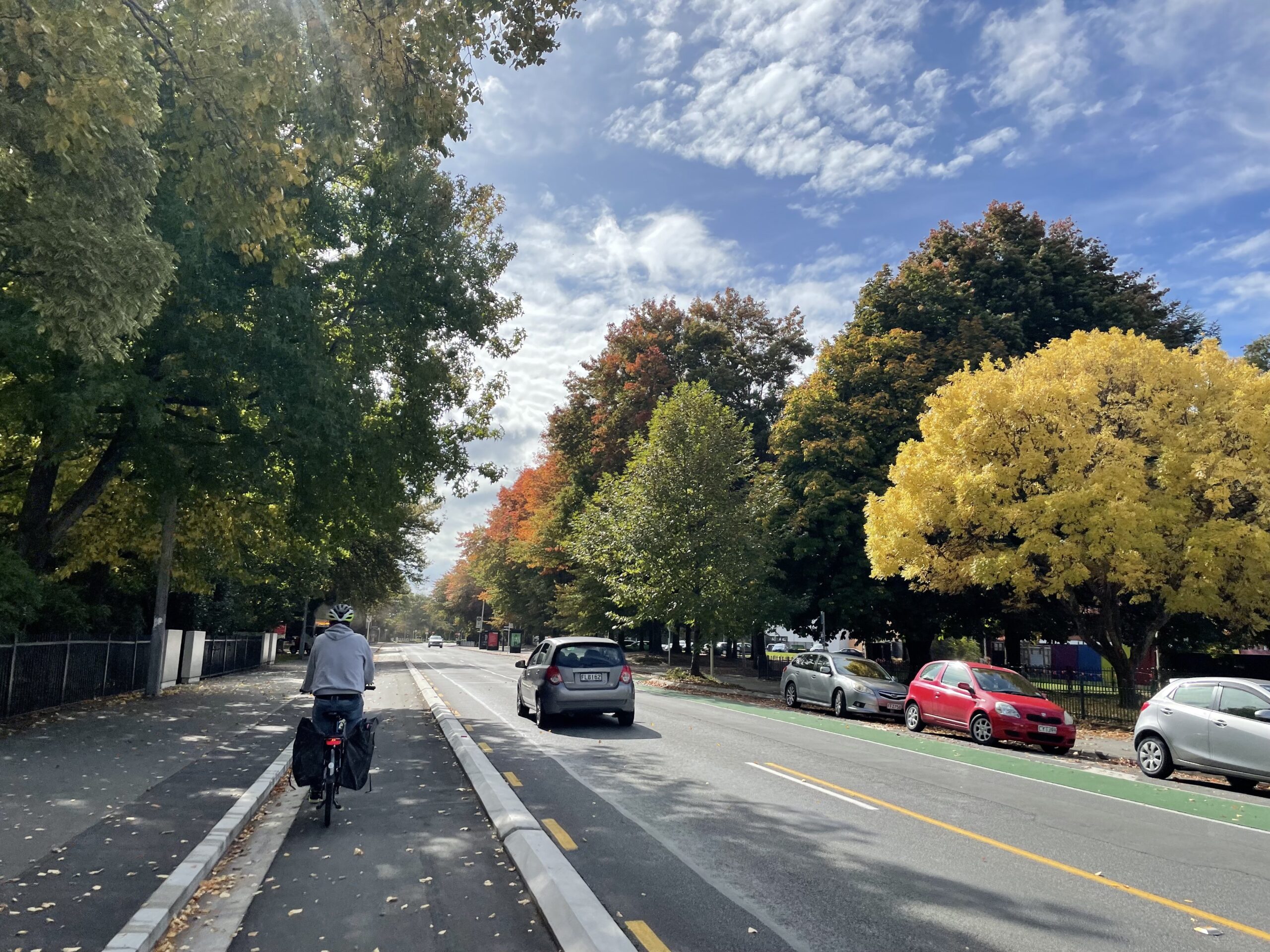
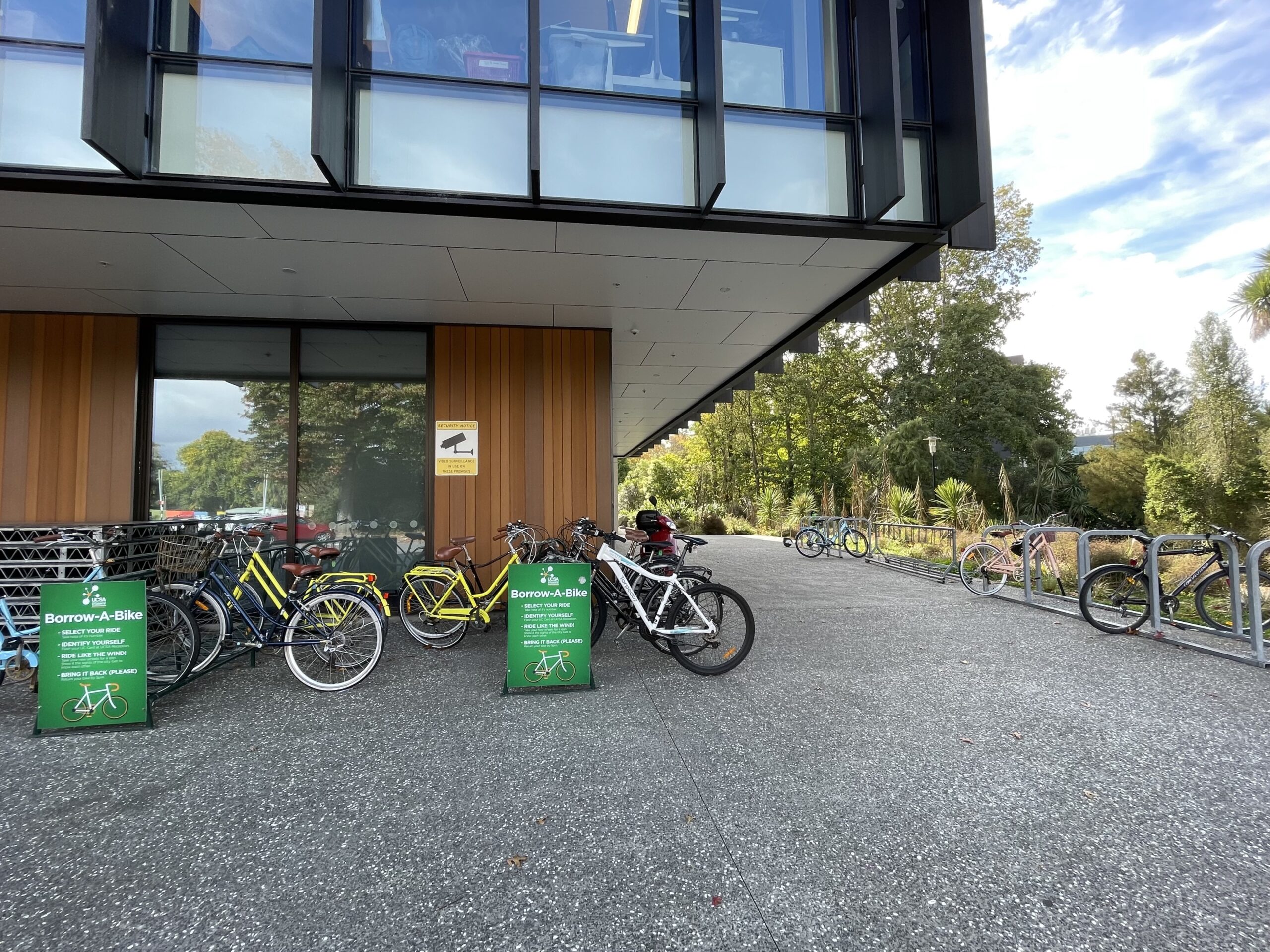
Below: a protected bike lane on Ilam Road near the University of Canterbury, and a “borrow a bike” scheme at the students’ association building, both as seen in April 2023. (Pics: Jolisa Gracewood)
Wellington is getting in on the bike action too
From Wellington City Council, an impressive update on the uptake of their growing bike network:
Wellington’s bike network has shifted up a gear, with new data showing more residents are getting on their bikes following the expansion of the city’s bike network.
Since 2022, the Council’s Bike Network Programme has delivered 32 kilometres of new bike routes across the capital. The result? A meaningful shift in access; 53% of Wellingtonians now live within 500 metres of a cycleway, compared with just 12% in 2021.
Cycling volumes are climbing too. Daily counts are up across most routes, with increases of 11–87% on new routes, contributing to an 18% citywide increase in cycling since 2020. And Wellingtonians say they feel safer on upgraded streets. Satisfaction reaches 75% in suburbs and 65% in the CBD where bike lanes exist but drops to 28% where they don’t.
…..
The next steps for Wellington’s bike network is completing critical gaps in the central city in preparation for growing demand, particularly following the completion of Te Ara Tupua next year that will unlock cycling and e-scooting to the Hutt Valley.
Speaking of Te Ara Tupua, which is due for completion by the middle of the year, The Post reports on a recent bit of progress. Good to see more accurate reporting about the broader (and some would say primary) benefits of the project – this is so much more than a walking and cycling path, albeit it’s soaked up most of the national budget for walking and cycling paths:
A new shared walking and cycling bridge beside State Highway 2 and above the Wellington rail line has now been fully assembled.
Featuring pillars adorned with a distinctive cultural design by artist Len Hetet, the bridge forms part of Te Ara Tupua— a $348 million Waka Kotahi NZ Transport Agency project delivering new coastal defences to protect the highway and rail corridor from storms and climate change, along with a 4.5‑kilometre shared path between Ngāuranga and Petone.

Get our small towns in on the action, too:
From September, here’s a post from a recent migrant from Auckland to Gisborne written just prior to local elections:
Gisborne already has the ingredients: flat terrain, manageable size, mild weather. With a little investment and vision, we could become New Zealand’s most cycle-friendly city, and the healthiest, happiest, and most connected, too.
The reality is, so many of our towns and smaller cities are ideal candidates for rolling out comprehensive bike networks. It’s especially noticeable in many of New Zealand’s holiday towns – where, every summer, you see huge numbers of people of all ages walking and cycling around, a Kiwi birthright.
Imagine how many more there could be with some proper infrastructure – which when done with available road space and simple protective barriers isn’t expensive, and also includes basic stuff like calmer traffic speeds and quality bike parking?
And of course, the corollary is: this kind of laid-back beachy life, where parents and kids and people of all ages will happily jump on bikes to access everyday destinations and activities, can absolutely be a feature of daily non-holiday life in our larger cities too!
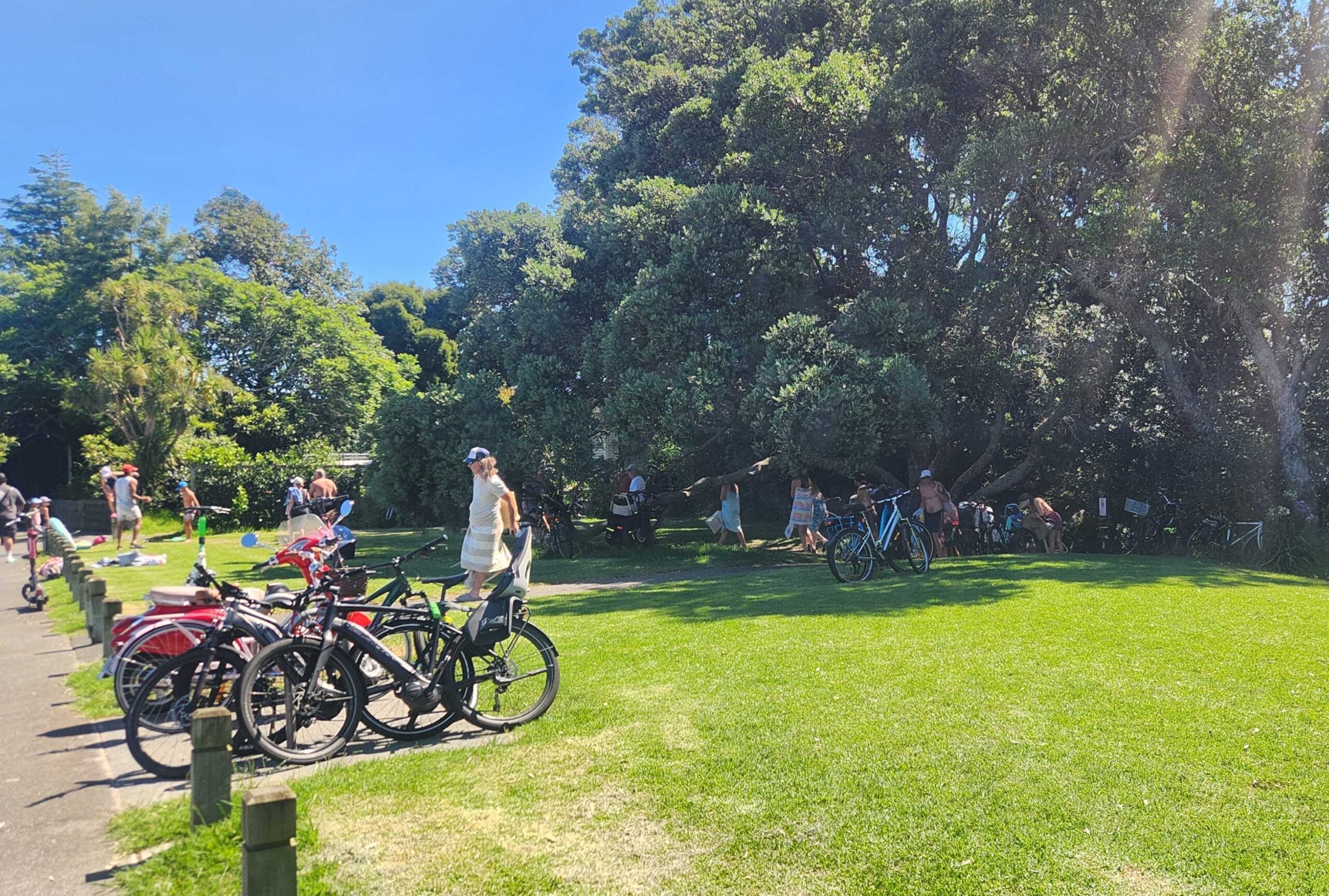
Above: just some of the dozens of bikes parked up at Point Chevalier beach yesterday, showing the access potential of even an incomplete local network. Note: there’s still a 1km gap, along a newly 50km/h road, between the new safe cycleways and this location. (Pic: Pippa Coom).
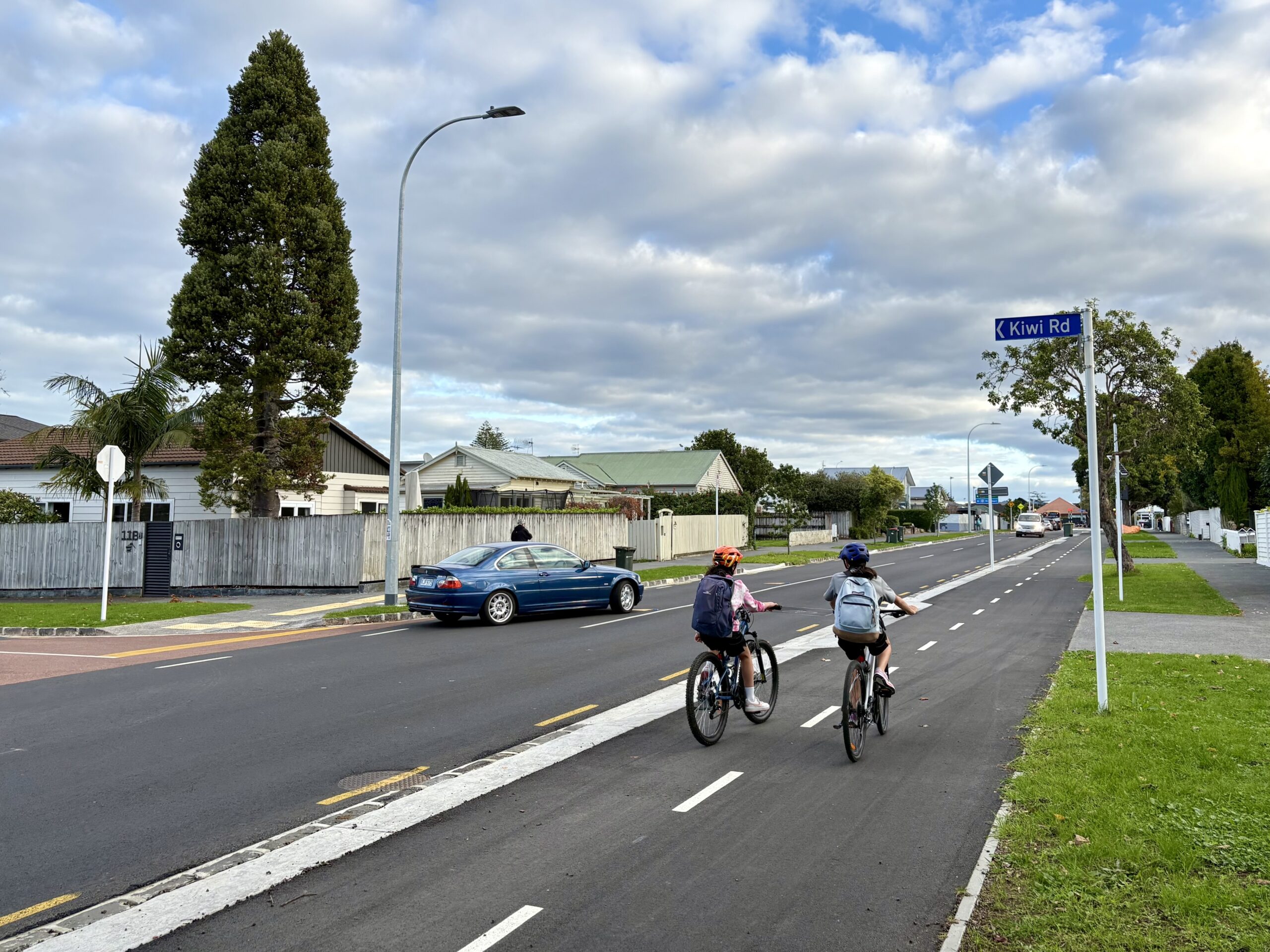
Below: the local infrastructure – a dedicated cycleway along Meola Road – shown in use during term-time, by school kids on bikes, giving kids independence and confidence, and relieving parents of the need to always chauffeur their offspring everywhere. Fix the gaps, join the dots! (Pic: Jolisa Gracewood)
A bike-friendly city is a happy city
The 2025 Happy City Index is in — and there’s something every cyclist will want to celebrate: the world’s happiest cities are also some of the best places to ride a bike.
Copenhagen, topping this year’s index, is more than just a poster child for Scandinavian design and high quality of life. It’s one of the undisputed global capitals of urban cycling — a place where bikes outnumber cars, and nearly 62 per cent of residents commute by bicycle daily. For locals, riding a bicycle is just part of everyday life. A very happy part of a very happy life.
…..
What do all these cities have in common? They put people before cars. Their governments invest in policies that benefit everyone not just motor vehicle commuters, they invest in climate-friendly infrastructure, and safe, active transportation infrastructure. And that investment pays off — not just in carbon savings, but in smiles per mile.
Cycling reduces stress, improves physical health, cuts emissions, and builds community. It’s the kind of low-cost, high-impact solution that makes cities not just more livable — but more lovable.
…..
The Happy City Index isn’t just a list — it’s a blueprint for success. And it’s a pretty simple formula. As urban centers around the globe rethink their futures, one message is clear: if you want happier people, give them space to ride safely.
Whether you’re a planner, a policymaker, or just a person who loves the freedom of two wheels, take note: the road to happiness is paved with bike lanes.
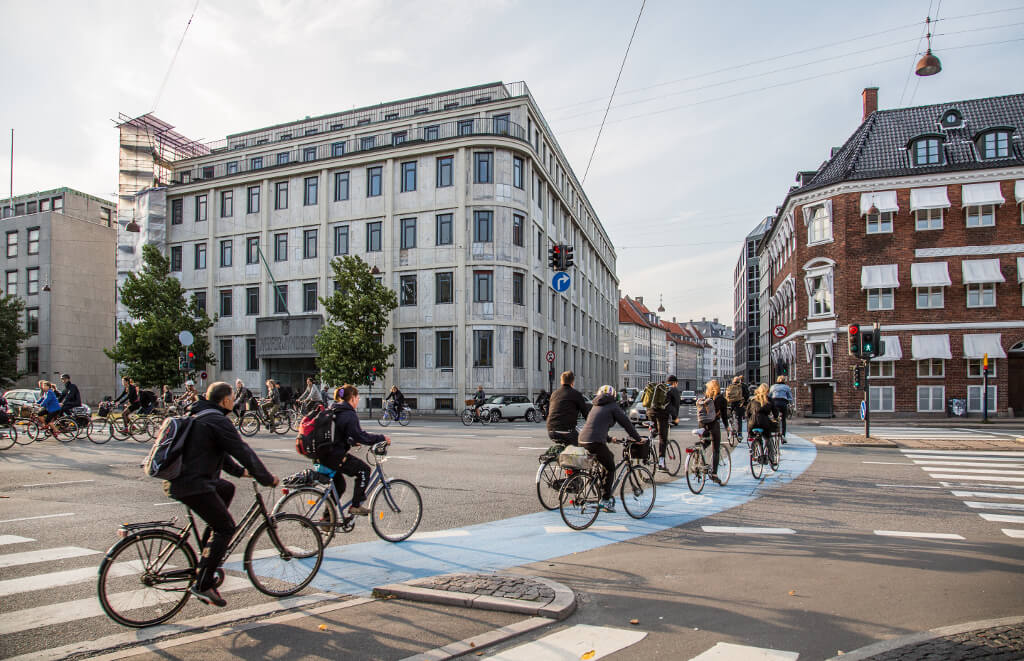 Image: via Momentum Mag
Sydney Harbour Bridge’s new bike ramp opens
Last week, Sydney opened its new Harbour Bridge access ramp, which finally allows for people to cycle – and scoot, and roll – up to the path across the bridge, instead of needing to scale a forbidding flight of stairs. As The Guardian reports:
The Sydney Harbour Bridge cycle path has a new, smooth ramp, replacing a notorious 55-step staircase and giving cyclists a continuous route from North Sydney into the CBD after decades of campaigns, scrapped designs and local opposition.
The rare upgrade to the city’s world-famous bridge, which opened to the public on Tuesday, will help unlock the bike path for heavy e-bikes, bikes with trailers, and older riders.
Tony Stanley, a Crows Nest local, has been unable to bring his wife and five-year-old daughter with him on bridge crossings as their e-bike and trailer were too heavy to take up the stairs.
On Tuesday, the family crossed together for the first time, with Stanley’s daughter on her own kids-sized two-wheeler, still decked out in Christmas tinsel.
“She normally rides to daycare every day … [but] she was able to ride over the harbour bridge all by herself today – it’s just fantastic,” Stanley said.
“It opens up where you can travel to now.”
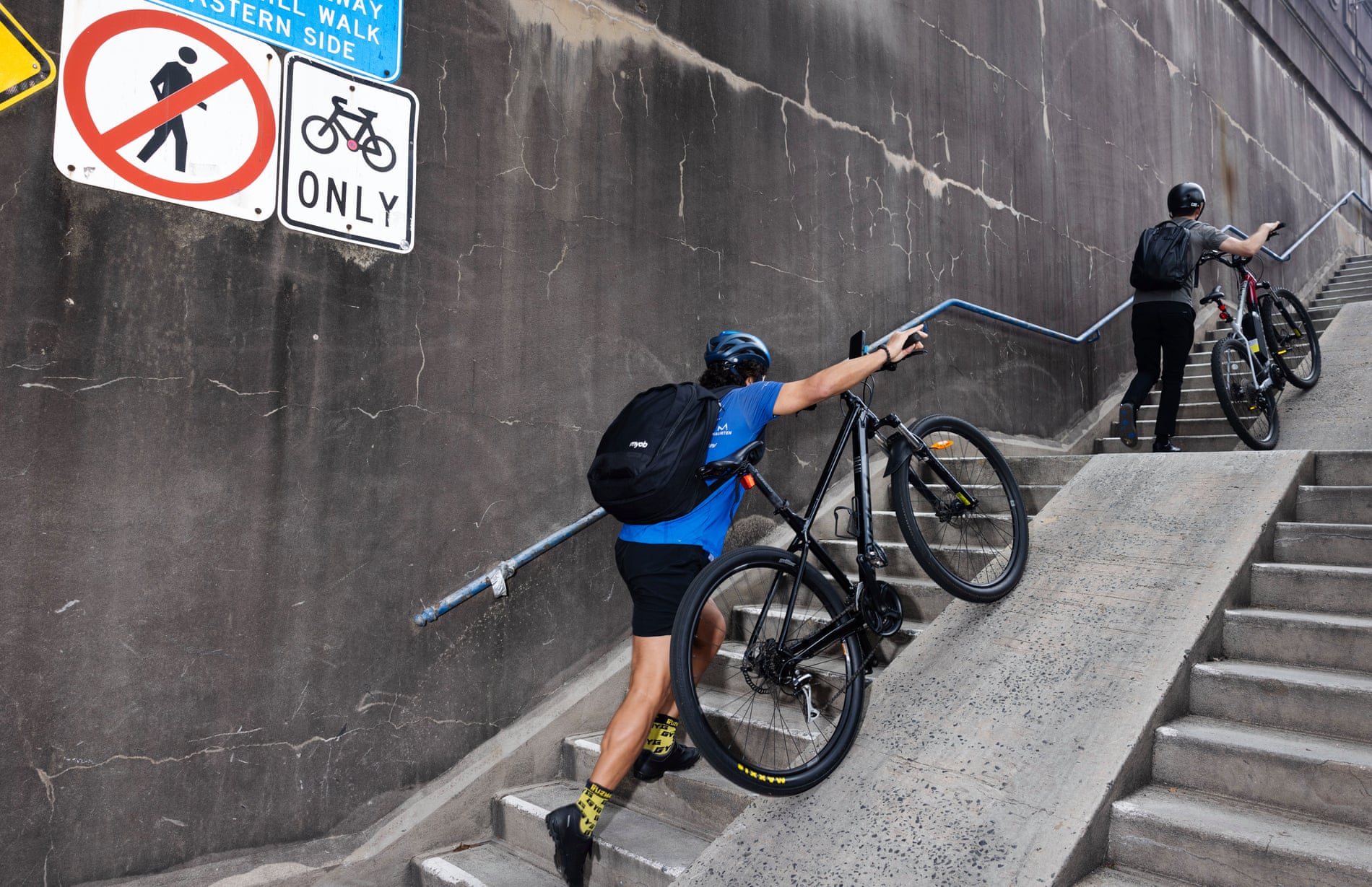
The old way to access the bridge (image via the linked Guardian article)
And here’s a another look at the new access:
New York City’s “Zohramp” effect!
Speaking of bridge fixes, New York’s new Mayor Zohran Mamdami has hit the ground running, or biking as the case may be, by immediately kicking off a temporary fix at one end of the the city’s busiest bike bridge – the Williamsburg Bridge.
He assisted city workers with smoothing a notorious bump in a narrow access point, and has also brought forward a project to redesign the whole area, which had been sitting on the shelf for years
Mayor Mamdani donned a pair of work gloves and joined a Department of Transportation crew to level the Williamsburg Bridge “bump,” the notorious narrow, but steep ramp at the Manhattan end of the city’s most-popular bridge bike path, the first step in a $70-million full redesign of the dangerous area that will begin this fall — prioritizing a project that seemed forever unchecked on his predecessor’s to-do list.
Mamdani told reporters that, as mayor, he will make big changes to city infrastructure, but also isn’t hesitant to make small, quick fixes that immediately improve life for cyclists — reminding reporters that he’s one of them.
“I’ve experienced this myself,” he said of the dropoff, which he called “a veritable gauntlet of cycling punishment.”
Mamdani has also put a major safety project back on track, on a Brooklyn boulevard that’s seen far too many deaths – including the father of a school friend of his – and where long-planned improvements have been repeatedly delayed by a handful of naysayers. Sound familiar?
His speech is impressive – see clip below. Wouldn’t it be incredible to hear our local leaders speak this clearly about the level of safety we can expect?
“I am so proud to have stood with this community, and I am even prouder to use the power of City Hall to deliver a better, safer future for the people of Greenpoint.”
And it’s clear he’s only just getting started:
“When I was interviewing [my new transport commissioner Mike Flynn], we did not simply ask him about fulfilling that which has already been put forward. We asked him, what will it take to make this city the envy of the world, when it comes to our streetscape and our public transit?”
Also from New York, an important message (which applies to Auckland as well, in our opinion):
That’s us for today. Have a great week. And feel free to drop any other recent stories about the power of bikes and micromobility to unlock cities, in the comments below!

 Processing...
Zohran Mamdami appears to be a man of principle and practice. It’s amazing how effective it is for a politician to say: “That thnig that needed mending? Well now I have mended it it – let me show you”.
So much better than: “We’ll commission a study to initiate a committee for a business case to disuss proposing a remedial option for a businesss case for a detailed business case…” which I believe is the traditional approach in New Zealand.
We had tangible “turnaround job” action with the cone hotline. Simeon Brown conducted many exorcisms too with only the necessary school-age child sacrifices.
Bikes are faster than cars in Auckland ?
Only if you stay away from the harbour bridge crossing
North Shore excepted, there’s probably not many peak hour commutes in Auckland that wouldn’t be faster on an bike than public transport or car. It’s certainly much, much cheaper with amazing health benefits.
I’m not sure that “get people from cars into bikes” works. I suspect the people most open to it, are presently in cars but on public transport. This was certainly my journey, and the same for others I know.
My journey was that I was keen to add morefitness to my daily routine and I was lucky enough to have about 60 % of my journey on a separated route.
I think there’s probably a fair whack of people who would similarly like to replace their commute with a bike but face too hostile an environment. Only takes one or two close calls to get people back in the car.
difference between public transport and active transport is waiting. PT has lots, Active is moving all the time, and not so much sitting down while you move. Some people like sitting down, others like continuous movement.
This is also why the ferry proposal instead of the skypath would never float, not that either ever did.
I have recently taken to cycle commuting – with some help from the trains (when they are running). My commute works out almost exactly the same as when I drove. However in trying to use the bike for errands around town (Not the CBD) my biggest hurdle is finding somewhere to park the bike. How do we advocate for more bicycle parking in your local neighbourhood? I am trying to avoid locking the bike to random fixtures.
Auckland Transport used to have a map you could register Cycle Parking requests on. I did it once and a few weeks later a park was installed. It doesn’t seem to be online anymore unfortunately – I guess you need to call or contact them online.
you can ‘request something new’ through the AT online form at https://contact.at.govt.nz/?cid=459372a7-456f-ec11-8f8e-0022481509e2
Also advisable is to email a local board member (not the local board generic email) and advocate. YMMV as to what you get back depending on what board area you are in.
Really like the format multiple articles in one…please keep it up. Regular cycling/ micromobility/ urbanism birds of a feather