Tomorrow, the Council’s Transport and Infrastructure Delivery committee meets for the first time this term (Tuesday 9 December at 10am) and there’s a bunch of interesting updates on the agenda.
Fare Increase Incoming
Public transport use seems to have stagnated this year with ridership stuck at about 86% of pre-COVID levels due to a combination of factors, including the ongoing rail disruption and the fare increases we’ve experienced in recent years.
The opening of the City Rail Link – now set for later next year – should signal the end of the rail disruption while also transforming public transport for many people throughout Auckland, driving growth in ridership. But the fares that people will pay are set to rise much higher than inflation again next year, according to an update from Auckland Transport to the Council’s Transport and Infrastructure Delivery committee for their Tuesday meeting.
The update doesn’t give as much information as in previous years, such as what the new rates will be, and the estimated impact it will have on ridership. But as can be seen below, the increase averages out at 5.1%, similar to the 5.2% average increase this year, which is above CPI inflation of 3%.
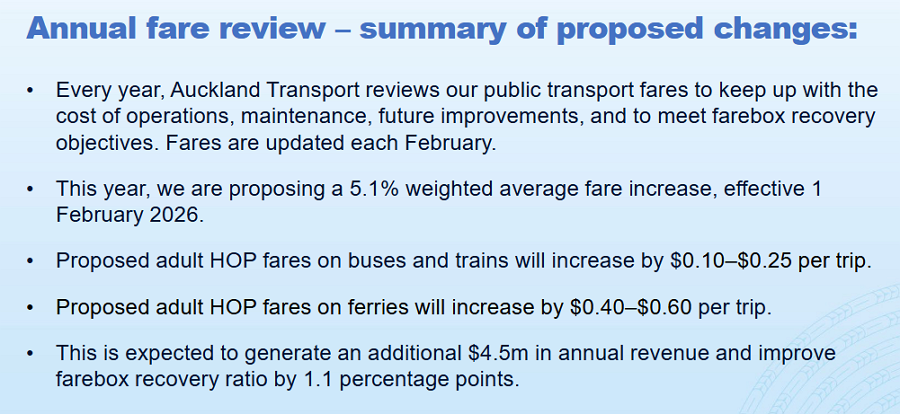
As noted, there’s also no mention of what impact this will have on ridership – but it will presumably be similar to this year, given the similar percentage increase, and the similar change in revenue and farebox recovery figures.

The estimated impacts of the last fare increase (Feb-2025).
This slide, below, suggests that AT are trying to make up for not changing fares following the arrival of COVID on our shores: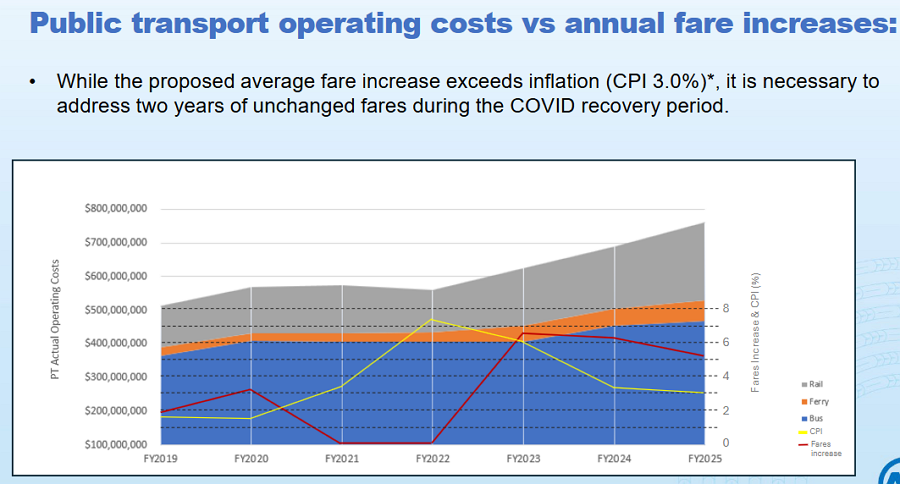 I continue to be baffled as to why AT chooses to increase fares, independent of anything else. At the very least, they should tie the price of parking to fares and have both increase at the same time.
This is also this note about concessions and the (delayed) National Ticketing Solution.
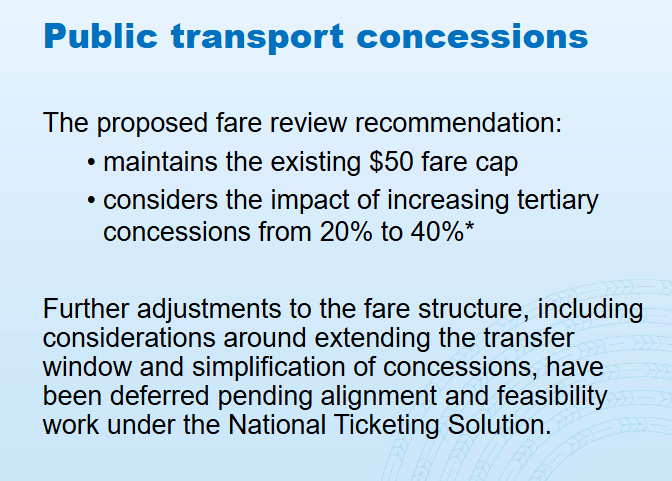 The change in tertiary concessions is good, and goes live this Sunday. Notably the press release includes some helpful information on the impact this change is expected to have:
“There are more than 51,000 students in Auckland who already have this discount loaded on their AT HOP card and who will benefit from cheaper fares overnight when the tertiary discount increases,” Councillor Baker says.
“This change will mean a student regularly travelling two or three zones on public transport will save around $200 to $250 per year.
“Overall we expect to students across Auckland to save about $5 million on their public transport costs because of the increased discount each year.
And
Increasing the tertiary discount to 40 per cent is expected to stimulate up to 3.6 million additional bus, train and ferry trips annually, helping restore tertiary ridership to 80 per cent of pre-pandemic levels.
Downtown Carpark (almost) gone
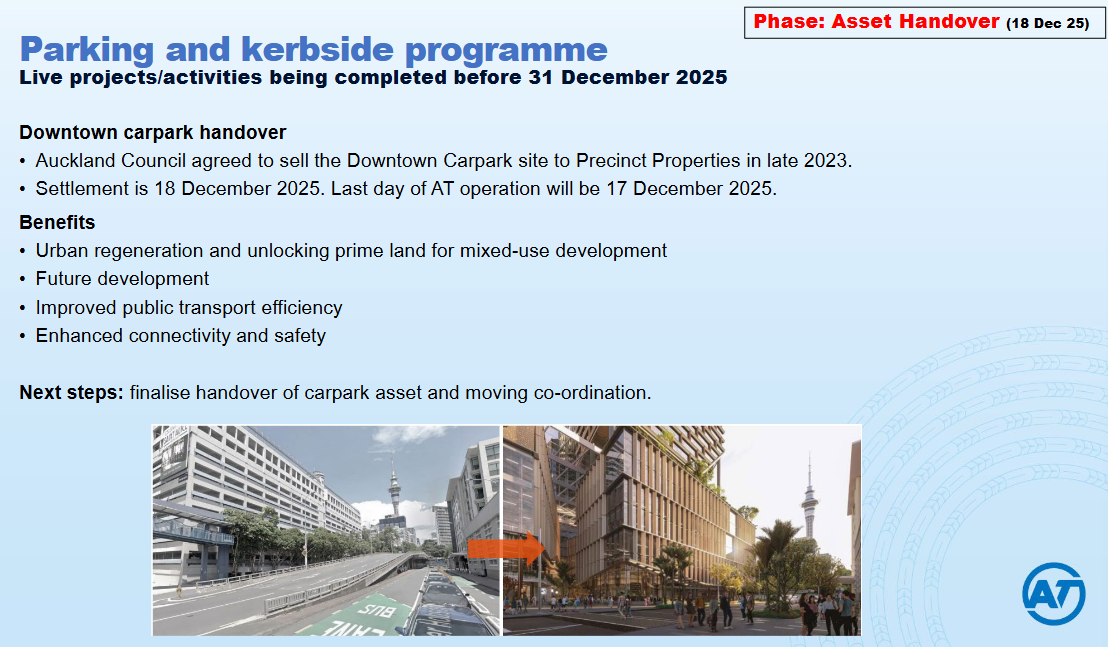
On the topic of parking, AT will be handing over the Downtown Carpark site in a few weeks.
The final piece of the Eastern Busway
AT says it’s looking to bring forward the final section of the Eastern Busway to start in February 2026, subject to approval from the NZTA board.
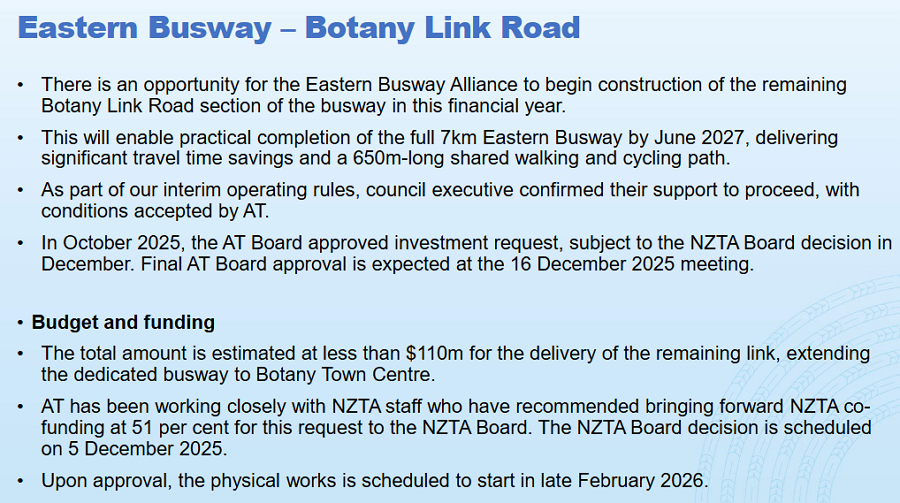
The Link Road will run through part of a reserve to connect Botany Town Centre.

Bus and Transit Lanes
AT has a set target of installing 10km of special vehicle lanes this financial year, and they plan to deliver a touch over that level with 10.33km. So far, they’ve completed 3.53km and around half of the total planned is expected to be delivered between April and June. These lanes will help improve bus priority, and some will also help freight too.
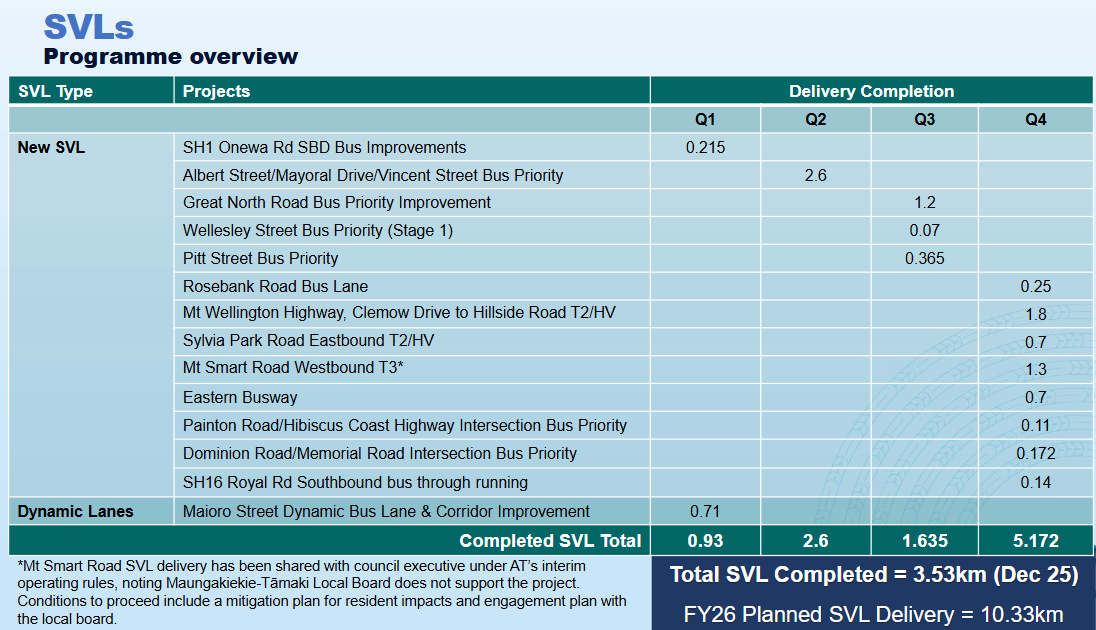
I’m not sure why the local board are opposed to the Mt Smart Rd project, as it seems like a good idea. I note the former chair seemed to support it during consultation… but then voted against it.
Maungakiekie-Tāmaki Local Board chair Maria Meredith said a quick-fix, low-cost solution will enable more efficient traffic movements in the early evenings.
“Mount Smart Road is often gridlocked in the evenings, but widening it isn’t an option without affecting nearby homes. Adding a transit lane is a smart, low-cost way to keep people moving,” she said.
“This initiative targets one of our community’s busiest roads, which currently sees evening travel times more than double compared to off-peak hours. We want to see congestion eased, so people can spend less time in traffic.”
New Ferries
As well as the City Rail Link, some more new kit we’ll get in 2026 will be the new electric and hybrid ferries. The first examples of each of these are now on the water and undergoing testing.
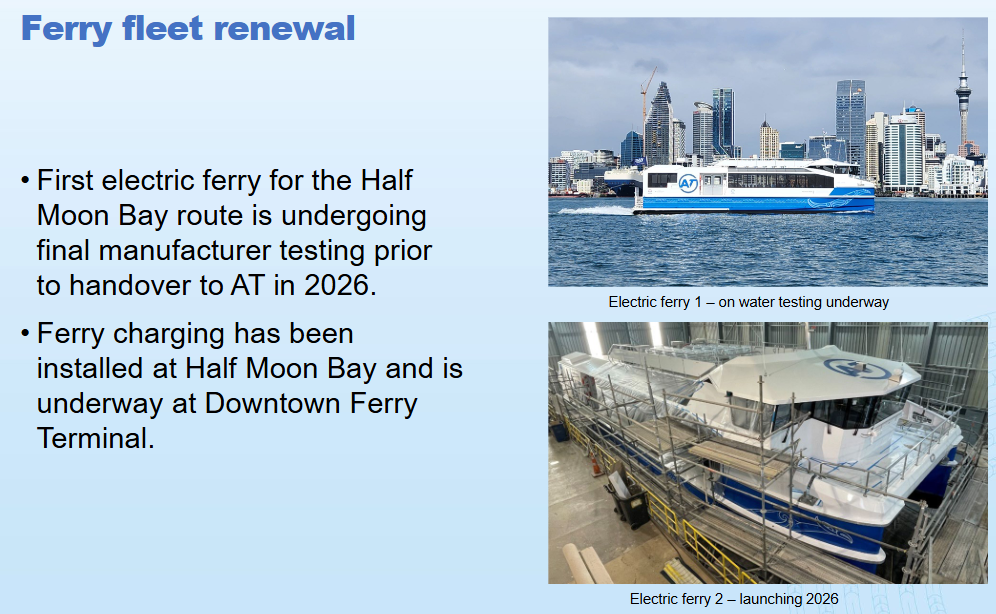
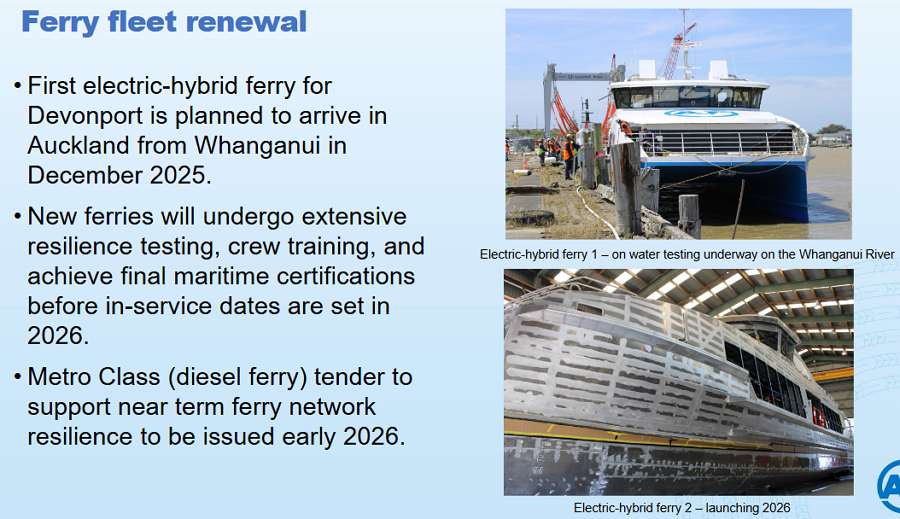
Given both there are both electric and hybrid options now available, it is absurd that AT are looking to buy a bunch of diesel ferries for the next phase of their fleet renewal.
CRL Readiness
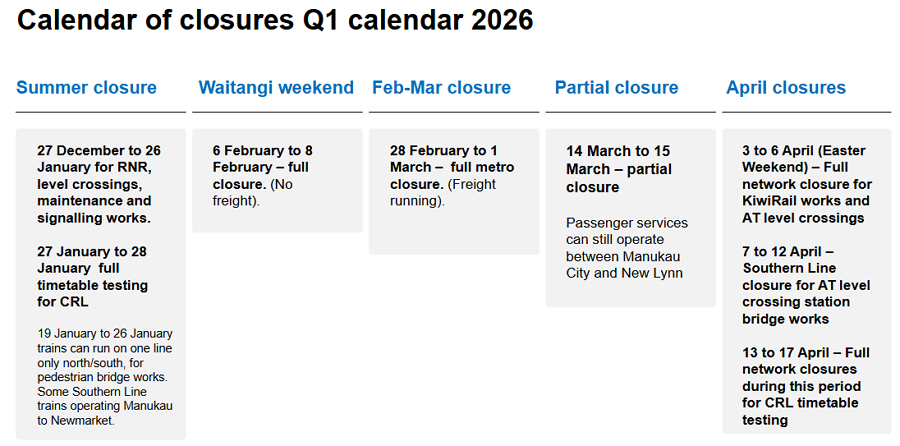
As part of an update on all of the work that’s going on to complete the CRL and have the network ready for Day One, this slide shows there are plenty more network closures planned for after the big summer shutdown.
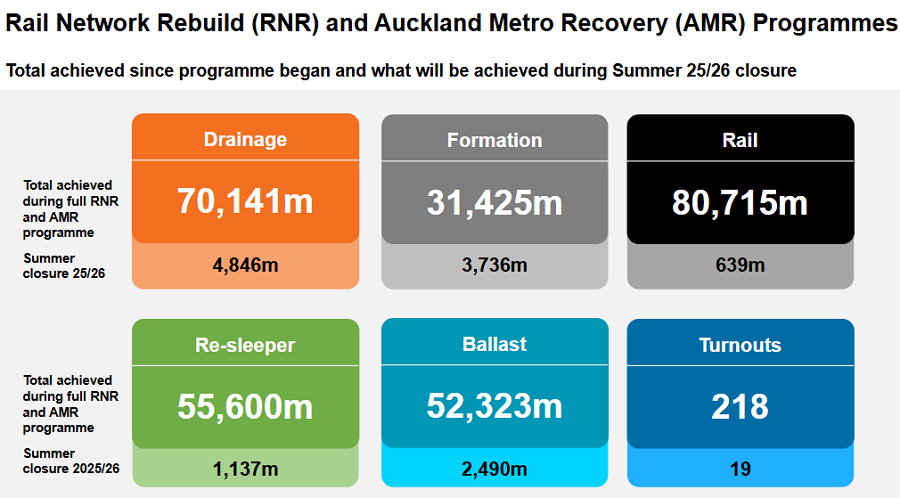
 There’s also an update on the scale of the works carried out during all the disruption we’ve endured over the last few years.
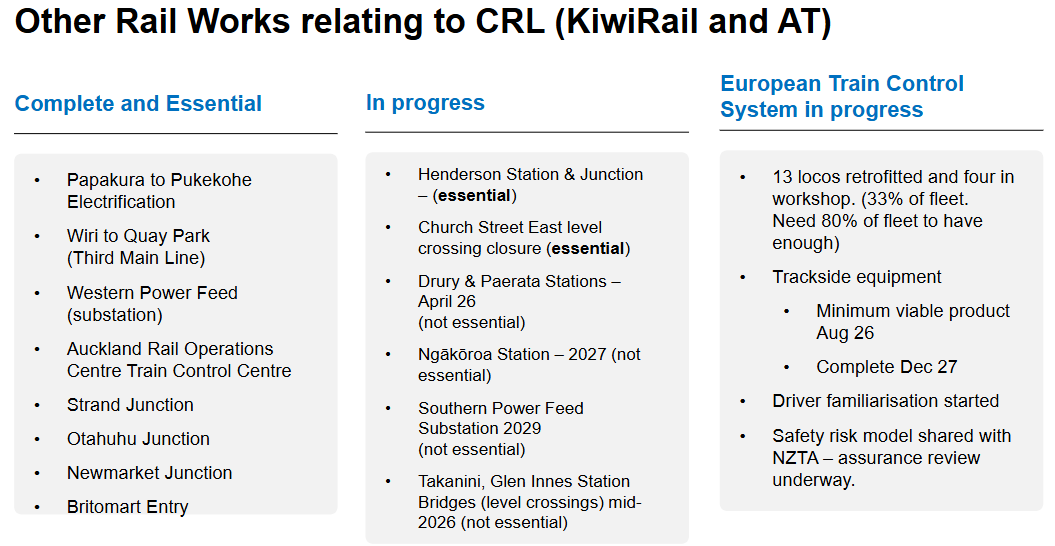
Plus, the follow updates of when some other projects around the network are due to be completed. Perhaps the most interesting thing here is the retrofitting of European Train Control System on freight locomotives – this is one of the outcomes of issues experienced a few years ago. That they need 80% of the fleet to have ECTS installed, and that it won’t happen until August, means CRL probably won’t be open until after then.
 The agenda also includes the formal letter from City Rail Link Limited to the Council informing them of the delay to the CRL opening date, including this:
CRL Ltd will not meet the current Target Project Delivery Date under the Project Delivery Agreement of 26 November 2025.
The reasons for this are varied but primarily relate to the Link Alliance failing to achieve the production rates required by the Link Alliance programme, challenges with systems testing and commissioning, and the close-out of defects and completion of project documentation.
CRL Ltd’s current assessment of the likely Target Project Delivery Date under the Project Delivery Agreement is 30 June 2026. CRL Ltd should have greater certainty in this date by the end of January 2026 following the completion of the testing and commissioning of standalone station and railway systems and assets, and the trial run of the Day 1 timetable on the full network.
While the civil and building works are substantially completed, and are expected to be fully completed by December 2025, the project is now progressing through the highly complex phase of station systems integration, testing, and commissioning. It is during this phase that any defects with the constructed assets will be identified and closed out, and project documentation completed. Accordingly, there remains a degree of uncertainty over the likely Practical Completion date under the Project Alliance Agreement (and therefore the Target Project Delivery Date under the Project Delivery Agreement).

 Processing...
At the recent information sessions on the NW Busway I asked about plans to add bus priority to Lincoln Road and Te Atatu Rd. Basically got a shrug of the shoulders and nothing to do with us response. Does anyone know if there is any plan for this ? It does seem we are still not actually joining all this up.
Te Atutu might be investigated, Lincoln Road needs widening, a major project.
When are we going to start seeing reallocation of road space for PT? Cheaper and more effective.
Yes. Widening an already wide road is simply digging heels in on a failed approach.
That’s about the opposite of what Lincoln Road needs. Perhaps the worst four-lane monster of an arterial road in Auckland, a constant magnet for crashes and excessive speed.
Busway is an NZTA project, and Lincoln and Te Atatu are AC roads so makes sense that NZTA said nothing to do with them.
Agree there needs to be better priority on those roads, and on both sides unlike the T2 lane at Te Atatu currently.
Appreciate the distinction between the two organisations but it is not a good enough system, it is like building roads on either side of a river and saying building a bridge is someone else’s job. The success of NW busway will rely on people getting to it in a time efficient way.
Am I crazy or is painting ferries blue and white a bad idea for visibility?
Shouldn’t they be bright yellow or something?
I’d actually go dark blue with flashes of yellow, like with the buses and trains.
The Local Board decided not to support the Mt Smart lanes basically because of massive misinformation on community facebook pages about how it was ‘taking a lane away from drivers’. Unfortunately the local board members amplified that rather than pointing out it was removing parking during peak hours and actually adding traffic capacity.
hmmm my local board area and bus I sometimes use through there. Seems silly to oppose then. As always it’s more about parking than driving, the biggest problem with cars: generally not space efficient during use, and only used X% of the time but need to store them for the 100-X% of the time.
Just a sneak peak into how things will go once the transport reform is complete and Local Boards are given more power.
Delighted to see we’ve found the money for the last section of the eastern busway. Never made any sense to build 90% of a project.
Did it make any sense to build any of it?
Yes, it’s an obvious gap in the rapid transit network.
Well, not if you ask our former transport minister. Only bikeways are a greater waste of money according to the local MP.
Anyway, of course it makes sense to build separated bus priority. How else can you make buses fast AND dependable enough to compete with the advantages cars have? And if you don’t make them competitive, how are you going to fit the traffic as we stop being a bunch of glorified suburbias and become an actual city?
Sorry for the rant, but it really bugs me that people question PT investment – you can discuss whether a specific things was maybe a bit too small or too big (Light Rail tunnel schemes…) but unless they are some white elephant scheme to some remote prestige project, new PT tends to be good much more often than new roads.
On a semi-related note, does this Botany scheme now actually include a station at the end?
I think this section is firmly in Mr Luxon’s electorate rather than Mr Brown’s. Stupidity of local MPs and councillors should have no influence on long term strategic projects. I don’t think it includes a station at this point.
I view this phase of the project as creating the start point for Botany to Airport project. End state of course is a full segregated busway from Ellerslie to the Airport, via Panmure and Botany.
If the services are frequent enough who needs a station? Hop on, hop off and be out of there.
* hop off, hop on
“If the services are frequent enough who needs a station?”
If services are frequent enough, they might not be able to get into your station. Because, you know, two other buses of other routes arrived just before you.
Also, stations have other uses, such as for U-turn facilities (rather than sending your bus once around a congested carmageddon peak hour block just to travel back the way it came) timing stops, driver amenities (they need to go to the toilet too), etc. I have no particular knowledge of the area, but Botany seems a rather logical start/end point for routes into various directions, thus a station would make sense.
Yes, I agree really. I was just trying to make a point as some of out stations are way over bloated for what is needed if they put more money into the frequency of buses instead. Passenger/driver toilets is a bonus too.
Botany is going to be a major interchange with A2B so design comes under both projects. Interim station at Botany will serve EB until A2B design is settled.
Yes, though looking at the picture above it seems the buses will now stop on the other side of the road from Botany Town Centre, rather than in the centre as they do now. Is that correct?
This is an old image. I think they’re just using the recently slightly upgraded bus stops in botany town centre.
With the Eastern Busway to be completed, I assume we are well down the track on planning and consenting for the stretch from Botany to Manukau…….?
We’ve certainly spent a lot of money on the unnecessary property purchase for it.
Like the Eastern Busway, it’s being designed with a debunked and disgraced transport planning approach.
So instead of an affordable design that reallocates space, and effectively increases accessibility while also reducing traffic, we will see, yet again, an overly-wide, unliveable corridor, and a design that increases traffic throughout the city, will cost to much to maintain, all delivered at cost that means we can’t afford other basic projects.
Anyone still defending this approach needs to move out of transport and public service: it’s worsening our climate impact while impoverishing our kids.
another long summer rail shutdown, never mind how I will get to work I guess. Can’t wait for post CRL where having the whole network down for a significant % of the year will be a thing of the past… right?
Yes, that’s very much the assurance that was given by the CRLL, AT and Kiwirail team at the committee this morning. The intention is that once CRL is operational while there will be closures to do works etc (as happens in all metros) we won’t see whole system shutdowns like this.
A National Ticketing Solution is a solution looking for a problem. You can assume it will cost a Bazillion dollars and be delivered late. But hey a very small number of people will be able to go to a different city and ride the bus without buying another ticket.
I struggle to see why a National Ticketing Solution would cost much more than a ticketing solution for Auckland alone.
Surely it is just a case of configuring the charges and fare zones for each city?
The Government is involved and it involves software so that means it will have to be bespoke, costly, late and a debacle. But yes they could just buy something off the shelf if they wanted.
Issue is often not the technology but trying to have it accommodate all of the different ways fares structures are designed e.g. Auckland has zones and free transfers, some more stage based designs, others have flat fares etc. All regions have different rates and concessions too.
Auckland had this problem too when HOP was first introduced then when AT went to change the system. In both cases they should have started by simplifying the structure and costs across the country before building the technology.
I would have thought it would all be configurable. However, it is possible having one card interact with multiple fare systems is more challenging than I give it credit for.
If so then I agree with others that it is completely absurd. If Auckland and Christchurch, and soon to be Wellington will allow paywave cards then it probably makes sense to put the money into helping the other councils get the Bee card working with paywave.
The cohort of people who travel between the systems but don’t use paywave must be reasonably small.
Seems Wellington has got impatient:
https://www.rnz.co.nz/news/national/581185/wellington-commuters-to-get-contactless-payment-options-in-2026
Agree totally. I heard [2nd hand] that because all the regions have different fare rules they’re essentially deploying an instance of the system for every region, but the off the shelf solution they chose doesn’t support this either so is being modified with difficulty and slowly. Seems crazy if true… even though standardising contracts and ticket prices would be hard and slow, probably still quicker than the wait for this solution, which unfortunately will be legacy by the time it is live and I bet difficult to support if heavily customised by the supplier…
The rare comment of yours I agree with. Not a real priority – albeit I see the issue more with the likelihood that any national scheme like that is going to beset by political interference and admin bloat. That is what makes it likely to be bad in terms of cost efficiency compared to the (relatively small) benefit of me being able to use my “Auckland” account when I use PT in Welly.
Don’t we already have a National Ticketing solution? It’s called contactless bank card payments.
I see zero value in investing a single dollar in a parallel system to this, when the money could be spend on actual transport solutions. Project needs to be stopped.
That’s my question too. Why would I bother taking my Auckland bus card to another city (and risk losing it somewhere) when I can just wave my debit or credit card? After all, as a non-resident, I’m not going to qualify for any special fare.
Is there nobody with the power to call this nonsense off?
Perhaps the Government could print little vouchers in standard denominations and people could used those. Maybe they could use metal tokens for smaller amounts. They could put the King’s head on them.
gee miffy you’re really a huge fan of these nonsense made-up numbers and letting them rule our lives
i suppose you’re also a fan of people sacrificing their health and wellbeing to “balance the books” and fight off your “debt” boogiemonster.
The NTS will let you pay by contactless card but you still need a system that can take that contactless card and know how much to charge you. That’s where the complexity lies.
Sure but what do I care if this system is “nationwide” or not? I don’t care if it’s the same system in Auckland as it is in Dunedin, what do I care what system Dunedin spends their money on?
Like one of those politician problems, like how to get quickly from parliament to the airport. Except none of them take PT anyway.
I don’t think we need a national system that can take the contactless card and know how much to charge you.
Visitors can use debit/credit cards or purchase a local card as they please; local users can use a local card if it is worth it to them – for discounts, for example.
And since quite a few localities already have a local contactless card system up and running, any other area that wants one can presumably purchase a copy of their system and adapt it locally, as you do with any other software.
And we need to have a non bank contactless card of some sort because people without contactless bank cards use PT too eg children.
The Maungakiekie side of the Maungakiekie-Tāmaki board are absolute turnips, saying no to anything that would improve things for people who don’t drive literally everywhere. I’m so mad at them for keeping our neighbourhood in the 90s in all the worst ways.
Yes. And it undermines democracy, which requires informed decision making.
Council could have been much more proactive about pushing back on misinformation in discussions.
Just wait until they’re given more power in a year or so!
The country has a regional ticketing system that accepts contactless payments (AT Hop), but not yet a national one. That’s a big gap, considering that contactless payments are well on the way to becoming the international norm.
Why AT Hop, with the most complex network (and probably ditto fare structure) in the country, couldn’t be adapted to work NZ wide is a bit of a mystery to me.
Because the Wellington Regional council threw it’s toys out of the cot at the suggestion of HOP. Hence the years long NTS fiasco.
Contactless payments by mobile phone, smart watch, or even those old-fashioned bits of plastic are indeed becoming the international norm.
Since an international contactless payment system already exists, why would we build a national one? Better, surely, to install the international one?
Ehlana, a transit smart card has to convert separate multiple taggings into a dollar amount, subsequently adjusted by any fare capping etc, according to the specific rules of a particular fare system. There’s no standard international (or even domestic) system for that, hence the problems.
So it seems the word that the summer BOL was going to be the last major rail disruption was a complete lie. Lol, lmao
Here’s the source for that total lie: https://www.kiwirailfreight.co.nz/news-and-media/operational-panui-october-2025
Patrick went through me for a shortcut last time I said this, but the CRL is increasingly becoming a damaged brand. There is no way that the actual benefits will (subjectively) make up for, in the minds of even its supporters, the endless delays and inconveniences. I can almost foresee the headlines from the press 1 year from now: “CRL a damp squib, far down on patronage, white elephant”
I think CRL is being used as the excuse for poor maintenance practices rather than anything else. I think the project is worth it, but I think their handling of the maintenance/disruption has been terrible. You can see that in the lack of patronage rebound compared to buses etc. – PT needs to be reliable, and KR is just flushing that away, and AT is just accepting it rather than fighting for Auckland. Same thing with dwell time, which could achieve similar time savings to CRL, yet is a fraction of the cost.
Just announced: Contactless coming to Wellington public transport before NTS.
“Wellingtonians will soon be able to tag onto public transport with their phones and debit cards.
Greater Wellington Regional Council chair Daran Ponter told RNZ Wellingtonians were “sick of waiting”, and contactless payment on buses and trains will roll out in the first half of next year.
… ”
https://www.rnz.co.nz/news/national/581185/wellington-region-to-ditch-snapper-public-transport-cards
The Public Transport Operating Cost vs Annual Fare Increases is an appalling chart.
Firstly, it compares the total of all costs against just one component of income – fare price. It doesn’t mention the other component – quantity of fares sold. So for the Committee audience of this report it is not overly useful. It is even less useful as CPI is a poor indicator of cost pressure for utilities. The CPI basket includes ‘consumer’ things like butter, meat, household rates and insurance. Things that AT does not buy much of. Better indicators of AT’s cost inflation would be wage growth, diesel, electricity, steel and tyres.
For AT’s customers however the CPI line and fare increase measure are both felt and relevant so it begs the question – who is this chart for?
Secondly, mixing dollars & %ages on the same chart is wilfully misleading when it is so easy to convert the dollar cost increases to annual %ages and show a simpler chart with only %ages.
I did it crudely as below and only bothered to show the overall OPEX, splitting it into bus train and ferry only confuses.
The chart clearly shows that fare price, while above CPI, is painful to AT’s customers and it is lagging behind AT’s cost inflation. Patronage had better be going up or AT’s overall income will be falling behind its costs – and that can’t go on forever.
The fact that the OPEX %age increases during the COVID years were zero it makes a mockery of the need that “AT are trying to make up for not changing fares following COVID”.
On behalf of Mr Plod:
https://www.greaterauckland.org.nz/wp-content/uploads/2025/12/Mr-Plod-graph.jpg
Thank you for this very useful graph, I just used it in the committee meeting to query the fare increase issues and it was a great help.
A significant portion of the operating cost increases are to do with the track access charges, which I think have tripled in the last five years. (They were probably too low before tbf).
I pushed on how patronage increase seems the best way to address the increasing operational costs, rather than fare increases, and why didn’t they give us figures on the impact of the next round of fare increases on patronage when they did provide the anticipated uplift from the increased tertiary discount. A long list of patronage increase initiatives were then listed by AT, and I have asked for a strategic discussion for the committee about this – the link between fare increases and patronage and the measures AT is taking to address fare increases depressing patronage etc. We shall see if that happens.
And I forgot to ask about the link with parking charges, so sneaked in an extra question at the end around this – there is some work coming on this and trying to line up doing increases at the same time. Hopefully that can be part of the broader strategy discussion too, as it all interacts.
Thanks, Julie! Very helpful.
Thanks from me too Julie!
Great to have a voice of reason on the Council.
If you get the chance, please also ask about what else AT is doing to increase revenue other than fares.
My rationale: In many parts of the world e.g. Asia it is normal for lots of advertising in regular train cars and buses (less in premium expresses to be fair).
What aversion does AT have to more advertising on board? Surely it would boost revenue without increasing fares?
That and if fares are lower then all else equal more people will take PT, which makes advertising rates higher… Surely everyone wins through more ads?
Btw 100% agree with a link between PT fare changes and parking charges.
Another small, positive step toward (generating the funding for) rebalancing our transport system towards active modes
Glen, advertising slathered on buses makes it harder to see out and can make passengers feel ill. Digital advertising at bus stops chews up lots of energy and makes the bus stop noisy and far too hot on a summer’s day.
And advertising is never a free lunch; we pay through all the externalities of consumerism and retail addiction.
The economic benefits of investing in public and active transport, and if reducing vehicle travel, are enormous and should be funded without needing to resort to using advertising revenue.
“Glen, advertising slathered on buses makes it harder to see out and can make passengers feel ill”
Solution, sit in one of the many seats that does not have advertising over the bus windows.
“. Digital advertising at bus stops chews up lots of energy and makes the bus stop noisy and far too hot on a summer’s day.”
Solution: move to the other end of the bus stop seat away from the digital display. Please advise the locations of which bus stops that have digital advertising screens are creating a noise?
“What aversion does AT have to more advertising on board? Surely it would boost revenue without increasing fares?”
Research is regularly conducted by AT into increasing the amount of advertising on buses, trains, at bus shelters and at train stations.
There is always a small but vocal minority who state that they don’t want any advertising on the PT network, even if it generates revenue. This included the previous head of the AT design studio who complained that advertising on the sides of the buses, interfered with her AT brand guidelines.
Bus Driver, there are often no seats available without the problem, so your solution doesn’t work. Either you don’t use buses at rush hour or you have no capacity to visualise the situation and the problem.
Where the digital signs are a problem, the noise and heat impacts the entire bus stop. Again, your solution doesn’t work. Either you don’t use a wide variety of bus stops in the heat of the day, or you have no capacity to visualise the situation and the problem. (The Victoria Street bus stop opposite Victoria Park is one of the worst.)
Can you stop gaslighting, please?
Zippo, that’s rewriting history. Wellington had its Snapper system before AT Hop, and both were long before contactless was a thing. Older readers will remember that the first smartcard system was in fact Snapper, introduced by NZ Bus, and it was Auckland that rejected having a common system between the two cities (for reasons valid at the time).
Why would Auckland agree to a privately owned ticketing system charging extra fees? Something they’re still doing to the present day.
It’s called contracting out, Zippo – a common enough practice, including for the core provision of providing vehicles. Unlike today, operators at the time also provided their own ticketing system (and in many cases set the fares).
Ha and you accuse others of rewriting history.
Having a unified system is better for users and Auckland put out a tender for one. Snapper bid for it and lost.
They challenged it in court and lost. They changed their offer and complained to the minister (Joyce) who ordered a review by NZTA, who decided that not only was the Thales solution the better option but it should be the backbone of a national system as they could see all regions would eventually want new systems.
Even so, Snapper were allowed to roll out to buses on the condition that they could integrate it with the national system but they weren’t able to and AT eventually had to pay extra money to replace all of the equipment with a system that worked.
Also back then we also had bus companies ripping off ratepayers with subsidy farming and plenty of other public unfriendly practices.
Matt L, I fully agree. What you’ve done is expanded my “(for reasons valid at the time)” comment, which is entirely consistent with what you say. Absolutely no history being rewritten, unlike Zippo’s throwing toys out of the cot comment – and I still don’t understand why the current AT Hop setup cannot be the basis for a national system.
Because when Wellington went to do integrated ticketed they refused to use HOP. NZTA backed down and decided to start over which is why we now have NTS.
The diesel ferries are typical short term thinking, slightly cheaper CAPEX for vastly more OPEX. Purely from the $$$s POV it’s a dumb choice. Then add in emissions/kids lungs/resilience etc. and the decision becomes even more dumb. Every new ferry should be either electric or hybrid.
i think miffy’s attitude is rather telling of how capitalists think. the money-minded don’t care about outcomes or overall wellbeing. pinching every penny in the here-and-now present is clearly the way to go.
I am not sure of the vastly bit.
Sure electric ferries would have significantly lower fuel costs and lower engine maintenance costs.
But it is the rest of the OPEX, the crew costs, the mandatory surveys and inspections, maintaining the hull and marine electronics, all the safety equipment, and berthage costs, and insurances, that probably absorb most of the OPEX.
And the not inconsiderable costs of establishing charging facilities, and the reduced utilisation inherent in more frequent refuelling/charging required, have to be considered. But lowering the emissions is certainly very desirable.
Labour, maintenance and fuel. Labour is roughly the same, maintenance and fuel are expected to be significantly cheaper. Fuel because electricity is cheaper than diesel, and maintenance as there are significantly less moving parts – with the only major maintenance cost expected to be a battery replacement 8-10 years for roughly $1m – but the costs of this is expected to have dropped significantly by the time the replacement battery is needed, like all battery prices.
https://www.nzherald.co.nz/business/fullers-boss-on-electric-vs-diesel-ferries-as-at-changes-course/AUTBRKLSJBHZVJMUFHSQ7ZEK3M/
If 70% of new ferries in the world are now electric, why would we buy diesel ones – if anything that’s more of a risk. Rest of the world is moving on and getting electric ferries from a $$$’s perspective, with the other benefits more of a bonus. (https://cleantechnica.com/2025/05/05/global-ferry-electrification-accelerates-70-of-new-orders-go-electric/). Costs more – as none of our ferries are travelling 1000km’s+ in a day without charging.
But even if it wasn’t a good financial decision, electric is still the no brainer between the resilience (as vulnerable to fuel shortages), emissions, and literally killing kids (roughly 10% of deaths each year are related to air pollution in NZ) – https://environment.govt.nz/publications/our-air-2024/ for more info re this.
FTR I barely ever take a ferry nor do I have any involvement in the industry – just think that our decisions with new vehicles should be aimed at what is the best value for money in the long run. It’s nuts when Fullers (with the well deserved rep it has) is the good guy saving money and saving kids, while AT is the bad guy wasting money to kill ratepayers prematurely.
Re Downtown carpark, does anyone know how much longer it will be open? I’m hoping it is kept open until CRL is operational. My bus leaves from midtown and no way I’m walking there from downtown at night. I caught an Uber last week and while I normally pay $18 it was $47 due to surge pricing. While 90% of my trips to the city are on PT, there are occasions I’ll continue to drive until CRL opens.
Catch a bus, it’s free if you are catching another bus
I am an older female with a disability, and waiting at bus stops in some parts of the city doesn’t feel safe at night while waiting for the connection. The bus stop i use on Wellesley Street has homeless people very close – i come across them in daylight on my normal commute.
Amid all these line closures, someone should ask AT when they plan on building the Gowing Drive link under the railway line to the GI-Tamaki Drive shared path.
It’s a critical connection allowing locals to bypass the road bottleneck by walking or cycling across the railway and up to Selwyn College etc. it makes the most of the shared path and John Rymer Place connection the Local Board fought so hard for.
Successive Orakei Local Boards have patiently advocated for the connection, and been undermined by AT’s changes of plans and cost escalations.
With luck the job will get done after Local Boards get more power, but it should have happened years ago under AT’s budget.
I find it frustrating that I always pay when using public transport, but so many people just hop on the bus without paying. Maybe if everyone pays then the fares they will not need to rise so much.
I think there will be less bad behavior on buses as well. There isn’t an easy fix though as drivers don’t want to confront the freeloaders.
Have just come back from ChCh,where l used bank card on Motu Move,deducted $3.00 at tag on(airport),no tag off required ,whatever payment system is used.
Got off at bus exchange,tagged onto bus for Shirley,because it recognizes the same card,it’s a free transfer.
There appears to be a $6.00 daily limit,and l was expecting to pay my “bed tax”,as an infrequent user,but the final result was $3.00,to travel 2/3 way across ChCh,using bank card.
How much simpler,could it get,linking Hop Card is an unnecessary step,IMO.