We’re rapidly approaching the end of the year and it’s been a while since we last looked at what was happened with public transport ridership, so it’s time to take a look again.
First up, data for October suggests that at a monthly level, we can see we’re tracking almost identically to last year.
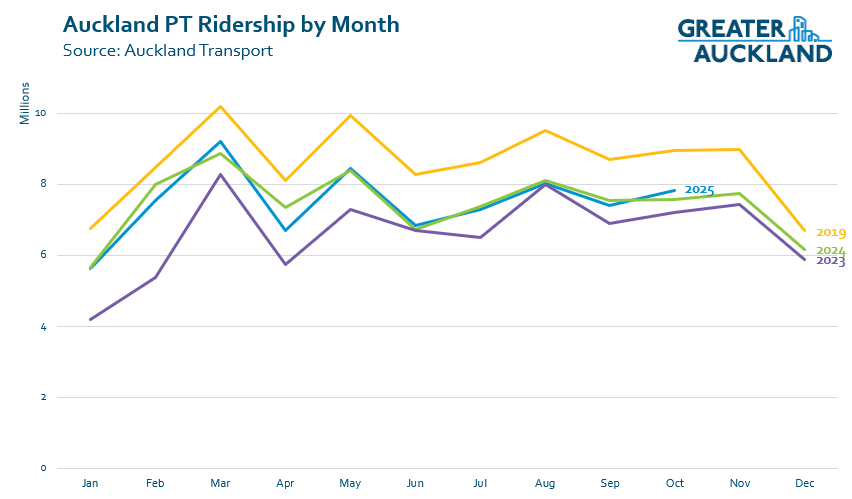
The post-COVID recovery has definitely stalled. On a 12-month rolling basis, ridership is sitting at just under 88.8 million trips, about 57k fewer compared to October last year – but more importantly, it is down over 600k on what it was at the end of last year.
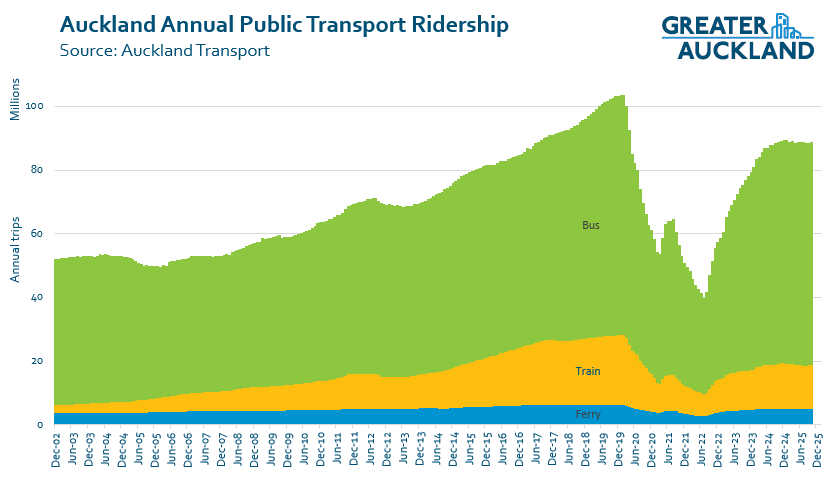 We’re only four months into Auckland Transport’s financial year, but at the current rate it doesn’t look like we’ll come close to their set target of 94 million trips by next June.
The targets for the next three years are reset every year as part of the Statement of Intent (SOI) process, and it should be noted that the previous version had the target for this year at 106.8 million trips – meaning the 94 million is a significant reduction on that. The chart below shows how AT’s targets have changed over time.
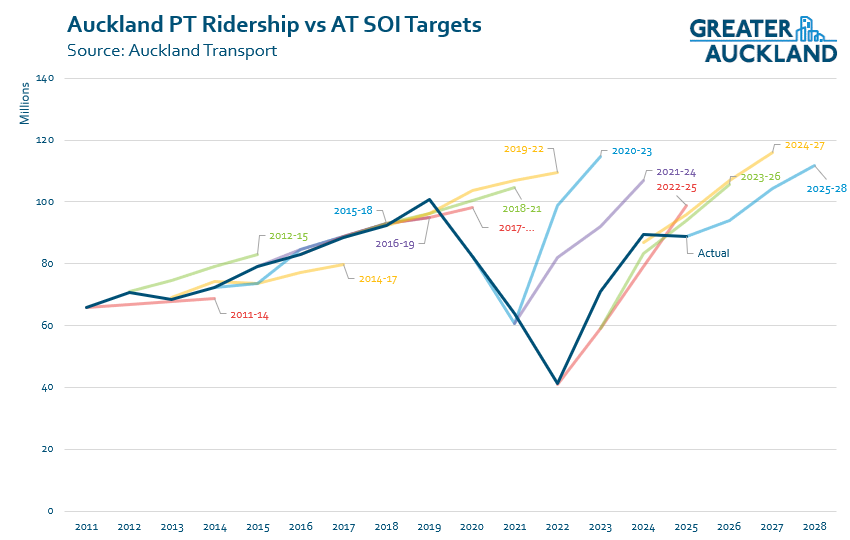
You can see that from 2015 till COVID hit, ridership was relatively in line with the targets. But since then, it has been much harder to predict. That we appear to have hit a ceiling is concerning, and is likely reflective a number of factors, such as:
Fare increases earlier this year
Earlier this year AT increased fares by an average of 5.2%, with those making shorter trips getting the highest increases. AT said at the time they expected this would reduce ridership by about 1 million trips.

There were a few other changes at the same time, such as dropping the 10% off-peak discount, and a big increases in ferry fares. In a report to Auckland Council, AT says both of those have had little impact overall.
Rail disruption
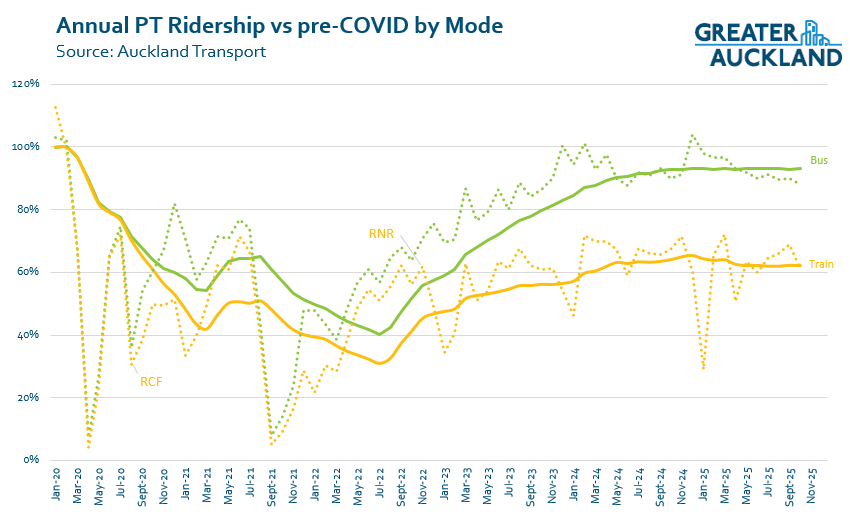
While some of the reduction in overall ridership can be attributed to the change in commuting patterns since COVID (more work-from-home), the usage of the rail network stands out as being well below the other modes.
Most of this is likely to be due to the significant disruption we have continued to see in the push to get the network ready for the City Rail Link. It has now been about five years of major disruption across the network, and this has really taken its toll.
In the immediate months following the initial COVID lockdown, both the rail network and bus network recovered at about the same rate. But then in August 2020, the network was hit by disruption as KiwiRail started to fix issues with Rolling Contact Fatigue (RCF). Things did start to recover again, although impacted by more stay-at-home periods to eliminate COVID transmission, but by late 2022 Kiwirail started working on the Rail Network Rebuild (RNR), which is still ongoing. And there has been other disruption like the closure of Pukekohe for a few years while the line was electrified.
 Wider economic challenges
The state of the economy is almost certainly playing a part in the ridership numbers, too. Unemployment is up while record numbers of Kiwis are leaving the country, and this must surely be having an impact.
Some bright spots
There are some bright spots, though.
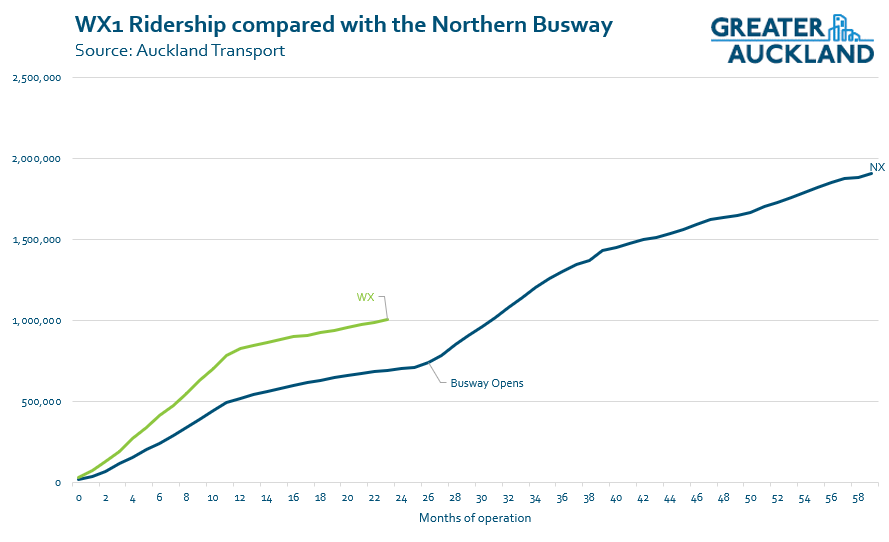
We recently reported on the progress towards the Northwest Busway. The WX1, which will operate on the busway, was launched in November 2023, and in October it just passed one million boardings over a 12-month period. This is actually faster than the NX1 grew until the Northern Busway fully opened.
It should also be noted that the 11W and 11T share much of the same route, and many people at the Lincoln and Te Atatu stations will just catch whichever one turns up first. Those buses carried an additional 920k over the last twelve months. This bodes well for the Northwest busway, should it get built.
Early next year the rail network disruption should finally come to an end, and then later in the year the CRL will finally open. We should also see the new stations at Drury and Paerata opening. All of this should help boost the rail network – though there’s still a bit to do just to catch up to where it was pre-COVID.
Improvements ahead
There are a couple of improvements coming at the end of the week.
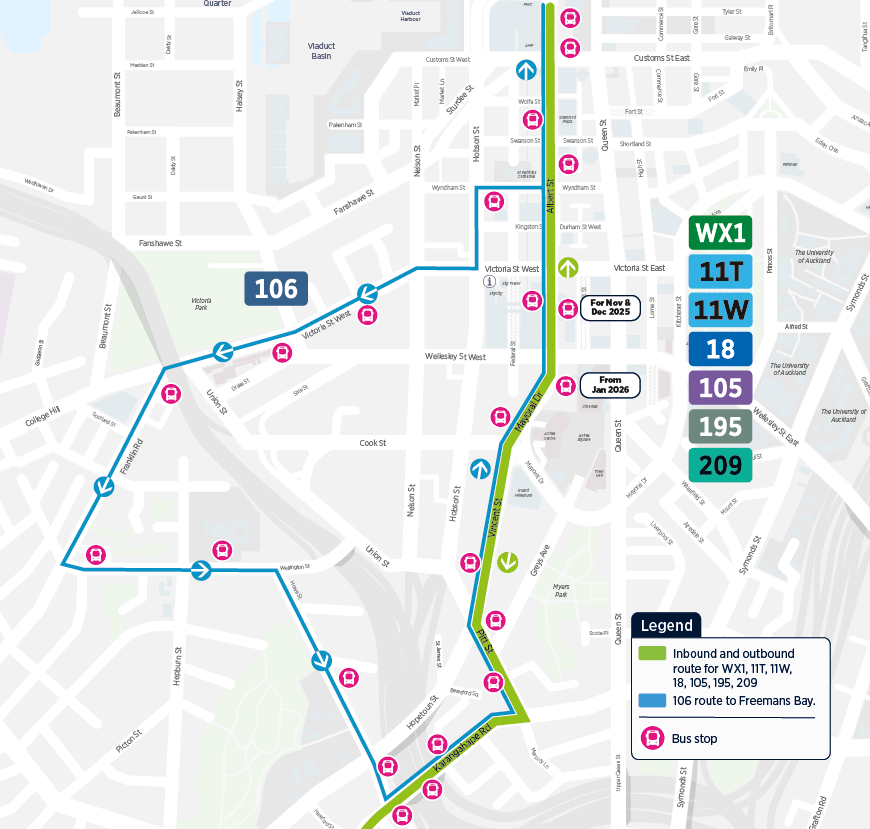
With the disruption from the City Rail Link coming to an end, from Saturday buses will return to Albert St:
From Saturday 29 November, Routes WX1, 11T, 11W, 18, 105, 195 and 209 will no longer travel in or out of the city using Queen Street, Hobson Street or Wyndham Street. These routes will no longer use bus stops on Queen Street and Hobson Street. Instead, they will travel down and use new bus stops on Albert Street, Mayoral Drive, Vincent Street and Pitt Street. For buses heading out of the city a temporary bus stop will be set up between Victoria Street and Wellesley Street. From early 2026, this bus stop will be moved to Mayoral Drive.
Stop 7131 – Karangahape Road/Queen Street will also be permanently closed. Routes WX1, 11T, 11W, 18, 105, 106, 195, 209 will move to a new bus stop, Stop 1525 – Stop A Karanga-a-Hape Station. Routes 866, 966, CTY and INN will move to Stop 7133 – Pitt Street.
Additionally, Route 106 will travel towards Freemans Bay as it currently does, but will travel into the city centre along Pitt Street, Vincent Street, Mayoral Drive and Albert Street. It will also no longer use Stop 7102 on Victoria Street, and instead use Stop 1378 on Wyndham Street.
And, earlier this year, AT finally looked to improve what at the time was the busiest non-frequent bus route, the 120. They introduced the 12, which had a modified route, but despite having a 2-digit route number – which is used to signify frequent routes – it wasn’t initially made frequent all day. On Sunday, that finally changes.
There are some other tweaks to services that connect to ferries too.
This post, like all our work, is brought to you by the Greater Auckland crew and made possible by generous donations from our readers and fans. If you’d like to support our work, you can join our circle of supporters here, or support us on Substack.

 Processing...
Was there anything specific causing the dip in ridership in 2012-2013? Fairly noticeable jump, but I can’t think of any major external factors that coincided?
It’s the drop-off from the Rugby World Cup boost that is only seen 12 months later when using a rolling average.
Main thing was that the previous year included a boost from the Rugby World Cup.
The main thing was the rugby world cup. If you take that away the bus numbers continue as a pretty steady climb. But the rail numbers did also flatten through 2011-2013 as there was a period when capacity was capped as they stopped adding SA trains in the last few years before the EMUs arrived.
Is there any data that shows the WX1 is leading to more ridership in general. Before WX1 all those numbers using buses would have been spread over multiple route designations, now the majority are counted as WX1. Would be great to see if it is having impact on overall ridership.
Not from the data releases publicly as it’s only boardings not journeys, however AT have said overall numbers have increased.
Is there not a WFH factor here? The last census figures for our neighbourhood (ie: Point Chev) had every commuting mode either flat or down, and working from home up quite sharply. Clearly, not every suburb will have the same WFH-friendly demographic profile, but it seems worth taking into account.
There probably trade-offs between more WFH and the slower economy requiring less people to move to work and then Auckland’s population growth which should drive PT usage.
WFH is absolutely part of it and AT have said in the past that there are more people overall using PT but they’re just not using it as much.
Buses are back to about 95% of pre-covid levels, if trains and ferries were too ridership would be around 98m trips, about 10m than they are now.
It’s certainly a factor when comparing with 2019 results, however it doesn’t explain the lack of growth when compared with last year.
Hasn’t unemployment gone up significantly in Auckland over the last year to over 6% now, vs 4.something% last year. That’s a big reason for less trips (less money flowing round, and less commuters).
I think that will be the biggest driver, along with I assume population growth in Auckland has dropped off with the sharp drop in net migration.
Why build infrastructure, just make everyone unemployed and we won’t need it.
Have they sorted the debacle of the congestion ruining the 12’s running times
In the year to September 2025, there were 138,900 migrant arrivals and 126,400 departures, resulting in a net migration gain of 12,400.
From Statistics NZ.
Net gain yes but it’s also important to look at the details and they show that for there is a net 10k gain in people under 20.
You would think the contactless payment system would of boosted numbers a bit. Perhaps it has it’s just more the rail disruptions, work from home and wider economic factors that have affected things the most I would say.
Related to patronage I see in the FAQ link found here : https://haveyoursay.at.govt.nz/better-journeys-on-green-lane-west
That patronage on route 65 has increased by around 60% since the route was upgraded in November 2024, with the highest month up by 75%.
Great link, goes super in depth.
I think they should terminate the 65 at Coyle Park, with half of the trips going via Selwyn Village (or all of them). Then offset the 65/66 so there is effectively a bus every 7-8 minutes along Pt Chev Rd (that’s always the bit that’s annoying frequency on the way home so generally I just start walking instead). That said, 15 min frequency is already great at present.
The rail network has lost a lot of public mindshare over the last 2 to 3 years. it’s a shame as when it runs, it’s actually pretty decent, but the constant closures have eroded public trust.
When the CRL finally opens, it’s a chance to rebuild the trust in the network, but if they screw it up it’ll be hard to bring back. There can’t be entire network closures over the summer after this year, or weeks at a time at Easter and other school holidays. People need to trust the system to be available when making plans.
Eastern busway opening may help numbers, but even a very optimistic 50% increase for the 70 / 72 would only add 1.5m to the total numbers.
When I started using trains in Auckland 20 years ago, there weren’t even screens or a PA to tell you if you’re train was delayed 30 mins.
Trust was low then but it built up and can be built up again.
Yeah there’s a once in a generation opportunity to rebuild, and newly build, trust and excitement in the network ahead soon.
I’m sure AT are aware, probably explains their nervousness about opening timing. Will be wanting it to go really well from the start and consistently so.
Media will leap on any snafu stories and catastrophise, as we all know. Just look at how they amplify any bad news real or exaggerated about the city centre… is so easy to in print with complaint.
I agree, but trust takes years to build, it can be lost in weeks.
Our train system needs to be seen as something “normal people” use. That means it needs to run all the time, and not just be a commuter service.
We really need people’s first post CRL train experience to be an excellent one, if it isn’t they’ll be “one and done” and not come back.
Evenings, weekends, holidays all need to have frequent and reliable train services. When you close the network for 4 – 6 weeks, people adapt their travel patterns to new normals and don’t come back.
And 26? years ago when I first caught a train in Auckland from Elleslie inter peak, the frequency on the southern line was hourly.
Unfortunately there will always be planned cancellations even after the CRL opens. That is despite KiwiRail adopting a preventative maintenance approach.